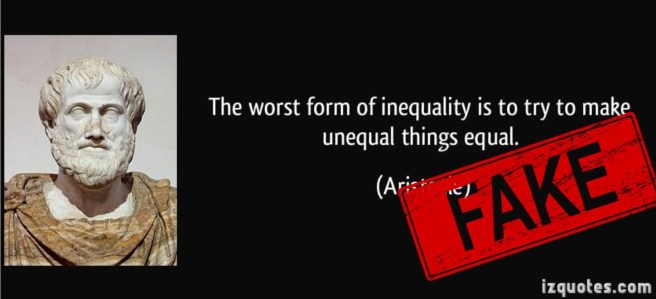
This quotation is huge online. But, like most things that look big on the internet, its actual size leaves something to be desired. I started poking around (by which I mean googling) and found pretty quickly that this line has already been called into doubt. It seems to have entered the popular discourse through the usual route, a quote book from the 19th century (1891). The sentiment appears in different collections with some intensity a decade later in 1901, 1903, and 1904.
Proverbial wisdom that uses knowing when to speak as the distinction between wise people and fools is pretty common: check out quoteinvestigator’s overview of the ubiquitous “Better to remain silent and be thought a fool than to speak and to remove all doubt” attributed apocryphally to both Mark Twain and Abraham Lincoln.
Based on my own new rating system, this quotation is Peisistratos Fake: it draws on ancient ideas, but has no real antiquity to it.
“The worst form of inequality is to try to make unequal things equal”
This has already been judged a “misattribution” by wikiquotes, but it has a life of its own as a meme that is used to justify inequality. What more a noble pursuit than the counterfeiting of ancient philosophical quotes in the service of upholding injustice!
This little horror shows up in the mid-seventies and has gained new life in the last decade or so. It seems that this is ‘inspired’ (to stretch the meaning of the word) by a segment from the Politics, which, by my reading, provides a very different sentiment from that purveyed by the meme:
Aristotle, Politics 3, 1280a 8-17
“First we must establish what people claim as the definitive boundaries of oligarchy and democracy and what principle of justice characterizes oligarchy and democracy in turn. For all people lay claim to some kind of justice, but they only pursue it up to a point and they do not define justice in its proper entirety.
For example, equality seems to be just and it is, but not to everyone, only to those who are equal to begin with. And so, inequality seems to be just, and, indeed, it is, but not for all people, only those who are not equal. But those people deprive [the concept of the meaning] in respect to those [whom it concerns] and render a bad judgment. The fault behind this is that the judgment is over something that concerns the people [making the judgment] themselves! Nearly all people are poor judges on matters that interest them.”
Just because this sentiment does not belong to Aristotle, does not mean that someone in the ancient world didn’t express (something like) it. H/T to Andrew Riggsby (@AntiqueThought) and John Ma (@Nakhthor) for pointing out these passages.
Cicero Republic 1.43
“But the people have too little participation in common justice and deliberation in monarchies; in aristocracies, the populace is incapable of having the smallest part of freedom since they lack access from any shared governance and power. When all the power is exercised by the people, even if it is done justly and moderately, the equality itself is not equal since it provides for no gradations in honor.”
Sed et in regnis nimis expertes sunt ceteri communis iuris et consilii, et in optimatium dominatu vix particeps libertatis potest esse multitudo, cum omni consilio communi ac potestate careat, et cum omnia per populum geruntur quamvis iustum atque moderatum, tamen ipsa aequabilitas est iniqua, cum habet nullos gradus dignitatis.
Pliny the Younger, Letters 9.5
“You stand very far away from this mistake, I know well, but I cannot keep myself from seeming to warn you when praising the way you maintain differences of class and honor. If these things are mixed up and confused, nothing is more unequal than that kind of equality. Goodbye!”
A quo vitio tu longe recessisti, scio, sed temperare mihi non possum quominus laudem similis monenti, quod eum modum tenes ut discrimina ordinum dignitatumque custodias; quae si confusa turbata permixta sunt, nihil est ipsa aequalitate inaequalius. Vale.
Pliny the Younger, Letters 2.12.5
“But this is judged by the majority—their views are counted but they are not weighed. Nothing else can happen in public decision making in which there is nothing as unequal as this kind of equality. This persists because the right is everyone’s equally even though wisdom is unequally distributed.”
Sed hoc pluribus visum est. Numerantur enim sententiae, non ponderantur; nec aliud in publico consilio potest fieri, in quo nihil est tam inaequale quam aequalitas ipsa. Nam cum sit impar prudentia, par omnium ius est.
“And I certainly seem to be experiencing the fate of Ibykos’ horse, a prize-winner who, even though old, was about to compete in the chariot race and was trembling because of experience at what was about to happen. Ibykos compared himself to him when he said that he too was old and was being compelled to move towards lust”
[Scholiast] Here is the saying of Ibykos the lyric poet:
τὸ τοῦ μελοποιοῦ Ἰβύκου ῥητόν·
“Love again, gazing up from under dark lashes,
Throws me down with every kind of spell
Into the Cyprian’s endless nets.
In truth, I tremble at this arrival,
Just as a prize-winning horse on the yoke in old age
Goes into the contest with his swift wheels, but not willingly.”
“If I saw you shining with dark hair
Or at another time with blond locks, mistress,
The same grace would gleam from both.
Love will make its home in your hair even when it’s gray.”
Diogenes Laertius, Lives of the Philosophers 9.11 on Pyrrho
“But Philo the Athenian, who was his friend, used to say that he often called to mind Democritus and then Homer, wondering at him and constantly saying “just as the generation of leaves so are the generations of men”. And he liked the fact that Homer compared human beings to wasps, flies and birds. He also used to add these lines: “But, friend, die too: why do you mourn like this? / Patroklos also died and he was much better than you.” He would recite that along with all the passages which attested to the uncertain and empty pursuits, the childish simplicity of humankind.
Poseidonios also passes down a certain story like this about him. When his shipmates were exceedingly anxious because of a storm, he was calm and unshaken in his spirit. After he pointed to a piglet on the boat who was eating, he said that it was right for a wise person to settle into such an untroubled state.”
Many books and websites quote Aristotle as saying “It is unbecoming for a young man to use maxims”. Aristotle kind of says this, but why he says it and what he means by a maxim is not understood clearly from the way this quotation is applied as a meme. This is ironic because the quotation is a maxim but it violates the very reason Aristotle says the young should not use maxims (because they don’t have the experience to know what they’re talking about).
Aristotle, Rhetoric 2.1395a
“Using maxims is appropriate for those who are older in age [when uttered] about things for which they have some experience. Using maxims before one is this age lacks propriety as does story-telling: [to speak] about what one has no experience in is foolish and uneducated. A sufficient sign of this is that bumpkins especially tend to make up maxims and they easily show them off.”
Something else this usage misses is how Aristotle defines a maxim. Oh, and there is also the fact that this comes from the Rhetoric. Aristotle is not claiming that it is unseemly for the young to use maxims because it is amoral or unethical, but rather that because of their youth and lack of experience they will not be persuasive by doing so.
2.1394a
“A maxim is a statement which does not concern specifics about each thing—as in what kind of a person Iphikrates was—but it is general. Nevertheless, it does not aim at all general things—such as the fact that straight is the opposite of crooked—but about however so many things are the goals of actions and what should be selected or avoided in acting.
And where the enthymeme is pretty much the syllogism for these things, maxims are the outcomes of the enthymeme or the starting principles without the syllogism’s completion. Here’s an example: ‘It isn’t right that any sensible man have his children educated to be excessively wise’ [Eur. Medea 296]. This is a maxim; should the cause and the explanation be added, it would be an enthymeme.”
Yesterday I called the following quote fake too quickly.
I am no great fan of Plato, but he got this right: “One of the penalties for refusing to participate in politics is that you end up being governed by your inferiors.” #vote
“….For they are not desirous of honors. It is indeed necessary to add some compulsion and penalty on them if they are intending to be willing to rule. This is likely the reason that a willingness to go to office without facing compulsion is considered shameful.
But the greatest penalty is to be ruled by someone worse if a person is not willing to hold office himself. It seems to me that people of propriety hold office (when they do) because they fear that outcome and that they enter into power not because they are going after something good or because they enjoy it, but because it is necessary and they are not able to entrust it to those better than themselves or their equals.”
The earliest instance of this I can find online is from 1963, in Proceedings and Debates of the Congress, 109, part 29. If you search google books, you will find this quote is really popular in management leadership books where it debuts in the early 2000s and finds steady, unattributed representation.
Wikiquote.com notes that this is an “unsourced quotation”. It should not be considered so, but its use might receive a little more nuanced: this passage is about how ‘good’ people should not be interested in power and enter into it not for profit or possible self-interest, but to prevent lesser people from ruling and harming the state. This is an old-fashioned Greek noblesse oblige. But it is not a fake quote.
"τῆς δὲ ζημίας μεγίστη τὸ ὑπὸ πονηροτέρου ἄρχεσθαι, ἐὰν μὴ αὐτὸς ἐθέλῃ ἄρχειν" "But the chief penalty is to be governed by someone worse if a man will not himself hold office and rule." But yeah, totally fake.
Thanks to those who called me out on the tweet. And to those who didn’t: call me out when I am wrong and I will fix it! As Cicero says: “All men make mistakes; but it is fools who persist in them” cuiusvis hominis est errare; nullius nisi insipientis perseverare in errore (Philippics 12.5). Or, as I prefer it: “any person can fuck up: but only fools keep fucking up in the same way.”
There are ideas that seem akin to this in Aristotle: in Nicomachean Ethics, for example, he says “[because], happiness seems to reside in leisure, we labor [sacrifice leisure] so that we may have leisure” δοκεῖ τε ἡ εὐδαιμονία ἐν τῇ σχολῇ εἶναι, ἀσχολούμεθα γὰρ ἵνα σχολάζωμεν (1177b). And Aristotle talks a lot about leisure as being desirable and “although leisure and business are both necessary, leisure is more fully an end than business” (εἰ γὰρ ἄμφω μὲν δεῖ, μᾶλλον δὲ αἱρετὸν τὸ σχολάζειν τῆς ἀσχολίας καὶ τέλος, 1337b33-35). Earlier, he repeats the phrase that “business is for the sake of leisure” (ἀσχολίαν δὲ σχολῆς), in a series of nearly Orwellian paradoxes: “war is for the sake of peace, business for the sake of leisure, and necessary and useful things are for the sake of the good.” (πόλεμον μὲν εἰρήνης χάριν, ἀσχολίαν δὲ σχολῆς, τὰ δ᾿ ἀναγκαῖα καὶ χρήσιμα τῶν καλῶν ἕνεκεν,1333c35-37).
So, for this one, I think we have a bit of an elaborated translation of an essentially Aristotelian idea. But, still, he didn’t really say this—Aristotle is perfectly capable of saying that the telos of a thing is another thing. Where he mentions telos in conjunction with leisure, he writes that leisure itself is an end on its own more than business [read: ‘labor’] is. This is a rather different notion than saying that one is the end of the other.
“Tolerance and apathy are the last virtues of a dying society”
The character of this quotation is alien to Aristotle and ancient Greek ideas including using “tolerance” in this way and “dying society” (see the quora discussion). I poked around a bit through Aristotle, changing some of the ideas (an ancient Greek might think of “sick” or “corrupt” society”) but there is nothing close to this.
While searching, I found the variation “Tolerance is the last virtue of a depraved society” attributed to Dr. James Kennedy (an Evangelical preacher) and then Hutton Gibson (father of Mel Gibson and Holocaust Denier). Some of the mis-translations and fake translations can be found in quote books from the 19th century. This one does not appear in any books older than a decade or so and mostly in self-published racist texts whose titles and authors I will not print.
Don’t google this to see how people use it, because it will be upsetting. A reddit user did point to the Loeb translation of Politics:
“Also difference of race is a cause of faction, until harmony of spirit is reached; for just as any chance multitude of people does not form a state, so a state is not formed in any chance period of time. ” (Politics Book 5 section 1303a)
Aristotle, Politics 1303a27-30
“Not being of the same tribe is a cause of strife until they “breathe in sync” [breathe together? Sumpneusê], for just as a state does not develop from an accidental mob, so too it does not come together at an accidental time.”
It is easy to take this passage as supporting a racist point of view; I think that it probably is kind of racist, but it connects more with the Greek political idea of homophrosune or homonoia, that a unifying feature of a multiple people must be shared beliefs or aims. Also, rather than focusing on the first clause (the same tribe thing) note the trouble focus on “accident”: states cannot just happen. They need planning, work and a reason to be.
(Also, homonoia is not unproblematic, but at least it leaves open the idea that people who look different can join together in common cause. Maybe that is a pretty low bar, but it is as far from the texts using this fake quote as Olympos is from Tartaros.)
But, don’t fear, I am not going to defend Aristotle here. He can be plenty hateful. The point is, he did not say this stupid thing. And, further, there’s plenty of material he actually did say which is reprehensible. So, why be so lazy and recycle some nonsense from an American preacher?
This is likely to be an ongoing list. If you have any additions, explanations, or counterclaims, leave a comment and we will integrate it. The Kiwi Hellenist has started a blog for some other authors.
1. “It is the mark of an educated mind to entertain a thought without accepting it”
This is probably a willful twisting of something from the Nicomachean Ethics
“It is right that we ask [people] to accept each of the things which are said in the same way: for it is the mark of an educated person to search for the same kind of clarity in each topic to the extent that the nature of the matter accepts it. For it is similar to expect a mathematician to speak persuasively or for an orator to furnish clear proofs!
Each person judges well what they know and is thus a good critic of those things. For each thing in specific, someone must be educated [to be a critic]; to [be a critic in general] one must be educated about everything.”
“For however many things have a plurality of parts and are not merely a complete aggregate but instead some kind of awhole beyond its parts, there is some cause of it since even in bodies, for some the fact that the there is contact is the cause of a unity/oneness while for others there is viscosity or some other characteristic of this sort.
4. “We are What we repeatedly do. Excellence is an act, not a habit.”
This one is has likely slipped into the Internet Aristotle Quotarium from Will Durant’s misconstruing of the Nicomachean Ethics. Indeed, this has been debunked more than a few times. Here’s another version: “Excellence is not a singular act but a habit. You are what you do repeatedly.” there are many variants
Here’s the closest Aristotle actually gets:
Aristotle, Nicomachean Ethics, 1105b
“It is therefore well said that a person becomes just by doing just things and prudent from practicing wisdom. And, no one could ever approach being good without doing these things. But many who do not practice them flee to argument and believe that they are practicing philosophy and that they will become serious men in this way. They act the way sick people do who listen to their doctors seriously and then do nothing of what they were prescribed. Just as these patients will not end up healthy from treating their body in this way, so most people won’t change their soul with such philosophy.”
5. “Knowing Yourself is the Beginning of all Wisdom”
No. I don’t even need to look this up. No. No. No. This is a version of the Delphic Oracles “know thyself” Γνῶθι σαυτόν. At least attribute it to Plato or Aristotle something. Or do what Diogenes Laertius does at give it to Pittakos (1.79.10)
6. “Whosoever is delighted in solitude, is either a wild beast or a god.”
“It is clear that the state is naturally prior to each individual person. If each person when separated is not sufficient on his own, just as other parts are to the whole while a person who is incapable of joining commonwealth or does not need any part of a state because of self-sufficiency is either a beast or a god.”
7. “Where the needs of the world and your talents cross, there lies your vocation.”
This is totally super-capitalist, corporate double-speak nonsense. It does not even remotely sound like Aristotle. I am not sure where it comes from and I cannot find it debunked, but I will keep looking.
8. “Pleasure in the job puts perfection in the work.”
This one is likely a mistranslation or an attribution of a lost saying by Seneca in On Tranquility of mind. But I can’t really justify that by what I have found in the Seneca. Regardless, this is more neo-capitalist nonsense. I have a hard time believing this is anywhere in Aristotle.
A few twitter correspondents responded that this sounds a little bit like the end of the Nicomachean Ethics where Aristotle writes “pleasure brings completion to an activity” ( τελειοῖ δὲ τὴν ἐνέργειαν ἡἡδονή, 1174b). I will not claim that this sounds nothing like the apocryphal translation above, but I will insist that in its context, Aristotle’s comment has nothing to do with “work” in the way it is construed, but instead this is about aesthetic pleasure. The worst version of this meme is this terrible, no-good, evil version:
Note the double emphasis on work? This is the kind of poster a middle manager puts up to ‘motivate’ his underpaid minions before he drives home in his Porsche….
9. “Well-begun is half done”
This is not really Aristotle. The idea is proverbial even when it is kind of quoted by Aristotle. But these words belong to someone else. Here is as close as Aristotle gets:
Aristotle, Politics 5, 1303b
“For the mistake happens in the beginning and the beginning is said to be half of the whole, so that even a minor mistake at the beginning is equal to those made at different stages.”
This particular quotation comes from the Benjamin Jowett translation and is replicated on the wikiquote site. Aristotle in phrasing this as “it is said” (λέγεται) is marking the line as a proverb. Horace’s “The one who has begun has completed half the task.” dimidium facti, qui coepit, habet (Epistle 1.2) is closer to the popular version. Hesiod has “fool does not know that half is greater than the whole” ( Νήπιοι οὐδ’ ἴσασιν ὅσῳ πλέον ἥμισυ παντός)
10. “The more you know the more you know you don’t know”
(yes, Pinterest). This is clearly a retread of Plato’s Apology 21d: “I think that I am wiser by this very small bit: I don’t pretend to know what I don’t know.” ἔοικα γοῦν τούτου γε σμικρῷ τινι αὐτῷ τούτῳ σοφώτερος εἶναι, ὅτι ἃ μὴ οἶδα οὐδὲ οἴομαι εἰδέναι.
11. “To write well, express yourself like common people, but think like a wise man. Or, think as wise men do, but speak as the common people do.”
This shows up a lot in business oriented and inspirational self-help tomes. This does not sound like Aristotle at all. I can’t find anything remotely close to this. Any challengers? (see also the shortened “Think like a wise man, Talk like the common people.”
12. “No great mind has ever existed without a touch of madness”
This is another indirect attribution that probably comes from Seneca De Tranquilitate Animi 10 (“or [believe] Aristotle that there was never any great genius without a tincture of insanity”. sive Aristoteli nullum magnum ingenium sine mixtura dementiae fuit). So, it is almost Aristotle, except that we do not have it in any of Aristotle’s extant works (and ancient authors like Seneca, Plutarch and Diogenes Laertius are not beyond making quotes up or misattributing them).
Aristotle does talk about poetry and madness in the Poetics and in his Problems.
“Memory is the scribe of the soul”
Ugh. “scribe”? Soul? This one sounds like it a misunderstanding or a fabrication made to sound old-fashioned.
14. “It is during our darkest moments that we must focus to see the light.”
I really did not need to look this one up. The tone of self-help encouragement motivating this quote is really not Aristotelian. I think this might be one of the clearest offenders. But, its essential badness made me google it. This line is often misattributed to Buddha–but it is often attributed to Aristotle…Onassis. So this meme is a new variation on an old virus. I fear we might already be too late
The character of this quotation is alien to Aristotle and ancient Greek ideas including using “tolerance” in this way and “dying society” (see the quora discussion). I poked around a bit through Aristotle, changing some of the ideas (an ancient Greek might think of “sick” or “corrupt” society”) but there is nothing close to this.
While searching, I found the variation “Tolerance is the last virtue of a depraved society” attributed to Dr. James Kennedy (an Evangelical preacher) and then Hutton Gibson (father of Mel Gibson and Holocaust Denier). Some of the mis-translations and fake translations can be found in quote books from the 19th century. This one does not appear in any books older than a decade or so and mostly in self-published racist texts whose titles and authors I will not print.
16. “There is only one way to avoid criticism: do nothing, say nothing, and be nothing.”
This one is easy. Wikiquote has already debunked it. But the content of the quote as well as its form should be a warning anyway. The final triplet is not really Aristotelian, but it is almost imaginably Greek. This is alleged to come from Elbert Hubbard’s Little Journeys to the Houses of American Statesmen, but that provides only the second half.
There are ideas that seem akin to this in Aristotle: in Nicomachean Ethics, for example, he says “[because], happiness seems to reside in leisure, we labor [sacrifice leisure] so that we may have leisure” δοκεῖ τε ἡ εὐδαιμονία ἐν τῇ σχολῇ εἶναι, ἀσχολούμεθα γὰρ ἵνα σχολάζωμεν (1177b). And Aristotle talks a lot about leisure as being desirable and “although leisure and business are both necessary, leisure is more fully an end than business” (εἰ γὰρ ἄμφω μὲν δεῖ, μᾶλλον δὲ αἱρετὸν τὸ σχολάζειν τῆς ἀσχολίας καὶ τέλος, 1337b33-35). Earlier, he repeats the phrase that “business is for the sake of leisure” (ἀσχολίαν δὲ σχολῆς), in a series of nearly Orwellian paradoxes: “war is for the sake of peace, business for the sake of leisure, and necessary and useful things are for the sake of the good.” (πόλεμον μὲν εἰρήνης χάριν, ἀσχολίαν δὲ σχολῆς, τὰ δ᾿ ἀναγκαῖα καὶ χρήσιμα τῶν καλῶν ἕνεκεν,1333c35-37).
So, for this one, I think we have a bit of an elaborated translation of an essentially Aristotelian idea. But, still, he didn’t really say this—Aristotle is perfectly capable of saying that the telos (“end, Goal”) of a thing is another thing. Where he mentions telos in conjunction with leisure, he writes that leisure itself is an end on its own more than business [read: ‘labor’] is. This is a rather different notion than saying that one is the end of the other.
19. “To appreciate the beauty of a snowflake it is necessary to stand out in the cold.”
This is another one of those lines that is so clearly Un-Aristolelian to anyone who has read a little bit of Aristotle that it seems absurd someone would attribute it to the Stagirite. But, spend a little time lurking on pinterest and inspirational meme-o-ramas, and you’ll find Aristotle and Plato carrying a lot of weight.
There is some actual Greek for this one (“Aνδρειότερος εἶναι μοί δοκεῖ ὂ τῶν ἐπιθυμῶν ἢ τῶν πολεμίων κρατῶν καὶ γὰρ χαλεπώτατόν ἐστι τὸ ἑαυτόν νικῆσαι) but the manuscript tradition is a little crazy. Basically, this is from multiple levels of quotebook traditions and is probably not Aristotle. It is, also, not really Aristotelian. The short story? It was added to one edition of Stobaeus’ Florilegium because it sounded a little like a quotation from Democritus. I have the story here.
This popular meme has its roots in the deep past…of the 1970s (that’s CE, just to clear up any confusion). Wikiquote suggests it is a mistaken summary or expansion of a section of the Politics but I think it is just modern partisan posturing.
I mean, this is kind of the whole aim and purpose of the Nicomachean Ethics, but this is not a quotation of a translation of it. It is just the kind of vanilla summary that an English Professor might give of the text in some lecture just before the world ends on the SyFy network. This is Helen-Cylon level fake.
So, this sounds nice, but would you really want to go against 50 people with one ally? This is motivational poster fake. Its earliest appearance is in self-help quotation books in the 1980s. Figures.
24. “Those that know do, those that understand, teach.”
This variation on the put down “those who can, do, those who can’t, teach” does not seem to appear before the last decade or so. But there may be something to its sense. In the Eudemian Ethics, Aristotle explores how some people are good at things without understanding them and that “those people will succeed even though they are witless and without reason, just as some people sing well enough even though they cannot teach others how to sing” (οὗτοι κατορθώσουσι κἂν τύχωσιν ἄφρονες ὄντες καὶ ἄλογοι, ὥσπερ καὶ εὖ ᾄσονται οὐ διδασκαλικοὶ ὄντες, 1247b). Peisistratos Level Fake.
This is a misattribution made only rather recently online from a Methodist Minister’s writings in the 1800s. It is a very Christian and rather un-Aristotelian notion. This is all about sin. It may be riffing on Aristotelian notions of practice and character, but it is Peisistratos Level Fake.
The following post is making the rounds in favor of impeachment (thanks to my friend and former roommate Timothy Gerolami, the south shore’s biggest P. Clodius Pulcher fan and librarian extraordinaire for bringing this to my attention):
I don’t want to disagree with the contents of the quote or the sentiments of using it (our current president is certainly impeachable and likely the worst and arguably the most corrupt president in our nation’s history). But this is a demonstrably false quotation on two counts.
First, Cicero died on the 7th of December in 43 BCE. So, the date of attribution is wrong, but that is not a big deal (for me). The bigger deal is that this passage is not a translation of anything in Cicero. It is from a modern novel by Taylor Caldwell called A Pillar of Iron (1965, 661) as documented by wikiquote. Another site documents how this quotation made the leap from historical novel to political discourse via a conservative judge. (For his speech, look here. And thanks again to Timmy G. for both links.)
When we quote the past, we appropriate it for modern purposes–which is fine. But when we use false quotations we attempt to assert a modern purchase with counterfeit currency. This is not about the aptness of the quotation or the rightness of the movement. Indeed, I don’t think it matters so deeply–but it is lazy and likely harmful to use a quotation in this way .
We seem to want the appearance of antiquity and propriety without wanting to do the work it requires. This laziness is not exactly the same as spreading false information (e.g. ‘fake news’) but emerges from the same meme-crazy, superficial information culture that makes fake news inevitable. It undermines our attempts to use history to understand our present events and attenuates the credibility of the very practice.
“At this point, what crime, what betrayal has this traitor not committed? He attacks our colonists, an army of the Roman people, and a general, a consul elect! He despoils the lands of the best citizens. He is the most hostile enemy who threatens good people with crosses and torture.
What peace can there be with this man, this Marcus Lepidus? No punishment would be enough for him to satisfy the state!”
Postea quod scelus, quod facinus parricida non edidit? Circumsedet colonos nostros, exercitum populi Romani, imperatorem, consulem designatum: agros divexat civium optimorum; hostis taeterrimus omnibus bonis cruces ac tormenta minitatur.
Cum hoc, M. Lepide, pax esse quae potest? Cuius ne supplicio quidem ullo satiari videtur posse res publica.
Cicero, De Haruspicium Responsis 17
“Yesterday I noticed someone muttering, and people were saying that he denied I could be endured because, when I was asked by this most unholy traitor what state I belonged to, I responded to the applause of you and the Roman knights “to the state which is impossible without me”.
I believe that he groaned at this. How should have I responded? I ask this from the very man who thinks I am intolerable. Should I have declared myself a Roman citizen?”
Vidi enim hesterno die quemdam murmurantem: quem aiebant negare ferri me posse, quia cum ab hoc eodem impurissimo parricida rogarer cuius essem civitatis, respondi me, probantibus et vobis et equitibus Romanis, eius esse, quae carere me non potuisset. Ille, ut opinor, ingemuit. Quid igitur responderem? quaero ex eo ipso, qui ferre me non potest. Me civem esse Romanum?