“I was asking him next why he made his poem start with the “rage of Achilles”. He said that it just leapt into his head that way without any prior thought.”
Here’s a bit of something different: I’d like to talk about new book my a good friend. Emily Austin’s Grief and the Hero: The Futility of Longing in the Iliad was released a few months ago. As anyone who has published something during the pandemic knows, there’s not much room for something as simple as a book in all the noise.
But this is a book I think people should read. Now, I read a lot of books about Homer. It is not just a job, it is something I have done as a hobby since I first read Gregory Nagy’s The Best of the Achaeans and Richard Martin’s The Language of Heroesas an undergraduate. I often ignored homework assignments in graduate school in favor of reading books like Donna Wilson’s Ransom and Revenge or Hilary Mackie’s Talking Trojans. See, before I started working on the Odyssey,I was all Iliad all the time.
D Schol. ad ll 1.1
“Sing the rage..” [People] ask why the poem begins from rage, so ill-famed a word. It does for two reasons. First, so that it might [grab the attention] of that particular portion of the soul and make audiences more ready for the sublime and position us to handle sufferings nobly, since it is about to narrate wars.
A second reason is to make the praises of the Greeks more credible. Since it was about to reveal the Greeks prevailing, it is not seemly to make it more worthy of credibility by failing to make everything contribute positively to their praise.”
Everyone knows the Iliad starts with the “rage of Achilles”. What that rage means and how it shapes the poem is not so universally understood. My first Greek teacher and now friend of two decades, Leonard Muellner, wrote one of the best books on this topic. In his The Anger of Achilles: Mênis in Greek Epic, Lenny shows how Achilles’ anger has cosmic implications and is rooted in a thematic pattern shared by gods like Demeter and Zeus. He also notes that there may have been versions of the poem that put Achilles’ rage alongside Apollo’s
The proem according to Aristoxenus
Tell me now Muses who have Olympian Homes
How rage and anger overtook Peleus’ son
And also the shining son of Leto. For the king was enraged…”
What I love about Emily Austin’s book is that she enters into a deep and ancient discussion and asks what seems like a simple question: what about the cause of rage? Starting from the premise that the absence of things, longing, what a Lacanian might call a “lack” (my words, not hers), Emily offers a reading of the epic that doesn’t countermand the importance of rage, but instead, decenters it, looking at how longing (pothê,) shapes the poem and its audiences expectations.
Here’s Emily talking about her book:
In Grief and the Hero, I set aside conversations about the Iliad’s composition and authorship, and instead consider the poem as narrative poetry. The heart of my book is Achilles’ experience of futility in grief. Rather than assuming that grief gives rise to anger, as most scholars have done, Grief and the Hero traces the origin of these emotions. Achilles’ grief for Patroklos is uniquely described with the word pothê, “longing.” By joining grief and longing, the Iliad depicts Achilles’ grief as the rupture of shared life—an insight that generates a new way of reading the epic. No action can undo the reality of his friend Patroklos’ death; but the experience of death drives Achilles to act as though he can achieve something restorative. Achilles’ cycles of weeping and vengeance-seeking bring home how those whom we have lost will never return to us, yet we are shaped by the life we shared with them. In Grief and the Hero, I uncover these affective dimensions of the narrative, which contribute to the epic’s lasting appeal. Loss, longing, and even revenge touch many human lives, and the insights of the Iliad have broad resonance.
I am not a disinterested party in this book. I read an early manuscript and recognized early on that this was an original contribution to an old debate. There is an urgency to longing and the absence of what we need to complete ourselves that motivates the actions of the poem and feeds the timeliness of this book. In a year of violence, disruption, and isolation, it is a perfect time to think about the causes of the things that set us apart.
Grief and the Hero provides a perfect complement to Muellner’s analysis of the thematic function of Achilles’ rage; it also functions as a corrective for many responses to Homer that shy away from the grand themes and the big stages of human life. There are a few dozen books about Homer I think a Homerist must read; there are only a handful I think everyone should try. Emily’s Grief and the Hero is now one of them.
Of course, I’m biased here. I’ve learned so much from talking to Emily about literature, loss and grief over the past few years that I am certainly not objective. But I asked a couple other friends for their thoughts too.
Emily Austin has written a rare and welcome contribution to recent Homeric scholarship: a “robustly literary” meditation on grief and the Iliad. In her reading, the Iliad shows how anger born of grief is never satisfied. It cycles on, relentlessly forward. Peace that comes from vengeance is illusory, and the yawning chasm of loss can only be repaired by letting go.
I have spent the better part of three years living inside the characters of the Iliad as I composed and now perform the Blues of Achilles, my first-person song cycle adaptation of the epic. I found Grief and the Hero exhaustingly resonant with what I’ve come to vividly understand as the core emotional arc of Achilles and those caught in his orbit. Grief and the Hero works for me on multiple levels: academic, creative, and, most importantly, human, so beautifully teasing out the most powerful and universal theme of the poem that I only began to fully discover and appreciate as I wrote my songs: the resolution of grief.
“In addition to providing a novel interpretation of the Iliad‘s narrative and applying close readings of phraseology and structures, Emily brings new depths to the character of Achilles that all subsequent interpretations will need to consider. Her approach is a perfect balance of careful scholarship and elegant interpretation.. She has challenged me to think about the human dimension of the stories.”
Those of us in academia have missed some minor things during the pandemic: book release parties, dinners to celebrate tenure, long talks away from loud conferences with friends. These are so insignificant compared to the losses of the past year that I feel bad even mentioning them. But loss is part of what makes us who we are.
Take a chance on a book; let’s make Emily’s year special.
and some epigrammatic humor to end the post
Palladas of Alexandria, Greek Anthology 9.169
“The Rage of Achilles has become the cause for me
a grammarian, of destructive poverty.
I wish the rage had killed me with the Greeks
before the hard hunger of scholarship killed me.”
Hippias: “I can’t really agree with you on these things, Socrates.”
Socrates: “Huh, I can’t agree with myself either. But it seems like our current discussion must go there, at least.
This is what I haven been saying for a long time—I wander back and forth on these topics and they never seem the same to me. Really, it is not a surprise at all that I or any other normal person find ourselves adrift. But if you and the other experts get lost too, then it is pretty frightening for us since we can’t stop our wandering even after coming to you.”
“And I went to see the doctor of philosophy
With a poster of Rasputin and a beard down to his knee
He never did marry or see a B-grade movie
He graded my performance, he said he could see through me
I spent four years prostrate to the higher mind
Got my paper and I was free”
“These things seem quite entertaining to me, but they are not true. I have also heard another reason for the bit, much more credible. I am happy with what is said by those who generally agree in Greece, who believe that the goddess is Hera and the work was made by Dionysus. For Dionysus went into Syria on the road that goes to Ethiopia. There are many signs left by Dionysus in the Shrine, among them are foreign clothing and Indian stones and Elephant horns which Dionysus brought from Ethiopia. There are also two really big phalluses that stand up at the entrance gates. This epigram has been inscribed upon them. ‘Dionysus dedicated these phalluses to Hera, his stepmother.’
This remains enough for me, but I will tell you of another oddity in the temple of Dionysus. The Greeks bear phalloi in honor of Dionysus, and they carry something in front of it, a little man carved out of wood which has huge genitals. These are called puppets. There is also one of these in the temple. On the right side of the temple, there is a small bronze man that has giant genitals.”
According to the Greek Anthology there was a temple to Apollônis, the mother of Attalos and Eumenes, at Cyzicos. The temple had at least nineteen epigrams inscribed on columns with accompanying relief images. All of the epigrams have mothers from myth and poetry as their subjects. The Eighth Epigram is on Odysseus’ mother Antikleia.
On the eighth tablet is the underworld visit of Odysseus. He addressed is own mother and asked her for news of his home (Greek Anthology 3.8)
“Wise-minded mother of Odysseus, Antikleia
You didn’t welcome your son home to Ithaka while alive.
Instead, he is shocked when his glance falls upon his sweet mother
Now wandering along the banks of Akheron.”
Of course, this scene plays upon book 11 of the Odyssey doubly: the image recalls Odysseus describing his mother in the Odyssey and it also plays upon the Odyssey’s catalogue of heroic mothers motif, which it in turn shares with the fragmentary Hesiodic Catalogue Of Women.
11.84-89
“Then came the spirit of my mother who had passed away,
The daughter of great-hearted Autolykos, Antikleia
Whom I left alive when I went to sacred Troy.
When I saw her I cried and pitied her in my heart,
But I could not allow her to come forward to touch
The blood before I had learned from Teiresias.”
Attalos, Eumenes and Apollônis? These were members of the Attalid clan who ruled from Pergamon during the Hellenistic period (after 241 BCE). Attalus I married Apollônis who was from Cyzicos.
A few weeks ago, I wrote about Orchards and Trees, using them as a metaphor to think about he development of Homeric poetry and its promulgation. Metaphors, of course, are not the things themselves! While one comparison can help us see a truth of a thing, several can help us get a better understanding of the things day-to-day language and thinking have trouble grasping.
The metaphor of the tree is at its core, a visual one. It may call to mind things and how we use them (ships and wood) or roots and branches, as in the stemmata of textual traditions. Homeric poems developed in a song culture, an aural landscape. Aural memory and oral performance inspire different qualia. And it is difficult–if not mistaken–to try to transfer an aural understanding to a visual one. As Epicurus observes, our senses do not translate from one domain to another. What does it mean to feel a smell?
So, try this one now. Imagine a supremely complex symphony: as you listen, melodies rise and fall over time, movements come and go and they return again, sometimes changed, sometimes syncopated, sometimes just an echo of what they once were. But some three or four note sequences are more insistent than others—they press through the sound and are emphasized first by this instrument and then by those.
Early 16th-century manuscript in mensural notation, containing a Kyrie by J. Barbireau. I have always been jealous of the talented musicians who can ‘see’ songs
The problem is that there are many of these sequences and some repeat intensely only to be lost and never to return, while others burst back through the rising wall of music to take over when they are least expected.
The music is beautiful but terrifyingly hard to follow: when you pause, however briefly, you realize you’ve been listening to one line of song when there were three or four others going on at the same time. It is hard to start again because you don’t want to lose track of the one you just heard. But you are already thinking about that brief gasp of song that escaped you.
The 16 thousand lines of the Iliad and 12 thousand lines of the Odyssey are like 24 and 20 hours of polyphonic music, played by musicians in separate rooms who can’t really hear each other but are somehow working in concert. The audience stands someplace apart. If we relax and let the composition fall over us, we can get some idea of the whole. But when we listen closely, we can get lost in the depth of each passing strain.
This is how I explain why it is so hard to translate epic or even to interpret it well. Each line has melodies full of resonant meaning that echo differently based on who you are and what you’ve heard before. When someone tells you the Iliad is about this or the Odyssey is about that they are following one repeated series of notes for their movement and resolution, and necessarily leaving others aside.
The total density of the soundscape of the poems and the generations of meaning’s potential within them makes them impossible to understand or explain in ‘real time’. When I hear someone talking about what epic means, sometimes it is like hearing a different poem talked about altogether. I have been listening to other movements, contemplating different themes.
The individual lines of Homer break into three units—segments scholars from Milman Parry and Albert Lord to John Miles Foley and Egbert Bakker have seen as units of composition (intonation units) or what we might even think of as ‘measures’. The ‘formulae’ are repeated patterns in a bounded soundscape. They are not simple building blocks, they are merely the observable repetitions of a system with clear limits: words and rhythm are part of the form of expression, not something imposed upon it.
We make meaning differently based on our sensory inputs and our cultures of performance and reception. There’s a strange prejudice Walter Ong identifies (explored more by Foley too) that visual cultures and literary productions are in some way more sophisticated and elaborate in both creation and reception than others. This ‘primitive’ pose is an outcropping of colonialism, yes, but it is also a simple observer bias. Even literary Greeks like Aristotle saw ‘writers’ in Homer where he should have found song.
Oral-formulaic theory helps break down our own cultural prejudices by revealing what is instrumentally possible for composition in performance. This is on the side of production; theories like J. M. Foley’s “traditional referentialtiy” or Barbara Graziosi’s and Johannes Haubold’s “resonance”. Each in part also draws on reader response theory, centering how audiences hear and respond to poems. If we try, we can intellectually grasp how intricate songs emerge in performance and how audiences dynamically receive them.
From Song to Translations
All this leaves aside how the epics moved from living song to the fossils we piece together on the page. This runs through the problems of performance, text, and reperformance. I emphasize song and aurality here because Homeric epic developed and flourished outside the constraints of a page. When a translator or interpreter tries to make sense of what they see on the page, it is like a conductor looking at a score for a symphony written in a different system of notation with many sections unclear.
The role of some instruments is left undesignated; some sounds cannot be made anymore; and some sequences just don’t make sense to a modern ear. As Casey Dué notes, Greg Nagy proposes a movement from performance, to transcript, to script, to scripture in the stabilization of the narrative: a translator has to move backward through these stages, yet abandon none
Because of the polyphony of Greek epic it is charged with meaning: the lines of song exist through time and carry many meanings at once. A translator listens to the whole song as it echoes and picks the melodies that ring strongest now.
Each of us is to an extent a translator of Homer and those of us who read the Greek but teach in another language are constantly moving from one domain to another. If Homer is a langue each of us has our own Homeric parole. In my first semester teaching as a professor, I gave a full lecture on the mythic, even Iliadic “plan of Zeus” (Dios d’eteleieto boulê), going so far as to have the students recite the line in the Greek. At the end of the class, a kind and forgiving student came up to me and said, “that was really cool, but there’s no plan of Zeus in my Iliad.”
I had assigned Stanley Lombardo’s fine translation. He writes about “Zeus’ Will” (as many others do). I hadn’t checked the translation and sounded as if I were speaking of a poem none of the students had read.
The way we each create our own Homer is in part why I have such trouble reading any version other than the Greek. This is why for even the best translations the fairest reaction is to crib from Richard Bentley’s response to Pope’s Iliad: “a pretty poem, Mr. Pope, but you must not call it Homer.” Here’s another quick example of this danger from Emily Wilson’s successful Odyssey translation.
Let’s start with my simple translations and the Greek. In the Odyssey’s proem, the narrator says of Odysseus:
“But he didn’t save his companions even though he wanted to.
They perished because of their own recklessness”
The fools! They ate up the cattle of Hyperion’s son Helios
And he deprived them of their homecoming day.”
The line σφετέρῃσιν ἀτασθαλίῃσιν (their own recklessness/stupidity) echoes through the poem as a theme that connects Odysseus’ companions, the suitors, and the hero too.
It comes again a mere 20 lines later as Zeus complains
“Friends, how mortals are always blaming the gods!
They say that evils come from us. But they themselves
Have pain beyond their fate because of their own recklessness.
So now Aigisthus too [suffered] beyond his fate…”
This is one of those four-note sequences, a melody earlier scholars would have called a formula that follows, indexes and guides the interpretation of the poem. When I read/teach the Odyssey I point to these passages as inviting us to see the world and its actors in a particular frame
In Wilson’s translation, σφετέρῃσιν ἀτασθαλίῃσιν disappears from the proem altogether, yielding the following.
“…He failed to keep them safe; poor fools,
They ate the Sun God’s Cattle, and the god
Kept them from home…”
And soon after, σφετέρῃσιν ἀτασθαλίῃσιν is rendered simply as “By folly.”
“This is absurd,
That mortals blame the gods They say we cause
Their suffering, but they themselves increase it
By folly. So Aegisthus overstepped:”
These choices limit the repetition and play down the theme of responsibility and recklessness that is central to the poem (from my reading). “Folly’ also disambiguates the complexity of atasthalia, which evokes foolishness, rashness, arrogance, and blindness. Of course, this is not an oversight Wilson commits alone: Lombardo translates the first example as “recklessness” and the second as “witlessness”
To be clear, Wilson and Lombardo have to make some choices; no language conveys the same semantic ambiguities of another. Translators perform hermeneutic magic, moving things from one realm to another. Some moments dazzle, others are imperfect illusions.
This takes us back to the symphony played in separate rooms heard only in parts. When people ask me why Homer is different, I sputter about its bigness and depth and land on the layers and power. Like translation itself, analogy and metaphor only take us so far.
There are several works cited above, but for the atasthalia theme see my recent Many Minded Manor these better books:
Astuanassa: A handmaid of Helen, Menelaos’ wife. She first discovered positions for intercourse and wrote On Sexual Positions. Philainis and Elephantinê rivaled her in this later—they were women who danced out these sorts of wanton acts.
We have learned about this embroidered girdle, that Hera took it from Aphrodite and gave it to Helen. Her handmaid Astuanassa stole it but Aphrodite took it back from her again.
As is largely unsurprising from the perspective of Greek misogyny, excessive interest in sexual behavior is projected a female quality. Expertise beyond interest is made the province of female ‘professionals’ (slaves) who may act as scapegoats and marginal figures for the corruption of both men and women. There is a combination of such interest with an excessive emphasis on eating (and eating really well) in Athenaeus where the pleasures of the body are combined.
Athenaeus, Deipnosophists 8.335c
“Dear men, even though I have great admiration for Chrysippus as the leader of the Stoa, I praise him even more because he ranks Arkhestratos, well-known for his Science of Cooking along with Philainis who is credited with a licentious screed about sexual matters—even though the iambic poet of Samos, Aiskhriôn, claims that Polycrates the sophist started this slander of her when she was really quite chaste. The lines go like this:
“I, Philainis, circulated among men
Lie here thanks to great old age.
Don’t laugh, foolish sailor, as your trace the cape
Nor make me a target of mockery or insult
For, by Zeus and his sons in Hell
I was never a slut with men nor a public whore.
Polykrates, Athenian by birth,
A bit clever with words and with a nasty tongue,
Wrote what he wrote. I don’t know anything about it.”
But the most amazing Chrysippus combines in the fifth book of his On Goodness and Pleasure that both “the books of Philianis and the Gastronomiai of Arkhestratos and forces of erotic and sexual nature, and in the same way slave-girls who are expert at these kinds of movements and positions and who are engaged in their practice.” He adds that they learn this type of material completely and then thoroughly possess what has been written on these topics by Philainis and Arkhestratos and those who have written on similar topics. Similarly, in his seventh book, he says ‘As you cannot wholly learn the works of Philianis and Arkhestratos’ Gastronomia because they do have something to offer for living better.’ “
The sacrifice of Iphigenia is a pivotal moment in the tale of the House of Atreus—it motivates Agamemnon’s murder and in turn the matricide of Orestes—and the Trojan War, functioning as it does as a strange sacrifice of a virgin daughter of Klytemnestra in exchange for passage for a fleet to regain the adulteress Helen, Iphigeneia’s aunt by both her father and mother. The account is famous in Aeschylus’ Agamemnon and the plays Iphigenia at Aulis and Iphigenia among the Taurians by Euripides. Its earliest accounts, however, provide some interesting variations:
Hes. Fr. 23.13-30
“Agamemnon, lord of men, because of her beauty,
Married the dark-eyed daughter of Tyndareus, Klytemnestra.
She gave birth to fair-ankled Iphimede in her home
And Elektra who rivaled the goddesses in beauty.
But the well-greaved Achaeans butchered Iphimede
on the altar of thundering, golden-arrowed Artemis
on that day when they sailed with ships to Ilium
in order to exact payment for fair-ankled Argive woman—
they butchered a ghost. But the deer-shooting arrow-mistress
easily rescued her and anointed her head
with lovely ambrosia so that her flesh would be enduring—
She made her immortal and ageless for all days.
Now the races of men upon the earth call her
Artemis of the roads, the servant of the famous arrow-mistress.
Last in her home, dark-eyed Klytemnestra gave birth
after being impregnated by Agamemnon to Orestes,
who, once he reached maturity, paid back the murderer of his father
and killed his mother as well with pitiless bronze.”
This fragment presents what is possibly the earliest account of the tale of Iphigenia and contains the major elements: the sacrifice of Agamemnon’s daughter is tied to vengeance against Helen; the daughter is rescued by Artemis, made immortal and made her servant. [In some traditions she is either made immortal or made into a priestess of Artemis at Tauris]. Orestes kills the murderer of his father and his mother. Continue reading “The Names of Agamemnon’s Daughters and the Death of Iphigenia”→
We have posted before about Odysseus’ sister Ktimene. She is mentioned by the swineherd Eumaios but never by Odysseus. The scholia connect her to one of Odysseus’ companions. The evidence for this seems to be the fact that Ktimene was sent to Same for marriage (where Eurylochus is from) and a kinship term used for him by Odysseus. Also of interest, according to the scholion, Odysseus may have had more sisters.
Homer, Odyssey 15.364-41
Strong Ktimenê, the youngest of the children she bore.
I was raised with her, and she honored me little less.
But when we both made it to much-praised youth,
They gave her to Samê and received much in return
But she gave me a cloak, tunic and clothing
Dressing me finely and give me sandals for my feet
And sent me to the field. But she loved me more in her heart.
“She bore the youngest of the children”: [this means] of the female children. For his father only had Odysseus [for a son]. There were more sisters of Odysseus.”
“So he spoke, and I was turning over in my thoughts
As I began to draw the sharp-edged sword next to my thick thigh,
Whether I should cut off his head and drive him to the ground
Even though he really was my relative. But our companions
Were restraining me with gentle words from all sides.”
“Pêos: A relative by marriage. In-law. Also, “in-lawness” [Pêosunê], relation-by-marriage. There is also Pêôn [genitive plural], for “of relatives-by-marriage. Homer has: “relatives and friends” [Il. 3.163]
“…There is a difference between in-law and friend. People who have no connection to you by birth are friends. In-laws are related to you through marriage.”
“Then fine-cheeked Melanthô reproached him shamefully.
Dolios fathered her and Penelope raised her. She treated her like her own child and used to give her delights* [athurmata] for her heart.
But she did not have grief in her thoughts for Penelope,
But she was having sex with and feeling affection for Eurumakhos.
She was reproaching Odysseus with abusive words.
“Wretched stranger, you are completely insane—
You don’t want to go sleep in the smith’s house
Or into a lodge but instead you say so much boldly
Here among the many men. And you are not at all afraid
In your heart. Really, wine has overtaken your thoughts or else
Your mind is always the kind to babble meaningless things.
Are you so confident because you defeated the beggar Iros?
May no other better than Iros quickly arise
Who might bash your head between his two strong hands
And drive you out of the house once he drenches you with so much blood.”
Then very-clever Odysseus answered as he glared at her:
“I will quickly tell Telemachus what you are saying, bitch,
After he comes here so that he can tear you apart by the limbs.”
[athurmata] Melanthô used to get ornaments and toys, and Penelope did not deprive her of delights, but instead was doing these things to please her—it is clear, this means material for children. For athurmata are the games of children.
“Athurma: a children’s toy. Josephus writes: “[the man who] was a toy of the king and was put on display for jokes and laughter while drinking.” And elsewhere: “it is not the place of men to waste time with children’s toys” In the Epigrams: “They stripped it clean and dedicated it near the road as a fine toy.” Instead of dedication: in Cratinus’ Odysseuses: “a new-fangled delight was made.”
“As a serpent awaits a man in front of its home on the mountain,
One who dined on ruinous plants [pharmaka], and a dread anger overtakes him
As it coils back and glares terribly before his home.
So Hektor in his unquenchable [asbestos] fury [menos] would not retreat,
After he leaned his shining shield on the wall’s edge.
He really glowered as he spoke to his own proud heart
As he stands before the walls of his city in book 22, Hektor is compared to a snake, coiled to strike an intruder. This moment of anticipation of violence is prolonged as Hektor turns away from the pleas of his family not to face Achilles. In a moment marked by the repeated speech introduction “ (ὀχθήσας δ᾽ ἄρα εἶπε πρὸς ὃν μεγαλήτορα θυμόν), Hektor ruminates, and worries despite what the opening simile anticipates. He resolves to face Achilles, but then immediately changes his mind: “When Hektor noticed Achilles, a tremor overtook him and he could not bear to wait for him / but he left the gates behind and left in flight” Ἕκτορα δ᾽, ὡς ἐνόησεν, ἕλε τρόμος: οὐδ᾽ ἄρ᾽ ἔτ᾽ ἔτλη / αὖθι μένειν, ὀπίσω δὲ πύλας λίπε, βῆ δὲ φοβηθείς).
What happens between the end of Hektor’s speech and his choice to run from Achilles?
*****
In the fall of 2019, I submitted my final manuscript for a book about the Homeric Odyssey and modern psychology. To say I had spent a lot of time with this book would be as much of an understatement as to make the overly banal claim that I learned a lot in the process. Both statements are true, but neither gets to the core of how much researching and writing this book changed the way I read ancient literature and think about just being a human being.
This project started with the observation in class one day in 2011 that Odysseus and Telemachus may be suffering from something we’d call learned helplessness and ended up with a reading of the whole epic as rumination on human agency, traumatized peoples, and the way stories have the power both to liberate and to chain us.
But, as with most long projects, my feeling at the submission was one of release and escape–every time I finish a paper or book, I wonder if I am done, if I have written all the words in me, and whether I have any other thoughts worth forming. I wanted to be done with the Odyssey and its trauma for a while, to think about something new, or, perhaps, to think about nothing at all.
And so much of what I read for the Odyssey book continued to course through my mind. Some people may bristle at the terminology, but it was clear to me that we were being collectively traumatized: by our fear about the safety of our lives and our loved ones’; by our inability to do anything about it; by the massive and arrogant failure of our government to protect or aid us; by fears about losing our homes and feeding our children; by the necessary and powerful reminder of racist rot at the core of our civilization provided by the #BlackLivesMatter protests; by the horrible uncertainty of the Trump administration’s attempt to steal the election; by rising threats of violence; and by a white supremacist coup. Each week and month of the pandemic was a frozen moment in an actual apocalypse, the unveiling of the terrible truths of who and what we are.
The question I started asking myself in April was whether or not knowing you’re being traumatized helps you process the trauma. The answers I found were contrary. So I started doing the very thing I swore I wasn’t going to do anymore, to think about Homer and human psychology. Somewhere along the way that took me back to Hektor, Troy’s prince and protector.
Hektor’s Trauma
Very few people who read or write about the Iliad can make great sense of Hektor. His traditional character is part of James Redfield’s widely cited The Tragedy of Hektor (1975) and his strange engagement with his advisor Poulydamas–with whom he argues on three separate occasions–is seen as a function of the limits of Trojan politics but rarely as evidence of the emotional response of an actual human being.
Indeed, throughout the Iliad, Hektor’s behavior can be hard to parse, and so much harder to defend. He is harsh to his brother, but within limits; his kindness to Helen and joy in his son seems ill-fit to his rejection of Andromache’s advice. In war, he seems relentless, speaking repeatedly of glory and the alternating chance of war, while pursuing an offensive onslaught that seems either wholly irrational or an artificial hastening of the war’s ultimate plot. Sure, we see the man-killing Hektor in all his unquenchable fury, but there are questions: he barely fights Ajax to a draw in book 7; he needs the help of another man and a god to slay Patroklos in book 16; he must be tricked to face Achilles when the final conflict awaits him.
I have always had a soft spot for Hektor–in his acceptance of his doomed state, I used to find a welcome nobility in contrast to Achilles’ selfishness. And, yet, the way he dismisses Poulydamas or ignores Andromache has always troubled me. His final flight from Achilles has always been something I failed to explain to students. Over the years I have called it denial, escapism, a wavering panic when the doom on the horizon finally appears. Who among us can say we won’t quail in our final moments, or shudder and engage in a brief fantasy that there’s more life yet to live?
During the pandemic, I started to think of Hektor as someone marked by prolonged uncertainty and torturous anticipation. In a way, we have lived in our own kind of siege over the past year: often unable to leave our homes, afraid of what days and weeks would bring, and plagued beyond all else by uncertainties that undermined many things we held to be true, even sacred. I started to think of Hektor and the Trojans as living this way not for one year, but for nine, hearing of the deaths or abductions of family members in other cities, seeing no way to break out. Before the beginning of the epic we know, Hektor spent nine years pacing the walls of his city, unable to fight off his enemies yet unable to flee. Until, of course, the Iliad’s action lets him break free.
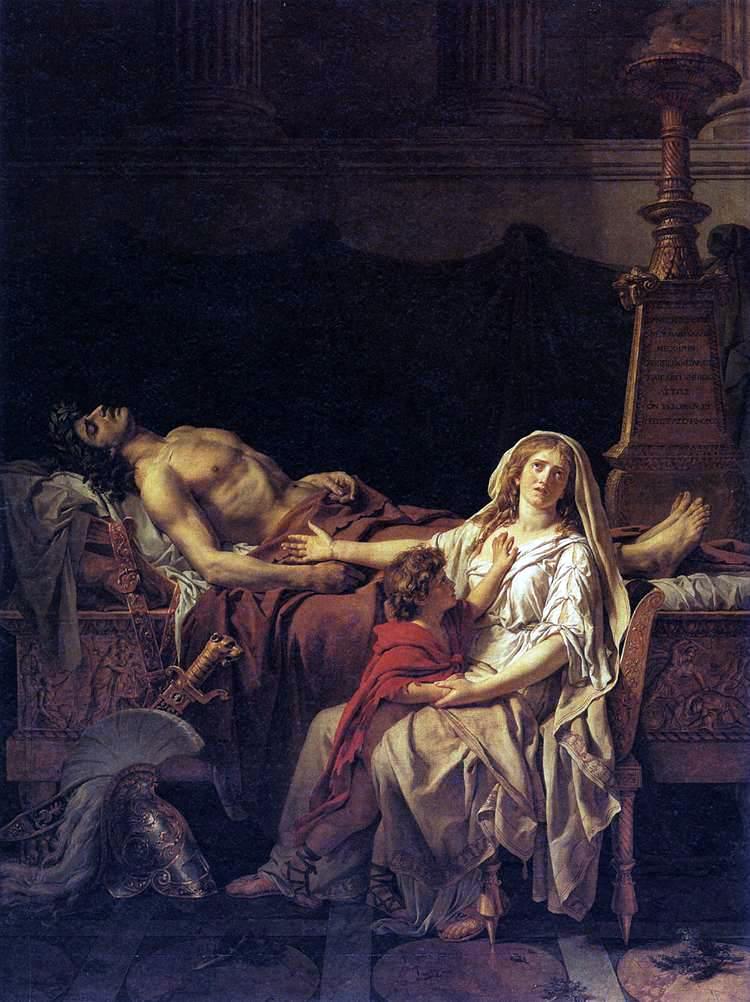
The Grief and Recriminations of Andromache over the Body of Hector Her Husband (1783) by Jacques-Louis David
Fight, Flight, or Freeze
In the third edition of his The Body Bears the Burden: Trauma, Dissociation, and Disease (2014), Robert Scaer looks at the cycle of arousal and rest that characterizes the function of our nervous system in response to crisis or danger. In simple terms, we can think of the fight or flight response which triggers different neurotransmitters to prepare for rapid response: in a resting state, our bodies are prepared for and more efficient at digesting and storing nutrients and also at processing and storing knowledge of facts and events (13). The fight/flight response puts us in a high-energy nervous state, raising blood-pressure and moving blood into our muscular system.
Such a shifting of biological resources is an essential survival tool. But when we experience prolonged arousal without release or resolution we can become locked in or frozen, establishing an unstable state that may look immobile but may actually be “rapid and exaggerated sympathetic/parasympathetic oscillation (15). To put it in other words: when we face a crisis situation we can neither fight nor flee, our “freeze” reaction is a parafunctional cycling through the same fight/flight and resting process over and over again. In this state, our minds can become “numb and dissociated” and our vascular and digestive systems suffer. So, if over the past year you’ve found yourself inexplicably tired, facing unanticipated digestive issues, out of breath with a racing heart while sitting still, you may have been showing the symptoms of your body encoding our trauma
As Scaer outlines (15-16), Animals often show remarkable responses to this freeze (a “discharge”) that can include convulsions and more in an instinctive attempt to restore “autonomic homeostasis” (16), that is, stability. Human beings, however, rarely show such ‘rests’ to discharge the trauma and reset the body. Such an inability to resolve the freeze moment, it seems, compounds the long term dangers of physical responses to trauma and the likelihood that memories of the events will incite similar physical responses, a return to a traumatized state. Scaer argues that many chronic diseases may be rooted in the reshaping of our brains by trauma and the inability of our conscious minds to distinguish between now and traumatizing events.
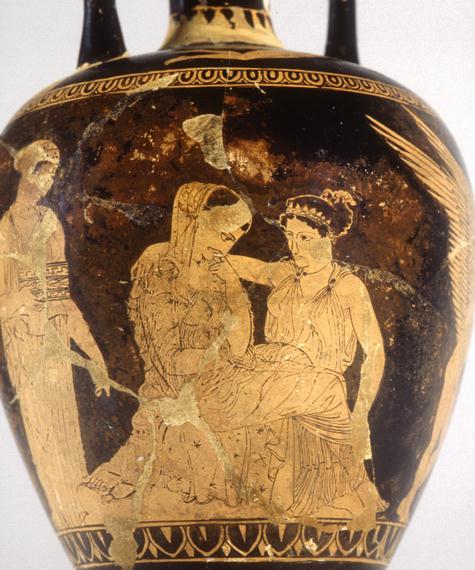
Hector’s last visit with his wife, Andromache, and infant son Astyanax, startled by his father’s helmet (Apulian red-figure vase, 370–360 BC)
Reading Hektor’s Trauma
I see so much of my sleepless nights, habitual doom scrolling, and somatic disarray in this description. And during these moments, I have wondered how this can change the way we approach Hektor both in a single moment and from the perspective of the whole narrative.
When we see Hektor before the walls of Troy, he is “coiled” like a snake (elissomenos) and he wouldn’t retreat because of his unquenchable heart. Note that I translate that participle clause ἄσβεστον ἔχων μένος causally. This is, of course, a significant choice, but I think a well-motivated one. This is the only time in Greek epic when menos—one’s energy, life force—is described as asbestos, “inextinguishable, unsatisfiable”. The adjective appears to mark extreme or powerful expressions of emotion as in describing the laughter of the gods at Hephaistos (1.599) or war cries of groups as they engage in battle (11.500, 11.530; 13.169; 13.450; 16.267). In the Odyssey, asbeston twice modifies kleos (4.584; 7.133). This word seems to describe extreme moments of pitch, or aggression with a sense of duration. But as Lorenzo Garcia argues in his Homeric Durability, asbestosmarks things that ultimately cannot endure: what the sound of a laugh or a war-cry share in common with Hektor’s menos is an unsustainable intensity. In addition, the adjective marks something that is public, shared, or heard by others. Here, the asbeston menos is something private, a massive, unsustainable thing somehow contained within a single person.
The simile compares Hektor to an animal coiled for attack; in describing his refusal to retreat, the narrative uniquely describes the energy driving him; the speech introduction that follows places him in a motif of deliberation over fighting or fleeing. Speeches introduced by the formula “He really glowered as he spoke to his own proud heart” (ὀχθήσας δ᾽ἄρα εἶπε πρὸς ὃν μεγαλήτορα θυμόν) are dramatic representations of deliberation—moments that happen in an instant but are unfolded in the time of performance to allow audiences to consider the inner workings of heroic minds. The simile of the serpent creates extra space and invites audiences to consider the space between the image of the coiled snake and Hektor’s actions: it is as much about how Hektor is the snake and how he is not.
For mortals, the moment of deliberation seems to be that very freeze before the selection of fight or flight: at 11.404-410, Odysseus, caught alone in battle worries about being overcome as the battle rages around him. At 17.90, Menelaos pauses in the defense of Patroklos’ body, afraid to face Hektor alone. At 18.5, Achilles is paralyzed by fear that something has happened to Patroklos and later at 20.143, Achilles finds himself perplexed at the sudden disappearance of Aeneas who has been rescued by the gods. At 21.552, Agenor the son of Antenor pauses mid-battle to decide to run or face Achilles.
The participle characterizing the speech, okhthêsas, moreover, expresses anger or resentment and may be an iterative of ekhthomai, that same root that gives us Greek words for hostility and enmity. Especially when combined with the asseverative particle ἄρα, this verb communicates an inward wrath at a choice with no good options. It is the coiling of anticipation, of loss, and of a loss of control. It is, I think, a formulaic marker for the process of navigating between fight and flight. In its pairing with the opening simile, it marks Hektor in that same moment, in an extended freeze. His resolution, however, contrasts with the other scenes: Hektor ends up acting contrary to his choice to stand.
Hektor’s menos, his anger, is a reflex of his loss of control and of his longing for something to be different. Andromache anticipates this when she speaks to him in book (6.407-409):
“Divine one, your menos will destroy you and you do not pity
Your infant child and my wretched fate, the one who will soon
Be your widow. For the Achaeans are on their way to kill you…”
Hektor’s drive to protect those he cares for most is the very thing that separates him from them, that unites them only in loss and longing. This calls to my mind the work of my friend, Emily Austin, who has written a book foregrounding the thematic importance of loss and longing (pothos) in the Iliad: it is the sudden absence that motivates Achilles’ menis. I think it is also the unconquerable fire that keeps Hektor from ever truly being still.
Thinking about the fight/flight/freeze complex as described by Scaer helps us confirm the poetic function of a Homeric formula: it also serves to invite audiences into a mind navigating a moment of crisis, of choice or judgment (hence Greek krisis) over running away or facing danger. In combination with a striking simile and a strange description of Hektor’s menos, this pattern also helps us see what can happen when the deliberation fails, when the freeze prolongs. Hektor’s menos is overloaded, it is too thoroughly interiorized, coiled inside him, breaking him from within.
Andromache looking down from the walls of Troy at Achilles dragging Hector’s corpse behind his chariot. Limestone, fragment of a sarcophagus, late 2nd century CE.
Hektor, Fighting and Fleeing
Almost 15 years ago, Elton Barker and I wrote an article about debates over fight or flight in the New Archilochus Poem and Homer. In it, we argued that both Homer and Archilochus were engaged in a tradition of poetic debate about the merits of fight or flight, transcending our narrow concepts of genre and operating ahierarchically, that is, prioritizing neither Homer nor Archilochus, but providing evidence of debate and reflection over time. I don’t think we’re wrong, still; but I do think that this debate is about more than drama and poets: it is about representing human emotion and cognition.
Broadly speaking, Scaer’s framework and my own experience makes me think that we need to rethink Hektor’s behavior throughout the epic and the depiction of Trojan responses to the war in general, allowing more richness to the emotive and cognitive content. There are thematic ties that tell a story of their own.
When Hektor speaks to Andromache in book 6, he anticipates the shame he worries about in book 22 and considers his wife’s suffering after his death. He expresses a characteristic fatalism when he dismisses Andromache to her weaving, saying, “I claim that there is no one who has escaped his fate, / whether a good person or a bad one, after they are born” (μοῖραν δ’ οὔ τινά φημι πεφυγμένον ἔμμεναι ἀνδρῶν, /οὐ κακὸν οὐδὲ μὲν ἐσθλόν, ἐπὴν τὰ πρῶτα γένηται, 6.488-489).
Perhaps it is too much to read into this passage to say that Hektor thinks flight is impossible (he does…), but it certainly helps explain his subsequent actions: keeping the Trojan army out on the field at night in book 8, breaking through the Greek fortifications despite a bad omen in book 12, and refusing to return to the defense of the city in book 18. When Polydamas calls for them to retreat, Hektor continues to insist Zeus is on their side and declares, “I will not flee him from the ill-sounding battle, but I will stand / against Achilles either to win great strength or to be taken myself. War is common ground and the one who kills is killed” (…οὔ μιν ἔγωγε / φεύξομαι ἐκ πολέμοιο δυσηχέος, ἀλλὰ μάλ’ ἄντην /στήσομαι, ἤ κε φέρῃσι μέγα κράτος, ἦ κε φεροίμην / ξυνὸς ᾿Ενυάλιος, καί τε κτανέοντα κατέκτα, 18.306-309).
When Hektor freezes in the choice to fight or flee in book 22, he knows there is no other option. In his speech, he often surprises modern audiences with a wish that he and Achilles could exchange pledges like young lovers and wishes neither would have to die even as he admits that shame would prevent him from retreat. As another friend Justin Arft has recently argued, Hektor “transitions from imagined mediation, to being unarmed, to being a woman, to intimate discourse, to he and Achilles in the place of lovers” (SCS 2021) and is flipping through cognitive schemas (patterns of behavior) trying to figure out what to do. It is as if Hektor has a handful of cards and is repeatedly flipping through them, looking for one that will change a fate he knows cannot be changed. He goes back through his own stories, perhaps stopping at his conversation with Andromache and thinking about what he loses, what he needs, and the absence of choices remaining to him. At the end, he returns to that deceptive idea, that fate alternates and he just might win the day (εἴδομεν ὁπποτέρῳ κεν Ὀλύμπιος εὖχος ὀρέξῃ, 130).
After not even a year yet in a society in trauma, I now see Hektor as someone whose response to the false hope of choice is to overcompensate, to come on too strong, and to engage in willful denial. He fights to extremes and then he flees excessively too. He is burdened by the weight of his past failures and the ultimate futility of his actions.
“Andromaque”, 1883 painting that can be seen in Rouen’s fine art museum in France.
The Trojans in Trauma
Of course, there’s not a single way to think about this moment. David Morris in his 2015 The Evil Hours notes that Freud theorized that war neuroses came from an internal conflict between self preservation and responsibility to honor and comrades (15). As Jonathan Shay adds in his Achilles in Vietnam, trauma undermines “the cohesion of consciousness” (1995,188). And this fragmentation has been born out by neurobiological studies since.
The additional thing to think about for Hektor and for us, is that the impact of trauma can be increased by duration. What if we think of the Trojan leader as coiled for nine years, as representing a people besieged, constantly poised between the need to fight and the desire for an impossible flight. The repeated suppression of the fight or flight choice, the prolonged freeze would be traumatizing neurobiologically. It would change the way Hektor’s mind and body worked.
I do want to be careful to say that I am not saying the Greeks would have seen it this way precisely, but rather that there is clearly a traditional marker through the collocation of simile, deliberative introduction, and the invitation to the audience to linger with Hektor for a moment (the freeze) that modern observers have seen as having both psychological and neurobiological components. Ancient audiences would have seen their own peers shaped and reshaped by similar traumas and their poems show evidence of understanding the long term impact experiences like isolation, betrayal, and helplessness can have on the working of human minds (think of Philoktetes, Ajax, Odysseus, and others like Klytemnestra and Medea in tragedy).
So, this is not a positivistic reading saying “this thing is definitely that” but more that our modern scientific discourse has outlined a space of behavior that traditional poetics found meaningful too and that the correlation between these observations may help us understand something about Hektor others have missed. But I think this is bigger than Hektor: it may be about the Trojans, a people besieged, as a whole.
In the traditional story of the Trojan War, the story of the horse seems all but ridiculous (ok, it is ridiculous). But what if we considered the Trojan willingness to accept a clear trap, to engage in such extreme denial, as a function of their collective trauma? We are no strangers to large parts of our population refusing to accept what others see as fact, in engaging in clearly self-destructive behavior because it adheres so much more closely to what they want to be true and reality causes them so much pain.
In Greek myth, trouble tends to run in families and cities, traveling from father to son and grandson until the whole line is used up. This too resounds with what we have learned over the past century. We know trauma can be passed down three generations. Large-scale studies of oppressed populations show greater evidence of trauma related behaviors (depression, suicide, drug use) in the grand-chhildren of those who suffered abuse and displacement than their peers. And these responses may be about more than the power of discourse and socialization. There’s growing evidence for the reshaping of DNA as a result of trauma. Our ancestors’ experiences may impact those parts of our DNA that inform our mental health and shape our responses to traumatic events in our lives.
(As a necessary aside, this makes it even harder to defend people who deny the justice of reparations on financial or ethical grounds. The legacy of past traumas are still shaping people today.)
Trauma impacts our physical health; it impedes learning and new memories; it alters how we respond to crisis; untreated, it deprives us of even instinctual advantages. The Iliad’s story of the Trojan War gives its audiences traumatized warriors and families on both sides. It shows people fraying then unraveling under the pressures of long term conflict. And it provides us with vignettes of men and women trying to make sense of the world as everything they know breaks down. When Hektor tries to face his death, but then runs, the traditional language and its images unfold a human mind at its most intense moment of crisis.
Over the past few years, I have often found myself arguing about what the humanities are, about what they are good for. A poem like the Iliad is not some timeless relic, a perfect object to be worshipped for the unmixed good it can bring. But it is a deeply complex inheritance, a poem that gives us the opportunity to move between what we know and see now and what others experienced thousands of years ago. By tracing out the story of Hektor’s mind and his body’s burden, we may find just a little help in learning how to carry our own.
“He put a large meat block on a burning fire
And placed on top of it the back of a sheep and a fat goat
And a slab of succulent hog, rich with fat.
As Automedon held them, Achilles cut.
Then he sliced them well into pieces and put them on spits
While the son of Menoitios, a godlike man, built up the fire.
But when the fire had burned up and the flame was receding,
He spread out the coal and stretched the spits over it.
Once he put the meat on the fire he seasoned it with holy salt.
When he cooked the meat and distributed it on platters,
Patroclus retrieved bread and placed it on a table
In beautiful baskets. Then Achilles gave out the meat.”