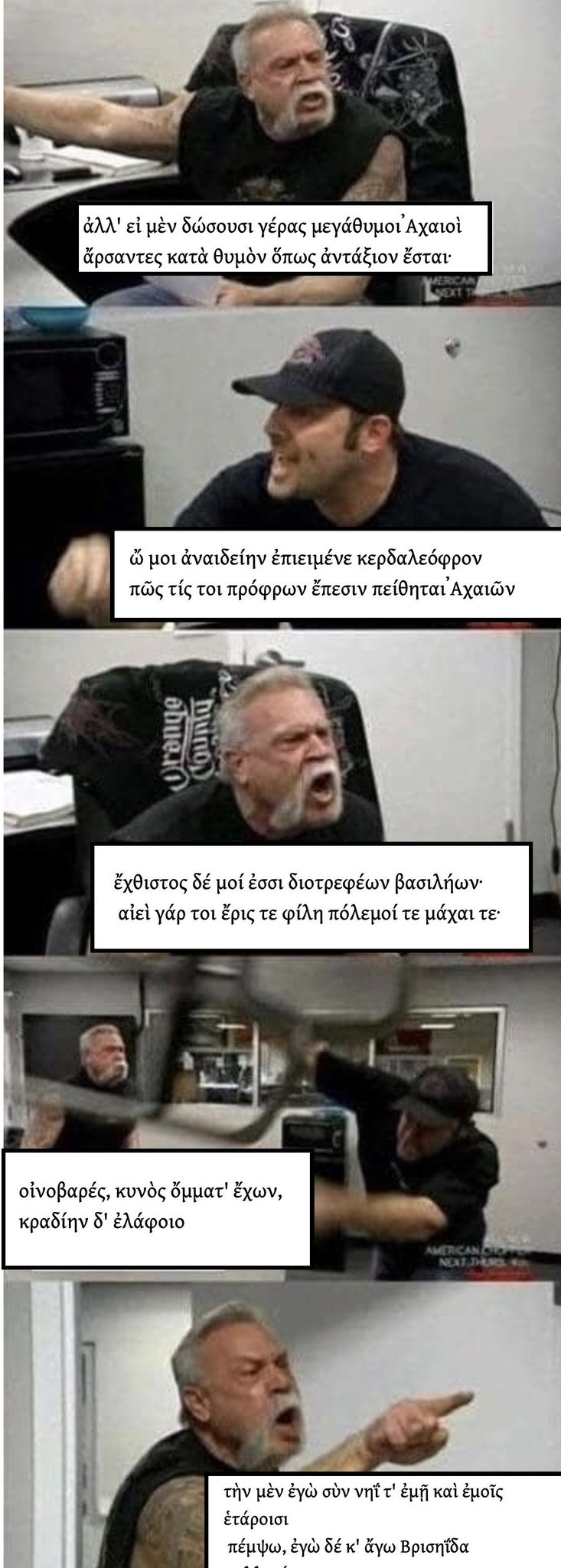
We have posted before about Odysseus’ sister Ktimene. She is mentioned by the swineherd Eumaios but never by Odysseus. The scholia connect her to one of Odysseus’ companions. The evidence for this seems to be the fact that Ktimene was sent to Same for marriage (where Eurylochus is from) and a kinship term used for him by Odysseus. Also of interest, according to the scholion, Odysseus may have had more sisters.
Homer, Odyssey 15.364-41
Strong Ktimenê, the youngest of the children she bore.
I was raised with her, and she honored me little less.
But when we both made it to much-praised youth,
They gave her to Samê and received much in return
But she gave me a cloak, tunic and clothing
Dressing me finely and give me sandals for my feet
And sent me to the field. But she loved me more in her heart.
“She bore the youngest of the children”: [this means] of the female children. For his father only had Odysseus [for a son]. There were more sisters of Odysseus.”
“So he spoke, and I was turning over in my thoughts
As I began to draw the sharp-edged sword next to my thick thigh,
Whether I should cut off his head and drive him to the ground
Even though he really was my relative. But our companions
Were restraining me with gentle words from all sides.”
“Pêos: A relative by marriage. In-law. Also, “in-lawness” [Pêosunê], relation-by-marriage. There is also Pêôn [genitive plural], for “of relatives-by-marriage. Homer has: “relatives and friends” [Il. 3.163]
“…There is a difference between in-law and friend. People who have no connection to you by birth are friends. In-laws are related to you through marriage.”
“[Metrodorus said] concerning the laws and customs among men that Agamemnon was the sky, Achilles was the sun, Helen was the earth, and Alexander was air, that Hektor was the moon and that the rest were named analogically with these. He claimed that Demeter was the liver, Dionysus the spleen, and Apollo was bile [anger].”
Some Allegorical Readings from the Scholia Vetera to the Odyssey (Dindorf)
Schol. E. ad Od. 1.38
“Allegorically, an uttered speech is called Hermes because of his hermeneutic nature and he is the director because he manages the soul’s thoughts and the mind’s reflections. He is Argeiphontes because he is bright and pure of murder. For he teaches, and evens out and calms the emotional part of the soul. Or, it is because he killed the dog Argos, which stands for madness and disordered thoughts. He is the one who makes the reflections of the mind appear bright and clean.
*Heraclitus the Obscure claims that Hermes is a representation of Odysseus’ rational mind (Homeric Problems 72-73)
Schol E.M. ad Od. 4.384
“The winds and every sort of breeze”: Some allegorize Proteus as matter itself. For without matter, they claim that the creator [could not] have made everything distinct. For, although matter is never clear to us, men, trees, water and all things come from it. Eidothea, you see, is thought. Matter produces thought once it is condensed. Others allegorize Proteus as the right part of the spring when the earth first begins to make the shapes of grapes and offspring. Menelaos, since it was not the right time for sailing and he missed the spring, sailed in the wrong direction. The name Proteus is suitable for allegory.”
“The holy cave of the Nymphs”: Some allegorize the cave as the universe, the nymphs are souls, they are also bees and the bodies are men. The two gates are the exit of souls, and one is creation, the entry point of the soul, in which no part of the body enters, but there are only souls. They are immortal. From this they call them olive—or, because of the victorious crown, or because…which is nourishing…”
In a post, Palaiophron talks about seeing me lecture and kindly does not make it clear that when a student first asked me for the etymology of Nausikaa, I was flabbergasted and admitted it. The context was a discussion of the names Nausithoos (“swift-in-ships”) and Nausinoos (“ship-minded”) in the Homeric and Hesiodic traditions. Why wouldn’t I think that the offering of two etymologies might prompt an audience member to wonder about a third, when I mentioned the name as a parallel?
The embarrassing truth is that for some unknown reason I had never really thought about the meaning of the name Nausikaa. So, on the spot, I suggested Ναυσι+ καίω for something like “ship-burner”. Palaiophron rightly reacted that this would be preposterous for the narrative of the Odyssey and eventually dug up the records of the ancients who tied the name to either a form of καίνυμι (to excel, or surpass) or from κοσμέω (to arrange, adorn).
So, he cites Pseudo-Zonaras, in his Lexicon, writes: “Nausikaa. Excelling in ships.” (Ναυσικάα. ταῖς ναυσὶ κεκασμένη) confirmed by Etymologicum Magnum which adds Nausikaa: “Excelling (that is, honored [or, an ornament to?]). Ναυσικάα: Κεκασμένη (ὅ ἐστι κεκοσμημένη). Kallierges repeats this (598.28): Ναυσικάα: Κεκασμένη (ὅ ἐστι κεκοσμημένη) ταῖς ναυσί.
“Just as when someone hides a firebrand in black ash
On the farthest edge of the wilderness where there are no neighbors
And saves the seed of fire when there is no other way to kindle it,
Just so Odysseus covered himself in leaves. Then Athena
Poured sleep over his eyes so he might immediately rest
From his exhausting toil, once she closed his dear lashes.”
This is one of the two greatest similes in the Odyssey, in my humblest of opinions. The other occurs right before the slaughter in book 21 (407-409):
“Just as a man who knows both lyre and song
easily stretches a string on a new peg
as he attaches the twisted sheep-gut to both sides
just so, without haste, Odysseus strung the great bow”
Students often complain about the lack of verisimilitude in the heroic diet–even though the Odyssey mentions that Odysseus’ companions fish and hunt birds before they kill the cattle in Thrinacia, students find something odd about a diet of meat, bread and wine.
Apparently ancient comic poets did too–and they were concerned about the reality of heroic sexual habits as well. Obviously, as the beginning of book 1 of the Iliad makes clear, eligible ladies were not in excess supply.
[Warning: this next passage is a little, well, explicit] Athenaeus, Deipnosophists 1.46
“Sarpedon makes it clear that they ate fish when he says that being captured is similar to hunting with a fishing net. In the comic charm, Eubolos also says jokingly:
Where dies Homer say that any of the Achaeans Ate fish? They only ever roast meat—he never has Anyone of them boil it at all! And not a one of them sees a single prostitute— They were stroking themselves for ten years! They knew a bitter expedition, those men who After taking a single city went back home With assholes much wider than the city they captured.
The heroes also didn’t allow freedom to the birds in the air, but they set snares and nets for thrushes and doves. They practices for bird hunting when they tied the dove to the mast of the ship and shot arrows at it, as is clear from the Funeral Games. But Homer leaves out their consumption of vegetables, fish and birds because of gluttony and because cooking is inappropriate, he judged it inferior to heroic and godly deeds.”
ἡ ἐπιορκία, hê epiorkía: “perjury
ἐπιορκεῖν, epiorkeîn; ψευδορκεῖν, pseudorkeîn: “to make a false oath; to commit perjury”
Hesiod, Works and Days 282-284
“Whoever lies when he has sworn a false oath in his witness
Outrages justice and falls into an incurable ruin,
His family is left harried and weakened afterwards.”
“Now may Zeus know this, the highest and the best of the gods,
Along with Earth, the Sun and the Furies, those who punish men
Under the earth, whenever someone perjures himself.”
Thrasymachus: While I like the alliteration, I don’t think *donum* works here.
As a “trick”—in this sense—isn’t really a deceit (more like a joke), and as the “treat” is something trifling (not a *gift*, which carries a sense of formality), I am wondering on something like “nugas nucesve,” “jests or nuts.”
While nuces were strewn at wedding and festivals (I’m thinking of the throwing of small bits of candy at bar mitzvahs, etc.), they were also children’s playthings, which captures, I think the idea of “treat,” as something given informally, even anonymously, and without expectation of return
After the death of Hektor in Iliad 22, the poem moves to Andromache who gives a remarkable speech, most of which is occupied with thoughts of their son.
Iliad 22.482-507
“And now you go under the hidden places of the earth to Hades’ home,
But you leave me in hateful grief, a widow in our home—
And your child too, still an infant, the one we bore
You and I, ill-fated, Hektor, you will not be of any use to him
Since you have died, and he won’t be to you.
For even if he should escape the Achaeans’ war of many tears,
Still there would be toil and griefs for this child afterward.
For others will deprive him of his lands.
The day that makes a child an orphan separates him from his peers.
He looks down all the time; his cheeks are covered in tears;
And the child goes in need to his father’s friends,
Asking one for a cloak and another for a tunic.
He holds out his little cup while they pity him—
He can moisten his lips but never fill his hunger.
A luckier child chases him from the feast,
Striking him with his hands and laying into him with words:
“Go away—your father doesn’t dine with us.”
And the cheerful child will return to his widowed mother,
Atsyanax, who used to eat only marrow and the rich fat
Of sheep as he sat on his father’s needs.
Then when sleep would come over him, he would stop playing
And rest on a bed in the arms of a nurse, his heart full
Of everything good on that soft bed.
But now, he would suffer much once he has lost this dear father,
Astyanax, as the Trojans call him as a nickname,
For you alone defended their bulwarks and great walls.”
I was profoundly moved by this speech for its vividness and terrible irony long before I was a parent myself. The first time I read this passage in Greek as I prepared for my PhD exams, I wept while completing it. As a parent now, I struggle even to think about reading it. The terrible irony of course is that Astyanax is actually killed by the victors before he can suffer the deprivations his mother predicts, although she does fear this fate:
Iliad 24.732–738
“You, child, will also either follow me
Where you will toil completing the wretched works
Of a cruel master or some Achaean will grab you
And throw you from the wall to your evil destruction
Because he still feels anger at Hektor killing his brother
Or father or son, since many a man of the Achaeans dined
On the endless earth under Hektor’s hands.”
In the popular tradition the one who carries out the killing of Astyanax is Odysseus, that ‘hero’ of that other epic who gets to go home to his own son and father. If the way we talk about and treat our enemies dehumanizes them—and us—what does it mean when we murder, torture, or harm children?
In the future Andromache imagines, Astyanax is marginalized even among his own people by the loss of his father–he loses his status, his friends, and his former happiness. But in a foreign land, he loses all hope of happiness–he is a slave to another if he is lucky to be alive. I have to ask myself every time I read this whether or not an orphaned child is significantly better off today.
I can’t stop thinking about some of the details that surfaced last week about the separation of children from families by the US Government at our borders and within them. This is not some new legacy of course—from slavery through the devastation of indigenous families up into the modern judicial system and its enforcement of the new (and old) “Jim Crows”, we have a powerful and inescapable legacy of separating children from families. This creates an essential cognitive dissonance. You cannot be ‘pro-family’ and tear families apart.
I know that there has been extensive prevarication about the extent and severity of these separations. I don’t want to hear more of this because it all just amounts to fragile attempts of denial and blame shifting. We are obliterating families for being unlucky, brown-skinned, poor, and on the wrong side of man-made borders. We can’t comfort ourselves that our essential goodness has changed much in a few thousand years.
“My son was crying as I put him in the seat. I did not even have a chance to try to comfort my son, because the officers slammed the door shut as soon as he was in his seat. I was cry, too. I cry even now when I think about that moment when the border officers took my son away.” pic.twitter.com/2EmdndFIKo
Last week, we turned to the most tragic of epics (according to Aristotle, at least), Homer’s Iliad.
This week we remain in Trojan War material but return to tragedy with the Rhesus, traditionally attributed to Euripides. This play covers the same basic events of Iliad 10 where Diomedes and Odysseus go out to spy on the Trojans at night and end up slaughtering the Thracian king Rhesus and his men to steal his horses. Euripides’ play give us a little more from both sides: we see a somewhat more monstrous Hektor, get to hear from Rhesus himself and are invited to see the slaughter as a calamity worthy of attention on its own.
In performing the play. we are less interested in whether or not it is genuinely Euripides–and its authenticity has been doubted for some time because of its contents and its style–than we are in how and why this play may have appealed to ancient audiences and what it has to tell us about the reception of Trojan War figures on the Athenian stage. We see Odysseus in many different plays, but having Hektor and his allies in a performance is a rare thing indeed. This play also invites us to think about the fixity of scenes from the Iliad we possess and the complex relationship between performative genres and audience expectations.
Euripides’ Rhesus 182
“It is right to cast your life in the dice game of fate For things that are worthy.”
“…I love to speak the truth All the time and I am never a duplicitous man. Long, long ago it would have been right for you to come And share our pain…”
“Ajax doesn’t seem to me to be any lesser than him Nor does Tydeus’ son. But that Odysseus, He is the most twisted crook, a man bold enough to be arrogant, One who has outraged this land most of all.”
Artistic Director: Paul O’Mahony (Out of Chaos Theatre) Associate Director: Liz Fisher Director of Outreach: Amy Pistone (Gonzaga University) Dramaturg: Emma Pauly Executive Producer: Lanah Koelle (Center for Hellenic Studies) Producers: Keith DeStone (Center for Hellenic Studies), Hélène Emeriaud, Janet Ozsolak, and Sarah Scott (Kosmos Society) Poster Artist: John Koelle Poster Designer: Allie Marbry (Center for Hellenic Studies)
Euripides, Rhesus 756-57
“In addition to our suffering, this has been handled With the greatest shame. This doubles the pain.”
Saturday, October 17 Assemblywomen, Aristophanes with Francisco Barrenechea (University of Maryland, College Park)
October 21 Agamemnon, Aeschylus with Fiona Macintosh (University of Oxford); translation by O. Taplin
October 28 Libation Bearers, Aeschylus; translation by O. Taplin
November 4 Eumenides, Aeschylus with Ellen McLaughlin (Barnard College) and Andrew Simpson (Catholic Univeristy of America); translation by O. Taplin
Euripides, Rhesus 938-942
“Athena, you deserve the blame for this. Odysseus and the son of Tydeus didn’t do it Don’t imagine you sneaked by me. Still, my sister Muses and I honor your city Most of all….”
This week, we turn to the most tragic of epics (according to Aristotle, at least), Homer’s Iliad
As everyone knows, the Iliad begins with the rage of Achilles. As many of us forget, it ends not with the Trojan Horse or the death of Achilles, but instead with the burial of horse-taming Hektor. I think it is probably dangerous to ask a Homerist to tell you about the Iliad, because so often we don’t know where to start, whether it should be in thinking about its relationship with the Odyssey or about what it means to say the word “Homer”. True Story: many years ago, while patronizing a drinking establishment in Queens, my wife asked me to tell her what the Iliad was about. After about 45 minutes, she asked how much more there was to it. I had not even finished book 1 yet…
Ancient performers of the epics didn’t have these challenges because audiences grew up hearing stories about most of the events and characters they would be singing about and because the performance contexts didn’t expect them to tell the whole story. We don’t know a lot about the actual performance contexts and practices of Homeric poetry in the ancient world (see the work of José Gonzalez on rhapsodes, Casey Dué’s work on multiformity, Egbert Bakker’s From Formula to Poetics or any of Gregory Nagy’s Poetry as Performanceor Plato’s Rhapsogy and Homer’s Music), but it seems likely that the stories were performed in episodes at various occasions and at times in monumental performances at festivals. How these performances were prepared is another issue: some think they were memorized from a script, others think they were composed in performance. I tend towards the latter belief with the acknowledgement that even when something is composed in performance, there are various degress of fixity from one performance to another and one singer to another…
And, here again, I have started to trail off. Often people talk about performance of song within Homer to start us thinking about epic performance (the songs of Demodokos and Phemios in the Odyssey; Achilles singing to his lyre in the Iliad) but there’s some evidence outside the poems too. One passage comes from Plato’s Ion:
Plato, Ion 535d-e
Ion: Now this proof is super clear to me, Socrates! I’ll tell you without hiding anything: whenever I say something pitiable, my eyes fill with tears. Whenever I say something frightening, my hair stands straight up in fear and my heart leaps!
Socrates: What is this then, Ion? Should we say that a person is in their right mind when they are all dressed up in decorated finery and gold crowns at the sacrifices or the banquests and then, even though they haven’t lost anything, they are afraid still even though they stand among twenty thousand friendly people and there is no one attacking him or doing him wrong?
Ion: Well, by Zeus, not at all, Socrates, TBH.
Socrates: So you understand that you rhapsodes produce the same effects on most of your audiences?
Ion: Oh, yes I do! For I look down on them from the stage at each moment to see them crying and making terrible expressions, awestruck by what is said. I need to pay special attention to them since if I make them cry, then I get to laugh when I receive their money. But if I make them laugh, then I’ll cry over the money I’ve lost!”
Note in this passage that Plato’s Socrates assumes that Ion is faithfull performing a ‘text’ ascribed to Homer and that they both identify as salient features of the performance the context (“sacrifices” and “festivals”) the emotional affect (crying and carrying on, channeling the emotive content of the scenes) and the impact on the audience (making them cry too) all while emphasizing the material benefit accruing to a rhapsode who pleases his audiences.
When I think about Homeric performance, I think a lot about how little we know about the audiences and their responses and how crucial this was to the shape of the poems we have. I too often forget that the performers were an important part of this process in shaping the reception through their use of intonation, voice, gesture, and tune. So, in our readings from the Iliad today, I will be thinking about the parts, and not the whole, and how performance creates a new text of its own.
We’ve selected some passages today for performance from different parts of the epic to give an idea of the power of the whole and to provide a range of characters for our actors. We will get some of the debate in book 1, some family scenes in Troy, and a whole range of lament and regret. What more could one ask for a Wednesday?
“But, you great shamepot, we follow you so that you feel joy, As we collect honor for Menelaos and you, dog-face, From the Trojans—you don’t shudder at this, you don’t care.”
Selected Passages (Using the Stanley Lombardo translation with permission from Hackett)
Iliad 1 Agamemnon and Achilles’ argument
Iliad 6 Hector and Andromache
Iliad 19 Agamemnon and Achilles reconcile – may be cut for time
Iliad 22 Andromache’s first lament for Hector
Iliad 24 Achilles and Priam
Iliad 24 Priam, Hecuba, Andromache and Helen laments for Hector
Iliad 1.224–228 [Achilles Addressing Agamemnon]
“Wine-sod! Dog-eyes! You have the heart of a deer! You never suffer to arm yourself to enter battle with the army Nor to set an ambush with the best of the Achaeans. That seems like death itself to you!”
“After a while, Diomedes good-at-the warcry, addressed them: “I will fight with you first because you are being foolish, son of Atreus, Which is right, Lord, in the assembly. So don’t get angry at all.”
Artistic Director: Paul O’Mahony (Out of Chaos Theatre) Associate Director: Liz Fisher Director of Outreach: Amy Pistone (Gonzaga University) Dramaturg: Emma Pauly Executive Producer: Lanah Koelle (Center for Hellenic Studies) Producers: Keith DeStone (Center for Hellenic Studies), Hélène Emeriaud, Janet Ozsolak, and Sarah Scott (Kosmos Society) Poster Artist: John Koelle Poster Designer: Allie Marbry (Center for Hellenic Studies)
Iliad 21.461-465
“Then lord Apollo the far-shooter answered, “Earthshaker, you would not think that I would be prudent If indeed I fought with you over mortals, Wretched men who are like the leaves now flourish Until they grow full, eat the fruit of fields, And then they diminish until they die…”
October 14 Rhesus, Euripides with Mary Ebbott (College of the Holy Cross)
Saturday, October 17 Assemblywomen, Aristophanes with Francisco Barrenechea (University of Maryland, College Park)
October 21 Agamemnon, Aeschylus with Fiona Macintosh (University of Oxford)
Iliad 24.503-6
“Achilles, respect the gods and take pity, Once you think of your own father. I am even more pitiable, Since I endure what no other mortal person ever has, To reach my hands to the lips of the man who slaughtered my child.”
“You, child, will also either follow me Where you will toil completing the wretched works Of a cruel master or some Achaean will grab you And throw you from the wall to your evil destruction Because he still feels anger at Hektor killing his brother Or father or son, since many a man of the Achaeans dined On the endless earth under Hektor’s hands.”
“After heaping up the mound [sêma] they returned. Then Once they were well gathered they shared a fine feast In the halls of the god-nourished king, Priam. Thus they were completing the burial of horse-taming Hektor.”