Sing the Rage! Returning to the Iliad with Reading Greek Tragedy Online

Tomorrow we return to the Iliad with Reading Greek Tragedy Online, a series produced in partnership with Out of Chaos Theatre, the Center for Hellenic Studies, and the Kosmos Society. This project started at the onset of COVID19 lockdowns in the US and UK and brings together actors and researches to stage scenes from the ancient stage and talk about how they impact us to this day. We have over 45 episodes posted already and will add 5 more before the end of the year.

We return to book 1 of the Iliad, the scene of the crime.

4 PM EST, Live and Archived

Homer, Iliad 1.1-9

Μῆνιν ἄειδε θεὰ Πηληϊάδεω ᾿Αχιλῆος
οὐλομένην, ἣ μυρί’ ᾿Αχαιοῖς ἄλγε’ ἔθηκε,
πολλὰς δ’ ἰφθίμους ψυχὰς ῎Αϊδι προΐαψεν
ἡρώων, αὐτοὺς δὲ ἑλώρια τεῦχε κύνεσσιν
οἰωνοῖσί τε πᾶσι, Διὸς δ’ ἐτελείετο βουλή,
ἐξ οὗ δὴ τὰ πρῶτα διαστήτην ἐρίσαντε
᾿Ατρεΐδης τε ἄναξ ἀνδρῶν καὶ δῖος ᾿Αχιλλεύς.

“Goddess, sing the rage of Pelias’ son Achilles,
Destructive, how it gave the Achaeans endless pain
And sent many brave souls of heroes to Hades—
And it made them food for the dogs
And all the birds as Zeus plan was being fulfilled.
Start from when those two first diverged in strife,
The lord of men Atreus’ son and godly Achilles.”

Youtube Link:

Homer, Iliad 1.158–168 [Achilles addressing Agamemnon]

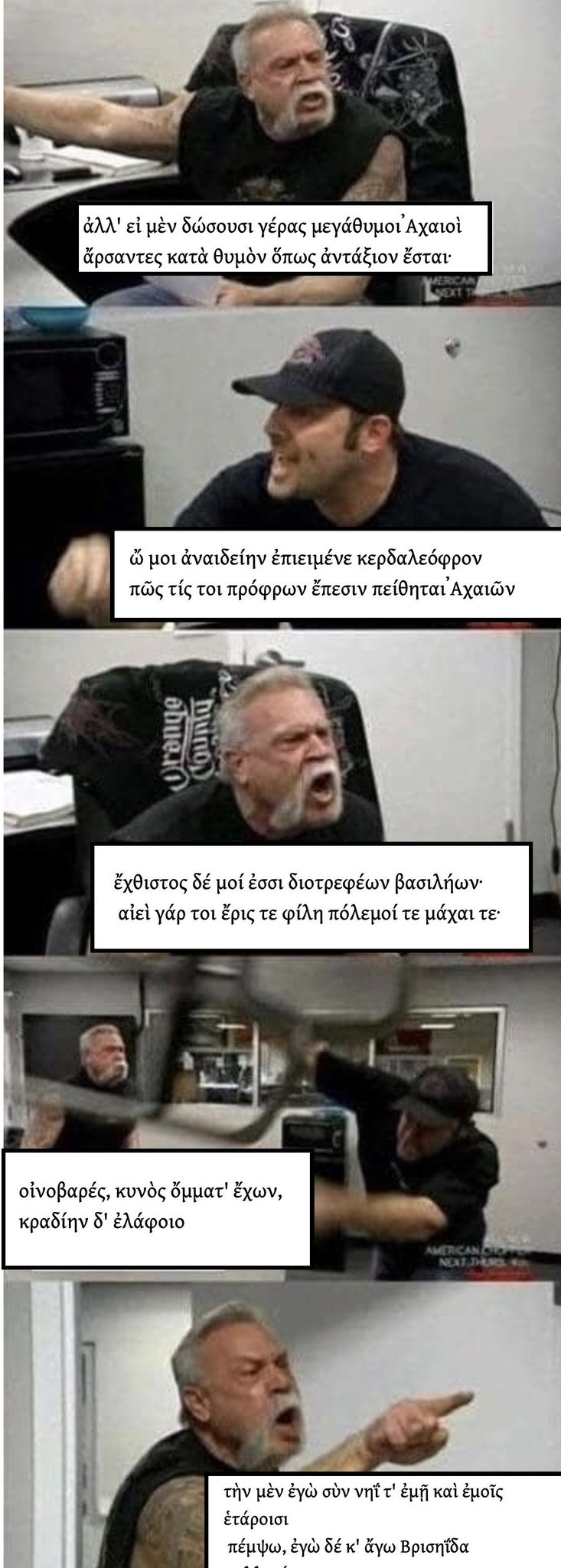
“But, you great shamepot, we follow you so that you feel joy,
As we collect honor for Menelaos and you, dog-face,
From the Trojans—you don’t shudder at this, you don’t care.”

ἀλλὰ σοὶ ὦ μέγ’ ἀναιδὲς ἅμ’ ἑσπόμεθ’ ὄφρα σὺ χαίρῃς,
τιμὴν ἀρνύμενοι Μενελάῳ σοί τε κυνῶπα
πρὸς Τρώων· τῶν οὔ τι μετατρέπῃ οὐδ’ ἀλεγίζεις·

Performers and Artists
Musical guest and performer: Bettina Joy de Guzman
Paul Hurley
Paul O’Mahony
Rene Thornton Jr.
Damian Jermaine Thompson
Sara Valentine
Special Guests: Jared Simrad and Maria Xanthou

Iliad 1.224–228 [Achilles Addressing Agamemnon]

“Wine-sod! Dog-eyes! You have the heart of a deer!
You never suffer to arm yourself to enter battle with the army
Nor to set an ambush with the best of the Achaeans.
That seems like death itself to you!”

οἰνοβαρές, κυνὸς ὄμματ’ ἔχων, κραδίην δ’ ἐλάφοιο,
οὔτέ ποτ’ ἐς πόλεμον ἅμα λαῷ θωρηχθῆναι
οὔτε λόχον δ’ ἰέναι σὺν ἀριστήεσσιν ᾿Αχαιῶν
τέτληκας θυμῷ· τὸ δέ τοι κὴρ εἴδεται εἶναι.

Crew and Amazing People
Artistic Director: Paul O’Mahony (Out of Chaos Theatre)
Host and Faculty Consultant: Joel Christensen (Brandeis University)
Executive Producer: Lanah Koelle (Center for Hellenic Studies)
Producers: Keith DeStone (Center for Hellenic Studies), Hélène Emeriaud, Janet Ozsolak, and Sarah Scott (Kosmos Society)
Director of Outreach: Amy Pistone (Gonzaga University)
Poster Designer: Allie Marbry (Center for Hellenic Studies)
Poster Illustration Artist: John Koelle

Eustathius, Commentary to Homer’s Iliad, 1.14

“That Homer was an Achilles-lover will appear in thousands of ways. Homer would have readily named the Iliad the Achillea, just as he named the Odysseia (Odyssey) after Odysseus, if it were not for the fact that he would thus slight and insult the rest of the Greek nobility by naming the poem after one person.”

῞Οτι δὲ φιλοαχιλλεὺς ὁ ποιητής, μυριαχοῦ φανήσεται, ὃς τάχα, ὥσπερ ἐξ ᾿Οδυσσέως τὴν ᾿Οδύσσειαν, οὕτω καὶ τὴν ᾿Ιλιάδα ἐξ ᾿Αχιλλέως ᾿Αχίλλειαν ἐπέγραψεν ἄν, εἰ μὴ τὸ πρεσβεῖον τῆς ῾Ελλάδος οὕτως ἤμελλε καταβαλεῖν  καὶ ταπεινῶσαι τῇ ἐξ ἑνός τινος ἐπιγραφῇ.

Future episodes

All start times are 3pm ET unless otherwise noted. Live stream available at chs.harvard.edu and on YouTube.

November 17 Goddess and The Women of Gods, conceived and directed by LeeAnet Noble, with Suzanne Lye (University of North Carolina, Chapel Hill) and Jackie Murray (University of Kentucky)

December 1 The Laodamiad by Chas LiBretto

December 15 An Ancient Cabaret

Media preview

How Do You Say Trick-Or-Treat in Latin and Greek?

repeated, but an important thread

Send me more languages and more suggestions and I will add them.

Latin — Aut dulcia aut dolum

Modern Greek: φάρσα ή κέρασμα

Ancient Greek: δόλος ἢ μισθός (see below for citation)

I prefer: δόλος ἢ δῶρον (but will take some suggestion for candy or sweet)

But what I really like is δόλος ἢ ξείνιον because I think Odysseus is the original trick(ster)-treater.

Odyssey 9.174-76

‘After I arrive, I will test these men, whoever they are,
Whether they are arrogant and wild, unjust men
Or kind to guests with a godfearing mind.”

ἐλθὼν τῶνδ’ ἀνδρῶν πειρήσομαι, οἵ τινές εἰσιν,
ἤ ῥ’ οἵ γ’ ὑβρισταί τε καὶ ἄγριοι οὐδὲ δίκαιοι,
ἦε φιλόξεινοι, καί σφιν νόος ἐστὶ θεουδής.’

9.229: “So that I might see him and whether he will give me guest gifts”
ὄφρ’ αὐτόν τε ἴδοιμι, καὶ εἴ μοι ξείνια δοίη.

9.406 “Really, is no one killing you by trick or by force?
ἦ μή τίς σ’ αὐτὸν κτείνει δόλῳ ἠὲ βίηφι;’

9.408 “Friends, No one is killing me with trick or force.”
‘ὦ φίλοι, Οὖτίς με κτείνει δόλῳ οὐδὲ βίηφιν.’

14.330 “absent already for a while, either openly or secretly”
ἤδη δὴν ἀπεών, ἢ ἀμφαδὸν ἦε κρυφηδόν.

cf.  Dutch “treats or your life”

There is this too:

Also:

Image result for Ancient GReek odysseus in disguise

Twitter

https://twitter.com/Nanocyborgasm/status/922826477346926592

Facebook: How do you say trick or trick in Latin?

Euthyphro: How DO you say “trick or treat” in Latin?

Socrates: I’ve sometimes used “Aut dulcia aut dolum!”

Sententiae Antiquae Working on it…

Ion: ‘Dolus donumve’ or indeed ‘dolus nisi donum’

Thrasymachus: While I like the alliteration, I don’t think *donum* works here.

As a “trick”—in this sense—isn’t really a deceit (more like a joke), and as the “treat” is something trifling (not a *gift*, which carries a sense of formality), I am wondering on something like “nugas nucesve,” “jests or nuts.”

While nuces were strewn at wedding and festivals (I’m thinking of the throwing of small bits of candy at bar mitzvahs, etc.), they were also children’s playthings, which captures, I think the idea of “treat,” as something given informally, even anonymously, and without expectation of return

You need the accusative, not the nominative.

Cratylus:  Dulcia aut ludos?

Talking With Homer in the Underworld

While Lucian is surely messing with us here, I think there are many tomes of Homeric scholarship set aright through this one paragraph.

Lucian, True History 2.20

“Two or three days had not yet passed when I approached the poet Homer at a moment when we both had free time and I was investigated the rest of the matters about him, especially where he was from. For this is still examined by us to this day. He said that he was not ignorant that some people say he his from Khios and others say Smyrna while a majority claims he is Kolophonian. But he was saying that he is in fact Babylonian and was not called Homer among his people but Tigranes. Later on, after he was a hostage [homêreusas] among the Greeks he changed his nickname.

When I asked him about the lines which were considered spurious and whether they had been written by him, he was claiming they were all his. For this reason I started to believe that the grammarians Zenodotus and Aristarchus were guilty of the most close-minded logic. Since he had responded sufficiently on these matters, I was asking him next why he made his poem start with the “rage of Achilles”. He said that it just leapt into his head that way without any prior thought. Then I was eager to know that thing, whether he wrote the Odyssey before the Iliad as many claim. He denied this.”

Οὔπω δὲ δύο ἢ τρεῖς ἡμέραι διεληλύθεσαν, καὶ προσελθὼν ἐγὼ Ὁμήρῳ τῷ ποιητῇ, σχολῆς οὔσης ἀμφοῖν, τά τε ἄλλα ἐπυνθανόμην καὶ ὅθεν εἴη. τοῦτο γὰρ μάλιστα παρ᾿ ἡμῖν εἰσέτι νῦν ζητεῖσθαι. ὁ δὲ οὐδ᾿ αὐτὸς μὲν ἀγνοεῖν ἔφασκεν ὡς οἱ μὲν Χῖον, οἱ δὲ Σμυρναῖον, πολλοὶ δὲ Κολοφώνιον αὐτὸν νομίζουσιν· εἶναι μέντοι γε ἔλεγεν Βαβυλώνιος, καὶ παρά γε τοῖς πολίταις οὐχ Ὅμηρος, ἀλλὰ Τιγράνης καλεῖσθαι· ὕστερον δὲ ὁμηρεύσας παρὰ τοῖς Ἕλλησιν ἀλλάξαι τὴν προσηγορίαν. ἔτι δὲ καὶ περὶ τῶν ἀθετουμένων στίχων ἐπηρώτων, εἰ ὑπ᾿ ἐκείνου εἶεν γεγραμμένοι. καὶ ὃς ἔφασκε πάντας αὑτοῦ εἶναι. κατεγίνωσκον οὖν τῶν ἀμφὶ τὸν Ζηνόδοτον καὶ Ἀρίσταρχον γραμματικῶν πολλὴν τὴν ψυχρολογίαν. ἐπεὶ δὲ ταῦτα ἱκανῶς ἀπεκέκριτο, πάλιν αὐτὸν ἠρώτων τί δή ποτε ἀπὸ τῆς μήνιδος τὴν ἀρχὴν ἐποιήσατο· καὶ ὃς εἶπεν οὕτως ἐπελθεῖν αὐτῷ μηδὲν ἐπιτηδεύσαντι. καὶ μὴν κἀκεῖνο ἐπεθύμουν εἰδέναι, εἰ προτέραν ἔγραψεν τὴν Ὀδύσσειαν τῆς Ἰλιάδος, ὡς οἱ πολλοί φασιν· ὁ δὲ ἠρνεῖτο.

Image result for medieval manuscript homer
Ambrosian Iliad

Anger, Eggs, and Some Semen: A Recipe for Apostasy

Further adventures in the Homeric Scholia

Schol. b ad Il. 2.783

“They report that Gaia, annoyed over the murder of the giants, slandered Zeus to Hera and that she went to speak out to Kronos. He gave her two eggs and he rubbed them down with his own semen and ordered her to put them down in the ground from where a spirit would arise who would rebel against Zeus from the beginning. She did this because she was really angry and set them down below Arimos in Kilikia.

But when Typhoeus appeared Hera relented and told Zeus everything. He struck him down with lightning and named him Mt. Aetna. This report works well for us not to have an issue that this is the Homeric Account. He names the grave a resting place euphemistically.”

φασὶ τὴν Γῆν ἀγανακτοῦσαν ἐπὶ τῷ φόνῳ τῶν Γιγάντων διαβαλεῖν Δία τῇ ῞Ηρᾳ. τὴν δὲ πρὸς Κρόνον ἀπελθοῦσαν ἐξειπεῖν. τὸν δὲ δοῦναι αὐτῇ δύο ᾠά, τῷ ἰδίῳ χρίσαντα θορῷ καὶ κελεύσαντα κατὰ γῆς ἀποθέσθαι, ἀφ’ ὧν ἀναδοθήσεται δαίμων ὁ ἀποστήσων Δία τῆς ἀρχῆς. θέσθαι, ἀφ’ ὧν ἀναδοθήσεται δαίμων ὁ ἀποστήσων Δία τῆς ἀρχῆς. ἡ δέ, ὡς εἶχεν ὀργῆς, ἔθετο αὐτὰ ὑπὸ τὸ ῎Αριμον τῆς Κιλικίας. ἀναδο-θέντος δὲ τοῦ Τυφῶνος ῞Ηρα διαλλαγεῖσα Διῒ τὸ πᾶν ἐκφαίνει. ὁ δὲ κεραυνώσας Αἴτνην τὸ ὄρος ὠνόμασεν. καλῶς δὲ καὶ τὸ φασίν, ἵνα  μὴ προσκρούοιμεν ὡς ῾Ομηρικῷ ὄντι τῷ στίχῳ. εὐφήμως δὲ τὸν τάφον εὐνὰς ἐκάλεσεν.

Heracles and Typhon, Acr. 36 plus. From the West Pediment of Hekatompedon. Acropolis Musuem, Athens.

“No Mortal Could Rival Me In Work”: Some Greek Passages for Labor Day

Plutarch, Perikles 1.4 5-6

“Often and quite contrarily, we look down on a laborer while delighting in his work.”

πολλάκις δὲ καὶ τοὐναντίον χαίροντες τῷ ἔργῳ τοῦ δημιουργοῦ καταφρονοῦμεν

Xenophon, Memorabilia 1.56-57

“His accuser claimed that he selected the most wretched lines from the most famous poets and used them as proofs to teach his followers to be evildoers and tyrants. He is said to have used the line from Hesiod “there is nothing reproachable about work, but laziness is reproachable” (WD 311) to claim that the poet exhorted not to refrain from any work, unjust or shameful, but to do everything for profit.

Socrates, although he might agree that it is good and useful for a man to be a worker and harmful and bad for him to be lazy—that work is good and laziness is bad—he used to say that being a worker required people to do something good. Gambling or any other immortal occupation which takes from others he used to call laziness. Within these parameters, Hesiod’s claim that “there is nothing reproachable about work, but laziness is reproachable” holds true.

ἔφη δ᾿ αὐτὸν ὁ κατήγορος καὶ τῶν ἐνδοξοτάτων ποιητῶν ἐκλεγόμενον τὰ πονηρότατα καὶ τούτοις μαρτυρίοις χρώμενον διδάσκειν τοὺς συνόντας κακούργους τε εἶναι καὶ τυραννικούς, Ἡσιόδου μὲν τὸ: ἔργον δ᾿ οὐδὲν ὄνειδος, ἀεργίη δέ τ᾿ ὄνειδος·
τοῦτο δὴ λέγειν αὐτὸν ὡς ὁ ποιητὴς κελεύει μηδενὸς ἔργου μήτ᾿ ἀδίκου μήτ᾿ αἰσχροῦ ἀπέχεσθαι, ἀλλὰ καὶ ταῦτα ποιεῖν ἐπὶ τῷ κέρδει.

Σωκράτης δ᾿ ἐπεὶ διομολογήσαιτο τὸ μὲν ἐργάτην εἶναι ὠφέλιμόν τε ἀνθρώπῳ καὶ ἀγαθὸν εἶναι, τὸ δὲ ἀργὸν βλαβερόν τε καὶ κακόν, καὶ τὸ μὲν ἐργάζεσθαι ἀγαθόν, τὸ δ᾿ ἀργεῖν κακόν, τοὺς μὲν ἀγαθόν τι ποιοῦντας ἐργάζεσθαί τε ἔφη καὶ ἐργάτας εἶναι, τοὺς δὲ κυβεύοντας ἤ τι ἄλλο πονηρὸν καὶ ἐπιζήμιον ποιοῦντας ἀργοὺς ἀπεκάλει. ἐκ δὲ τούτων ὀρθῶς ἂν ἔχοι τὸ: ἔργον δ᾿ οὐδὲν ὄνειδος, ἀεργίη δέ τ᾿ ὄνειδος.

Hesiod Works and Days, 289-90

“The gods made sweat the price for virtue.”

τῆς δ’ ἀρετῆς ἱδρῶτα θεοὶ προπάροιθεν ἔθηκαν
ἀθάνατοι·

Image result for ancient greek harvest vase
The “Harvesters vase” from Agia Triada ( 1500-1400 BC). Heraklion Archaeological Museum

Xenophon, Oeconomicus 4.15-16

“Critoboulos, Some say that whenever the great king gives gifts, he calls in first those who proved their excellence at war because there is no advantage to plowing many fields unless they defend them. After them, he rewards those who prepare and work the land best, because brave men cannot survive unless someone works the land.”

Φασὶ δέ τινες, ἔφη ὁ Σωκράτης, ὦ Κριτόβουλε, καὶ ὅταν δῶρα διδῷ ὁ βασιλεύς, πρῶτον μὲν εἰσκαλεῖν τοὺς πολέμῳ ἀγαθοὺς γεγονότας, ὅτι οὐδὲν ὄφελος πολλὰ ἀροῦν, εἰ μὴ εἶεν οἱ ἀρήξοντες· δεύτερον δὲ τοὺς κατασκευάζοντας τὰς χώρας ἄριστα καὶ ἐνεργοὺς ποιοῦντας λέγοντα, ὅτι οὐδ᾿ ἂν οἱ ἄλκιμοι δύναιντο ζῆν, εἰ μὴ εἶεν οἱ ἐργαζόμενοι. λέγεται δὲ καὶ Κῦρός ποτε, ὅσπερ εὐδοκιμώτατος δὴ βασιλεὺς γεγένηται, εἰπεῖν τοῖς ἐπὶ τὰ δῶρα κεκλημένοις, ὅτι αὐτὸς ἂν δικαίως τὰ ἀμφοτέρων δῶρα λαμβάνοι· κατασκευάζειν τε γὰρ ἄριστος εἶναι ἔφη χώραν καὶ ἀρήγειν τοῖς κατεσκευασμένοις.

Plutarch, fr. 43

“Let no one find fault with this line because wealth is made to be much praised ahead of virtue. Know that wealth here is the product workers get from their labors—it is a just portion gathered from their personal toil.”

Μηδεὶς λοιδορείτω τὸν στίχον εἰς τὸν πολυάρατον πλοῦτον ὁρῶν τὸν πόρρω τῆς ἀρετῆς ἐσκηνημένον, ἀλλὰ πλοῦτον οἰέσθω νῦν λέγεσθαι τὴν ἀπὸ τῶν ἔργων πορισθεῖσαν ἀφθονίαν τοῖς ἐργαζομένοις δικαίαν οὖσαν καὶ ἀπὸ τῶν οἰκείων πόνων ἠθροισμένην.

Pindar, Isthmian 1.47

“Men find different payment sweet for different work.”

μισθὸς γὰρ ἄλλοις ἄλλος ἐπ’ ἔργμασιν ἀνθρώποις
γλυκύς

Hesiod, Works and Days, 303

“Gods and men alike dislike a lazy man.”

τῷ δὲ θεοὶ νεμεσῶσι καὶ ἀνέρες ὅς κεν ἀεργὸς.

Archilochus fr. 307

“The trap does the sleeping fisherman’s work”

εὕδοντι δ᾿ αἱρεῖ κύρτος

Euripides, Hippolytus 189-190

“The life of men is wholly grievous, nor is there any release from toil.”

πᾶς δ’ ὀδυνηρὸς βίος ἀνθρώπων
κοὐκ ἔστι πόνων ἀνάπαυσις.

Homer, Odyssey 15.321-324

“No mortal could rival me in work:
No one could best me at building a fire or heaping dry wood,
At serving at the table, cooking meat or serving wine–
All those tasks lesser men complete for their betters.”

δρηστοσύνῃ οὐκ ἄν μοι ἐρίσσειε βροτὸς ἄλλος,
πῦρ τ’ εὖ νηῆσαι διά τε ξύλα δανὰ κεάσσαι,
δαιτρεῦσαί τε καὶ ὀπτῆσαι καὶ οἰνοχοῆσαι,
οἷά τε τοῖς ἀγαθοῖσι παραδρώωσι χέρηες.”

Odyssey, 18.366-383

“Eurymachus: I wish the two of us could have a labor-contest
In the height of spring when the days are drawing longer,
In the thickening grass. I would grip the curved scythe
And you could hold the same thing, so we could test each other
At work, fasting right up to dusk where the grass was thick.
And then the next day we could drive the oxen, the strongest ones,
Bright and large, both stuffed full with their food,
A pair of the same age, equally burdened, their strength unwavering.
I’d wish for a four-acre parcel to put under the plow.
Then you’d see me, how I would cut a furrow straight from end to end.
Or if, instead, Kronos’ son would send me a war today,
And I would have a shield and two spears
Matched with a bronze helmet well-fit to my temples.
Then you’d see me mixing it up in the front lines
And you wouldn’t bawl about, belittling my hungry stomach.”

“Εὐρύμαχ’, εἰ γὰρ νῶϊν ἔρις ἔργοιο γένοιτο
ὥρῃ ἐν εἰαρινῇ, ὅτε τ’ ἤματα μακρὰ πέλονται,
ἐν ποίῃ, δρέπανον μὲν ἐγὼν εὐκαμπὲς ἔχοιμι,
καὶ δὲ σὺ τοῖον ἔχοις, ἵνα πειρησαίμεθα ἔργου
νήστιες ἄχρι μάλα κνέφαος, ποίη δὲ παρείη·
εἰ δ’ αὖ καὶ βόες εἶεν ἐλαυνέμεν, οἵ περ ἄριστοι,
αἴθωνες μεγάλοι, ἄμφω κεκορηότε ποίης,
ἥλικες ἰσοφόροι, τῶν τε σθένος οὐκ ἀλαπαδνόν,
τετράγυον δ’ εἴη, εἴκοι δ’ ὑπὸ βῶλος ἀρότρῳ·
τῶ κέ μ’ ἴδοις, εἰ ὦλκα διηνεκέα προταμοίμην.
εἰ δ’ αὖ καὶ πόλεμόν ποθεν ὁρμήσειε Κρονίων
σήμερον, αὐτὰρ ἐμοὶ σάκος εἴη καὶ δύο δοῦρε
καὶ κυνέη πάγχαλκος ἐπὶ κροτάφοισ’ ἀραρυῖα,
τῶ κέ μ’ ἴδοις πρώτοισιν ἐνὶ προμάχοισι μιγέντα,
οὐδ’ ἄν μοι τὴν γαστέρ’ ὀνειδίζων ἀγορεύοις.

Filling Up the Heart

Homer Iliad, 1.517

“And [glaring greatly] cloud-gathering Zeus addressed her”

1.517 Τὴν δὲ μέγ’ ὀχθήσας προσέφη νεφεληγερέτα Ζεύς·

Schol. bT ad Il. 1.517 ex

“This is from filling the spirit/heart up to the top, from the word [river banks]. Or, it is from the word “burden”, the form “overburdened” which is a form of the aorist passive participle, as okhthêsas is.

ex. ὀχθήσας: εἰς ὕψος ἐπάρας τὸν θυμόν, παρὰ τοὺς ὄχθους. ἢ παρὰ τὸ ἄχθος ἀχθήσας, ὅ ἐστιν ἀχθεσθείς, καὶ ὀχθήσας

There is, of course, at least one article about this:

Holoka, James P. “”Looking Darkly” (ϒΠΟΔΡΑΙΔΩ&# X039D;): Reflections on Status and Decorum in Homer.” Transactions of the American Philological Association (1974-) 113 (1983): 1-16. doi:10.2307/283999.

looking darkly

Later, Holoka concludes:

Looking darkly 2

Go Get Briseis

This selection from the Iliad begins with Agamemnon, ends with Achilles, and has at its center Briseis, a woman captured in war and warred over by the Achaean heroes.

Iliad 1.318-350

Agamemnon did not threaten Achilles
and leave it at that. No, he told his able servants,
the heralds Talthybius and Eurybates:
“Go to Achilles’ hut, take Briseis by the arm,
and bring her here. If he won’t give her up,
well, I’ll go with more men and take her myself—
and all the worse for him.”

With that harsh instruction, he sent them on their way.
Reluctant, they walked the shore of the barren sea
to the Myrmidon encampment. And there they found him,
Achilles, idling by his hut and black ship,
not glad to see them. Frightened, awestruck,
they stood before the king saying nothing,
asking nothing. But, in his heart he knew.
He spoke: “Greetings, heralds. Messengers of Zeus and men,
come closer. You’re not to blame; Agamemnon is.
He’s the one who sent you for the girl, Briseis.
Come then, Zeus-born Patroclus, bring the girl out.
Give her to them to take away . . .”

And so Patroclus obeyed his dear comrade:
he brought Briseis from the hut and gave her over
to be led away. The men went back the way they came,
along the Achaean ships. The woman, reluctant,
went with them. Achilles was in tears.
He left his comrades, sat down on the grey sea’s shore,
and looked out on the boundless waters.

I want to highlight a word which occurs twice in the passage: ἀέκων, which I translate “reluctant.” Homer uses it to describe the heralds as they go to collect Briseis from Achilles. Some lines later he uses it to describe Briseis as the heralds return with her to Agamemnon.

What to make of this symmetry? Does it make sense to suggest the heralds and Briseis are in the same boat? The heralds seem to be reluctant because they fear Achilles. But Briseis is unconsenting in a more fundamental way: she’s a sex slave; all that’s happening is against her will. In other words, there’s reluctance, and then there’s reluctance. Homer, I suspect, is neither so monstrous nor so obtuse as to elide the difference.

So try this: in the passage above, reluctance isn’t a disposition of minds, but a disposition of bodies. Whether it’s the heralds or Briseis we’re talking about, the phenomenology of reluctantly going someplace would be largely the same: dragging feet; nervous glancing; head down; unsmiling expression, etc.

That’s one way to justify the symmetry suggested by ἀέκων (“reluctant”), but is that satisfying? I can’t resolve the matter. But what I’m sure of is that conundrums of this sort contribute to the Iliad’s claim on our attention.

Iliad 1.318-350

. . . οὐδ᾽ Ἀγαμέμνων
λῆγ᾽ ἔριδος τὴν πρῶτον ἐπηπείλησ᾽ Ἀχιλῆϊ,
ἀλλ᾽ ὅ γε Ταλθύβιόν τε καὶ Εὐρυβάτην προσέειπε,
τώ οἱ ἔσαν κήρυκε καὶ ὀτρηρὼ θεράποντε:
ἔρχεσθον κλισίην Πηληϊάδεω Ἀχιλῆος:
χειρὸς ἑλόντ᾽ ἀγέμεν Βρισηΐδα καλλιπάρῃον:
εἰ δέ κε μὴ δώῃσιν ἐγὼ δέ κεν αὐτὸς ἕλωμαι
ἐλθὼν σὺν πλεόνεσσι: τό οἱ καὶ ῥίγιον ἔσται.

ὣς εἰπὼν προΐει, κρατερὸν δ᾽ ἐπὶ μῦθον ἔτελλε:
τὼ δ᾽ ἀέκοντε βάτην παρὰ θῖν᾽ ἁλὸς ἀτρυγέτοιο,
Μυρμιδόνων δ᾽ ἐπί τε κλισίας καὶ νῆας ἱκέσθην,
τὸν δ᾽ εὗρον παρά τε κλισίῃ καὶ νηῒ μελαίνῃ
ἥμενον: οὐδ᾽ ἄρα τώ γε ἰδὼν γήθησεν Ἀχιλλεύς.
τὼ μὲν ταρβήσαντε καὶ αἰδομένω βασιλῆα
στήτην, οὐδέ τί μιν προσεφώνεον οὐδ᾽ ἐρέοντο:
αὐτὰρ ὃ ἔγνω ᾗσιν ἐνὶ φρεσὶ φώνησέν τε:
χαίρετε κήρυκες Διὸς ἄγγελοι ἠδὲ καὶ ἀνδρῶν,
ἆσσον ἴτ᾽: οὔ τί μοι ὔμμες ἐπαίτιοι ἀλλ᾽ Ἀγαμέμνων,
ὃ σφῶϊ προΐει Βρισηΐδος εἵνεκα κούρης.
ἀλλ᾽ ἄγε διογενὲς Πατρόκλεες ἔξαγε κούρην
καί σφωϊν δὸς ἄγειν . . .

ὣς φάτο, Πάτροκλος δὲ φίλῳ ἐπεπείθεθ᾽ ἑταίρῳ,
ἐκ δ᾽ ἄγαγε κλισίης Βρισηΐδα καλλιπάρῃον,
δῶκε δ᾽ ἄγειν: τὼ δ᾽ αὖτις ἴτην παρὰ νῆας Ἀχαιῶν:
ἣ δ᾽ ἀέκουσ᾽ ἅμα τοῖσι γυνὴ κίεν: αὐτὰρ Ἀχιλλεὺς
δακρύσας ἑτάρων ἄφαρ ἕζετο νόσφι λιασθείς,
θῖν᾽ ἔφ᾽ ἁλὸς πολιῆς, ὁρόων ἐπ᾽ ἀπείρονα πόντον:

 Photograph by Hans Bellmer, German Surrealist (1902-1975). The intimations of fear, sex, and violence seem appropriate.

Larry Benn has a B.A. in English Literature from Harvard College, an M.Phil in English Literature from Oxford University, and a J.D. from Yale Law School. Making amends for a working life misspent in finance, he’s now a hobbyist in ancient languages and blogs at featsofgreek.blogspot.com.

Briseis Weeps

For more on the Iliad from Briseis’ point of view,  see the extraordinary anonymous essay, Just a Girl: Being Briseis

D Scholia to the Iliad:

“The Poet seems to use their patronymic names and not their personal ones, for other ancient accounts notes that [Chryseis] was named Astynomê and [Briseis] was named Hippodameia.”

ἔοικε δὲ πατρωνυμικῶς τὰ ὀνόματα αὐτῶν σχηματίζειν ὁ Ποιητὴς, καὶ οὐ κυρίως. ὡς γὰρ οἱ ἄλλοι ἀρχαῖοι ἱστοροῦσιν, ἡ μὲν, ᾿Αστυνόμη ἐκαλεῖτο, ἡ δὲ, ῾Ιπποδάμεια.

Homer Iliad 19. 281-302

“Then when Briseis, like golden Aphrodite herself,
Saw Patroklos run through with sharp bronze,
Poured herself over him while she wailed and ripped
At her chest, tender neck, and pretty face with her hands.
And while mourning the woman spoke like one of the goddesses:

“Patroklos, you were the dearest to wretched me and
I left you alive when I went from your dwelling.
And now I find you here dead, leader of the armies,
When I return. Troubles are always wresting me from troubles.
The husband my father and mother gave me to
I watched run through with sharp bronze in front of the city,
And then the three brothers my mother bore,
Dear siblings, all met their fate on that day.
But you would not ever let me weep when swift Achilles
Was killing my husband and when he sacked the city of divine Munêtos—
No, you used to promise to make me the wedded wife
Of divine Achilles, someone he would lead home in his ships to Phthia,
where you would light the marriage torches among the Myrmidons.
So now I weep for you, dead and gentle forever.”
So she spoke, while weeping….

Βρισηῒς δ’ ἄρ’ ἔπειτ’ ἰκέλη χρυσέῃ ᾿Αφροδίτῃ
ὡς ἴδε Πάτροκλον δεδαϊγμένον ὀξέϊ χαλκῷ,
ἀμφ’ αὐτῷ χυμένη λίγ’ ἐκώκυε, χερσὶ δ’ ἄμυσσε
στήθεά τ’ ἠδ’ ἁπαλὴν δειρὴν ἰδὲ καλὰ πρόσωπα.
εἶπε δ’ ἄρα κλαίουσα γυνὴ ἐϊκυῖα θεῇσι·
Πάτροκλέ μοι δειλῇ πλεῖστον κεχαρισμένε θυμῷ
ζωὸν μέν σε ἔλειπον ἐγὼ κλισίηθεν ἰοῦσα,
νῦν δέ σε τεθνηῶτα κιχάνομαι ὄρχαμε λαῶν
ἂψ ἀνιοῦσ’· ὥς μοι δέχεται κακὸν ἐκ κακοῦ αἰεί.
ἄνδρα μὲν ᾧ ἔδοσάν με πατὴρ καὶ πότνια μήτηρ
εἶδον πρὸ πτόλιος δεδαϊγμένον ὀξέϊ χαλκῷ,
τρεῖς τε κασιγνήτους, τούς μοι μία γείνατο μήτηρ,
κηδείους, οἳ πάντες ὀλέθριον ἦμαρ ἐπέσπον.
οὐδὲ μὲν οὐδέ μ’ ἔασκες, ὅτ’ ἄνδρ’ ἐμὸν ὠκὺς ᾿Αχιλλεὺς
ἔκτεινεν, πέρσεν δὲ πόλιν θείοιο Μύνητος,
κλαίειν, ἀλλά μ’ ἔφασκες ᾿Αχιλλῆος θείοιο
κουριδίην ἄλοχον θήσειν, ἄξειν τ’ ἐνὶ νηυσὶν
ἐς Φθίην, δαίσειν δὲ γάμον μετὰ Μυρμιδόνεσσι.
τώ σ’ ἄμοτον κλαίω τεθνηότα μείλιχον αἰεί.
῝Ως ἔφατο κλαίουσ’…

For an exploration of this speech from compositional and thematic perspectives, see Casey Dué ‘s Homeric Variations on a Lament by Briseis.

Magical Monday: A Homeric Simile and Puppy Sacrifice

Odyssey 9.287-293

“So I was speaking, but [the Kyklops] did not answer me because of his pitiless heart.
But then he leapt up, shot out his hands at my companions,
Grabbed two together, and struck them against the ground
Like puppies. Brains were flowing out from them and they dyed the ground.
After tearing them limb from limb, he prepared himself a meal.
He ate them like a mountain-born lion and left nothing behind,
The innards, the meat, and the marrow-filled bones.”

Image result for Ancient Greek dog

ὣς ἐφάμην, ὁ δέ μ’ οὐδὲν ἀμείβετο νηλέϊ θυμῷ,
ἀλλ’ ὅ γ’ ἀναΐξας ἑτάροισ’ ἐπὶ χεῖρας ἴαλλε,
σὺν δὲ δύω μάρψας ὥς τε σκύλακας ποτὶ γαίῃ
κόπτ’· ἐκ δ’ ἐγκέφαλος χαμάδις ῥέε, δεῦε δὲ γαῖαν.
τοὺς δὲ διὰ μελεϊστὶ ταμὼν ὁπλίσσατο δόρπον·
ἤσθιε δ’ ὥς τε λέων ὀρεσίτροφος, οὐδ’ ἀπέλειπεν,
ἔγκατά τε σάρκας τε καὶ ὀστέα μυελόεντα.

My perplexity over this passage provides a good example of how Twitter can be used for good. Last year, I asked a question about killing puppies got some great responses. One found a later passage that deals with puppies and has some interesting thematic resonance with Odysseus’ development:

https://twitter.com/TCleveland4Real/status/856587459827838976

Several mentioned that this is a typical way to deal with unwanted puppies:

https://twitter.com/Jen_Dodgson/status/856583596416548864

And several respondents also made nice points about the helplessness of the puppies in the image.

I think that all of these ideas are essential to a full interpretation of this passage. But, I do wonder if, in addition, we should consider ancient Greek practices of puppy sacrifice. I know that the following accounts are later, but what if we imagine the simile used here as evoking ideas of purification through sacrifice?

https://twitter.com/matthewlloyd85/status/936247021433905152

Plutarch, Roman Questions 280 c

“Nearly all the Greeks made use of the dog in sacrifice and some still do today, for cleansing rituals. They also bring puppies for Hekate along with other purification materials; and they rub down people who need cleansing with the puppies.”

τῷ δὲ κυνὶ πάντες ὡς ἔπος εἰπεῖν Ἕλληνες ἐχρῶντο καὶ χρῶνταί γε μέχρι νῦν ἔνιοι σφαγίῳ πρὸς τοὺς καθαρμούς· καὶ τῇ Ἑκάτῃ σκυλάκια μετὰ τῶν ἄλλων καθαρσίων ἐκφέρουσι καὶ περιμάττουσι σκυλακίοις τοὺς ἁγνισμοῦ δεομένους 

Plutarch, Romulus 21.10

“The Greeks in their purification bring out the puppies and in many places use them in the practice called periskulakismos [‘carrying puppies around’]”

καὶ γὰρ ῞Ελληνες ἔν τε τοῖς καθαρσίοις σκύλακας ἐκφέρουσι καὶ πολλαχοῦ χρῶνται τοῖς λεγομένοις περισκυλακισμοῖς·

Pausanias, Laconica 15

“Here, each of these groups of youths sacrifice a puppy to Enyalius, god of war, because they believe that it is best to make this most valiant of the domesticated animals to the bravest of the gods. I don’t know any other Greeks who believe it is right to sacrifice puppies to the gods except for the Kolophonians. For the Kolophonians sacrifice a black female puppy to the goddess of the Crossroad. The sacrifices of both the Kolophonians and the Spartan youths take place at night.”

ἐνταῦθα ἑκατέρα μοῖρα τῶν ἐφήβων σκύλακα κυνὸς τῷ Ἐνυαλίῳ θύουσι, θεῶν τῷ ἀλκιμωτάτῳ κρίνοντες ἱερεῖον κατὰ γνώμην εἶναι τὸ ἀλκιμώτατον ζῷον τῶν ἡμέρων. κυνὸς δὲ σκύλακας οὐδένας ἄλλους οἶδα Ἑλλήνων νομίζοντας θύειν ὅτι μὴ Κολοφωνίους· θύουσι γὰρ καὶ Κολοφώνιοι μέλαιναν τῇ Ἐνοδίῳ σκύλακα. νυκτεριναὶ δὲ ἥ τε Κολοφωνίων θυσία καὶ τῶν ἐν Λακεδαίμονι ἐφήβων καθεστήκασιν.

Plutarch, Roman Questions 290 d

“Indeed, the ancients did not consider this animal to be clean either: it was never sacrificed to one of the Olympian goes, but when it is given to Hekate at the cross-roads, it functions as part of the sacrifices that turn away and cleanse evil. In Sparta, they sacrifice dogs to the bloodiest of the gods, Enyalios. In Boiotia, it is the public cleansing ritual to walk between the parts of a dog that has been cut in half. The Romans themselves, during the Wolf-Festival which they call the Lupercalia, they sacrifice a dog in the month of purification.”

Οὐ μὴν οὐδὲ καθαρεύειν ᾤοντο παντάπασιν οἱ παλαιοὶ τὸ ζῷον· καὶ γὰρ Ὀλυμπίων μὲν οὐδενὶ θεῶν καθιέρωται, χθονίᾳ δὲ δεῖπνον Ἑκάτῃ πεμπόμενος εἰς τριόδους ἀποτροπαίων καὶ καθαρσίων ἐπέχει μοῖραν. ἐν δὲ Λακεδαίμονι τῷ φονικωτάτῳ θεῶν Ἐνυαλίῳ σκύλακας ἐντέμνουσι· Βοιωτοῖς δὲ δημοσίᾳ καθαρμός ἐστι κυνὸς διχοτομηθέντος τῶν μερῶν διεξελθεῖν· αὐτοὶ δὲ Ῥωμαῖοι τοῖς Λυκαίοις, ἃ Λουπερκάλια καλοῦσιν, ἐν τῷ καθαρσίῳ μηνὶ κύνα θύουσιν.

Twitter brought another example from Festus

https://twitter.com/CorpusCynicum/status/1024017651788640256

https://twitter.com/CorpusCynicum/status/1024017739529302016

Heroic Grief: Celebrating a New Book on the Iliad

Lucian, True History 2.20

“I was asking him next why he made his poem start with the “rage of Achilles”. He said that it just leapt into his head that way without any prior thought.”

ἐπεὶ δὲ ταῦτα ἱκανῶς ἀπεκέκριτο, πάλιν αὐτὸν ἠρώτων τί δή ποτε ἀπὸ τῆς μήνιδος τὴν ἀρχὴν ἐποιήσατο· καὶ ὃς εἶπεν οὕτως ἐπελθεῖν αὐτῷ μηδὲν ἐπιτηδεύσαντι.

Here’s a bit of something different: I’d like to talk about new book my a good friend. Emily Austin’s Grief and the Hero: The Futility of Longing in the Iliad was released a few months ago. As anyone who has published something during the pandemic knows, there’s not much room for something as simple as a book in all the noise.

But this is a book I think people should read. Now, I read a lot of books about Homer. It is not just a job, it is something I have done as a hobby since I first read Gregory Nagy’s The Best of the Achaeans  and Richard Martin’s The Language of Heroes as an undergraduate. I often ignored homework assignments in graduate school in favor of reading books like Donna Wilson’s Ransom and Revenge or Hilary Mackie’s Talking Trojans. See, before I started working on the Odyssey, I was all Iliad all the time.

D Schol. ad ll 1.1

“Sing the rage..” [People] ask why the poem begins from rage, so ill-famed a word. It does for two reasons. First, so that it might [grab the attention] of that particular portion of the soul and make audiences more ready for the sublime and position us to handle sufferings nobly, since it is about to narrate wars.

A second reason is to make the praises of the Greeks more credible. Since it was about to reveal the Greeks prevailing, it is not seemly to make it more worthy of credibility by failing to make everything contribute positively to their praise.”

Μῆνιν ἄειδε: ζητοῦσι, διὰ τί ἀπὸ τῆς μήνιδος ἤρξατο, οὕτω δυσφήμου ὀνόματος. διὰ δύο ταῦτα, πρῶτον μέν, ἵν’ ἐκ τοῦ πάθους †ἀποκαταρρεύσῃ† τὸ τοιοῦτο μόριον τῆς ψυχῆς καὶ προσεκτικωτέρους τοὺς ἀκροατὰς ἐπὶ τοῦ μεγέθους ποιήσῃ καὶ προεθίσῃ φέρειν γενναίως ἡμᾶς τὰ πάθη, μέλλων πολέμους ἀπαγγέλλειν· δεύτερον δέ, ἵνα τὰ ἐγκώμια τῶν ῾Ελλήνων πιθανώτερα ποιήσῃ. ἐπεὶ δὲ ἔμελλε νικῶντας ἀποφαίνειν τοὺς ῞Ελληνας, εἰκότως †οὐ κατατρέχει ἀξιοπιστότερον† ἐκ τοῦ μὴ πάντα χαρίζεσθαι τῷ ἐκείνων ἐπαίνῳ.

Everyone knows the Iliad starts with the “rage of Achilles”. What that rage means and how it shapes the poem is not so universally understood. My first Greek teacher and now friend of two decades, Leonard Muellner, wrote one of the best books on this topic. In his The Anger of Achilles: Mênis in Greek Epic, Lenny shows how Achilles’ anger has cosmic implications and is rooted in a thematic pattern shared by gods like Demeter and Zeus. He also notes that there may have been versions of the poem that put Achilles’ rage alongside Apollo’s

The proem according to Aristoxenus

Tell me now Muses who have Olympian Homes
How rage and anger overtook Peleus’ son
And also the shining son of Leto. For the king was enraged…”

῎Εσπετε νῦν μοι, Μοῦσαι ᾿Ολύμπια δώματ’ ἔχουσαι,
ὅππως δὴ μῆνίς τε χόλος θ’ ἕλε Πηλεΐωνα,
Λητοῦς τ’ ἀγλαὸν υἱόν· ὁ γὰρ βασιλῆι χολωθείς.

What I love about Emily Austin’s book is that she enters into a deep and ancient discussion and asks what seems like a simple question: what about the cause of rage? Starting from the premise that the absence of things, longing, what a Lacanian might call a “lack” (my words, not hers), Emily offers a reading of the epic that doesn’t countermand the importance of rage, but instead, decenters it, looking at how longing (pothê,) shapes the poem and its audiences expectations.

Here’s Emily talking about her book:

In Grief and the Hero, I set aside conversations about the Iliad’s composition and authorship, and instead consider the poem as narrative poetry. The heart of my book is Achilles’ experience of futility in grief. Rather than assuming that grief gives rise to anger, as most scholars have done, Grief and the Hero traces the origin of these emotions. Achilles’ grief for Patroklos is uniquely described with the word pothê, “longing.” By joining grief and longing, the Iliad depicts Achilles’ grief as the rupture of shared life—an insight that generates a new way of reading the epic. No action can undo the reality of his friend Patroklos’ death; but the experience of death drives Achilles to act as though he can achieve something restorative. Achilles’ cycles of weeping and vengeance-seeking bring home how those whom we have lost will never return to us, yet we are shaped by the life we shared with them. In Grief and the Hero, I uncover these affective dimensions of the narrative, which contribute to the epic’s lasting appeal. Loss, longing, and even revenge touch many human lives, and the insights of the Iliad have broad resonance.

I am not a disinterested party in this book. I read an early manuscript and recognized early on that this was an original contribution to an old debate. There is an urgency to longing and the absence of what we need to complete ourselves that motivates the actions of the poem and feeds the timeliness of this book. In a year of violence, disruption, and isolation, it is a perfect time to think about the causes of the things that set us apart.

Grief and the Hero provides a perfect complement to Muellner’s analysis of the thematic function of Achilles’ rage; it also functions as a corrective for many responses to Homer that shy away from the grand themes and the big stages of human life. There are a few dozen books about Homer I think a Homerist must read; there are only a handful I think everyone should try. Emily’s Grief and the Hero is now one of them.

Of course, I’m biased here. I’ve learned so much from talking to Emily about literature, loss and grief over the past few years that I am certainly not objective. But I asked a couple other friends for their thoughts too.

Alex Loney, Associate Professor, Wheaton College

Emily Austin has written a rare and welcome contribution to recent Homeric scholarship: a “robustly literary” meditation on grief and the Iliad. In her reading, the Iliad shows how anger born of grief is never satisfied. It cycles on, relentlessly forward. Peace that comes from vengeance is illusory, and the yawning chasm of loss can only be repaired by letting go.

Joe Goodkin, Singer, Songwriter, Homeric Bard

I have spent the better part of three years living inside the characters of the Iliad as I composed and now perform the Blues of Achilles, my first-person song cycle adaptation of the epic. I found Grief and the Hero exhaustingly resonant with what I’ve come to vividly understand as the core emotional arc of Achilles and those caught in his orbit. Grief and the Hero works for me on multiple levels: academic, creative, and, most importantly, human, so beautifully teasing out the most powerful and universal theme of the poem that I only began to fully discover and appreciate as I wrote my songs: the resolution of grief.

Justin Arft, Assistant Professor, University of Tennessee Knoxville

“In addition to providing a novel interpretation of the Iliad‘s narrative and applying close readings of phraseology and structures, Emily brings new depths to the character of Achilles that all subsequent interpretations will need to consider. Her approach is a perfect balance of careful scholarship and elegant interpretation.. She has challenged me to think about the human dimension of the stories.”

Those of us in academia have missed some minor things during the pandemic: book release parties, dinners to celebrate tenure, long talks away from loud conferences with friends. These are so insignificant compared to the losses of the past year that I feel bad even mentioning them. But loss is part of what makes us who we are.

Take a chance on a book; let’s make Emily’s year special.


and some epigrammatic humor to end the post

Palladas of Alexandria, Greek Anthology 9.169

“The Rage of Achilles has become the cause for me
a grammarian, of destructive poverty.
I wish the rage had killed me with the Greeks
before the hard hunger of scholarship killed me.”

Μῆνις ᾿Αχιλλῆος καὶ ἐμοὶ πρόφασις γεγένηται
οὐλομένης πενίης γραμματικευσαμένῳ.
εἴθε δὲ σὺν Δαναοῖς με κατέκτανε μῆνις ἐκείνη,
πρὶν χαλεπὸς λιμὸς γραμματικῆς ὀλέσει.


Psst…if you use this flyer you can get a discount