Didn’t Get What You Wanted for Christmas? Tell Xenophon About It

From Xenophon’s Memorabilia 1.6.10

“You appear to think that happiness comes from delicacy and abundance. But I think that wanting nothing is godlike,  that wanting as little as possible is next-best, that the divine is the highest goal and next-best the closest thing.”

[10] ἔοικας, ὦ Ἀντιφῶν, τὴν εὐδαιμονίαν οἰομένῳ τρυφὴν καὶ πολυτέλειαν εἶναι: ἐγὼ δὲ νομίζω τὸ μὲν μηδενὸς δεῖσθαι θεῖον εἶναι, τὸ δ᾽ ὡς ἐλαχίστων ἐγγυτάτω τοῦ θείου, καὶ τὸ μὲν θεῖον κράτιστον, τὸ δ᾽ ἐγγυτάτω τοῦ θείου ἐγγυτάτω τοῦ κρατίστου.

 The full text.

Tremellius Scropha, Chauvinist Pig?

Macrobius, Saturnalia 1.6.30

“Tremellius Scropha received his cognomen in this way. At one time, Tremellius was at home with his family and children. When a neighbor’s sow (scropha) wandered onto the property, Tremellius’ slaves caught and killed it. The neighbor called his guards and surrounded the villa, so that the sow could not be taken away, and he ordered Tremellius to return the sow. Tremellius, learning the details of the matter from his estate-manager, hid the sow’s body under the blanket on which his wife was lying down, and allowed his neighbor to search the property. When they came to the bedroom, Tremellius pointed to the bed and swore a solemn oath: that there was no sow in the entire house except for that one which lay in the sheets. This exceptionally witty oath earned Tremellius the cognomen of ‘Scropha’ (‘the sow’).”

Tremellius vero Scropha cognominatus est eventu tali. Is Tremellius cum familia atque liberis in villa erat. Servi eius, cum de vicino scropha erraret, subreptam conficiunt: vicinus advocatis custodibus omnia circumvenit, ne qua ecferri possit: isque ad dominum appellat restitui sibi pecudem. Tremellius, qui ex vilico rem conperisset, scrophae cadaver sub centonibus conlocat super quos uxor cubabat: quaestionem vicino permittit. Cum ventum est ad cubiculum, verba iurationis concipit: nullam esse in villa sua scropham nisi istam, inquit, quae in centonibus iacet: lectulum monstrat. Ea facetissima iuratio Tremellio Scrophae cognomentum dedit.

Teachers Trample Upon His Work with Unwashed Feet

Macrobius, Saturnalia I.XXIV 10-15

“Symmachus then said, ‘If you are of the opinion that Vergil knew nothing but poetics, then it is clear that you would begrudge him the title of orator: but listen to what he himself proclaims about the vast learning of his own work. The letter of Vergil himself, in which he makes a plea to Augustus, begins thus: I have received frequent letters from you. Below that, he adds, ­Indeed, I would gladly send you something about my Aeneid, if I had anything worthy of your ears. Yet such a great work has been begun, that I seem to myself to have been almost out of my senses when I undertook it, especially since (as you well know) I must communicate into it many other, more serious types of learning. These words of Vergil are not contradicted by the poem’s tremendous supply of learning, which almost all teachers pass over with unwashed feet, as though a grammarian were allowed to know nothing but the explanations of words. Therefore, those learned swells have fixed the limits of learning, as though they were sacred boundaries, and if anyone should venture beyond them, he should be censured as though he had looked into the temple of a goddess from which men are banned entirely. But we, who are endowed with a fuller understanding, should not allow the inner sanctum of this sacred poem to be left hidden from human sight – we should investigate the hallways of arcane knowledge and offer up the hidden, inner sancta of thought to be celebrated by the cultivation of the learned.’”

10 Si in hac opinione es, inquit Symmachus, ut Maro tibi nihil nisi poeticum sensisse aestimetur, licet hoc quoque eidem nomen invideris: audi, quid de operis sui multiplici doctrina ipse pronuntiet. Ipsius enim Maronis epistola, qua conpellat Augustum, ita incipit: 11 Ego vero frequentes a te litteras accipio, et infra: De Aenea quidem meo, si mehercle iam dignum auribus haberem tuis, libenter mitterem: sed tanta inchoata res est, ut paene vitio mentis tantum opus ingressus mihi videar, cum praesertim, ut scis, alia quoque studia ad id opus multoque potiora inpertiar. 12 Nec his Virgilii verbis copia rerum dissonat, quam plerique omnes litteratores pedibus inlotis praetereunt, tamquam nihil ultra verborum explanationem liceat nosse grammatico. Ita sibi belli isti homines certos scientiae fines et velut quaedam pomeria et effata posuerunt, ultra quae si quis egredi audeat, introspexisse in aedem deae a qua mares absterrentur existimandus sit. 13 Sed nos, quos crassa Minerva dedecet, non patiamur abstrusa esse adyta sacri poematis, sed archanorum sensuum investigato aditu doctorum cultu celebranda praebeamus reclusa penetralia.

Some Ancient Greek Proverbs on Gifts for Christmas

Zenobius 1.71

“A Fox can’t be bribed” this is applied to those who are not easily captured by gifts

᾿Αλώπηξ οὐ δωροδοκεῖται: ἐπὶ τῶν οὐ ῥᾳδίως δώροις ἁλισκομένων.

Zenobius 3.42

“Praise any gift someone gives you.”

Δῶρον δ’ ὅ τι δῷ τις ἐπαίνει

Zenobius, 4.4

“An enemy’s gifts are not gifts, and bring no benefit.” This proverb is mentioned by Sophokles in his Ajax. Euripides also says something similar in the Medea: “the gift of a wicked man brings no benefit”.

᾿Εχθρῶν ἄδωρα δῶρα κοὐκ ὀνήσιμα [=Soph. Ajax 665] μέμνηται τῆς παροιμίας ταύτης Σοφοκλῆς ἐν Αἴαντι μαστιγοφόρῳ. Λέγει δὲ καὶ Εὐριπίδης ἐν τῇ Μηδείᾳ,K Κακοῦ ἀνδρὸς δῶρον ὄνησιν οὐκ ἔχει.

Diogenianus, 4.21
“Gifts persuade the gods and reverent kings. This is applied to those who twist judgments because of bribes.”

Δῶρα θεοὺς πείθει, καὶ αἰδοίους βασιλῆας: ἐπὶ τῶν διὰ δῶρα τὰς δίκας ἀντιστρεφόντων.

Michael Apostolios 1.82

“The Graces are Naked”: [a phrase asserting that] it is right to give thanks for a gift without envy or vanity.”

Αἱ Χάριτες γυμναί: ὅτι δεῖ τὴν δωρεὰν ἀφειδῶς ἢ ἀκενοδόξως χαρίζεσθαι.

gifts

Michael Apostolios, 7.65

“You come, bearing sleepover gifts.” This proverb is applied to those who give many things. That are called sleepover gifts from the practice where on the day after a wedding gifts are carried from the bride’s father to the bridegroom and the bride in procession. A child leads, bearing a white cloak and a burning lamp and a basket-bearer follows him. After them come the rest of the women in order carrying golden items, basins, perfumes, litters, combs, alabaster jars, sandals, chests. Sometimes they take the dowry at the same time.”

᾿Επαύλια δῶρα φέρειν ἥκεις: ἐπὶ τῶν πολλὰ δωρουμένων. ᾿Επαύλια δὲ καλεῖται τὰ μετὰ τὴν ἐχομένην ἡμέραν τῶν γάμων παρὰ τοῦ τῆς νύμφης πατρὸς δῶρα φερόμενα τῷ νυμφίῳ καὶ τῇ νύμφῃ ἐν πομπῆς σχήματι· παῖς γὰρ ἡγεῖται χλανίδα λευκὴν ἔχων καὶ λαμπάδα καιομένην, ἔπειτα μετὰ τοῦτον κανηφόρος· εἶθ’ αἱ λοιπαὶ ἀκολουθοῦσιν ἐφεξῆς, φέρουσαι χρυσία, λεκανίδας, σμήγματα, φορεῖα, κτένας, κοίτας, ἀλαβάστρους, σανδάλια, μυράλιτρα. ἐνίοτε δὲ καὶ τὴν προῖκα ἅμα τῶν νυμφίων φέρουσιν.

Michael Apostolios, 8.66

“Heraklean bath.” This is applied to people who take gifts. For Hephaistos gave a bath to Herakles as a gift.”

῾Ηράκλεια λουτρά: ἐπὶ τῶν δῶρα λαμβανόντων. κατὰ δωρεὰν γὰρ ὁ ῞Ηφαιστος ἀνέδωκε λουτρὰ τῷ ῾Ηρακλεῖ.


Arsenius, 13.151

“I, a poor man, don’t want to give a wealthy man a gift.”

Οὐ βούλομαι πλουτοῦντι δωρεῖσθαι πένης·


Arsenius, 15.95a

“Great gifts bring fear of chance.”

Τὰ μεγάλα δῶρα τῆς τύχης ἔχει φόβον,

A Heated Literary Argument

Macrobius, Saturnalia I.XXIV 5-9

“Then Symmachus said, ‘We will consider Cicero, who is immune to insult, later. Now, since the discussion is about Vergil, I ask you wether the works of this poet are suited only to the education of children, or would you confess that there are other, loftier things in them? For, you seem to me to hold on to the verses of Vergil just as when we, as children, used to recite them back to our teachers.’

Evangelus responded, ‘Nay Symmachus, for when we were children, we admired them without critical discernment, but neither our teachers nor our age would allow us to point out their faults. And no one will shamelessly deny that there are faults, since Vergil himself confessed it. When he, on his deathbed, ordered his poem to be burned, what else could have motivated him but a fear that his reputation would be diminished by the judgment of posterity? And rightly so: he blushed to think of the judgment of future generations, when they read scenes such as Venus begging her one and only husband, with whom she had no children, to make new arms for her son. There are also a thousand other thoroughly embarassing things, whether they be expressed in Greek words here or barbarian words there, or whether they be found simply in the careless organization of the work.’

Everyone shuddered at what he was saying, when Symmachus rejoined, ‘This, my dear Evangelus, is the great glory of Vergil: he gains by no one’s praise, and is diminished by no one’s censure. As for all of your cutting remarks, anyone from the common herd of schoolteachers could refute them (though, in saying this, I do not mean to insult our friend Servius, who excels all of the ancient teachers in his learning). Yet, I ask: since the poetic parts of such a great poet have displeased you, are you at least pleased by the oratorical strands which run so strongly throughout his work?’

Evangelus first responded to this inquiry with laughter, and then added, ‘To be sure, that is what’s left to you, that you would declare Vergil an orator too. It is no wonder, since just a minute ago your absurd puffery exalted him to the lofty ranks of the philosophers.’”

Tum Symmachus: De Cicerone, Evangele, qui conviciis inpenetrabilis est, post videbimus: nunc, quia cum Marone nobis negotium est, respondeas volo, utrum poetae huius opera instituendis tantum pueris idonea iudices an alia illis altiora inesse fatearis? Videris enim mihi ita adhuc Virgilianos habere versus qualiter eos pueri magistris praelegentibus canebamus. 6 Immo pueri cum essemus, Symmache, sine iudicio mirabamur, inspicere autem vitia nec per magistros nec per aetatem licebat: quae tamen non pudenter quisquam negabit, cum ipse confessus sit. Qui enim moriens poema suum legavit igni quid nisi famae suae posteritati subtrahendo curavit? 7 Nec inmerito: erubuit quippe de se futura iudicia, si legeretur petitio deae precantis filio arma a marito cui soli nupserat nec ex eo prolem suscepisse se noverat, vel si mille alia multum pudenda seu in verbis modo Graecis modo barbaris seu in ipsa dispositione operis deprehenderentur. 8 Cumque adhuc dicentem omnes exhorruissent, subtexuit Symmachus: Haec est quidem, Evangele, Maronis gloria, ut nullius laudibus crescat, nullius vituperatione minuatur: verum ista quae proscindis defendere quilibet potest ex plebeia grammaticorum cohorte, ne Servio nostro, qui priscos, ut mea fert opinio, praeceptores doctrina praestat, in excusandis talibus quaeratur iniuria: sed quaero, utrum, cum poetica tibi in tanto poeta displicuerit, nervi tamen oratorii, qui in eodem validissimi sunt, placere videantur? 9 Haec verba primum Evangeli risus excepit. Deinde subiecit: Id hercle restat denique, ut et oratorem Virgilium renuntietis: nec mirum, cum et ad philosophos ambitus vester paulo ante provexerit.

Fragmentary Friday: Odysseus’ Weak Wooing of Helen

Hesiodic Catalogue of Women, Fr. 198 MW (=154C Most) 2-9

“From Ithaca the sacred force of Odysseus came to woo,
The son of Laertes who knows many well made plans.
He did not ever send any gifts for the thin-ankled girl,
For he knew in his heart that fair Menelaos would conquer
For he was the best of Achaeans in wealth.
But he sent messages to Sparta, always,
To horse-taming Kastor and prize-winning Polydeukes

ἐκ δ’ ᾿Ιθάκης ἐμνᾶτο ᾿Οδυσσῆος ἱερὴ ἴς,
υἱὸς Λαέρταο πολύκροτα μήδεα εἰδώς.
δῶρα μὲν οὔ ποτ’ ἔπεμπε τανισφύρου εἵνεκα κούρης·
ἤιδεε γὰρ κατὰ θυμὸν ὅτι ξανθὸς Μενέλαος
νικήσει, κτήνωι γὰρ ᾿Αχαιῶν φέρτατος ἦεν·
ἀγγελίην δ’ αἰεὶ Λακεδαίμονάδε προΐαλλεν
Κάστορί θ̣’ ἱπποδάμ̣ω̣ι̣ καὶ ἀεθλοφόρωι Πολυδεύκει.

hoplites

Some of the longer fragments of the Hesiodic Catalogue of Women deal with the wooing of Helen. While later traditions offer various explanations for why Menelaos prevailed, several fragments isolate one feature of her future bridegroom:

Hesiod, Fr.204 85-57

“But everyone
The son of Atreus, war-loving Menelaus conquered
Because he brought the most [gifts]….”
… ἀλ̣λ̣’ ἄ̣[ρα πάντας
᾿Ατρε[ίδ]ης ν̣[ίκησε]ν ἀρηΐφιλος Μενέλαος
πλεῖ̣[στ]α πορών…

Hes. Fr. 203

“The Olympian gave bravery to the descendants of Aiakos,
Brains to the offspring of Amythaon, and wealth to the sons of Atreus.”

ἀλκὴν μὲν γὰρ ἔδωκεν ᾿Ολύμπιος Αἰακίδηισι,
νοῦν δ’ ᾿Αμυθαονίδαις, πλοῦτον δ’ ἔπορ’ ᾿Ατρεΐδηισι.

Aiakos was the father of Peleus and Telamon, making him the grandfather of Achilles and Ajax. The descendants of Amythaon were prophets through his son Melampous. The sons of Atreus were Agamemnon and Menelaos.

Zonaras 7.14 Part I: Debt Reform Fails, Revolt Ensues

The Plebeians are duped by the false promise of debt reform:

When Lartius became dictator, the plebeians contrived no revolutionary measures, but found themselves in arms. While the Latins maintained peace in accordance with the agreements, the money-lenders began to treat debtors with violent insolence, and on that account the plebeians rose once again and went to the senate chamber. Everyone would have died therein if some had not already announced that the Volusci were making an attack upon the land. In response to this report, the plebeians departed not with the aim of sparing the senate, but assuming that it would be destroyed by enemies as never before. On that account, they placed no guard on the walls and offered no assistance, until Servilius freed some who were oppressed after defaulting on their loans, and granted exemption from debt collection for as long as they served in the army; he also promised to relieve their debts. Then, in response to these promises, the plebeians went out and conquered the enemy. When, subsequently, the received neither a reduction of their debts nor any other suitable recompense, they clamored again and vented their anger, raising a rebellion against the senate and the generals.

Τότε μὲν οὖν δικτάτωρος γενομένου Λαρκίου οὐδὲν ὁ δῆμος ἐνεωτέρισεν, ἀλλὰ καὶ ἐν τοῖς ὅπλοις ἐγένοντο. τῶν δὲ Λατίνων ἡσυχίαν ἀγόντων ἐπὶ συνθήκαις, οἱ δανεισταὶ τοὺς ὀφειλέτας μετεχειρίζοντο βιαιότερον, καὶ ὁ δῆμος αὖθις ἐστασίαζε διὰ τοῦτο, ὥστε καὶ εἰς τὸ συνέδριον συνδραμεῖν· καὶ πάντες ἂν ὑπὸ τῶν εἰσπεσόντων ἐν αὐτῷ διεφθάρησαν, εἰ μή τινες τοὺς Οὐολούσκους εἰς τὴν χώραν ἐμβαλεῖν ἤδη κατήγγειλαν. πρὸς δὲ τὴν τοιαύτην ἀγγελίαν ὁ δῆμος ἠρέμησεν, οὐχὶ φεισάμενος τῆς βουλῆς, ἀλλ’ ὡς ὑπὸ τῶν πολεμίων ὅσον οὔπω φθαρησομένης. διὸ οὔτε τοῦ τείχους ἔθεντο φυλακὴν οὔτε τινὰ παρεῖχον βοήθειαν, μέχρις ὁ Σερουίλιος τούς τε ἐξ ὑπερημερίας κρατουμένους ἀφῆκε, καὶ ἄδειαν τῶν εἰσπράξεων καθ’ ὅσον στρατεύοιντο ἐψηφίσατο, καὶ κουφίσαι τὰ χρέα ὑπέσχετο. τότε μὲν οὖν διὰ ταῦτα τοῖς πολεμίοις ἐπεξελθόντες ἐνίκησαν· μήτε δὲ τῶν χρεῶν κουφισθέντες μήτ’ ἄλλου μηδενὸς τυχόντες ἐπιεικοῦς, καὶ πάλιν ἐθορύβουν τε καὶ ὠργίζοντο, καὶ κατὰ τῆς βουλῆς καὶ τῶν στρατηγῶν ἐστασίαζον.

‘He Knew When to Speak, and When to be Silent’

Macrobius, Saturnalia 6.19-26

Vetius Agorius Praetextatus narrates the humorous origin of his cognomen:

“In the past, it was the custom for senators to enter into the curia with their sons who wore the toga praetexta. Whenever a discussion was held upon a great matter in the senate, and had to be extended into the next day, it was agreed that no one would say anything publicly about the matter which they had discussed until it had been formally announced. The mother of a boy named Papirius, who had been in the curia with his father, asked her son what the Senators had done that day. The boy responded that the matter must be kept quiet, and was not his to divulge. The mother became even more desirous of hearing: the secrecy of the affair and the silence of the boy goaded her soul on to asking further, so she began to make more pressing and vigorous inquiry. At last, because his mother urged him so, the boy contrived a deceitful jest: he said that it had been discussed in the senate whether it would be better for the Republic if one man took two wives, or if one wife were shared among two men.

When the mother heard this, her very soul went pale: she left the house trembling, and brought the news to other married women. On the following day, great crowds of mothers flocked together before the senate. Crying and pleading, they begged that one woman be married to two men, rather than that one man take two wives. As they entered the senate, the senators wondered what this wildness was, and what the mothers wanted. They feared that the shameless frenzy of the modest sex was a portent of no minor affair. The boy Papirius then took away all fear. He walked into the middle of the curia, and narrated what his mother had insisted on hearing and what he had told her, exactly as it had happened. The senate applauded his faith and brilliance, and issued a decree that subsequently no boys should enter the senate with their fathers, with the exception of Papirius alone. Afterward, the name of Papirius was granted to him as an honorific title, on account of his discretion in knowing when to speak and when to remain silent even at the age when he still wore the toga praetexta. This cognomen afterward remained in our family.

The Scipios received their name in a similar way, because Cornelius, who helped to guide his blind father like a rod, was given the name Scipio which he bequeathed to his posterity. Thus, Avienus, is your Messala named from the cognomen of that Valerius Maximus who, after he captured the Sicilian city Messana, was awarded the cognomen of Messala.”

Domenico Beccafumi, ‘The Story of Papirius’

Mos antea senatoribus fuit in curiam cum praetextatis filiis introire. Cum in senatu res maior quaepiam consultabatur eaque in posterum diem prolata est, placuit ut hanc rem super qua tractavissent ne quis enuntiaret priusquam decreta esset. 20 Mater Papirii pueri, qui cum parente suo in curia fuerat, percontatur filium quidnam in senatu egissent Patres. Puer respondit tacendum esse, neque id dici licere. Mulier fit audiendi cupidior: secretum rei et silentium pueri animum eius ad inquirendum everberat: quaerit igitur conpressius violentiusque. 21 Tum puer urgente matre lepidi atque festivi mendacii consilium capit. Actum in senatu dixit, utrum videretur utilius magisque e re publica esse, unusne ut duas uxores haberet, an ut una apud duos nupta esset. 22 Hoc illa ubi audivit, animo conpavescit: domo trepidans egreditur: ad ceteras matronas adfert: postridieque ad senatum copiosae matrumfamilias catervae confluunt. Lacrimantes atque obsecrantes orant, una potius ut duobus nupta fieret quam ut uni duae. 23 Senatores ingredientes curiam quae illa mulierum intemperies et quid sibi postulatio isthaec vellet mirabantur, et ut non parvae rei prodigium illam verecundi sexus inpudicam insaniam pavescebant. Puer Papirius publicum metum demit. 24 Nam in medium curiae progressus, quid ipsi mater audire institisset, quid matri ipse simulasset, sicuti fuerat, enarrat. 25 Senatus fidem atque ingenium pueri exosculatur, consultumque facit uti posthac pueri cum patribus in curiam ne introeant praeter illum unum Papirium. Eique puero postea cognomentum honoris gratia decreto inditum Praetextatus, ob tacendi loquendique in praetextata aetate prudentiam. 26 Hoc cognomentum postea familiae nostrae in nomen haesit. Non aliter dicti Scipiones, nisi quod Cornelius qui cognominem patrem luminibus carentem pro baculo regebat Scipio cognominatus nomen ex cognomine posteris dedit: sic Messala tuus, Aviene, dictus a cognomento Valerii Maximi qui, postquam Messanam urbem Siciliae nobilissimam cepit, Messala cognominatus est.

The Sacrifice of the Lokrian Maidens: Four Sources

Aelian, fr. 47 on the Locrian Women (cf. Apd. E. 6.20-22 below)

De virginibus Locrensibus ob stupratam Cassandram Troiam missis.

“Apollo told the Locrians that the horror would not stop for them unless they sent two maidens to Troy every year as recompense to Athena for Kasandra, “until you have fully propitiated the goddess.”

And the maidens who were sent would grow old in Troy unless replacements came.

[Meanwhile] the women were giving birth to cripples and monsters. Those who had suffered forgetfulness of the outrages done sent [representatives] to Delphi. Then the oracle did not receive them, because the god was angry with them. When they managed to learn the cause of the anger, the oracle prophesied. And it told them what was required concerning the virgins.

And they, since they could not deny the command, submitted the issue for judgment to Antigonus, concerning which Locrian city should send the payment. And the king decreed that the very thing which was entrusted to him for judgment would be decided by vote.”

ὁ ᾿Απόλλων φησὶ πρὸς Λοκροὺς μὴ ἂν αὐτοῖς τὸ δεινὸν λωφῆσαι, εἰ μὴ πέμποιεν ἀνὰ πᾶν ἔτος δύο παρθένους ἐς τὴν ῎Ιλιον τῇ ᾿Αθηνᾷ, Κασάνδρας ποινήν, ‘ἕως ἂν ἱλεώσητε τὴν θεόν.’
καὶ αἵ γε πεμφθεῖσαι κατεγήρασαν ἐν τῇ Τροίᾳ, τῶν διαδόχων μὴ ἀφικνουμένων.
αἱ δὲ γυναῖκες ἔτικτον ἔμπηρα καὶ τέρατα· οἳ δὲ τῶν τετολμημένων σφίσι λήθην καταχέαντες ἧκον ἐς Δελφούς.οὔκ ουν ἐδέχετο αὐτοὺς τὸ μαντεῖον, τοῦ θεοῦ μηνίοντος αὐτοῖς. καὶ λιπαρούντων μαθεῖν τὴν αἰτίαν τοῦ κότου, ὀψέ ποτε χρῆσαι.
καὶ τὸ ἐλλειφθὲν κατὰ τὰς παρθένους προφέρει αὐτοῖς.
οἳ δὲ (οὐδὲ γὰρ ἔσχον ἀνήνασθαι τὸ πρόσταγμα) ἐπ’ ᾿Αντιγόνῳ τίθενται τὴν κρίσιν ὑπὲρ τοῦ τίνα χρὴ Λοκρικὴν πόλιν πέμπειν δασμόν.
ὁ δὲ βασιλεὺς ᾿Αντίγονος, ἐφεθέν οἱ δικάσαι προσέταξε κλήρῳ διακριθῆναι.

Plutarch, De Sera Numinis Vindicta 557c-d

“And, truly, it has not been so long since the Lokrians stopped sending their virgins to Troy, “the girls who like the lowest slaves, with naked feet / sweep Athena’s temple around the altar / and come to great old age without a veil”—for the crime of Ajax!”

καὶ μὴν οὐ πολὺς χρόνος ἀφ’ οὗ Λοκροὶ πέμποντες εἰς Τροίαν πέπαυν-
ται τὰς παρθένους,

‘αἳ καὶ ἀναμπέχονοι γυμνοῖς ποσὶν ἠύτε δοῦλαι
ἠοῖαι σαίρεσκον ᾿Αθηναίης περὶ βωμόν,
νόσφι κρηδέμνοιο, καὶ εἰ βαθὺ γῆρας ἱκάνοι,’

διὰ τὴν Αἴαντος ἀκολασίαν.

Timaios, FrGrH 555 F146b (=Schol. to Lyk. 1141)

“After Ajax of Lokros was shipwrecked near Guraia and buried in Tremont, in the land of Delos, the Locrians who were saved, barely, returned home. A plague and famine gripped Lokris for tree years because of Ajax’s lawless act against Kasandra. The god prophesied that they needed to propitiate the goddess Athena in Troy each year by sending two virgins by lot and vote. The Trojans who went out to meet the women who were sent, if they caught them, they would kill them, and they would burn their bones with wild, unfruited wood from the Traronian mountain near Troy and then through the ash into the sea. And the Lokrians would have to send other women. If any of them fled, once they returned secretly into Athena’s temple, they would sweep and clean it and they would not approach the goddess or exit the shrine unless if was night. They were shaven, wearing a single tunic, and barefoot.

The first of the Lokrian maidens were Periboia and Kleopatra. First they sent virgins, then the Locrians sent year-old infants with their nurses. When one thousand years had past, after the Phocian War, they stopped that type of sacrifice. This is according to the Sicilian, Timaios. The Cyrenian Kallimakhos also mentions this story.”

TZETZ. LYKOPHR. Al. 1141: Αἴαντος τοῦ Λοκροῦ περὶ τὰς Γυραίας ναυαγήσαντος καὶ ταφέντος ἐν Τρέμοντι χώραι τῆς Δήλου, οἱ Λοκροὶ μόλις σωθέντες ἦλθον εἰς τὴν οἰκείαν. φθορὰ δὲ καὶ λοιμὸς μετὰ τρίτον ἔτος ἔσχε τὴν Λοκρίδα διὰ τὴν εἰς Κασάνδραν ἀθέμιτον πρᾶξιν τοῦ Αἴαντος. ἔχρησε δὲ ὁ θεὸς ἱλάσκεσθαι τὴν θεὰν ᾿Αθηνᾶν τὴν ἐν ᾿Ιλίωι ἐπ’ ἔτη α, β παρθένους πέμποντας κλήρωι καὶ λαχήσει. πεμπομένας δὲ αὐτὰς προυπαντῶντες οἱ Τρῶες εἰ κατέσχον, ἀνήιρουν, καὶ καίοντες ἀκάρποις καὶ ἀγρίοις ξύλοις τὰ ὀστᾶ αὐτῶν ἀπὸ Τράρωνος ὄρους τῆς Τροίας τὴν σποδὸν εἰς θάλασσαν ἔρριπτον· καὶ πάλιν οἱ Λοκροὶ ἑτέρας ἔστελλον. εἰ δέ τινες ἐκφύγοιεν, ἀνελθοῦσαι λάθρα εἰς τὸ τῆς ᾿Αθηνᾶς ἱερόν, ἔσαιρον αὐτὸ καὶ ἔραινον, τῆι δὲ θεῶι οὐ προσήρχοντο οὔτε τοῦ ἱεροῦ ἐξήρχοντο, εἰ μὴ νύκτωρ. ἦσαν δὲ κεκαρμέναι, μονοχίτωνες καὶ ἀνυπόδητοι. πρῶται δὲ τῶν Λοκρίδων παρθένων Περίβοια καὶ Κλεοπάτρα ἀφίκοντο. καὶ πρῶτον μὲν τὰς παρθένους, εἶτα τὰ βρέφη ἐνιαύσια μετὰ τῶν τροφῶν αὐτῶν ἔπεμπον οἱ Λοκροί· χιλίων δ’ ἐτῶν παρελθόντων, μετὰ τὸν Φωκικὸν πόλεμον, ἐπαύσαντο τῆς τοιαύτης θυσίας 〚ὥς φησι Τίμαιος ὁ Σικελός〛. μέμνηται δὲ τῆς ἱστορίας καὶ ὁ Κυρηναῖος Καλλίμαχος (F 13d Schn = F 35 Pf).

Apollodorus 6.20–22

“The Lokrians barely made it back to their own land; three years later, a plague struck Lokris and they obtained an oracle to propitiate Athena in Troy by sending two maidens there for one thousand years. Periboia and Kleopatra were the first selected by lot.

But when they went to Troy, they were pursued by the local inhabitants until they entered the shrine. They did not approach the goddess, but they swept and sprinkled water on the temple. They did not exit the temple; their hair was cut, they wore single-tunics and no shoes.

When they died, the Lokrians sent others and they entered the city at night so that they would not be murdered if seen outside the precinct. Later, the Lokrians started sending infants with nurses. When one thousand years had passed, they stopped sening suppliants after the Phocian War.”

Λοκροὶ δὲ μόλις τὴν ἑαυτῶν καταλαβόντες, ἐπεὶ μετὰ τρίτον ἔτος τὴν Λοκρίδα κατέσχε φθορά, δέχονται χρησμὸν ἐξιλάσασθαι τὴν ἐν Ἰλίῳ Ἀθηνᾶν καὶ δύο παρθένους πέμπειν ἱκέτιδας ἐπὶ ἔτη χίλια. καὶ λαγχάνουσι πρῶται Περίβοια καὶ Κλεοπάτρα.

αὗται δὲ εἰς Τροίαν ἀφικόμεναι, διωκόμεναι παρὰ τῶν ἐγχωρίων εἰς τὸ ἱερὸν κατέρχονται: καὶ τῇ μὲν θεᾷ οὐ προσήρχοντο, τὸ δὲ ἱερὸν ἔσαιρόν τε καὶ ἔρραινον: ἐκτὸς δὲ τοῦ νεὼ οὐκ ἐξῄεσαν, κεκαρμέναι δὲ ἦσαν καὶ μονοχίτωνες καὶ ἀνυπόδετοι.

τῶν δὲ πρώτων ἀποθανουσῶν ἄλλας ἔπεμπον: εἰσῄεσαν δὲ εἰς τὴν πόλιν νύκτωρ, ἵνα μὴ φανεῖσαι τοῦ τεμένους ἔξω φονευθῶσι: μετέπειτα δὲ βρέφη μετὰ τροφῶν ἔπεμπον. χιλίων δὲ ἐτῶν παρελθόντων μετὰ τὸν Φωκικὸν πόλεμον ἱκέτιδας ἐπαύσαντο πέμποντες.

There is actually an inscription from the historical period making arrangements for this sacrifice.

womans-cult

An Encomium to Youth

Euripides, Heracles 637-654:

“Youth is always precious to me, and old age, a burden heavier than Aetna’s crags, is placed upon my head, shrouding the light of my eyes in shady gloom. Let me not possess the fortune of an eastern tyrant, and let me not choose houses full of gold in preference to youth, which is the most beautiful thing both in fortune and in poverty. I hate old age, such a sad and deadly thing. Let it be swept away among the waves! Would that it never came upon the homes and cities of mortals! Let it be born away on wings through the air!

If the gods had intelligence and wisdom, according to mortal standards, they would have given us a two-fold youth, a clear mark of virtue wherever it were found, and those who have died would cross again the double channel into the rays of the sun. But the base-born would have but one single life, and thus it would be possible to distinguish the bad from the good, just as sailors know the number of the stars among the clouds. But as things stand now, there is no clear boundary between the bad and good, and as time rolls on, it increases nothing but wealth.”

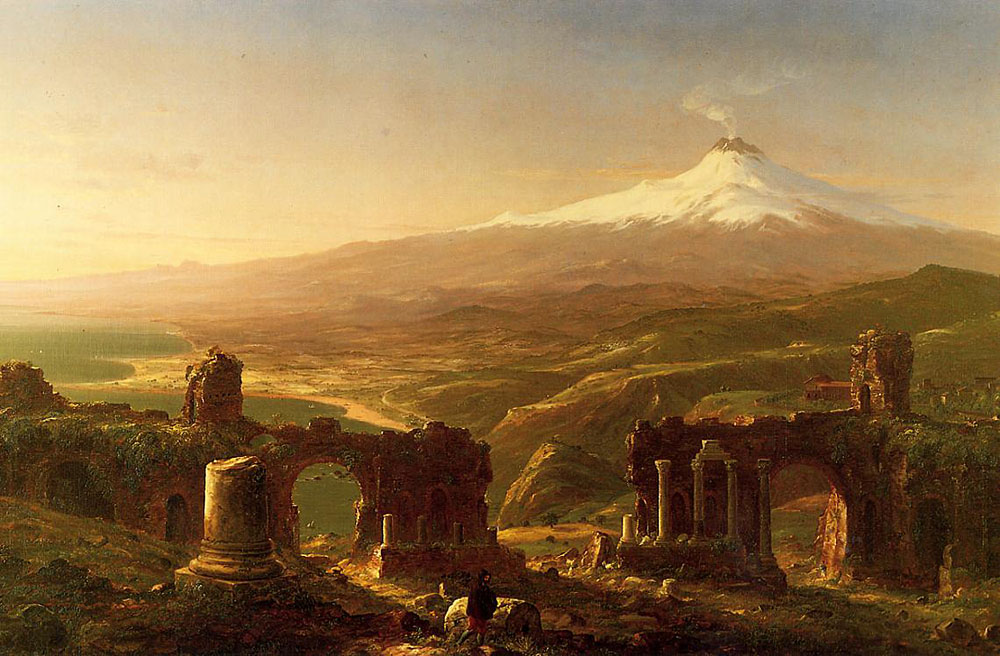
Thomas Cole, ‘Mount Etna from Taormina,’ 1843

ἁ νεότας μοι φίλον αἰ-
εί: τὸ δὲ γῆρας ἄχθος
βαρύτερον Αἴτνας σκοπέλων
ἐπὶ κρατὶ κεῖται, βλεφάρων
σκοτεινὸν φάος ἐπικαλύψαν.
μή μοι μήτ᾽ Ἀσιήτιδος
τυραννίδος ὄλβος εἴη,
μὴ χρυσοῦ δώματα πλήρη
τᾶς ἥβας ἀντιλαβεῖν,
ἃ καλλίστα μὲν ἐν ὄλβῳ,
καλλίστα δ᾽ ἐν πενίᾳ.
τὸ δὲ λυγρὸν φόνιόν τε γῆ-
ρας μισῶ: κατὰ κυμάτων δ᾽
ἔρροι, μηδέ ποτ᾽ ὤφελεν
θνατῶν δώματα καὶ πόλεις
ἐλθεῖν, ἀλλὰ κατ᾽ αἰθέρ᾽ αἰ-
εὶ πτεροῖσι φορείσθω.

εἰ δὲ θεοῖς ἦν ξύνεσις
καὶ σοφία κατ᾽ ἄνδρας,
δίδυμον ἂν ἥβαν ἔφερον
φανερὸν χαρακτῆρ᾽ ἀρετᾶς
ὅσοισιν μέτα, κατθανόντες τ᾽
εἰς αὐγὰς πάλιν ἁλίου
δισσοὺς ἂν ἔβαν διαύλους,
ἁ δυσγένεια δ᾽ ἁπλοῦν ἂν
εἶχεν ζόας βίοτον,
καὶ τῷδ᾽ ἦν τούς τε κακοὺς ἂν
γνῶναι καὶ τοὺς ἀγαθούς,
ἴσον ἅτ᾽ ἐν νεφέλαισιν ἄ-
στρων ναύταις ἀριθμὸς πέλει.
νῦν δ᾽ οὐδεὶς ὅρος ἐκ θεῶν
χρηστοῖς οὐδὲ κακοῖς σαφής,
ἀλλ᾽ εἱλισσόμενός τις αἰ-
ὼν πλοῦτον μόνον αὔξει.