Don’t Bother Me, I’m Reading!

Augustine on Ambrose, Confessions 6.3

“But when he [St. Ambrose] was reading, his eyes were lead along the pages and his heart was revealing their sense, but his voice and tongue maintained silence. Often, when we were in his presence (for he prohibited no one from coming in, nor was it his habit that an entrant should be announced to him), we would see him reading silently – never otherwise. After sitting in unbroken silence (who, indeed,would burden a man so intent on something?), we would leave him. We conjectured that when he had seized upon that small interval of time for rejuvenating his mind, taking a break from the tumult of other people’s affairs, he did not want to be summoned away to something else, so he took care lest some eavesdropper get caught up in it would hear something which the author of the book being read had expressed unclearly, thus making it necessary for Ambrose to explain and discuss various difficult questions. Then, by spending his free minutes on such a task, he would get through fewer books than he wished, even though the cause of preserving his voice, which was easily wrecked, had been a more just reason for reading silently.”

“Hey get the fuck outta here, I’m reading!”

sed cum legebat, oculi ducebantur per paginas et cor intellectum rimabatur, vox autem et lingua quiescebant. saepe cum adessemus (non enim vetabatur quisquam ingredi aut ei venientem nuntiari mos erat), sic eum legentem vidimus tacite et aliter numquam, sedentesque in diuturno silentio (quis enim tam intento esse oneri auderet?) discedebamus et coniectabamus eum parvo ipso tempore quod reparandae menti suae nanciscebatur, feriatum ab strepitu causarum alienarum, nolle in aliud avocari et cavere fortasse ne, auditore suspenso et intento, si qua obscurius posuisset ille quem legeret, etiam exponere esset necesse aut de aliquibus difficilioribus dissertare quaestionibus, atque huic operi temporibus impensis minus quam vellet voluminum evolveret, quamquam et causa servandae vocis, quae illi facillime obtundebatur, poterat esse iustior tacite legendi. quolibet tamen animo id ageret, bono utique ille vir agebat.

Reading aloud is often viewed with some derision in the modern world, but it was the default mode of reading in antiquity. Augustine (4th-5th centuries BCE) is a comparatively late author, yet found Ambrose’s habit of silent reading sufficiently remarkable to record here.

I confess that I usually read silently, yet I find that it is – in contradistinction to the suggestion here – the surest way to guarantee that someone will assume that you are at your leisure and effectively begging to be interrupted.

Temple Epigrams–Odysseus Sees His Mother

Greek Anthology 3.8

According to the Greek Anthology there was a temple to Apollônis, the mother of Attalos and Eumenes, at Cyzicos. The temple had at least nineteen epigrams inscribed on columns with accompanying relief images. All of the epigrams have mothers from myth and poetry as their subjects. The Eighth Epigram is on Odysseus’ mother Antikleia.

On the eighth tablet is the underworld visit of Odysseus. He addressed is own mother and asked her for news of his home.

“Wise-minded mother of Odysseus, Antikleia
You didn’t welcome your son home to Ithaka while alive.
Instead, he is shocked when his glance falls upon his sweet mother
Now wandering along the banks of Akheron.”

᾿Εν τῷ Η ἡ τοῦ ᾿Οδυσσέως νεκυομαντεία• καθέστηκεν τὴν ἰδίαν μητέρα ᾿Αντίκλειαν περὶ τῶν κατὰ τὸν οἶκον ἀνακρίνων

Μᾶτερ ᾿Οδυσσῆος πινυτόφρονος, ᾿Αντίκλεια,
ζῶσα μὲν εἰς ᾿Ιθάκην οὐχ ὑπέδεξο πάιν•
ἀλλά σε νῦν ᾿Αχέροντος ἐπὶ ῥηγμῖσι γεγῶσαν
θαμβεῖ, ἀνὰ γλυκερὰν ματέρα δερκόμενος.

odysseus7109

Of course, this scene plays upon book 11 of the Odyssey doubly: the image recalls Odysseus describing his mother in the Odyssey and it also plays upon the Odyssey’s catalogue of heroic mothers motif, which it in turn shares with the fragmentary Hesiodic Catalogue Of Women.

11.84-89
“Then came the spirit of my mother who had passed away,
The daughter of great-hearted Autolykos, Antikleia
Whom I left alive when I went to sacred Troy.
When I saw her I cried and pitied her in my heart,
But I could not allow her to come forward to touch
The blood before I had learned from Teiresias.”

ἦλθε δ’ ἐπὶ ψυχὴ μητρὸς κατατεθνηυίης,
Αὐτολύκου θυγάτηρ μεγαλήτορος ᾿Αντίκλεια,
τὴν ζωὴν κατέλειπον ἰὼν εἰς ῎Ιλιον ἱρήν.
τὴν μὲν ἐγὼ δάκρυσα ἰδὼν ἐλέησά τε θυμῷ•
ἀλλ’ οὐδ’ ὧς εἴων προτέρην, πυκινόν περ ἀχεύων,
αἵματος ἄσσον ἴμεν πρὶν Τειρεσίαο πυθέσθαι.

Attalos, Eumenes and Apollônis? These were members of the Attalid clan who ruled from Pergamon during the Hellenistic period (after 241 BCE). Attalus I married Apollônis who was from Cyzicos.

Bumptious, Second-Rate Scholarship

“[W.A. Merrill] published in 1907 an edition of Lucretius, containing nothing original, but collecting the works of others with that bibliographical fulness in which Americans excel. He has since changed his opinions on the text and developed originality as a reactionary, and his obtuseness enables him to stick to the reading of the manuscripts in many places where the critics whom he formerly followed abandoned them. I have a very low opinion of his intelligence, and he is bumptious into the bargain…”

-A.E. Housman in a letter to Grant Richards, recorded in The Letters of A.E. Housman, ed. Henry Mass (London : Rupert Hart-Davis, 1971) p. 143 (2 March 1916)

The Charms of the Greek

“It is a just though trite observation, that victorious Rome was herself subdued by the arts of Greece. Those immortal writers who still command the admiration of modern Europe, soon became the favorite object of study and imitation in Italy and the western provinces. But the elegant amusements of the Romans were not suffered to interfere with their sound maxims of policy. Whilst they acknowledged the charms of the Greek, they asserted the dignity of the Latin tongue, and the exclusive use of the latter was inflexibly maintained in the administration of civil as well as military government. The two languages exercised at the same time their separate jurisdiction throughout the empire: the former, as the natural idiom of science; the latter, as the legal dialect of public transactions. Those who united letters with business were equally conversant with both; and it was almost impossible, in any province, to find a Roman subject, of a liberal education, who was at once a stranger to the Greek and to the Latin language.”

-Edward Gibbon, The Decline and Fall of the Roman Empire Vol. 1 Chp. 2 Part 2

One-Percent-Pindar: Scholion to Olympian 1.1

“He was rather in the habit of praising riches, and we can say that he was a slave to his own wealth-loving nature.”

Authentic portrait of Pindar

ἀλλὰ πολύς ἐστιν ἐγκωμιάζων τὸν πλοῦτον, καί φαμεν ἡττᾶσθαι αὐτὸν τῆς ἑαυτοῦ φύσεως φιλοχρημάτου τυγχανούσης.

Brother/Lover from the Same Mother

Cicero, pro Caelio 32

“Indeed, that is what I would do quite eagerly if I weren’t always hindered by the enmity of her husband, or, pardon me, I meant to say her brother – I’m always making that mistake.”

Quod quidem facerem vehementius, nisi intercederent mihi inimicitiae cum istius mulieris viro—fratre volui dicere; semper hic erro.

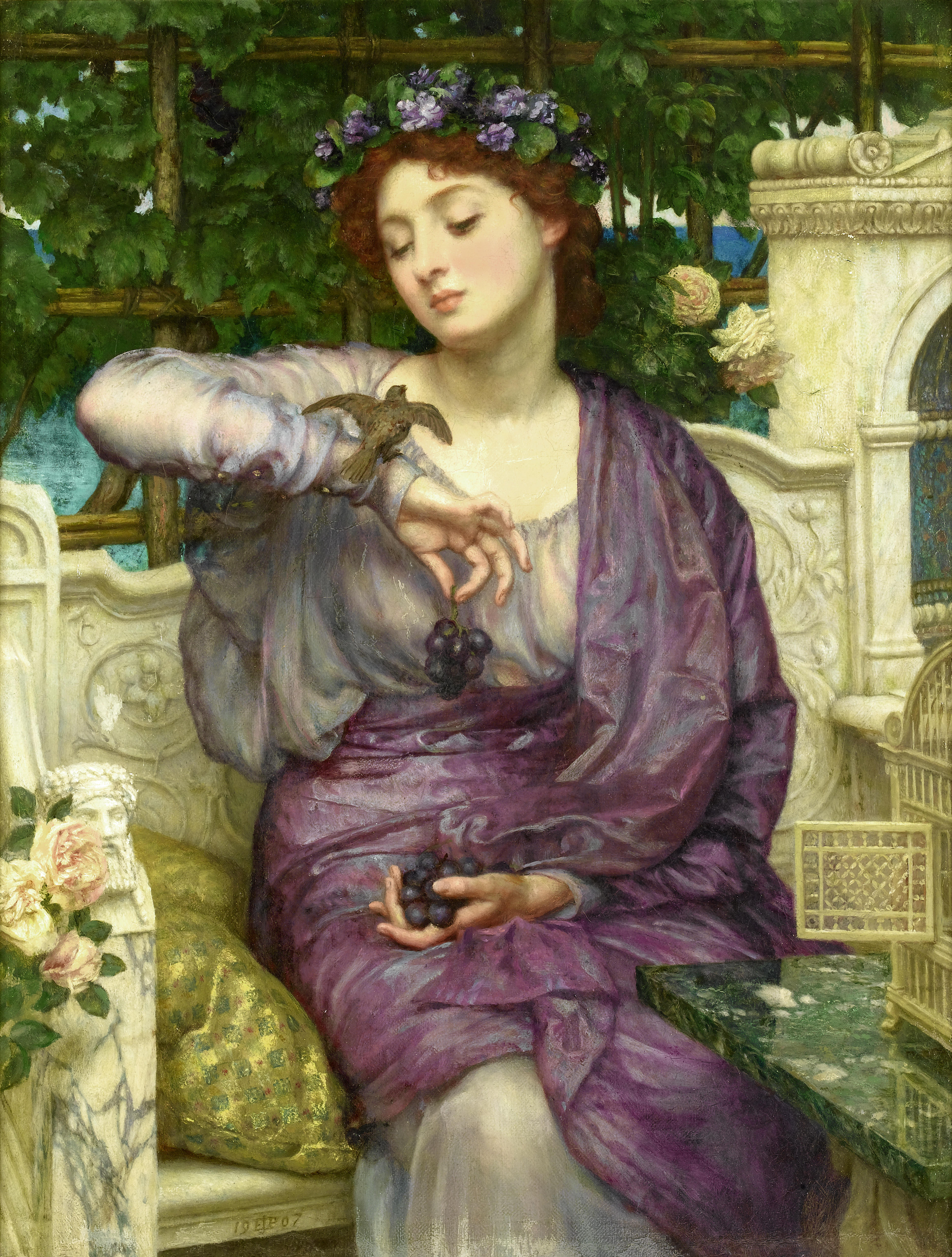
Sir Edward John Poynter, ‘Lesbia and Her Sparrow’

The siblings here alluded to are Cicero’s personal enemy Publius Clodius and his sister Clodia. (They were children of the distinguished and somewhat infamous patrician Claudian family; they used the popular ‘Clodius’ form of their name to emphasize their attachment to the popular party and the people it pandered to. Indeed, Publius Clodius had his status formally changed from patrician to plebeian so that he could stand for election as a Tribune.) This Clodia is usually identified with the Lesbia of Catullus’ poems. The rather ungentlemanly things which he writes about her seem to have been rather consistent with the common street gossip regarding her.

Brutus, Caesar, Cicero: Orators, Politicians, and… Abominable Poets

Tacitus, Dialogus de Oratoribus 21

“We may grant to Caesar that he achieved less in the way of eloquence than his divine genius would have demanded, largely due to the greatness of his thoughts and occupations. Similarly, we may leave Brutus to his philosophical inquiries. For, in the realm of rhetoric, even his admirers would admit that he was not equal to his own reputation. That is, perhaps, unless there is someone who would read Caesar’s On Behalf of Decius the Samnite or Brutus’ On Behalf of King Deiotarus and other works of the same dull mildness; this reader must also admire the poems of these same men. For indeed, they wrote poems and even deposited them in libraries; though they were no better poets than Cicero, they were more fortunate, because fewer people know about their poetic endeavors.”

“Ouch!”

concedamus sane C. Caesari, ut propter magnitudinem cogitationum et occupationes rerum minus in eloquentia effecerit, quam divinum eius ingenium postulabat, tam hercule quam Brutum philosophiae suae relinquamus; nam in orationibus minorem esse [6] fama sua etiam admiratores eius fatentur: nisi forte quisquam aut Caesaris pro Decio Samnite aut Bruti pro Deiotaro rege ceterosque eiusdem lentitudinis ac teporis libros legit, nisi qui et carmina eorundem miratur. fecerunt enim et carmina et in bibliothecas rettulerunt, non melius quam Cicero, sed [7] felicius, quia illos fecisse pauciores sciunt.

Poisoned Husbands and Wives on Death Row

 Valerius Maximus, Memorable Words and Deeds 2.5.3

“The poisoning-court, once unknown to Roman customs and laws, was instituted after many Roman matrons had been implicated in the crime. After these women in question had poisoned their husbands in a secret plot, they were indicted based on the testimony of a single serving-girl. A number of one hundred and seventy were condemned to death by the court.”

Veneficii quaestio, et moribus et legibus Romanis ignota, complurium matronarum patefacto scelere orta est. quae, cum viros suos clandestinis insidiis veneno perimerent, unius ancillae indicio protractae, pars capitali iudicio damnatae centum et septuaginta numerum expleverunt.


WomanAncientRome.jpg

An Epitaph for Anacreon; and Some of His Poems

Greek Anthology 7.26, Antipater of Sidon

“Stranger passing by the humble grave of Anakreon,
If my books were of any use to you,
Pour some wine on my ashes, pour it out in drops
So that my bones can smile, refreshed a bit by wine,
so I, who loved the shouting raves of Dionysus,
so I, who was a partner of music matched to drink,
may not lie dead apart from Bacchus in this place below,
the land which all the race of mortals one day must know.”

Ξεῖνε, τάφον παρὰ λιτὸν ᾿Ανακρείοντος ἀμείβων,
εἴ τί τοι ἐκ βίβλων ἦλθεν ἐμῶν ὄφελος,
σπεῖσον ἐμῇ σποδιῇ, σπεῖσον γάνος, ὄφρα κεν οἴνῳ
ὀστέα γηθήσῃ τἀμὰ νοτιζόμενα,
ὡς ὁ Διωνύσου μεμελημένος εὐάσι κώμοις,
ὡς ὁ φιλακρήτου σύντροφος ἁρμονίης
μηδὲ καταφθίμενος Βάκχου δίχα τοῦτον ὑποίσω
τὸν γενεῇ μερόπων χῶρον ὀφειλόμενον.

Fr. 395

“Hades’ hall is horrifying
And the passage there is hard.
Worse: it is decided that
who ventures there does not return.”

Ἀίδεω γάρ ἐστι δεινὸς
μυχός, ἀργαλῆ δ᾿ ες αὐτὸν
κάτοδος. και γὰρ ἐτοῖμον
καταβάντι μὴ ἀναβῆναι

Anacreon. Marble. Roman copy of the 2nd century A.D. after a Greek original of the 5th century B.C. Inv. No. 491. Copenhagen, New Carlsberg Glyptotek.

Anacreon fr. 2

“I don’t love the man who while drinking next to a full cup
Talks about conflicts and lamentable war.
But whoever mixes the shining gifts of Aphrodite and the Muses
Let him keep in mind loving, good cheer.”

οὐ φιλέω, ὃς κρητῆρι παρὰ πλέωι οἰνοποτάζων
νείκεα καὶ πόλεμον δακρυόεντα λέγει,
ἀλλ’ ὅστις Μουσέων τε καὶ ἀγλαὰ δῶρ’ ᾿Αφροδίτης
συμμίσγων ἐρατῆς μνήσκεται εὐφροσύνης.

Fr. 428

“I love and again do not love
I am insane and yet sane too”

ἐρέω τε δηὖτε κοὐκ ἐρέω
καὶ μαίνομαι κοὐ μαίνομαι

Didn’t Get What You Wanted for Christmas? Tell Xenophon About It

From Xenophon’s Memorabilia 1.6.10

“You appear to think that happiness comes from delicacy and abundance. But I think that wanting nothing is godlike,  that wanting as little as possible is next-best, that the divine is the highest goal and next-best the closest thing.”

[10] ἔοικας, ὦ Ἀντιφῶν, τὴν εὐδαιμονίαν οἰομένῳ τρυφὴν καὶ πολυτέλειαν εἶναι: ἐγὼ δὲ νομίζω τὸ μὲν μηδενὸς δεῖσθαι θεῖον εἶναι, τὸ δ᾽ ὡς ἐλαχίστων ἐγγυτάτω τοῦ θείου, καὶ τὸ μὲν θεῖον κράτιστον, τὸ δ᾽ ἐγγυτάτω τοῦ θείου ἐγγυτάτω τοῦ κρατίστου.

 The full text.