An Encomium to Youth

Euripides, Heracles 637-654:

“Youth is always precious to me, and old age, a burden heavier than Aetna’s crags, is placed upon my head, shrouding the light of my eyes in shady gloom. Let me not possess the fortune of an eastern tyrant, and let me not choose houses full of gold in preference to youth, which is the most beautiful thing both in fortune and in poverty. I hate old age, such a sad and deadly thing. Let it be swept away among the waves! Would that it never came upon the homes and cities of mortals! Let it be born away on wings through the air!

If the gods had intelligence and wisdom, according to mortal standards, they would have given us a two-fold youth, a clear mark of virtue wherever it were found, and those who have died would cross again the double channel into the rays of the sun. But the base-born would have but one single life, and thus it would be possible to distinguish the bad from the good, just as sailors know the number of the stars among the clouds. But as things stand now, there is no clear boundary between the bad and good, and as time rolls on, it increases nothing but wealth.”
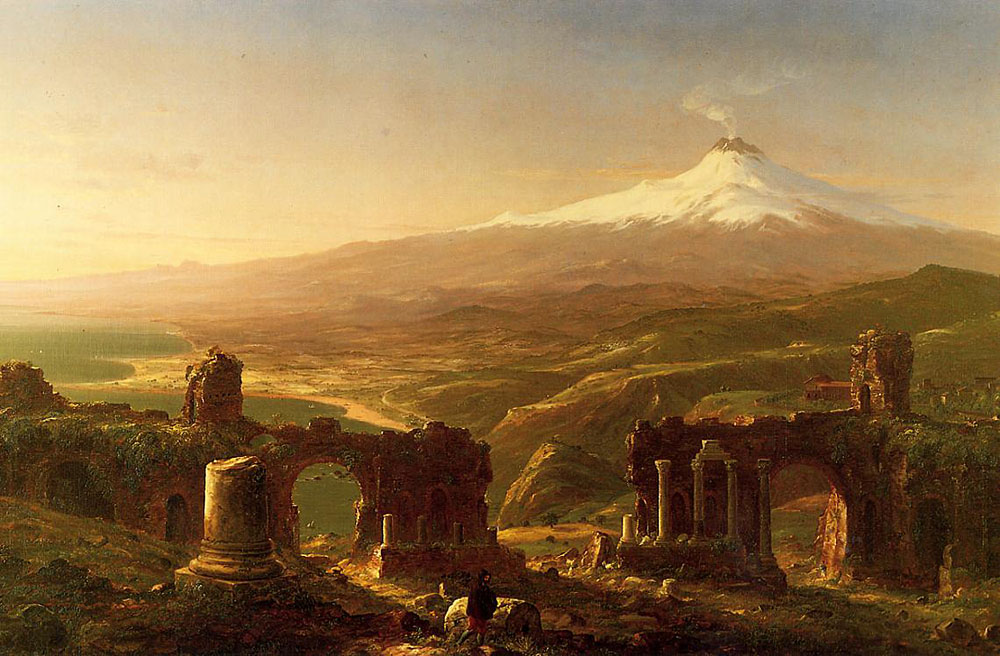
Thomas Cole, ‘Mount Etna from Taormina,’ 1843

ἁ νεότας μοι φίλον αἰ-
εί: τὸ δὲ γῆρας ἄχθος
βαρύτερον Αἴτνας σκοπέλων
ἐπὶ κρατὶ κεῖται, βλεφάρων
σκοτεινὸν φάος ἐπικαλύψαν.
μή μοι μήτ᾽ Ἀσιήτιδος
τυραννίδος ὄλβος εἴη,
μὴ χρυσοῦ δώματα πλήρη
τᾶς ἥβας ἀντιλαβεῖν,
ἃ καλλίστα μὲν ἐν ὄλβῳ,
καλλίστα δ᾽ ἐν πενίᾳ.
τὸ δὲ λυγρὸν φόνιόν τε γῆ-
ρας μισῶ: κατὰ κυμάτων δ᾽
ἔρροι, μηδέ ποτ᾽ ὤφελεν
θνατῶν δώματα καὶ πόλεις
ἐλθεῖν, ἀλλὰ κατ᾽ αἰθέρ᾽ αἰ-
εὶ πτεροῖσι φορείσθω.

εἰ δὲ θεοῖς ἦν ξύνεσις
καὶ σοφία κατ᾽ ἄνδρας,
δίδυμον ἂν ἥβαν ἔφερον
φανερὸν χαρακτῆρ᾽ ἀρετᾶς
ὅσοισιν μέτα, κατθανόντες τ᾽
εἰς αὐγὰς πάλιν ἁλίου
δισσοὺς ἂν ἔβαν διαύλους,
ἁ δυσγένεια δ᾽ ἁπλοῦν ἂν
εἶχεν ζόας βίοτον,
καὶ τῷδ᾽ ἦν τούς τε κακοὺς ἂν
γνῶναι καὶ τοὺς ἀγαθούς,
ἴσον ἅτ᾽ ἐν νεφέλαισιν ἄ-
στρων ναύταις ἀριθμὸς πέλει.
νῦν δ᾽ οὐδεὶς ὅρος ἐκ θεῶν
χρηστοῖς οὐδὲ κακοῖς σαφής,
ἀλλ᾽ εἱλισσόμενός τις αἰ-
ὼν πλοῦτον μόνον αὔξει.

Mycenae, Argos and Amyklai: Agamemnon’s Homes

Schol. ad. Il. 2.559 ex

“From Argos, the son of Zeus and Niobe, the daughter of Phorôneus. Because he used to live there, Argos was assigned to those under Agamemnon. For this reason, Homer used to call all the Greeks Argives.”

ex. <οἳ δ’ ῎Αργος τ’ εἶχον:> ἀπὸ ῎Αργου τοῦ Διὸς καὶ Νιόβης τῆς Φορωνέως. διὰ δὲ τὸ πρῶτον ᾠκίσθαι πρότερον ἐτάχθη τῶν ὑπὸ ᾿Αγαμέμνονα. ἀφ’ οὗ καὶ πάντας ῞Ελληνας ᾿Αργείους καλεῖ. b(BCE3)

Mycenae, Homer, Iliad 2.560-580

“Those who held the well-built city of Mycenae,
Rich Korinth and well-built Kleônae,
And those who inhabited Orneai, lovely Araithurea
And Sikuon where Adrastos first was king,
Those who lived in Huperêsiê and steep Gonoessa,
Pellênê and who lived near Aigios,
Aigalios, all through wide Helikê,
Strong Agamemnon led their hundred ships
Atreus’ son—by far the greatest and best armies
Followed him. And he was glorious in his shining bronze,
He stood out conspicuously among the heroes
Because he was the best and led the largest armies.”

Οἳ δὲ Μυκήνας εἶχον ἐϋκτίμενον πτολίεθρον
ἀφνειόν τε Κόρινθον ἐϋκτιμένας τε Κλεωνάς,
᾿Ορνειάς τ’ ἐνέμοντο ᾿Αραιθυρέην τ’ ἐρατεινὴν
καὶ Σικυῶν’, ὅθ’ ἄρ’ ῎Αδρηστος πρῶτ’ ἐμβασίλευεν,
οἵ θ’ ῾Υπερησίην τε καὶ αἰπεινὴν Γονόεσσαν
Πελλήνην τ’ εἶχον ἠδ’ Αἴγιον ἀμφενέμοντο
Αἰγιαλόν τ’ ἀνὰ πάντα καὶ ἀμφ’ ῾Ελίκην εὐρεῖαν,
τῶν ἑκατὸν νηῶν ἦρχε κρείων ᾿Αγαμέμνων
᾿Ατρεΐδης· ἅμα τῷ γε πολὺ πλεῖστοι καὶ ἄριστοι
λαοὶ ἕποντ’· ἐν δ’ αὐτὸς ἐδύσετο νώροπα χαλκὸν
κυδιόων, πᾶσιν δὲ μετέπρεπεν ἡρώεσσιν
οὕνεκ’ ἄριστος ἔην πολὺ δὲ πλείστους ἄγε λαούς.

Schol. ad Il. 2.569 ex

“Eurustheus used to rule Mycenae. After he died, entrusting it to the Athenians, they established Atreus to lead there after he fled with Thyestes for the murder of Chrysippos.”

ex. <οἳ δὲ Μυκήνας εἶχον:> Μυκηνῶν ἦρχεν Εὐρυσθεύς. ἐπεὶ δὲ συμβαλὼν ᾿Αθηναίοις ἐτελεύτα, ἱστῶσιν ᾿Ατρέα αὐτόθι διάγοντα, ἅμα Θυέστῃ ἐπὶ τῷ φόνῳ Χρυσίππου φυγόντα. b(BCE3)

Schol. ad Il. 2.572 ex

“For Adrastos, after he was exiled, lived with his mother’s brother Polybos and he assigned them to rule even though it was not the custom.”

ex. <῎Αδρηστος:> ἐκπεσὼν γὰρ ῎Αργους παρὰ Πολύβῳ τῷ μητροπάτορι ᾤκει, καὶ ὑπέταξεν αὐτοὺς οὐκ εἰωθότας ἄρχεσθαι. b
(BCE3)

Hera on her three sacred cities, Il. 4.52

“Truly, there are three cities most dear to me by far:
Argos, and Sparta and wide-wayed Mycenae”

ἤτοι ἐμοὶ τρεῖς μὲν πολὺ φίλταταί εἰσι πόληες
῎Αργός τε Σπάρτη τε καὶ εὐρυάγυια Μυκήνη·

Continue reading “Mycenae, Argos and Amyklai: Agamemnon’s Homes”

“It was all so unimaginably different…”

From Louis MacNeice’s Autumn Journal Part IX:

The Glory that was Greece: put it in a syllabus, grade it
Page by page
To train the mind or even to point a moral
For the present age:
Models of logic and lucidity, dignity, sanity,
The golden mean between opposing ills
Though there were exceptions of course but
only exceptions
The bloody Bacchanals on the Thracian hills.
So the humanist in his room with Jacobean panels
Chewing his pipe and looking on a lazy quad
Chops the Ancient World to turn a sermon
To the greater glory of God.
But I can do nothing so useful or so simple;
These dead are dead
And when I should remember the paragons of Hellas
I think instead
Of the crooks, the adventurers, the opportunists,
The careless athletes and the fancy boys,
The hair-splitters, the pedants, the hard-boiled sceptics
And the Agora and the noise
Of the demagogues and the quacks; and the women pouring
Libations over graves
And the trimmers at Delphi and the dummies at Sparta
and lastly
I think of the slaves.
And how one can imagine oneself among them
I do not know;
It was all so unimaginably different
And all so long ago.

Hubert Robert, ‘Ruins of a Doric Temple’

Here You Will Read Pleasing Things

Macrobius, Saturnalia 1.10-12

“I want the present work to be of this sort: there are in it many arts, many lessons, and the examples of many ages, all blown together into one book. If, while reading these, you do not neglect those thing which you already know, nor avoid those things which you do not yet know, you will find many things which are either a pleasure to read, a mark of distinction to have read, or at any rate useful to have remembered. I think that I have inserted nothing into this work which is either useless to know or difficult to understand; everything here will make your intellect more active, your memory better-supplied, your speech more skillful, and your language less degraded, except when the course of the Latin language betrays me, since I was born under a foreign sky. I ask that those, who have the time and inclination to read this, will consider my plea and be just and good in their judgment, if they find the native elegance of Roman speech lacking in me.”

Ferdinand Hodler, ‘The Reader’

10 Tale hoc praesens opus volo: multae in illo artes, multa praecepta sint, multarum aetatum exempla, sed in unum conspirata: in quibus si neque ea quae iam tibi sunt cognita asperneris, nec quae ignota sunt vites, invenies plurima quae sit aut voluptati legere aut cultui legisse aut usui meminisse. 11 Nihil enim huic operi insertum puto aut cognitu inutile aut difficile perceptu, sed omnia quibus sit ingenium tuum vegetius, memoria adminiculatior, oratio sollertior, sermo incorruptior, nisi sicubi nos sub alio ortos caelo Latinae linguae vena non adiuvet. 12 Quod ab his, si tamen quibusdam forte nonnumquam tempus voluntasque erit ista cognoscere, petitum impetratumque volumus ut aequi bonique consulant, si in nostro sermone nativa Romani oris elegantia desideretur.

Euripides and Women

Athenaeus, Deipnosophists 13.5.35

“Euripides the poet was also a lover of women. Hieronymos writes in his Historical Researches that “When someone told Sophocles that Euripides was a women-hater, he said, “Perhaps that is the case in his tragedies, but he loves women in bed.”

φιλογύνης δ’ ἦν καὶ Εὐριπίδης ὁ ποιητής. ῾Ιερώνυμος γοῦν ἐν ῾Ιστορικοῖς ῾Υπομνήμασίν φησιν οὕτως (fr. 6 Hi)· ‘εἰπόντος Σοφοκλεῖ τινος ὅτι μισογύνης ἐστὶν Εὐριπίδης, ἔν γε ταῖς τραγῳδίαις, ἔφη ὁ Σοφοκλῆς· ἐπεὶ ἔν γε τῇ κλίνῃ φιλογύνης.’


Schol in Aristoph. Lys. 283 (arg.)

“For Euripides is a woman-hater and says many things against them”

μισογύνης γὰρ ὁ Εὐριπίδης καὶ πολλὰ κατ’ αὐτῶν λέγων.


From the Suda

“[Euripides] was gloomy and unfriendly and he avoided social engagement. This is why he appeared to be a misogynist. He still married; first Khoirinê, the daughter of Mnesilokhos, who bore him Mnesilokhos and Mnhsarkhidê. After he divorced her, hetook a second wife, although she was also shown to be unfaithful. When he was in exile from Athens he went to Arkhelaos, the king of the Macedonians, where he lived, enjoying the greatest honor.

He died thanks to the plotting of Arribaios the Macedonian and Krateuas the Thessalian. These poets envied him, so they bribed one of the king’s servants named Lusimakhos with only ten minae to release the dogs the king raised against Euripides. Others record that he was not killed by dogs but was torn apart by women at night when he was sneaking out to Krateros, Arkhelaos’ lover. (For they also report that he was predisposed to these kind of affairs too.) Others say that he was going out to meet the wife of Nikodokos of Arethusa.”

euripides-bust

σκυθρωπὸς δὲ ἦν τὸ ἦθος καὶ ἀμειδὴς καὶ φεύγων τὰς συνουσίας· ὅθεν καὶ μισογύνης ἐδοξάσθη. ἔγημε δὲ ὅμως πρώτην μὲν Χοιρίνην, θυγατέρα Μνησιλόχου· ἐξ ἧς ἔσχε Μνησίλοχον καὶ Μνησαρχίδην καὶ Εὐριπίδην. ἀπωσάμενος δὲ ταύτην ἔσχε καὶ δευτέραν, καὶ ταύτης ὁμοίως ἀκολάστου πειραθείς. ἀπάρας δὲ ἀπ’᾿Αθηνῶν ἦλθε πρὸς ᾿Αρχέλαον τὸν βασιλέα τῶν Μακεδόνων, παρ’ ᾧ διῆγε τῆς ἄκρας ἀπολαύων τιμῆς. ἐτελεύτησε δὲ ὑπὸ ἐπιβουλῆς ᾿Αρριβαίου τοῦ Μακεδόνος καὶ Κρατεύα τοῦ Θετταλοῦ, ποιητῶν ὄντων καὶ φθονησάντων αὐτῷ πεισάντων τε τὸν βασιλέως οἰκέτην τοὔνομα Λυσίμαχον, δέκα μνῶν ἀγορασθέντα, τοὺς βασιλέως, οὓς αὐτὸς ἔτρεφε, κύνας ἐπαφεῖναι αὐτῷ. οἱ δὲ ἱστόρησαν οὐχ ὑπὸκυνῶν, ἀλλ’ ὑπὸ γυναικῶν νύκτωρ διασπασθῆναι, πορευόμενον ἀωρὶ πρὸς Κρατερὸν τὸν ἐρώμενον ᾿Αρχελάου (καὶ γὰρ σχεῖν αὐτὸν καὶ περὶ τοὺς τοιούτους ἔρωτας), οἱ δέ, πρὸς τὴν γαμετὴν Νικοδίκου τοῦ ᾿Αρεθουσίου

Human Folly, How Well We Know Thee!

Euripides, Hippolytus 916-920

O humanity, you miss the mark so often! You teach so many skills, and you have contrived and discovered all things, yet why do you not know nor seek to teach fools to reason rightly?

ὦ πόλλ᾽ ἁμαρτάνοντες ἄνθρωποι μάτην,
τί δὴ τέχνας μὲν μυρίας διδάσκετε
καὶ πάντα μηχανᾶσθε κἀξευρίσκετε,
ἓν δ᾽ οὐκ ἐπίστασθ᾽ οὐδ᾽ ἐθηράσασθέ πω,
φρονεῖν διδάσκειν οἷσιν οὐκ ἔνεστι νοῦς;

Reflections on Tyranny: Euripides, Archilochus, Tibullus, and… Gibbon

Euripides, Ion 621-632:

“Who can be blessed or fortunate when he draws out the length of his days by fearing for his life? I would rather live as a happy citizen than be a tyrant who delights in keeping bad company, and hates excellent men because he fears death. You might say that gold overcomes these things, that being rich is a source of joy? I have no desire to hear the empty jangle of coin in my hand as I horde a fortune, nor do I long for labors: let me possess a modest share without toil.”

τίς γὰρ μακάριος, τίς εὐτυχής,
ὅστις δεδοικὼς καὶ παραβλέπων βίον
αἰῶνα τείνει; δημότης ἂν εὐτυχὴς
ζῆν ἂν θέλοιμι μᾶλλον ἢ τύραννος ὤν,
ᾧ τοὺς πονηροὺς ἡδονὴ φίλους ἔχειν,
ἐσθλοὺς δὲ μισεῖ κατθανεῖν φοβούμενος.
εἴποις ἂν ὡς ὁ χρυσὸς ἐκνικᾷ τάδε,
πλουτεῖν τε τερπνόν; οὐ φιλῶ ψόφους κλύειν
ἐν χερσὶ σῴζων ὄλβον οὐδ᾽ ἔχειν πόνους:
εἴη γ᾽ ἐμοὶ μὲν μέτρια μὴ λυπουμένῳ.


There are multiple parallels for this basic sentiment, but I will list two which readily occur to mind:

Archilocus, 22:

“I care not for the wealth of golden Gyges, nor has envy ever seized me, nor am I jealous of the works of the gods, nor do I have any desire to be a great tyrant. Such things lay far outside of my consideration.”

οὔ μοι τὰ Γύγεω τοῦ πολυχρύσου μέλει,
οὐδ᾽ εἷλέ πώ με ζῆλος, οὐδ᾽ ἀγαίομαι
θεῶν ἔργα, μεγάλης δ᾽ οὐκ ἐρέω τυραννίδος:
ἀπόπροθεν γάρ ἐστιν ὀφθαλμῶν ἐμῶν.

Tibullus, 1.1.1-6:

“Let someone else heap up mounds of tawny gold and cultivate his many acres; let constant labor wear him down while his enemy lives next door, and let sound of war trumpets chase away his dreams. As for me, let my honorable poverty lead me through a quiet life, as long as my hearth burns with a constant fire.”

Divitias alius fulvo sibi congerat auro
Et teneat culti iugera multa soli,
Quem labor adsiduus vicino terreat hoste,
Martia cui somnos classica pulsa fugent:
Me mea paupertas vita traducat inerti,
Dum meus adsiduo luceat igne focus.


Jumping ahead almost 1,800 years, Edward Gibbon gives an account of the pitfalls of tyranny in his description of Didius Julianus, who purchased the imperial throne from the praetorian guards, who had resolved to sell it after brutally murdering the previous emperor, Pertinax. Gibbon’s account is imbued with the same spirit which runs through the above three passages:

“From the senate Julian was conducted, by the same military procession, to take possession of the palace. The first objects that struck his eyes, were the abandoned trunk of Pertinax, and the frugal entertainment prepared for his supper. The one he viewed with indifference, the other with contempt. A magnificent feast was prepared by his order, and he amused himself, till a very late hour, with dice, and the performances of Pylades, a celebrated dancer. Yet it was observed, that after the crowd of flatterers dispersed, and left him to darkness, solitude, and terrible reflection, he passed a sleepless night; revolving most probably in his mind his own rash folly, the fate of his virtuous predecessor, and the doubtful and dangerous tenure of an empire which had not been acquired by merit, but purchased by money.”
-The Decline and Fall of the Roman Empire, Volume I, Chapter V

The Tyrannicides Harmodius and Aristogeiton

A Lover of Pleasure, A Hater of Toil

Suda entry on Aulus Postumius:

“Aulus Postumius was a man of property and the highest birth, and true to his own birth he was gossipy, loquacious, and notably given to boasting. Having taken an interest from his earliest youth in Greek education and language, he entirely immersed himself in these studies to such a degree that he scandalized the older and more dignified members of the Roman establishment. Finally, he wrote a poem and a history of practical deeds. In the preface to this work, he entreats his chance readers to grant him some pardon, if he as a Roman was not able to fully take command of the Greek language and the judicious use of it. This is a mark of absolute absurdity, and is almost as bad as if someone writing an account of athletic events like boxing or the pancration were to go to the stadium and, when the time to fight arrived, asked the pardon of the spectators in the event that he could not endure the physical exertion or the blows of his opponent. Obviously, this king of man incurs mockery and judgment out of hand. The same thing should happen to other history writers like him, lest they dare things beyond what is good. Aulus Postumius was a lover of pleasure and a hater of toil.”

Αὖλος Ποστόμιος οἰκίας μὲν ἦν καὶ γένους πρώτου, κατὰ τὴν ἰδίαν φύσιν στωμύλος καὶ λάλος καὶ πέρπερος διαφερόντως. ἐπιθυμήσας δ’ εὐθέως ἐκ παίδων τῆς ῾Ελληνικῆς ἀγωγῆς καὶ διαλέκτου πολὺς μὲν ἦν ἐν τούτοις καὶ κατακορής, ὥστε δι’ ἐκεῖνον καὶ τὴν αἵρεσιν τὴν ῾Ελληνικὴν προσκόψαι τοῖς πρεσβυτέροις καὶ τοῖς ἀξιολογωτάτοις τῶν ῾Ρωμαίων, τέλος δὲ καὶ ποίημα γράφων καὶ πραγματικὴν ἱστορίαν ἐνεχείρησεν· ἐν ᾗ διὰ τοῦ προοιμίου παρεκάλει τοὺς ἐντυγχάνοντας συγγνώμην ἔχειν, εἰ ῾Ρωμαῖος ὢν μὴ δύνηται κατακρατεῖν τῆς ῾Ελληνικῆς διαλέκτου καὶ τῆς κατὰ χειρισμὸν οἰκονομίας· ὅπερ ἐστὶ πάσης ἀτοπίας σημεῖον, καὶ παραπλήσιον, ὡς ἂν εἴ τις ἐς τοὺς γυμνικοὺς ἀγῶνας ἀπογραψάμενος πυγμὴν ἢ παγκράτιον, παρελθὼν ἐς τὸ στάδιον, ὅτε δέοι μάχεσθαι, παραιτοῖτο τοὺς θεωμένους συγγνώμην ἔχειν, ἐὰν μὴ δύνηται τὸν πόνον ὑπομένειν μήτε τὰς πληγάς. δῆλον γὰρ ὡς εἰκὸς γέλωτα τὸν τοιοῦτον ὀφλεῖν καὶ τὴν δίκην ἐκ χειρὸς λαμβάνειν· ὅπερ ἔδει καὶ τοὺς τοιούτους ἱστοριογράφους, ἵνα μὴ κατετόλμωντοῦ καλῶς ἔχοντος. ἦν δὲ καὶ φιλήδονος καὶ φυγόπονος.

Tawdry Tuesday, Myth Edition: Zeus’ Golden Rain–The Greek Anthology on Persuading Women

DanaeLouvreCA925
This is a real vase, held in the Louvre.

The Fifth Book of the Greek Anthology is a collection of erotic epigrams. Many of them use myth in amusing ways, for instance, the poem where the speaker claims to be Telephus and asks his addressee to be his Achilles. There are a series of poems that reflect on the practice of giving women gold using the story of Danae. These are a little funny, but if you observe some of the motifs in advertising around Valentine’s Day, they get a little less amusing….

Paulus Silentiarius, Greek Anthology, 5.219

“Golden Zeus cut through the seal of untouched maidenhood
after he entered Danae’s chamber of beaten bronze.
I think that what the story means is this: Gold, the all-conquerer,
Overcomes walls and chains.
Gold reproaches all reins and every lock,
Gold bends all blinking women its way.
It turned around Danae’s mind too: No lover needs
To beg the Paphian’s favor if he has money.”

Χρύσεος ἀψαύστοιο διέτμαγεν ἅμμα κορείας
Ζεὺς διαδὺς Δανάας χαλκελάτους θαλάμους.
φαμὶ λέγειν τὸν μῦθον ἐγὼ τάδε• „Χάλκεα νικᾷ
τείχεα καὶ δεσμοὺς χρυσὸς ὁ πανδαμάτωρ.”
χρυσὸς ὅλους ῥυτῆρας, ὅλας κληῖδας ἐλέγχει,
χρυσὸς ἐπιγνάμπτει τὰς σοβαροβλεφάρους•
καὶ Δανάας ἐλύγωσεν ὅδε φρένα. μή τις ἐραστὰς
λισσέσθω Παφίαν, ἀργύριον παρέχων.

Parmenion, Greek Anthology 5.33

“You poured onto Danae as gold, Olympian, so that the girl
Might be persuaded by a gift, and not tremble before Kronos’ son.”

᾿Ες Δανάην ἔρρευσας, ᾿Ολύμπιε, χρυσός, ἵν’ ἡ παῖς
ὡς δώρῳ πεισθῇ, μὴ τρέσῃ ὡς Κρονίδην.

5.34

“Zeus got Danae for gold, and I’ll get you for some too:
I cannot give more than Zeus did!”

῾Ο Ζεὺς τὴν Δανάην χρυσοῦ, κἀγὼ δὲ σὲ χρυσοῦ•
πλείονα γὰρ δοῦναι τοῦ Διὸς οὐ δύναμαι.

Antipater of Thessalonica, 5.30

“Once there was a golden race, a bronze age, and a silver one too.
But today, Cytherea takes every form.
She honors the golden man, has loved the bronze one
And never turns her face from silver men.
The Paphian stretches out like Nestor—and I don’t think that Zeus
Rained on Danae in gold: he came carrying a hundred gold coins!”

Χρύσεος ἦν γενεὴ καὶ χάλκεος ἀργυρέη τε
πρόσθεν• παντοίη δ’ ἡ Κυθέρεια τὰ νῦν•
καὶ χρυσοῦν τίει καὶ χάλκεον ἄνδρ’ ἐφίλησεν
καὶ τοὺς ἀργυρέους οὔ ποτ’ ἀποστρέφεται.
Νέστωρ ἡ Παφίη. δοκέω δ’, ὅτι καὶ Δανάῃ Ζεὺς
οὐ χρυσός, χρυσοῦς δ’ ἦλθε φέρων ἑκατόν.

Danae 2
Yes. Another one.
danae-1908
The Greek vases make Gustav Klimt’s painting look tame.

The Folly of Preemptive Forgiveness

Macrobius, Saturnalia 1.13-15:

“I have, in my lack of discretion, incurred the pleasing censure which was once leveled by Marcus Cato against Aulus Albinus, who was consul with Lucius Lucullus. This Albinus once wrote a book of Roman history in Greek. In the first part of his History it is written that no one should be made at him if anything in that book were to be found ill composed or sloppily written. ‘For,’ he said, ‘I am a Roman man, born in Latium, and Greek is most foreign to me.’ With that, he asked pardon and release from bad opinion in the event that he had made any errors. When Marcus Cato read this, he said, ‘Aulus, you’re a goddamn fool for preferring to ask pardon for an offense rather than not commit it altogether; for, we usually ask for pardon when we either make a mistake unaware or have committed some crime under compulsion. I ask you, who forced you to commit that for which, before you have even done it, you have asked to be pardoned?’”

Sed ne ego incautus sum, qui venustatem reprehensionis incurri a M. quondam Catone profectae in A. Albinum qui cum L. Lucullo consul fuit.  Is Albinus res Romanas oratione Graeca scriptitavit. In eius historiae primo scriptum est ad hanc sententiam neminem succensere sibi convenire, si quid in illis libris parum composite aut minus eleganter scriptum foret. Nam sum, inquit, homo Romanus, natus in Latio; et eloquium Graecum a nobis alienissimum est. Ideoque veniam gratiamque malae existimationis, si quid esset erratum, postulavit. Ea cum legisset M. Cato: Ne tu, inquit, Aule, nimium nugator es, cum maluisti culpam deprecari quam culpa vacare: nam petere veniam solemus aut cum inprudentes erravimus aut cum noxam imperio conpellentis admisimus. Te, inquit, oro, quis perpulit ut id committeres quod, priusquam faceres, peteres ut ignosceretur?