Head and Heart: A Quotation Falsely Attributed to Aristotle

A twitter correspondent asked me to check on the following quotation often attributed to Aristotle: “Educating the mind without educating the heart is no education at all.” The proliferation of unattributed quotations was one of the reasons we started our twitter feed years back–and tracking down proverbs is something that allows me to procrastinate with purpose!

I was almost immediately certain that this line could not be Aristotelian (or even ancient Greek) for the following reasons: the mind/heart division would only make sense from the period of Classical Greek if it were a drastic mis-translation; the phraseology as translated does not seem Aristotelian at all.

Image result for ancient greek education

I started out with a simple google search and was a little disappointed, but not exactly surprised, at how widespread the unattributed quote was. I then searched for discussions of the provenance/authenticity of the quotation (there were a few). While doing this, I switched between the TLG where I search Aristotle’s corpus for paideu-, didask- and manthan– compounds (varied as well for their root forms etc.) and the Loeb Classical Library online where I searched using English “education”, “teaching”. “learning” etc. I was not shocked to come up with nothing.

The best texts for education in Aristotle are the Politics  and the Nicomachean Ethics. There is also some material in the Poetics and the Rhetorica. The closest I came to a comment like the quotation is actually in the margin of the Loeb for the Politics (H. Rackham, 1926) 8.6 “Teaching is powerless without a foundation of good habits”. This annotates a passage that begins as follows:

“Some think that we are good by nature; others by habit, and others by teaching. It is clear that what comes naturally is not subject to our will, but it is based on divine causes, given to those who are fortunate

—γίνεσθαι δ᾿ ἀγαθοὺς οἴονται οἱ μέν φύσει, οἱ δ᾿ ἔθει, οἱ δὲ διδαχῇ. τὸ μὲν οὖν τῆς φύσεως δῆλον ὡς οὐκ ἐφ᾿ ἡμῖν [ὑπάρχει],2 ἀλλὰ διά τινας θείας αἰτίας τοῖς ὡς ἀληθῶς εὐτυχέσιν ὑπάρχει·

This is too tenuous a connection and unrelated a statement, I think, to have anything to do with the quotation. So, taking a tip from Yahoo answers, I looked into Google books and found several variations on the saying without attribution during the latter half of the 19th century.

In Home, the School and the Church, Or, the Presbyterian Education we find “whilst the state plan educates the mind without educating the heart…” (1850). Similarly, in the report of the faculty of Waterville College (1856) we find  “To educate the head without educating the heart is to make moral monsters…”

But this did not explain how and when the text came to be attributed to Aristotle. Many self-help books, educational texts, and business texts past-2000 attribute the quotation to Aristotle, but the earliest print attribution in google books I could find is from  1991’s Invitational Teaching, Learning Living.

So, the quotation is as I first suspected: absolutely false (and, to add my opinion, rather banal). I cannot say with certainty when it made the leap from proverbial blather to Aristotelian counterfeit, but it happened before the modern internet.

Here are some actual quotes on education from Aristotle.

Politics 8 (1337a)

“No one could doubt that a lawgiver must make provisions for the education of the youth. For, when this does not happen in a state, it undermines the constitution.”

Ὅτι μὲν οὖν τῷ νομοθέτῃ μάλιστα πραγματευτέον περὶ τὴν τῶν νέων παιδείαν, οὐδεὶς ἂν ἀμφισβητήσειεν. καὶ γὰρ ἐν ταῖς πόλεσιν οὐ γιγνόμενον τοῦτο βλάπτει τὰς πολιτείας.

“It is clear that education must be one and the same for everyone.”

φανερὸν ὅτι καὶ τὴν παιδείαν μίαν καὶ τὴν αὐτὴν ἀναγκαῖον εἶναι πάντων

1340b

“Since it is clear from these arguments that music is able to shape the character of the soul, and if it can do this, it is manifest that it should applied and taught to the young.”

ἐκ μὲν οὖν τούτων φανερὸν ὅτι δύναται ποιόν τι τὸ τῆς ψυχῆς ἦθος ἡ μουσικὴ παρασκευάζειν, εἰ δὲ τοῦτο δύναται ποιεῖν, δῆλον ὅτι προσακτέον καὶ παιδευτέον ἐν αὐτῇ τοὺς νέους.

Here are some quotes attributed to Aristotle by Diogenes Laertius in his Lives of the Eminent Philosophers.

“He said that the root of education is bitter but the fruit is sweet. ”

Τῆς παιδείας ἔφη τὰς μὲν ῥίζας εἶναι πικράς, τὸν δὲ καρπὸν γλυκύν.

“He used to say that three things are needed for education: innate ability, study, and practice.”

τριῶν ἔφη δεῖν παιδείᾳ, φύσεως, μαθήσεως, ἀσκήσεως.

“When asked what the difference was between those who were educated and those who were not, Aristotle said “as great as between the living and the dead.” He used to say that education was an ornament in good times and a refuge in bad. He also believed that teachers should be honored more than parents who merely gave birth. The latter give life, but the former help us live well. “

ἐρωτηθεὶς τίνι διαφέρουσιν οἱ πεπαιδευμένοι τῶν ἀπαιδεύτων, “ὅσῳ,” εἶπεν, “οἱ ζῶντες τῶν τεθνεώτων.” τὴν παιδείαν ἔλεγεν ἐν μὲν ταῖς εὐτυχίαις εἶναι κόσμον, ἐν δὲ ταῖς ἀτυχίαις καταφυγήν. τῶν γονέων τοὺς παιδεύσαντας ἐντιμοτέρους εἶναι τῶν μόνον γεννησάντων· τοὺς μὲν γὰρ τὸ ζῆν, τοὺς δὲ τὸ καλῶς ζῆν παρασχέσθαι.

“When asked what he had gained from philosophy, he said “doing unbidden what some do for fear of the law.”

ἐρωτηθεὶς τί ποτ’ αὐτῷ περιγέγονεν ἐκ φιλοσοφίας, ἔφη, “τὸ ἀνεπιτάκτως ποιεῖν ἅ τινες διὰ τὸν ἀπὸτῶν νόμων φόβον ποιοῦσιν.”

I also quickly searched Stobaeus to see if the sentiment had been mis-attributed from some other ancient author. It wasn’t. But there are some other worthy quotes.

Stobaeus, 2.31.64

“Diogenes said that the uneducated differ from wild beasts only in their shape.”

     ῾Ο αὐτὸς ἔφη τοὺς ἀπαιδεύτους μόνῃ τῇ μορφῇ τῶν θηρίων διαφέρειν.

2.31.68 [Antisthenes]

“It right that those who are to become good men shape their bodies in the gymnasium and their soul through education.”

Δεῖ τοὺς μέλλοντας ἀγαθοὺς ἄνδρας γενήσεσθαι τὸ μὲν σῶμα γυμνασίοις ἀσκεῖν, τὴν δὲ ψυχὴν παιδεύσει.

Ariston (Stob. 2.31.95)

“A navigator loses his way in neither a great nor a small vessel; but the inexperienced do in both. In the same way, an educated person is not troubled in wealth or poverty, but the uneducated is troubled in both.”

     Κυβερνήτης μὲν οὔτε ἐν μεγάλῳ πλοίῳ οὔτε ἐν μικρῷ ναυτιάσει, οἱ δὲ ἄπειροι ἐν ἀμφοῖν· οὕτως ὁ μὲν πεπαιδευμένος καὶ ἐν πλούτῳ καὶ ἐν πενίᾳ οὐ ταράττεται, ὁ δ’ ἀπαίδευτος ἐν ἀμφοῖν.

2.31.96 Pythagoras

    “A lack of education is the mother of all suffering.”

᾿Απαιδευσία πάντων τῶν παθῶν μήτηρ·

3.4.61 (Attributed to Socrates)

“While foreigners wander on the roads, the uneducated wander in their actions.”

     Οἱ μὲν ξένοι ἐν ταῖς ὁδοῖς, οἱ δὲ ἀπαίδευτοι ἐν τοῖς πράγμασι πλανῶνται.

3.20 12b

“Many evils come from uneducated rage.”

     Πόλλ’ ἐστὶν ὀργῆς ἐξ ἀπαιδεύτου κακά.


Image result for false dwight

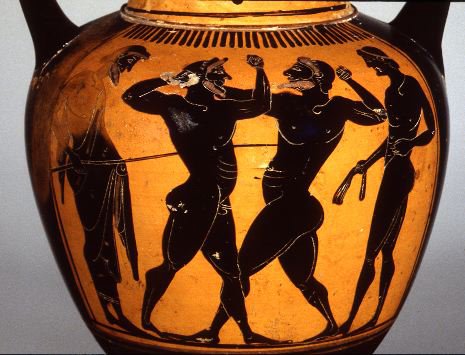
Less Strength, More Skill: Homeric Boxing

Quid prodest multos vincere luctatione vel caestu, ab iracundia vinci?

“What good is it to conquer many in boxing or wrestling only to be overcome by own own anger?”  -Seneca the Younger, Moral Epistles 88.19

During the funeral games in the Iliad, the victor in the boxing match, the older Epeios—who is described as the “son of Kapaneus, a man knowledgeable in boxing” (εἰδὼς πυγμαχίης υἱὸς Πανοπῆος ᾿Επειός, 23.665) knocks down Euryalos with a single blow (23.660-699). In the scholia to this passage, we find the comment that “this shows, as is right, that they had an art of boxing–it was not just about strength” (schol. B ad Il. 23.665: ἦν δέ, ὡς ἔοικε, καὶ τέχνη παρ’ αὐτοῖς τῆς πυγμῆς, οὐ μόνον ἡ δύναμις).

In the Odyssey, Odysseus returns home in disguise and is forced to box the local beggar Iros to entertain the suitors who are plaguing his home. In this scene, it is again his intelligence that wins the day.

Odyssey 18.89-100

“They led [Iros and Odysseus] into the middle. Both men raised their hands.
Much-enduring, godly Odysseus deliberated then
whether he would pummel him and make the soul depart his fallen opponent
or just strike him enough to lay him out on the ground.
As he deliberated this seemed better to him,
just to strike him so that the Achaians might not figure out who he was.
And then, when their hands were raised, Iros punched his right shoulder,
but Odysseus hit him on the neck under the ear—the bones within
bent. Immediately, dark blood spat from his mouth
And he fell moaning in the dust as he ground his teeth together
and kicked the ground with his feet. Then the arrogant suitors
nearly died with laughter as they raised their hands….”

ἐς μέσσον δ’ ἄναγον· τὼ δ’ ἄμφω χεῖρας ἀνέσχον.
δὴ τότε μερμήριξε πολύτλας δῖος ᾿Οδυσσεύς,
ἢ ἐλάσει’ ὥς μιν ψυχὴ λίποι αὖθι πεσόντα,
ἦέ μιν ἦκ’ ἐλάσειε τανύσσειέν τ’ ἐπὶ γαίῃ.
ὧδε δέ οἱ φρονέοντι δοάσσατο κέρδιον εἶναι,
ἦκ’ ἐλάσαι, ἵνα μή μιν ἐπιφρασσαίατ’ ᾿Αχαιοί.
δὴ τότ’ ἀνασχομένω ὁ μὲν ἤλασε δεξιὸν ὦμον
῏Ιρος, ὁ δ’ αὐχέν’ ἔλασσεν ὑπ’ οὔατος, ὀστέα δ’ εἴσω
ἔθλασεν· αὐτίκα δ’ ἦλθεν ἀνὰ στόμα φοίνιον αἷμα,
κὰδ δ’ ἔπεσ’ ἐν κονίῃσι μακών, σὺν δ’ ἤλασ’ ὀδόντας
λακτίζων ποσὶ γαῖαν· ἀτὰρ μνηστῆρες ἀγαυοὶ
χεῖρας ἀνασχόμενοι γέλῳ ἔκθανον. αὐτὰρ ᾿Οδυσσεὺς

This post is in honor of Paul Holdengraber and his fabulous interviews with the pugilist Mike Tyson.

https://twitter.com/holdengraber/status/868115021427073024

A Twitter correspondent aptly added this:

https://twitter.com/FemiAbodunde/status/670370481846018048

A Hydrophilic High: Aelian on the Effects of Medicinal Seahorse

Aelian, De Natura Animalium 14.20

“Some people who know a lot about fishing claim that the stomach of a sea-horse—if someone dissolves it in wine after boiling it and gives it to someone to drink—is an extraordinary potion combined with wine, when compared to other medicines. For, at first, the most severe retching overcomes anyone who drinks it and then a dry coughing fit takes over even though he vomits nothing at all, and then: the upper part of his stomach grows and swells; warm spells roll over his head; and, finally, snot pours from his nose and releases a fishy smell. Then his eyes turn blood-red and heated while his eye-lids swell up.

They claim that a desire to vomit overwhelms him but that he can bring nothing up. If nature wins, then he evades death and slips away into forgetfulness and insanity. But if the wine permeates his lower stomach, there is nothing to be done, and the individual dies eventually. Those who do survive, once they have wandered into insanity, are gripped by a great desire for water: they thirst to sea water and hear it splashing. And this, at least, soothes them and makes them sleep. Then they like to spend their time either by endlessly flowing rivers or near seashores or next to streams or some lakes. And even though they don’t want to drink, they love to swim, to put their feet in the water, and to wash their hands.”

  1. Λέγουσι δὲ ἄνδρες ἁλιείας ἐπιστήμονες, τὴν τοῦ ἱπποκάμπου γαστέρα εἴ τις ἐν οἴνῳ κατατήξειενἕψων καὶ τοῦτον δοίη τινὶ πιεῖν, φάρμακον εἶναι τὸν οἶνον ἄηθες ὡς πρὸς τὰ ἄλλα φάρμακα ἀντικρινόμενον· τὸν γάρ τοι πιόντα αὐτοῦ πρῶτον μὲν καταλαμβάνεσθαι λυγγὶ σφοδροτάτῃ, εἶτα βήττειν ξηρὰν βῆχα, καὶ στρεβλοῦσθαι μέν, ἀναπλεῖν δὲ αὐτῷ οὐδὲ ἕν, διογκοῦσθαι δὲ καὶ διοιδάνειν τὴν ἄνω γαστέρα, θερμά τε τῇ κεφαλῇ ἐπιπολάζειν ῥεύματα, καὶ διὰ τῆς ῥινὸς κατιέναι φλέγμα καὶ ἰχθυηρᾶς ὀσμῆς προσβάλλειν· τοὺς δὲ ὀφθαλμοὺς ὑφαίμους αὐτῷ γίνεσθαι καὶ πυρώδεις, τὰ βλέφαρα δὲ διογκοῦσθαι. ἐμέτων δὲ ἐπιθυμίαι ἐξάπτονταί φασιν, ἀναπλεῖ δὲ οὐδὲ ἕν. εἰ δὲ ἐκνικήσειεν ἡ φύσις, τὸν μὲν <τὸ> ἐς θάνατον σφαλερὸν παριέναι, ἐς λήθην δὲ ὑπολισθαίνειν καὶ παράνοιαν. ἐὰν δὲ ἐς τὴν κάτω γαστέρα διολίσθῃ, μηδὲν ἔτι εἶναι, πάντως δὲ ἀποθνήσκειν τὸν ἑαλωκότα. οἱ δὲ περιγενόμενοι ἐς παράνοια ἐξοκείλαντες ὕδατος ἱμέρῳ πολλῷ καταλαμβάνονται, καὶ ὁρᾶν διψῶσιν ὕδωρ καὶ ἀκούειν λειβομένου· καὶ τοῦτό γε αὐτοὺς καταβαυκαλᾷ καὶ κατευνάζει. καὶ διατρίβειν φιλοῦσιν ἢ παρὰ τοῖς ἀενάοις ποταμοῖς ἢ αἰγιαλῶν πλησίον ἢ παρὰ κρήναις ἢ λίμναις τισί, καὶ πιεῖν μὲν οὐ πάνυ <τι>7 γλίχονται, ἐρῶσι δὲ νήχεσθαι καὶ τέγγειν τὼ πόδε ἢ ἀπονίπτειν τὼ χεῖρε.


Related image

This is not a suggestion for experimentation over the long weekend. Drugs, as the Odyssey warns, might make you forget your homecoming

Retreat or Resist? Seneca and Plutarch Disagree on Peace of Mind

How do we maintain equanimity in the midst of chaos? It is probably not at all coincidental that I keep turning to authors from the Roman Imperial period for answers….

Seneca, Moral Epistle 94.68-69

“Don’t believe it is possible for anyone to be happy because of someone else’s unhappiness. The these examples placed before our ears and ears, must be taken apart—we have to empty our hearts of the corrupting tales that fill them. Virtue must be introduced into the place they held—a virtue which can uproot these lies and contrafactual ideologies; a virtue which may separate us from the people whom we have trusted too much, to return us to sane beliefs. This is wisdom, truly: to be returned to a prior state and to that place from where public sickness dislodged us. A great part of health is to have rejected the champions of madness and to have abandoned that union which was destructive for everyone involved.”

Non est quod credas quemquam fieri aliena infelicitate felicem. Omnia ista exempla, quae oculis atque auribus nostris ingeruntur, retexenda sunt et plenum malis sermonibus pectus exhauriendum. Inducenda in occupatum locum virtus, quae mendacia et contra verum placentia exstirpet, quae nos a populo, cui nimis credimus, separet ac sinceris opinionibus reddat. Hoc est enim sapientia, in naturam converti et eo restitui,unde publicus error expulerit. Magna pars sanitatis est hortatores insaniae reliquisse et ex isto coitu invicem noxio procul abisse.

Seneca seems to be unfamiliar with schadenfreude (probably because it was a Greek word). Or, perhaps he refuses to acknowledge it as real tranquility. Plutarch may have agreed that Seneca’s prescription was good for attaining ataraxia, but Plutarch does not see it as a efficacious for mental health. 

Plutarch, On the Tranquility of the Mind 465c-d

“The one who said that “it is necessary that someone who would be tranquil avoid doing much both in private and public” makes tranquility extremely pricey for us since its price is doing nothing. This would be like advising a sick man “Wretch, stay unmoving in your sheets” [Eur. Orestes 258.].

And certainly, depriving the body of experience is bad medicine for mental illness. The doctor of the mind is no better who would relieve it of trouble and pain through laziness, softness and the betrayal of friends, relatives and country. Therefore, it is also a lie that tranquility comes to those who don’t do much. For it would be necessary for women to be more tranquil than men since they do most everything at home….”

Ὁ μὲν οὖν εἰπὼν ὅτι “δεῖ τὸν εὐθυμεῖσθαι μέλλοντα μὴ πολλὰ πρήσσειν μήτε ἰδίῃ μήτε ξυνῇ,” πρῶτον μὲν ἡμῖν πολυτελῆ τὴν εὐθυμίαν καθίστησι, γινομένην ὤνιον ἀπραξίας· οἷον ἀρρώστῳ παραινῶν ἑκάστῳ
μέν᾿, ὦ ταλαίπωρ᾿, ἀτρέμα σοῖς ἐν δεμνίοις.
καίτοι κακὸν μὲν ἀναισθησία σώματος φάρμακον ἀπονοίας· οὐδὲν δὲ βελτίων ψυχῆς ἰατρὸς ὁ ῥᾳθυμίᾳ καὶ μαλακίᾳ καὶ προδοσίᾳ φίλων καὶ οἰκείων καὶ πατρίδος ἐξαιρῶν τὸ ταραχῶδες αὐτῆς καὶ λυπηρόν.
Ἔπειτα καὶ ψεῦδός ἐστι τὸ εὐθυμεῖν τοὺς μὴ πολλὰ πράσσοντας. ἔδει γὰρ εὐθυμοτέρας εἶναι γυναῖκας ἀνδρῶν οἰκουρίᾳ τὰ πολλὰ συνούσας·

Image result for Ancient Greek insanity

Walking and Running: More Deep Thoughts with Aristotle

From the Problems attributed to Aristotle (see here and here for other excerpts):

882b

“Why do people fall more while running than walking?”

Διὰ τί μᾶλλον θέοντες ἢ βαδίζοντες πίπτουσιν;

883b

“Why does the road seem longer when we don’t know how far we are walking than when we do, even if everything else is the same?”

Διὰ τί πλείων δοκεῖ ἡ ὁδὸς εἶναι, ὅταν μὴ εἰδότες βαδίζωμεν πόση τις, ἢ ὅταν εἰδότες, ἐὰν τἆλλα ὁμοίως | ἔχοντες τύχωμεν;


883b

“Why is running harder than walking?”

Διὰ τί χαλεπώτερον θεῖν ἢ βαδίζειν;


884a

“Why do short walks wear us out?”

Διὰ τί κοπώδεις οἱ βραχεῖς τῶν περιπάτων;


885b

“Why do those on horses fall less frequently? Is it because they are more afraid?”

Διὰ τί οἱ ἀφ᾿ ἵππων ἧττον πίπτουσιν; ἢ διὰ τὸ φοβεῖσθαι φυλάττονται μᾶλλον;

“Why do some of us feel numb?”

Διὰ τί ναρκῶσιν;

Image result for Aristotle Renaissance

Seneca and Cicero on Education and Research

Recently we have posted Socrates’ odd depiction of the life of the mind as without emotion and pleasure followed by rather gentle epistolary reflections on the urge (or compulsion!) to publish. Here are some Roman thoughts on academic endeavors.

Seneca, Moral Epistles 88.20

“Why do we train our children in the liberal arts? It is not because these studies can grant someone virtue, but because they prepare the soul for accepting it.”

“Quare ergo liberalibus studiis filios erudimus?” Non quia virtutem dare possunt, sed quia animum ad accipiendam virtutem praeparant.

Cicero, De Finibus 5.18

“Don’t we observe that people who are attracted to academic studies and the arts take no account of strength or business when they are dedicated to thought itself and knowledge and they are compensated by the pleasure they derive from learning? Homer seems to me to have understood this when he composed the verses about the Sirens. For they did not seem to attract those who were traveling past by the sweetness of their voices or the newness and variety of their singing, but the men used to cling to their rocks because of a passion for learning the many things they claimed to know.”

qui ingenuis studiis atque artibus delectantur, nonne videmus eos nec valetudinis nec rei familiaris habere rationem omniaque perpeti ipsa cognitione et scientia captos et cum maximis curis et laboribus compensare 49eam quam ex discendo capiant voluptatem? Mihi quidem Homerus huiusmodi quiddam vidisse videtur in iis quae de Sirenum cantibus finxerit. Neque enim vocum suavitate videntur aut novitate quadam et varietate cantandi revocare eos solitae qui praetervehebantur, sed quia multa se scire profitebantur, ut homines ad earum saxa discendi cupiditate adhaerescerent.

Cicero, De Senectute 30

“No teachers of the liberal arts should considered unlucky even when they have aged and lost their physical strength”

nec ulli bonarum artium magistri non beati putandi, quamvis consenuerint vires atque defecerint.

Seneca, De Otio 5

“For have we not seen how great nor how many things there are, but our sight lays open a path of investigation and lays the bedrock of truth so that our inquiry may move from well-known things to hidden and discover something older than the world itself…”

Nec enim omnia nec tanta visimus quanta sunt, sed acies nostra aperit sibi investigandi viam et fundamenta vero iacit, ut inquisitio transeat ex apertis in obscura et aliquid ipso mundo inveniat antiquius…

Image result for Ancient Roman scholars

A twitter correspondent desired the addition of a passage. We aim to please…

Cicero, De Oratore I.20

“And, by my judgment, no one could be an orator worthy of all praise unless he has pursued learning in all the significant subject and arts. Surely, it is from an understanding of these things that oratory may blossom and grow. Unless this material is sensed and transmitted through his speech, an orator will possess empty, even childish language. Indeed, I will not completely place such a weight upon our orators—especially not our own who  labor in so much distraction from our urban life—that I believe that there is nothing which they may not know—even though the power of the name orator and the very claim of speaking well seems to accept and promise the ability to speak well and at length about any subject which is proposed.”

Ac, mea quidem sententia, nemo poterit esse omni laude cumulatus orator, nisi erit omnium rerum magnarum atque artium scientiam consecutus. Etenim ex rerum cognitione efflorescat et redundet oportet oratio; quae, nisi subest res ab oratore percepta et cognita, inanem quamdam habet elocutionem, 21et paene puerilem. Neque vero ego hoc tantum oneris imponam nostris praesertim oratoribus, in hac tanta occupatione urbis ac vitae, nihil ut eis putem licere nescire: quanquam vis oratoris professioque ipsa bene dicendi, hoc suscipere ac polliceri videtur, ut omni de re, quaecumque sit proposita, ab 22eo ornate copioseque dicatur.

Spare the Son to Punish the Father

Epistles of Phalaris, VII: To Euenus

“Though my mind was made up, when once I had taken your son prisoner, to kill him for the injustices he had inflicted upon my captains, I later changed my mind and spared him. I would prefer that you suffer because he lives than that he suffer the loss of dying.”
Εὐήνῳ.
Γνώμης γενόμενος τὸ πρῶτον ἁλόντα αἰχμάλωτον ἀποκτεῖναί σου τὸν υἱὸν ἀνθ’ ὧν ἠδίκηκέ μου τοὺς ναυάρχους, μετέγνων ὕστερον καὶ σέσωκα. μᾶλλον γὰρ βούλομαι διὰ τῆς ἐκείνου ζωῆς σὲ λυπεῖν ἢ διὰ τῆς ἀναιρέσεως τὸν ἀποθανόντα.

Two Roman Notes of Encouragement for Procrastinating Authors

I suspect there are others are just like me right now, keeping busy and avoiding the start of summer projects. Alas, Martial’s words ring in my head every morning: “You will live tomorrow, you say? Postumus, even living today is too late; he is the wise man, who lived yesterday.” (Cras uiues? Hodie iam uiuere, Postume, serum est: / ille sapit quisquis, Postume, uixit heri, 5.58). Here are two Roman authors talking about writing and publication.

Seneca, De Tranquillitate Animi 13-14

“Why do we need to compose work that will endure for generations? Why not stop driving to make sure posterity won’t be quiet about you? You have been born mortal—a silent funeral is less annoying! So, for the sake of passing time, write something for your use in a simple style not for publication. There is less need to work for those who study just for today.”

Quid opus est saeculis duratura componere? Vis tu non id agere, ne te posteri taceant? Morti natus es, minus molestiarum habet funus tacitum! Itaque occupandi temporis causa, in usum tuum, non in praeconium aliquid simplici stilo scribe; minore labore opus est studentibus in diem.


Pliny the Younger, Letters 10 To Octavius Rufus

“For the meantime, do as you wish regarding publication too. Recite it from time to time, then you may feel more eager to publish and then you may experience the joy I have long been predicting for you, and not without reason. I imagine what crowds, what admiration, what clamor then silence awaits you. (For myself, I like this as much as applause when I speak or read, as long as it shows a desire to hear me speaking). There is a great reward ready for you! Stop undermining your work with endless delay! When even this is excessive, we need to be wary of hearing the name of idleness, laziness, or even fear. Farewell!”

Et de editione quidem interim ut voles: recita saltem quo magis libeat emittere, utque tandem percipias gaudium, quod ego olim pro te non temere praesumo. Imaginor enim qui concursus quae admiratio te, qui clamor quod etiam silentium maneat; quo ego, cum dico vel recito, non minus quam clamore delector, sit modo silentium acre et intentum, et cupidum ulteriora audiendi. Hoc fructu tanto tam parato desine studia tua infinita ista cunctatione fraudare; quae cum modum excedit, verendum est ne inertiae et desidiae vel etiam timiditatis nomen accipiat. Vale.

Image result for Ancient Roman Book

Addendum:

Pliny the Younger, Letters 1.2

“Clearly, something must be published – ah, it would be best if I could just publish what I have already finished! (You may hear in this the wish of laziness.)

Est enim plane aliquid edendum — atque utinam hoc potissimum quod paratum est! Audis desidiae votum

Speechless About the Life of the Mind

Recent teaching advice from the Chronicle of Higher Education: Go Easy on the Socratic Method.

Plato, Philebus 21d-e

P: This argument has made me completely speechless right now

S: Let’s not give up yet! Let’s take up and examine the life of the mind too.

P: What sort of life are you talking about?

S: If someone would accept living while possessing intelligence, thought, knowledge and perfect memory, but without having any small or great part of pleasure or pain but instead be completely untouched by these kinds of things.

P: Socrates, neither life seems attractive to me, nor to anyone else, I believe.”

ΠΡΩ. Εἰς ἀφασίαν παντάπασί με, ὦ Σώκρατες, οὗτος ὁ λόγος ἐμβέβληκε τὰ νῦν.

ΣΩ. Μήπω τοίνυν μαλθακιζώμεθα, τὸν δὲ τοῦ νοῦ μεταλαβόντες αὖ βίον ἴδωμεν.

ΠΡΩ. Τὸν ποῖον δὴ λέγεις;

ΣΩ. Εἴ τις δέξαιτ᾿ ἂν αὖ ζῆν ἡμῶν φρόνησιν μὲν καὶ νοῦν καὶ ἐπιστήμην καὶ μνήμην πᾶσαν πάντων κεκτημένος, ἡδονῆς δὲ μετέχων μήτε μέγα μήτε σμικρόν, μηδ᾿ αὖ λύπης, ἀλλὰ τὸ παράπαν ἀπαθὴς πάντων τῶν τοιούτων.

ΠΡΩ. Οὐδέτερος ὁ βίος, ὦ Σώκρατες, ἔμοιγε τούτων αἱρετός, οὐδ᾿ ἄλλῳ μή ποτε, ὡς ἐγᾦμαι, φανῇ.

Image result for Ancient GReek life of the mind

You’re Forgiven Only Once

Epistles of Phalaris, VI: To Zeuxippus

“I grant pardon to your son on account of his youth, and to you on account of your old age, though you have both done unpardonable things. If, however, you do not desist from your boldness, neither his youth nor your age will save you. Nay, rather, you will be punished all the more for those things by which you have just now earned your pardon.”

Image result for phalaris tyrant

Ζευξίππῳ.
Τῷ μὲν υἱῷ σου διὰ τὴν νεότητα συγγινώσκω, σοὶ δὲ διὰ τὸ γῆρας, καίπερ ἀσύγγνωστα πεποιηκόσιν. ἂν μέντοι μὴ παύσησθε τῆς αὐθαδείας, οὔτ’ ἐκεῖνον ἡ νεότης οὔτε σὲ τὸ γῆρας ἐξαιρήσεται, δι’ αὐτὰ δὲ ταῦτα καὶ μᾶλλον κολασθήσεσθε, δι’ ἃ νῦν συγγνώμης ἀξιοῦσθε.