Know-nothings, Faith-healers, and Quacks: Mystifying and Abusing Mental Illness

Hippocrates of Cos, The Sacred Disease 1 and 2

“This work is about that disease which people call “sacred”. It does not seem to me to be more divine or more sacred than any of the rest of the diseases, but it also has a natural cause and people have assumed it is sacred because of their own inexperience and their considerable wonder over how different it seems to them.”

[…]

Περὶ τῆς ίερῆς νούσου καλεομένης ὧδ᾿ ἔχει. οὐδέν τί μοι δοκεῖ τῶν ἄλλων θειοτέρη εἶναι νούσων οὐδὲ ἱερωτέρη, ἀλλὰ φύσιν μὲν ἔχει καὶ πρόφασιν, οἱ δ᾿ ἄνθρωποι ἐνόμισαν θεῖόν τι πρῆγμα εἶναι ὑπὸ ἀπειρίης καὶ θαυμασιότητος, ὅτι οὐδὲν ἔοικεν ἑτέροισι·

“Those who first claimed that the disease is divinely caused seem to me to be something like the wizards, snake-oil salesmen, faith-healers, and quacks of today, those kinds of men who pretend to great piety and superior knowledge. These kinds of healers shelter themselves and use superstition as a shield against their own helplessness when they have nothing they can do to help. They claim that this affliction is sacred so it won’t be clear that they don’t know anything. They add a ready-made story and throw in a treatment in order to keep their own position strong.”

Ἐμοὶ δὲ δοκέουσιν οἱ πρῶτοι τοῦτο τὸ νόσημα ἱερώσαντες τοιοῦτοι εἶναι ἄνθρωποι οἷοι καὶ νῦν εἰσι μάγοι τε καὶ καθάρται καὶ ἀγύρται καὶ ἀλαζόνες, οὗτοι δὲ καὶ προσποιέονται σφόδρα θεοσεβέες εἶναι καὶ πλέον τι εἰδέναι. οὗτοι τοίνυν παραμπεχόμενοι καὶ προβαλλόμενοι τὸ θεῖον τῆς ἀμηχανίης τοῦ μὴ ἔχειν ὅ τι προσενέγκαντες ὠφελήσουσι, καὶ ὡς μὴ κατάδηλοι ἔωσιν οὐδὲν ἐπιστάμενοι, ἱερὸν ἐνόμισαν τοῦτο τὸ πάθος εἶναι· καὶ λόγους ἐπιλέξαντες ἐπιτηδείους τὴν ἴησιν κατεστήσαντο ἐς τὸ ἀσφαλὲς σφίσιν αὐτοῖσι,

As Vivian Nutton makes clear in the overview of Mental Illness in the Ancient World (available in Brill’s New Pauly), Hippocrates Breaks from Ancient Near Eastern and Early Greek tradition here in offering physical explanations for mental illness of all kinds instead of divine explanations. Platonic and Aristotelian traditions follow with variations on somatism (the body as the cause), adding in addition to the humors, bile, and disharmony among the organs, habits (excessive consumption, actions) and environments. These approaches were refined by Hellenistic doctors and the work of Rufus and Galen where treatments also came to include psychotherapeutic as well as the physical treatments. The swing towards demonic possession as an explanation during Late Antiquity and the Christian middle ages took mental health approaches back towards the ‘sacred’ explanations of pre-rational antiquity.

Some other posts about mental health from antiquity. Oftentimes translators keep the ancient Greek term melancholy (“black bile”)


Galen says loss of speech is not melancholy

Women, misogyny, and suicide

Lykanthropy as a type of melancholy

Hippocrates on melancholic desire for isolation

Hippocrates and Galen on hallucination and depression

The positive side of delusion

Aristotle on Mind-body connection

Music for healing mental affliction

Galen on the use of narcotics

Celsus on abusive treatments for mental illness

Seneca and Epictetus on Sick Days for Mental Health

Seneca and Plutarch on Whether Peace of Mind Helps

Epictetus, Treatises Collected by Arrian, 2.15: To those who cling tenaciously to any judgments they have made 

“Whenever some people hear these words—that it is right to be consistent, that the moral person is free by nature and never compelled, while everything else may be hindered, forced, enslaved, subjected to others—they imagine that it is right that they maintain every judgment they have made without compromising at all.

But the first issue is that the judgment should be a good one. For, if I wish to maintain the state of my body, it should be when it is healthy, well-exercised. If you show me that you have the tones of a fevered mind and brag about it, I will say ‘Dude, look for a therapist. This is not health, but sickness.’ “

ιε′. Πρὸς τοὺς σκληρῶς τισιν ὧν ἔκριναν ἐμμένοντας.

῞Οταν ἀκούσωσί τινες τούτων τῶν λόγων, ὅτι βέβαιον εἶναι δεῖ καὶ ἡ μὲν προαίρεσις ἐλεύθερον φύσει καὶ ἀνανάγκαστον, τὰ δ’ ἄλλα κωλυτά, ἀναγκαστά, δοῦλα, ἀλλότρια, φαντάζονται ὅτι δεῖ παντὶ τῷ κριθέντι ὑπ’ αὐτῶν ἀπαραβάτως ἐμμένειν. ἀλλὰ πρῶτον ὑγιὲς εἶναι δεῖ τὸ κεκριμένον. θέλω γὰρ εἶναι τόνους ἐν σώματι, ἀλλ’ ὡς ὑγιαίνοντι, ὡς ἀθλοῦντι· ἂν δέ μοι φρενιτικοῦ τόνους ἔχων ἐνδεικνύῃ[ς] καὶ ἀλαζονεύῃ ἐπ’ αὐτοῖς, ἐρῶ σοι ὅτι ‘ἄνθρωπε, ζήτει τὸν θεραπεύσοντα. τοῦτο οὐκ εἰσὶ τόνοι, ἀλλ’ ἀτονία’.


Image result for ancient greek asclepius relief
Hygeia [“Health”] and her father Asklepios Taken from Pinterest

The Envy and Spite of Intellectual Life

D.H. Lawrence, Lady Chatterley’s Lover

“There was a gorgeous talk on Sunday evening, when the conversation drifted again to love.

‘Blest be the tie that binds Our hearts in kindred something-or-other’

— said Tommy Dukes. ‘I’d like to know what the tie is…The tie that binds us just now is mental friction on one another. And, apart from that, there’s damned little tie between us. We bust apart, and say spiteful things about one another, like all the other damned intellectuals in the world. Damned everybodies, as far as that goes, for they all do it. Else we bust apart, and cover up the spiteful things we feel against one another by saying false sugaries. It’s a curious thing that the mental life seems to flourish with its roots in spite, ineffable and fathomless spite. Always has been so! Look at Socrates, in Plato, and his bunch round him! The sheer spite of it all, just sheer joy in pulling somebody else to bits…Protagoras, or whoever it was! And Alcibiades, and all the other little disciple dogs joining in the fray! I must say it makes one prefer Buddha, quietly sitting under a bo-tree, or Jesus, telling his disciples little Sunday stories, peacefully, and without any mental fireworks. No, there’s something wrong with the mental life, radically. It’s rooted in spite and envy, envy and spite. Ye shall know the tree by its fruit.'”

Image result for d.h. lawrence

Cancel Murderers and Tyrants?

Andocides, On the Mysteries 78 (excerpt from a decree read in the speech)

“…For those who have committed massacres or created tyrannies, in addition to everything else, have the council erase their names everywhere, wherever there is some mention of them in public, in accordance with what we have said and any copy of it which the lawmakers or elected officers possess.”

ἢ σφαγεῦσιν ἢ τυράννοις· τὰ δὲ ἄλλα πάντα ἐξαλεῖψαι τοὺς πράκτορας καὶ τὴν βουλὴν κατὰ τὰ εἰρημένα πανταχόθεν, ὅπου τι ἔστιν ἐν τῷ δημοσίῳ, καὶ εἴ <τι> ἀντίγραφόν που ἔστι, παρέχειν τοὺς θεσμοθέτας καὶ τὰς ἄλλας ἀρχάς

Plutarch, Moralia 473f

“Just as in a painting’s colors, we must put the bright and shining matters in the front of the mind and hide and cover the depressing ones away—for it is not possible to erase them or eradicate them completely.”

δεῖ δ᾿ ὥσπερ ἐν πινακίῳ χρωμάτων ἐν τῇ ψυχῇ τῶν πραγμάτων τὰ φαιδρὰ καὶ λαμπρὰ προβάλλοντας, ἀποκρύπτειν τὰ σκυθρωπὰ καὶ πιέζειν· ἐξαλεῖψαι γὰρ οὐκ ἔστι παντάπασιν οὐδ᾿ ἀπαλλαγῆναι.

I have been thinking for some time about the amnesty at the end of the Odyssey, which creates an erasure of the murders of the suitors family so that the Odysseus and his people can escape the cycle of vengeance. There are some echoes of this in the Roman practice of damnatio memoriaeI have thought a lot about Malcolm Gladwell’s application of Mark Grenovetter’s threshold theory to thinking about he sociology of school shootings. I am not sure that erasing events is the solution (nor am I suggesting that Gladwell and Grenovetter think so). What we are really facing in this question is how the stories we tell, how the way we cover events, creates paradigms and narratives that perpetuate themselves.

At the end of the Odyssey, Zeus intervenes and erases the Ithakans’ memory of the murder of the suitors to re-establish peace and stability for Odysseus’ return.

Homer, Odyssey 24.478–486

“My child, why do you inquire or ask me about these things?
Didn’t you contrive this plan yourself, that Odysseus
would exact vengeance on these men after he returned home?
Do whatever you want—but I will say what is fitting.
Since Odysseus has paid back the suitors,
let him be king again for good and take sacred oaths.
Let us force a forgetting of that slaughter of children and relatives.
Let all the people be friendly towards each other
as before. Let there be abundant wealth and peace.”

τέκνον ἐμόν, τί με ταῦτα διείρεαι ἠδὲ μεταλλᾷς;
οὐ γὰρ δὴ τοῦτον μὲν ἐβούλευσας νόον αὐτή,
ὡς ἦ τοι κείνους ᾿Οδυσεὺς ἀποτείσεται ἐλθών;
ἕρξον ὅπως ἐθέλεις· ἐρέω δέ τοι ὡς ἐπέοικεν.
ἐπεὶ δὴ μνηστῆρας ἐτείσατο δῖος ᾿Οδυσσεύς,
ὅρκια πιστὰ ταμόντες ὁ μὲν βασιλευέτω αἰεί,
ἡμεῖς δ’ αὖ παίδων τε κασιγνήτων τε φόνοιο
ἔκλησιν θέωμεν· τοὶ δ’ ἀλλήλους φιλεόντων
ὡς τὸ πάρος, πλοῦτος δὲ καὶ εἰρήνη ἅλις ἔστω.

(To be honest, after yet another national tragedy I cannot read Zeus’ words as anything but bitter sarcasm. This is, in all likelihood, an extremely anachronistic interpretation. But I cannot help but wonder if ancient audiences ever heard these lines and were unsettled, if not angered…)

It is clear that Zeus has to do this in order to end the conflict (and end the epic) because both parties are motivated by the cycle of vengeance. When Eupeithes’ speaks to the assembled Ithakans earlier in Book 24, he specifically mentions the fear of becoming an object of shame in a narrative pattern.

Homer, Odyssey 24.432-437

“Let us go. Otherwise we will be ashamed forever.
This will be an object of reproach even for men to come to learn,
if we do not pay back the murders of our relatives and sons.
It cannot be sweet to my mind at least to live like this.
But instead, I would rather perish immediately and dwell with the dead.
But, let’s go so that those men don’t cross to the mainland first.”

ἴομεν· ἢ καὶ ἔπειτα κατηφέες ἐσσόμεθ’ αἰεί.
λώβη γὰρ τάδε γ’ ἐστὶ καὶ ἐσσομένοισι πυθέσθαι,
εἰ δὴ μὴ παίδων τε κασιγνήτων τε φονῆας
τεισόμεθ’· οὐκ ἂν ἐμοί γε μετὰ φρεσὶν ἡδὺ γένοιτο
ζωέμεν, ἀλλὰ τάχιστα θανὼν φθιμένοισι μετείην.
ἀλλ’ ἴομεν, μὴ φθέωσι περαιωθέντες ἐκεῖνοι.”

Eupeithes–and Odysseus for most of the epic–act according to patterns they have received, embedded cultural expectations about how to behave in certain situations. The Odyssey‘s sudden end–its resolution through an act of erasure that challenges the very nature of the genre of memory itself–should prompt us to understand that the conflict has no resolution according to conventional paradigms. Rather than being a simple, closed end, this ending should incite us to realize that the stories themselves have been a problem.


Image result for Ancient Greek Odysseus discus

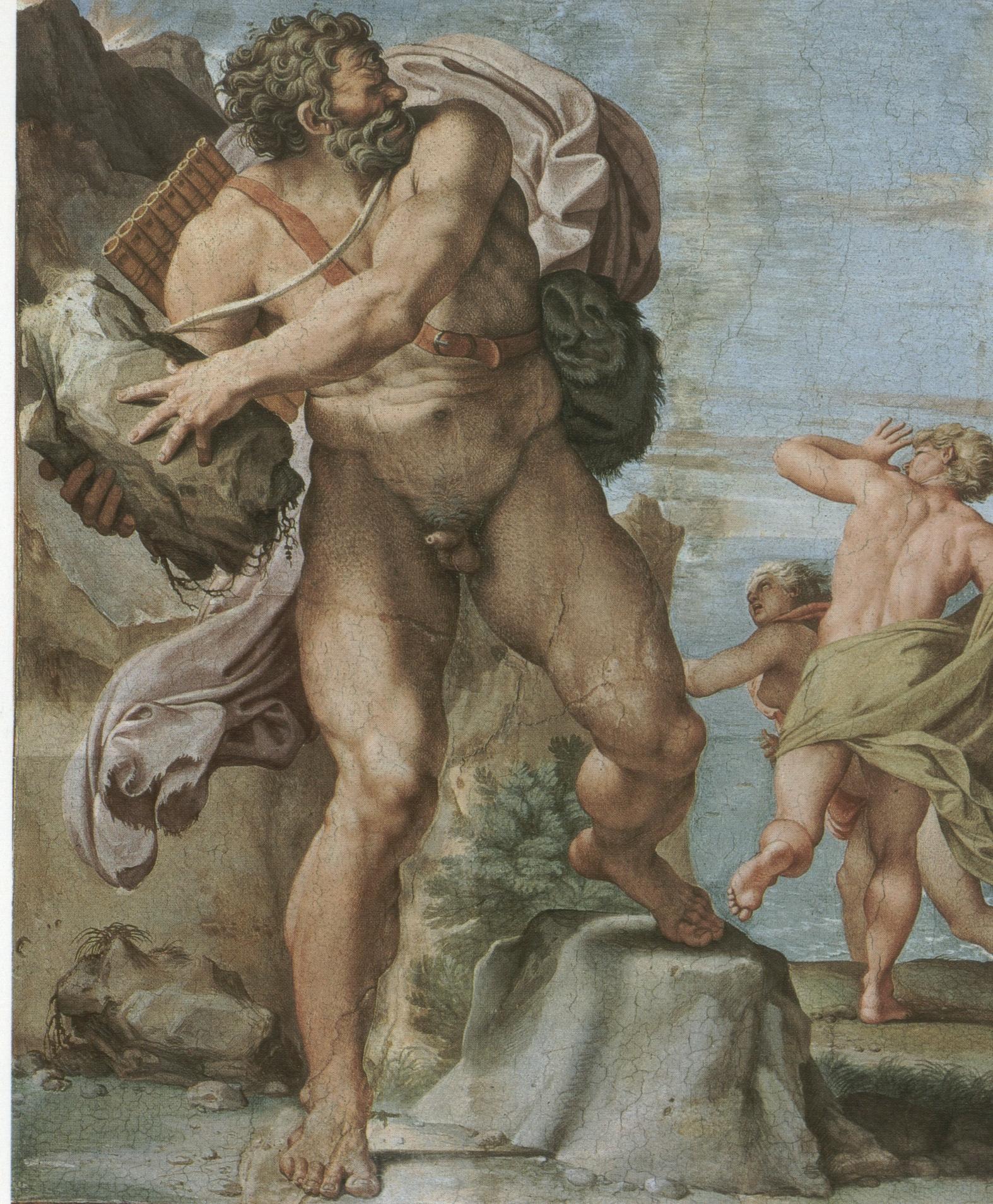
“The Cyclops Polyphemus ,”by Annibale Carracci

(I have written about some of this the Routledge Handbook of Classics and Cognitive Theory)

The Excellence of Catullus

George Otto Trevelyan, The Life and Letters of Lord Macaulay

“I have pretty nearly learned all that I like best in Catullus. He grows on me with intimacy. One thing he has,—I do not know whether it belongs to him, or to something in myself,—but there are some chords of my mind which he touches as nobody else does. The first lines of ‘Miser Catulle;’ the lines to Cornificius, written evidently from a sick bed; and part of the poem beginning ‘Si qua recordanti’ affect me more than I can explain. They always move me to tears.” [Macaulay quoted]

Image result for catullus

Presocratic Healthcare Plan: Everyone a Doctor, Everyone a Sage

A Letter to Hippocrates: Ps.-Hipp. Epist. 23 (9.392–93 Littré)

“Democritus writes to Hippocrates on the nature of human beings:

“Hippocrates, all people should know the art of medicine, since it it is noble and also advantageous for life and it is a special possession of those people who have deep experience in education and argumentation. I think that the pursuit of wisdom is the sibling and roommate of medicine since wisdom frees the soul of suffering, and medicine rids the body of illnesses.”

Δημόκριτος Ἱπποκράτει περὶ φύσιος ἀνθρώπου.

χρὴ πάντας ἀνθρώπους ἰητρικὴν τέχνην ἐπίστασθαι, ὦ Ἱππόκρατες, καλὸν γὰρ ἅμα καὶ ξυμφέρον ἐς τὸν βίον, τουτέων δὲ μάλιστα τοὺς παιδείας καὶ λόγων ἴδριας γεγενημένους. ἱστορίην σοφίης γὰρ δοκέω ἰητρικῆς ἀδελφὴν καὶ ξύνοικον· σοφίη μὲν γὰρ ψυχὴν ἀναρύεται παθέων, ἰητρικὴ δὲ νούσους σωμάτων ἀφαιρέεται [. . .].

Image from Wikipedia

Matchmaking With the Ancients

Hesiod, Works and Days 695-705

“The time to bring a wife to your home
is when you are not too many years under thirty,
or just a few years older. This is the season for marriage.
Your wife should be four years in puberty and married in the fifth.
Marry a virgin so you may teach her proper habits,
And marry a woman who lives nearby, making sure you check
every detail so that you won’t be wed to a joke for your neighbors.
For nothing is better for a man than a wife,
a good one, and nothing is more horrible than a bad one,
one who lies down to eat, and who can cook her husband without a fire,
even though he is a strong man, she makes him age when he’s young.”

  ῾Ωραῖος δὲ γυναῖκα τεὸν ποτὶ οἶκον ἄγεσθαι,
μήτε τριηκόντων ἐτέων μάλα πόλλ’ ἀπολείπων
μήτ’ ἐπιθεὶς μάλα πολλά· γάμος δέ τοι ὥριος οὗτος·
ἡ δὲ γυνὴ τέτορ’ ἡβώοι, πέμπτῳ δὲ γαμοῖτο.
παρθενικὴν δὲ γαμεῖν, ὥς κ’ ἤθεα κεδνὰ διδάξῃς,
[τὴν δὲ μάλιστα γαμεῖν, ἥτις σέθεν ἐγγύθι ναίει]
πάντα μάλ’ ἀμφὶς ἰδών, μὴ γείτοσι χάρματα γήμῃς.
οὐ μὲν γάρ τι γυναικὸς ἀνὴρ ληίζετ’ ἄμεινον
τῆς ἀγαθῆς, τῆς δ’ αὖτε κακῆς οὐ ῥίγιον ἄλλο,
δειπνολόχης, ἥ τ’ ἄνδρα καὶ ἴφθιμόν περ ἐόντα
εὕει ἄτερ δαλοῖο καὶ ὠμῷ γήραϊ δῶκεν.

Ovid, Heroides, 9.26-34 Deianeira addresses Herakles

“But I am considered well-married, because I am called Hercules’ wife
And because my father-in-law is the one who sounds deeply with swift steeds.
Yet, this is how the unequal colts arrive unhappily at the plow,
The way that a lesser bride matches to a great husband.
This isn’t an honor but merely the appearance of it which pains who carries it more;
If you want to be married happily, marry your equal.
My husband is always absent—he’s more famous as my guest than husband
As he pursues is terrible monsters and beasts.”

At bene nupta feror, quia nominer Herculis uxor,
sitque socer, rapidis qui tonat altus equis.
quam male inaequales veniunt ad aratra iuvenci,
tam premitur magno coniuge nupta minor.
non honor est sed onus species laesura ferentes:
siqua voles apte nubere, nube pari.
vir mihi semper abest, et coniuge notior hospes
monstraque terribiles persequiturque feras.

Hipponax, Fr. 68

“A woman has two days which are the sweetest:
When someone marries her and when someone carries her out dead.”

δύ᾿ ἡμέραι γυναικός εἰσιν ἥδισται,
ὅταν γαμῇ τις κἀκφέρῃ τεθνηκυῖαν.

Euripides, fr. 137 (Andromeda)

“Best of all riches is to find a noble spouse.”

τῶν γὰρ πλούτων ὅδ’ ἄριστος
γενναῖον λέχος εὑρεῖν.

Red-figure skyphoid pyxis by the Adrano Group, ca 330-320 BC, today at the Pushkin Museum in Moscow. Image shown under Creative Common License: shakko, Pyxis01 pushkinCC BY-SA 3.0 (Thanks to Commenter Marcus Cyron for reminding me to post this credit)


The Books In My Dreams

Tracing my finger along the shelf of my library, I stopped upon a recently purchased volume which grabbed my attention – an old Teubner edition of Arrian’s Anabasis of Alexander, which I had found at the bookstore for the inconceivably low price of three dollars. I drew it from the shelf, and in doing so revealed the face of a demon, whose glowing eyes transfixed me and branded my soul with a dread terror I will never forget. Its gaze possessed something more than the power of an ordinary dream, for I awoke with the sleep paralysis which used to afflict me so often in former days. Anyone who has experienced sleep paralysis knows the horror of waking from the visions of a nightmare to a terror even worse – the inability to move. Worse still, my eyes when I woke up were fixed on that terrible spot – the shelf from which I had drawn Arrian in my dream.

My thoughts as I lay there entirely deprived of the faculty of motion tended exactly where you might expect: to the conclusion that the book was haunted. Indeed, I convinced myself that the entire collection of books which I had purchased along with the Arrian must be haunted. Here, I should note that all of these books were acquired at rock-bottom prices at a Half Price Books store in Austin which had clearly received boxfuls of a classics professor’s old stash. Apparently unsure of their real market value, a regular trove of Teubners, OCT’s, and even assorted editions with commentaries from the 19th and early 20th century were effectively being given away at three to five dollars each. Naturally enough, I assumed that this vast treasury was only sitting there because this old classicist (the absence of bookplates or inscriptions left their identity unknown) had died, given that surely no living person who had accumulated such a store would willingly part with it in life. Now that I had my hands on so many of the books, I was the object of the dead classicist’s malicious envy, and would somehow be dragged to the grave myself by the influence of infernal operations which the living cannot understand. I resolved that night to get rid of the books.

Rational and sober reflection belong very much to the sunlit, prosaic boredom of the daytime. After so rashly resolving to abandon the books the night before, I decided to hazard my body (and for all that, who knows? – perhaps my soul) in holding on to the books for one more night. No further apparitions ever haunted that ethereal library of dreams, and so the fresh accession of scholarly treasures was to remain. But so, too, was the horror which that night had aroused in the depths of my soul.

IMG_7697.JPG
The haunted Teubner

There is no dearth of paeans to the book – the book as object, the book as experience, the book as a bulwark against barbarism and the decay of civilization. Books as books are alternatively objects of pure pleasure and escapism or the instruments of the most serious and scientific engagement with the world. Books lie at the heart of the world’s three major monotheistic religions; books feature in some paradoxical way as one of the chief activities for pleasure at the beach; and books are converted into instruments of torture to sap the love of learning out of children in school. Readers love books, and writers love books, and so it is perhaps not accidental that writers often write books about books. I confess that I will read any of these that come in my way. Generally, they wax lyrical in the most overblown and effusive strains about the book and the act of reading as somehow the most gratifying and essential part of human experience. It is all bullshit of course, but it is bullshit which has been so thoroughly filtered, so refined, so polished and carefully curated in the hands of other literary obsessives that I cannot help but hang on to every word of it.

Yet for all that I read there about childhood experiences with books, the thrill of libraries, or how wonderful it was to read to Borges, I don’t recall many authors discussing the centrality of books in their dreams. When I was a child, I would dream about toys which I hoped to get, and still vividly remember wishing for a voice-modifying tape recorder marketed as one of Macaulay Culkin’s tools from the Home Alone movies. As an adolescent, I would of course dream all the time about romance and sex. The ideal dreamscape consists of the attainment of desires which are simultaneously the deepest-rooted and the most unattainable. And so, it is odd enough that as an adult, I dream – I mean, really dream – about books.

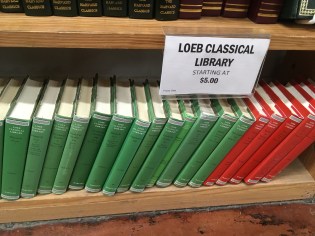
My recurring bibliofantasy runs something like this: I walk into a bookstore (it varies between smaller local shops and large chains like Barnes and Noble) and stumble upon a section of thousands of Greek and Latin classics, usually Loebs, stacked from floor to ceiling. I begin to grab the books with a ravenous and not quite gentlemanly frenzy. Among the volumes are authors of whom I have never even heard. (Of course, even seasoned classicists are surely unfamiliar with a long list of minor authors, but here my mind is just inventing names which must appear vaguely Greek and legitimate enough to pass muster in the vague haze of a dream.) Invariably, at some point in the dream, it occurs to me that I am in a dream because it all seems too good to be true, and yet I suppress that doubt and plough on ahead in the warm embrace of my bibliomania. At some point I wake up, and of course, it hurts – it feels like a real loss.

But why should this appear to be such a fantasy? San Antonio is not a city famous for literacy, and so it is rare enough to find a decent book store well-stocked with works in English; even a touch of classicism here is a fantasy too far. Yet I could easily purchase any work I want online, or search through something like the TLG. What is lacking is the experience of the physical book combined with the utter serendipity of stumbling upon it in the store. Surely enough, people may find true love on matchmaking apps, but how many people could get invested in that as a narrative? All of the romance of life lies in chance and accident, and the ease of ordering up some rare volume from the other side of the world, while convenient, is surely lacking in the quality which will send a shiver down your spine and set the heart a-flutter.

Whenever I visit a new city, the most important tourist destination is the bookstore. Most recently, I was surprised to find that the bookstores of Venice far surpass those of Florence. Perhaps my expectations of finding a full multi-volume collection of all of Petrarch’s Latin works in every bookstore in Florence was wholly unreasonable, the product of those dreams.

My library now consists of thousands of books, and nothing could reasonably induce me to part with any of it. Books are the only things to which I am attached, and I would sooner go without a computer and internet access than part with the volumes I’ve collected over the past seventeen years or so. It was around that time when I began reading in earnest, seventeen years ago, that I first fell in love. Though she and I were friends for some years and came several times to the brink of a full-blown confession of our feelings, it was a romance which was never to be. To this day, I still have dreams about the fulfillment of the romance that never was, and which would now be utterly impossible. Yet, it is perhaps only in the ethereal world of dreams that one can experience a love whose month is ever May. In a curious inversion of Anselm’s argument, its perfection lies in its unreality. Sometimes I wake from the fantasy world in which thousands of lost classics loom over me, waiting to be read, and regret that it was all a dream – nothing but a dream. But as the song reminds us, so is life.

IMG_6129.JPG
A tiny fragment of my dreams.

If You’re Happy and You Know It, Think of Death

Petrarch, Secretum 1.1:

Augustine: What are you doing, little man? Why do you sleep? What are you waiting for? Have you become so forgetful of your own misery? Or do you not remember that you are mortal?

Francesco: I remember, to be sure, and that thought never comes upon me without a certain horror.

Augustine: Would that you remember as you say you do and consulted your own interest! Indeed, then you would have freed me from a lot of labor, since it is indeed true that nothing is more effective for condemning the temptations of this life and composing the mind to endure the many tempests of this world than the recollection of one’s own misery and a constant meditation upon death. Yet, it should not come upon you lightly or superficially – it should settle into your bones and marrow.

The Ironboors are made of Salt and Snores - The Fandomentals

Augustinus: Quid agis, homuncio? quid somnias? quid expectas? miseriarum ne tuarum sic prorsus oblitus es? An non te mortalem esse meministi?
Francescus: Memini equidem nec unquam sine horrore quodam cogitatio illa subit animum.
Augustinus: Utinam meminisses, ut dicis, et tibi consuluisses! etenim et multum michi negotii remisisses, cum sit profecto verissimum ad contemnendas vite huius illecebras componendumque inter tot mundi procellas animum nichil efficacius reperiri quam memoriam proprie miserie et meditationem mortis assiduam; modo non leviter, aut superficietenus serpat, sed in ossibus ipsis ac medullis insideat.

Weekend Party Advice: Don’t Talk about Centaurs!

Xenophanes, fr. B1 13-24

“First, it is right for merry men to praise the god
with righteous tales and cleansing words
after they have poured libations and prayed to be able to do
what is right: in fact, these things are easier to do,
instead of sacrilege. It is right as well to drink as much as you can
and still go home without help, unless you are very old.
It is right to praise a man who shares noble ideas when drinking
so that we remember and work towards excellence.
It is not right to narrate the wars of Titans or Giants
nor again of Centaurs, the fantasies of our forebears,
Nor of destructive strife. There is nothing useful in these tales.
It is right always to keep in mind good thoughts of the gods.”

χρὴ δὲ πρῶτον μὲν θεὸν ὑμνεῖν εὔφρονας ἄνδρας
εὐφήμοις μύθοις καὶ καθαροῖσι λόγοις,
σπείσαντάς τε καὶ εὐξαμένους τὰ δίκαια δύνασθαι
πρήσσειν• ταῦτα γὰρ ὦν ἐστι προχειρότερον,
οὐχ ὕβρεις• πίνειν δ’ ὁπόσον κεν ἔχων ἀφίκοιο
οἴκαδ’ ἄνευ προπόλου μὴ πάνυ γηραλέος.
ἀνδρῶν δ’ αἰνεῖν τοῦτον ὃς ἐσθλὰ πιὼν ἀναφαίνει,
ὡς ἦι μνημοσύνη καὶ τόνος ἀμφ’ ἀρετῆς,
οὔ τι μάχας διέπειν Τιτήνων οὐδὲ Γιγάντων
οὐδὲ Κενταύρων, πλάσμα τῶν προτέρων,
ἢ στάσιας σφεδανάς• τοῖς οὐδὲν χρηστὸν ἔνεστιν•
θεῶν προμηθείην αἰὲν ἔχειν ἀγαθήν.

Image result for ancient greek centaur
2nd Century CE Mosaic (Berlin)


The Poor Trojans Are All Dead

Mark Twain, The Innocents Abroad:

“We sailed through the barren Archipelago, and into the narrow channel they sometimes call the Dardanelles and sometimes the Hellespont. This part of the country is rich in historic reminiscences, and poor as Sahara in every thing else. For instance, as we approached the Dardanelles, we coasted along the Plains of Troy and past the mouth of the Scamander; we saw where Troy had stood (in the distance,) and where it does not stand now—a city that perished when the world was young. The poor Trojans are all dead, now. They were born too late to see Noah’s ark, and died too soon to see our menagerie. We saw where Agamemnon’s fleets rendezvoused, and away inland a mountain which the map said was Mount Ida.

Within the Hellespont we saw where the original first shoddy contract mentioned in history was carried out, and the “parties of the second part” gently rebuked by Xerxes. I speak of the famous bridge of boats which Xerxes ordered to be built over the narrowest part of the Hellespont (where it is only two or three miles wide.) A moderate gale destroyed the flimsy structure, and the King, thinking that to publicly rebuke the contractors might have a good effect on the next set, called them out before the army and had them beheaded. In the next ten minutes he let a new contract for the bridge. It has been observed by ancient writers that the second bridge was a very good bridge. Xerxes crossed his host of five millions of men on it, and if it had not been purposely destroyed, it would probably have been there yet. If our Government would rebuke some of our shoddy contractors occasionally, it might work much good. In the Hellespont we saw where Leander and Lord Byron swam across, the one to see her upon whom his soul’s affections were fixed with a devotion that only death could impair, and the other merely for a flyer, as Jack says. We had two noted tombs near us, too. On one shore slept Ajax, and on the other Hecuba.”

mesoavhammu.gif