Hermione and the Sons of Heroes

Lysimachos BNJ 382 F 10b Scholia Ad Andromache, 32

Proksenos in the first book of Epirote Histories says that Pielos was born from Neoptolemos, also named Peleus, and not from Hermione as is told.

Πρόξενος δὲ ἐν τῆι πρώτηι τῶν ᾽Ηπειρωτικῶν Νεοπτολέμου μὲν Πίελόν φησι γεγονέναι, τὸν καὶ Πηλέα· οὐ μὴν ὅτι ἐξ ῾Ερμιόνης, <ὡς> προδεδήλωται.


Eustathios, Commentarii ad Homeri Odysseam 1.141, vv. 26-3

“People say that Sophocles records, in his Hermione, that when Menelaos was still in Troy, Tyndareus gave her to Orestes. Later on, she was seized from him and given to Neoptolemus to honor the promise made in Troy. After Neoptolemos was killed by Makhaireus, who was asking Apollo to pay him back for his father’s murder, she was returned to Orestes again. Tisamenos was born from them.”

Σοφοκλῆς δέ φασιν ἐν Ἑρμιόνῃ ἱστορεῖ, ἐν Τροίᾳ ὄντος ἔτι Μενελάου, ἐκδοθῆναι τὴν Ἑρμιόνην ὑπὸ τοῦ Τυνδάρεω τῷ Ὀρέστῃ. εἶτα ὕστερον ἀφαιρεθεῖσαν αὐτοῦ, ἐκδοθῆναι τῷ Νεοπτολέμῳ κατὰ τὴν ἐν Τροίᾳ ὑπόσχεσιν. αὐτοῦ δὲ Πυθοῖ ἀναιρεθέντος ὑπὸ Μαχαιρέως ὅτε τὸν Ἀπόλλω τινύμενος τὸν τοῦ πατρὸς ἐξεδίκει φόνον, ἀποκαταστῆναι αὖθις αὐτὴν τῷ Ὀρέστῃ. ἐξ ὧν γενέσθαι τὸν Τισαμενόν.

From Wikimedia: By Class of Cambridge 49 – Jastrow (2006), Public Domain, https://commons.wikimedia.org/w/index.php?curid=511079

Grace Me With Your Correction

Leon Battista Alberti,
On the Advantages and Disadvantages of Literature (Part IV)

“Thus, bestowing some effort upon my own habit and the entreaties of my friends, I have published this little treatise on the advantages and disadvantages of literature. Which, to be sure, my brother, I will suppose to be pleasing to you, because I have both kept up the custom of my friends, but also because I have seized upon material which is neither common nor explained before this time. I am well versed in the study of literature, in which I have spent my whole life up until yesterday – I know what its advantages and disadvantages are. But you (to use a word from your Ephebes) my brother, read my little book over again, correct it, and change it according to your judgment. Make it so that my little contrivance here is more pleasing and more worthy by the grace of your emendation.”

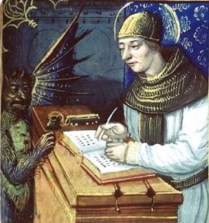
Image result for MEDIEVAL CORRECTOR

Itaque consuetudini nostre et meorum petitionibus operam impertiens hoc de commodis litterarum atque incommodis edidi opusculum. Quod quidem, mi frater, tum quod meis morem gesserim, tum etiam quod fuerim materiam nactus non vulgarem neque satis ante hoc tempus explicitam gratum tibi futurum arbitrabor. Et novi studia litterarum, quibus ad hunc usque diem superiorem etatem omnem traduxi meam, quam sint commoda atque incommoda. Tu vero (ut tuo in Ephebis utar dicto), mi frater, relege hunc nostrum libellum, corrige, immuta tuo quidem arbitratu, emendationeque tua inventionem nostram effice gratiorem ac digniorem.

How Do You Persuade the Close-Minded?

 Epictetus’ Dissertationes ad Arriano Digestae (“Treatises Collected and Edited by Arrian”)

Book 1.5 Against the Academics

“Epictetus said that if someone resists what is clearly true, then it is not easy to devise an argument to persuade him to change his mind. This is due neither to the man’s strength or the teacher’s weakness, but instead because once someone has been assailed and hardens to stone, how could anyone prevail upon him with reason?

Men are hardened to reason in two ways: one is the petrification of thought; the other comes from shame, whenever someone is deployed in battle to such a degree that he will not acknowledge what is obvious or depart from his fellow combatants. Most of us fear the necrosis of our bodies and we will do anything to avoid having this happen in anyway; but we don’t think at all about the mortification of our mind. By Zeus, if a man is disposed in such a way concerning the mind itself that he can’t follow any argument or understand anything, we believe that he is ill. But if shame or self-regard hardens a man, we still persist in calling this strength!

Do you sense that you are awake? “No”, he answers, “Not more than when I imagine that I am awake while I dream.” The fantasy of dreaming differs in no way from being awake? “Not at all.”

How do I have a conversation with this man? What kind of fire or iron can I take to him to make him perceive that he has turned to stone? Although he realizes it, he pretends he does not. He is even worse than a corpse. One man does not perceive the conflict—he is sick. The other perceives it and neither moves nor responds—he is even worse. His sense of shame and his self-regard have been amputated and his reason has not been excised but instead has been mutilated.

Should I call this strength? May it not be so, unless I should also it strength when perverts do and say everything that occurs to them in public.”

ε′. Πρὸς τοὺς ᾿Ακαδημαικούς.

῎Αν τις, φησίν, ἐνίστηται πρὸς τὰ ἄγαν ἐκφανῆ, πρὸς τοῦτον οὐ ῥᾴδιόν ἐστιν εὑ<ρεῖν λόγ>ον, δι’ οὗ μεταπείσει τις αὐτόν. τοῦτο δ’ οὔτε παρὰ <τὴν ἐκεί>νου γίνεται δύναμιν οὔτε παρὰ τὴν τοῦ διδάσκοντος ἀσθένειαν, ἀλλ’ ὅταν ἀπαχθεὶς ἀπολιθωθῇ, πῶς ἔτι χρήσηταί τις αὐτῷ διὰ λόγου;

᾿Απολιθώσεις δ’ εἰσὶ διτταί· ἡ μὲν τοῦ νοητικοῦ ἀπολίθωσις, ἡ δὲ τοῦ ἐντρεπτικοῦ, ὅταν τις παρατεταγμένος ᾖ μὴ ἐπινεύειν τοῖς ἐναργέσι μηδ’ ἀπὸ τῶν μαχομένων ἀφίστασθαι. οἱ δὲ πολλοὶ τὴν μὲν σωματικὴν ἀπονέκρωσιν φοβούμεθα καὶ πάντ’ <ἂν> μηχανησαίμεθα ὑπὲρ τοῦ μὴ περιπεσεῖν τοιούτῳ τινί, τῆς ψυχῆς δ’ ἀπονεκρουμένης οὐδὲν ἡμῖν μέλει. καὶ νὴ Δία ἐπὶ αὐτῆς τῆς ψυχῆς ἂν μὲν ᾖ οὕτως διακείμενος, ὥστε μηδεν<ὶ> παρακολουθεῖν μηδὲ συνιέναι μηδέν, καὶ τοῦτον κακῶς ἔχειν οἰόμεθα· ἂν δέ τινος τὸ ἐντρεπτικὸν καὶ αἰδῆμον ἀπονεκρωθῇ, τοῦτο ἔτι καὶ δύναμιν καλοῦμεν.

Καταλαμβάνεις ὅτι ἐγρήγορας; ‘οὔ’, φησίν· ‘οὐδὲ γάρ, ὅταν ἐν τοῖς ὕπνοις φαντάζωμαι, ὅτι ἐγρήγορα’. οὐδὲν οὖν διαφέρει αὕτη ἡ φαντασία ἐκείνης; ‘οὐδέν’. ἔτι τούτῳ διαλέγομαι; καὶ ποῖον αὐτῷ πῦρ ἢ ποῖον σίδηρον προσαγάγω, ἵν’ αἴσθηται ὅτι νενέκρωται; αἰσθανόμενος οὐ προσποιεῖται· ἔτι χείρων ἐστὶ τοῦ νεκροῦ. μάχην οὗτος οὐ συνορᾷ· κακῶς ἔχει. συνορῶν οὗτος οὐ  κινεῖται οὐδὲ προκόπτει· ἔτι ἀθλιώτερον ἔχει. ἐκτέτμηται τὸ αἰδῆμον αὐτοῦ καὶ ἐντρεπτικὸν καὶ τὸ λογικὸν οὐκ ἀποτέτμηται, ἀλλ’ ἀποτεθηρίωται. ταύτην ἐγὼ δύναμιν εἴπω; μὴ γένοιτο, εἰ μὴ καὶ τὴν τῶν κιναίδων, καθ’ ἣν πᾶν τὸ ἐπελθὸν ἐν μέσῳ καὶ ποιοῦσι καὶ λέγουσι.

Image result for Epictetus

The Throne and the Grave

Edward Gibbon, The Decline and Fall of the Roman Empire (XLVIII):

“A being of the nature of man, endowed with the same faculties, but with a longer measure of existence, would cast down a smile of pity and contempt on the crimes and follies of human ambition, so eager, in a narrow span, to grasp at a precarious and short-lived enjoyment. It is thus that the experience of history exalts and enlarges the horizon of our intellectual view. In a composition of some days, in a perusal of some hours, six hundred years have rolled away, and the duration of a life or reign is contracted to a fleeting moment: the grave is ever beside the throne: the success of a criminal is almost instantly followed by the loss of his prize and our immortal reason survives and disdains the sixty phantoms of kings who have passed before our eyes, and faintly dwell on our remembrance. The observation that, in every age and climate, ambition has prevailed with the same commanding energy, may abate the surprise of a philosopher: but while he condemns the vanity, he may search the motive, of this universal desire to obtain and hold the sceptre of dominion.”

File:Ruins of Byzantine Church of Saint George in Alanya Castle.jpg


Unity, From Knowledge not Belief

Plato, Cleitophon 409a

“When he was asked whether likemindedness was the same as unity of belief or knowledge, he dismissed the term unity of belief because many times a unity of believe was forced upon people in a harmful way. Since he agreed that friendship was entirely a good thing and the result of justice, he necessarily said that likemindedness was related to knowledge not belief.”

τὴν δὲ ὁμόνοιαν ἐρωτώμενος εἰ ὁμοδοξίαν εἶναι λέγοι ἢ ἐπιστήμην, τὴν μὲν ὁμοδοξίαν ἠτίμαζεν· ἠναγκάζοντο γὰρ πολλαὶ καὶ βλαβεραὶ γίγνεσθαι ὁμοδοξίαι ἀνθρώπων, τὴν δὲ φιλίαν ἀγαθὸν ὡμολογήκει πάντως εἶναι καὶ δικαιοσύνης ἔργον, ὥστε ταὐτὸν ἔφησεν εἶναι ὁμόνοιαν ἐπιστήμην οὖσαν, ἀλλ᾿ οὐ δόξαν.

Cicero, Laws 1.33

“What people do not hate the arrogant, the evil, the cruel, or the thankless? We know from these facts that the whole human race is tied together in unity and the result is that  understanding how to live correctly makes people better.”

quae superbos, quae maleficos, quae crudeles, quae ingratos non aspernatur, non odit? quibus ex rebus cum omne genus hominum sociatum inter se esse inteliegatur, illud extremum est, quod recte vivendi ratio meliores efficit.

Ruins of Roman Temple to Concord

Gellius, Totally Understanding Oral Traditions

Gellius, Attic Nights, 3.11.2-5

“Some report that Homer was older by birth than Hesiod—among this number are Philochorus and Xenophanes. But others say he was younger, including the poet Lucius Accius and Ephorus the historian. In the first book of On Images, however, Marcus Varro says that there is little agreement about which was born first, but that what is not in bout is that they lived at the same time. Evidence from this comes from the inscription on the tripod which was allegedly put on Mt. Helikon.

Accius, still, in book one of the Didasalica uses somewhat superficial arguments…he continues ‘since Homer, when he recounts at the start of his poem that Achilles is the son of Peleus and does not add who Peleus is—which is something he would have added if he had not seen it already explained by Hesiod (Fr. 211). Similarly, when it comes to the Cyclops’ Accius says, ‘Homer would have highlighted the fact that he was one-eyed and would not have passed over such a marvelous detail if it had not already been popularized in the older poems of Hesiod.”

(2) alii Homerum quam Hesiodum maiorem natu fuisse scripserunt, in quis Philochorus et Xenophanes; alii minorem, in quis L. Accius poeta et Ephorus historiae scriptor. (3) M. autem Varro in primo De imaginibus, uter prior sit natus, parum constare dicit, sed non esse dubium, quin aliquo tempore eodem vixerint; idque ex epigrammate ostendi, quod in tripode scriptum est, qui in monte Helikone ab Hesiodo positus traditur. (4) Accius autem in primo didascalico levibus admodum argumentis utitur … (5) quod Homerus, inquit, cum in principio carminis Achillem esse filium Pelei diceret, quis esset Peleus, non addidit; quam rem procul, inquit, dubio dixisset, nisi ab Hesiodo iam dictum videret. de Cyclope itidem, inquit, vel maxime quod unoculus fuit, rem tam insignem non praeterisset, nisi aeque prioris Hesiodi carminibus involgatum esset.

Image result for hesiod
This is a mood.

Spoken Latin and the Politics of Bland Triviality

An opinion piece written by Ian Mosley appeared today in the Christian Humanist outlet Mere Orthodoxy. While not as wildly offensive as a number of other essays written in a similar mode, it nevertheless represents a kind of apparently gentle conservatism that bills itself as essentially reasonable because it is somehow wholly dispassionate and above the fray of politics. In particular, I was struck by this paragraph describing the experience of a spoken Latin conventiculum:

At these events, politics is usually a non-issue. Ardent left-wing activists happily read and discuss Augustine and Erasmus in the original Latin alongside trad-Catholic reactionaries. The medium of an ancient language is somewhat helpful here, because the hot-button buzzwords and slogans people most readily divide over are difficult to translate. It’s much easier to discuss things like family and favorite foods.

Putting aside the question of how the political views of the participants in these conventicula are so readily identified in an environment purportedly free of “hot-button” or political topics, the scene envisioned here is one of the vacuous insipidity characteristic of a morning talk show. While I didn’t learn Latin to talk about contemporary politics, I also didn’t learn Latin to talk about my favorite foods – a topic much better suited, in my own case, to the swear-enhanced superlatives of gritty colloquial English.

Mr. Mosley has also betrayed his own empty cynicism by writing that it is “buzzwords and slogans [over which] people most readily divide.” That is to say, the mode of expression itself, and not the horrific reality underlying it, is what divides people. The New York Times may consider hiring Mosley when David Brooks or Brett Stephens get tired of wiping their asses on broadsheet and handing it to the editor, because he has already mastered the art of the dispassionate and reasonable oracular pronouncement delivered by a man who clearly feels that nothing is at stake for him socially or politically. Politics is never a “non-issue.” In the most trivial sense, the groups of scholars and Latin teachers which make up many of these conventicula are subjected to constant threat of reduced funding or even elimination of classical language instruction at both secondary and post-secondary institutions for political reasons. My own Latin program received a severe blow this year thanks to a potent cocktail of budget restriction and the easy expendability of anachronistic irrelevance. But I will wait patiently for Victor Davis Hanson, or Brett Stephens, or even Ian Mosley to suggest that the decline was somehow related to identity politics or critical theory.

It is worth considering the subtext Mosley’s thesis here, though, because it is often repeated in conservative appeals for a more manly and muscular approach to the classics. Hanson and Heath are perhaps the chief exemplars of this, but I have even heard such apparently apolitical figures as Reginald Foster claim that a part of Latin’s attraction lies in its resistance to bullshitting and jargon. This is patently untrue. Medieval and scholastic Latin is replete with unintelligible jargon, mostly developed for expressing abstract philosophical ideas, and poorly suited to the rather clunky and concrete mode of Latin expression. One can already anticipate the counter-argument that Medieval Latin represents a degradation from Ciceronian purity – you don’t find jargon in classical Latin. There may be less of it, to be sure, but there is also far less abstract jargon in Chaucer’s English than in that of today.

It is also worth considering that the tradition of Latin theology (which I would assume is important to someone who cites Augustine with such unseasonable frequency) is not only dependent upon the development and importation of highfalutin philosophical jargon into Latin, but also helped to speed it on to the labyrinthine incomprehensibility of Scholasticism. Some of the more traditional fuddy-duddies have claimed that the reason why it is impossible to translate contemporary English “buzzwords and slogans” into Latin is because they don’t mean anything. But the problem is that they mean too much for Latin to handle. Much of the conceptual content behind the slogans and buzzwords here decried stems from centuries of history and philosophical thought which occurred subsequent to the point at which Latin ceased to be a living language. Modern Romance languages possess their jargon, slogans, and buzzwords for contemporary political and social issues because those languages evolved in tandem with the societies which employ them. Our politicians and social commentators can’t quite keep themselves from fucking up every day even while using the entire apparatus of their native language; I shudder to think of what they would be reduced to if all they had to work with was the thought available to Cicero.

Anyone who has walked through a Renaissance villa knows that the political reception and use of ancient literature is not some peculiarly modern phenomenon. The classics were not read simply for the extraction of ornamental mythic tales or decorous Latin tags. People read Livy, Sallust, and Tacitus for the intrigue and political conflict, and made use of that reading not just to understand the politics of their own time, but also to frame and develop their contemporary political narrative. Cosimo de Medici might return from exile and put an end to the pretense of Florentine liberty, but he could bill himself as a modern Camillus. Anyone who wanted to kill a political leader could paper over the ugliness of political assassination by commissioning a bust of Brutus or a painting of Harmodius and Aristogeiton. Yet I don’t recall that I saw much by way of classical reception focused on anyone’s favorite dinner.

People take the trouble to read Augustine and Erasmus in Latin because they were active figures who tried to influence their world by engaging that world in their writing. People still love to read Tacitus because he talked honestly (i.e. cynically) about the political history of his people; indeed, the main criticism leveled against him is that he simply wrote against tyrants when it was safe, and did little to oppose them in practice. But Apicius’ cookbook isn’t flying off the shelves (or really even in print) because no one learns dead languages just to idly toy around with artificial parlor talk.

http://www.italiamedievale.org/portale/wp-content/uploads/banchetto-con-pavone-vestito.jpg

Failed Poet, Philosopher Prince

Aelian, Varia Historia 2.30

“Plato, the son of Ariston, at first pursued poetry and used to write heroic verse. But he soon burned it all because he despised it, since he reckoned that his poetry was far inferior when compared to Homer’s. He then tried tragedy and even completed a tetralogy, and he was about to enter the competition, even to the point of giving the verses to actors. But right before the Dionysia, he went and heard Socrates; and once he was seized by that Siren, he not only withdrew from the competition, but he also gave up the writing of tragedy for good to immerse himself in philosophy.”

Πλάτων ὁ ᾿Αρίστωνος τὰ πρῶτα ἐπὶ ποιητικὴν ὥρμησε, καὶ ἡρωϊκὰ ἔγραφε μέτρα• εἶτα αὐτὰ κατέπρησεν ὑπεριδὼν αὐτῶν, ἐπεὶ τοῖς ῾Ομήρου αὐτὰ ἀντικρίνων ἑώρα κατὰ πολὺ ἡττώμενα. ἐπέθετο οὖν τραγῳδίᾳ, καὶ δὴ καὶ τετραλογίαν εἰργάσατο, καὶ ἔμελλεν ἀγωνιεῖσθαι, δοὺς ἤδη τοῖς ὑποκριταῖς τὰ ποιήματα. πρὸ τῶν Διονυσίων δὲ παρελθὼν ἤκουσε Σωκράτους, καὶ ἅπαξ αἱρεθεὶς ὑπὸ τῆς ἐκείνου σειρῆνος, τοῦ ἀγωνίσματος οὐ μόνον ἀπέστη τότε, ἀλλὰ καὶ τελέως τὸ γράφειν τραγῳδίαν ἀπέρριψε, καὶ ἀπεδύσατο ἐπὶ φιλοσοφίαν.

Although he did not master poetry, Plato could still deal out a sick burn:

Aelian 4.9

“Plato used to call Aristotle Pôlos [the Foal]. What did he wish with that name? Everyone knows that a foal, when it has had its fill of baby’s milk, kicks its mother. Thus Plato was signaling a certain ingratitude on Aristotle’ part. Indeed, Aristotle received the greatest seeds of Philosophy from Plato and then, though he was filled to the brim with the best ideas, he broke with Plato rebelliously. He founded his own house, took his friends on Plato’s walk, and set himself up to be Plato’s rival.”

῾Ο Πλάτων τὸν ᾿Αριστοτέλη ἐκάλει Πῶλον. τί δὲ ἐβούλετο αὐτῷ τὸ ὄνομα ἐκεῖνο; δηλονότι ὡμολόγηται τὸν πῶλον, ὅταν κορεσθῇ τοῦ μητρῴου γάλακτος, λακτίζειν τὴν μητέρα. ᾐνίττετο οὖν καὶ ὁ Πλάτων ἀχαριστίαν τινὰ τοῦ ᾿Αριστοτέλους. καὶ γὰρ ἐκεῖνος μέγιστα ἐς φιλοσοφίαν παρὰ Πλάτωνος λαβὼν σπέρματα καὶ ἐφόδια, εἶτα ὑποπλησθεὶς τῶν ἀρίστων καὶ ἀφηνιάσας, ἀντῳκοδόμησεν αὐτῷ διατριβὴν καὶ ἀντιπαρεξήγαγεν ἐν τῷ περιπάτῳ ἑταίρους ἔχων καὶ ὁμιλητάς, καὶ ἐγλίχετο ἀντίπαλος εἶναι Πλάτωνι.

Image result for aristotle and plato

The Tantalus of the Library

Isaac Casaubon, Letter to Claude Saumaise (DXLIII)

“I received your letters, and the ancient epigrams which you added. How can I show my gratitude for these? To be sure, you can guess how grateful I am from my almost shameless petition for them. So, I’m ashamed of myself for giving you so much vexation. I do not understand the method and aim of your studies. And so, believe me, I am concerned about you and your health – I think of you as a brother. I exceed you in age, but you have outstripped me with the miraculous gifts which instilled in me long ago a marvelous expectation for you. Just spare your intellect, have some concern for your health, enjoy the joy of your age and preserve yourself in this, your youth, so that you can when you are older complete those studies which cannot be completed except by you.

I seem to see you like Tantalus in the middle of the water, for you cannot enjoy all of the riches of the Palatine Library. I can sense your avidity from your letters, and I also know with what violent force you are driven on to your studies. This makes me fear for your little body. Otherwise, I will write at another time about the poems which you sent – now I am extremely busy. If you see the [???] of Bongars, you will know from it what my cares are. For I have set aside my Polybius for the meantime. Farewell, my dearest friend.”

Casaubon543 (1).png


The Loss of Valuable Libraries

Edward Gibbon, The Decline and Fall of the Roman Empire (LI):

“I sincerely regret the more valuable libraries which have been involved in the ruin of the Roman empire; but when I seriously compute the lapse of ages, the waste of ignorance, and the calamities of war, our treasures, rather than our losses, are the objects of my surprise. Many curious and interesting facts are buried in oblivion: the three great historians of Rome have been transmitted to our hands in a mutilated state, and we are deprived of many pleasing compositions of the lyric, iambic, and dramatic poetry of the Greeks. Yet we should gratefully remember, that the mischances of time and accident have spared the classic works to which the suffrage of antiquity had adjudged the first place of genius and glory: the teachers of ancient knowledge, who are still extant, had perused and compared the writings of their predecessors; nor can it fairly be presumed that any important truth, any useful discovery in art or nature, has been snatched away from the curiosity of modern ages.”

Picture