Uncertain about injecting bleach or buying a tanning booth? Maybe try some Ancient Roman nonsense first!
Pliny the Elder Natural History, 28.33
“The treatment is for their hands to be washed in water first and then for that water to be sprinkled on patients. However, those who are struck at some point by a scorpion are never attacked again by wasps and bees. Someone who knows that clothes worn at a funeral are never touched by moths or that snakes are only with great labor pulled out out of their holes except by the left hand will not be shocked by this.
Of the discoveries of Pythagoras, this will not prove false: an unequal number of vowels foretells lameness, blindness, or some similar disability on the right side; an even number predicts this on the left. People claim that a difficult birth labor will result in an immediate delivery if a stone or a missile which has killed three animals with a single strike (a human, a boar and a bear) is thrown over the home containing the pregnant woman. This is done with more success with a spear that has been pulled from a human body and has not touched the ground. This works the same if the spear is carried inside.”
remedio est ablui prius manus eorum aquaque illa eos quibus medearis inspergi. rursus a scorpione aliquando percussi numquam postea a crabronibus, vespis apibusve feriuntur. minus miretur hoc qui sciat vestem a tineis non attingi quae fuerit in funere, serpentes aegre praeterquam laeva manu extrahi. e Pythagorae inventis non temere fallere, inpositivorum nominum inparem vocalium numerum clauditates oculive orbitatem ac similes casus dextris adsignare partibus, parem laevis. ferunt difficiles partus statim solvi, cum quis tectum in quo sit gravida transmiserit lapide vel missili ex his qui tria animalia singulis ictibus interfecerint, hominem, aprum, ursum. probabilius id facit hasta velitaris evulsa corpori hominis, si terram non attigerit. eosdem enim inlata effectus habet.
“You encourage me to be brave and have hope of recuperating my safety—and I wish that the situation were so that we might rightly hope. For now, when may miserable me expect your letters? Who will carry them to me? I would have awaited them at Brundisium if the sailors had allowed it, though they did not wish to await a storm.
Whatever remains, endure with all of your great dignity, my Terentia. We have lived and flourished. It was not vice but virtue which has afflicted us! Nothing has been done wrong, other than not losing life with its accessories. But if this was better for our children, that we live, we will endure what remains even if they should not be endured. And, yet, as I urge you to stand firm, I cannot convince myself.”
Tu quod me hortaris ut animo sim magno et spem habeam reciperandae salutis, id velim sit eius modi ut recte sperare possimus. nunc miser quando tuas iam litteras accipiam? quis ad me perferet? quas ego exspectassem Brundisi si esset licitum per nautas, qui tempestatem praetermittere noluerunt.
Quod reliquum est, sustenta te, mea Terentia, ut potes honestissime. viximus, floruimus; non vitium nostrum sed virtus nostra nos adflixit. peccatum est nullum, nisi quod non una animam cum ornamentis amisimus. sed si hoc fuit liberis nostris gratius, nos vivere, cetera, quamquam ferenda non sunt, feramus. atqui ego, qui te confirmo, ipse me non possum.
Child murder, worries about immigrants, and paranoia about drugs. Why are the ancients so weird?
Scholia B on Euripides, Medea 264
Parmeniskos writes as follows: “The story is that because the Korinthian women did not want to be ruled by a foreign woman and poison-user, they conspired against her and killed her children, seven male and seven female. Euripides says that Medea had only two. When the children were being pursued, they fled to the temple of Hera Akraia and sheltered in the shrine. But the Korinthians did not restrain themselves even there—they slaughtered the children over the altar.
Then a plague fell upon the city and many bodies were ruined by the disease. When they went to the oracle, it prophesied that they should appease the god for the slaughter of Medea’s children. For this reason, even in our day, the Korinthians send seven young men and seven young women from the most illustrious families each year to spend the year in the sanctuary to appease the rage of the children and the divine anger which arose because of them.”
But Didymos argues against this and provides Kreophylos’ writings: “For Medea is said to have killed the leader of Korinth at the time, Kreon, with drugs, when she was living there. Because she feared his friends and relatives, she fled to Athens, but left her sons who were too young and incapable of accompanying here, at the altar of Hera Akraia. She thought that their father would provide for their safety. But once Kreon’s relatives killed them they circulated the tale that Medea not only killed Kreon but murdered her own children too.”
“Kleostratos the drunk, when someone asked him in admonishment “Aren’t you ashamed to be drunk?”, responded “Aren’t you ashamed of admonishing a drunk?”
“Alcidamas called the Odyssey a ‘fine mirror of human life’ ”
καλὸν ἀνθρωπίνου βίου κάτοπτρον
Aristotle, Rhetoric
Like many of the people I talk to, I find myself incapable of focusing on much these days as a I move mechanically from zoom ‘teaching’ to virtual meetings, all while doom scrolling on twitter. We joke about “the end of the world” even as it is in fact the end of an era. I often think of these repeated motions as a kind of paralysis: with no new goal, bereft of any way to change anything, just waiting for some report or action to show me the way. Then, at the end of each day, watching the news leaves me exhausted in the wake of intense, yet impotent, rage.
The image that comes to my mind too frequently is Odysseus on the shore of Kalypso’s island in the Odyssey’s fifth book. (5.151–159):
Kalypso found [Odysseus] sitting on the water’s edge. His eyes were never dry
of tears and his sweet life was draining away as he mourned
over his homecoming, since the goddess was no longer pleasing to him.
But it was true that he stretched out beside her at night by necessity
In her hollow caves, unwilling when she was willing.
By day, however, he sat on the rocks and sands
wracking his heart with tears, groans and grief,
Shedding tears as he gazed upon the barren sea.
When we find Odysseus at the beginning of his epic he has been here on the shore of Ogygia, crying during the day for seven years (and, let’s not forget, having sex with a goddess each night, which has lost its charm). I think I go here because I have taught the Odyssey and I have spent the past five years writing a book about Homeric epic’s internal theory of the human mind, emphasizing how the Odyssey presents its characters responding to suffering and trauma in ways that correspond to modern psychological observations and interventions. I don’t know if this makes me any more capable of coping with what we are all facing, but it does remind me daily that the nothing we are experiencing is something and that this drawn out, uncertain catastrophe is reshaping us.
What I have learned from these years of reading is that ancient poetry (and modern literature too) can come as close to anything else as offering a guide to our grief and providing a primer on how to stay human in inhumane times. And this makes it even clearer to me that not talking about these experiences while they happen is dangerous. I hear the trauma and fear in my own voice and in the words of my friends and colleagues, and I worry about who we will all be on the other side. Talking about this may make a difference. Acknowledging it might help us emerge a little stronger, if not faster, with fewer of us left behind.
Helplessness and Complex Loss
“The person who is sick in the body needs a doctor;
someone who is sick in the mind needs a friend
For a well-meaning friend knows how to treat grief.”
One of the things I think that gets overlooked when people focus on the Odyssey’s heroic narrative is the extent to which the epic features characters who are trapped and deprived of control over their life in some fundamental way. Odysseus, of course, is clearly marginalized from action right at the beginning of the epic. But when Athena—as Mentor—first finds Telemachus, he is caught in a daydream, thinking about his father:
“God-like Telemachus saw her much the first
For he was sitting among the suitors, pained in his dear heart,
Dreaming about his noble father in his thoughts…”
In his recent book about Telemachus, Charles Underwood sees this daydream as a type of fantasy where Telemachus explores possible futures (2018, 25–31). I like this formulation a lot, but what I also see here is that it is not until after several conversations with Athena that Telemachus can even conceive of acting himself. He is, essentially, a grammatical subject but not an agent, which makes him an object of the forces in his world and goes a great way to explain his lack of action.
Telemachus is, I think, in a kind of paralysis that issues from his experience of the world (rather than in it because he has done so little). And he sets us up to see other figures in the epic from the perspective of agency and object, of limitations that our views of ourselves in the world impose on whether we think we can act in it. Penelope, Odysseus, and even minor figures like Eupeithes the father of a slaughtered suitor appear in frozen states. In each case, the epic invites its audiences to see how a character’s experiences and context shape or constrain their ability to act in the world.
And here’s a simplified explanation for what the epic is reflecting. When we cannot run from a threat or rise to fight it, we are shocked into a moment of inaction, frozen in time like proverbial deer in headlights. From modern perspectives, this paralysis is rooted in a deferred fight-or-flight response. We have all encountered such moments when we do not know how to act, but deferment prolonged over time can have psychological consequences, creating pathological anxiety responses and forming an essential part of our relationship with trauma. Chronic activation of this stress response can have serious consequences for mental and physical health. Digestive issues? Yes. Sleep? Yes. Immune response? Yes, unfortunately
In his book The Evil Hours, David J. Morris talks about how people suffering from trauma exist in a “liminal state” between life and death (2015, 6-7). To what extent people get stuck in this state has little to do with who you are before—no one can predict the overlapping impact of emotional and somatic responses. But a sense of helplessness can enhance the impact of trauma considerably. As a category, psychologists have discussed “learned helplessness”—the process of becoming habituated to a lack of agency and control over life—and its maladaptations for over a century. A developed sense of helplessness can make it hard to learn new things or demonstrate what you have learned; it has been linked to depression and anxiety; and it can prevent us from making plans for the future because we believe or suspect our own agency does not matter at all (see Mikuluncer 1994 for a full study).
A sense of lost agency—which contributes to depression on its own—is just not about helplessness: it has a recursive and reinforcing relationship with trauma. Prolonged helplessness changes the way we see the world and is itself traumatizing; helplessness in the face of prolonged suffering can be dehumanizing.
The Odyssey, I think, gives us a range of figures subject to helplessness and marginalization from different sources. Odysseus, of course, is the most obvious figure (followed by Telemachus, as I write about in a few places). But many major and minor figures are trapped in cycles of behavior from which they have little escape. Menelaos and Helen in book 4 are engaged in “off task coping” (drugs and alcohol), arguing about the past through the stories they tell, constrained by the decisions they made, the actions they committed, and the inability to imagine any different future.
The enslaved people of the epic have either completely internalized their worthlessness and commitment to their masters (Eumaios and Eurykleia) or they lash out with ‘misbehavior’ only to be murdered for it later (Melantho, Melanthios, the other enslaved women). Laertes has retreated to his gardens, repeatedly going over the same works again and again. Penelope reduces to tears amid her pacing from room to hall, expressing that most human of needs to feel something or give up. Her uncertainty is like the fragmentation David Morris describes in traumatized figures: their past and present seem disconnected and the future is hard to imagine at all. Trauma and helplessness undermine the internal assumptions of causality which makes it possible for us to act in the world.
The Odyssey also gives us a sense of trauma’s multiple sources: it is not just that people are marginalized by their sense of helplessness, but they are also undone by unresolved loss. Characters like Penelope, Menelaos, and Eupeithes (the father who lost his son and speaks in favor of killing Odysseus at the end of the epic) are shown undone by the grief that comes from not knowing if someone is dead or alive (in reference to Odysseus) or not being able to attend to their grief in a way they understand (as in Eupeithes’ desire for revenge). In recent years, researchers have called these types of emotion “ambiguous loss” or “complicated grief” and have explained how they create and perpetuate states of inaction (see Boss 1999) or paralytic returns to the topic of loss and uncertainty (see Hall et al. 2014).
So, if you feel paralyzed for events, stultified by your own response, or lost in trying to make some sense of each day, that’s your brain and body telling you something. The world is changing in ways we cannot fully understand, and it hurts. It is ok not to write a book during your isolation; it is normal to feel distracted and lost. Overeating or drinking too much? Look at the suitors waiting for something to happen in their lives. Having trouble sleeping? Both Telemachus and Odysseus stay awake all night. Having trouble not sleeping? Penelope is overwhelmed with exhaustion (and weeping) by Athena.
Greek Anthology, 15.9: Ἐγκώμιον εἰς Θεοδόσιον τὸν βασιλέα (by the Poet Cyrus)
[A praise-poem for the Emperor Theodosius]
“You bear all of *Aiakos’ grandson’s famous deeds
Except for his illicit love; you shoot like Teucer,
But you weren’t born a bastard; you have a gorgeous form
Like Agamemnon, but wine doesn’t make you insane.
I compare your understanding to divine Odysseus in every way,
But you abstain from evil tricks. And you pour out a honeysweet voice,
King, equal to that of the old **Pylian, but before
You witness time wearing out a third generation of men.”
Vergerio, de ingenuis moribus et liberalibus adulescentiae studiis, LIV:
“Everything will turn out well enough if our time is disposed of properly, if we on every day give fixed hours to the pursuit of literature, and he we are never dragged away by any business which prevents us from reading something every day. For, if Alexander was in the habit of reading much in his camp, and if Caesar wrote books as he was setting off with his army, and if Augustus after undertaking something so great in the Battle of Mutina nevertheless always read or wrote or declaimed every day in his tent, what could come upon us in our urban leisure which could call us far off from the study of literature? It is useful, however, for us to consider even the smallest loss of time as a great one; we should also keep an account of our time, just as we do of our life and health, so that nothing is uselessly lost, as when we commit our idle hours, (and those which others commit to leisure) to lighter studies or a bit of pleasant reading.”
Fient autem commode omnia si rite tempora dispensabuntur, si singulis diebus statutas horas litteris dabimus, neque ullo negotio abstrahemur quominus aliquid quotidie legamus. Nam si Alexander in castris lectitare plurimum solebat, si Caesar etiam cum exercitu proficiscens libros scribebat, et Augustus Mutinensi bello rem tantam adortus, semper tamen in castris legere aut scribere quotidieque declamitare consueverat, quid poterit urbano otio intervenire quod nos diu prorsus a litterarum studiis avocet? Utile autem est, ut vel cuiuslibet minimi temporis iacturam pro magna deputemus, et ita temporis, quemadmodum et vitae ac salutis, rationem habeamus, ut nihil inutiliter nobis depereat, veluti si inertes horas et quae apud ceteros otiosae sunt aut studiis levioribus dabimus aut lectione iucunda transigemus.
This week we turn to Euripides’ Iphigenia at Aulis, a story of the sacrifice of a daughter so armies can go to war to fight for the return of Helen. Euripides asks us to consider what is like to be Agamemnon. What pressures eventuate in the sacrifice of his daughter? This play questions of who is in charge in a crisis and ends with a dim view of the Achaean army, which is compared to a mob screaming for the sacrifice of Iphigenia and threatening to stone Achilles if he gets in the way. Irrational mobs? Agitation to sacrifice one to preserve freedom of action for the many? There’s nothing here to resonate with current events at all.
559-567
“People have different natures;
They have different ways. But acting rightly
Always stands out.
The preparation of education
points the way to virtue.
For it is a mark of wisdom to feel shame
and it brings the transformative grace
of seeing through its judgment
what is right; it is reputation that grants
an ageless glory to your life.”
We will be discussing the play with special guests Adam Barnard and Mat Carbon and our actors:
Iphigenia – Evvy Miller
Clytemnestra – Eunice Roberts
Agamemnon – Michael Lumsden
Menelaus – Paul O’Mahony
Achilles – Tim Delap
Chorus – Tamieka Chavis
Messenger – Richard Neale
“It is light that is sweetest for humans to see
And the world below is nothing. Whoever prays for death
Is mad. Living badly is better than dying well.”
If you liked today’s earlier post about The Gardens of Adonis, then you’re in luck, because Erasmus has more!
Erasmus, Adagia 1.4:
Ἀδώνιδος κῆποι, that is ‘the Gardens of Adonis’ used to be said of trifling and unprofitable things which were suited only to the brief pleasure of the moment. Pausanius notes that the gardens of Adonis were once among the little delights, teeming with lettuce and fennel, in which seeds used to be placed in a pot, and for that reason it came to be used proverbially against worthless and trifling fools who were born for insipid pleasures. Included in thus bunch are singers, sophists, bawdy poets, gluttons, and others of that sort. There were however two gardens sacred to Venus on account of Adonis, her love who was snatched away at the first bloom of his youth and turned into a flower. Plato makes mention of these in his Phaedrus: :
‘will a farmer in his right mind, who has concern for his seeds and wants them one day to bear fruit, sow them with zeal in the gardens of Adonis during the summer, and does he rejoice to see them made beautiful within the space of eight days, or will he do those things (if ever) rather as a joke, for the sake of merriment?’
Similarly, Plutarch, in his commentary entitled Περὶ τοῦ βραδέως ὑπὸ θείου τιμωρουμένου, that is, ‘About One Punished Late by the Gods,’
‘He is a capricious god concerned with trifles who (though we have nothing divine in us nor anything which approaches his image and which might remain fixed and unchanged forever, but instead after the manner of leaves – as Homer says – droop in every respect and die in a short time) has such care for us, much as women who tend the gardens of Adonis which flourish for a few days and minister to the souls which endure for a brief period in our weak flesh, receiving no solid root of life and soon snuffed out by any chance accident.’
Theophrastus recounts in Idyll 8
Πὰρ δ᾿ ἁπαλοὶ κᾶποι πεφυλαγμένοι ἐν ταλαρίσκοις,
Ἀργυρέοις,
that is,
‘There are soft gardens preserved in shining baskets.’
The proverb is also given this way,
Ἀκαρπότερος τῶν Ἀδώνιδος κήπων,
that is,
‘Less fruitful than the gardens of Adonis.’
In a not dissimilar mode, Isaeus, mentioned in Philostratus, calls juvenile pleasures Ταντάλου κήπους, ‘the gardens of Tantalus’, because they are so similar to shades and dreams, and do not fill up the human mind, but rather provoke it. Similarly, Pollux used to call the speech of the sophist Athenodorus ‘the gardens of Tantalus’ because it was so juvenile and trifling, making a large pretense to be something when it was in fact nothing.”
The Gardens of Adonis (1888) by John Reinhard Weguelin
Adonis Horti.iv
Ἀδώνιδος κῆποι, id est Adonidis horti, de rebus leviculis dicebatur parumque frugiferis et ad brevem praesentemque modo voluptatem idoneis. Pausanias testatur Adonidis hortos olim in deliciis fuisse, lactucis potissimum ac feniculis frequentes, in quibus semina haud aliter atque in testa deponi consueverint, eoque rem in proverbium abiisse contra futiles ac nugones homines et voluptatibus ineptis natos ; cujusmodi sunt cantores, sophistae, poetae lascivi, cuppediarii atque id genus alii. Erant autem ii horti Veneri sacri propter Adonidem ejus amasium primo aetatis flore praereptum atque in florem conversum. Horum mentionem facit Plato in Phaedro : Ὁ νοῦν ἔχων γεωργός, ὧν σπερμάτων κήδοιτο καὶ ἔγκαρπα βούλοιτο γενέσθαι, πότερα σπουδῇ ἂν θέρους εἰς Ἀδώνιδος κήπους ἀρῶν χαίροι θεωρῶν καλοὺς ἐν ἡμέραισιν ὀκτὼ γιγνομένους, ἢ ταῦτα μὲν δὴ παιδιᾶς τε καὶ ἑορτῆς χάριν δρώῃ ἄν, ὅτε καὶ ποιοῖ; id est Num agricola qui sapiat semina quae curae haberet quaeque cuperet aliquando fructum adferre, aetatis tempore summo studio in Adonidis hortos mittet gaudetque spectare eos intra dies octo jam pulchros effectos, an ea quidem per lusum ac festi gratia faciet, si quando tamen fecerit ? Item Plutarchus in commentario, cui titulus Περὶ τοῦ βραδέως ὑπὸ θείου τιμωρουμένου, id est De eo, qui a numine sero punitur : Ἀλλὰ μικρός τις καὶ κενόσπουδος ὁ θεός ἐστιν ὥστε μηδὲν ἡμῶν ἐχόντων θεῖον ἐν αὑτοῖς μηδὲ προσόμοιον ἁμωσγέπως ἐκείνῳ καὶ διαρκὲς καὶ βέβαιον, ἀλλὰ φύλλοις, ὡς Ὅμηρος ἔφη, παραπλησίως ἀπομαραινομένων παντάπασι καὶ φθινόντων ἐν ὀλίγῳ, ποιεῖσθαι λόγον τοσοῦτον, ὥσπερ αἱ τοὺς Ἀδώνιδος κήπους ἐπ᾿ ὀστράκοις τισὶ τιθηνούμεναι καὶ θεραπεύουσαι γυναῖκες, ἐφημέρους ψυχὰς ἐν σαρκὶ τρυφερᾷ καὶ βίου ῥίζαν ἰσχυρὰν οὐ δεχομένῃ βλαστανούσας, εἶτα ἀποσβεννυμένας ἀεὶ ὑπο τῆς τυχούσης προφάσεως, id est Immo morosior quispiam et levicularum rerum curiosus est deus, qui cum nihil habeamus divinum in nobis, neque quod ullo modo ad illius similitudinem accedat quodque constet ac stabile perpetuumque sit, quin magis foliorum ritu, quemadmodum ait Homerus, undequaque marcescamus intereamusque brevi, tantam nostri curam habeat non aliter quam mulieres, quae Adonidis hortos ad dies pauculos vernantes in testulis quibusdam nutriunt foveatque animas brevi duraturas in carne tenera et solidam vitae radicem non recipiente suppullulantes ac mox ad quamvis occasionem interituras. Meminit et Theocritus Idyllio Θ :
Πὰρ δ᾿ ἁπαλοὶ κᾶποι πεφυλαγμένοι ἐν ταλαρίσκοις,
Ἀργυρέοις,
id est
Adsunt et teneri calathis candentibus horti,
Servati.
Effertur paroemia etiam hoc modo, Ἀκαρπότερος τῶν Ἀδώνιδος κήπων, id est Infructuosior Adonidis hortis. Non dissimili figura Isaeus apud Philostratum juveniles voluptates appellat Ταντάλου κήπους, quod umbris ac somniis persimiles sint nec expleant hominis animum sed irritent potius. Similiter Pollux sophistae Athenodori dictionem appellabat Tantali hortos, quod juvenilis esset ac levis, speciem prae se ferens, quasi esset aliquid, cum nihil esset.
Hadrian, fr. II [A minor Latin Poet and a Major Roman Emperor]
“You were wanton in verse, but pure of thought”
Lascivus versu, mente pudicus eras.
Martial, 12.97
“Even though your wife is a girl of a kind
A man would scarcely seek with inappropriate prayers
(rich, noble, erudite, chase, what a find!)
You bust your nut, Bassus, but on the hair
Of the the men you buy with your wife’s money.
And when to its mistress your dick is returned
Though it was for so many thousands bought
It is so limp that its full size cannot be earned
Even if by sweet whispers or soft strokings sought.
For once, have some shame or let’s go to court.
Bassus, you sold it—your dick ain’t yours.”
Uxor cum tibi sit puella qualem
votis vix petat improbis maritus,
dives, nobilis, erudita, casta,
rumpis, Basse, latus, sed in comatis,
uxoris tibi dote quos parasti.
et sic ad dominam reversa languet
multis mentula milibus redempta
ut nec vocibus excitata blandis
molli pollice nec rogata surgat.
sit tandem pudor aut eamus in ius.
non est haec tua, Basse: vendidisti.
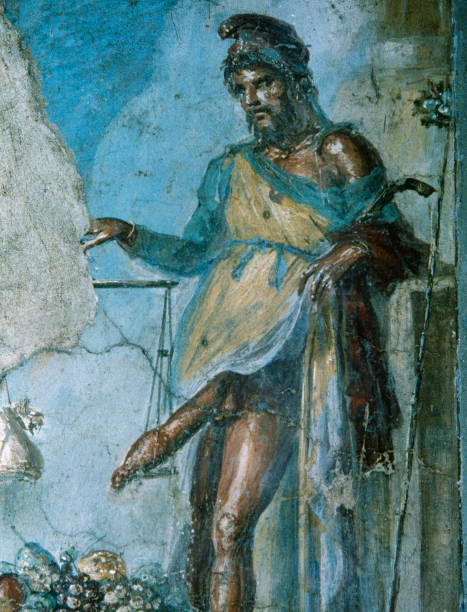
Wall-painting: Priapus weighing his phallus (Pompeii)