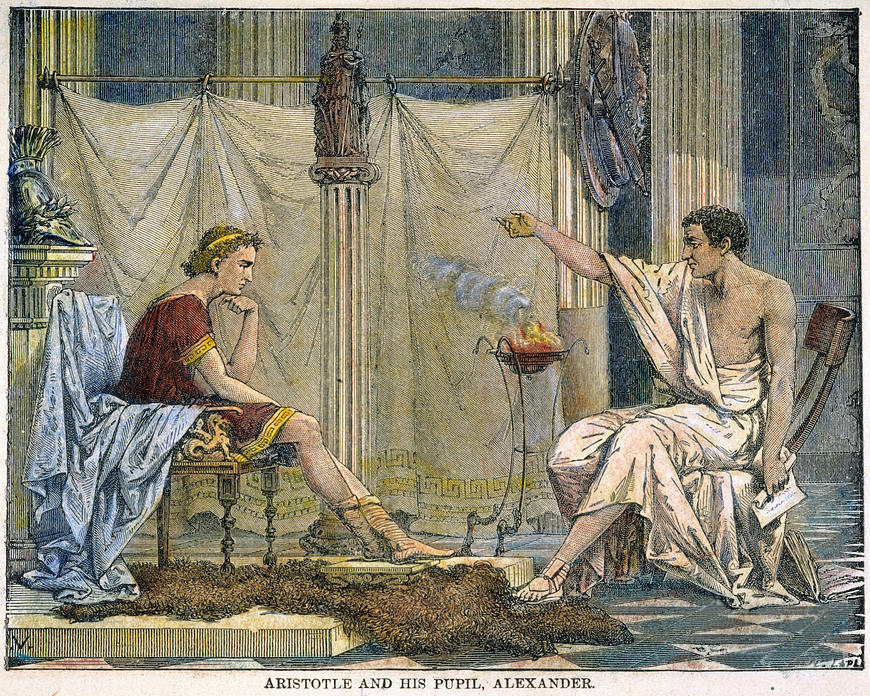
“Knowledge has little or no impact on [acquiring virtues] while the other conditions are not of limited importance but are critical since virtue emerges from doing just and wise things. So, acts are called just and wise when there are the sorts of thing which a just or wise person might do but the just and wise person is not the one who does these things but who does them as wise and just people do.
So, it is well said that a person becomes just and wise from doing just and wise acts and that no one could become good without doing them. But the majority of people don’t do these things, instead they take refuge in talk, thinking that this is philosophy and that they will become good people in this way. They act like injured people who listen carefully to doctors but then do nothing of what they’re told to do.”
James Boswell, Memorandum Friday, October 7th 1763:
You go on charmingly. Be steady and firm. You have told Brown your story, and he will assist you. Begin on Sunday to dine with him. If you please, and the day is good, put on scarlet and gold, and please humour with cockade. Send today for book of maps and read Xenophon with more pleasure. Make commonplace-book of a quire, but don’t bind it. Do like Castillon; mark where different subjects are to be found. Extract from Tacitus, Ovid, Xenophon, Voltaire, and so pick up treasure as you go on. Push scheme of Society. You must allow three hours every evening for amusement. Six hours are enough a day for labour.
Dio Chrysostom, Discourse 6: Diogenes, or, On a Tyrant
“All human terrors have as a solace that they might come to an end. A man in chains can imagine being freed someday; it is not impossible for an exile to get home; and the sick may hope for health right up to death. But it is not possible for a tyrant to escape his state; indeed, he cannot pray for it, unless he prays for something different.
People who have lost friends to death know that they will eventually stop grieving. But problems grow harder for tyrants in contrast. It is not easy for a tyrant to grow old, unlike that proverbial horse [who has less to do]. For those he has hurt and those who despise him grow in number, while he is incapable of helping himself because of his aged body.”
“These men have committed so much horror beyond their own criminal behavior that even while running a so-called democracy they turned each person’s house into a prison and put the police in our homes.”
“For such dealing with criminals, white or black, the South had no machinery, no adequate jails or reformatories; its police system was arranged to deal with blacks alone, and tacitly assumed that every white man was ipso facto a member of that police. Thus grew up a double system of justice, which erred on the white side by undue leniency and the practical immunity of red-handed criminals, and erred on the black side by undue severity, injustice, and lack of discrimination.”
“You have to believe, by god, that he will be no better in the future after getting this judgment from you and will never stop taking bribes against you if you acquit him.”
“The crime was less offensive than the acquittal.”
Minus crimine quam absolutione peccatum est
Demosthenes, On the False Legation
“For your reputation, for your religion, for your safety, for every advantage you have, do not acquit this man—no, exact vengeance upon him to make him an example to everyone, to our citizens and to the rest of the world.”
“This is a domestic problem, in which sometimes it is enough to claim that there was only one crime, or it was just a mistake, or less severe than is claim for an acquittal”
Est enim domestica disceptatio, in qua et semel peccasse et per errorem et levius quam obiciatur absolutioni nonnumquam sufficit.
Dinarchus, Against Demosthenes 29
“Do not acquit this man, citizens, do not acquit and leave unpunished someone who has signed off on the misfortunes of this state and the world, a man who has been caught in corruption against the state….”
“Today you need to change your minds about what you have done. You need to refuse to keep being abused by these people. Don’t reproach those who have done wrong in private! Do not acquit the guilty when it is in your power to punish them.”
“You need to understand that it is impossible for you to acquit. If you ignore the charge when they admit that they are conspiring against the traders, then you will seem to make a judgment against the importers. If they were making up any other kind of defense, no one would criticize a vote to acquit since you can choose to believe whatever side you want. But, as things are now, you can’t imagine you are doing something amazing if you acquit unpunished those who admit that they broke the law!”
“After the dust has soaked up the blood
Of a dying man, there is no resurrection.
My father can’t cast a spell on this
But all other things he can turn back and forth
Without losing his breath at all.”
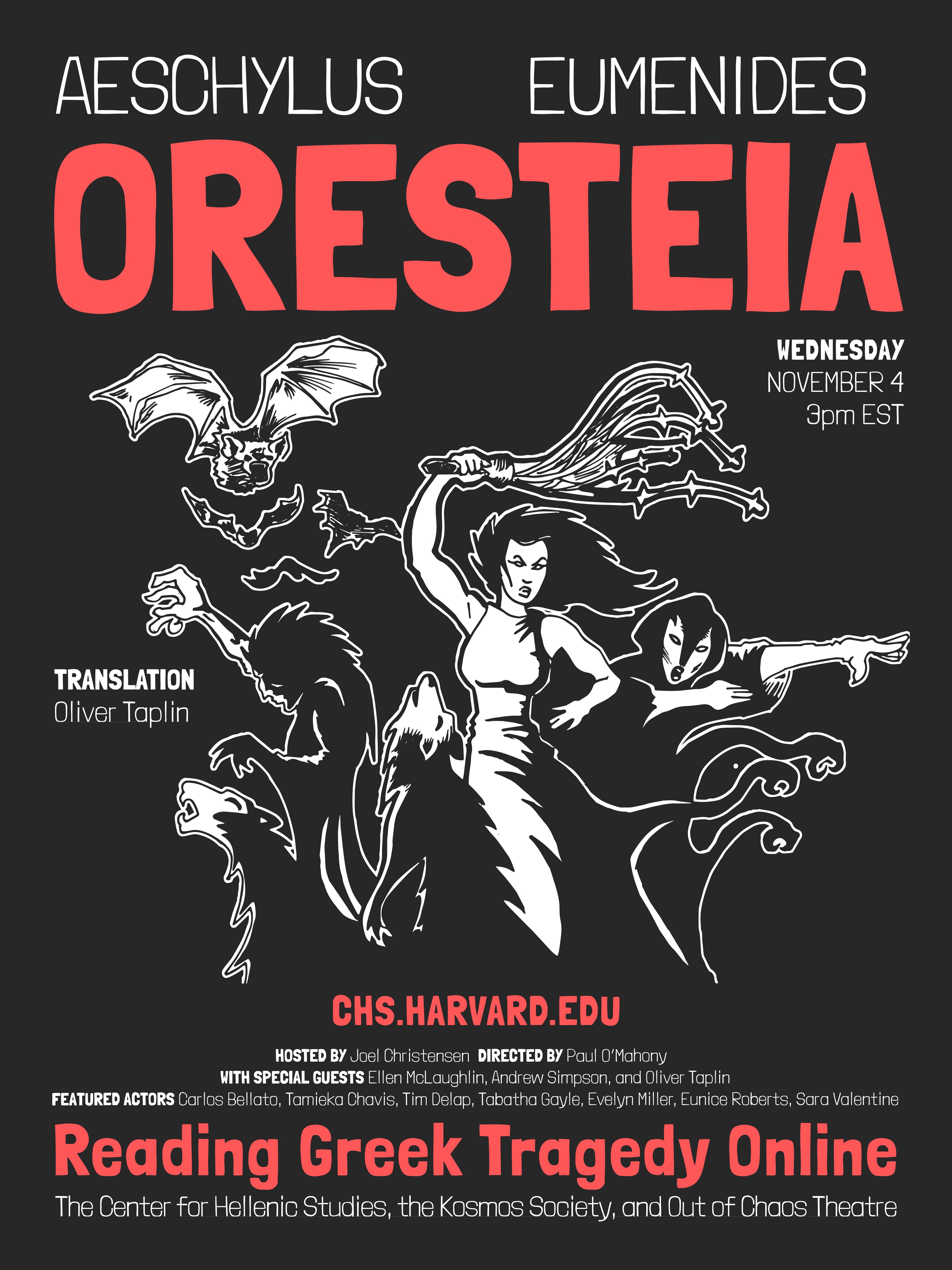
This week brings us the final play of Aeschylus’ Oresteia, the Eumenides. In it. We find a maddened, battered Orestes who fled from his brief ‘victory’ in killing his mother and Aegisthus, hounded by the earth-bound goddesses of vengeance, the Furies. At the start of this play, Orestes manages to evade them in Athens, but they too are chased by the ghost of Klytemnestra who demands vengeance for her murder.
This takes us to the final and elemental conflict of the trilogy, the face-off between justice and vengeance and the creation of trial by jury at Athens. One set of divine mandates insisted that Orestes kill his mother for her murder of his father; another set demands his suffering for killing her. How is this cycle of suffering and vengeance in any way ‘just’?
The Oresteia, like the end of the Odyssey, acknowledges that a cycle of vengeance is ultimately irresolvable and that human anger and suffering demands some other remedy. In this particular version of the tale, the solution arises at Athens, where Athena and Apollo introduce a trial by peers as a solution for the retributive strife that tears states apart.
Aeschylus, Eumenides 696-698
“I advise the citizens to revere
Neither anarchy nor despotism
And never to cast fear out of the city completely.”
Artistic Director: Paul O’Mahony (Out of Chaos Theatre) Associate Director: Liz Fisher Director of Outreach: Amy Pistone (Gonzaga University) Dramaturg: Emma Pauly Executive Producer: Lanah Koelle (Center for Hellenic Studies) Producers: Keith DeStone (Center for Hellenic Studies), Hélène Emeriaud, Janet Ozsolak, and Sarah Scott (Kosmos Society) Poster Artist: John Koelle Poster Designer: Allie Marbry (Center for Hellenic Studies)
Aeschylus, Eumenides 368-369
“Humankind’s delusions so sacred under the sky
Shrink as they melt on the earth without honor.”
October 28 Libation Bearers, Aeschylus; translation by O. Taplin
November 4 Eumenides, Aeschylus
with Ellen McLaughlin (Barnard College) and Andrew Simpson (Catholic Univeristy of America); translation by O. Taplin
November 11 Medea, Euripides
with Fiona Macintosh (University of Oxford)
Orestes Pursued by the Furies by William-Adolphe Bouguereau (1862)
Aeschylus, Eumenides 977-987
“I pray that the insatiable evil
Of civil strife
Will never burn through this state.
May the dust never drink deep the dark blood of our citizens
As it terrorizes the country
In the endless rage of murder meted out for murder.
May we have joy
In our shared view of friendship
And hate with a single focus.
This is a cure of many problems mortals have.”
Since we are all about to be rendered powerless by shameless show trials, why not wrest back for ourselves a gesture appropriate to the tenor of our times.
In Aristophanes’ Peace a rude hand gesture is mentioned (549):
Καὶ τὸν δορυξὸν οἷον ἐσκιμάλισεν.
Perseus’ translation (“this sickle-maker is thumbing his nose at the spear-maker?” ) may not do justice to the gesture or its meaning. Ancient commentary glosses this in a slightly different way. (See this site for a reference to the digitus impudicus in the Clouds)
Schol ad Ar. Pax. 549
Eskimálisen: “instead of he stuck his finger up” for to skimalísai is properly to shove a finger into a bird’s anus. But when people wish to insult someone, they extend their middle finger, retract the rest, and show it.”
Apart from loving this passage’s instructions about how to give a middle finger, I am intrigued by the fact that Greeks gave the middle finger at all and by the chance that the reference to a bird’s anus might provide an amusing folk etymology for why we call it the “bird”. But, first and foremost, we can learn why the Greeks gave the finger.
A popular article in Slate claims that the middle finger is offensive because it is phallic, so sticking it up is like rudely showing someone a penis. Wikipedia says it is all about sexual intercourse. The Greek evidence, however, indicates that while phallic meaning is operative, what one does with the threatened phallus is truly insulting (at hubris levels even!). So, let’s go through some of the extant evidence.
We have some confirmation of the synonymy the scholion indicates between giving the middle finger and sticking a finger in an anus:
Phrynichus, 83.15
Katadaktulizein: “to wantonly touch through the rectum with a finger. Attic Greeks use the term skimalizein.
There is also a proverb recorded that repeats much of the same material as we find in the scholion.
Michal. Apostol. Parom. 7.98
“You should get fingered” : [This is a proverb applied] for those worthy of insult. For skimalísai means when someone wants to insult someone, people raise their middle finger, retract the rest, and show it. Properly, this indicates shoving a finger into a bird’s anus.”
The Suda pretty much provides the same information but with an opening alternative:
“Eskimalisen: [This is when] one insults by joining thumb and middle finger and striking them. Or, instead it means to give the finger [katedaktulise]: for “to finger” is, properly, to place your middle finger into a bird’s anus. But it is not only this: whenever people want to insult someone, they stretch out their middle finger, withdraw the rest, and show it. So Aristophanes says: “[see] how he fingered the spear-maker.”
In another entry we find a more abstract use of the verb with several options for translation. (There is also an explanation about why people are sticking fingers in birds.) Don’t sleep on the Suda: the entry combines agricultural information with an anecdote from philosophy:
Skimalisô: “I treat as nothing; I mock; I grab with a little finger as I would a woman’s ass”. Skimalizein means to examine with a little finger, to see if chickens are about to lay eggs.
When two men were resting above at one of Zeno’s drinking parties, and the one below him was sticking his foot in the other’s ass, and Zeno was doing the same thing to him with his knee, he turned around and said, “what kind of pain do you think you were causing the man below you?”
The entries from the Suda are pretty far removed from the time of Aristophanes’ Peace (only 1500 years or so). Although the steady tradition from the scholia through the lexicographers indicates some consistency, we still need a little more to help flesh this out.
So, a final piece of evidence to wrap this all up. One of the words for the middle finger in Attic Greek is καταπύγων (a meaning attested by both Photius and Hesychius: Καταπύγων: ὁ μέσος δάκτυλος). This word, when not referring to fingers, generally indicates someone “given to unnatural lust” (LSJ) or one who is lecherous, derived from the preposition kata and the noun pugê (buttocks, ass). The point, if I may, is that the middle finger in this colloquialism is directly associated with something that goes deep in the buttocks.
To stay with the assertion in Slate, as the largest finger, the middle finger raised does seem to have a phallic association, but in the Greek usage at least the showing of such a phallic symbol is a threat of its use. Based on the association of the gesture and the word for the middle finger with “wantonness”, the gesture threatens deep anal penetration, a threat like Catullus’ pedicabo (“I will sexually violate your ass”). Google searches will find this answer, but without the pleasant lexical tour!
A FALISCAN BLACK-GLAZED ASKOS | CIRCA 4TH CENTURY B.C. | Ancient Art & Antiquities Auction | Ancient Art & Antiquities, vases | Christie’s from Pinterest
But lest you fear that the gesture is now too base and vulgar to be used, no less a luminary than the philosopher Diogenes employed it:
Diogenes Flips off Demosthenes (Diogenes Laertius, 6.34 and 35)
Once, when some foreigners wanted to see Demosthenes, he put up his middle finger, and said, “this is the Athenian demagogue!”
“[Diogenes] used to say that most people were a single finger away from insanity. If someone walks around holding out his middle finger, he seems nuts. But if he is holding his index, he doesn’t.”
“When Harmodios defeated his lawsuit, as he intended, [Hipparkhos] insulted him. After they invited his sister to come out to carry a basket in a certain procession, they rejected her, claiming they had not invited her at all because she was not good enough. Even as Harmodios took this badly, Aristogeitôn was a great deal angrier. Then all of the arrangements were made for the deed with those who were sympathetic to them but they were waiting for the great Panathenaia festival, because on that day there would be no suspicion at all if the citizens who were going to be part of the procession would be armed.
They had to begin the act, but the others were supposed to take care of the bodyguard immediately. The conspirators were few for safety’s sake, since they hoped that even those who did not know beforehand would be willing to share the struggle for their own freedom necessarily if they had arms in their hands and saw so few acting boldly.”
“But his death is said to have occurred by the more polished people not in the way most believe, because his sister was not allowed to be a basket-bearer in the procession. That’s pretty simplistic. Instead, they say Harmodius was Aristogeitôn’s brother and had been educated by him. For this reason, Aristogeitôn also took pride in educating people and considered Hipparkhos his rival. At the same time, it seems, Harmodios was in love with one of the fine and well-born young men of the day. People use his name but I don’t remember it. This young man was enamored with both Harmodios and Aristogeitôn for a while because they were wise. But when he started hanging out with Hipparkhos, he despised them and they were so pissed off by this slight that they killed Hipparkhos.”
“Dearest Harmodius, you have never died,
But they say you live in the isles of the blest
Where swift-footed Achilles
And Tydeus’ fine son Diomedes are”
“I will wrap my sword with a branch of myrtle,
Just as Harmodius and Aristogeiton did
When at the Athenian sacrifices
They killed the tyrant, a man named Hipparchus”
“Fame will always be yours in this land,
Dearest Harmodios and Aristogeiton,
Because you killed the tyrant
And made the Athenians equal under the law.”
As we say proverbially of pain once alleviated by the delay of time but now renewed that ‘the scar is scraped again’, so too when the vexation of our mind comes back to us, we say ‘the wound is fresh again’ – with an easy transference of these sayings either way. The examples of this are so frequent that none of them ought to be repeated. Cicero in his most charming way brought out that metaphor against Clodius, who was at the time stirring up a people, already exasperated by famine, with his various seditious meetings. He said, ‘As you stand here like a nail upon this ulcer.’
Vt dolor iam temporis mora lenitus, quum renouatur, refricari cicatrix prouerbio dicitur, ita quum redintegratur animi molestia, vulnus recrudescere dicimus, pulcherrima vtrinque translatione. Quae exempla frequentiora sunt, quam vt vllum repeti debeat. Eam metaphoram <M. Tullius•> venustissime extulit in Clodium, qui populum fame iam exasperatum concionibus insuper seditiosis in rabiem agebat: Vt tu, inquit, in hoc vlcere tanquam vnguis existeres.
“The land is full of evils; the sea is full of evils.
Diseases come to humans at day and at night
they come on their own bringing evils to mortals in silence
Since devious Zeus took their voices away.”
“The whole state often suffers because of a wicked man
Who transgresses the gods and devises reckless deeds.
Kronos’ son rains down great pain on them from heaven:
Famine and plague and the people start to perish.
[Women don’t give birth and households waste away
Thanks to the vengeance of Olympian Zeus.] And at other times
Kronos’ son ruins their great army or their wall
Or he destroys their ships on the the sea.”