Four Years of Presidential Memory: The Wages of a Wicked Man, Plague, Broken Walls, Fallen Armies

Hesiod, Works and Days, 101-105

“The land is full of evils; the sea is full of evils.
Diseases come to humans at day and at night
they come on their own bringing evils to mortals in silence
Since devious Zeus took their voices away.”

πλείη μὲν γὰρ γαῖα κακῶν, πλείη δὲ θάλασσα·
νοῦσοι δ’ ἀνθρώποισιν ἐφ’ ἡμέρῃ, αἳ δ’ ἐπὶ νυκτὶ
αὐτόματοι φοιτῶσι κακὰ θνητοῖσι φέρουσαι
σιγῇ, ἐπεὶ φωνὴν ἐξείλετο μητίετα Ζεύς.
οὕτως οὔ τί πη ἔστι Διὸς νόον ἐξαλέασθαι.

Hesiod, Works and Days 240-247

“The whole state often suffers because of a wicked man
Who transgresses the gods and devises reckless deeds.
Kronos’ son rains down great pain on them from heaven:
Famine and plague and the people start to perish.
[Women don’t give birth and households waste away
Thanks to the vengeance of Olympian Zeus.] And at other times
Kronos’ son ruins their great army or their wall
Or he destroys their ships on the the sea.”

πολλάκι καὶ ξύμπασα πόλις κακοῦ ἀνδρὸς ἀπηύρα,
ὅστις ἀλιτραίνῃ καὶ ἀτάσθαλα μηχανάαται.
τοῖσιν δ’ οὐρανόθεν μέγ’ ἐπήγαγε πῆμα Κρονίων,
λιμὸν ὁμοῦ καὶ λοιμόν, ἀποφθινύθουσι δὲ λαοί·
[οὐδὲ γυναῖκες τίκτουσιν, μινύθουσι δὲ οἶκοι
Ζηνὸς φραδμοσύνῃσιν ᾿Ολυμπίου· ἄλλοτε δ’ αὖτε]
ἢ τῶν γε στρατὸν εὐρὺν ἀπώλεσεν ἢ ὅ γε τεῖχος
ἢ νέας ἐν πόντῳ Κρονίδης ἀποτείνυται αὐτῶν.

Ambrogio Lorenzetti – Bad Government and the Effects of Bad Government

Four Years of Presidential Memory: Reasons for Revolutions, Wanting To Be Equal Vs. Wanting Just More

Aristotle, Politics 1302 a

“We have already happened to discuss the reason why people are predisposed towards a revolution. People who desire equality rise up in strife when they believe that they have less even though they are allegedly equal to those they oppose. But those who want inequality or their own superiority imagine that even though they are unequal that don’t have more but merely an equal amount. (Of course, these feelings may exist both justly and unjustly. People who are in a lesser position engage in strife in order to become equal; those who are merely equal, do it to become superior.”

Τοῦ μὲν οὖν αὐτοὺς ἔχειν πως πρὸς τὴν μεταβολὴν αἰτίαν καθόλου μάλιστα θετέον περὶ ἧς ἤδη τυγχάνομεν εἰρηκότες. οἱ μὲν γὰρ ἰσότητος ἐφιέμενοι στασιάζουσιν ἂν νομίζωσιν ἔλαττον ἔχειν ὄντες ἴσοι τοῖς πλεονεκτοῦσιν, οἱ δὲ τῆς ἀνισότητος καὶ τῆς ὑπεροχῆς ἂν ὑπολαμβάνωσιν ὄντες ἄνισοι μὴ πλέον ἔχειν ἀλλ᾿ ἴσον ἢ ἔλαττον (τούτων δ᾿ ἔστι2 μὲν ὀρέγεσθαι δικαίως, ἔστι δὲ καὶ ἀδίκως)· ἐλάττους 30τε γὰρ ὄντες ὅπως ἴσοι ὦσι στασιάζουσι, καὶ ἴσοι ὄντες ὅπως μείζους. πῶς μὲν οὖν ἔχοντες στασιάζουσιν, εἴρηται.

Plutarch, Solon 94 (Full text on the Scaife Viewer)

“The city was following the laws, but they were already expecting a revolution and longing for a different kind of government, not because they were hoping for equality, but because they would have more in a revolution and they would rule over their opposition in every way.”

ὥστε χρῆσθαι μὲν ἔτι τοῖς νόμοις τὴν πόλιν, ἤδη δὲ πράγματα νεώτερα προσδοκᾶν καὶ ποθεῖν ἅπαντας ἑτέραν κατάστασιν, οὐκ ἴσον ἐλπίζοντας, ἀλλὰ πλέον ἕξειν ἐν τῇ μεταβολῇ καὶ κρατήσειν παντάπασι τῶν διαφερομένων.

Four Years of Presidential Memory: A Tyrant and A Plague

N.B This is a different Pythagoras from the one with the theorem.

Suda, s.v. Pythagoras of Ephesos

“Pythagoras of Ephesos. Once he overthrew the government called the reign of the Basilidai, Pythagoras became the harshest tyrant. He seemed and sometimes was very kind to the people and the masses, increasing their hopes, but under-delivering on their profits. Because he despoiled those in high esteem and power and liquidated their property, he was not at all tolerable.

He did not hesitate to impose the harshest punishments or to mercilessly kill those who had done no wrong—for he had gotten just this crazy. His lust for money was endless. He was also quickest to anger in response to any insults to those near to him. On their own, these things would have been enough reason for people to kill him in the worst way, but he also was contemptuous of the divine. Indeed, many of his previously mentioned victims he actually killed in temples.

When the daughters of one man took refuge in a temple, he did not dare to extract them forcefully, but he waited them out so long that the girls resolved their hunger with a rope. A plague then afflicted the people along with a famine and Pythagoras, who was worried for himself, sent representatives to Delphi, requesting relief from these sufferings. She said that he needed to build temples and take care of the dead. He lived before Cyrus of Persia, according to Batôn.”

Πυθαγόρας ᾽Εφέσιος· καταλύσας δι᾽ ἐπιβουλῆς τὴν τῶν Βασιλιδῶν καλουμένην ἀρχήν, ἀνεφάνη τε τύραννος πικρότατος. καὶ τῶι μὲν δήμωι καὶ τῆι πληθύι ἦν τε καὶ ἐδόκει κεχαρισμένος, ἅμα τὰ μὲν αὐτοὺς ἐπελπίζων ὑποσχέσεσιν, τὰ δὲ ὑποσπείρων αὐτοῖς ὀλίγα κέρδη· τούς γε μὴν ἐν ἀξιώσει τε καὶ δυνάμει περισυλῶν καὶ δημεύων φορητὸς οὐδαμὰ οὐδαμῆ ἦν. καὶ κολάσαι δὲ πικρότατα οὐκ ἂν ὤκνησε, καὶ ἀφειδέστατα ἀποκτεῖναι οὐδὲν ἀδικοῦντας (ἐξελύττησε γὰρ εἰς ταῦτα)· ἔρως τε χρημάτων ἄμετρος· καὶ διαβολαῖς ταῖς ἐς τοὺς πλησίους ἐκριπισθῆναι κουφότατος ἦν. ἀπέχρησε μὲν οὖν καὶ ταῦτα ἂν κάκιστα ἀνθρώπων ἀπολέσαι αὐτόν, ἤδη δὲ καὶ τοῦ θείου κατεφρόνει· τῶν γοῦν προειρημένων οἷς ἐπέθετο παμπόλλους ἐν τοῖς ναοῖς ἀπέκτεινεν, ἑνὸς δὲ τὰς θυγατέρας καταφυγούσας εἰς τὸ ἱερὸν ἀναστῆσαι μὲν βιαίως οὐκ ἐτόλμησε, συνεχῆ δὲ φυλακὴν ἐπιστήσας ἐξετρύχωσεν ἄρα ἐς τοσοῦτον, ὡς βρόχωι τὰς κόρας τὸν λιμὸν ἀποδρᾶναι. οὐκοῦν ἠκολούθησε δημοσίαι νόσος καὶ τροφῶν ἀπορία· καὶ σαλεύων ὑπὲρ ἑαυτοῦ ὁ Πυθαγόρας εἰς Δελφοὺς ἀπέστειλε καὶ ἤιτει λύσιν τῶν κακῶν. ἡ δὲ ἕφη νεὼν ἀναστῆσαι καὶ κηδεῦσαι τοὺς νεκρούς. ἦν δὲ πρὸ Κύρου τοῦ Πέρσου, ὥς φησι Βάτων.

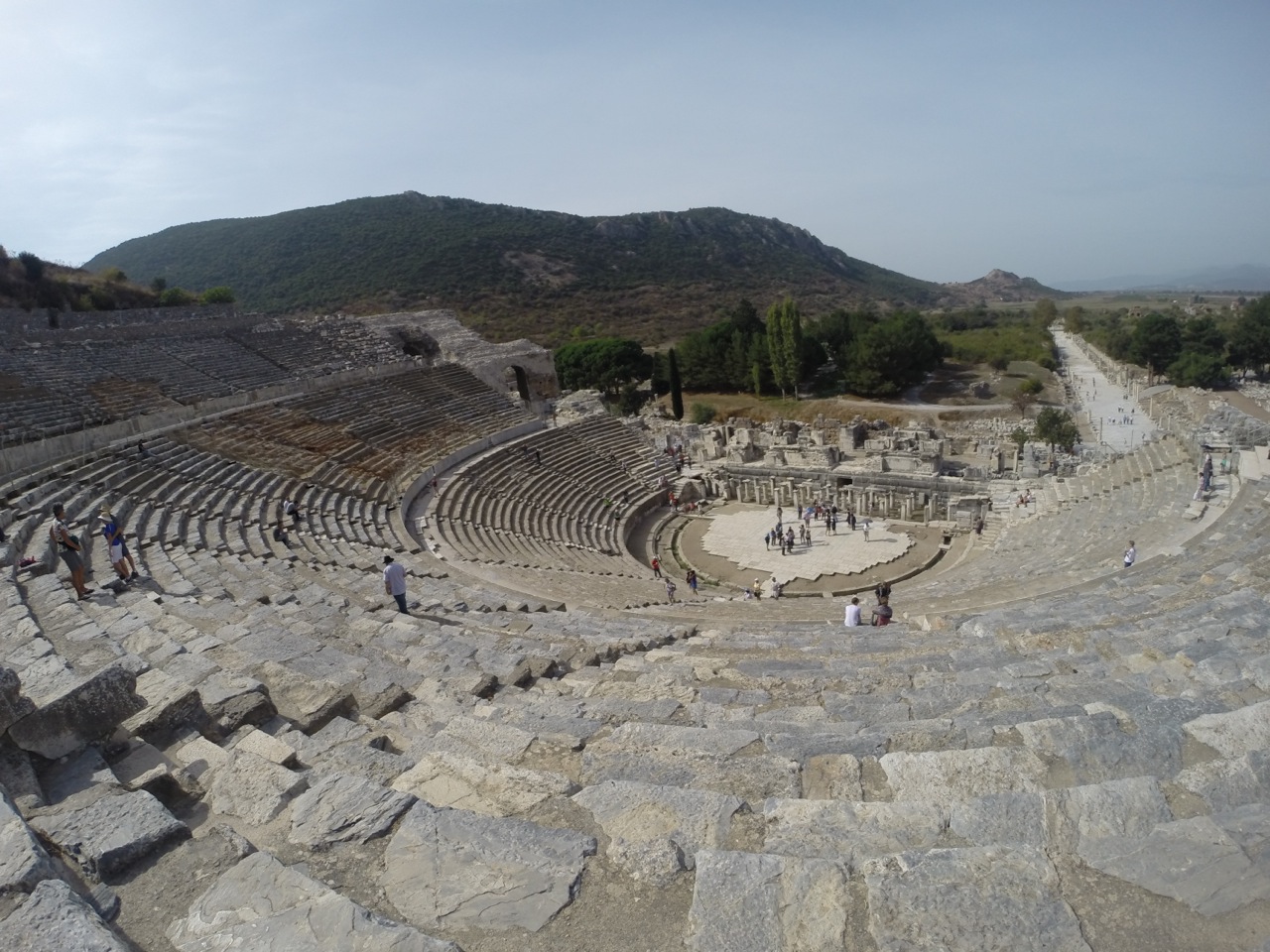
Ancient Theater at Ephesus

Four Years of Presidential Memory: Another Plague, Profiteering

For more on how leaders make plagues worse, look around, or go here.

Philo, On the Virtues 92

“They were so messed up in the mind and so obsessed with making money, they treated every kind of profit as if they were dying”

εἰσὶ δ᾿ οἳ οὕτως ῥυπῶσι τὰς διανοίας προστετηκότες ἀργυρισμῷ καὶ δυσθανατῶντες περὶ πᾶσαν ἰδέαν κέρδους

Plato, Laws 906c (Full text on the Scaife Viewer)

“But there are some souls who live with us on the earth and have come to possess unjust profit, which is clearly inhuman. They implore the guards, whether they are shepherds or guard-dogs, or the highest of all masters as they beg them, trying to persuade them with pleasing words and enchanting spells—as the stories of evil men go. They are able to profiteer among human beings without suffering anything!

But we say that the crime we call now “profiteering” is the same as a disease in the body’s flesh, or what we would call a plague in some seasons and years, or what, once the word is translated, is injustice itself in cities and states.”

ψυχαὶ δή τινες ἐπὶ γῆς οἰκοῦσαι καὶ ἄδικον λῆμμα κεκτημέναι, δῆλον ὅτι θηριώδεις πρὸς τὰς τῶν φυλάκων ψυχὰς ἄρα κυνῶν ἢ τὰς τῶν νομέων ἢ πρὸς τὰς τῶν παντάπασιν ἀκροτάτων δεσποτῶν προσπίπτουσαι πείθουσι θωπείαις λόγων, καὶ ἐν εὐκταίαις τισὶν ἐπῳδαῖς, ὡς αἱ φῆμαί φασιν αἱ τῶν κακῶν, ἐξεῖναι πλεονεκτοῦσι σφίσιν ἐν ἀνθρώποις πάσχειν μηδὲν χαλεπόν. φαμὲν δ᾿ εἶναί που τὸ νῦν ὀνομαζόμενον ἁμάρτημα τὴν πλεονεξίαν ἐν μὲν σαρκίνοις σώμασι νόσημα  καλούμενον, ἐν δὲ ὥραις ἐτῶν καὶ ἐνιαυτοῖς λοιμόν, ἐν δὲ πόλεσι καὶ πολιτείαις τοῦτο αὐτό, ῥήματι μετεσχηματισμένον, ἀδικίαν.

Theognis, 725-726

“No one goes to Hell with all his precious possessions”

… τὰ γὰρ περιώσια πάντα/ χρήματ’ ἔχων οὐδεὶς ἔρχεται εἰς ᾿Αίδεω

Image result for ancient greek money hoard
Money hoard. From the Smithsonian Magazine

Four Years of Presidential Memories: Hated By the People, Plotted Against by Friends

Diodorus Siculus, The Library of History 37.22a (Partial text on Lacus Curtius)

“Sertorius, when he noticed that the uprising among the indigenous people was overwhelming, turned nasty to his allies: he accused some and had them killed; others he threw into prison; but he liquidated the wealth of the richest men. Even though he acquired a great deal of gold and silver this way, he did not put any of it into the public treasury for the war effort, instead he hoarded it for himself. He didn’t use it to pay the soldiers either or even share some of it with his commanders.

When it came to capital cases, he did not consult the council or advisers, but had hearings in private and gave judgments after serving as the solitary judge. He did not consider his commanders worthy of invitations to his banquets and demonstrated no beneficence to his friends. As he was generally driven mad by the worsening state of his own rule, he acted tyrannically toward everyone: he was hated by the people and conspired against by his friends.”

Ὅτι ὁ Σερτώριος θεωρῶν ἀκατάσχετον οὖσαν τὴν ὁρμὴν τῶν ἐγχωρίων πικρῶς προσεφέρετο τοῖς συμμάχοις, καὶ τοὺς μὲν καταιτιώμενος ἀπέκτεινεν, τοὺς δὲ εἰς φυλακὴν παρεδίδου, τῶν δὲ εὐπορωτάτων ἐδήμευε τὰς οὐσίας. πολὺν δὲ ἄργυρον καὶ χρυσὸν ἀθροίσας οὐκ εἰς τὸ κοινὸν τοῦ πολέμου ταμιεῖον κατετίθετο, ἀλλ᾿ ἰδίᾳ ἐθησαύριζεν· οὔτε τοῖς στρατιώταις ἐχορήγει τὰς μισθοφορίας, οὔτε τοῖς ἡγεμόσι μετεδίδου τούτων, οὔτε τὰς κεφαλικὰς κρίσεις μετὰ συνεδρίου καὶ συμβούλων ἐποιεῖτο, διακούων δὲ ἰδίᾳ καὶ μόνον κριτὴν ἑαυτὸν ἀποδείξας ἐποιεῖτο τὰς ἀποφάσεις· εἴς τε τὰ σύνδειπνα τοὺς ἡγεμόνας οὐκ ἠξίου παραλαμβάνειν, οὐδὲ φιλανθρωπίας οὐδεμιᾶς μετεδίδου τοῖς φίλοις. καθόλου δὲ διὰ τὴν ἐπὶ τὸ χεῖρον ἐπίδοσιν τῆς περὶ αὐτὸν ἐξουσίας ἀποθηριωθεὶς τυραννικῶς ἅπασιν προσεφέρετο. καὶ ἐμισήθη μὲν ὑπὸ τοῦ πλήθους, ἐπεβουλεύθη δὲ ὑπὸ τῶν φίλων.

Quintus Sertorius by Gerard van der Kuijl

The Obscure Logic Of Elections

Cicero, Pro Murena 35-36 (Full text on the Scaife Viewer)

“What strait or what channel do you imagine has as many currents, twists, and tide changes as the disturbances in the breaking waves produced by elections? A missed day or extra night often changes everything and a small whisper of a rumor can transform public opinion.

Often too, something happens without any clear reason and and you notice how the people are frequently amazed at what happened, as if they didn’t do it themselves! Nothing is more uncertain than a mob; nothing is less clear than what people want; nothing is more obscure than the whole logic of elections!”

Quod enim fretum, quem Euripum tot motus, tantas, tam varias habere putatis agitationes commutationesque fluctuum, quantas perturbationes et quantos aestus habet ratio comitiorum? Dies intermissus aut nox interposita saepe perturbat omnia, et totam opinionem parva non numquam commutat aura rumoris. Saepe etiam sine ulla aperta causa fit aliud atque existimaris, ut non numquam ita factum esse etiam populus admiretur, quasi vero non ipse fecerit. Nihil est incertius volgo, nihil obscurius voluntate hominum, nihil fallacius ratione tota comitiorum. 

Four Years of Presidential Memory: Oligarchy and Plutocracy

Menander Rhetor, 1.16. How to Praise Cities…

“There are three kinds of governments: monarchy, aristocracy, and democracy. There is bad form which corresponds to each: Tyranny is the worse form of monarchy; oligarchy and also plutocracy are the bad form of aristocracy; and mob rule is the worse kind of democracy. In addition to these, sometimes there is one with elements from all of them, like the Roman Empire or ancient Sparta….

“Where offices are occupied by those who fulfill what is needed by the law, then he considered the state to be an aristocracy. Where they were filled by those who had the most money, a plutocracy; where everyone could serve, a democracy.”

Πολιτεῖαι μέν εἰσι τρεῖς, βασιλεία, ἀριστοκρατία, δημοκρατία, ταύταις δὲ παρακείμεναί εἰσι κακίαι, βασιλείᾳ μὲν τυραννίς, ἀριστοκρατίᾳ δὲ ὀλιγαρχία καὶ πλουτοκρατία λεγομένη, δημοκρατίᾳ δὲ λαοκρατία. παρὰ πάσας δὲ ταύτας ἡ μικτὴ ἐκ πάντων τούτων, ὁποία ἥ τε Ῥωμαϊκὴ καὶ ἡ Λακωνικὴ τὸ παλαιόν.

καὶ ὅπου μὲν ἐκ τῶν  τὰ νόμιμα ἐπιτελούντων αἱ ἀρχαὶ καθίστανται, ταύτην μὲν τὴν πολιτείαν ἀριστοκρατίαν ἐνόμιζεν εἶναι, ὅπου δ’ ἐκ τιμημάτων, πλουτοκρατίαν, ὅπου δ’ ἐκ πάντων, δημοκρατίαν.

“if the state is a plutocracy, [praise it] as if it were really an aristocracy”

εἰ δὲ πλουτοκρατουμένην, ὡς ἀριστοκρατουμένην εἰ δὲ πλουτοκρατουμένην, ὡς ἀριστοκρατουμένην·

Xenophon, Memorabilia 4.16.12 (Full text on the Scaife Viewer)

“[Socrates] believed that kingship and tyranny were both governments but that they differed from one another. For he believed that kingship was government of a willing people and according to the laws of the city, while tyranny was when people were unwilling and against the laws, but instead according to the wishes of the ruler. Whenever leaders were selected from those who meet the standards of the law, the government is in aristocracy. When they are chosen from those who have enough property, it is a plutocracy. When they are elected from everyone, it is a democracy.”

Βασιλείαν δὲ καὶ τυραννίδα ἀρχὰς μὲν ἀμφοτέρας ἡγεῖτο εἶναι, διαφέρειν δὲ ἀλλήλων ἐνόμιζε. τὴν μὲν γὰρ ἑκόντων τε τῶν ἀνθρώπων καὶ κατὰ νόμους τῶν πόλεων ἀρχὴν βασιλείαν ἡγεῖτο, τὴν δὲ ἀκόντων τε καὶ μὴ κατὰ νόμους, ἀλλ᾿ ὅπως ὁ ἄρχων βούλοιτο, τυραννίδα. καὶ ὅπου μὲν ἐκ τῶν τὰ νόμιμα ἐπιτελούντων αἱ ἀρχαὶ καθίστανται, ταύτην μὲν τὴν πολιτείαν ἀριστοκρατίαν ἐνόμιζεν εἶναι, ὅπου δ᾿ ἐκ τιμημάτων, πλουτοκρατίαν, ὅπου δ᾿ ἐκ πάντων, δημοκρατίαν.

Aristotle, Politics 2.7 (1273a-1273b)

“If election based on wealth is oligarchic while election according to excellence is aristocratic, there can be a third system according to which a state is organized as the Carthaginian polity is constructed. For they choose their leaders looking at two issues, especially the most significant offices, that of kings and generals.

But it is right to think that this departure from aristocracy is an error by the lawmaker. For among the most critical issues to consider from the beginning is how the best citizens might be able to have the free time and to refrain from anything inappropriate, both in office and in their private life. If it is right to consider furnishing the means for free time [to rule], it is bad for the most significant positions to be for sale (the kingship and the generalship).

For this law makes wealth more important than virtue and makes the whole state structured around money. Whatever the power structure considers valuable, the opinion of the rest of the citizens will follow. Wherever virtue is not honored above all else, the constitution cannot be aristocratic. It is also likely that those who purchase their offices will make a profit from them when they rule after spending their own money. For, it would be strange if a respectable man who is poor will want to profit but a corrupt man who has spent his own money would be disinclined to do the same.”

εἴπερ οὖν τὸ μὲν αἱρεῖσθαι πλουτίνδην ὀλιγαρχικὸν τὸ δὲ κατ᾿ ἀρετὴν ἀριστοκρατικόν, αὕτη τις ἂν εἴη τάξις τρίτη καθ᾿ ἥνπερ συντέτακται καὶ τοῖς Καρχηδονίοις τὰ περὶ τὴν πολιτείαν· αἱροῦνται γὰρ εἰς δύο ταῦτα βλέποντες, καὶ μάλιστα τὰς μεγίστας, τούς τε βασιλεῖς καὶ τοὺς στρατηγούς. δεῖ δὲ νομίζειν ἁμάρτημα νομοθέτου6 τὴν παρέκβασιν εἶναι τῆς ἀριστοκρατίας ταύτην· ἐξ ἀρχῆς γὰρ τοῦθ᾿ ὁρᾶν ἐστὶ τῶν ἀναγκαιοτάτων, ὅπως οἱ βέλτιστοι δύνωνται σχολάζειν καὶ μηδὲν ἀσχημονεῖν, μὴ μόνον ἄρχοντες ἀλλὰ μηδ᾿ ἰδιωτεύοντες. εἰ δὲ δεῖ βλέπειν καὶ πρὸς εὐπορίαν χάριν σχολῆς, φαῦλον τὸ τὰς μεγίστας ὠνητὰς εἶναι τῶν ἀρχῶν, τήν τε βασιλείαν καὶ τὴν στρατηγίαν. ἔντιμον γὰρ ὁ νόμος οὗτος ποιεῖ τὸν πλοῦτον μᾶλλον τῆς ἀρετῆς καὶ τὴν πόλιν ὅλην φιλοχρήματον· ὅ τι δ᾿ ἂν ὑπολάβῃ τίμιον εἶναι τὸ κύριον, ἀνάγκη καὶ τὴν τῶν ἄλλων πολιτῶν δόξαν ἀκολουθεῖν τούτοις· ὅπου δὲ μὴ μάλιστα ἀρετὴ τιμᾶται, ταύτην οὐχ οἷόν τ᾿ εἶναι βεβαίως ἀριστοκρατικὴν πολιτείαν. ἐθίζεσθαι δ᾿ εὔλογον κερδαίνειν τοὺς ὠνουμένους, ὅταν δαπανήσαντες ἄρχωσιν· ἄτοπον γὰρ εἰ πένης μὲν ὢν ἐπιεικὴς δὲ βουλήσεται κερδαίνειν, φαυλότερος δ᾿ ὢν οὐ βουλήσεται δαπανήσας.

From the Oxford English dictionary

Plutocracy

Some Words:

πλουθυγίεια: “wealth and health”

πλούταξ: “a rich churl”

πλούταρχος: “master of riches”

πλουτογαθής: “delighting in riches”

πλουτοκρατέομαι: “to live in a state governed by the rich”

πλουτοκρατία: “an oligarchy of wealth

πλουτοποιός: “enriching”

πλουτοτραφής: “raised on wealth”

πλουτόχθων: “rich in things of the earth”

Polybius, Histories 6.4

“The proof that what I have said is true comes from the following. It must not be asserted that every well-made government is a principality, but only the government which is assented to voluntarily and which is governed by reason rather than fear and force. Nor should we consider every oligarchy to be an aristocracy: the latter emerges only when men rule because they are the most just and the most prudent. In a similar way, a true democracy is not that in which the majority has the power to do whatever it wants, but what counts is if the will of the majority enforces observance of its traditional laws, honor to the customary laws, duty to parents, respect to elders, obedience to the laws—then it is right to call a state a democracy.

From this, we can isolate six types of government: the three I have just mentioned and three additional, related forms, monarchy, oligarchy, and mob rule. The first of these, monarchy, arises naturally, and without machination. The second follows it and develops from it with preparation and adjustment. Once this has transformed into the evil form akin to it, tyranny, and aristocracy develops from the dissolution of both. When aristocracy devolves into oligarchy as is natural, and the people turn into rage over the injustice of their leaders, democracy emerges. Over time, mob-rule develops from outrage and illegality. Anyone can understand clearly from this pattern that the things I am saying now are true, based on the nature of each government in its origins and its evolution.”

polybius

ὅτι δ᾽ ἀληθές ἐστι τὸ λεγόμενον ἐκ τούτων συμφανές. [2] οὔτε γὰρ πᾶσαν δήπου μοναρχίαν εὐθέως βασιλείαν ῥητέον, ἀλλὰ μόνην τὴν ἐξ ἑκόντων συγχωρουμένην καὶ τῇ γνώμῃ τὸ πλεῖον ἢ φόβῳ καὶ βίᾳ κυβερνωμένην: [3] οὐδὲ μὴν πᾶσαν ὀλιγαρχίαν ἀριστοκρατίαν νομιστέον, ἀλλὰ ταύτην, ἥτις ἂν κατ᾽ ἐκλογὴν ὑπὸ τῶν δικαιοτάτων καὶ φρονιμωτάτων ἀνδρῶν βραβεύηται. [4] παραπλησίως οὐδὲ δημοκρατίαν, ἐν ᾗ πᾶν πλῆθος κύριόν ἐστι ποιεῖν ὅ, [5] τι ποτ᾽ ἂν αὐτὸ βουληθῇ καὶ πρόθηται παρὰ δ᾽ ᾧ πάτριόν ἐστι καὶ σύνηθες θεοὺς σέβεσθαι, γονεῖς θεραπεύειν, πρεσβυτέρους αἰδεῖσθαι, νόμοις πείθεσθαι, παρὰ τοῖς τοιούτοις συστήμασιν ὅταν τὸ τοῖς πλείοσι δόξαν νικᾷ, τοῦτο καλεῖν δεῖ δημοκρατίαν. διὸ καὶ γένη μὲν ἓξ εἶναι ῥητέον πολιτειῶν, [6] τρία μὲν ἃ πάντες θρυλοῦσι καὶ νῦν προείρηται, τρία δὲ τὰ τούτοις συμφυῆ, λέγω δὲ μοναρχίαν, ὀλιγαρχίαν, ὀχλοκρατίαν. [7] πρώτη μὲν οὖν ἀκατασκεύως καὶ φυσικῶς συνίσταται μοναρχία, ταύτῃ δ᾽ ἕπεται καὶ ἐκ ταύτης γεννᾶται μετὰ κατασκευῆς καὶ διορθώσεως βασιλεία. [8] μεταβαλλούσης δὲ ταύτης εἰς τὰ συμφυῆ κακά, λέγω δ᾽ εἰς τυραννίδ᾽, αὖθις ἐκ τῆς τούτων καταλύσεως ἀριστοκρατία φύεται. [9] καὶ μὴν ταύτης εἰς ὀλιγαρχίαν ἐκτραπείσης κατὰ φύσιν, τοῦ δὲ πλήθους ὀργῇ μετελθόντος τὰς τῶν προεστώτων ἀδικίας, γεννᾶται δῆμος. [10] ἐκ δὲ τῆς τούτου πάλιν ὕβρεως καὶ παρανομίας ἀποπληροῦται σὺν χρόνοις ὀχλοκρατία. [11] γνοίη δ᾽ ἄν τις σαφέστατα περὶ τούτων ὡς ἀληθῶς ἐστιν οἷα δὴ νῦν εἶπον, ἐπὶ τὰς ἑκάστων κατὰ φύσιν ἀρχὰς καὶ γενέσεις καὶ μεταβολὰς ἐπιστήσας.

Image result for Medieval manuscript elections

Shocked at Electoral Outcomes

Seneca, De Vita Beata 1.5

“But now the people—in defense of their own wickedness—act against reason indeed. And so, as unstable fancy flits full circle, that same thing happens as in elections in which those who selected people for office are also shocked that those very people are in office!

We approve the same things we criticize! This is the outcome of every judgment which gives preference to the majority.”

Nunc vero stat contra rationem defensor mali sui populus. Itaque id evenit quod in comitiis, in quibus eos factos esse praetores idem qui fecere mirantur, cum se mobilis favor circumegit. Eadem probamus, eadem reprehendimus; hic exitus est omnis iudicii, in quo secundum plures datur.

Cain, by Henri Vidal 1896

Four Years of Presidential Memories: A Student Debt Proposal, Collect The Balance In Hell

This charming detail from Valerius Maximus might be the perfect rider for an education bill right about now…

Valerius Maximus, Wondrous Deeds and Sayings 2.6.10

“This ancient custom of the Gauls returns to my mind as I leave their walls: The story goes that they used to loan money which was scheduled to be repaid in the underworld, because they considered human souls to be immortal. I would call them fools if they didn’t believe the same thing wearing pants as Pythagoras did wrapped in his cloak.”

Horum moenia egresso vetus ille mos Gallorum occurrit,quo[s] memoria proditum est pecunias mutuas, quae iis apud inferos redderentur, da<ri soli>tas,  quia persuasum habuerint animas hominum immortales esse. dicerem stultos, nisi idem bracati sensissent quod palliatus Pythagoras credidit.

Image result for Ancient Roman Loans

Four Years of Presidential Memories: A Vote for the Whole Country

Dinarchus, Against Philocles 19-20

“It is right, citizens, that you consider this and remember the current times: you need good faith, not corruption. You need to hate wicked men, cleanse the city of these kinds of monsters, and show all people that the majority of the people have not been ruined by a few politicians and generals. We are not slaves to their opinions because we know that we can easily defend ourselves with justice and values shared with each other as long as the gods favor us if anyone attacks us unjustly. But we know equally that no city will be preserved through corruption, betrayal and the values of wicked men like these.

For this reason, citizens, do not heed any request nor pity. Do not acknowledge the truth of the guilt which you have seen made against the injustice of the acts. […] But all of you help your common country and the laws, since both of these are being tried now against this man’s wickedness. You are about to cast a vote for the whole country, both for the established religions and the ancient laws and the constitution which was prepared for you by your forebears.”

Ἅ χρὴ λογισαμένους ὑμᾶς πάντας, ὦ Ἀθηναῖοι, καὶ τῶν παρόντων καιρῶν ἀναμνησθέντας, οἳ πίστεως οὐ δωροδοκίας δέονται, μισεῖν τοὺς πονηρούς, ἀνελεῖν ἐκ τῆς πόλεως τὰ τοιαῦτα θηρία, καὶ δεῖξαι πᾶσιν ἀνθρώποις ὅτι οὐ συνδιέφθαρται τὸ τοῦ δήμου πλῆθος τῶν ῥητόρων καὶ τῶν στρατηγῶν τισιν, οὐδὲ δουλεύει ταῖς δόξαις, εἰδότας ὅτι μετὰ μὲν δικαιοσύνης καὶ τῆς πρὸς ἀλλήλους ὁμονοίας ῥᾳδίως ἀμυνούμεθα, θεῶν ἵλεων ὄντων, ἐάν τινες ἡμῖν ἀδίκως ἐπιτιθῶνται, μετὰ δὲ δωροδοκίας καὶ προδοσίας καὶ τῶν ὁμοίων τούτοις κακῶν, ἃ τοῖς τοιούτοις ἀνθρώποις πρόσεστιν, οὐδεμί᾿ ἂν πόλις σωθείη.

μηδεμίαν οὖν δέησιν, ὦ Ἀθηναῖοι, μηδ᾿ ἔλεον εἰς ὑμᾶς λαμβάνοντες αὐτούς, μηδὲ τὴν ἐξ αὐτῶν τῶν ἔργων καὶ τῆς ἀληθείας ἀποδεδειγμένην ὑμῖν κατὰ τῶν κρινομένων ἀδικίαν . . . ἄκυρον ποιήσαντες, βοηθήσατε κοινῇ τῇ πατρίδι καὶ τοῖς νόμοις· ταῦτα γὰρ ἀμφότερα διαδικάζεται νῦν πρὸς τὴν τούτου πονηρίαν. ὑπὲρ πάσης, ὦ Ἀθηναῖοι, τῆς χώρας νῦν μέλλετε φέρειν τὴν ψῆφον καὶ τῶν ἐν ταύτῃ κατεσκευασμένων ἱερῶν καὶ τῶν ἀρχαίων νομίμων καὶ τῆς παραδεδομένης ὑπὸ τῶν προγόνων ὑμῖν πολιτείας.

Image result for Demosthenes
Demosthenes from the Yale University Art Gallery