“Certainly, whenever there is some mass or malignancy of humors or a blockage or some wasting force invades the body, there is a danger previously absent that a person will get sick and there are times when this risk is severe. These types of causes are hard to diagnose because the person doesn’t feel any pain yet.
This is like the infection from a rabid dog: there’s no particular sign in the body before the person afflicted comes near madness. These kinds of causes make it necessary, therefore, that the doctor inquire from patients about everything that happened to them.”
“He also levied a tax of three on every thousand so that people, distressed by these charges, would note also that families of equal wealth whose lives were modest and simple paid less to the public treasury and repent from their behavior.
Both those who paid the taxes because of luxury and those who gave up their luxury because of the taxes were angry to him. For most people believe that hindering the display of their wealth deprives them of it and also that the display comes from their luxuries not their necessities.
This is what they say really surprised Ariston the philosopher, that those who possess superficial excess are thought to be luckier than those who are well-supplied with what is needed and useful.”
After over 35 episodes, we return this week to Thebes with Sophocles’ Oedipus at Colonus. Although this play was written near the end of Sophocles’ life, it takes place between the events of his earlier Antigone and Oedipus Tyrannos. Often people casually assume that these three plays are part of the same trilogy, when in fact they were written in very different periods: Antigone appeared 10 years before the Peloponnesian War (441 BCE) as Pericles became the pre-eminent Athenian politician while Tyrannos was performed after the onset of the war and, likely, at the beginning of the famous plague. Colonus comes nearly a generation later. While scholars debate its exact performance and composition dates, it seems likely that it was one of the final plays Sophocles wrote before his death in 406/5 and that his son produced the play after the fall of Athens (perhaps as late as 401 BCE).
There is a belatedness to this play, an air of revision and reconsideration as we find Oedipus reflecting on his actions and the limits of his agency. It part, like many Athenian plays, this tragedy is about the reception of the mythical past. Its themes, moreover, also respond to contemporary (and modern) concerns from the crisis of immigration and exile to the very notion of what constitutes a community in times of struggle and civil strife. Within this, however, there remains the essential Oedipal question about identity and knowledge. How do we know who we are and understand our place in the world? What is our responsibility to our community? How do we define our community? And, perhaps most important for Oedipus, Athens, and our world today: how do we stay who we are when everything falls apart?
Sophocles, Oedipus at Colonus 258-259
“What use is a good reputation? What good is Fame flowing off to no end?”
“….for you do not fear My name or my actions, since you know That I suffered the actions instead of doing them, If you must speak of what my mother and father did— These are the reasons you fear me. I know this well. How could I be evil in nature When I acted after being hurt so that even if I understood what I was doing, I could not have been bad? I got to where I did understanding nothing, But I was ruined by those who understood what was happening.”
“Would you say that the city agreed properly then To give me the one gift I wanted? No, not at all, when on the day itself when My rage was burning, and it was my sweetest wish To die by stoning—well, No one was trying to help me with that desire.”
Chorus – Petra McGregor, Jesse McLaughlin, Vincent Agnello
Special Guests: Laura Slatkin
Sophocles, Oedipus at Colonus 562-568
“I know that I was raised as an exile, Like you, and as man in exile I toiled In the face of the greatest risks to my life– That’s why I would never turn away an exile like you are now, since I know I am only a man And I have no greater share of tomorrow than you.”
Artistic Director: Paul O’Mahony (Out of Chaos Theatre) Associate Director: Liz Fisher Director of Outreach: Amy Pistone (Gonzaga University) Dramaturg: Emma Pauly Executive Producer: Lanah Koelle (Center for Hellenic Studies) Producers: Keith DeStone (Center for Hellenic Studies), Hélène Emeriaud, Janet Ozsolak, and Sarah Scott (Kosmos Society) Poster Artist: John Koelle Poster Designer: Allie Marbry (Center for Hellenic Studies)
Sophocles, Oedipus at Colonus 1211-1223
“Whoever longs for a greater portion Of living beyond what is enough Will seem clearly to me To be guarding foolishness. Since the long days set out Many things closer to pain And you can’t see where pleasure is, Whenever someone stumbles into more Than is needed. But as an ally equal to all, Hades is a revelation Without a song, a dance, or a wedding, That fate of death at the end.
Tuesday, December 8 – Wednesday, December 9Odyssey ‘round the world – a special 24-hour event featuring performances of every rhapsody of the Odyssey recorded by students, faculty, and actors around the world. View the schedule.
December 9 Performing Epic: The Odyssey with Suzanne Lye (University of North Carolina at Chapel Hill), Leonard Muellner (Brandeis University), Sheila Murnaghan (University of Pennsylvania), and Greg Nagy (Harvard University); translation by Stanley Lombardo, courtesy of Hackett Publishing Company
December 16 Cyclops, Euripides with Carl Shaw (New College of Florida)
December23 Series Finale: Frogs, Aristophanes
Sophocles, Oedipus at Colonus 607-615
“Most dear son of Aegeus, only the gods don’t age Or ever die, but that wrestler time Eventually wears everything else out. The earth’s strength wanes, the body’s strength fades, Trust dies and distrust waxes stronger, Breath never lands the same among friends Nor between cities who were once allied. Some things that are pleasing now turn bitter In later time, but then friendship comes again in turn.”
Pericles, having lost his sons in the plague, bore their loss in the most manly way, and persuaded all the Athenians to bear the deaths of their friends with a happier spirit.
Xanthippe said that while a thousand disasters had taken hold of the city and themselves, in the midst of all of them Socrates could be seen with the same face both when leaving and when coming back to the house. He was agreeably equipped for everything, and he was always gracious in mind, above all pain, and stronger than every fear.
The following poems are taken from the Greek Anthology.
Philippos, 11.321
“Grammarians, children of hateful Blame, thorn-worms
Book-monsters, whelps of Zenodotus,
Soldiers of Kallimakhos, a man you project like a shield
But do not spare from your tongue,
Hunters of grievous conjunctions who take pleasure
In min or sphin* and in asking if the Cyclops kept dogs,
May you wear out your lives, wretches, muttering over the abuse
Of others. Come sink your arrow in me!”
“Useless race of grammarians, digging at the roots of
Someone else’s poetry, luckless worms who walk on thorns,
Perverters of great art, boasting over your Erinna*,
Bitter, parched watchdogs of Kallimakhos,
Rebukes to poets, death’s shade to children learning,
Go to hell, you fleas that secretly bite eloquent men.”
“Goodbye, men whose eyes have wandered over the universe,
And you thorn-counting worms of Aristarchus.
What’s it to me to examine which paths the Sun takes
Or whose son Proteus was or who was Pygmalion?
I would know as many works whose texts are clean. But let
The dark inquiry rot away the Mega-Kallimakheis!”
One of the most iconic images of Oedipus in the 5th century BCE depicts the moment of his interview with the Sphinx. Here is a representative example (Beazley Archive 205372; Gregorian Etruscan Museum, Vatican City, Vat. 16541):
This is the moment when the Sphinx asks Oedipus her famous question. The iconic nature of this also makes it ripe for parody.
This is the best picture I could manage of the scene (if you are interested, see J. Boardman’s article in JHS 90 (1970) 194-195. This vase features the beast masturbating and ejaculating while the hero looks on and holds his sword. It is dated to the mid-fifth century BCE. (I found it in the LIMC, number 69).
There is a much more tame version of the later, which maintains the phallus, but skimps on the erections and ejaculations. This vase is in the Boston MFA, 01.8036.
“For the sake of Zeus, allow me to interrogate the tragedians and the storytellers who came before them as to what they had in mind when they pour so great an ignorance on Laios’ son who joined that terrible journey with his mother and on Telephos who, although he did not pursue sex, also laid next to the one who bore him and would have done the same things if a serpent had not interrupted him by divine command. How can these things happen when nature even allows the mindless animals to recognize the nature of this union from simple touch—they do not need special signs or anything from the man who exposed Oedipus on Mt. Cithairon.
The camel, indeed, would certainly never have sex with its own mother. There was a herdsman, who tried to force this, and, by covering up a female as much as possible and hiding all of her except for her genitals, drove the child to its mother. The ignorant animal, thanks to its excitement for sex, did the deed and then understood it. While biting and trampling the man who was responsible for this unnatural union, it killed him terribly by kneeling on top of him. Then it threw itself off a cliff.
In this, Oedipus was ignorant in failing to kill himself and just putting out his eyes: for, he did not know that it was possible to escape his troubles by getting rid of himself and not curing his home and family, and as such to try to cure evils which had passed with an incurable evil.”
Scholion to Euripides’ Phoenician Women 1760 = FGrHist 16 F10
“Peisander records that the sphinx was sent to Thebes in accordance with Hera’s rage from the farthest parts of Aethiopia, because Laios had committed sacrilege in his abnormal lust for Khrusippos* whom he abducted from Pisa but they did not avenge. It was the sphinx, who, as it is written, had the tail of a dragon. She seized and gobbled up great and small men, among whom was Haimon, Kreon’s son and Hippion, the son of Eurunomos who had fought against the Kentaurs. (Eurunomos and Êioneus were sons of Magnêtês the son of Aolos and Phylodikê.) Then Hippios, who was a foreigner, was seized by the Sphinx; but Êioneus, the son by Oinomaus, was killed in the same way along with many suitors [i.e. men who came to solve the riddle].
Laios first conceived of this lawless lust. But Khrusyppos, out of shame, used his sword on himself. Then, Teiresias, because he was a prophet, knew that Laios was hated by the gods, and he sent him on the road to Apollo where it was proper to make sacrifices to the goddess Hera as the maker-of-marriages. He dishonored this. Then, when he was coming home, he was murdered in the narrowest part of the road along with his charioteer after he struck Oedipus with a goad. After killing them, Oedipus buried them with their clothing but stripped Laios’ belt and sword and took it with him. He collected up the chariot and gave it to Polybos. Then he married his mother after solving the riddle.
After that, once he had completed the sacrifices at Kithaira, he was coming home with Iokastê in his carriage. He remembered the place where the events had happened in the narrowest part of the road and he showed it to Iocasta and explained the event and showed her the belt. She handled it poorly but was silent. For she did not know he was her son. After that, an old horse-hand came from Sikyon and told Oedipus everyone: how he found him, took him, and gave him to Meropê. He also showed him the swaddling clothes and goad and asked for a reward for saving him. In this way, the whole truth was understood. They say that after Iokastê’s death and his blinding, he married Euruganeia, a virgin, and that the four children were born from her. Peisander records these things.”
*Khrusippos=Chrysippus, Pelop’s first child before Atreus and Thyestes
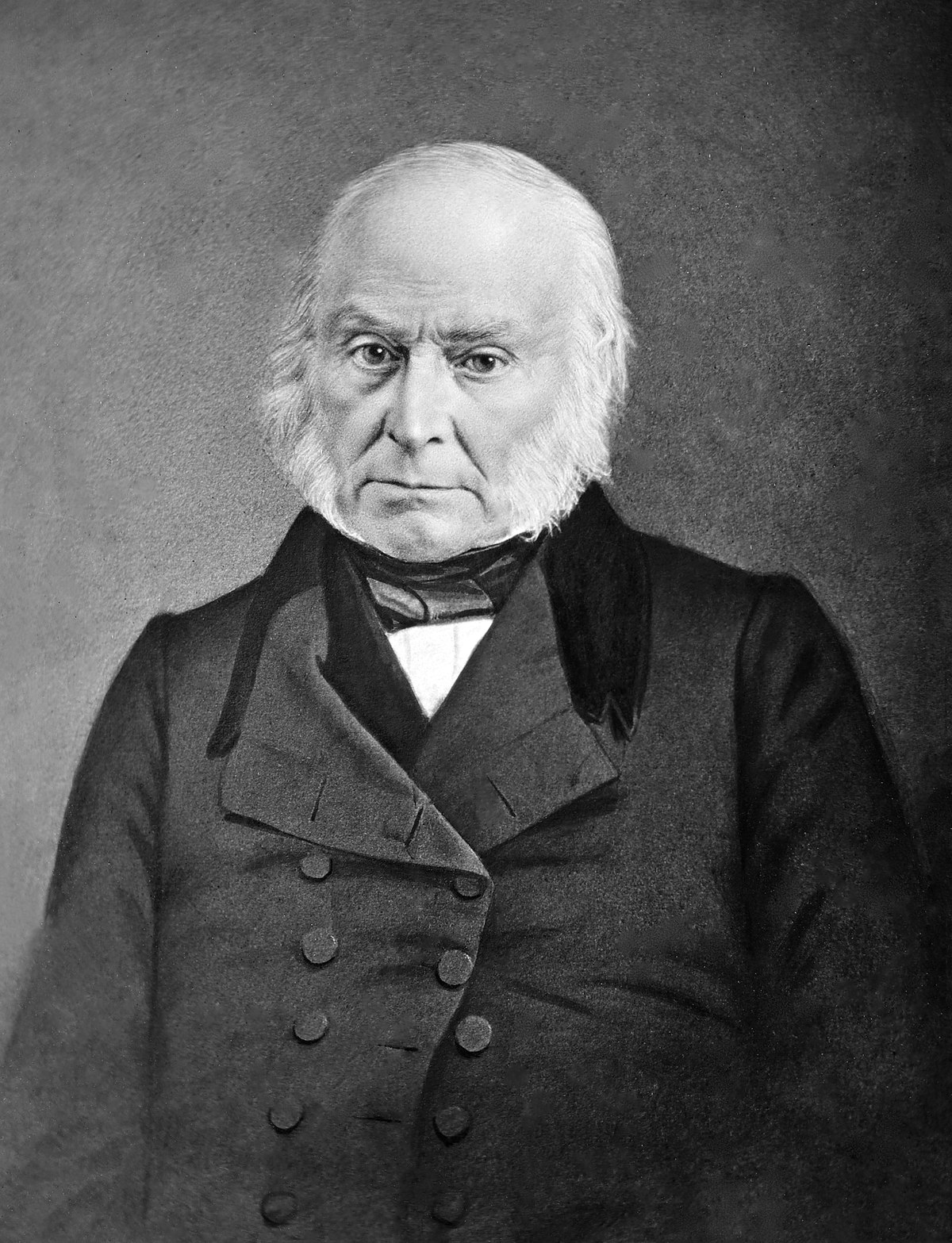
John Quincy Adams, Letter to Charles Francis Adams (February 21, 1830):
“Every one of the letters of Cicero is a picture of the state of the writer’s mind when it was written. It is like an invocation of shades to read them. I see him approach me like the image of a phantasmagoria. He seems opening his lips to speak to me and passes off, but his words as if they had fallen upon my ears are left deeply stamped upon the memory. I watch with his sleepless nights. I share his solitary sighs. I feel the agitation of his pulse, not for himself but for his son…for his country. There is sometimes so much in it of painful reality that I close the book. No tragedy was ever half so pathetic. My morning always ends with a hearty execration of Caesar, and with what is perhaps not so right, a sensation of relief at the 23 stabs of the Ides of March… Everything else in the story is afflicting and gloomy.” [Quoted in Fred Kaplan’s John Quincy Adams: American Visionary.]
“Pythagoras shut himself in a hole in the ground and told his mother to tell people that he was dead. After that, once he reappeared again later, he was telling fantastic tales of reincarnation and the people of Hades, explaining to the living about the matters of the dead. From these stories, he created that kind of repute for himself that, before the Trojan War, he was Aithalidês the son of Hermes and then Euphorbos, and then Hermotimos of Samos, then Delian Pythios and after all of them, Pythagoras.”