“Chance is also capable of afflicting us with sickness, stripping us of possessions, or bad-mouthing us to people or ruler. But it cannot make a good, brave, or great-souled person a wicked coward with a cheap mind. And chance cannot steal away the mindset which when always with is is of greater use in life than a captain upon the sea.
It is impossible for a captain to calm a rough wave and the wind and equally so to find a harbor when he needs it where he wants it. And he cannot face whatever happens fearlessly and steadfast. But, as long as he he does not forget himself and uses his skill, “he flees the clouded sea / once he has furled the sail to the lower mast”.
Whenever the sea looms over him, he sits in his shaking and trembles. But the mindset of the wise person provides the most calm to his bodily responses, eliminating the conditions of disease with self-control, a wise diet, and measured toils. Even if the cause of suffering comes from the outside there is a passage through the storm if “he endures it well with a light and drawn sailed” as Asclepiades says. But if something unexpected and serious overtakes him and overpowers, well, the harbor is close and he can still swim free of his body as from a ship that will float no more.”
Joel sings “love is a battlefield” at every department holiday party, and yet no general ever says at muster, “troops, war is loving.” We don’t, that is, ordinarily reverse the terms of a metaphor. In practice, one term stands still and the other term does the work of elucidating it.
But what if metaphor flowed both ways (metaphorically speaking), such that on one occasion X elucidated Y, and on another occasion Y elucidated X? That is what we find in the Greek Anthology when we compare epigrams across their sepulchral and amatory boundaries.
It’s a dissonant reading, but one we’re justified in making when topoi arranged to make a poem about death are rearranged to make an equally effective poem about love. Furthermore, I think we can say that when responsibility for clarifying terms (love, death) passes back and forth between the terms themselves, the end result is a body of poems whose referents are one another.
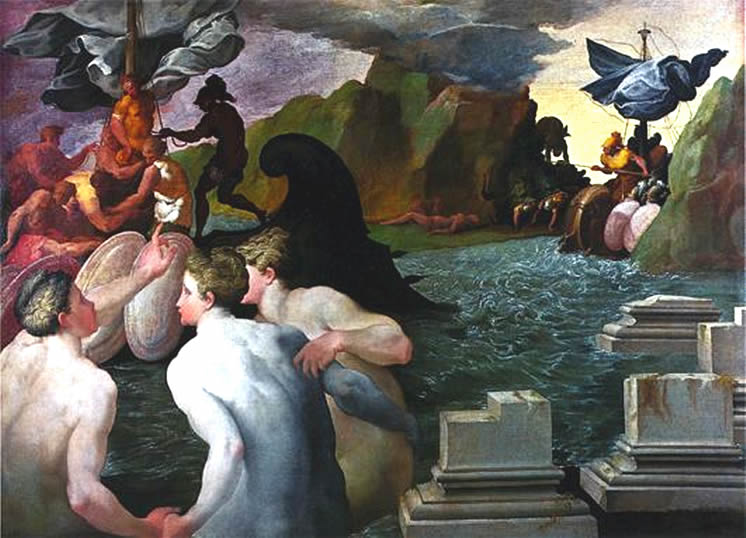
Here are two pairings of an amatory and sepulchral epigram. In the first, it is the imagery of the sea, and in the second the imagery of robbery, that are employed to account for the phenomenologically distinct experiences of loving and dying. With each pairing, try to think not only of how death is a metaphor for love, but how love is a metaphor for death:
[1] The Sea
Meleager 5.190
Bitter wave of desire,
Restless winds of jealousy,
And a wintry sea of celebrations:
Where to, am I being carried?
Since my heart’s tiller swings this way and that,
Will I see that tender Scylla again?
Leonidas 5.273
The East wind’s savage, sudden gusts,
Night, and waves from Orion’s dark setting
Did me in: I, Callaeschrus, lost my hold on life
While sailing in the middle of the Libyan sea.
Tumbling about in the water, prey for fish,
I died. And so, this gravestone is a liar.
[2] Robbery
Anonymous 7.737
Here I am, a wretched man three times over:
Overpowered by a thief’s violence,
Prostrate, and wept for by no one.
Diophanes of Myrina 5.309
A thief three times over,
That’s what Desire should really be called:
He’s watchful, he’s brazen, he strips you bare.
“Around noon, when the sun’s flame was already hot, we turned off in some village to the home of some old men known well to the thieves. This was easy to understand for even a donkey thanks to the prolonged conversation and shared kisses. They also gave some gifts to them which I had carried on my back and seemed to relate that they were obtained through theft with secret whispers. Once we were unburdened of every bag, they left us to amble and eat in a field next to the home.
But I was not really drawn to a pastoral communion with either the ass or my old horse and I was also not quite used to eating grass. I could see a garden on the other side of the stable, so I broke into it, already wracked by hunger. I filled my stomach immediately with those vegetables, even though they were raw, and I was saying a little prayer to all the gods as I looked around the place, hoping I might find the light of rose bushes in the nearby gardens.
This isolation was providing me confidence I did not have before, if once I was away from the road and hidden by bushes, I could eat the medicine and rise from the curved-hoof of four-footed pack animal to stand straight like a man, while no one was looking.”
Diem ferme circa medium, cum iam flagrantia solis caleretur, in pago quodam apud notos ac familiares latronibus senes devertimus. Sic enim primus aditus et sermo prolixus et oscula mutua quamvis asino sentire praestabant. Nam et rebus eos quibusdam dorso meo depromptis munerabantur, et secretis gannitibus quod essent latrocinio partae videbantur indicare. Iamque nos omni sarcina levatos in pratum proximum passim libero pastui tradidere. Nec me cum asino vel equo meo compascuus coetus attinere potuit, adhuc insolitum alioquin prandere faenum; sed plane pone stabulum prospectum hortulum iam fame perditus fidenter invado, et quamvis crudis holeribus affatim tamen ventrem sagino, deosque comprecatus omnes cuncta prospectabam loca, sicubi forte conterminis in hortulis candens reperirem rosarium. Nam et ipsa solitudo iam mihi bonam fiduciam tribuebat, si devius et frutectis absconditus, sumpto remedio, de iumenti quadripedis incurvo gradu rursum erectus in hominem inspectante nullo resurgerem.
A few weeks ago, I wrote about Orchards and Trees, using them as a metaphor to think about he development of Homeric poetry and its promulgation. Metaphors, of course, are not the things themselves! While one comparison can help us see a truth of a thing, several can help us get a better understanding of the things day-to-day language and thinking have trouble grasping.
The metaphor of the tree is at its core, a visual one. It may call to mind things and how we use them (ships and wood) or roots and branches, as in the stemmata of textual traditions. Homeric poems developed in a song culture, an aural landscape. Aural memory and oral performance inspire different qualia. And it is difficult–if not mistaken–to try to transfer an aural understanding to a visual one. As Epicurus observes, our senses do not translate from one domain to another. What does it mean to feel a smell?
So, try this one now. Imagine a supremely complex symphony: as you listen, melodies rise and fall over time, movements come and go and they return again, sometimes changed, sometimes syncopated, sometimes just an echo of what they once were. But some three or four note sequences are more insistent than others—they press through the sound and are emphasized first by this instrument and then by those.
Early 16th-century manuscript in mensural notation, containing a Kyrie by J. Barbireau. I have always been jealous of the talented musicians who can ‘see’ songs
The problem is that there are many of these sequences and some repeat intensely only to be lost and never to return, while others burst back through the rising wall of music to take over when they are least expected.
The music is beautiful but terrifyingly hard to follow: when you pause, however briefly, you realize you’ve been listening to one line of song when there were three or four others going on at the same time. It is hard to start again because you don’t want to lose track of the one you just heard. But you are already thinking about that brief gasp of song that escaped you.
The 16 thousand lines of the Iliad and 12 thousand lines of the Odyssey are like 24 and 20 hours of polyphonic music, played by musicians in separate rooms who can’t really hear each other but are somehow working in concert. The audience stands someplace apart. If we relax and let the composition fall over us, we can get some idea of the whole. But when we listen closely, we can get lost in the depth of each passing strain.
This is how I explain why it is so hard to translate epic or even to interpret it well. Each line has melodies full of resonant meaning that echo differently based on who you are and what you’ve heard before. When someone tells you the Iliad is about this or the Odyssey is about that they are following one repeated series of notes for their movement and resolution, and necessarily leaving others aside.
The total density of the soundscape of the poems and the generations of meaning’s potential within them makes them impossible to understand or explain in ‘real time’. When I hear someone talking about what epic means, sometimes it is like hearing a different poem talked about altogether. I have been listening to other movements, contemplating different themes.
The individual lines of Homer break into three units—segments scholars from Milman Parry and Albert Lord to John Miles Foley and Egbert Bakker have seen as units of composition (intonation units) or what we might even think of as ‘measures’. The ‘formulae’ are repeated patterns in a bounded soundscape. They are not simple building blocks, they are merely the observable repetitions of a system with clear limits: words and rhythm are part of the form of expression, not something imposed upon it.
We make meaning differently based on our sensory inputs and our cultures of performance and reception. There’s a strange prejudice Walter Ong identifies (explored more by Foley too) that visual cultures and literary productions are in some way more sophisticated and elaborate in both creation and reception than others. This ‘primitive’ pose is an outcropping of colonialism, yes, but it is also a simple observer bias. Even literary Greeks like Aristotle saw ‘writers’ in Homer where he should have found song.
Oral-formulaic theory helps break down our own cultural prejudices by revealing what is instrumentally possible for composition in performance. This is on the side of production; theories like J. M. Foley’s “traditional referentialtiy” or Barbara Graziosi’s and Johannes Haubold’s “resonance”. Each in part also draws on reader response theory, centering how audiences hear and respond to poems. If we try, we can intellectually grasp how intricate songs emerge in performance and how audiences dynamically receive them.
From Song to Translations
All this leaves aside how the epics moved from living song to the fossils we piece together on the page. This runs through the problems of performance, text, and reperformance. I emphasize song and aurality here because Homeric epic developed and flourished outside the constraints of a page. When a translator or interpreter tries to make sense of what they see on the page, it is like a conductor looking at a score for a symphony written in a different system of notation with many sections unclear.
The role of some instruments is left undesignated; some sounds cannot be made anymore; and some sequences just don’t make sense to a modern ear. As Casey Dué notes, Greg Nagy proposes a movement from performance, to transcript, to script, to scripture in the stabilization of the narrative: a translator has to move backward through these stages, yet abandon none
Because of the polyphony of Greek epic it is charged with meaning: the lines of song exist through time and carry many meanings at once. A translator listens to the whole song as it echoes and picks the melodies that ring strongest now.
Each of us is to an extent a translator of Homer and those of us who read the Greek but teach in another language are constantly moving from one domain to another. If Homer is a langue each of us has our own Homeric parole. In my first semester teaching as a professor, I gave a full lecture on the mythic, even Iliadic “plan of Zeus” (Dios d’eteleieto boulê), going so far as to have the students recite the line in the Greek. At the end of the class, a kind and forgiving student came up to me and said, “that was really cool, but there’s no plan of Zeus in my Iliad.”
I had assigned Stanley Lombardo’s fine translation. He writes about “Zeus’ Will” (as many others do). I hadn’t checked the translation and sounded as if I were speaking of a poem none of the students had read.
The way we each create our own Homer is in part why I have such trouble reading any version other than the Greek. This is why for even the best translations the fairest reaction is to crib from Richard Bentley’s response to Pope’s Iliad: “a pretty poem, Mr. Pope, but you must not call it Homer.” Here’s another quick example of this danger from Emily Wilson’s successful Odyssey translation.
Let’s start with my simple translations and the Greek. In the Odyssey’s proem, the narrator says of Odysseus:
“But he didn’t save his companions even though he wanted to.
They perished because of their own recklessness”
The fools! They ate up the cattle of Hyperion’s son Helios
And he deprived them of their homecoming day.”
The line σφετέρῃσιν ἀτασθαλίῃσιν (their own recklessness/stupidity) echoes through the poem as a theme that connects Odysseus’ companions, the suitors, and the hero too.
It comes again a mere 20 lines later as Zeus complains
“Friends, how mortals are always blaming the gods!
They say that evils come from us. But they themselves
Have pain beyond their fate because of their own recklessness.
So now Aigisthus too [suffered] beyond his fate…”
This is one of those four-note sequences, a melody earlier scholars would have called a formula that follows, indexes and guides the interpretation of the poem. When I read/teach the Odyssey I point to these passages as inviting us to see the world and its actors in a particular frame
In Wilson’s translation, σφετέρῃσιν ἀτασθαλίῃσιν disappears from the proem altogether, yielding the following.
“…He failed to keep them safe; poor fools,
They ate the Sun God’s Cattle, and the god
Kept them from home…”
And soon after, σφετέρῃσιν ἀτασθαλίῃσιν is rendered simply as “By folly.”
“This is absurd,
That mortals blame the gods They say we cause
Their suffering, but they themselves increase it
By folly. So Aegisthus overstepped:”
These choices limit the repetition and play down the theme of responsibility and recklessness that is central to the poem (from my reading). “Folly’ also disambiguates the complexity of atasthalia, which evokes foolishness, rashness, arrogance, and blindness. Of course, this is not an oversight Wilson commits alone: Lombardo translates the first example as “recklessness” and the second as “witlessness”
To be clear, Wilson and Lombardo have to make some choices; no language conveys the same semantic ambiguities of another. Translators perform hermeneutic magic, moving things from one realm to another. Some moments dazzle, others are imperfect illusions.
This takes us back to the symphony played in separate rooms heard only in parts. When people ask me why Homer is different, I sputter about its bigness and depth and land on the layers and power. Like translation itself, analogy and metaphor only take us so far.
There are several works cited above, but for the atasthalia theme see my recent Many Minded Manor these better books:
Marcus Cornelius Fronto to Antoninus Augustus Ambr. 390 17
“Aesopus the tragedian reportedly never put a mask on his face until he had looked at it for awhile from the other side so that he might change his gestures and alter his voice in line with the appearance of the mask.”
Tragicus Aesopus fertur non prius ullam suo induisse capiti personam, antequam diu ex adverso contemplaret, ut pro personae voltu gestum sibi capessere ac vocem <adsimulare posset>
“Erato, come and stand by me and tell me how Jason
took to fleece back to Iolkos with the help
of Medea’s love. You share in Aphrodite’s realm
and you bewitch the unmarried girls with worries
and this is the very reason you won your name.”
In the first year of Reading Greek Tragedy Online, we wandered on our path a little bit to comedy, fragments, and even to epic. This year we are moving out of the archaic and classical worlds to the Hellenistic period, turning to our only full telling of the tale of Jason and the Argonauts, the Argonautica of Apollonius Rhodes.
There were certainly versions of the tale before Ap. Rhodes made his break with Callimachus for epic’s rushing river. Indeed, it is pretty clear that the story of the Voyage of the Argo was an ancient one that was told in many forms, likely influencing and being influenced by Homer’s Odyssey and many other lost traditions. But the way we name the tale is important: it is not just the story of Jason and his crew. It is also the story of Medea, a quest, and a love affair arranged by scheming gods.
In a way, there are elements of Argonautica in the Iliad, the Odyssey, and in Vergil’s later Aeneid. And its story blends into theirs as well. As Catullus frames it in Carmen 64, it was the voyage of the Argo that brought Peleus to Thetis, one domino that needed to fall to lead to their marriage banquet, the arrival of Eris, the golden apple, and so much more.
But Ovid probably encapsulates one view of the voyage best, in Amores 2.11:
“As waves watched, shocked, the pine cut down from Pelion’s peak
Was the first to teach us the evil ways of the sea—
That one that raced madly through crushing cliffs
And made to steal the gold-marked fleece.
I wish the Argo had been overcome, drawing a deep funereal drink
Then no oar would have troubled the broad water’s peace.”
Prima malas docuit mirantibus aequoris undis
Peliaco pinus vertice caesa vias,
Quae concurrentis inter temeraria cautes
Conspicuam fulvo vellere vexit ovem.
o utinam, nequis remo freta longa moveret,
Argo funestas pressa bibisset aquas!
Apollonius Rhodes, Argonautica 3.1405-7
He went back into the city, mixing into the Kolkhians,
turning over how he might oppose them more swiftly.
The day ended and Jason’s labor was finished.”
Artistic Director: Paul O’Mahony (Out of Chaos Theatre) Host and Faculty Consultant: Joel Christensen (Brandeis University) Executive Producer: Lanah Koelle (Center for Hellenic Studies) Producers: Keith DeStone (Center for Hellenic Studies), Hélène Emeriaud, Janet Ozsolak, and Sarah Scott (Kosmos Society) Production Assistant: Francesca Bellei (Harvard University) Director of Outreach: Amy Pistone (Gonzaga University) Dramaturgical Support: Emma Pauly and Emma Joy Hill Associate Directors: Beth Burns, Liz Fisher, Tabatha Gayle, Laura Keefe, and Toph Marshall Poster Designer: Allie Marbry (Center for Hellenic Studies) Poster Illustration Artist: John Koelle
“Now I would like to recite the family and names of the heroes
their journeys through the treacherous sea and all the things
they did while they wandered. I hope the Muses will be supporters of my song.”
Wednesday, May 26 | Pedro Calderón de la Barca’s El Monstruo de los Jardines (The Monster in the Garden) with Francisco Barrenechea (University of Maryland, College Park); translation by C. Svich
Epicurus, Letter to Herodotus [=Diogenes Laertius 10.65]
“For this reason, because the soul is embodied, it never loses perception even if some part of it is removed. So, even if parts of the soul perish along with the container when it is destroyed completely or partially, should the soul in fact persist it retains perception. But the rest of the body that remains either whole or in parts does not have perception when this thing has been removed, that number of atoms requisite for the nature of the soul.
So, really, when the whole mass is destroyed, the soul scatters and no longer has the same abilities and can no longer move, just as if it never even obtained perception.”
Fronto to Marcus Aurelius Antoninus Augustus (“On Speeches”, Ambr. 382)
“…I am going to add in some potentially inapt and unfair comments, for I plan to remind you of the experience of having me as a teacher…
Still, it would be better for you to neglect these things than to nurture them poorly. For when it comes to that confused in the combined type, grafted in part on Cato’s pine-nuts and Seneca’s soft and febrile plums, well I think it should be pulled up by the roots—no, to use a Plautine line, uprooted below the roots!
I am not ignorant that Seneca is a person fully stuffed and overflowing with ideas, but to be honest I see his sentences as trotting around, announcing their course with a full gallop, but stopping to fight nowhere and never striking the sublime. Like Laberius, he plays at wit-darts, or really just assembling sounds, rather than composing words worth repeating.
Do you believe that you would uncover graver sentiments on the same ideas in your Annaeus than in Sergius*? Ah, Sergius’ words don’t have the same rhythm or the same speed as Seneca’s, I admit. The sounds don’t sing the same, I won’t deny it.
But what if the same meal is offered to two people and the first picks up the olives on the table with his fingers, brings them to his mouth, puts them between his teeth to chew them in the right and proper way, while the other throws them up high and catches them with his mouth open and then shows them off once caught with his lips like a juggler? Really, children at school would applaud at what was done and the guest would be entertained, but one will have eaten lunch properly while the other did tricks with his lips.
So you say that some things are expressed cleverly and some with weight. But sometimes little silver coins are found in the sewer. Should we take over the job of cleaning the sewers too?”
…pauca subnectam fortasse inepta iniqua, nam rursus faxo magistrum me experiare….
Neglegas tamen vero potius censeo quam prave excolas. Confusam eam ego eloquentiam, catachannae ritu partim pineis nucibus Catonis partim Senecae mollibus et febriculosis prunulis insitam, subvertendam censeo radicitus, immo vero, Plautino ut utar verbo, exradicitus. Neque ignoro copiosum sententiis et redundantem hominem esse: verum sententias eius tolutares video nusquam quadripedo concitas cursu ten<d>ere, nusquam pugnare, nusquam maiestatem studere; ut Laberius dictabolaria, immo dicteria, potius eum quam dicta confingere.
Itane existimas graviores sententias et eadem de re apud Annaeum istum reperturum te quam apud Sergium? Sed non modulatas aeque: fateor; neque ita| cordaces: ita est; neque ita tinnulas: non nego. Quid vero, si prandium utrique adponatur, adpositas oleas alter digitis prendat, ad os adferat, ut manducandi ius fasque est ita dentibus subiciat, alter autem oleas suas in altum iaciat, ore aperto excipiat, ut calculos praestigiator, primoribus labris ostentet? Ea re profecto pueri laudent, convivae delectentur; sed alter pudice pranderit, alter labellis gesticulatus erit.
At enim sunt quaedam in libris eius scite dicta, graviter quoque nonnulla. Etiam laminae interdum argentiolae cloacis inveniuntur; eane re cloacas purgandas redimemus?
*either Sergius Flavius or Plautus, an author reputed to have used harsh language
“After he left from Circe’s island, Odysseus arrived at another island, tossed up on it by struggling winds. Calypso, Circe’s sister welcomed him there and considered him worthy of a great deal of help. She had sex with him almost as if in marriage.
He went from there to a massive lake near the sea which was called the Nekyopompos. The people who live around that lake are prophets and they told him everything that had happened to him and what would happen in the future. When he left there, he was thrown from the sea when a great storm arose onto “the Sirens,” rocks which have that name from the peculiar sound that comes from waves crashing around them. Once he freed himself from there, he arrived at the place called “Charybdis,” a wild and desolate territory. He lost all his ships and his army here.
Then Odysseus was carried alone on a ship’s plank in the sea, waiting for a death from violence. But some Phoenician sailors passing by saw him swimming in the water and saved him in their pity. They took him to the island Crete to Idomeneus, a leader of the Greeks. When he saw Odysseus naked and impoverished, he sympathetically gave him a great of gifts because he had been a general with him at Troy along with two ships and people to guard him safely home. He sent him back to Ithaka like this. Wise Dictys wrote these details down after he heard them from Odysseus.”
“A life commingled with virtue is like an eternal spring: it is clean, untroubled, drinkable and sweet, communal and wealthy, without harm and indestructible”
“Examine in yourself whether you desire to be wealthy or lucky. If you want wealth, know that it is neither good nor wholly yours. If you desire to be happy understand that it is good and under your power. One is the timely gift of chance, the other is a choice.”




.jpg)
_-_%D0%9F%D0%BE%D1%80%D1%82%D1%80%D1%82%D0%B5%D1%82_%D0%9C%D0%B0%D1%80%D0%BA%D0%B0_%D0%90%D0%B2%D1%80%D0%B5%D0%BB%D0%B8%D1%8F_%D0%B2_%D1%8E%D0%BD%D0%BE%D1%81%D1%82%D0%B8.jpg)
