Books Both Thick and Thin

Isaac Disraeli, The Curiosities of Literature (Vol. II):

The grossness and multitude of Aristotle and Varro’s books were both a prejudice to the authors, and an hinderance to learning, and an occasion of the greatest part of them being lost. The largeness of Plutarch’s treatises is a great cause of his being neglected, while Longinus and Epictetus, in their pamphlet Remains, are every one’s companions. Origen’s 6,000 volumes (as Epiphanius will have it) were not only the occasion of his venting more numerous errors, but also for the most part of their perdition. Were it not for Euclid’s Elements, Hippocrates’s Aphorisms, Justinian’s Institutes, and Littleton s Tenures in small pamphlet volumes, young mathematicians, freshwater physicians, civilian novices, and les apprentices en la ley d’Angleterre, would be at a loss and stand, and total disencouragement. One of the greatest advantages the Dispensary has over King Arthur is its pamphlet size. So Boileau’s Lutrin, and his other pamphlet poems, in respect of Perrault s and Chapelain’s St. Paulin and la Pucelle. These seem to pay a deference to the reader’s quick and great understanding; those to mistrust his capacity, and to confine his time as well as his intellect.

Notwithstanding so much may be alleged in favour of books of a small size, yet the scholars of a former age regarded them with contempt. Scaliger, says Baillet, cavils with Drusius for the smallness of his books; and one of the great printers of the time (Moret, the successor of Plantin) complaining to the learned Puteanus, who was considered as the rival of Lipsius, that his books were too small for sale, and that purchasers turned away, frightened at their diminutive size; Puteanus referred him to Plutarch, whose works consist of small treatises; but the printer took fire at the comparison, and turned him out of his shop, for his vanity at pretending that he wrote in any manner like Plutarch! a specimen this of the politeness and reverence of the early printers for their learned authors; Jurieu reproaches Colomies that he is a great author of little books!

At least, if a man is the author only of little books, he will escape the sarcastic observation of Cicero on a voluminous writer — that “his body might be burned with his writings,” -of which we have had several, eminent for the worthlessness and magnitude of their labours.

It was the literary humour of a certain Maecenas, who cheered the lustre of his patronage with the steams of a good dinner, to place his guests according to the size and thickness of the books they had printed. At the head of the table sat those who had published in folio, foliissimo; next the authors in quarto; then those in octavo. At that table Blackmore would have had the precedence of Gray. Addison, who found this anecdote in one of the Anas, has seized this idea, and applied it with his felicity of humour in No. 529 of the Spectator.

Cancel This! Isocrates Navigates Freedom of Speech

Isocrates, To Nicocles 3

“There are many ways people are educated in private life. Most importantly, avoiding luxury and being forced to think every day about their life. Then, they have the laws which we happen to live by civically. Finally, we are educated by freedom of speech and the right given to friends to openly criticize and to enemies to attack one another’s faults.”

Τοὺς μὲν γὰρ ἰδιώτας ἐστὶ πολλὰ τὰ παιδεύοντα, μάλιστα μὲν τὸ μὴ τρυφᾶν ἀλλ᾿ ἀναγκάζεσθαι περὶ τοῦ βίου καθ᾿ ἑκάστην τὴν ἡμέραν βουλεύεσθαι, ἔπειθ᾿ οἱ νόμοι καθ᾿ οὓς ἕκαστοι πολιτευόμενοι τυγχάνουσιν, ἔτι δ᾿ ἡ παρρησία καὶ τὸ φανερῶς ἐξεῖναι τοῖς τε φίλοις ἐπιπλῆξαι καὶ τοῖς ἐχθροῖς ἐπιθέσθαι ταῖς ἀλλήλων ἁμαρτίαις·

Isocrates, On the Peace 14

“I know that it is hard to stand against your opinions and that that there is no freedom of speech when there is democracy except that which is employed here among these great fools who don’t care about you and in the theater among the comic poets.

You know that is most shocking of all? You give those who let the rest of Greece know about our state’s failures so much more gratitude than those who do good things for us. And you are as annoyed to those who correct you and warn you as you are with those who contrive evil against the state!”

Ἐγὼ δ᾿ οἶδα μὲν ὅτι πρόσαντές ἐστιν ἐναντιοῦσθαι ταῖς ὑμετέραις διανοίαις, καὶ ὅτι δημοκρατίας οὔσης οὐκ ἔστι παρρησία, πλὴν ἐνθάδε μὲν τοῖς ἀφρονεστάτοις καὶ μηδὲν ὑμῶν φροντίζουσιν, ἐν δὲ τῷ θεάτρῳ τοῖς κωμῳδοδιδασκάλοις· ὃ καὶ πάντων ἐστὶ δεινότατον, ὅτι τοῖς μὲν ἐκφέρουσιν εἰς τοὺς ἄλλους Ἕλληνας τὰ τῆς πόλεως ἁμαρτήματα τοσαύτην ἔχετε χάριν ὅσην οὐδὲ τοῖς εὖ ποιοῦσι πρὸς δὲ τοὺς ἐπιπλήττοντας καὶ νουθετοῦντας ὑμᾶς οὕτω διατίθεσθε δυσκόλως ὥσπερ πρὸς τοὺς κακόν τι τὴν πόλιν ἐργαζομένους.

Ostracism! That’s Cancel Culture for you!

Doubled Ignorance: Plato on the Dunning-Kruger Effect and Lawmaking

Plato, Laws, 863 c (Full text on the Scaife viewer)

“Someone wouldn’t be wrong in saying that ignorance is a third cause of f*ck-ups.  But a law-maker would be better in splitting this cause into two, understanding the simple one as a cause of minor mistakes. The doubled ignorance—when someone who is screwing up is held not only by ignorance but by the belief of wisdom too as if they perfectly understand all the things they know nothing about—is the cause of serious and harmful mistakes when it has power and strength.

But when present in people who are weak, doubled ignorance produces the errors of children and old people. A law-maker will consider these mere mistakes and will make laws accordingly, which will be the most lenient and full of pardon of all.”

ΑΘ. Τρίτον μὴν ἄγνοιαν λέγων ἄν τις τῶν ἁμαρτημάτων αἰτίαν οὐκ ἂν ψεύδοιτο· διχῇ μὴν διελόμενος αὐτὸ ὁ νομοθέτης ἂν βελτίων εἴη, τὸ μὲν ἁπλοῦν αὐτοῦ κούφων ἁμαρτημάτων αἴτιον ἡγούμενος, τὸ δὲ διπλοῦν, ὅταν ἀμαθαίνῃ τις μὴ μόνον ἀγνοίᾳ συνεχόμενος ἀλλὰ καὶ δόξῃ σοφίας, ὡς εἰδὼς παντελῶς περὶ ἃ μηδαμῶς οἶδεν, μετὰ μὲν ἰσχύος καὶ ῥώμης ἑπομένης μεγάλων καὶ ἀμούσων ἁμαρτημάτων τιθεὶς αἴτια τὰ τοιαῦτα, ἀσθενείας δὲ ἑπομένης, παίδειά τε ἁμαρτήματα καὶ πρεσβυτέρων γιγνόμενα θήσει μὲν ἁμαρτήματα καὶ ὡς ἁμαρτάνουσιν νόμους τάξει, πρᾳοτάτους γε μὴν πάντων καὶ συγγνώμης πλείστης ἐχομένους.

Medieval Floor Tile with fool

Just the Facts

Here is a pairing of Hellenistic sepulchral epigrams with Felix Feneon’s 1906 “news in three lines” (nouvelles en trois lignes).

Feneon’s journalistic task was to relay a factual incident in no more than 130 characters. Perhaps we can look at the epigrams through Feneon’s “epigrammatic” style and see certain things more clearly than we otherwise might:  the uncomplicated X-happened-because-of-Y logic; the invitation to pure spectation and foreclosure of emotional involvement; and certainly, the foregrounding of the writerly discipline such productions require.

[1] The Roof’s Gone!

Antipater of Thessalonica 7.402 (Greek Anthology)

Because of winter snow melting on its roof,
The house fell down, killing the old woman, Lysidike.
Neighbors did not build a tomb with dug-up earth,
But made the house itself her grave.

Feneon 156.

Gas explosion in the home of Larrieu from Bordeaux.
He was injured. His mother-in-law’s hair caught fire.
The ceiling blew open.


[2] One Bad Step

Antipater of Thessalonica 7.398 (Greek Anthology)

I don’t know whether to fault Dionysus
Or blame Zeus’ rain, but both are tricky
For feet: once, coming down from the country
After a banquet, the grave seized Polyxenos
When he fell from a slippery hilltop.
Now he lies far from Aeolian Smyrna.
Take my advice, a drunk person in the dark
Should fear a wet path.

Feneon 688.

A misstep, at dusk, on the bridge
in Rue du Moulin, in Dontilly,
and Madame Louis Nourry drowned.

[3] Despair

Eutolmius Scholasticus 7.608 (Greek Anthology)

Mourning the death of her short-lived son,
Menippa poured out her life breath
Along with her booming dirge.
She would not have it back again
To weep when she drew breath.
No, she ended her lament and her life
At the same time.

Feneon 963.

Her daughter dead, her son far away,
Madame Boulet, from Buchet (commune of Buhy),
hanged herself in despair.

Antipater of Thessalonica 7.402 (Greek Anthology)

χειμερίου νιφετοῖο περὶ θριγκοῖσι τακέντος
δῶμα πεσὸν τὴν γραῦν ἔκτανε Λυσιδίκην
σῆμα δέ οἱ κωμῆται ὁμώλακες οὐκ ἀπ᾽ ὀρυκτῆς
γαίης, ἀλλ᾽ αὐτὸν πύργον ἔθεντο τάφον.

Feneon 156

Explosion de gaz chez le Bordelais Larrieu. Il fut blessé. Les cheveux de sa belle-mère flambèrent. Le plafond creva.

Antipater of Thessalonica 7.398 (Greek Anthology)

οὐκ οἶδ᾽ εἰ Διόνυσον ὀνόσσομαι, ἢ Διὸς ὄμβρον
μέμψομ᾽ ὀλισθηροὶ δ᾽ εἰς πόδας ἀμφότεροι.
ἀγρόθε γὰρ κατιόντα Πολύξενον ἔκ ποτε δαιτὸς
τύμβος ἔχει γλίσχρων ἐξεριπόντα λόφων
κεῖται δ᾽ Αἰολίδος Σμύρνης ἑκάς. ἀλλά τις ὄρφνης
δειμαίνοι μεθύων ἀτραπὸν ὑετίην.

Feneon 688

Un faux pas, à la brune, sur la passerelle du ru du Moulin, à Dontilly, et Mme Louis Nourry se noya.

Eutolmius Scholasticus 7.608 (Greek Anthology)

υἱέος ὠκυμόρου θάνατον πενθοῦσα Μενίππη
κωκυτῷ μεγάλῳ πνεῦμα συνεξέχεεν,
οὐδ᾽ ἔσχεν παλίνορσον ἀναπνεύσασα γοῆσαι:
ἀλλ᾽ ἅμα καὶ θρήνου παύσατο καὶ βιότου.

Feneon 963

Sa fille morte, son fils loin, Mme Boulet,du Buchet (commune de Buhy), s’est pendue de désespoir.

The suicide of Ajax. Detail from a red-figure krater at the British Museum.

Larry Benn has a B.A. in English Literature from Harvard College, an M.Phil in English Literature from Oxford University, and a J.D. from Yale Law School. Making amends for a working life misspent in finance, he’s now a hobbyist in ancient languages and blogs at featsofgreek.blogspot.com.

To be Cancelled or Not?

Aristotle, On Interpretation 19a

“What is exists whenever it does; what does not exist does not exist when it does not. Still, there’s no necessity to everything in existing or not existing. For it is not the same thing to say that everything that exists does exist and that everything exists by necessity when it occurs. Clearly, it is the same with things that do not exist.

The same argument obtains here as with contrary statements. Everything necessarily exists or does not exist and will be or will not be. But it it not possible for us to say which thing will necessarily happen. For example, I say that there will be a sea-battle tomorrow or maybe there won’t be. There’s certainly nothing to make it necessary that a sea-battle will happen tomorrow or not. But it is certainly necessary that it either happens or it doesn’t.”

Τὸ μὲν οὖν εἶναι τὸ ὂν ὅταν ᾖ, καὶ τὸ μὴ ὂν μὴ εἶναι ὅταν μὴ ᾖ, ἀνάγκη· οὐ μὴν οὔτε τὸ ὂν ἅπαν ἀνάγκη εἶναι οὔτε τὸ μὴ ὂν μὴ εἶναι. οὐ γὰρ ταὐτόν ἐστι τὸ ὂν ἅπαν εἶναι ἐξ ἀνάγκης ὅτε ἔστι, καὶ τὸ ἁπλῶς εἶναι ἐξ ἀνάγκης. ὁμοίως δὲ καὶ ἐπὶ τοῦ μὴ ὄντος. καὶ ἐπὶ τῆς ἀντιφάσεως ὁ αὐτὸς λόγος. εἶναι μὲν ἢ μὴ εἶναι ἅπαν ἀνάγκη, καὶ ἔσεσθαί γε ἢ μή· οὐ μέντοι διελόντα γε εἰπεῖν θάτερον ἀναγκαῖον. λέγω δὲ οἷον ἀνάγκη μὲν ἔσεσθαι ναυμαχίαν αὔριον ἢ μὴ ἔσεσθαι, οὐ μέντοι ἔσεσθαί γε αὔριον ναυμαχίαν ἀναγκαῖον οὐδὲ μὴ γενέσθαι· γενέσθαι μέντοι ἢ μὴ γενέσθαι ἀναγκαῖον.

File:Gent, Justus van - Aristotle - c. 1476.jpg
Justus van Gent, Aristotle 1476

If She’s Black, So What?

Asclepiades 5.210 (Greek Anthology)

Didyme has captured me with her eyes,
Alas! And I melt like wax before a flame
When I behold her beauty.
And if she’s black, so what?
Coals are too, and yet when we heat them
They glow like rose petals.

Τὠφθαλμῷ Διδύμη με συνήρπασεν: ὤμοι, ἐγὼ δὲ
τήκομαι, ὡς κηρὸς πὰρ πυρί, κάλλος ὁρῶν.
εἰ δὲ μέλαινα, τί τοῦτο; καὶ ἄνθρακες: ἀλλ᾽ὅτε κείνους
θάλψωμεν, λάμπους᾽ ὡς ῥόδεαι κάλυκες.

This epigram owes its fame chiefly to its eroticization of what, based on her/ name and her color, is presumed to be an African woman. But in a poem that is almost wholly conventional, the racialized woman, and the speaker’s justification of her, are poetic conventions too. If anything does distinguish the poem, it might be it’s prurience. 

Most of the epigram’s conventional elements are easily identified: the eyes as instruments of bewitchment (Ibycus Fr.287); the lover’s liquefaction in the presence of desire (Alcman Fr.59a and Sappho Fr.112); eroticizing of skin color, albeit white skin (Rufinus 5.60 and Dioscorides 5.56 in the Greek Anthology [GA]); and the lover as inflaming the beloved (Rufinus 5.87 GA), when not the other way around.   

Conventional also, though less obviously so, is the beloved’s roseate glow. In 2 epigrams about sexual intercourse (5.54 and 5.55 GA), Dioscorides describes a woman’s buttocks as “rose-like” in color. Rufinus describes the vagina as rose-like in its glow (5.36 GA) and uses “rose” as a euphemism for vagina (5.36 GA). So when Asclepiades suggests that the stimulated woman–and stimulation is what “heat them” references–glows red, the change in coloration is not to her skin in general, but to her sex organs. 

What about her African name and dark skin? Scholars have pointed out that the name Didyme was quite common for Egyptian women in the period, and so we can read its use here as stereotypical (i.e., conventional). And as for Didyme’s dark skin, consider these lines by Philodemus (5.132 GA) who worked after Asclepiades: 

If she’s Opician, and named Flora, and doesn’t sing Sappho’s songs,
No matter, even Perseus desired Indian Andromeda.

The English might not convey the extent to which the form of these lines–an objection and an answer to the objection–is nearly identical to “And if she’s black, so what? / Coals are too.” What structures the couplet in both Philodemus and Asclepiades is εἰ δὲ . . . καὶ (“and if . . . even”, or translated differently, “and if . . . also”). “If she’s Opician” (from Opicia, the area around Naples) is modeled on “if she’s black” in Asclepiades. “Even Perseus” (or “Perseus too”) is modeled on “coals too” (or “even coals”) in Asclepiades. Perseus’ lover is marked as non-Greek and presumably brown just  Asclepiades’ lover is non-Greek and black. If Asclepiades ‘invented’ the use of this form for racialized erotic content, then the tradition absorbed it and made it conventional, just as he himself had absorbed the tradition’s conventions.

Fayum mummy portrait. c.100 C.E.
Royal Ontario Museum.
ROM 918.20.1.

Larry Benn has a B.A. in English Literature from Harvard College, an M.Phil in English Literature from Oxford University, and a J.D. from Yale Law School. Making amends for a working life misspent in finance, he’s now a hobbyist in ancient languages and blogs at featsofgreek.blogspot.com.

Gratitude for a Recovery

Greek Anthology 6.300, Leonidas [Lathria = Aphrodite]

“Lathrian, please take this from the wanderer, the pauper,
The man of little flour, Leonidas, as thanks:
Moist cakes of barely and well-stored olive oil,
Along with this green fig straight from the tree.
Lady, take these five grapes from a cluster good for wine
And this final libation from the bottom of the cup.
And if you save me from hateful poverty as you saved me
From sickness, expect a young goat too.”

Λαθρίη, ἐκ πλανίου ταύτην χάριν ἔκ τε πενέστεω
κἠξ ὀλιγησιπύου δέξο Λεωνίδεω,
ψαιστά τε πιήεντα καὶ εὐθήσαυρον ἐλαίην,
καὶ τοῦτο χλωρὸν σῦκον ἀποκράδιον,
κεὐοίνου σταφυλῆς ἔχ᾿ ἀποσπάδα πεντάρραγον,
πότνια, καὶ σπονδὴν τήνδ᾿ ὑποπυθμίδιον.
ἢν δέ μέ γ᾿, ὡς ἐκ νούσου ἀνειρύσω, ὧδε καὶ ἐχθρῆς
ἐκ πενίης ῥύσῃ, δέξο χιμαιροθύτην.

File:Greek - Oinochoe in the Camirus, or "Wild Goat" Style - Walters 482108 - Detail.jpg
“Wild Goat Style”

Cometas Scholasticus, Greek Anthology 9.597

“I was struck immobile from my hips to the bottom of my feet
Completely denied my life’s work for so long,
Halfway between life and death, Hades’ neighbor,
Merely breathing, but a corpse in every other way.
But wise Philippos, whom you view in the picture,
Brought me back to life by healing the dread disease.
And Antoninus walks on the earth again as before!
I tread on it with my feet and I feel whole.”

Νωθρὸς ἐγὼ τελέθεσκον ἀπ᾿ ἰξύος ἐς πόδας ἄκρους
τῆς πρὶν ἐνεργείης δηρὸν ἀτεμβόμενος,
ζωῆς καὶ θανάτοιο μεταίχμιον, Ἄϊδι γείτων,
μοῦνον ἀναπνείων, τἄλλα δὲ πάντα νέκυς.
ἀλλὰ σοφός με Φίλιππος, ὃν ἐν γραφίδεσσι δοκεύεις,
ζώγρησεν, κρυερὴν νοῦσον ἀκεσσάμενος·
αὖθις δ᾿ Ἀντωνῖνος, ἅπερ πάρος, ἐν χθονὶ βαίνω:
καὶ ποσὶ πεζεύω, καὶ ὅλος αἰσθάνομαι.

Plato Says It’s Like We’re Drunk All The Time

Plato Phadeo 79c2-c8

“Therefore, weren’t we saying this long before that the mind, whenever it uses the body for examining anything—either through seeing or hearing or any other kind of perception, since examining a thing through the body is to examine it through the senses—at that moment the mind is dragged down by body towards things that never exist in the same way and it wanders and is troubled and gets dizzy as if it’s drunk, since it has been contaminated by those sorts of things.”

Οὐκοῦν καὶ τόδε πάλαι ἐλέγομεν, ὅτι ἡ ψυχή, ὅταν μὲν τῷ σώματι προσχρῆται εἰς τὸ σκοπεῖν τι ἢ διὰ τοῦ ὁρᾶν ἢ διὰ τοῦ ἀκούειν ἢ δι’ ἄλλης τινὸς αἰσθήσεως—τοῦτο γάρ ἐστιν τὸ διὰ τοῦ σώματος, τὸ δι’ αἰσθήσεως σκοπεῖν τι—τότε μὲν ἕλκεται ὑπὸ τοῦ σώματος εἰς τὰ οὐδέποτε κατὰ ταὐτὰ ἔχοντα, καὶ αὐτὴ πλανᾶται καὶ ταράττεται καὶ εἰλιγγιᾷ ὥσπερ μεθύουσα, ἅτε τοιούτων ἐφαπτομένη;

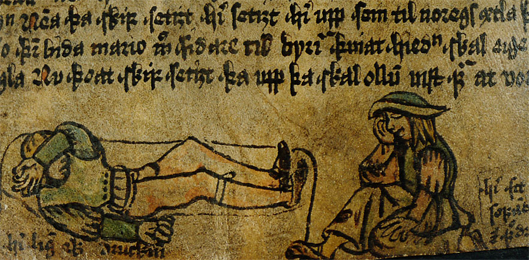
Illumination from AM 147 4to of two intoxicated 15th century Icelanders

Chance, Sickness, and Safe Passage Through the Storm

Plutarch, On Tranquility of Mind 475 d-f -476a

“Chance is also capable of afflicting us with sickness, stripping us of possessions, or bad-mouthing us to people or ruler. But it cannot make a good, brave, or great-souled person a wicked coward with a cheap mind. And chance cannot steal away the mindset which when always with is is of greater use in life than a captain upon the sea.

It is impossible for a captain to calm a rough wave and the wind and equally so to find a harbor when he needs it where he wants it. And he cannot face whatever happens fearlessly and steadfast. But, as long as he he does not forget himself and uses his skill, “he flees the clouded sea / once he has furled the sail to the lower mast”.

Whenever the sea looms over him, he sits in his shaking and trembles. But the mindset of the wise person provides the most calm to his bodily responses, eliminating the conditions of disease with self-control, a wise diet, and measured toils. Even if the cause of suffering comes from the outside there is a passage through the storm if “he endures it well with a light and drawn sailed” as Asclepiades says. But if something unexpected and serious overtakes him and overpowers, well, the harbor is close and he can still swim free of his body as from a ship that will float no more.”

καὶ γὰρ ἡ τύχη δύναται νόσῳ περιβαλεῖν, ἀφελέσθαι χρήματα, διαβαλεῖν πρὸς δῆμον ἢ τύραννον· κακὸν δὲ καὶ δειλὸν καὶ ταπεινόφρονα καὶ ἀγεννῆ καὶ φθονερὸν οὐ δύναται ποιῆσαι τὸν ἀγαθὸν καὶ ἀνδρώδη καὶ μεγαλόψυχον οὐδὲ παρελέσθαι τὴν διάθεσιν, ἧς ἀεὶ παρούσης πλέον ἢ κυβερνήτου πρὸς θάλατταν ὄφελός ἐστι πρὸς τὸν βίον. κυβερνήτῃ γὰρ οὔτε κῦμα πραῧναι τραχὺ καὶ πνεῦμα δυνατόν ἐστιν, οὔθ᾿ ὅποι βούλεται δεομένῳ λιμένος τυχεῖν οὔτε θαρραλέως καὶ ἀτρόμως ὑπομεῖναι τὸ συμβαῖνον· ἀλλ᾿ ἕως οὐκ ἀπέγνωκε τῇ τέχνῃ χρώμενος

φεύγει μέγα λαῖφος ὑποστολίσας εἰς ἐνέρτερον ἱστὸν / ἐρεβώδεος ἐκ θαλάσσης,

ἐπειδὰν δὲ τὸ πέλαγος ὑπέρσχῃ, τρέμων κάθηται καὶ παλλόμενος. ἡ δὲ τοῦ φρονίμου διάθεσις τοῖς τε σωματικοῖς παρέχει γαλήνην ἐπὶ πλεῖστον, ἐκλύουσα τὰς τῶν νόσων κατασκευὰς ἐγκρατείᾳ καὶ διαίτῃ σώφρονι καὶ μετρίοις πόνοις· κἄν τις ἔξωθεν ἀρχὴ πάθους ὥσπερ διαδρομὴ γένηται σπιλάδος, “εὐσταλεῖ καὶ κούφῃ κεραίᾳ παρήνεγκεν,” ὥς φησιν Ἀσκληπιάδης· παραλόγου δέ τινος καὶ μεγάλου καταλαβόντος καὶ κρατήσαντος, ἐγγὺς ὁ λιμὴν καὶ πάρεστιν ἀπονήξασθαι τοῦ σώματος ὥσπερ ἐφολκίου μὴ στέγοντος.

File:Boat Cdm Paris 322 n2.jpg
Boats Cup, c. 520 BCE

Happy Birthday Rome–You Were Almost Remora!

Traditional founding of Rome: April 21, 753 BCE

This passage from Ennius is preserved in Cicero’s De Divinatione 1.48

“They were struggling over whether the city would be called Roma or Remora.
And worry about which one of them would rule infected all men.
They were awaiting the word as when the consul wishes to give the signal
And all men eagerly look to the wall’s border to see
How soon he will send out the chariots from the painted mouths—
This is the way the people were watching and holding their mouths
For which man the victory would elevate to a great kingdom.
Meanwhile, the white sun receded into the darkness of night.
When suddenly a white light struck the sky with its rays.
At the same time there came flying straight down the most beautiful
Bird from the left and then the golden sun rose.
Three times, four sacred forms of birds descended from the sky
And settled themselves in propitious and noble positions.
In this, Romulus recognized that the first place was granted to him,
A kingdom and place made certain by the signs of birds.”

Certabant urbem Romam Remoramne vocarent.
Omnibus cura viris uter esset induperator.
Expectant vel uti, consul cum mittere signum
Volt, omnes avidi spectant ad carceris oras,
Quam mox emittat pictis e faucibus currus:
Sic expectabat populus atque ora tenebat
Rebus, utri magni victoria sit data regni.
Interea sol albus recessit in infera noctis.
Exin candida se radiis dedit icta foras lux.
Et simul ex alto longe pulcherruma praepes
Laeva volavit avis: simul aureus exoritur sol.
Cedunt de caelo ter quattor corpora sancta
Avium, praepetibus sese pulchrisque locis dant.
Conspicit inde sibi data Romulus esse priora,
Auspicio regni stabilita scamna locumque.

Festus, Sextus Pompeius, On the Meaning of Words, p. 266 M. (= p. 326, 35 L.)

“Alcimus says that Romulus was the son born to Tyrrhenia and Aeneas and that Alba was Aeneas’ granddaughter from her, whose son, named Rhodius, founded the city of Rome.”

Alcimus ait, Tyrrhenia Aeneae natum filium Romulum fuisse, atque eo ortam Albam Aeneae neptem, cuius filius nomine Rhodius condiderit urbem Romam.

Servius Danielis, Aeneid, 1, 373

“The Annals were gathered in this way: the pontifex had a whitened tablet for each year on which he kept written the names of the consul and the rest of the magistrates and below which he typically kept notes of anything worthy of remembering which happened at home or abroad and at sea or on land on a daily basis. Ancient authorities edited the annual records kept with this care and they named them after the pontifices who assembled them, the Annales Maximi.”

ita autem annales conficiebantur: tabulam dealbatam quotannis pontifex maximus habuit, in qua praescriptis consulum nominibus et aliorum magistratuum digna memoratu notare consueverat domi militiaeque terra marique gesta per singulos dies. cuius diligentiae annuos commentarios in octoginta libros veteres rettulerunt eosque a pontificibus maximis, a quibus fiebant, Annales Maximos appellarunt.

Aulus Gellius, Attic Nights 11 .14

The most noble and chaste response of King Romulus on the use of wine

Lucius Piso Frugi displays the simplest elegance of phrase and style in the first book of his Annales when he writes concerning the lifestyle and diet of King Romulus. These are the words who he has written: “They say that when Romulus was invited to dinner he didn’t drink much because he had business the next day. His fellow dinners remarked, “Romulus, if all men acted like you, wine would be cheaper.” And Romulus replied, “No, it would be more dear: if each man drank as he much as he desired: for I drank what I wanted.”

Sobria et pulcherrima Romuli regis responsio circa vini usum.

1 Simplicissima suavitate et rei et orationis L. Piso Frugi usus est in primo annali, cum de Romuli regis vita atque victu scriberet. 2 Ea verba, quae scripsit, haec sunt: “Eundem Romulum dicunt ad cenam vocatum ibi non multum bibisse, quia postridie negotium haberet. Ei dicunt: “Romule, si istuc omnes homines faciant, vinum vilius sit”. His respondit: “immo vero carum, si, quantum quisque volet, bibat; nam ego bibi quantum volui”.

Plutarch, Theseus and Romulus 2

“A ruler’s first duty is to save the state itself. This is saved no less in refraining from what is not fitting than from pursuing what is fitting. But the one who shirks or overreaches is no longer a king or a ruler, but in fact becomes a demagogue or a despot. He fills the subjects with hatred and contempt. While the first problem seems to come from being too lenient or a concern for humanity, the second comes from self-regard and harshness.”

δεῖ γὰρ τὸν ἄρχοντα σώζειν πρῶτον αὐτὴν τὴν ἀρχήν· σώζεται δ᾿ οὐχ ἧττον ἀπεχομένη τοῦ μὴ προσήκοντος ἢ περιεχομένη τοῦ προσήκοντος. ὁ δ᾿ ἐνδιδοὺς ἢ ἐπιτείνων οὐ μένει βασιλεὺς οὐδὲ ἄρχων, ἀλλ᾿ ἢ δημαγωγὸς ἢ δεσπότης γιγνόμενος, ἐμποιεῖ τὸ μισεῖν ἢ καταφρονεῖν τοῖς ἀρχομένοις. οὐ μὴν ἀλλ᾿ ἐκεῖνο μὲν ἐπιεικείας δοκεῖ καὶ φιλανθρωπίας εἶναι, τοῦτο δὲ φιλαυτίας ἁμάρτημα καὶ χαλεπότητος.