Wild Claims to Massive Fame

Montesquieu, Considerations on the Greatness and the Decline of the Romans (Part 1)

We should not take up the same idea of Rome in its beginnings which we give to the cities which we see today, unless it be one of those in Crimea, made for enclosing spoils, beasts, and the produce of the country. The ancient names of Rome’s principal cities correspond to this usage.

The city did not have the same streets, unless one called by that name the continuation of the paths which lead to them. Houses were located without order, and were very small; for the people, being always at work or in a public place, hardly kept themselves within their houses.

But the greatness of Rome soon appeared in its public buildings. The accomplishments which gave, and give even today, the highest idea of their power, were completed under the kings. They began from that point to construct their eternal city.

Il ne faut pas prendre de la ville de Rome, dans ses commencements, l’idée que nous donnent les villes que nous voyons aujourd’hui, à moins que ce ne soit de celles de la Crimée, faites pour renfermer le butin, les bestiaux et les fruits de la campagne. Les noms anciens des principaux lieux de Rome ont tous du rapport à cet usage.
La ville n’avait pas même de rues, si l’on n’appelle de ce nom la continuation des chemins qui y aboutissaient. Les maisons étaient placées sans ordre et très petites : car les hommes, toujours au travail ou dans la place publique, ne se tenaient guère dans les maisons.
Mais la grandeur de Rome parut bientôt dans ses édifices publics. Les ouvrages qui ont donné et qui donnent encore aujourd’hui la plus haute idée de sa puissance ont été faits sous les Rois On commençait déjà à bâtir la ville éternelle.
Romulus et ses successeurs furent presque toujours en guerre avec leurs voisins pour avoir des citoyens, des femmes ou des terres. Ils revenaient dans la ville avec les dépouilles des peuples vaincus : c’étaient des gerbes de blé et des troupeaux ; cela y causait une grande joie. Voilà l’origine des triomphes, qui furent dans la suite la principale cause des grandeurs où cette ville parvint.

Memorable Teacher, Remarkable Vice

Suetonius, On Grammarians 23

“Quintus Remmius Palaemon from Vicetia, a house-born slave, first learned weaving, people say, and then learned his letters when he followed his master’s son to school. After he was freed, he taught in Rome and held first place among the grammarians even though he was infamous for every kind of vice and even though Tiberius and soon Claudius were declaring that there was no one who should be less trusted for the education of boys. But he was capturing people with his skill of memory and then his ease of speech. He improvised not a few poems on the spot. He wrote, as well, in various meters, some of them rare.

He was so arrogant that he called Marcus Varro a porker; he declared that letters were born and would die with him; and that his own name appeared in the Bucolics not coincidentally but because Vergil was predicting that some day a Palaemon would be a judge of all poets and poems. He even used to boast that pirates once spared him thanks to his name’s celebrity.

He indulged in luxury so much that he bathed often during the day and could not live on his wealth even though he took four hundred thousand sesterces a year from the school and not much less from his household, where he opened shops with pre-made clothing and fostered his fields so seriously that it is believed that the vine he grafted by his own hand produced grapes for 365 days straight.

But he was especially guilty for libidinous acts against women, up to the edge of infamy. They say that a certain man was known for an apt saying who, when he was not able to avoid his questing kiss even as he tried in the midst of a crowd, said, “Teacher, do you want to slurp up anyone you see moving in a hurry?”*

XXIII. Q. Remmius Palaemon, Vicetinus, mulieris verna, primo, ut ferunt, textrinum, deinde herilem filium dum comitatur in scholam, litteras didicit. Postea manumissus docuit Romae ac principem locum inter grammaticos tenuit, quanquam infamis omnibus vitiis, palamque et Tiberio et mox Claudio praedicantibus, nemini minus institutionem puerorum vel iuvenum committendam. Sed capiebat homines cum memoria rerum, tum facilitate sermonis; nec non etiam poemata faciebat ex tempore. Scripsit vero variis, nec vulgaribus metris. Arrogantia fuit tanta, ut M. Varronem porcum appellaret; secum et natas et morituras litteras iactaret; nomen suum in “Bucolicis” non temere positum, sed praesagante Vergilio, fore quandoque omnium poetarum ac poematum Palaemonem iudicem. Gloriabatur etiam, latrones quondam sibi propter nominis celebritatem pepercisse. Luxuriae ita indulsit, ut saepius in die lavaret, nec sufficeret sumptibus, quanquam ex schola quadringena annua caperet, ac non multo minus ex re familiari; cuius diligentissimus erat, cum et officinas promercalium vestium exerceret, et agros adeo coleret, ut vitem manu eius insitam satis constet CCCLXV dies uvas edidisse. Sed maxime flagrabat libidinibus in mulieres, usque ad infamiam oris; dicto quoque non infaceto notatum ferunt cuiusdam, qui cum in turba osculum sibi ingerentem quanquam refugiens devitare non posset, “Vis tu,” inquit, “magister, quotiens festinantem aliquem vides, abligurire?”

*abligurrio: “to lick away, waste, or spend in luxurious indulgence”. I am not quite sure I got the best sense of this in English.

Image result for Ancient Roman teachers

Ennius the Press Secretary

Petrarch, Africa 9.10-31:

Ennius sat silently meditating on the deck, the constant witness to and companion in Scipio’s affairs. Scipio approached him and began in these pleasant words:

‘Will you never break your silence, o my sweet solace of my many labors? Speak, I beg you. For you can see my heart melting away from many cares. You’re accustomed to ease them with your pleasant speech. Just relax your face, loosen your expression, if highest Apollo gave you the talent which you excel in at your birth, if the crowd of the goddesses washed you as an infant submerged in the Castalian pool on sacred Helicon, led you to the high hills, and have you the pen, the voice, and the mind of a poet.’

Ennius raised his head at these words and spoke thus: ‘O young flower of Italy, certain pledge of divine offspring, why does it please you to be moved by my mouth, or why do you order me thus? Indeed, I was considering in my silent heart that no age will ever bring forth a greater work of outstanding virtue than the one which our happy age sees; no one will ever move anything great under his mind for whom an honest name does not sound among his great hopes, who will not, coming to the point, wish to recall the deeds of Scipio, who would not wish to see your face as a gift. The greater fame of the grave will remain for you after the grave, for Spite plucks away at mortal achievements. But Death consumes Envy and wards it off from the funeral busts. Your glory had already conquered this pest, and now it safely flees the ground, the diseases and malignant habits of people, through the lofty breezes, and bore itself as the equal to the gods.”

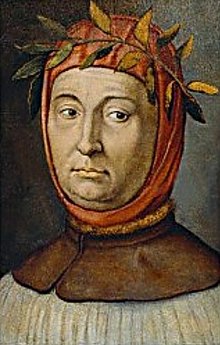
Petrarch - Wikipedia

Puppe ducis media tacitus meditansque sedebat

Ennius, assiduus rerum testisque comesque;

Scipio quem tandem aggreditur verbisque benignis

Excitat incipiens: “Nunquamne silentia rumpes,

O michi multorum solamen dulce laborum?

Fare, precor; nam perpetuis tabentia curis

Pectora nostra vides. Placido sermone levare

Illa soles; faciesque modo, tantum ora resolve,

Si tibi nascenti, quo polles, summus Apollo

Ingenium celeste dedit, si turba dearum

Castalio infantem demersum gurgite lavit

Ex Elicone sacro, collesque eduxit in altos,

Et calamum et vocem tribuit mentemque poete.”

Ennius auditis caput extulit atque ita fatur:

“O flos Italie, iuvenis, stirpisque deorum

Certa fides, quid nunc nostro placet ore moveri,

Quidve iubes? Equidem tacito modo pectore mecum

Volvebam quod nulla ferent iam secula maius

Eximie virtutis opus, quam nostra quod etas

Leta videt, nullusque unquam sub mente movebit

Grande aliquid, cui non, magnas spes inter, honestum

Nomen in ore sonet, qui non venturus ad actum

Scipiade meminisse velit, pro munere vultus

Non cupiat vidisse tuos. Maiorque sepulcri

Post cineres te fama manet. Mortalia Livor

Carpit enim; at Mors Invidiam consumit et arcet

Ac procul a bustis abigit. Tua gloria pridem

Vicerat hanc pestem, iamque altas tuta per auras

Fugit humum morbosque hominum moresque malignos,

Seque parem tulit alma deis.

Helen’s Sons and Menelaos’ Bastards

In Homer, Helen and Menelaos have a single child, Hermione and there is a reference to Menelaos’ son Megapenthes. But there are no mentions of Helen having children with anyone else. The mythographical tradition fixes this.

Jacoby BNJ 758 F 6 = Scholia on Euripides, Andromache 898

“Lysimachus and some others report that Nikostratos was also born from Helen. But the one who gathered the Cypriot tales says that it was Pleisthenes who came to Cyprus with Aganos and that he was the child born to Alexander from Helen.”

Λυσίμαχος καὶ ἄλλοι τινὲς ἱστοροῦσιν γενέσθαι ἐξ ῾Ελένης καὶ Νικόστρατον. ὁ δὲ τὰς Κυπριακὰς ἰστορίας συντάξας Πλεισθένην φησί, μεθ᾽ οὗ εἰς Κύπρον ἀφῖχθαι καὶ τὸν ἐξ αὐτῆς τεχθέντα ᾽Αλεξάνδρωι ῎Αγανον.

Apollodorus 3.133

“Menelaos fathered Hermione from Helen and according to some others Nikostraos; Akousilaos claims that [Menelaos] fathered Megapenthes with a servant girl who was Aitolian in race (she was named Pieres, or, it was Tereis who was Pierian; according to Eumelos he gave birth to a son named Xenodamos from a nymph named Knossia.”

Μενέλαος μὲν οὖν ἐξ ῾Ελένης ῾Ερμιόνην ἐγέννησε καὶ κατά τινας Νικόστρατον, ἐκ δούλης <δὲ> [Πιερίδος] γένος Αἰτωλίδος ἤ, καθάπερ ᾽Ακουσίλαός φησι, <Πιερίδος> [Τηρηίδος], Μεγαπένθη, ἐκ Κνωσσίας δὲ νύμφης κατὰ Εὐμηλον Ξενόδαμον.

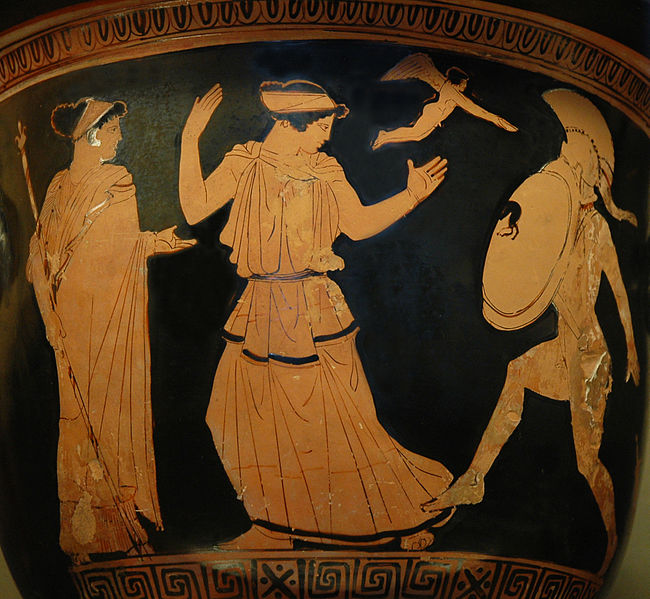
File:Helen Menelaus Louvre G424.jpg
Detail of an Attic red-figure crater, ca. 450–440 BC, found in Gnathia (now Egnazia, Italy). Louvre.


Poet, Interpret Thyself

Scriptura sui ipsius interpres, Martin Luther

D Scholia to the Iliad (5.385)

“Aristarchus believed it best to make sense of those things that were presented more fantastically by Homer according to the poet’s authority, that we not be overwhelmed by anything outside of the things presented by Homer.”

᾿Αρίσταρχος ἀξιοῖ τὰ φραζόμενα ὑπὸ τοῦ Ποιητοῦ μυθικώτερον ἐκδέχεσθαι, κατὰ τὴν
Ποιητικὴν ἐξουσίαν, μηδὲν ἔξω τῶν φραζομένων ὑπὸ τοῦ Ποιητοῦ περιεργαζομένους.

Porphyry, Homeric Questions 1.1

Since often in our conversations with one another about Homeric questions, when I try to show you that Homer interprets himself for the most part, and we consider from every angle in most instances based on our training more than [simply] knowing what he says, you have considered it right that I write up the things we have said rather than allow them to fall aside and disappear because we’ve forgotten them.

     Πολλάκις μὲν ἐν ταῖς πρὸς ἀλλήλους συνουσίαις ῾Ομηρικῶν ζητημάτων γινομένων, ᾿Ανατόλιε, κἀμοῦ δεικνύναι πειρωμένου, ὡς αὐτὸς μὲν ἑαυτὸν τὰ πολλὰ ῞Ομηρος ἐξηγεῖται, ἡμεῖς δὲ ἐκ τῆς παιδικῆς κατηχήσεως περινοοῦμεν μᾶλλον ἐν τοῖς πλείστοις ἢ νοοῦμεν ἃ λέγει, ἠξίωσας ἀναγράψαι με τὰ λεχθέντα μηδὲ διαπεσόντα ἐᾶσαι ὑπὸ τῆς λήθης ἀφανισθῆναι.


Porphyry, Homeric Questions 1.12-14

“Because I think to best to make sense of Homer through Homer, I usually show by example how he may interpret himself, sometimes in juxtaposition, sometimes in other ways.

᾿Αξιῶν δὲ ἐγὼ ῞Ομηρον ἐξ ῾Ομήρου σαφηνίζειν αὐτὸν ἐξηγούμενον ἑαυτὸν ὑπεδείκνυον, ποτὲ μὲν παρακειμένως, ἄλλοτε δ’ ἐν ἄλλοις.


Image result for Homer Ancient

Augustus Caesar, Maybe Not the Nicest Guy

Suetonius, Divus Augustus 15

“Following the capture of Perusia, [Augustus] turned his mind to vengeance on many people—facing those who were trying to beg forgiveness or make an excuse with one response: “you must die.”

Some authors record that three hundred people from both orders were picked out from the war-prisoners and slaughtered like sacrificial animals at the altar built to Divine Julius on the Ides of March. There are those who report that he turned to war with a specific plan, namely to trap his secret adversaries and those whom fear rather than willingness constrain and, once the model of Lucius Antonius* was offered, to pay the bonuses promised to veterans once he had conquered his enemies and liquidated their assets.”

Perusia capta in plurimos animadvertit, orare veniam vel excusare se conantibus una voce occurrens “moriendum esse.” Scribunt quidam trecentos ex dediticiis electos utriusque ordinis ad aram Divo Iulio exstructam Idibus Martiis hostiarum more mactatos. Exstiterunt qui traderent conpecto eum ad arma isse, ut occulti adversarii et quos metus magis quam voluntas contineret, facultate L. Antoni ducis praebita, detegerentur devictisque iis et confiscatis promissa veteranis praemia solverentur.

*Lucius (Marcus Antonius’ brother) had been a target of the siege at Perusia. Octavian [Augustus] let him live and sent him to serve as governor in what is now Spain.

Image result for ancient roman augustus perugia
Augustus as Pontifex Maximus, A Righteous and Religious Man

How Many Gods Do You Count?

Montesquieu, Dissertation on Roman Politics in Religion (Part 14)

The political system which prevailed in the religion of the Romans developed itself more fully in their victories. If they had listened to superstition, they would have brought among the vanquished the gods of the victors; they would have overturned their temples; and, in establishing a new mode of worship, they would have imposed upon them a cruder servitude than before. Rome herself submitted to the gods of foreigners, and received them in her breast; and through this connection, the strongest which can exist among humans, she attached herself to people who regarded her more as the sanctuary of religion than as the mistress of the world.

But, in order to avoid multiplying the number of beings, the Romans, following the example of the Greeks, adroitly mixed the foreign gods among their own. If they found among their conquests a god who had some resemblance to one of those worshipped in Rome, they adopted it, as it were, in giving it the name of a Roman deity, and they accorded it, if I may use the expression, the rights of the bourgeoisie in their city. So, when they found some famous hero who had purged the land of some monster, or who subjugated some barbarous people, they gave him straightaway the name of Hercules. ‘We have pierced all the way to the Ocean,’ says Tacitus, ‘and we have found there the columns of Hercules: either because Hercules was there, or because we have attributed to this hero all of the deeds worthy of Herculean glory.’

Varro counted forty four of these defeaters of monsters; Cicero counted but six, twenty two Muses, five Suns, four Vulcans, five Mercuries, four Apollos, three Jupiters. Eusebius goes farther: he counts as many Jupiters as there were people.

The Romans, who had no other divinity than the genius of the Republic, paid no attention to the disorder and confusion which they introduced into mythology: the credulity of the people, which is always beyond ridicule and extravagance, made up for it all.

La politique qui régnait dans la religion des Romains se développa encore mieux dans leurs victoires. Si la superstition avait été écoutée, on aurait porté chez les vaincus les dieux des vainqueurs: on aurait renversé leurs temples ; et, en établissant un nouveau culte, on leur aurait imposé une servitude plus rude que la première. On fit mieux : Rome se soumit elle-même aux divinités étrangères, elle les reçut dans son sein ; et, par ce lien, le plus fort qui soit parmi les hommes, elle s’attacha des peuples qui la regardèrent plutôt comme le sanctuaire de la religion que comme la maîtresse du monde.

Mais, pour ne point multiplier les êtres, les Romains, à l’exemple des Grecs, confondirent adroitement les divinités étrangères avec les leurs : s’ils trouvaient dans leurs conquêtes un dieu qui eût du rapport à quelqu’un de ceux qu’on adorait à Rome, ils l’adoptaient, pour ainsi dire, en lui donnant le nom de la divinité romaine, et lui accordaient, si j’ose me servir de cette expression, le droit de bourgeoisie dans leur ville. Ainsi, lorsqu’ils trouvaient quelque héros fameux qui eût purgé la terre de quelque monstre, ou soumis quelque peuple barbare, ils lui donnaient aussitôt le nom d’Hercule. « Nous avons percé jusqu’à l’Océan, dit Tacite, et nous y avons trouvé les colonnes d’Hercule ; soit qu’Hercule y ait été, soit que nous ayons attribué à ce héros tous les faits dignes de sa gloire. »

Varron a compté quarante-quatre de ces dompteurs de monstres ; Cicéron n’en a compté que six, vingt-deux Muses, cinq Soleils, quatre Vulcains, cinq Mercures, quatre Apollons, trois Jupiters. Eusèbe va plus loin: il compte presque autant de Jupiters que de peuples.

Les Romains, qui n’avaient proprement d’autre divinité que le génie de la république, ne faisaient point d’attention au désordre et à la confusion qu’ils jetaient dans la mythologie : la crédulité des peuples, qui est toujours au-dessus du ridicule et de l’extravagant, réparait tout.

Changing Tack: Cicero on Ends and Means in Politics

Ep. 20 (I.9) Cicero to Lentulus Spinther

“For I do not think it is necessary to fight against such powers nor to get rid of the precedence taken by our highest citizens, even if it were possible; nor do I think it necessary to affix myself to a single opinion when situations change and the desires of good men change with them—no, one must change with the times. Remaining in an permanent opinion has never been praised among exceptional men for the governing of the state.

But, as in sailing it is good to get ahead of a storm even if you will not find the harbor; yet if you can make it to safe ground by changing your approach, only a fool would risk danger to hold to the course he began rather than make his destination by changing something. Thus, while all of us running the state should seek the proposition which I have often sought—peace with dignity—we should ensure not to speak the same but always to seek the same thing.”

  1. nam neque pugnandum arbitrarer contra tantas opes neque delendum, etiam si id fieri posset, summorum civium principatum <neque> permanendum in una sententia conversis rebus ac bonorum voluntatibus mutatis, sed temporibus adsentiendum. numquam enim <in>praestantibus in re publica gubernanda viris laudata est in una sententia perpetua permansio; sed ut in navigando tempestati obsequi artis est etiam si portum tenere non queas, cum vero id possis mutata velificatione adsequi stultum est eum tenere cum periculo cursum quem coeperis potius quam eo commutato quo velis tamen pervenire, sic, cum omnibus nobis in administranda re publica propositum esse debeat, id quod a me saepissime dictum est, cum dignitate otium, non idem semper dicere sed idem semper spectare debemus.
Image result for Medieval Manuscript Cicero
Burney 275

Bad Planning and Disasters

Aesop: The Monkey and the Fisherman: ΑΛΙΕΥΣ ΚΑΙ ΠΙΘΗΞ

“Some fisherman was setting is net for fish along the seashore. A monkey was watching him and wanted to copy what he was doing. When the man went into some cave to take a nap and left his net on the beach, the monkey came down, and was trying to fish in the same way. Ignorant of the skill, he was using the net poorly and just wrapped it all around himself. He immediately fell into the sea and drowned. When the fisherman found him already drowning, he said, “fool, your ignorance and bad planning ruined you.”

The moral of the story is that people who try to imitate acts beyond their ability bring disaster upon themselves.”

ἀνήρ τις ἁλιεὺς παρὰ τὴν θάλασσαν ἄγραν ἰχθύων ἐποίει. πίθηξ δέ τις αὐτὸν κατιδὼν ἐκμιμήσασθαι ἠβουλήθη. τοῦ δὲ ἀνδρὸς ἐν σπηλαίῳ τινὶ ἑαυτὸν εἰσελθόντος διαναπαῦσαι καὶ τὸ δίκτυον παρὰ τὸν αἰγιαλὸν καταλιπόντος ἐλθὼν

ὁ πίθηξ καὶ τοῦ δικτύου λαβόμενος ἀγρεῦσαι δῆθεν δι’ αὐτοῦ ἐπεχείρει. ἀγνώστως δὲ τῇ τέχνῃ καὶ ἀσυντάκτως χρώμενος καὶ τῷ δικτύῳ περισχεθεὶς ἐπὶ τῆς θαλάσσης εὐθὺς πέπτωκε καὶ ἀπεπνίγη. ὁ δὲ ἁλιεὺς καταλαβὼν αὐτὸν ἤδη ἀποπνιγέντα ἔφη· „ὦ ἄθλιε, ὤλεσέ σε ἡ ἀφροσύνη καὶ ἡ ματαία ἐπίνοια.”

     ὁ μῦθος δηλοῖ, ὡς οἱ τὰ ὑπὲρ αὐτοὺς μιμεῖσθαι πειρώμενοι ἑαυτοῖς ἐντεῦθεν ἐπάγουσι κινδύνους.


More Cyrenaic Wisdom

Diogenes Laertius, Lives of the Philosophers – Aristippus (70)

“When someone proposed a riddle to Aristippus and asked him to solve it, Aristippus responded, ‘You idle fool, you want this solved, even though it offers us plenty of trouble in its unsolved state?’

He said that it was better to be a beggar than to be uneducated, for a beggar is lacking money, but the uneducated person is lacking humanity.

One time, when upbraided, he ran away. When someone pursued him, asking why he fled, he responded, ‘Because you have the power of talking trash, and I have the power of not listening.’

When someone said that he always saw philosophers at the doorways of the rich, Aristippus replied, ‘So too you always find doctors at the doorways of the sick. But one would not on that account choose rather to be sick than to be a doctor.”

Aristippus

Αἴνιγμά τινος αὐτῷ προτείναντος καὶ εἰπόντος, “λῦσον,” “τί, ὦ μάταιε,” ἔφη, “λῦσαι θέλεις ὃ καὶ δεδεμένον ἡμῖν πράγματα παρέχει;” ἄμεινον ἔφη ἐπαιτεῖν ἢ ἀπαίδευτον εἶναι· οἱ μὲν γὰρ χρημάτων, οἱ δ’ ἀνθρωπισμοῦ δέονται. λοιδορούμενός ποτε ἀνεχώρει· τοῦ δ’ ἐπιδιώκοντος εἰπόντος, “τί φεύγεις;”, “ὅτι,” φησί, “τοῦ μὲν κακῶς λέγειν σὺ τὴν ἐξουσίαν ἔχεις, τοῦ δὲ μὴ ἀκούειν ἐγώ.” εἰπόντος τινὸς ὡς ἀεὶ τοὺς φιλοσόφους βλέποι παρὰ ταῖς τῶν πλουσίων θύραις, “καὶ γὰρ οἱ ἰατροί,” φησί, “παρὰ ταῖς τῶν νοσούντων· ἀλλ’ οὐ παρὰ τοῦτό τις ἂν ἕλοιτο νοσεῖν ἢ ἰατρεύειν.”