Diogenes Laertius, Lives of the Philosophers – Aristippus (70)
“When someone proposed a riddle to Aristippus and asked him to solve it, Aristippus responded, ‘You idle fool, you want this solved, even though it offers us plenty of trouble in its unsolved state?’
He said that it was better to be a beggar than to be uneducated, for a beggar is lacking money, but the uneducated person is lacking humanity.
One time, when upbraided, he ran away. When someone pursued him, asking why he fled, he responded, ‘Because you have the power of talking trash, and I have the power of not listening.’
When someone said that he always saw philosophers at the doorways of the rich, Aristippus replied, ‘So too you always find doctors at the doorways of the sick. But one would not on that account choose rather to be sick than to be a doctor.”
“The people of the west have their own alcohol made from soaked grain in many different ways in Gaul and Spain with many different names but with the same idea. The people of Spain have already taught us that these kinds of beverages will last even a long amount of time.
Egypt, too, has worked out a similar drink made from grain and in no corner of the world does intoxication ever take a break. They even drink this type of beverage without diluting them as one does with wine. But, by Hercules, that land used to seem to offer grains alone. Alas, the miraculous inventiveness of vice! A way has also been found to make water intoxicating!”
. Est et occidentis populis sua ebrietas e fruge madida, pluribus modis per Gallias Hispaniasque, nominibus aliis sed ratione eadem. Hispaniae iam et vetustatem ferre ea genera docuerunt. Aegyptus quoque e fruge sibi potus similis excogitavit, nullaque in parte mundi cessat ebrietas; meros quippe hauriunt tales sucos nec diluendo ut vina mitigant; at, Hercules, illic tellus fruges parare videbatur. heu, mira vitiorum sollertia! inventum est quemadmodum aquae quoque inebriarent.
Julian the Apostate, Epigrams 1
“Who are you and where are you from Dionysus? By the Bakhos true
I know only the son of Zeus and I do not know you.
He smells like nektar, but you smell like goat.
Did the Celts make you from grain because of their lack of grapes?
Ah, we should call you not Dionysus, but Demetrios instead.
And Bromos*** not Bromios since you are born of wheat**.”
The note from the Loeb attributes an understanding of this fragment to Hermann who compares it to Nonnos, Dionysiaca, 20.149–153, 166–181
Nonnos, Dion. 20.149-153
“The was a certain murderous man living there, of Ares’s line
Who was a mimic of his father’s wretched customs.
The criminal would drag faultless strangers to their doom,
That dread maniac Lykourgos, and then when he cut off
Their mortal heads with steel he hung them in his doorway…”
“The degree to which the best governed states have dedicated themselves to fine music finds ample testimony, especially in the case of Terpander who brought an end to the civil strife that was ruining the Spartans.
There’s also Thaletas of Crete who people say listened to the Delphic oracle and went Sparta and returned people to health with music, saving Sparta from the Pandemic that was gripping the land, as Pratinas claims.
Homer too says that the Greeks stopped a plague with music, for he says that “sons of the Achaeans propitiated the god with song and dance all day long / singing the noble paean and praising the / far-shooter who took pleasure in hearing the song.”
I’ll leave those verses as the final words in my argument about music, good teacher, since you started this discussion by quoting them to us. In truth, music’s first and finest labor is to give thanks back to the gods, and after that comes a cleansing of the soul, sure tone, and sustained harmony.”
Now when it is said, that men in manhood so often throw their Greek and Latin aside, and that this very fact shows the uselessness of their early studies, it is much more true to say that it shows how completely the literature of Greece and Rome would be forgotten, if our system of education did not keep up the knowledge of it. But it by no means shows that system to be useless, unless it followed that when a man laid aside his Greek and Latin books, he forgot also all that he had ever gained from them. This, however, is so far from being the case, that even where the results of a classical education are least tangible, and least appreciated even by the individual himself, still the mind often retains much of the effect of its early studies in the general liberality of its tastes and comparative comprehensiveness of its views and
notions.
All this supposes, indeed, that classical instruction should be sensibly conducted; it requires that a classical teacher should be fully acquainted with modern history and modern literature, no less than with those of Greece and Rome. What is, or perhaps what used to be, called a mere scholar, cannot possibly communicate to his pupils the main advantages of a classical education. The knowledge of the past is valuable, because without it our knowledge of the present and of the future must be scanty; but if the knowledge of the past be confined wholly to itself, if, instead of being made to bear upon things around us, it be totally isolated from them, and so disguised by vagueness and misapprehension as to appear incapable of illustrating them, then indeed it becomes little better than laborious trifling, and they who declaim against it may be fully forgiven.
Plutarch, On the Fortune of Alexander (Moralia 328d-f)
“When Alexander the great was taming Asia, Homer was being read and the children of the Persians, Susianans, and Gedrosians learned to sing the tragedies of Euripides and Sophocles. Shoot, even though Socrates, when he was prosecuted for bringing a foreign god to the Athenains, lost his case to those Athenian sycophants, Baktria and the Caucasus learned to kneel before Greek gods.
While Plato wrote a book about a single constitution, he persuaded no one to use it because of its severity; but Alexander created more than seventy cities among barbarian tribes and plated Greek institutions all over Asia and conquered their harsh and uncivilized ways. Few of us have even read Plato’s Laws, but countless thousands have followed Alexander’s and still used them.
Really, those who were conquered by Alexander are luckier than those who resisted him—they had no one who could help them change their pathetic lives; but the champion taught those conquered how to be happy.”
What is amazing about this passage is the quick but clear elision between culture as a marker of value and brute force to impose cultural supremacy. Similar themes are common in European treatises from Plutarch to today.
I mean, if Homer is so great, why does he need Alexander to take him to Asia?
“The Lydians and Ionans [report] that letters came from Phoinix the son of Agênor who invented them. But the Cretans report differently that they were developed from writing on the leaves of palm trees [phoinikes].
Skamôn, in the second book of his Inventions, says that they were named for Aktaion’s daughter Phoinikê. The story goes that he had no male children, but that he had daughters Aglauros, Ersê, and Pandrosos. Phoinikê died still a virgin. For this reason, Aktaion named the letters “Phoenician” for her, because he wished to give some honor to his daughter.”
“Letters: Know that Phoenicians were the first to invent letters. For this reason, letters are also called Phoinikeia. People also say that Kadmos first brought them to Greece. And Apis, the Egyptian, brought medicine. Asklepios improved the art itself. Look also in the entry on Phoenician Letters.” [reference is the same as reported in Photios’ Lexicon.]
Whatever may have been the exact notions of his future course which presented themselves to him, it is evident that he was not insensible to the attraction of visions of extensive influence, and almost to his latest hour he seems to have been conscious of the existence of the temptation within him, and of the necessity of contending against it. “I believe,” he said many years afterwards, in speaking of these early struggles to a Rugby pupil who was consulting him on the choice of a profession, — “I believe that, naturally, I am one of the most ambitious men alive,” and “the three great objects of human ambition,” he added, to which alone he could look as deserving the name, were ” to be the Prime-Minister of a great kingdom, the governor of a great empire, or the writer of works which should live in every age and in every country.” But in some respects the loftiness of his aims made it a matter of less difficulty to confine himself at once to a sphere in which, whilst he felt himself well and usefully employed, he felt also that the practical business of his daily duties acted as a check upon his own inclinations and speculations. Accordingly, when he entered upon his work at Laleham he seems to have regarded it as his work for life. “I have always thought,” he writes in 1823, “with regard to ambition, that I should like to be aut Caesar aut nullus [“either Caesar or a nobody”], and as it is pretty well settled for me that I shall not be Caesar, I am quite content to live in peace as nullus.”
“For comedy—which can provide a great deal to eloquence since it works through every character and feeling—I will explain soon what purpose I think it serves for students in its own place. For, once characters are safely formed, comedy is among the most important things to read. I am speaking of Menander, but I will not bar the others, for the Latin authors also provide some utility.
Students must first read texts which especially nourish the intelligence and strengthen the character. A long life will give them time for the rest of the works which are good mainly for intellectual reasons. The older Latin poets, moreover, who are mostly effective for their innate ability rather than their skill, can offer a lot—especially for building a great vocabulary. One can find a seriousness in their tragedies and in their comedies an elegance and a certain Attic nature. Their compositions are more considered, too, than modern authors who think that the only virtue of writing is its “quotability”. A high register and, if I may say, a kind of power must be found in these authors since we have now stumbled into the vices of pleasure in our manner of speaking too. And, finally, we should lean on the best orators who take from the poems of the ancients to strengthen their claims or decorate their speaking”
Comoediae, quae plurimum conferre ad eloquentiam potest, cum per omnis et personas et adfectus eat, quem usum in pueris putem paulo post suo loco dicam: nam cum mores in tuto fuerint, inter praecipua legenda erit. De Menandro loquor, nec tamen excluserim alios, nam Latini quoque auctores adferent utilitatis aliquid; sed pueris quae maxime ingenium alant atque animum augeant praelegenda: ceteris, quae ad eruditionem modo pertinent, longa aetas spatium dabit. Multum autem veteres etiam Latini conferunt, quamquam plerique plus ingenio quam arte valuerunt, in primis copiam verborum: quorum in tragoediis gravitas, in comoediis elegantia et quidam velut atticismos inveniri potest. Oeconomia quoque in iis diligentior quam in plerisque novorum erit, qui omnium operum solam virtutem sententias putaverunt. Sanctitas certe et, ut sic dicam, virilitas ab iis petenda est, quando nos in omnia deliciarum vitia dicendi quoque ratione defluximus. Denique credamus summis oratoribus, qui veterum poemata vel ad fidem causarum vel ad ornamentum eloquentiae adsumunt.
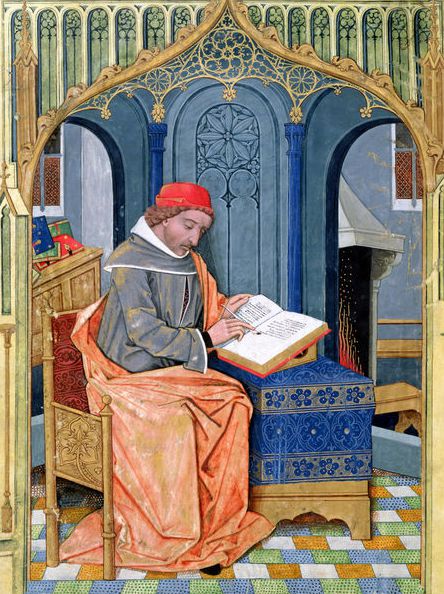
Portrait of Matthaeus Platearius d.c.1161 writing “The Book of Simple Medicines”, c.1470 (Wikimedia Commons)
At Olympia. Plato claims in the Phaedrus that a metal Colossos was set up next to the dedication of the Kypselids at Olympia. But they claim that this from Kypselos himself and not the Kypselids. Agaklutos speaks about this in his On Olympia. “An ancient temple of Hera, dedicated by the Skillians. Those people are Eleians. Inside the temple is a gold colossus, a dedication from Kypselos of Korinth. For people say that Kypselos promised that if he should become tyrant of the Korinthians, then he would make everyone’s property sacred for ten years. Once he collected the taxes from this sacred assessment, he had the metal colossus created.”
Didymos, however, reports that Periander, his son, had the colossus made to restrain the luxury and audacity of the Korinthians. Theophrastus also reports in the second book of his Magic Moments, “while others spend funds on more masculine affairs, like raising an army and conquering enemies, as Dionysius the tyrant did. For he believed that it was necessary not only to waste others’ money but also his own in order to make sure that there would be no funds for plots against him. The pyramids of Egypt and the colossus of the Kypselids and all those kinds of things have similar or identical designs.
It is also reported that there was an an epigram on the colossus: “If I am not a colossus made of gold / then may the race of the Kypselids be wiped away.”
Apellas of Pontos, however, claims that he inscription was, “If I am not a solid-cold Colossus, may the race of Kypselids be completely destroyed”
“Amyntas in his work which he named Stages writes that in the Caspian land there are many herds of cattle and horses almost beyond counting. He adds this as well, that in some seasons an unconquerable plague of rats blights the land. He continues with evidence, saying that even though the rivers flow at that of year with a huge surge, the rats swim fearlessly and they even hold on to each other’s tales, biting down on one another, to form a bridge and they they cross the strait in this way.
After swimming into the farmland, he says, they grind down the roots of crops and swarm over trees and once they use their fruits for their meals they sever the branches too just because they are not able to eat them. For this reason, the Caspians—in order to ward off this invasion of rats and the ruin they bring—do not kill the predatory birds which come in turn, flying down from the clouds, and fulfill their nature by freeing the Caspians of this plague.
Caspian foxes are so numerous that they frequent both the sheepfolds in the country and they also appear in cities. By Zeus, a fox will show up in a house not to steal something or ruin it, but like some kind of pet. The Caspian foxes wag their tails just like pet dogs in our land.
The rats of the terrible plague afflicting the Caspians are almost the same in size when you look a them as the ikhneumenos of Egypt, but they are wild, and terrible, and they have teeth strong enough to cut and even eat metal. The rats in Teridon, Babylonia are like this too—and traders bring their skins to sell among the Persians. Indeed, these skins are soft and can be sewn together as a tunic to warm people. And they call them kandutanes, because it is dear to them.
Here is something amazing about these rats: if a pregnant female is caught and her fetus is removed, when the female fetus is dissected and examined, it also has a baby.”