Claudia Severa invites her friend Sulpicia Lepidina (wife of the prefect at Vindolanda) to a birthday party. Despite the use of soror, the two women are not believed to be sisters. With part of the document written by Severa herself, this (and the accompanying notes) is believed to be the earliest-known Latin written by a woman.
Side I
Cl(audia) · Seuerá Lepidinae [suae
[sa]l[u]tem
iii Idus Septembr[e]s soror ad diem
sollemnem natalem meum rogó
libenter faciás ut uenias
ad nos iucundiorem mihi
Side II
[diem] interuentú tuo facturá si
…s
Cerial[em t]uum salutá Aelius meus .[
et filiolus salutant … … sperabo te soror uale soror anima mea ita ualeam karissima et haue
(The italicized text was written by Severa herself)
“Claudia Severa to her Lepidina, greetings. On September 11, sister, for my birthday celebration, I ask you sincerely to make sure you come to (join) us, to make the day more fun for me by your arrival…Say hello to your Cerialis. My Aelius and little boy say hello. I await you, sister. Be well, sister, my dearest soul, so I may be well too. Hail.”
A sad text. Also a good one to use in class, it utilizes both Latin and Hebrew, and goes well with a discussion of diversity in the city and empire. It is also one of the latest dated texts in this document.
(H)Ic iacet Gaudi=
osa infantula
qui bissit annoru=
m plus minu(s) tre=
s requiebit in
pacem. שלום
“Here lies the child Gaudiosa, who lived around three years. She will rest in peace. Shalom (in Hebrew)
Antiquity has left us only one fragment of the iambic poet Hedyle. It is not iambic!
Athenaeus 7.297b
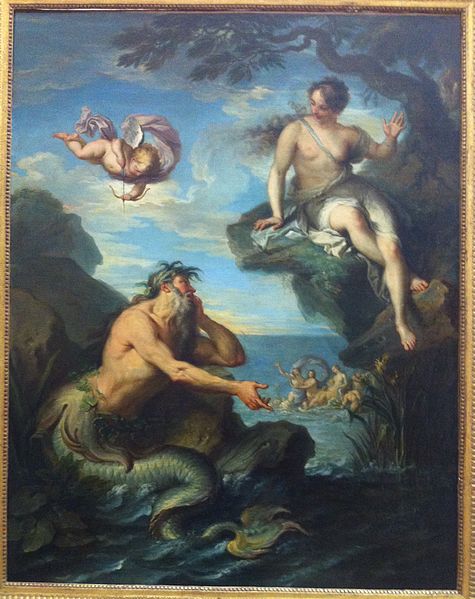
“Hêdulos, the Samian or Athenian, says that Glaukos threw himself in the sea after he fell in love with Melicertes. Hêdulê, his mother and the daughter of the Athenian Moskhinê, was a composer of iambic lines. In her poem called “Skylla”, she records that Glaukos went into his own cave after he fell in love with Skylla
“Either carrying shells as gifts
From the Erythaian cliff
Or halcyon chicks still unwinged
Presents for the girl from an anxious man.
His Siren girl neighbor felt pity
For he was swimming toward that beach
And the regions close to Aitna.”
The following fragment is from a poem whose central conceit is a singing contest between Mt. Kithairon and Mt. Helikon. The former wins; the latter loses. Mountains leave happy and sad….
“…the Kouretes
Sheltered the sacred offspring
Of the goddess in secret
From crooked-monded Kronos
When blessed Rhea stole him
And earned great honor among
The immortal gods….”
He sang those things.
Immediately the Muses told
The gods to cast their secret
Votes into the gold-gleaming urns.
They all rose up at once.
Then Kithairôn took the greater number.
Hermes quickly announced
By shouting that he had won
His longed-for victory
And the gods decorated him
With garlands[…]
And his mind filled with joy.
But the other, Helikon,
Overcome by hard griefs,
Ripped out a smooth rock
and the mountain [shook].
He broke it from on high
Painfully into ten thousand stones…”
“You lie there beneath Aphrodite’s golden ceiling,
Grapes, full with Dionysus’ drink.
Your mother, the vine, will no longer wrap her love branch around you
And protect your head beneath her sweet leaf.”
“Anigrian Nymphs, daughters of the river, you ambrosial
Creatures who always step on the depths with rosy feet.
Say hello to and preserve Kleonymos who set out for you goddesses
These wooden images beneath the pines.”
“Isis sends her mother the most greetings. I make a prayer for you each day before lord Sarapis and the gods who are with him.
I want to tell you that I made it safely and well to Alexandria in four days. I send greetings to my sister and her children, and Elouath and his wife, as well as Diokorous and her husband and son and Tamalis and her husband and son, and Hêron and Ammonarion and her children and her husband and Sanpat and her children. If Aiôn wants to join the army, have him come. For everyone is joining the army.
I pray for you and everyone in the house to be well.
After the suitor Amphimedon arrives in the underworld and tells the story of Penelope’s shroud and Odysseus’ return, Agamemnon responds:
Odyssey 24.192-202:
“Blessed child of Laertes, much-devising Odysseus,
You really secured a wife with magnificent virtue!
That’s how good the brains are for blameless Penelope,
Ikarios’ daughter, how well she remembered Odysseus,
Her wedded husband. The fame of her virtue will never perish,
And the gods will craft a pleasing song
Of mindful Penelope for mortals over the earth.
This is not the way for Tyndareos’ daughter.
She devised wicked deeds and since she killed
Her wedded husband, a hateful song
Will be hers among men, she will attract harsh rumor
To the race of women, even for those who are good.”
More than half of this speech praises Penelope for being a loyal, ‘good’ wife (and that is another issue of its own). Of course, this makes Agamemnon think of Klytemnestra. There’s a lot to be said about how this passage sets up the end of the Odyssey, but Agamemnon’s words are striking because they reflect a sad reality not just about misogynistic thinking but about the operation of human thought.
Let’s start with the misogyny: Agamemnon says here, quite clearly, that because of the behavior of one woman (well, two if we hear ambiguity in the phrase “Tyndareos’ daughter” and think of Helen too) all women have bad fame, even if they are “good”? A simple response to this is to wonder whether the same applies to men (of course not…) Let’s pass over the fact that the murder of Agamemnon was probably well deserved. I think this passage also reflects human cognition: the story of Klytemnestra is paradigmatic. We learn basic patterns about people and the world and apply these patterns (prejudices) as substitutions for deeper thought.
I am not sure whether this serves as a bit of an anticipatory apologetic on the part of epic–that the tale of Penelope cannot match up to negative messages about women. It probably stands as an acknowledgement of a “negative expectancy effect”–we are primed to hear negative tales and to believe negative things. I suspect that on Homer’s part this is probably less about women and more about anticipating the reception of this poem.
But, at the very least, this is a clear indication that Homer knows the way it goes: we live in a cultural system that discounts positive stories about women in favor of negative ones and which, accordingly, downgrades the authority of the stories they tell. In our responses to the testimonies of men and women, men have the privilege of being individuals whose lives might be ruined by rumor and false claims, while women are always already undermined. This is is an example of structural misogyny.
For discussions of this passage see: On the contrasting fame of Klytemnestra and Penelope, see Franco 2012, 60–61. For invocations of Klytemnestra as an example of how a woman can ruin a nostos, see Murnaghan 2011, chapter 4 and Nagy 1999, 36–39.
Classical myth deserves trigger warnings.
Franco, Cristina. 2012. “Women in Homer,” in Sharon L. James and Sheila Dillon, eds., A Companion to Women in the Ancient World. London. 55–65.
Marquardt, Patricia. 1989. “Love’s Labor’s Lost: Women in the Odyssey,” in Robert Sutton, ed., Daidalikon: Studies in Honor of Raymond V. Schoder, S.J. Chicago. 239-248.
Murnaghan, Sheila. 2011. Disguise and Recognition in the Odyssey, Second Edition. Lanham.
Nagy, Gregory 1996. Poetry as Performance: Homer and Beyond. Cambridge
“It is also necessary for a woman to take to heart that she will find no kind of purifying remedy for this mistake [adultery], something that would allow her to approach the temples and altars of the gods as a chaste and god-loved woman. This is because in this crime especially the divine spirit is most unforgiving. The most beautiful achievement of a free woman and the foremost glory is to provide as testimony to her prudence toward her husband her children, if they do in fact bear the imprint of similarity to the father who sowed them. That seems to me to be enough regarding marriage.
The following seems to be right to me when it comes to the management of the body. A woman should wear white, but be dressed simply and without decoration. This style of dressing is achieved without transparent or decorated robes or robes which are made from silk; instead a woman should wear modest and white clothing. She preferably also avoids luxury and ostentation and will not cause vile jealousy in other women. She should also not put on gold or emeralds at all—this behavior would make her seem wealthy and haughty to common women.
It is necessary that the well-governed city which is ordered completely with a view to its whole should be one of common experiences and likemindedness. And it should keep out the craftspeople who create these sorts of baubles from its territory. A prudent woman should not embellish her appearance with foreign decoration and makeup but should use the native beauty of the body—she should decorate her body by washing it in water rather than bringing it shame. For this brings honor to herself and the man she lives with.
Women need to make processions from their homes to make sacrifices to the leading-god of the city for themselves, their husbands, and their households. They must make their expedition to the theater or to the market for household goods, however, not when the evening star is rising nor when it is dark but whenever it is still light, accompanied by a single servant or, at most, two as is proper.
In addition, a prudent woman must also perform sacrificial rites for the gods as is permitted to her, but must abstain from the occult rites and rituals of the Great Mother at home. For the common law prohibits women from performing these rituals, since, in addition to other things, these practices make them drunk and insane. The woman of the home needs to be temperate and uncontaminated by everything, even when she is governing the home.”
According to some testimonia Melinno was Nossis’ daughter. The Following poem may be a poem to the city of Rome or to strength Personified (in Greek, rhômê)
“They claim that after some time Themis was given by Gaia whatever he share was and then that Apollo received that as a gift from Themis. They say that Apollo gave to Poseidon the portion of land called Kalauria which is near Troizen as an exchange-gift for the oracle. I have also heard that men who were shepherding their flocks chanced upon the oracle and were inspired by the mist and then acted as prophets of Apollo. The account with the most adherents is the story of Phêmonoê, that she was the first prophet of the god and the first person who sang hexameters.
Boiô, a local woman who created a Hymn for the Delphians, used to say that people who visited from the Hyperboreans along with others and Olên created the oracle for the god and that he, Olên, was the first to give prophecies and to sing a hexameter.
Boiô composed these verses: “Here in fact, they built the oracle of good memory / the children of the Hyperboreans, Pagasos and shining Aguieus.”
Once she has named other Hyperboreans, near the end of the hymn she mentioned Olên: “And Olên who was the first prophet of Phoibos / and the first to make the song of ancient epic verses.” There is in common memory no mention of him at all; all that is left is the prophecy of women only.”