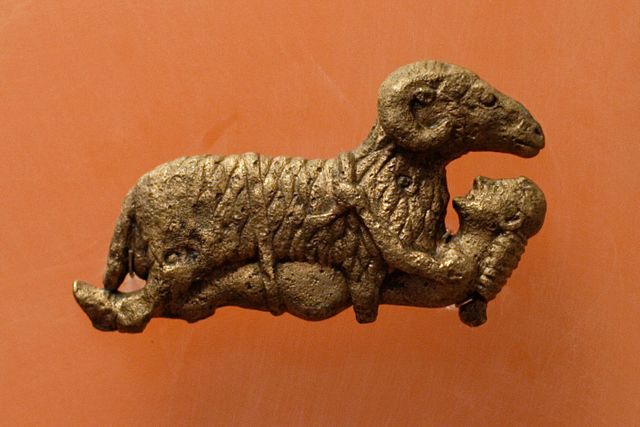
Then god-born Odysseus responded to him with a speech:
“Eumaios, you have really raised the spirit in my thoughts
By saying each of these things, how much you suffered grief in you heart. But Zeus has certainly added some good to your trouble Since you came and have worked much in the home of a mild man,
Who provides food and drink rightly. You live a good life.
But I have come her after wandering through many cities of men”
So they spoke saying these kinds of things
And they stayed awake not much more, only a little.
This is the response Odysseus gives to Eumaios’ story of his enslavement as a child.
Eumaios’ Story: Odyssey, 15.389–484
Then the swineherd, marshal of men, responded:
“Friend, since you have asked me and inquired truly of these things,
Listen now in silence and take some pleasure and drink your wine
While you sit there. These nights are endless. There is time for sleep
And there is time to take pleasure in listening. It is not at all necessary
For you to sleep before it is time. Even a lot of sleep can be a burden.
Let whoever of the rest the heart and spirit moves
Go out and sleep. For as soon as the down shows itself
Let him eat and follow the master’s swine.
As we two drink and dine in this shelter
Let us take pleasure as we recall one another’s terrible pains.
For a man finds pleasure even in pains later on
After he has suffered so very many and survived many too.
I will tell you this because you asked me and inquired.
There is an island called Suriê, if you have heard of it,
Above Ortygia, where the rays of the sun rise.
It is not too filled, but it is a good place
Well stocked with cows, sheep, with much wine and grain too.
Poverty never curses the people there, nor does any other
Hateful sickness fall upon the wretched mortals,
But when the race of humans grow old in the city
Apollo silverbow comes with Artemis
And kills them with his gentle arrows.
There are two cities there and everything is divided between them.
My father used to rule both of them as king
Ktêsios the son of Ormenos, a man equal to the immortal gods.
The ship-famous Phaeacians used to to frequent there
Pirates, bringing countless treasures in their black ships.
There was a Phoenician woman in my father’s house
Beautiful and broad and skilled in wondrous works.
The devious Phoenicians were corrupting her.
First, one of them joined her for sex while she was washing clothes
Near the swift ship—these things mix up the thoughts
For the female sex even when one of them is work-focused.
“So he spoke, and stripping off his cloak he grabbed a discus,
Larger and wider, not a little heavier than the ones
Which the Phaeacians where throwing among one another.
He turned around and whirled it from his strong hand
And the stone boomed. Then the oar-wielding Phaeacians
Leapt to the ground, those men famous for their ships,
At the hurl of the stone. Then it flew past all of their markers,
Swiftly hurling it from his hand. Then Athena set the boundary
After taking on the form of a man, and she spoke a word and called out:
“Even a blind person, friend, could find this marker
As he felt all around, since it is not at all mixed in with the others—
No, it is first by far. Be happy at this competition–
None of the Phaeacians will come close or surpass it.”
So much-enduring Odysseus said and he laughed
Taking pleasure in the fact that he had a real friend in the game.”
“But a longing for Odysseus who has gone wrecks me.
I am feel ashamed to name him, stranger, even though he is absent.
For he used to really care about me and take pains in his heart.
But I call him my older brother even though he is not here.”
Translators who contend with this passage may struggle with it because it seems odd in English to say “I feel shame to name…” someone. In fact, I don’t think I would understand this passage at all (and I still might be wrong) if it were not for my wife’s language and culture (she speaks Tamil, a language from southern India). In many cultures, naming someone by their personal name is a sign of privilege; not naming them or using an honorific is a token of respect. In Tamil, for instance, there are different names for aunts and uncles depending on whether they are older or younger than your parents.
Outside of the family, as a sign of respect, one calls older men and women aunt and uncle (or grandfather and grandmother) and family friends or cousins of close age but still older “big sister” (akka) or big brother (anna).
The passage above hinges, I think, on some kind of a token of respect. Eumaios, the swineherd, is hesitant to speak Odysseus’ name and declares that he should call him êtheion. Most translators render this as “lord”, “sir”, “master”. But the scholia give a different answer.
Schol. BQHV ad Hom. Od. 14.147
BQ. “But I call him elder…” I do not call Odysseus ‘master’ but big brother because of his loving-care for me. For to êtheie is the address of a younger [brother] to an older.”
H. “This is one part of the speech [?]. But it clearly means older brother”
ἓν μέρος λόγου ἐστί· δηλοῖ δὲ τὸν πρεσβύτερον ἀδελφόν. H.
êtheion: Older brother, really amazing.
ἠθεῖον, πρεσβύτερον ἀδελφὸν, θαυμαστὸν ἄγαν. V.
The sociolinguistic apparatus that conveys the full force of Eumaios’ feeling here is not fully present in English. But even just translating this as “brother” would make sense since, earlier, Eumaios claims that he would not even mourn his parents as much as he would Odysseus.
(This is a little disturbing from the perspective of how a slave defers to the master, but it works out even better for Eumaios’ view of his position in the ‘family’ since later he says that he was raised with Odysseus’ sister Ktimene).
Euryalus (a Phaeacian youth) has just claimed that Odysseus looks more like a pirate than an athlete.
Very-clever Odysseus glared at him and then answered in response
“Friend, you don’t speak well. You’re like a reckless man.
The gods don’t give good things to people at once in this way–
Not in form or brains or in ability to speak.
For one man is not exceptional in looks
But a god crowns his form with words. People delight
As they see him, and he speaks without hesitation in public,
With sweet reverence, and is conspicuous among those assembled,
And they gaze upon him like a god when he goes through the city.
Another is equal to the immortals in his appearance
But no charm sits well upon his words—
Just so, your shape is excellent, not even a god
Could make it differently. But your mind is limited [apophôlios].
You have raised the spirit in my dear chest
By speaking against what is right. I am no novice in sports,
As you at least claim, but I think I was among the best
When I could trust my youth and my hands.
But now I am overcome by evil and pains. I have endured much
Surviving the wars of men and the harrowing waves.
But, even so, after suffering much, I will play your games.
Your speech gnaws at my heart: you have pissed me off by speaking.”
“it is the Homeric custom to get a sense of the manner and character of someone you meet from their words. [This occurs elsewhere] for Telemachus: “you are of good blood, dear child, based on the way you think.” This is because he believe that being well-born and educated necessarily go together and he says everything appropriately. But Odysseus, for he did not maintain strongly that he is reckless, but says that he is like someone who is, because of his response and what he said.”
“Apophôlios properly means one who is not worthy of being included in the number of men, for they lack words and deeds at the right time. They call the primary schools phôleus. The one who has not frequented schools is called un-schooled.”
“Hear me, leaders and chiefs of the Phaeacians.
We have already sated our desire for the righteous feast
And the lyre which is the companion to a bountiful meal.
Now, let us go out and test ourselves at every kind of competition
So that this stranger may tell his friends once he gets home
How much we are better than the rest at boxing
And wrestling, and jumping and running.”
[now, let us go out..]“Why were the Phaeacians after dinner competing in the field competition, the race and the double race, and not any other sport? For these are wholly the activities of leisurely people. Perhaps because it was necessary to make this suitable to their character, since the poetry is imitation [mimesis], [the poet] composed it thus. For they say “the feast and the cithara and dances are always dear to us”
And how does he say later “For we are not preeminent at boxing or wrestling”? Certainly, in however much they are inexperienced with Odysseus, they believe they all surpass him in these games when in the actual performance once he speaks of himself himself, Odysseus boasted about the rest of the competitions, begging out only in the race and responding to the praise of Alkinoos when he said “but we run swiftly with our feet and are best at ships…” (247)
The Odyssey is somewhat preoccupied with Telemachus’ paternity and the means by which it might be established. As mentioned in an earlier post, Aristotle suggests that children who are not like their father are monstrous. The Odyssey is also preoccupied with monstrous bodies–the giant Kikones, the deformed (morally and physically) Kyklopes, the transformed sailors, the mutilated bodies of servants–and the transformation of Odysseus’ body because of trauma at sea, age, and the needs of disguise. The threat of finding a monster at home might also be implied…
Athena signals Telemachus’ positive identity from the beginning. But the boy himself is uncertain!
Homer, Odyssey 1.207-209
“…if in fact this great child is from the same Odysseus.
For you look terribly like that man in his beautiful eyes
and his head…”
Telemachus famously quibbles over the identification, wondering in classic moody adolescent fashion if any of this is true. Some of the scholia try to support him…
Od. 1.215-216
“My mother says that I am his, but I, well, I just
Don’t know. For no one ever witnesses his own origin…”
“No one knows his own origin..” and elsewhere [we find] “they claim that that man is my father” (Od.4.387.) Similarly, Euripides says “a mother is a more dear parent than a father / for she knows the child is hers but he only thinks it” and Menander says, “no one knows from what man he is born / but we all suspect or believe it.” And some claim that Telemachus says these things because he was left when he was small.”
Later in the Odyssey, Nestor likens son to father (implicitly).
Od. 3.121-125
“..when shining Odysseus father was preeminent in all kinds of tricks, your father, if truly you are his son. And wonder overtakes me as I look at you
For your speeches, at least, are really fine—no one would expect
A younger man to utter such suitable things.”
In Sparta, Helen notes that Telemachus looks like, well, Telemachus even though she has never seen him! Menelaos agrees. The scholia get a little frustrated.
Od. 4.138-146
“For I do not think that anyone looks so suitable,
Neither a man nor a woman, and wonder overtakes me as I look at him,
How this one looks like the son of great-hearted Odysseus,
Telemachus, the one that man left just born in his household
When the Achaeans left for the sake of dog-faced me
And went to Troy, raising their bold war.”
“Fair Menelaos spoke to her and answered:
‘I was just thinking the same thing, wife, which you imagined.
For these are the same kind of feet and hands,
The look of the eyes and the hair on the head as that man.”
“These sort of feet are that man’s”: For likeness in bodies especially shows through in the extremities and the gaze. And however so much grows more slowly, that much provides more precise signs of recognition over time. This is why it is said “From feet to the head.”
The threat of children not looking like fathers is central to the fall of the race of iron. But it is couched within a general social collapse. In this case, ancient scholia turn to the abstract issue. In this case, a child dissimilar to parents would be a monstrum, but in the sense of an omen or a sign of a fallen generation. From this perspective the tension latent in Telemachus’ potential dissimilarity to his father is about stability of the last generation of epic heroes. The bastard sons of Odysseus and potential infidelity of Penelope signal, perhaps, the end of the race of heroes and a premature end to heroic epic.
Hesiod, Works and Days 180–185
“Zeus will destroy this race of mortal humans
Or they will perish when they are born with temples already grey.
Then a father will not be like his children, nor children at all like parents;
A guest will not be dear to a host, a friend not to a friend
And a relative will not be dear as in years before.”
b. “Similar to…” likeness, similarity, a shared voice or similarity in mind or in shape, [lost here] because of the multitude of wickedness and adulteries…”
“similar to”: the similarity is clearly the commonness, the conversation, and the affection. For affection (philia) develops from similarity. Altogether this expresses tragically the oncoming evils in life following this, the distrust between children and fathers, between guests and hosts, and among friends. Friendship is the third thing mentioned. Also: cognate, companionable, hospitable.”
Later, Aristotle channels some of the same cultural assumptions from a scientific perspective. Here the monstrum (greek teras) is an indication of deformity.
Aristotle, Generation of Animals, Book 4, 767b
“These causes are also of the same. Some [offspring] are born similar to their parents while others are not. Some are similar to their father; others are like their mother, applying both to the body as a whole and to each part. Offspring are more like their parents than their ancestors and more like their ancestors than passersby.
Males are more similar to their father and females are more similar to their mother. But some are not like any of their relatives, but are still akin to human beings while others are like not at all like humans in their appearance, but rather like some monster. For whoever is not like his parents is in some way a monster because nature has in these cases wandered in some way from the essential character.”
The question of the title occurred to me as I dressed my children in their Halloween Costumes a week early (I have one Queen Amadala and one diminutive Darth Vader in my household. So, I asked twitter and Facebook and here are my favorites. In the spirit of inclusion, I have included the discussion below. I anonymized the names from FB because, while twitter is public, FB is not in the same way.
Send me more languages and more suggestions and I will add them.
Latin — Aut dulcia aut dolum
Modern Greek: φάρσα ή κέρασμα
Ancient Greek: δόλος ἢ μισθός (see below for citation)
I prefer: δόλος ἢ δῶρον (but will take some suggestion for candy or sweet)
But what I really like is δόλος ἢ ξείνιον because I think Odysseus is the original trick(ster)-treater.
Odyssey 9.174-76
‘After I arrive, I will test these men, whoever they are,
Whether they are arrogant and wild, unjust men
Or kind to guests with a godfearing mind.”
Thrasymachus: While I like the alliteration, I don’t think *donum* works here.
As a “trick”—in this sense—isn’t really a deceit (more like a joke), and as the “treat” is something trifling (not a *gift*, which carries a sense of formality), I am wondering on something like “nugas nucesve,” “jests or nuts.”
While nuces were strewn at wedding and festivals (I’m thinking of the throwing of small bits of candy at bar mitzvahs, etc.), they were also children’s playthings, which captures, I think the idea of “treat,” as something given informally, even anonymously, and without expectation of return
“Rustic shepherds, wretched reproaches, nothing but bellies,
We know how to say many lies similar to the truth
And we know how to speak the truth when we want to.”
“He was like someone speaking many lies similar to the truth.”
ἴσκε ψεύδεα πολλὰ λέγων ἐτύμοισιν ὁμοῖα·
In studying memory systems, Martin Conway suggests that there are two forces in human memory: correspondence, which is about equivalence between details of ‘reality’ (or experience) and details of a story and coherence, which means that details make sense together in a narrative. When it comes to the way these systems operate in the human mind, not only does he argue that the memory systems have different neuro-anatomy, but he suggests that the episodic memory system (which prizes correspondence) developed earlier and is more basic to day-to-day survival than the autobiographical memory system which focuses more on coherence and is essential for the development of a goal or ‘identity’ driven self. The two systems are not exclusive—autobiographical memory selects from episodic memory in the creation of a coherent self.
Perhaps rather than considering these moments from the Theogony and the Odyssey as reflections of a tension between “fact and fiction”, we might find the relationship of correspondence and coherence more illuminating. Just as the Theogonic narrative selects from the range of mythical episodes to create a coherent narrative that is goal-driven, so too does Odysseus select and reintegrate details throughout books 13–19 in order to reintegrate into his community and complete a narrative of vengeance.
Some things to read
Martin A. Conway. “Memory and the Self,” Journal of Memory and Language 53 (2005) 594-628.
Charles Fernyhough. Pieces of Light: How the New Science of Memory Illuminates the Stories We Tell About Our Past. London: Profile, 2012.
David C. Rubin. “The Basic-systems Model of Episodic Memory,” Perspectives on Psychological Science 1 (2006) 277-311.
Edmund Wilson. “On Free Will and How the Brain is Like a Colony of Ants.” Harper’s September 2014, 49-52.
Cicero, Academica II 28 (fragment from an unknown Latin tragedy)
“I see you, I see you. Live, Ulysses, while you can”
video, video te. vive, Ulixes, dum licet
Cicero, Letters to Friends 10.13 (To Plancus, 11 May 43)
“You must weave an end fit to the beginning. Whoever defeats Marcus Antonius will win the war. That’s why Homer called Ulysses the “city-sacker” instead of Ajax or Achilles”
tu contexes extrema cum primis. qui enim M. Antonium oppresserit, is bellum confecerit. itaque Homerus non Aiacem nec Achillem sed Ulixem appellavit πτολιπόρρθιον.
Tacitus, Germania 3
“But, I digress. Some people believe that Ulysses was taken by that long and fantastic journey and arrived in the German lands. Asciburgium, which is still inhabited on the banks of the Rhine, was founded by Ulysses and named by him. They add too that an altar was built and given the name of his father Laertes, which was found in the same place once. There were also monuments and certain mounds inscribed with Greek letters—these can be found still on the boundary between Germany and Raetia. I do not intend to confirm or refute these things with evidence—let everyone diminish or increase belief from his own inclination.”
ceterum et Ulixen quidam opinantur longo illo et fabuloso errore in hunc Oceanum delatum adisse Germaniae terras, Asciburgiumque, quod in ripa Rheni situm hodieque incolitur, ab illo constitutum nominatumque; aram quin etiam Ulixi consecratam, adiecto Laërtae patris nomine, eodem loco olim repertam, monumentaque et tumulos quosdam Graecis litteris inscriptos in confinio Germaniae Raetiaeque adhuc extare. quae neque confirmare argumentis neque refellere in animo est: ex ingenio suo quisque demat vel addat fidem.
Seneca, Epistulae Morales 88
“You ask, ‘where did Ulysses wander?’ rather than trying to ensure that we are not always wandering? We don’t have the time to listen to whether he was tossed between Italy and Sicily or beyond the world we know—indeed, so long a journey could not happen in such constraint—storms of the spirit toss us daily even as our madness compels us towards Ulysses’ sufferings. We never lack beauty to distract our eyes, nor an enemy; from this side wild monsters delight in human flesh too and from that side evil charms our ears. From another quarter still expect shipwrecks and every kind of evil. Teach me this instead: how I might love my country, my wife, my father, and how I may find my way to these true ports even when shipwrecked?”
Quaeris, Vlixes ubi erraverit, potius quam efficias, ne nos semper erremus? Non vacat audire, utrum inter Italiam et Siciliam iactatus sit an extra notum nobis orbem, neque enim potuit in tam angusto error esse tam longus; tempestates nos animi cotidie iactant et nequitia in omnia Vlixis mala inpellit. Non deest forma, quae sollicitet oculos, non hostis; hinc monstra effera et humano cruore gaudentia, hinc insidiosa blandimenta aurium, hinc naufragia et tot varietates malorum. Hoc me doce, quomodo patriam amem, quomodo uxorem, quomodo patrem, quomodo ad haec tam honesta vel naufragus navigem.
In book 19 of the Odyssey, Odysseus (in disguise) confirms for Penelope that he saw Odysseus (in the past) as he was traveling to Troy by describing the woolen cloak and golden brooch he was wearing. Fewer than two hundred lines later, Eurykleia recognizes Odysseus by his scar. In Greek, the words used for the “wool”[oúlê] cloak and the scar [oulé] differ only in accent. Later in the Odyssey, Dolios uses another word that sounds the same but means something else to address Odysseus. How might audiences distinguish between these meanings? How might the epic capitalize upon their similarity? (see below for some answers)
Odyssey 19.225–227
“Glorious Odysseus had a purple wool [oúlên] cloak with a double fold
And the brooch on it was made of gold with double clasps
On the surface it had an intricate design.”
“Immediately he pondered in his heart how she might not take him
And recognize his scar [oulén] and bring everything out in the open.
But she came near and took him up for bathing. Immediately
She recognized the scar [oulén] which long ago a boar gave him with its white fang
When he went to Parnassus to see Autolykos and his sons.”
“Be well [oule] and be of great cheer. May the gods give you blessings”
οὖλέ τε καὶ μέγα χαῖρε, θεοὶ δέ τοι ὄλβια δοῖεν.
How might audiences tell the difference between these two words in addition to accent? Usage in the hexameter line indicates some separation. “Scar” tends to come at the beginning of the line:
The one exception to this separation in the Odyssey seems to be when Odysseus is transformed into a better looking version of himself in books 6 and 23. Here, the “woolly hair” begins the line, placing the same sounds in the same position as his defining scar.
“She made the woolly hair come from his head like a hyacinth flower.”
In this, Dolios’ hapax legomenon greeting to Odysseus seems potentially playful and interesting: οὖλέ τε καὶ μέγα χαῖρε, θεοὶ δέ τοι ὄλβια δοῖεν. Here the imperative could sound like a vocative for “wool”. But, it might also recall another word that sounds the same, οὖλος “destructive”, which appears in the Iliad but not in the Odyssey.
Ancient authors associate this imperative with “wholeness, and healthiness”:
Schol. H ad. Hom. Od. 24.402
“Oule: “be healthy, from “wholeness”. This is only said once.
οὖλε] ὑγίαινε· παρὰ τὸ ὅλην. τῶν ἅπαξ εἰρημένων. H.
Strabo 14.1.6
“The Milesians and Delians call Apollo Oulios, as if he his a bringer of health and healing. For, to oulein is to “to be healthy” [hugiainein], from which we get the word “scar” [oulê] and the [greeting] “be well and be very happy”.
The aural similarity between these four terms (“scar”, “wool”, “ruinous”, “whole”) and their potentially intentional juxtapositions and interplay in the Odyssey help to map out different variations on Odysseus’ character and his development in this particular epic. In folk etymology, the name (whence Roman Ulysses through Doric Olisseus?. cf. Oulikseus below “Alternatives…”) may mark him as the “scarred man”, evoking the tale of his naming and thus an essential aspect of his character.
The “wool” may recall both his physical trait of curly hair (emphasized in his rejuvenations in the Odyssey) and his legendary tale of sneaking out under a ram after the blinding of Polyphemos (depicted in many vase images at an early period and perhaps echoed when Priam describes him as a “ram among the sheep” in the Iliad 3.197–198). But the “wool garment” has intra-textual relevance within our epic (since Odysseus in disguise keeps asking for a cloak) and as the garment that confirms his past identity to Penelope.
Both “scar” and “wool”, then, are intimately connected with the characterization of an Odysseus from a broader mythical perspective and are introduced as positive identification for the hero in this epic. The echo of a “destructive” hero is mostly up to speculation. The meaning of the final imperative “be whole”, however, might be intentionally jarring and telling: at this moment, Odysseus has finally confirmed his identities with everyone and has become whole, combining and transcending his identities as “woolly haired” and “scarred”.
“Scar and wound [ôteilê] are different. For a ‘scar’ is a strike healed from an earlier wound; whereas a ôteilê is what the wound [trauma] is called. But Homer has obscured the difference when he said “the same mark [oulê] poured out black blood from the wound [ôteilês].”
Chantraine s.v. οὐλή, “cicatrice, blessure, cicatrisée. From *ϝολ-. Cf. lat volnus, eris?
Beekes s.v οὐλή, “scarred wound, scar”,< IE *uel- ‘draw, tear’. But “As a common basis for these nouns, the root *uelh3- ‘to strike’ must be assumed…”
οὖλος, “wool”
Chaintraine, s.v. οὖλος 2 “Le sense ancient de οὖλος “bouclé, crépu” [“curled, frizzy”] se tire aisément de 2 εἰλέω “tourner, rouler”…Le sens secondaire de “dense” etc. n’impose pas un rapport avec 1 εἰλέω “serrer, presser”.
Beeks s.v. οὖλος, “frizzy, shaggy, woolly, crinkly’ “can be connected with εἰλέω 2 “to roll, rutnr, wind’…” We may reconstruct *uol(H)-no ‘wool’, either from *uel “to twist’ or *uelH- ‘to pluck’ (Lat. Vello).
Note for 19.225 from Merry, Riddell and Montro 1886: οὔλην ‘thick,’ ‘woolly,’ from the same root as Lat. vellus, also lāna (for vlā-na). Whether it is akin to “εἶρος, ἔρια” (Lat. vervēx) is more than doubtful.”
οὖλος, “ruinous”
Chantraine, s.v. οὖλος 3 “perniceaux, funeste, destructeur”. Epithet of Ares, Achilles and in the hellinist period, Eros… Ety. Famille ὄλλυμι, *ὄλϝος à côte de *ὀλεϝός >ὀλοός…