Some Truth Behind Odysseus’ Pseudonyms

Odyssey 24.303–307

“Certainly, I will explain everything to you truly.
I am from Alybas where I live in a glorious home,
I am the son of Apheidas, the son of lord Polypêmôn.
My name is Epêritos. But some god struck me
So I came here from Sicily even though I was unwilling.”

“τοιγὰρ ἐγώ τοι πάντα μάλ’ ἀτρεκέως καταλέξω.
εἰμὶ μὲν ἐξ ᾿Αλύβαντος, ὅθι κλυτὰ δώματα ναίω,
υἱὸς ᾿Αφείδαντος Πολυπημονίδαο ἄνακτος·
αὐτὰρ ἐμοί γ’ ὄνομ’ ἐστὶν ᾿Επήριτος· ἀλλά με δαίμων
πλάγξ’ ἀπὸ Σικανίης δεῦρ’ ἐλθέμεν οὐκ ἐθέλοντα·

The names that Odysseus chooses here from his family tree are interesting as a reflection of his persona and his experience. The most obvious, on the surface, is Apheidas which means “unsparing”; the grandfather’s name, Polu-pêmôn, means “of many pains”. The final element, his personal name Epêritos, is the least transparent—Eustathius argues that it derives from the verb erizein, “to engage in strife.” Eustathius also interprets the paternal name, Apheidas, positively, suggesting that it anticipates the projected liberality of the speaker in terms of gift giving. The name could also indicate however, a person taken to risk or unsparing of others: to wit, Odysseus is in this scene rather unsparing of his father who suffers much grief because of him.

Eust. Comm. Ad Hom. Od. II 324

“He says that he is the son of Apheidas [“unsparing”] because he wants to emphasize his own liberality and great gift-giving. This is the very thing Laertes understands and says in a bit that “Odysseus would have responded and sent you away with gifts. He lies in saying his father’s name is Polu-pêmôn as a riddle for the many sufferings which he has suffered.

The name Epêritos is similar to “contentious” [perimakhêtos] and comes from “to engage in strife” [erizô] since Odysseus was this way to all and was “conversant in the ways of men,” or it is because he fostered the good strife. Note that by analogy epêristos ought to be similar to amphêristos, but it has introduced a sigma for the sake of the dactyl. This happens also in the phrase nêrthiton oros and euktiton [well-built] and euktimenên [“well-built”] and others. This is the same type of composition we find in Epêritos.”

(Vers. 305.) ᾿Αφείδαντος δὲ υἱὸς εἶναι λέγει, ἐμφαίνων τὸ ἑαυτοῦ ἐλευθέριον καὶ μεγαλόδωρον· ὃ συνιστῶν καὶ ὁ Λαέρτης ἔφη πρὸ ὀλίγων, ὅτι δώροις ἄν σε ᾿Οδυσσεὺς ἀμειψάμενος ἀπέπεμπε. Πολυπήμων δὲ αὐτῷ καταψεύδεται πάππος πρὸς αἴνιγμα τῶν πολλῶν πημάτων ὧν ἔπαθε. (Vers. 306.)

Τὸ δὲ ᾿Επήριτος ταυτόν πώς ἐστι τῷ περιμάχητος ἀπὸ τοῦ ἐρίζω, ἐπεὶ πᾶσιν ἔμελλε καὶ ἐπίστροφος ἦν ἀνθρώπων ᾿Οδυσσεὺς, ἢ καὶ ὅτι τὴν ἀγαθὴν ὑπέτρεφεν ἔριν. ᾿Ιστέον δὲ ὅτι κατὰ ἀναλογίαν ἐπήριστος ὤφειλεν εἶναι ὁμοίως τῷ ἀμφήριστος ἀπήγαγε δὲ τὸ σίγμα διὰ χρείαν δακτύλου. ὃ γίνεται καὶ ἐν τῷ, νήρθιτον ὄρος, καὶ εὔκτιτον καὶ εὐκτιμένην καὶ ἐν ἄλλοις. καὶ τοιοῦτος μὲν ὁ πλαστὸς οὗτος ᾿Επήριτος.

Image result for Odysseus ancient Greek

Melting Snow and Counterfeit Steel: Penelope and Odysseus

This is how the narrative describes Penelope and Odysseus during their encounter while Odysseus is in disguise.

Odyssey 19.204–212

‘As she was listening her tears began to flow and her skin’s color receded
As when snow melts on the highest mountaintops,
The snow the east wind melts after the west wind piles it up,
And rivers grow full and flow from the thaw—
That’s how her beautiful cheeks melted, pouring tears
As she wept for her own husband even as he sat there. But Odysseus
Pitied his wife as she mourned in his heart—
But his eyes stood motionless like horn or iron
Under his brows as he cloaked his tears with a trick.”

τῆς δ’ ἄρ’ ἀκουούσης ῥέε δάκρυα, τήκετο δὲ χρώς.
ὡς δὲ χιὼν κατατήκετ’ ἐν ἀκροπόλοισιν ὄρεσσιν,
ἥν τ’ εὖρος κατέτηξεν, ἐπὴν ζέφυρος καταχεύῃ,
τηκομένης δ’ ἄρα τῆς ποταμοὶ πλήθουσι ῥέοντες·
ὣς τῆς τήκετο καλὰ παρήϊα δάκρυ χεούσης,
κλαιούσης ἑὸν ἄνδρα, παρήμενον. αὐτὰρ ᾿Οδυσσεὺς
θυμῷ μὲν γοόωσαν ἑὴν ἐλέαιρε γυναῖκα,
ὀφθαλμοὶ δ’ ὡς εἰ κέρα ἕστασαν ἠὲ σίδηρος
ἀτρέμας ἐν βλεφάροισι· δόλῳ δ’ ὅ γε δάκρυα κεῦθεν.


Related image
Penelope and Odysseus, by Johann Heinrich Tischbein

Calculated Fictions: The Logic Of Odysseus’ Lies

Od. 13.256-273

“I heard of Ithaca even in broad Krete
Far over the sea. And now I myself have come
With these possessions. I left as much still with my children
When I fled, because I killed the dear son of Idomeneus,
Swift-footed Orsilokhos who surpassed all the grain-fed men
In broad Krete with his swift feet
Because he wanted to deprive me of all the booty
From Troy, over which I had suffered much grief in my heart,
Testing myself against warlike men and the grievous waves.
All because I was not showing his father favor as an attendant
In the land of the Trojans, but I was leading different companions.
I struck him with a bronze-pointed spear as he returned
From the field, after I set an ambush near the road with a companion.
Dark night covered the sky and no human beings
Took note of us, I got away with depriving him of life.
But after I killed him with the sharp bronze,
I went to a ship of the haughty Phoenicians
And I begged them and gave them heart-melting payment.”

“πυνθανόμην ᾿Ιθάκης γε καὶ ἐν Κρήτῃ εὐρείῃ,
τηλοῦ ὑπὲρ πόντου· νῦν δ’ εἰλήλουθα καὶ αὐτὸς
χρήμασι σὺν τοίσδεσσι· λιπὼν δ’ ἔτι παισὶ τοσαῦτα
φεύγω, ἐπεὶ φίλον υἷα κατέκτανον ᾿Ιδομενῆος,
᾿Ορσίλοχον πόδας ὠκύν, ὃς ἐν Κρήτῃ εὐρείῃ
ἀνέρας ἀλφηστὰς νίκα ταχέεσσι πόδεσσιν,
οὕνεκά με στερέσαι τῆς ληΐδος ἤθελε πάσης
Τρωϊάδος, τῆς εἵνεκ’ ἐγὼ πάθον ἄλγεα θυμῷ,
ἀνδρῶν τε πτολέμους ἀλεγεινά τε κύματα πείρων,
οὕνεκ’ ἄρ’ οὐχ ᾧ πατρὶ χαριζόμενος θεράπευον
δήμῳ ἔνι Τρώων, ἀλλ’ ἄλλων ἦρχον ἑταίρων.
τὸν μὲν ἐγὼ κατιόντα βάλον χαλκήρεϊ δουρὶ
ἀγρόθεν, ἐγγὺς ὁδοῖο λοχησάμενος σὺν ἑταίρῳ·
νὺξ δὲ μάλα δνοφερὴ κάτεχ’ οὐρανόν, οὐδέ τις ἥμεας
ἀνθρώπων ἐνόησε, λάθον δέ ἑ θυμὸν ἀπούρας.
αὐτὰρ ἐπεὶ δὴ τόν γε κατέκτανον ὀξέϊ χαλκῷ,
αὐτίκ’ ἐγὼν ἐπὶ νῆα κιὼν Φοίνικας ἀγαυοὺς
ἐλλισάμην καί σφιν μενοεικέα ληΐδα δῶκα·

This is the first ‘lie’ Odysseus tells upon his arrival on Ithaca. He does not know that he is speaking to Athena and a scholiast explains his choices as if he were speaking to a suitor or one who would inform them.

Scholia V ad. Od. 13.267

“He explains that he killed Idomeneus’ son so that the suitors will accept him as an enemy of dear Odysseus. He says that he has sons in Crete because he will have someone who will avenge him. He says that the death of Orsilochus was for booty, because he is showing that he would not yield to this guy bloodlessly. He says that he trusted Phoenicians so that he may not do him wrong, once he has reckoned that they are the most greedy for profit and they spared him.”

τὸν μὲν ἐγὼ κατιόντα] σκήπτεται τὸν ᾿Ιδομενέως υἱὸν ἀνῃρηκέναι, ἵνα αὐτὸν πρόσωνται οἱ μνηστῆρες ὡς ἐχθρὸν τοῦ ᾿Οδυσσέως φίλου. ἑαυτῷ δὲ ἐν Κρήτῃ υἱούς φησιν εἶναι, ὅτι τοὺς τιμωρήσοντας ἕξει. καὶ τὸν ᾿Ορσιλόχου δὲ θάνατον λέγει διὰ τὴν λείαν, δεικνὺς ὅτι οὐδὲ ἐκείνῳ παραχωρήσει ἀναιμωτί. Φοίνιξι δὲ πιστεῦσαι λέγει, ἵνα μὴ ἀδικήσῃ, λογισάμενος ὅτι οἱ φιλοκερδέσταται αὐτοῦ ἐφείσαντο.
V.


Image result for Odysseus Medieval

Orsilochus is a name of a son of Diokles as well.

Very-Profitable (?): Odysseus, Turning Away from Truth

After Odysseus realizes he is not lost, but is in fact in Ithaca, the narrative describes him preparing to speak.

Od. 13.250-255

“So she spoke, and much-enduring, shining Odysseus
Was delighting in his own paternal land which Pallas Athena
Declared to him, the daughter of Aegis-bearing Zeus.
Then he responded to her with winged words—
He didn’t speak the truth, but he chose the opposite to that,
Since he was always fostering very-profitable thought in his chest.”

ὣς φάτο, γήθησεν δὲ πολύτλας δῖος ᾿Οδυσσεὺς
χαίρων ᾗ γαίῃ πατρωΐῃ, ὥς οἱ ἔειπε
Παλλὰς ᾿Αθηναίη, κούρη Διὸς αἰγιόχοιο·
καί μιν φωνήσας ἔπεα πτερόεντα προσηύδα· —
οὐδ’ ὅ γ’ ἀληθέα εἶπε, πάλιν δ’ ὅ γε λάζετο μῦθον,
αἰὲν ἐνὶ στήθεσσι νόον πολυκερδέα νωμῶν·

Schol.HV ad Od. 254 ex:

“Odysseus turned to the opposite; to the opposite of the truth which is he took up a story for a second time.”

πάλιν δ’ ὅγε λάζετο] εἰς τὸ ἐναντίον ἔστρεφεν. H. εἰς τοὐναντίον τοῦ ἀληθοῦς, ὅ ἐστιν, ἐκ δευτέρου δὲ τὸν λόγον ἀνελάβετο. V.

The scholia says this but misses the fact that in archaic and classical Greek poetry this compound is only applied to Odysseus.

Hesychius

“fostering a polykerdea mind: This means turning his deceptive and lying thought to many things, devising different thoughts for different matters”

νόον πολυκερδέα νωμῶν· τὸν ἀπατηλὸν καὶ ψεύστην νοῦν ἐπὶ πολλὰ τρέπων· ἄλλο ἐπ’ ἄλλο διανοούμενος (ν 255)

πολυκερδέα· πανοῦργον: polykerdea: doing anything, i.e. wicked.

But: πολὺ κέρδιον· πολὺ βέλτιον: polu kerdion [means] much better.

23.77 Eurykleia speaking to Penelope about Odysseus

“He would not allow me to say anything, thanks to the [devious thoughts] of his mind”

οὐκ εἴα εἰπεῖν πολυκερδείῃσι νόοιο.

24.167-8 Amphimedon telling the story of the slaughter

“But he ordered his wife with [very devious thoughts]
To set out the bow and gray iron for the suitors…”

αὐτὰρ ὁ ἣν ἄλοχον πολυκερδείῃσιν ἄνωγε
τόξον μνηστήρεσσι θέμεν πολιόν τε σίδηρον


Image result for Odysseus ancient Greek

“A Safe Harbor for the Soul”: On Poetry and Reason

Philo, On Dreams 1.233

“Perhaps this is not sung truly, but it is wholly profitable and advantageous”

καὶ τάχα μὲν οὺκ ἀληθῶς, πάντως δὲ λυσιτελῶς καὶ συμφερόντως ᾄδεται


Proclus, Commentary on Plato’s Parmenides 1025.29-37

“Our soul experiences many wanderings and turns—one comes from the imagination, another emerges in the beliefs before these, and other occurs in understanding. But the life governed by the mind is free from vagrancy and this is the mystical harbor of the soul into which the poem leads Odysseus after the great wandering of his life and where we too, if we want to be saved, may find our mooring.”

Πολλαὶ οὖν αἱ πλάναι καὶ αἱ δινεύσεις τῆς ψυχῆς· ἄλλη γὰρ ἡ ἐν ταῖς φαντασίαις, ἄλλη πρὸ τούτων ἡ ἐν δόξαις, ἄλλη ἡ ἐν αὐτῇ τῇ διανοίᾳ· μόνη δὲ ἡ κατὰ νοῦν ζωὴ τὸ ἀπλανὲς ἔχει, καὶ οὗτος ὁ μυστικὸς ὅρμος τῆς ψυχῆς, εἰς ὃν καὶ ἡ ποίησις ἄγει τὸν ᾿Οδυσσέα μετὰ τὴν πολλὴν πλάνην τῆς ζωῆς, καὶ ἡμεῖς, ἐὰν ἄρα σώζεσθαι θέλωμεν, μᾶλλον ἑαυτοὺς ἀνάξομεν.


Image result for Ancient Greek Odysseus mind song
National Archaeological Museum, Athens 1130

Tricky, Suffering, and Evil: Some Views of Odysseus

Some random ancient lines about Odysseus

Eur. Fr. 715

“Odysseus is not only tricky.
He teaches usefully that a man can be wise, even if he’s slow.”

Οὐ τἄρ’ ᾿Οδυσσεύς ἐστιν αἱμύλος μόνος.
χρεία διδάσκει, κἂν βραδύς τις ᾖ, σοφόν.

Diogenes Laertius, 6.27

“[Diogenes] was amazed that scholars were studying Odysseus’ sufferings but remained ignorant of their own.”

τούς τε γραμματικοὺς ἐθαύμαζε τὰ μὲν τοῦ Ὀδυσσέως κακὰ ἀναζητοῦντας, τὰ δ᾽ ἴδια ἀγνοοῦντας.

Plutarch, De Sera Numina Vindicta [“On Delay in Divine Vengeance”, 567c]

“Agathocles, the tyrant of Syracuse, also taunted the Corcyreans with a laugh when they asked why he sacked their island, saying “Because, by Zeus, your ancestors welcomed Odysseus.” And similarly, when the people of Ithaka were complaining that his soldier took their sheep, he said “Your king came to us and blinded our shepherd!”

᾿Αγαθοκλῆς δ’ ὁ Συρακοσίων τύραννος καὶ σὺν γέλωτι χλευάζων Κερκυραίους ἐρωτῶντας διὰ τί πορθοίη τὴν νῆσον αὐτῶν ‘ὅτι νὴ Δί’’ εἶπεν ‘οἱ πατέρες ὑμῶν ὑπεδέξαντο τὸν ᾿Οδυσσέα’, καὶ τῶν ᾿Ιθακησίων ὁμοίως ἐγκαλούντων ὅτι πρόβατα λαμβάνουσιν αὐτῶν οἱ στρατιῶται ‘ὁ δ’ ὑμέτερος’ ἔφη ‘βασιλεὺς ἐλθὼν πρὸς ἡμᾶς καὶ τὸν ποιμένα προσεξετύφλωσεν.’

Sophocles,  Fr. 965

“I am called Odysseus for evil deeds correctly:
For many who have been my enemy hate me.”

ὀρθῶς δ’ ᾿Οδυσσεύς εἰμ’ ἐπώνυμος κακῶν•
πολλοὶ γὰρ ὠδύσαντο δυσμενεῖς ἐμοί

Image result for Ancient Greek Odysseus

Many Meanings for Many-Wayed

Homer, Odyssey, 1.1

“Sing to me, Muse, of the man of many ways…”

῎Ανδρα μοι ἔννεπε, Μοῦσα, πολύτροπον, ὃς μάλα πολλὰ

Scholia Od ad 1.1

“The problem: Polytropos [“many-wayed”] Antisthenes claims that Homer doesn’t praise Odysseus as much as he criticizes him when he calls him polytropos. He didn’t make Achilles and Ajax polytropoi, but they were direct [‘simple’] and noble. Nor did he make Nestor the wise tricky, by Zeus, and devious in character—he simply advised Agamemnon and the rest and if he had anything good to counsel, he would not stand apart keeping it hidden; in the manner Achilles showed that he believed the man the same as death “who says one thing but hides another in his thoughts.”

᾿Απορία. πολύτροπον] οὐκ ἐπαινεῖν φησιν ᾿Αντισθένης ῞Ομηρον τὸν ᾿Οδυσσέα μᾶλλον ἢ ψέγειν, λέγοντα αὐτὸν πολύτροπον. οὐκ οὖν τὸν ᾿Αχιλλέα καὶ τὸν Αἴαντα πολυτρόπους πεποιηκέναι, ἀλλ’ ἁπλοῦς καὶ γεννάδας· οὐδὲ τὸν Νέστορα τὸν σοφὸν οὐ μὰ Δία δόλιον καὶ παλίμβολον τὸ ἦθος, ἀλλ’ ἁπλῶς τε ᾿Αγαμέμνονι συνόντα καὶ τοῖς ἄλλοις ἅπασι, καὶ εἰς τὸ στρατόπεδον εἴ τι ἀγαθὸν εἶχε συμβουλεύοντα καὶ οὐκ ἀποκρυπτόμενον τοσοῦτον ἀπεῖχε τοιοῦτον τρόπον ἀποδέχεσθαι ὁ ᾿Αχιλλεὺς ὡς ἐχθρὸν ἡγεῖσθαι ὁμοίως τῷ θανάτῳ ἐκεῖνον “ὅς χ’ ἕτερον μὲν κεύθει ἐνὶ φρεσὶν, ἄλλο δὲ εἴπῃ” (Il. ι, 313.).

“Antisthenes in interpreting this asks “why, then, is wretched Odysseus called polytropos? Really, this is the way to mark him out as wise. Isn’t it true that his manner never indicates his character, but that instead it signals his use of speech? The man who has a character difficult to penetrate is well-turned. These sorts of inventions of words are tropes/ways/manners

λύων οὖν ὁ ᾿Αντισθένης φησὶ, Τί οὖν; ἆρά γε πονηρὸς ὁ ᾿Οδυσσεὺς ὅτι πολύτροπος ἐκλήθη; καὶ μὴν διότι σοφὸς οὕτως αὐτὸν προσείρηκε. μήποτε οὖν ὁ τρόπος τὸ μέν τι σημαίνει τὸ ἦθος, τὸ δέ τι σημαίνει τὴν τοῦ λόγου χρῆσιν; εὔτροπος γὰρ ἀνὴρ ὁ τὸ ἦθος ἔχων εἰς τὸ εὖ τετραμμένον· τρόποι δὲ λόγων αἱ ποιαὶ πλάσεις.

Schol. ad Demosthenes. Orat. 20

“For a man of many ways changes himself in accordance with the nature of the matters at hand.”

πολύτροπος γὰρ ὁ ἀνὴρ καὶ πρὸς τὴν τῶν πραγμά-των φύσιν συμμεταβάλλεται.

Plato, Hippias Minor 366a

Soc. “People who are many-wayed are deceptive because of their foolishness and thoughtlessness, or because of wickedness and some thought?

Hippias: Most of all, because of wickedness and intelligence.

Soc. So, it seems, they are really intelligent.

Hip. Yes, by Zeus, wicked smart.

Soc. And men who are smart—are they ignorant of what they do or do they understand it?

Hip. They really understand what they are doing. For this reason, they also do evil.

Soc. So, is it the ignorant or the wise who know these things which they understand?

Hip. The wise know these very things, how to deceive.

—ΣΩ. Πολύτροποι δ’ εἰσὶ καὶ ἀπατεῶνες ὑπὸ ἠλιθιότητος καὶ ἀφροσύνης, ἢ ὑπὸ πανουργίας καὶ φρονήσεώς τινος;

—ΙΠ. ῾Υπὸ πανουργίας πάντων μάλιστα καὶ φρονήσεως.

—ΣΩ. Φρόνιμοι μὲν ἄρα εἰσίν, ὡς ἔοικεν.

—ΙΠ. Ναὶ μὰ Δία, λίαν γε.

—ΣΩ. Φρόνιμοι δὲ ὄντες οὐκ ἐπίστανται ὅτι ποιοῦσιν, ἢ ἐπίστανται; —

—ΙΠ. Καὶ μάλα σφόδρα ἐπίστανται· διὰ ταῦτα καὶ κακουργοῦσιν.

—ΣΩ. ᾿Επιστάμενοι δὲ ταῦτα ἃ ἐπίστανται πότερον ἀμαθεῖς εἰσιν ἢ σοφοί;

—ΙΠ. Σοφοὶ μὲν οὖν αὐτά γε ταῦτα, ἐξαπατᾶν.

Pseudo-Phocylides, Sententiae

“Don’t trust the people;  the mob is many-wayed. For the people, water, and fire are all uncontrollable things.”

Λαῶι μὴ πίστευε, πολύτροπός ἐστιν ὅμιλος· λαὸς <γὰρ> καὶ ὕδωρ καὶ πῦρ ἀκατάσχετα πάντα.

Hesychius

Polytropos: One who [is turned] toward many things; or, someone who changes his understanding at each opportune moment.”

πολύτροπος· ὁ ἐπὶ πολλὰ τρεπόμενος, ἢ τρέπων τὴν ἑαυτοῦ διάνοιαν ὑφ’ ἕνα καιρόν

Schol HM 1.1 ex 62-74 (Attributed to Porphyry)

“If wise men are clever at speaking to others, then they also know how to speak the same thought in different ways; and, because they know the many different ways of words about the same matter. And if wise men are also good, then this is reason Homer says that Odysseus who is wise is many-wayed: he knew how to engage with people in many ways.

Thus Pythagoras is said to have known the right way to address speeches to children, to make those addresses appropriate for women to women, those fit for leaders to leaders, and those appropriate for youths to youths. It is a mark of wisdom to find the manner best for each group of people; and it is a mark of ignorance to use a single type of address toward people who are unaccustomed to it. It is the same for medicine in the successful use of its art, which fits the many-wayed nature of therapy through the varied application to those who need assistance. This manner of character is unstable, much-changing.

Many-wayedness of speech is also a finely crafted use of language for different audiences and it becomes single-wayed. For, one approach is appropriate to each. Therefore, fitting the varied power of speech to each, shaping what is proper to each for the single iteration, makes the many-wayed in turns single in form and actually ill-fit to different types of audiences, rejected by many because it is offensive to them.

εἰ δὲ οἱ σοφοὶ δεινοί εἰσι διαλέγεσθαι, καὶ ἐπίστανται τὸ αὐτὸ νόημα κατὰ πολλοὺς τρόπους λέγειν· ἐπιστάμενοι δὲ πολλοὺς τρόπους λόγων περὶ τοῦ αὐτοῦ πολύτροποι ἂν εἶεν. εἰ δὲ οἱ σοφοὶ καὶ ἀγαθοί εἰσι, διὰ τοῦτό φησι τὸν ᾿Οδυσσέα ῞Ομηρος σοφὸν ὄντα πολύτροπον εἶναι, ὅτι δὴ τοῖς ἀνθρώποις ἠπίστατο πολλοῖς τρόποις συνεῖναι. οὕτω καὶ Πυθαγόρας λέγεται, πρὸς παῖδας ἀξιωθεὶς ποιήσασθαι λόγους, διαθεῖναι πρὸς αὐτοὺς λόγους παιδικούς, καὶ πρὸς γυναῖκας γυναιξὶν ἁρμοδίους, καὶ πρὸς ἄρχοντας ἀρχοντικούς, καὶ πρὸς ἐφήβους ἐφηβικούς. τὸ γὰρ ἑκάστοις πρόσφορον τρόπον ἐξευρίσκειν σοφίας εἶναι, ἀμαθίας δὲ τὸ πρὸς τοὺς ἀνομοίως ἔχοντας τῷ τοῦ λόγου χρῆσθαι μονοτρόπῳ. ἔχειν δὲ τοῦτο καὶ τὴν ἰατρικὴν ἐν τῇ τῆς τέχνης κατορθώσει, ἠσκηκυῖαν τῆς θεραπείας τὸ πολύτροπον, διὰ τὴν τῶν θεραπευομένων ποικίλην σύστασιν. τρόπος μὲν οὖν τὸ παλίμβολον τοῦτο τοῦ ἤθους, τὸ πολυμετάβολον. λόγου δὲ πολυτροπία καὶ χρῆσις ποικίλη λόγου εἰς ποικίλας ἀκοὰς μονοτροπία γίνεται. ἓν γὰρ τὸ ἑκάστῳ οἰκεῖον· διὸ καὶ τὸ ἁρμόδιον ἑκάστῳ τὴν ποικιλίαν τοῦ λόγου εἰς ἓν συναγείρει τὸ ἑκάστῳ πρόσφορον, τὸ δ’ αὖ μονοειδές, ἀνάρμοστον ὂν πρὸς ἀκοὰς διαφόρους, πολύτροπον ποιεῖ τὸν ὑπὸ πολλῶν ἀπόβλητον ὡς αὐτοῖς ἀπότροπον λόγον. H M1 Q R

Image result for Ancient Greek Odysseus

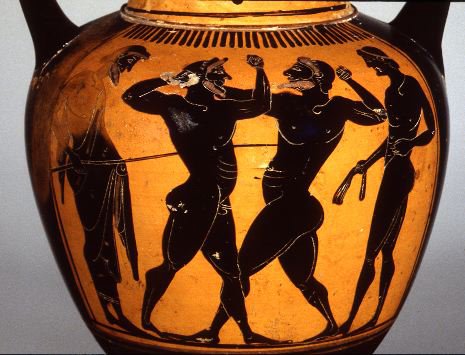
Less Strength, More Skill: Homeric Boxing

Quid prodest multos vincere luctatione vel caestu, ab iracundia vinci?

“What good is it to conquer many in boxing or wrestling only to be overcome by own own anger?”  -Seneca the Younger, Moral Epistles 88.19

During the funeral games in the Iliad, the victor in the boxing match, the older Epeios—who is described as the “son of Kapaneus, a man knowledgeable in boxing” (εἰδὼς πυγμαχίης υἱὸς Πανοπῆος ᾿Επειός, 23.665) knocks down Euryalos with a single blow (23.660-699). In the scholia to this passage, we find the comment that “this shows, as is right, that they had an art of boxing–it was not just about strength” (schol. B ad Il. 23.665: ἦν δέ, ὡς ἔοικε, καὶ τέχνη παρ’ αὐτοῖς τῆς πυγμῆς, οὐ μόνον ἡ δύναμις).

In the Odyssey, Odysseus returns home in disguise and is forced to box the local beggar Iros to entertain the suitors who are plaguing his home. In this scene, it is again his intelligence that wins the day.

Odyssey 18.89-100

“They led [Iros and Odysseus] into the middle. Both men raised their hands.
Much-enduring, godly Odysseus deliberated then
whether he would pummel him and make the soul depart his fallen opponent
or just strike him enough to lay him out on the ground.
As he deliberated this seemed better to him,
just to strike him so that the Achaians might not figure out who he was.
And then, when their hands were raised, Iros punched his right shoulder,
but Odysseus hit him on the neck under the ear—the bones within
bent. Immediately, dark blood spat from his mouth
And he fell moaning in the dust as he ground his teeth together
and kicked the ground with his feet. Then the arrogant suitors
nearly died with laughter as they raised their hands….”

ἐς μέσσον δ’ ἄναγον· τὼ δ’ ἄμφω χεῖρας ἀνέσχον.
δὴ τότε μερμήριξε πολύτλας δῖος ᾿Οδυσσεύς,
ἢ ἐλάσει’ ὥς μιν ψυχὴ λίποι αὖθι πεσόντα,
ἦέ μιν ἦκ’ ἐλάσειε τανύσσειέν τ’ ἐπὶ γαίῃ.
ὧδε δέ οἱ φρονέοντι δοάσσατο κέρδιον εἶναι,
ἦκ’ ἐλάσαι, ἵνα μή μιν ἐπιφρασσαίατ’ ᾿Αχαιοί.
δὴ τότ’ ἀνασχομένω ὁ μὲν ἤλασε δεξιὸν ὦμον
῏Ιρος, ὁ δ’ αὐχέν’ ἔλασσεν ὑπ’ οὔατος, ὀστέα δ’ εἴσω
ἔθλασεν· αὐτίκα δ’ ἦλθεν ἀνὰ στόμα φοίνιον αἷμα,
κὰδ δ’ ἔπεσ’ ἐν κονίῃσι μακών, σὺν δ’ ἤλασ’ ὀδόντας
λακτίζων ποσὶ γαῖαν· ἀτὰρ μνηστῆρες ἀγαυοὶ
χεῖρας ἀνασχόμενοι γέλῳ ἔκθανον. αὐτὰρ ᾿Οδυσσεὺς

This post is in honor of Paul Holdengraber and his fabulous interviews with the pugilist Mike Tyson.

https://twitter.com/holdengraber/status/868115021427073024

A Twitter correspondent aptly added this:

https://twitter.com/FemiAbodunde/status/670370481846018048

Awkward Mother’s Day Gifts from Lucian

Lucian, On the Syrian Goddess 16

“These things seem quite entertaining to me, but they are not true. I have also heard another reason for the bit, much more credible.  I am happy with what is said by those who generally agree in Greece, who believe that the goddess is Hera and the work was made by Dionysus. For Dionysus went into Syria on the road that goes to Ethiopia. There are many signs left by Dionysus in the Shrine, among them are foreign clothing and Indian stones and Elephant horns which Dionysus brought from Ethiopia. There are also two really big phalluses that stand up at the entrance gates. This epigram has been inscribed upon them. ‘Dionysus dedicated these phalluses to Hera, his stepmother.’

This remains enough for me, but I will tell you of another oddity in the temple of Dionysus. The Greeks bear phalloi in honor of Dionysus, and they carry something in front of it, a little man carved out of wood which has huge genitals. These are called puppets. There is also one of these in the temple. On the right side of the temple, there is a small bronze man that has giant genitals.”

[Thanks to the commander of trash for making me look at this passage]

Τὰ δέ μοι εὐπρεπέα μὲν δοκέει ἔμμεναι, ἀληθέα δὲ οὔ· ἐπεὶ καὶ τῆς τομῆς ἄλλην αἰτίην ἤκουσα πολλὸν πιστοτέρην. ἁνδάνει δέ μοι ἃ λέγουσιν τοῦ ἱροῦ πέρι τοῖς ῞Ελλησι τὰ πολλὰ ὁμολογέοντες, τὴν μὲν θεὸν ῞Ηρην δοκέοντες, τὸ δ’ ἔργον Διονύσου τοῦ Σεμέλης ποίημα· καὶ γὰρ δὴ Διόνυσος ἐς Συρίην ἀπίκετο κείνην ὁδὸν τὴν ἦλθεν ἐς Αἰθιοπίην. καὶ ἔστι πολλὰ ἐν τῷ ἱρῷ Διονύσου ποιητέω σήματα, ἐν τοῖσι καὶ ἐσθῆτες βάρβαροι καὶ λίθοι ᾿Ινδοὶ καὶ ἐλεφάντων κέρεα, τὰ Διόνυσος ἐξ Αἰθιόπων ἤνεικεν, καὶ φαλλοὶ δὲ ἑστᾶσι ἐν τοῖσι προπυλαίοισι δύο κάρτα μεγάλοι, ἐπὶ τῶν ἐπίγραμμα τοιόνδε ἐπιγέγραπται, “τούσδε φαλλοὺς Διόνυσος ῞Ηρῃ μητρυιῇ ἀνέθηκα.” τὸ ἐμοὶ μέν νυν καὶ τόδε ἀρκέει, ἐρέω δὲ καὶ ἄλλ’ ὅ τι ἐστὶν ἐν τῷ νηῷ Διονύσου ὄργιον. φαλλοὺς ῞Ελληνες Διονύσῳ ἐγείρουσιν, ἐπὶ τῶν καὶ τοιόνδε τι φέρουσιν, ἄνδρας μικροὺς ἐκ ξύλου πεποιημένους, μεγάλα αἰδοῖα ἔχοντας· καλέεται δὲ τάδε νευρόσπαστα. ἔστι δὲ καὶ τόδε ἐν τῷ ἱρῷ· ἐν δεξιῇ τοῦ νηοῦ κάθηται μικρὸς ἀνὴρ χάλκεος ἔχων αἰδοῖον μέγα.

Some Fragments on mothers

Sophocles, Fr. 685 (Phaedra)

“Children are the anchors of a mother’s life”

ἀλλ’ εἰσὶ μητρὶ παῖδες ἄγκυραι βίου

Euripides’ Meleager Fr. 527

“The only things you can’t get with money
Are nobility and virtue. A noble child
Can be born from a poor woman’s body.”

μόνον δ’ ἂν ἀντὶ χρημάτων οὐκ ἂν λάβοις
γενναιότητα κἀρετήν• καλὸς δέ τις
κἂν ἐκ πενήτων σωμάτων γένοιτο παῖς.

Euripides, fr. 358 (Erechtheus)

“Children have nothing sweeter than their mother.
Love your mother children, there is no kind of love anywhere
Sweeter than this one to love.”

οὐκ ἔστι μητρὸς οὐδὲν ἥδιον τέκνοις•
ἐρᾶτε μητρός, παῖδες, ὡς οὐκ ἔστ’ ἔρως
τοιοῦτος ἄλλος ὅστις ἡδίων ἐρᾶν.

Sophocles, Electra 770-771

“Even if she suffers terribly, a mother cannot hate her child.”

οὐδὲ γὰρ κακῶς
πάσχοντι μῖσος ὧν τέκῃ προσγίγνεται.

And a somewhat nicer passage

According to the Greek Anthology there was a temple to Apollônis, the mother of Attalos and Eumenes, at Cyzicos. The temple had at least nineteen epigrams inscribed on columns with accompanying relief images. All of the epigrams have mothers from myth and poetry as their subjects. The Eighth Epigram is on Odysseus’ mother Antikleia.

On the eighth tablet is the underworld visit of Odysseus. He addressed is own mother and asked her for news of his home (Greek Anthology 3.8)

“Wise-minded mother of Odysseus, Antikleia
You didn’t welcome your son home to Ithaka while alive.
Instead, he is shocked when his glance falls upon his sweet mother
Now wandering along the banks of Akheron.”

᾿Εν τῷ Η ἡ τοῦ ᾿Οδυσσέως νεκυομαντεία• καθέστηκεν τὴν ἰδίαν μητέρα ᾿Αντίκλειαν περὶ τῶν κατὰ τὸν οἶκον ἀνακρίνων

Μᾶτερ ᾿Οδυσσῆος πινυτόφρονος, ᾿Αντίκλεια,
ζῶσα μὲν εἰς ᾿Ιθάκην οὐχ ὑπέδεξο πάιν•
ἀλλά σε νῦν ᾿Αχέροντος ἐπὶ ῥηγμῖσι γεγῶσαν
θαμβεῖ, ἀνὰ γλυκερὰν ματέρα δερκόμενος.

Of course, this scene plays upon book 11 of the Odyssey doubly: the image recalls Odysseus describing his mother in the Odyssey and it also plays upon the Odyssey’s catalogue of heroic mothers motif, which it in turn shares with the fragmentary Hesiodic Catalogue Of Women.

11.84-89
“Then came the spirit of my mother who had passed away,
The daughter of great-hearted Autolykos, Antikleia
Whom I left alive when I went to sacred Troy.
When I saw her I cried and pitied her in my heart,
But I could not allow her to come forward to touch
The blood before I had learned from Teiresias.”

ἦλθε δ’ ἐπὶ ψυχὴ μητρὸς κατατεθνηυίης,
Αὐτολύκου θυγάτηρ μεγαλήτορος ᾿Αντίκλεια,
τὴν ζωὴν κατέλειπον ἰὼν εἰς ῎Ιλιον ἱρήν.
τὴν μὲν ἐγὼ δάκρυσα ἰδὼν ἐλέησά τε θυμῷ•
ἀλλ’ οὐδ’ ὧς εἴων προτέρην, πυκινόν περ ἀχεύων,
αἵματος ἄσσον ἴμεν πρὶν Τειρεσίαο πυθέσθαι.

Attalos, Eumenes and Apollônis? These were members of the Attalid clan who ruled from Pergamon during the Hellenistic period (after 241 BCE). Attalus I married Apollônis who was from Cyzicos.

Image result for Ancient Greek mother
Achilles and his mom–a story for a different day.

Some Ancient Greek Passages on Work for May 1st

Xenophon, Oeconomicus 4.15-16

“Critoboulos, Some say that whenever the great king gives gifts, he calls in first those who proved their excellence at war because there is no advantage to plowing many fields unless they defend them. After them, he rewards those who prepare and work the land best, because brave men cannot survive unless someone works the land.”

Φασὶ δέ τινες, ἔφη ὁ Σωκράτης, ὦ Κριτόβουλε, καὶ ὅταν δῶρα διδῷ ὁ βασιλεύς, πρῶτον μὲν εἰσκαλεῖν τοὺς πολέμῳ ἀγαθοὺς γεγονότας, ὅτι οὐδὲν ὄφελος πολλὰ ἀροῦν, εἰ μὴ εἶεν οἱ ἀρήξοντες· δεύτερον δὲ τοὺς κατασκευάζοντας τὰς χώρας ἄριστα καὶ ἐνεργοὺς ποιοῦντας λέγοντα, ὅτι οὐδ᾿ ἂν οἱ ἄλκιμοι δύναιντο ζῆν, εἰ μὴ εἶεν οἱ ἐργαζόμενοι. λέγεται δὲ καὶ Κῦρός ποτε, ὅσπερ εὐδοκιμώτατος δὴ βασιλεὺς γεγένηται, εἰπεῖν τοῖς ἐπὶ τὰ δῶρα κεκλημένοις, ὅτι αὐτὸς ἂν δικαίως τὰ ἀμφοτέρων δῶρα λαμβάνοι· κατασκευάζειν τε γὰρ ἄριστος εἶναι ἔφη χώραν καὶ ἀρήγειν τοῖς κατεσκευασμένοις.

Plutarch, fr. 43

“Let no one find fault with this line because wealth is made to be much praised ahead of virtue. Know that wealth here is the product workers get from their labors—it is a just portion gathered from their personal toil.”

Μηδεὶς λοιδορείτω τὸν στίχον εἰς τὸν πολυάρατον πλοῦτον ὁρῶν τὸν πόρρω τῆς ἀρετῆς ἐσκηνημένον, ἀλλὰ πλοῦτον οἰέσθω νῦν λέγεσθαι τὴν ἀπὸ τῶν ἔργων πορισθεῖσαν ἀφθονίαν τοῖς ἐργαζομένοις δικαίαν οὖσαν καὶ ἀπὸ τῶν οἰκείων πόνων ἠθροισμένην.

Plutarch, Perikles 1.4 5-6

“Often and quite contrarily, we look down on a laborer while delighting in his work”

πολλάκις δὲ καὶ τοὐναντίον χαίροντες τῷ ἔργῳ τοῦ δημιουργοῦ καταφρονοῦμεν

Hesiod, Works and Days, 289-90

“The gods made sweat the price for virtue.”

τῆς δ’ ἀρετῆς ἱδρῶτα θεοὶ προπάροιθεν ἔθηκαν
ἀθάνατοι·


Pindar, Isthmian 1. 47

“Men find different payment sweet for different work.”

μισθὸς γὰρ ἄλλοις ἄλλος ἐπ’ ἔργμασιν ἀνθρώποις
γλυκύς


Hesiod, Works and Days, 303

“Gods and men alike dislike a lazy man.”

τῷ δὲ θεοὶ νεμεσῶσι καὶ ἀνέρες ὅς κεν ἀεργὸς.

Image result for Ancient Greek sisyphus vase

When an aristocrat co-opts the language of the proletariat…

Odyssey 15.321-324

“No mortal could rival me in work:
No one could best me at building a fire or dry wood,
At serving at the table, cooking meat or serving wine–
All those tasks lesser men complete for their betters.”

δρηστοσύνῃ οὐκ ἄν μοι ἐρίσσειε βροτὸς ἄλλος,
πῦρ τ’ εὖ νηῆσαι διά τε ξύλα δανὰ κεάσσαι,
δαιτρεῦσαί τε καὶ ὀπτῆσαι καὶ οἰνοχοῆσαι,
οἷά τε τοῖς ἀγαθοῖσι παραδρώωσι χέρηες.”

Odyssey, 18.366-383

“Eurymachus: I wish the two of us could have a labor-contest
In the height of spring when the days are drawing longer,
In the thickening grass. I would grip the curved scythe
And you could hold the same thing, so we could test each other
At work, fasting right up to dusk where the grass was thick.
And then the next day we could drive the oxen, the strongest ones,
Bright and large, both stuffed full with their food,
A pair of the same age, equally burdened, their strength unwavering.
I’d wish for a four-acre parcel to put under the plow.
Then you’d see me, how I would cut a furrow straight from end to end.
Or if, instead, Kronos’ son would send me a war today,
And I would have a shield and two spears
Matched with a bronze helmet well-fit to my temples.
Then you’d see me mixing it up in the front lines
And you wouldn’t bawl about, belittling my hungry stomach.”

“Εὐρύμαχ’, εἰ γὰρ νῶϊν ἔρις ἔργοιο γένοιτο
ὥρῃ ἐν εἰαρινῇ, ὅτε τ’ ἤματα μακρὰ πέλονται,
ἐν ποίῃ, δρέπανον μὲν ἐγὼν εὐκαμπὲς ἔχοιμι,
καὶ δὲ σὺ τοῖον ἔχοις, ἵνα πειρησαίμεθα ἔργου
νήστιες ἄχρι μάλα κνέφαος, ποίη δὲ παρείη·
εἰ δ’ αὖ καὶ βόες εἶεν ἐλαυνέμεν, οἵ περ ἄριστοι,
αἴθωνες μεγάλοι, ἄμφω κεκορηότε ποίης,
ἥλικες ἰσοφόροι, τῶν τε σθένος οὐκ ἀλαπαδνόν,
τετράγυον δ’ εἴη, εἴκοι δ’ ὑπὸ βῶλος ἀρότρῳ·
τῶ κέ μ’ ἴδοις, εἰ ὦλκα διηνεκέα προταμοίμην.
εἰ δ’ αὖ καὶ πόλεμόν ποθεν ὁρμήσειε Κρονίων
σήμερον, αὐτὰρ ἐμοὶ σάκος εἴη καὶ δύο δοῦρε
καὶ κυνέη πάγχαλκος ἐπὶ κροτάφοισ’ ἀραρυῖα,
τῶ κέ μ’ ἴδοις πρώτοισιν ἐνὶ προμάχοισι μιγέντα,
οὐδ’ ἄν μοι τὴν γαστέρ’ ὀνειδίζων ἀγορεύοις.