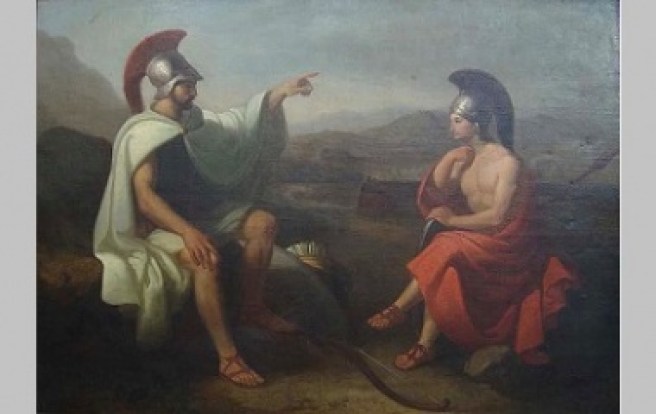
Joannes Malalas, Chronographia, 5.21 6-7 (=Diktys BNJ 49 F 10)
“Some time passed and Odysseus began to see dreams which told of his death. After he woke, he summoned everyone who had experience in interpreting dreams—among whom was Kleitophon of Ithaka and Polyphemos of Argos. He told the dream to them and said what he thought:
“I was not lying on my own bed but instead there was a beautiful and frightening divine creature which could not keep the shape of a grown man. I saw it happily. But I was also disoriented by it. That bed from which it took life was no longer obvious to me from my familiarity with it or by knowledge. Therefore, once I recognized this, I wanted to throw my arms around it eagerly. But it spoke using a human voice and said there was a connection and binding of relationship between us and that it was my fate to be destroyed by him. As I was thinking about this a sudden stab came at me from the sea, targeted at me by his order. I became paralyzed by my great panic and I died shortly. These are the things I saw and you need to fear nothing when you offer me an interpretation. I know well that the vision is not a good one.
Then those who were there were examining the interpretation and they said that Telemachus should not be there. When he left, they said that Odysseus would be struck by his own child and die. He immediately rushed toward Telemachus because he wanted to kill him. But when he saw his son crying and begging him and he returned to a paternal mindset, he decided to have his son sent away and he ordered him to guard himself. Then he himself returned to the farthest part of Kephalenia, believing he would protect himself from fear of death.”
Proclus, Commentary on Plato’s Parmenides 1025.29-37
“Our soul experiences many wanderings and turns—one comes from the imagination, another emerges in the beliefs before these, and other occurs in understanding. But the life governed by the mind is free from vagrancy and this is the mystical harbor of the soul into which the poem leads Odysseus after the great wandering of his life and where we too, if we want to be saved, may find our mooring.”
Thrasymachus: While I like the alliteration, I don’t think *donum* works here.
As a “trick”—in this sense—isn’t really a deceit (more like a joke), and as the “treat” is something trifling (not a *gift*, which carries a sense of formality), I am wondering on something like “nugas nucesve,” “jests or nuts.”
While nuces were strewn at wedding and festivals (I’m thinking of the throwing of small bits of candy at bar mitzvahs, etc.), they were also children’s playthings, which captures, I think the idea of “treat,” as something given informally, even anonymously, and without expectation of return
“The rest of them were sitting, and they had taken their seats.
Only Thersites, a man of measureless speech, was still declaring–
A man who knew many disordered things in his thoughts and who
Strived pointlessly with kings out of order,
–whatever he thought would be amusing to the Argives.
And he was the most shameful man who came to Troy.
He was cross-eyed and crippled in one foot. His shoulders
Were curved, dragged in toward his chest. And on top
His head was mishapen, and the hair on his head was sparse.
He was most hateful to both Achilles and Odysseus
For he was always reproaching them. Then he was shrilly cawing
At lordly Agamemnon again, as he spoke reproaches. The Achaeans
Were terribly angry at him and were finding fault in their heart.
As he shouting greatly, he was reproaching Agememnon.”
Homer presents a overlap between ‘beautiful body’ and ‘beautiful mind’. This physiognomic category error pervades a great deal of classical Greek culture. In the Iliad, Thersites transgresses physical boundaries through his unheroic body and ethical boundaries by using the genre of rebuke upward in the social hierarchy. He is hateful to both Achilles and Odysseus because they exemplify in a complementary fashion the ‘center’ or ideal of the heroic person—Achilles is the beautiful body, Odysseus is a beautiful mind. But both of them stay within the boundaries of ‘normal’ in their own deviance (Achilles’ political straying, Odysseus’ aging, imperfect body). Thersites, labelled by many as a comic scapegoat, functions as an inferior in order to define the center as non-transgressive. This is, in particular, why he is hateful to Achilles and Odysseus: without him, their persons might be monstrous or disabled. And this also helps explain why Odysseus must physical beat Thersites in public.
Thomson, Rosemarie Garland. 1997. Extraordinary Bodies: Figuring Physical Disability in American Culture and Literature. New York.
5: “related perceptions of corporeal otherness” includes mutilation, deformation, crippledness, or physical disability…”
7: “..the meanings attributed to extraordinary bodies reside not in inherent physical flaws but in social relationships in which one group is legitimated by possessing valued physical characteristics and maintains its ascendency and its self-identity by imposing the role of cultural or corporeal inferiority on others.”
Mitchell, David T. and Sharon L. Snyder. Narrative Prosthesis: Disability and the Dependency of Discourse. Ann Arbor. 2000. Cf. Wills, David. 1995. Prosthesis. Stanford.
57: “Whereas the “unmarred” surface enjoys its cultural anonymity ad promises little more than a confirmation of the adage of a “healthy” mind in a “healthy” body, disability signifies a more variegated and sordid series of assumptions and experiences. Its unruliness must be tamed by multiple mappings of the surface. If form leads to content or “embodies” meaning, then disability’s disruption of acculturated bodily norms also suggests a corresponding misalignment of subjectivity itself.”
59: “If the “external effect” led directly to a knowledge of the “internal faculty,” then those who inhabited bodies deemed “outside the norm” proved most ripe for a scrutiny of their moral or intellectual content. Since disabled people by definition embodied a form that was identified as “outside” the normal or permissible, their visages and bodily outlines became the physiognomist’s (and later the pathologist’s) object par excellence. Yet, the “sinister capability” of physiognomy proves more complex than just the exclusivity of interpretive authority that Stafford suggests. If the body would offer a surface manifestation of internal symptomatology, then disability and deformity automatically preface an equally irregular subjectivity. Physiognomy proves a deadly practice to a population already existing on the fringes of social interaction and “humanity.””
60: “Elizabeth Cornelia Evans argues that physiognomic beliefs can be traced back as far as ancient Greece. She cites Aristotle as promoting physiognomic reasoning when he proclaims, “It is possible to infer character from physique, if it is granted that body and soul change together in all natural affections . . . For if a peculiar affection applies to any individual class, e.g., courage to lions, there must be some corresponding sign for it; for it has been assumed that body and soul are affected together” (7). In fact, one might argue that physiognomics came to be consolidated out of a general historical practice applied to the bodies of disabled peoples. If the extreme evidence of marked physical differences provided a catalog of reliable signs, then perhaps more minute bodily differentiations could also be cataloged and interpreted. In this sense, people with disabilities ironically served as the historical locus for the invention of physiognomy.”
See Odyssey: 1.302: “I see that you are really big and noble, and be brave / that a man born in the future might speak well of you” μάλα γάρ σ’ ὁρόω καλόν τε μέγαν τε, / ἄλκιμος ἔσσ’, ἵνα τίς σε καὶ ὀψιγόνων ἐὺ εἴπῃ =3.199–200 (Nestor addressing Telemachus). Cf. 4.141–147 where Helen recognizes Telemachus because he looks like his father and Menelaos responds “I was just now thinking this too, wife, as you note the similarity: / these are the kinds of feet and hands / the eye glances, and head and hair belonging to that man” (οὕτω νῦν καὶ ἐγὼ νοέω, γύναι, ὡς σὺ ἐΐσκεις· / κείνου γὰρ τοιοίδε πόδες τοιαίδε τε χεῖρες / ὀφθαλμῶν τε βολαὶ κεφαλή τ’ ἐφύπερθέ τε χαῖται, 4.148–150).
Cf. Achilles to Lykaon, Il. 21.108: “Don’t you see what kind of man I am, beautiful and big?” οὐχ ὁράᾳς οἷος καὶ ἐγὼ καλός τε μέγας τε;
167–8: Rebuke is a speech genre highly marked for social position: Penelope rebukes Eurykleia, Nausikaa rebukes her handmaidens. Melanthô should not rebuke Odysseus because it would transgress the normative boundaries for a slave to reproach a master.
On Thersites as a “bona fide satirist”, see Rosen 2003:123. Halliwell 1991:281 too draws attention to Thersites’ role as a “habitual entertainer”, and points to Plato’s shrewd description of him as a γελωτοποιός (Rep.10.620c3). For Thersites as a blame-poet, see Nagy 1979: 211-75. For Thersites’ in general see Lowry 1991 and Postelthwaite 1998.
Lowry, E. R. Thersites: A Study in Comic Shame.
Marks, Jim. 2005. “The Ongoing Neikos: Thersites, Odysseus, and Achilleus.” AJP 126:1–31.
Nagy, G. 1979. The Best of the Achaeans. Baltimore.
Postlethwaite, N. 1998.Thersites in the Iliad, in Homer: Greek and Roman Studies, eds. I. McAuslan and P. Walcot, Oxford, = 83-95.
Rose, P. W. 1997. “Ideology in the Iliad: Polis, Basileus, Theoi.” Arethusa 30:151-199.
Rosen, R. M. 2003. “The Death of Thersites and the Sympotic Performance of Iambic Mock-ery.” Pallas 61:21–136.
Thalmann, W. G. 1988. “Thersites: comedy, scapegoats and heroic ideology in the Iliad.” TAPA 118:1-28.
Vodoklys, E.1992.. Blame-Expression in the Epic Tradition. New York.
Special thanks to David M. Perry for giving me a starter Bibliography for Disability Studies and to Dimitri Nakassis for adding to the bibliography on Thersites.
Erik has a beautiful post about the Cyclops Polyphemos. The scholia present some debates about what exactly a Cyclops looks like.
Schol. ad Od. 9.106
“Aristotle examines how the Cyclops Polyphemos came to be a cyclops when neither his father nor his mother was a cyclops. He resolved the issue with a different myth. For, he asserted, horses came from Boreas but Pegasos was born from Poseidon and Medousa. Why, then, would it be strange that this wild beast be born from Poseidon? Similarly, other wild beasts were born from him in the sea, as well as marvels and unusual things.
Hesiod laughably etymologizes [the Kyklopes], saying “They were given the nickname Kyklopes / because they have one single circle eye in the middle of their forehead.” But Homer clearly describes their nature.
For, if it was of that sort, just as he described the other particular features of the Cyclops, like his size, his cruelty, he would have also described his eye! Philoxenos says that he diverged from Hesiod in that the fact he could not see because he was blinded in one eye. For Homer does not say this about all the other Cyclopes. It is likely that Polyphemos lost his other eye for some other reason before Odysseus’ arrival.
Others oppose this, claiming that if he had two eyes and Odysseus blinded one, how would he say what is attributed to him, “Cyclops, if any mortal man asks you who is the blinder of your eye…” He does not say eyes. And in return the Cyclops says “My father is able to heal my eye.” For if he had another eye, properly, and Odysseus were speaking to him in this way, how would he not have taken care of the other eye? But he said “the earth-shaker will not heal [my] eye.” For this very reason people argue about his eye being completely pierced, because of what is said here, if he did not take care of the eye when it was first compromised, he would never be able to heal it.”
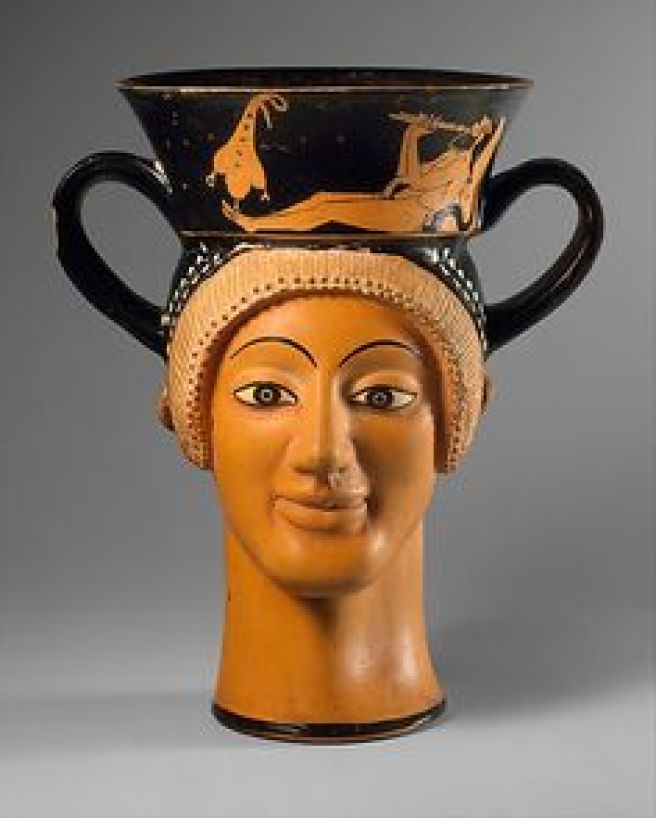
From the MFA in Boston, taken artfully on my phone.
These are, of course, the types of investigations for which Seneca would have the most disdain:
Seneca, De Brevitate Vitae 13
“It would be annoying to list all the people who spent their lives pursuing board games, ball games, or sunbathing. Men whose pleasures are so busy are not at leisure. For example, no one will be surprised that those occupied by useless literary studies work strenuously—and there is great band of these in Rome now too. This sickness used to just afflict the Greeks, to discover the number of oars Odysseus possessed, whether the Iliad was written before the Odyssey, whether the poems belong to the same author, and other matters like this which, if you keep them to yourself, cannot please your private mind; but if you publish them, you seem less learned than annoying.”
Persequi singulos longum est, quorum aut latrunculi aut pila aut excoquendi in sole corporis cura consumpsere vitam. Non sunt otiosi, quorum voluptates multum negotii habent. Nam de illis nemo dubitabit, quin operose nihil agant, qui litterarum inutilium studiis detinentur, quae iam apud Romanos quoque magna manus est. Graecorum iste morbus fuit quaerere, quem numerum Ulixes remigum habuisset, prior scripta esset Ilias an Odyssia, praeterea an eiusdem essent auctoris, alia deinceps huius notae, quae sive contineas, nihil tacitam conscientiam iuvant sive proferas, non doctior videaris sed molestior.
Mocking the quibbles of scholars is where the pejorative use of the term ‘academic’ comes. This is an ancient tradition!
Athenaeus, Deipnosophistae 1.22
“You know that somewhere Timo the Philasian calls the Museum a birdcage as he mocks the scholars who are supported there because they were fed like the priciest birds in a big cage:
Many are fed in many-peopled Egypt,
The paper-pushers closed up waging endless war
in the bird-cage of the Muses.
“Did they not hear from you, when they were children,
What kind of a man Odysseus was among your parents,
He did nothing unfair nor said anything [unfair]
Among the people? This is the right of divine kings—
They can hate some people and love another.”
“this is the way of kings, to hate one person but love another. Etc. This line is presented gnomically about kings, because they hate some people but love another. This is not strictly applicable to Odysseus. Therefore line must be taken for use in this particular situation.”
“Sardinian Laugh”: A proverb used for people who laugh at their own death. According to Demôn it developed from the fact that the Sardinians used to sacrifice the best and the oldest of their captives each year to Cronus as they laughed to display their courage. Timaios, on the other hand, claims that men who had lived a long enough time were in the habit of laughing when they were pushed by their sons into the trenches in which they would bury them. But others claim the saying comes from smiling with devious intent.
Others say—and this includes Cleitarchus—that when they place a small child in Kronos’ hand in Carthage during their most important prayers (a bronze statue is set out with hands stretched out over a cooking pot) and after they light the fire, the boy seems to laugh as he is shriveled by the fire. But Simonides says that when the Sardinians were not willing to hand over Talos—the fabricated man—to Minos, that Talos leapt into the fire, because he was bronze, clutched them to his chest and killed them as they gasped for air.
Silenus argues in the fourth book of his On the Syracusans that there is a sweet plant similar celery which when people eat it they bite off segments of their own faces. There are also some who say that this is to laugh at danger. This is what happens when Homer says that “shining Odysseus grinned sardonically” and in other places,” she laughed with her lips, but she was not pleased under her dark brows”
Joannes Malalas, Chronographia, 5.21 6-7 (=Diktys BNJ 49 F 10)
“Some time passed and Odysseus began to see dreams which told of his death. After he woke, he summoned everyone who had experience in interpreting dreams—among whom was Kleitophon of Ithaka and Polyphemos of Argos. He told the dream to them and said what he thought:
“I was not lying on my own bed but instead there was a beautiful and frightening divine creature which could not keep the shape of a grown man. I saw it happily. But I was also disoriented by it. That bed from which it took life was no longer obvious to me from my familiarity with it or by knowledge. Therefore, once I recognized this, I wanted to throw my arms around it eagerly. But it spoke using a human voice and said there was a connection and binding of relationship between us and that it was my fate to be destroyed by him. As I was thinking about this a sudden stab came at me from the sea, targeted at me by his order. I became paralyzed by my great panic and I died shortly. These are the things I saw and you need to fear nothing when you offer me an interpretation. I know well that the vision is not a good one.
Then those who were there were examining the interpretation and they said that Telemachus should not be there. When he left, they said that Odysseus would be struck by his own child and die. He immediately rushed toward Telemachus because he wanted to kill him. But when he saw his son crying and begging him and he returned to a paternal mindset, he decided to have his son sent away and he ordered him to guard himself. Then he himself returned to the farthest part of Kephalenia, believing he would protect himself from fear of death.”
The Odyssey follows the slaughter of the suitors with the mutilation and murder of slaves: the torture of the goatherd Melanthios (Od. 22.474–477) and the hanging of twelve slave women (Od. 22.463–73). But it also considers the death of the older slave Eurykleia on multiple occasions. We first hear about her in book 1:
Homer, Odyssey 1.428-433
“And with him Eurykleia carried the burning torches.
She knew proper things, the daughter of Ops, the son of Peisênor
whom Laertes bought to be among his possessions
when she was just a girl and he paid a price worth 20 oxen. And he used to honor her equal to his dear wife in his home
but he never had sex with her and he was avoiding his wife’s anger.”
So, it seems, Eurykleia’s life is ‘dear’—in the archaic English meaning of having a high price—since she was worth so many oxen and Laertes honored her equal to his wife without having sex with her. Despite so high a price—or perhaps because of it—her life is risked several times in the epic. The moment that has always stuck with me comes from the famous recognition of the scar scene. While this scene has garnered a lot of attention for the way the scar triggers a story and communicates Odysseus’ identity, there have been relatively few comments about the violence imminent in the scene.
Homer, Odyssey 19.466-490
“The old woman, as she took it in the flat part of her hands,
recognized the scar as she felt it, and she dropped the foot.
His shin fell onto the basin and the bronze clanged,
then it tilted to one side and water sloshed out onto the ground.
Joy and pain overtook her mind at once and
both of her eyes filled with tears as her strong voice got stuck inside.
She touched his beard and then addressed Odysseus.
“You really are Odysseus, dear child.
I did not recognize you before, before I examined my lord all over.”
And then she would have gotten Penelope’s attention too
with her eyes because she wanted to tell her
that her dear husband was here.
But she was not able to turn or to notice anything
because Athena had turned her mind elsewhere. But Odysseus closed his hand on her throat with his right hand and with his left hand he drew her close and said,
“Auntie, why do you want to ruin me?
You fed me yourself on your own breast.
Now after suffering many pains I have returned
in the twentieth year to my fatherland.
But since you have recognized me and a god put it in your mind
be silent lest anyone else in the home learn it.
For I will speak this out and it will be completed,
If the god subdues the haughty suitors under me I will not leave you even though you were my nurse, when I kill all the other slave women in my home.”
This theme is internalized later when Eurykleia threatens her own life.When she tries to tell Penelope in book 23 that Odysseus is actually present, she offers to wager her life on the truth of the statement when Penelope doubts her.
Homer, Odyssey 23.75-79
“…I wanted to tell you myself
but he took me with his hands at my throat
and would not allow me to speak thanks to the cleverness of his mind.
So, follow me. But I will wager myself over this to you: If I have deceived you, kill me with the most pitiful death”
For me, Eurykleia’s willingness to wager her life is indication of an internalized oppression created by the experience of slavery. But the specific value of her initial price is interesting too. This probably complicates matters, but there is little in the Homeric poems set at a worth of 20 oxen. The price comes up again during the slaughter of the suitors. Eurymachus tries to offer Odysseus recompense and sets the price for each suitor at 20 oxen (in addition to payment for all the food and drink).
Homer, Odyssey 21.54–59
“But now, even though it is ordained by fate, spare your people.
And in exchange we will gather about the land as payment
As much as was drunk up and eaten in your halls,
And each man will bring a payment worth twenty oxen,
Which we will pay in bronze and gold, until your heart
Softens—before this, there is no blame for being angry.”
Post-script: An average ox seems to cost around $3000.00 right now. So, in modern ox-dollars, Eurykleia was valued at $60,000. This seems a little off to me. According to Beef Magazine (which is a real thing)a good bull on average can run more like $7500, placing Eurykleia at $150,000. I do not print any of this to make light of the selling of human beings (because, when we leave the abstract, this is all really horrifying), but instead, rather, to give a really relative view of what her–and the suitors–economic value might be in today’s terms. The range is basically luxury car to cheap apartment. This is, alternatively, the price acceptable for a good slave, but not worth the life of an offending suitor. In both cases the economic equivalence for any human life is, to put it simply, dehumanizing.
“The rest of them were sitting, and they had taken their seats.
Only Thersites, a man of measureless speech, was still declaring–
A man who knew many disordered things in his thoughts and who
Strived pointlessly with kings out of order,
–whatever he thought would be amusing to the Argives.
And he was the most shameful man who came to Troy.
He was cross-eyed and crippled in one foot. His shoulders
Were curved, dragged in toward his chest. And on top
His head was mishaped, and the hair on his head was sparse.
He was most hateful to both Achilles and Odysseus
For he was always reproaching them. Then he was shrilly cawing
At lordly Agamemnon again, as he spoke reproaches. The Achaeans
Were terribly angry at him and were finding fault in their heart.
As he shouting greatly, he was reproaching Agememnon.”
Homer presents a overlap between ‘beautiful body’ and ‘beautiful mind’. This physiognomic category error pervades a great deal of classical Greek culture. In the Iliad, Thersites transgresses physical boundaries through his unheroic body and ethical boundaries by using the genre of rebuke upward in the social hierarchy. He is hateful to both Achilles and Odysseus because they exemplify in a complementary fashion the ‘center’ or ideal of the heroic person—Achilles is the beautiful body, Odysseus is a beautiful mind. But both of them stay within the boundaries of ‘normal’ in their own deviance (Achilles’ political straying, Odysseus’ aging, imperfect body). Thersites, labelled by many as a comic scapegoat, functions as an inferior in order to define the center as non-transgressive. This is, in particular, why he is hateful to Achilles and Odysseus: without him, their persons might be monstrous or disabled. And this also helps explain why Odysseus must physical beat Thersites in public.
Thomson, Rosemarie Garland. 1997. Extraordinary Bodies: Figuring Physical Disability in American Culture and Literature. New York.
5: “related perceptions of corporeal otherness” includes mutilation, deformation, crippledness, or physical disability…”
7: “..the meanings attributed to extraordinary bodies reside not in inherent physical flaws but in social relationships in which one group is legitimated by possessing valued physical characteristics and maintains its ascendency and its self-identity by imposing the role of cultural or corporeal inferiority on others.”
Mitchell, David T. and Sharon L. Snyder. Narrative Prosthesis: Disability and the Dependency of Discourse. Ann Arbor. 2000. Cf. Wills, David. 1995. Prosthesis. Stanford.
57: “Whereas the “unmarred” surface enjoys its cultural anonymity ad promises little more than a confirmation of the adage of a “healthy” mind in a “healthy” body, disability signifies a more variegated and sordid series of assumptions and experiences. Its unruliness must be tamed by multiple mappings of the surface. If form leads to content or “embodies” meaning, then disability’s disruption of acculturated bodily norms also suggests a corresponding misalignment of subjectivity itself.”
59: “If the “external effect” led directly to a knowledge of the “internal faculty,” then those who inhabited bodies deemed “outside the norm” proved most ripe for a scrutiny of their moral or intellectual content. Since disabled people by definition embodied a form that was identified as “outside” the normal or permissible, their visages and bodily outlines became the physiognomist’s (and later the pathologist’s) object par excellence. Yet, the “sinister capability” of physiognomy proves more complex than just the exclusivity of interpretive authority that Stafford suggests. If the body would offer a surface manifestation of internal symptomatology, then disability and deformity automatically preface an equally irregular subjectivity. Physiognomy proves a deadly practice to a population already existing on the fringes of social interaction and “humanity.””
60: “Elizabeth Cornelia Evans argues that physiognomic beliefs can be traced back as far as ancient Greece. She cites Aristotle as promoting physiognomic reasoning when he proclaims, “It is possible to infer character from physique, if it is granted that body and soul change together in all natural affections . . . For if a peculiar affection applies to any individual class, e.g., courage to lions, there must be some corresponding sign for it; for it has been assumed that body and soul are affected together” (7). In fact, one might argue that physiognomics came to be consolidated out of a general historical practice applied to the bodies of disabled peoples. If the extreme evidence of marked physical differences provided a catalog of reliable signs, then perhaps more minute bodily differentiations could also be cataloged and interpreted. In this sense, people with disabilities ironically served as the historical locus for the invention of physiognomy.”
See Odyssey: 1.302: “I see that you are really big and noble, and be brave / that a man born in the future might speak well of you” μάλα γάρ σ’ ὁρόω καλόν τε μέγαν τε, / ἄλκιμος ἔσσ’, ἵνα τίς σε καὶ ὀψιγόνων ἐὺ εἴπῃ =3.199–200 (Nestor addressing Telemachus). Cf. 4.141–147 where Helen recognizes Telemachus because he looks like his father and Menelaos responds “I was just now thinking this too, wife, as you note the similarity: / these are the kinds of feet and hands / the eye glances, and head and hair belonging to that man” (οὕτω νῦν καὶ ἐγὼ νοέω, γύναι, ὡς σὺ ἐΐσκεις· / κείνου γὰρ τοιοίδε πόδες τοιαίδε τε χεῖρες / ὀφθαλμῶν τε βολαὶ κεφαλή τ’ ἐφύπερθέ τε χαῖται, 4.148–150).
Cf. Achilles to Lykaon, Il. 21.108: “Don’t you see what kind of man I am, beautiful and big?” οὐχ ὁράᾳς οἷος καὶ ἐγὼ καλός τε μέγας τε;
167–8: Rebuke is a speech genre highly marked for social position: Penelope rebukes Eurykleia, Nausikaa rebukes her handmaidens. Melanthô should not rebuke Odysseus because it would transgress the normative boundaries for a slave to reproach a master.
On Thersites as a “bona fide satirist”, see Rosen 2003:123. Halliwell 1991:281 too draws attention to Thersites’ role as a “habitual entertainer”, and points to Plato’s shrewd description of him as a γελωτοποιός (Rep.10.620c3). For Thersites as a blame-poet, see Nagy 1979: 211-75. For Thersites’ in general see Lowry 1991 and Postelthwaite 1998.
Lowry, E. R. Thersites: A Study in Comic Shame.
Marks, Jim. 2005. “The Ongoing Neikos: Thersites, Odysseus, and Achilleus.” AJP 126:1–31.
Nagy, G. 1979. The Best of the Achaeans. Baltimore.
Postlethwaite, N. 1998.Thersites in the Iliad, in Homer: Greek and Roman Studies, eds. I. McAuslan and P. Walcot, Oxford, = 83-95.
Rose, P. W. 1997. “Ideology in the Iliad: Polis, Basileus, Theoi.” Arethusa 30:151-199.
Rosen, R. M. 2003. “The Death of Thersites and the Sympotic Performance of Iambic Mock-ery.” Pallas 61:21–136.
Thalmann, W. G. 1988. “Thersites: comedy, scapegoats and heroic ideology in the Iliad.” TAPA 118:1-28.
Vodoklys, E.1992.. Blame-Expression in the Epic Tradition. New York.
Special thanks to David M. Perry for giving me a starter Bibliography for Disability Studies and to Dimitri Nakassis for adding to the bibliography on Thersites.