“There were another three who sat equally apart in a circle, each on her own seat, the Fates, those daughters of necessity, dressed in white clothes with fillets on their heads: Lachesis, Klotho, and Atropos, all joining the hymn with the chorus of Sirens. Lachesis sings what was; Klotho sings what is, and Atropos sings what will be.”
“There are three Fates—one allotted to different times—and part of the wool of their spindle is already spun, some still needs to be, and some is currently being worked. One of the Moirai is for the past—Atropos—because all things which are behind us cannot be altered (atrepta); the future, then, is Lakhesis, because that which is allotted [lêksis] by nature awaits everything; and the present belongs to Klôthô who decides what is proper for each as she spins (klôthein). That’s how the myth ends and not improperly.”
It is marked as misattributed on wikiquote (where its original attestation seems to be Gabriel Suarez’s The Tactical Rifle, which assigns it to a certain Hericletus [sic]); Reddit has also marked it as a misquotation, although it assigns it to the apocryphal “Cynic Epistles” which were attributed to Heraclitus (this text is not available online as far as I can find; I have ordered it).
It is disturbing how popular this is as a meme: you can find it on quotefancy,pinterest, and way too many other places (it is of particular importance on sites that glorify firearms and snipers). Oh, it has also made the leap to popular history books, appearing in Paul B Bardunias’ and Fred Ray’s “Hoplites at War.”
To anyone who has read any of the extant fragments from Heraclitus, this is clearly not even remotely his style (here’s a cool site where you can find his fragments in Greek and translation). While it may be a bit too much to expect the internet to be familiar with Heraclitean obscurity, this passage sounds thoroughly and depressingly modern. It is not, of course, out of the character of Greek poetry to idolize a promakhos (the person who fights in front for his community), but phrasing and the “bring the others back” denouement is against the basic aesthetics of Greek martial poetry (see, for example, Callinus or Tyrtaeus). Of course, since all we have from Heraclitus is fragmentary, we are, as it were, in the dark.
Here’s one fragment that might work as inspiration:
Fr. 49 (103)
“One person is ten thousand to me, if he is the best.”
Εἷς ἐμοὶ μύριοι, ἐὰν ἄριστος ᾖ.
And here are a few more if we are looking for bellicose Pre-socratic quotations:
Fr. 53 (44)
“War is father and king of everything. War proves some to be gods and others human beings; it makes some slaves and others free.”
Many books and websites quote Aristotle as saying “It is unbecoming for a young man to use maxims”. Aristotle kind of says this, but why he says it and what he means by a maxim is not understood clearly from the way this quotation is applied as a meme. This is ironic because the quotation is a maxim but it violates the very reason Aristotle says the young should not use maxims (because they don’t have the experience to know what they’re talking about).
Aristotle, Rhetoric 2.1395a
“Using maxims is appropriate for those who are older in age [when uttered] about things for which they have some experience. Using maxims before one is this age lacks propriety as does story-telling: [to speak] about what one has no experience in is foolish and uneducated. A sufficient sign of this is that bumpkins especially tend to make up maxims and they easily show them off.”
Something else this usage misses is how Aristotle defines a maxim. Oh, and there is also the fact that this comes from the Rhetoric. Aristotle is not claiming that it is unseemly for the young to use maxims because it is amoral or unethical, but rather that because of their youth and lack of experience they will not be persuasive by doing so.
2.1394a
“A maxim is a statement which does not concern specifics about each thing—as in what kind of a person Iphikrates was—but it is general. Nevertheless, it does not aim at all general things—such as the fact that straight is the opposite of crooked—but about however so many things are the goals of actions and what should be selected or avoided in acting.
And where the enthymeme is pretty much the syllogism for these things, maxims are the outcomes of the enthymeme or the starting principles without the syllogism’s completion. Here’s an example: ‘It isn’t right that any sensible man have his children educated to be excessively wise’ [Eur. Medea 296]. This is a maxim; should the cause and the explanation be added, it would be an enthymeme.”
This is likely to be an ongoing list. If you have any additions, explanations, or counterclaims, leave a comment and we will integrate it. The Kiwi Hellenist has started a blog for some other authors.
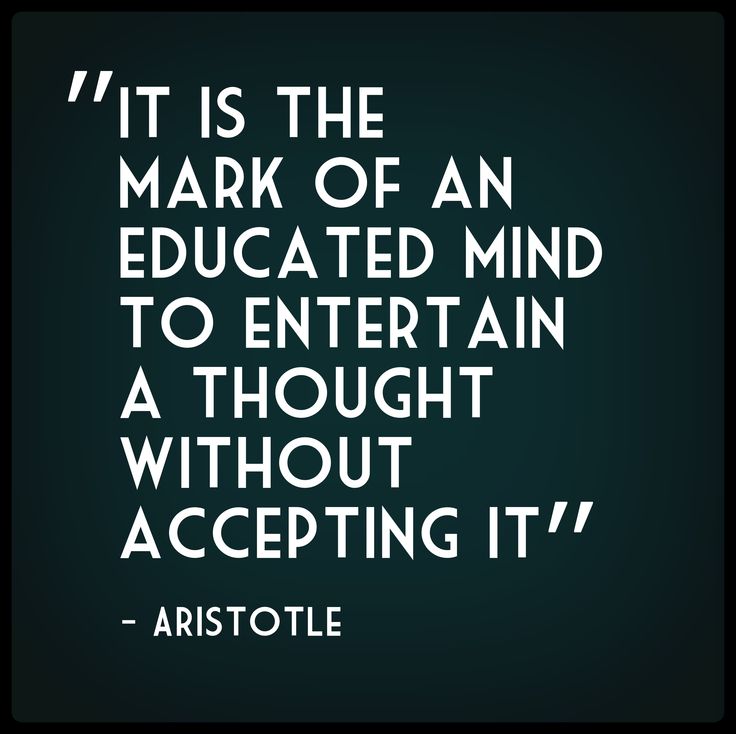
1. “It is the mark of an educated mind to entertain a thought without accepting it”
This is probably a willful twisting of something from the Nicomachean Ethics
“It is right that we ask [people] to accept each of the things which are said in the same way: for it is the mark of an educated person to search for the same kind of clarity in each topic to the extent that the nature of the matter accepts it. For it is similar to expect a mathematician to speak persuasively or for an orator to furnish clear proofs!
Each person judges well what they know and is thus a good critic of those things. For each thing in specific, someone must be educated [to be a critic]; to [be a critic in general] one must be educated about everything.”
“For however many things have a plurality of parts and are not merely a complete aggregate but instead some kind of awhole beyond its parts, there is some cause of it since even in bodies, for some the fact that the there is contact is the cause of a unity/oneness while for others there is viscosity or some other characteristic of this sort.
4. “We are What we repeatedly do. Excellence is an act, not a habit.”
This one is has likely slipped into the Internet Aristotle Quotarium from Will Durant’s misconstruing of the Nicomachean Ethics. Indeed, this has been debunked more than a few times. Here’s another version: “Excellence is not a singular act but a habit. You are what you do repeatedly.” there are many variants
Here’s the closest Aristotle actually gets:
Aristotle, Nicomachean Ethics, 1105b
“It is therefore well said that a person becomes just by doing just things and prudent from practicing wisdom. And, no one could ever approach being good without doing these things. But many who do not practice them flee to argument and believe that they are practicing philosophy and that they will become serious men in this way. They act the way sick people do who listen to their doctors seriously and then do nothing of what they were prescribed. Just as these patients will not end up healthy from treating their body in this way, so most people won’t change their soul with such philosophy.”
5. “Knowing Yourself is the Beginning of all Wisdom”
No. I don’t even need to look this up. No. No. No. This is a version of the Delphic Oracles “know thyself” Γνῶθι σαυτόν. At least attribute it to Plato or Aristotle something. Or do what Diogenes Laertius does at give it to Pittakos (1.79.10)
6. “Whosoever is delighted in solitude, is either a wild beast or a god.”
“It is clear that the state is naturally prior to each individual person. If each person when separated is not sufficient on his own, just as other parts are to the whole while a person who is incapable of joining commonwealth or does not need any part of a state because of self-sufficiency is either a beast or a god.”
7. “Where the needs of the world and your talents cross, there lies your vocation.”
This is totally super-capitalist, corporate double-speak nonsense. It does not even remotely sound like Aristotle. I am not sure where it comes from and I cannot find it debunked, but I will keep looking.
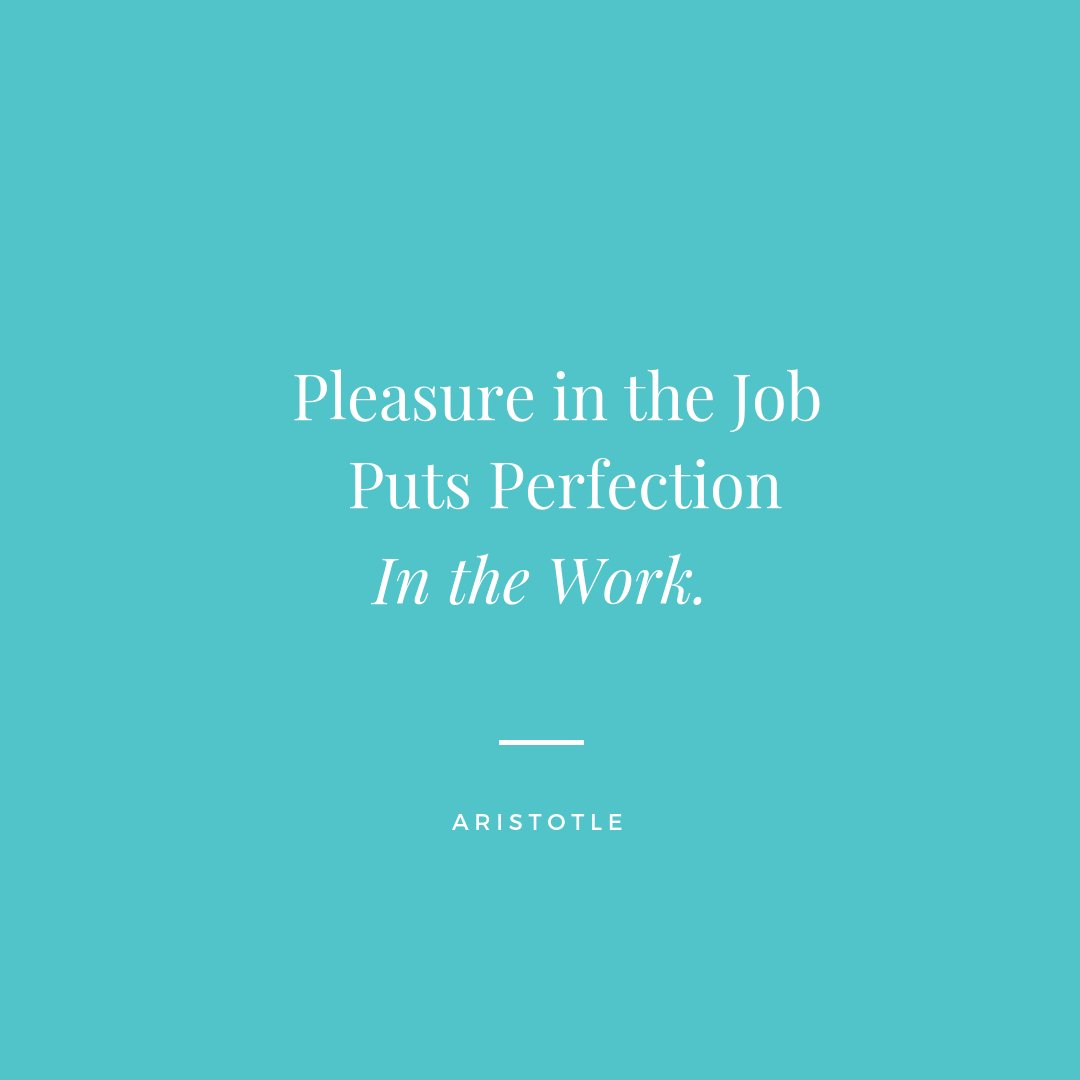
8. “Pleasure in the job puts perfection in the work.”
This one is likely a mistranslation or an attribution of a lost saying by Seneca in On Tranquility of mind. But I can’t really justify that by what I have found in the Seneca. Regardless, this is more neo-capitalist nonsense. I have a hard time believing this is anywhere in Aristotle.
A few twitter correspondents responded that this sounds a little bit like the end of the Nicomachean Ethics where Aristotle writes “pleasure brings completion to an activity” ( τελειοῖ δὲ τὴν ἐνέργειαν ἡἡδονή, 1174b). I will not claim that this sounds nothing like the apocryphal translation above, but I will insist that in its context, Aristotle’s comment has nothing to do with “work” in the way it is construed, but instead this is about aesthetic pleasure. The worst version of this meme is this terrible, no-good, evil version:
Note the double emphasis on work? This is the kind of poster a middle manager puts up to ‘motivate’ his underpaid minions before he drives home in his Porsche….
9. “Well-begun is half done”
This is not really Aristotle. The idea is proverbial even when it is kind of quoted by Aristotle. But these words belong to someone else. Here is as close as Aristotle gets:
Aristotle, Politics 5, 1303b
“For the mistake happens in the beginning and the beginning is said to be half of the whole, so that even a minor mistake at the beginning is equal to those made at different stages.”
This particular quotation comes from the Benjamin Jowett translation and is replicated on the wikiquote site. Aristotle in phrasing this as “it is said” (λέγεται) is marking the line as a proverb. Horace’s “The one who has begun has completed half the task.” dimidium facti, qui coepit, habet (Epistle 1.2) is closer to the popular version. Hesiod has “fool does not know that half is greater than the whole” ( Νήπιοι οὐδ’ ἴσασιν ὅσῳ πλέον ἥμισυ παντός)
10. “The more you know the more you know you don’t know”
(yes, Pinterest). This is clearly a retread of Plato’s Apology 21d: “I think that I am wiser by this very small bit: I don’t pretend to know what I don’t know.” ἔοικα γοῦν τούτου γε σμικρῷ τινι αὐτῷ τούτῳ σοφώτερος εἶναι, ὅτι ἃ μὴ οἶδα οὐδὲ οἴομαι εἰδέναι.
11. “To write well, express yourself like common people, but think like a wise man. Or, think as wise men do, but speak as the common people do.”
This shows up a lot in business oriented and inspirational self-help tomes. This does not sound like Aristotle at all. I can’t find anything remotely close to this. Any challengers? (see also the shortened “Think like a wise man, Talk like the common people.”
12. “No great mind has ever existed without a touch of madness”
This is another indirect attribution that probably comes from Seneca De Tranquilitate Animi 10 (“or [believe] Aristotle that there was never any great genius without a tincture of insanity”. sive Aristoteli nullum magnum ingenium sine mixtura dementiae fuit). So, it is almost Aristotle, except that we do not have it in any of Aristotle’s extant works (and ancient authors like Seneca, Plutarch and Diogenes Laertius are not beyond making quotes up or misattributing them).
Aristotle does talk about poetry and madness in the Poetics and in his Problems.
“Memory is the scribe of the soul”
Ugh. “scribe”? Soul? This one sounds like it a misunderstanding or a fabrication made to sound old-fashioned.
14. “It is during our darkest moments that we must focus to see the light.”
I really did not need to look this one up. The tone of self-help encouragement motivating this quote is really not Aristotelian. I think this might be one of the clearest offenders. But, its essential badness made me google it. This line is often misattributed to Buddha–but it is often attributed to Aristotle…Onassis. So this meme is a new variation on an old virus. I fear we might already be too late
The character of this quotation is alien to Aristotle and ancient Greek ideas including using “tolerance” in this way and “dying society” (see the quora discussion). I poked around a bit through Aristotle, changing some of the ideas (an ancient Greek might think of “sick” or “corrupt” society”) but there is nothing close to this.
While searching, I found the variation “Tolerance is the last virtue of a depraved society” attributed to Dr. James Kennedy (an Evangelical preacher) and then Hutton Gibson (father of Mel Gibson and Holocaust Denier). Some of the mis-translations and fake translations can be found in quote books from the 19th century. This one does not appear in any books older than a decade or so and mostly in self-published racist texts whose titles and authors I will not print.
16. “There is only one way to avoid criticism: do nothing, say nothing, and be nothing.”
This one is easy. Wikiquote has already debunked it. But the content of the quote as well as its form should be a warning anyway. The final triplet is not really Aristotelian, but it is almost imaginably Greek. This is alleged to come from Elbert Hubbard’s Little Journeys to the Houses of American Statesmen, but that provides only the second half.
There are ideas that seem akin to this in Aristotle: in Nicomachean Ethics, for example, he says “[because], happiness seems to reside in leisure, we labor [sacrifice leisure] so that we may have leisure” δοκεῖ τε ἡ εὐδαιμονία ἐν τῇ σχολῇ εἶναι, ἀσχολούμεθα γὰρ ἵνα σχολάζωμεν (1177b). And Aristotle talks a lot about leisure as being desirable and “although leisure and business are both necessary, leisure is more fully an end than business” (εἰ γὰρ ἄμφω μὲν δεῖ, μᾶλλον δὲ αἱρετὸν τὸ σχολάζειν τῆς ἀσχολίας καὶ τέλος, 1337b33-35). Earlier, he repeats the phrase that “business is for the sake of leisure” (ἀσχολίαν δὲ σχολῆς), in a series of nearly Orwellian paradoxes: “war is for the sake of peace, business for the sake of leisure, and necessary and useful things are for the sake of the good.” (πόλεμον μὲν εἰρήνης χάριν, ἀσχολίαν δὲ σχολῆς, τὰ δ᾿ ἀναγκαῖα καὶ χρήσιμα τῶν καλῶν ἕνεκεν,1333c35-37).
So, for this one, I think we have a bit of an elaborated translation of an essentially Aristotelian idea. But, still, he didn’t really say this—Aristotle is perfectly capable of saying that the telos (“end, Goal”) of a thing is another thing. Where he mentions telos in conjunction with leisure, he writes that leisure itself is an end on its own more than business [read: ‘labor’] is. This is a rather different notion than saying that one is the end of the other.
19. “To appreciate the beauty of a snowflake it is necessary to stand out in the cold.”
This is another one of those lines that is so clearly Un-Aristolelian to anyone who has read a little bit of Aristotle that it seems absurd someone would attribute it to the Stagirite. But, spend a little time lurking on pinterest and inspirational meme-o-ramas, and you’ll find Aristotle and Plato carrying a lot of weight.
There is some actual Greek for this one (“Aνδρειότερος εἶναι μοί δοκεῖ ὂ τῶν ἐπιθυμῶν ἢ τῶν πολεμίων κρατῶν καὶ γὰρ χαλεπώτατόν ἐστι τὸ ἑαυτόν νικῆσαι) but the manuscript tradition is a little crazy. Basically, this is from multiple levels of quotebook traditions and is probably not Aristotle. It is, also, not really Aristotelian. The short story? It was added to one edition of Stobaeus’ Florilegium because it sounded a little like a quotation from Democritus. I have the story here.
This popular meme has its roots in the deep past…of the 1970s (that’s CE, just to clear up any confusion). Wikiquote suggests it is a mistaken summary or expansion of a section of the Politics but I think it is just modern partisan posturing.
I mean, this is kind of the whole aim and purpose of the Nicomachean Ethics, but this is not a quotation of a translation of it. It is just the kind of vanilla summary that an English Professor might give of the text in some lecture just before the world ends on the SyFy network. This is Helen-Cylon level fake.
So, this sounds nice, but would you really want to go against 50 people with one ally? This is motivational poster fake. Its earliest appearance is in self-help quotation books in the 1980s. Figures.
24. “Those that know do, those that understand, teach.”
This variation on the put down “those who can, do, those who can’t, teach” does not seem to appear before the last decade or so. But there may be something to its sense. In the Eudemian Ethics, Aristotle explores how some people are good at things without understanding them and that “those people will succeed even though they are witless and without reason, just as some people sing well enough even though they cannot teach others how to sing” (οὗτοι κατορθώσουσι κἂν τύχωσιν ἄφρονες ὄντες καὶ ἄλογοι, ὥσπερ καὶ εὖ ᾄσονται οὐ διδασκαλικοὶ ὄντες, 1247b). Peisistratos Level Fake.
This is a misattribution made only rather recently online from a Methodist Minister’s writings in the 1800s. It is a very Christian and rather un-Aristotelian notion. This is all about sin. It may be riffing on Aristotelian notions of practice and character, but it is Peisistratos Level Fake.
This has been bouncing around lately with the hashtag #Aristotle
Like many of the fake-istotle quotes, this one can be googled out of existence in about 5 seconds. According to wikiquote, this was first attributed to Aristotle by Lowell L. Bennion in his Religion and the Pursuit of Truth 1989, 52). They suggest that it is a misunderstanding of Nicomachean Ethics 1094b24. The density of the passage provides some grounds for why it may have been (over)simplified. But since it stands so early at the beginning of the Ethics, I suspect that there was a kind of smash and run search for an authoritative sounding quotation. As a side note, there is an interesting–by which I mean crazy–discussion of what this fake quote might mean on Quora. Some of the content there is interesting and accurate (about the idea of the fake quotation, not the actual bit); other parts are like Ancient Aliens crazy.
Aristotle, Nicomachean Ethics, 1 1094a24-1095a
“It is right that we ask [people] to accept each of the things which are said in the same way: for it is the mark of an educated person to search for the same kind of clarity in each topic to the extent that the nature of the matter accepts it. For it is similar to expect a mathematician to speak persuasively or for an orator to furnish clear proofs!
Each person judges well what they know and is thus a good critic of those things. For each thing in specific, someone must be educated [to be a critic]; to [be a critic in general] one must be educated about everything.”
Xenarchus’ Porphyra fr. 7 (preserved in Athenaeus’ Deipnosophists, 6. 224-225)
“Poets are ridiculous. They never invent
anything new—each one of them simply
remixes the same things again and again.
But there is no race more creative or profane
than the fish-sellers!
Since it is no longer permitted to them to dampen
Their fish, a practice forbidden by the law,
When some man completely hateful to the gods
Saw that his fish were drying, well,
He started a brawl among them quite intentionally
There were punches; he acted as if he were hit hard,
Fell to the ground pretending to pass out lying
Among his fish. Someone shouted “water, water”!
And a different guy grabbed a pitcher and poured it out—
A little on the man, but the rest on the fish!
You would have claimed they’d just been caught!”