The full passage also has a prescription for sexual performance
Magical Papyri, 7.185
“To be able to fuck a lot: mix fifty [pine nuts] with two measures of honey and seeds of pepper and drink it. To have an erection whenever you want: mix pepper with honey and rub it on your thing.”
Complications: this might just be a metaphor. στροβίλια can be phallic; κόκκος can mean “testicles” or female genitals. Also, seeds are, well, seminal. So there is some affiliative magic going on here.
2. I was a little unsure about στροβίλια, but I checked Galen (De Simp. Medic. 12.55.7) and it seems to be a pine nut (Κώνου ὁ καρπὸς, ὃν δὴ καὶ κόκαλον ὀνομάζουσι καὶ στρόβιλον). I am happy for a botanist’s help.
3. τὸ πρᾶ̣γ̣μ̣α: There is a variant attributed to Democritus τὸ π[έλ]μα, which looks like we could treat as a diminutive of τὸ πέος (“penis”) if we wanted to. So, you know, “spread pepper and honey on your little prick”)
νυσταλογερόντιον: nustalogerontion, “sleepy old man”
Even on weekdays, I get ornery without a nap. Although, to be fair, I worry that this is partly because I am like the bard Ion
Plato, Ion 532c
‘What then is the reason, Socrates, that I can’t pay attention or say anything worthy of account but simply fall asleep whenever someone talks about any other poet while, when anyone talks about Homer, I spring awake, I focus sharply, and I have an abundance of things to say?”
My five-year old son talks in his sleep. And I don’t mean that he merely makes sounds–he holds entire conversations with himself. Sometimes there are arguments. As I discovered this morning, however, there is no Ancient Greek word for “sleeping-talkng” or “sleep walking”.
Based on the compound “walking on air” (ἀεροβατεῖν) I propose ὑπνολέγειν (“sleep-talking”) and ὑπνοβατεῖν (“sleep-talking”). But I must admit that my faith is a bit rattled. So, here are some sleep-compounds from ancient Greek.
ὑπνομαχέω: (hupnomakheô) “fight against sleep”
ὑπνοποιός: (hupnopoios) “sleep-making”
ὑπνάπατης: (hupnapatês) “cheating of sleep”
ὑπνοφόβης: (hupnophobês) “frightening in sleep”
ὑπνοφόρος: (hupnophoros) “sleep-bringing”
ὑπνοδεσμήτος: (hupnodesmêtos) “bound-by-sleep”
ὑπνοτραπἑζος: (hupnotrapezos) “table-sleeper” (an epithet for a parasite)
Gorgias on Sleep and His Brother (Aelian, Varia Historiia 2.30)
“When Gorgias of Leontini was at the end of his life and, extremely old, he was over taken by a certain weakness, he stretched out in his bed slipping off to sleep. When one of his attendants who was looking over him asked how he was doing, Gorgias replied “Sleep is now starting to hand me over to his brother.””
Gorgias of Leontini was an orator who lived nearly one hundred years. In Greek myth, Sleep (Hypnos) and Death (Thanatos) are brothers. Here’s the Euphronios Krater that shows the pair carrying off the mortally wounded Sarpedon.
This is likely the penultimate, or at least the antepenultimate, post about animal sounds. I am not losing steam, exactly; but I am losing material. This post is a little bit of a failure. But, along the way, we will get to sounds for weasels, snakes, and mice. This is a win, even if the elusive cat’s meow remains beyond me. If anyone finds evidence, I will gladly post it.
A proverb (in Arsenius and elsewhere; this version is from the Etymologicum Magnum)
“[Comparing] a cat to Athena. This is used for those who poorly compare serious things with minor because of some minor similarity, as the proverb applies—as if someone compares Athena with a cat because they both have gray eyes.”
As I have posted about before, there is confusion in early Greek between weasels and cats because both are used in an early period to rid the home of rodents and cats are not as well-represented until the Hellenistic period or later. This complicates finding evidence for ancient Greek representations of cat sounds (I cannot find any) and weasel sounds (very little evidence). But there are some interesting things to say about cats.
The first thing to note is that there are different names and spellings for the felix domesticus. The early Αἴλουρος appears in Herodotus (with an extra syllable). By the early Byzantine period we find an interesting etymology based on the cat’s twirling tail.
Etym. Magnum.
“Ailouros: An animal. The name comes from twisting, turning and moving the tail. Also an ailourios, some call a root this”
“Attic speakers say aielouros; Greeks say ailouros”
αἰέλουρος ᾿Αττικοί, αἴλουρος ῞Ελληνες.
N.B. This form does appear in Herodotus, Sophocles, and more!
Additional evidence gives us little information about the ailouros. It is clear that Herodotus’ cat is the cat as we might recognize it. In other early Greek authors, the evidence gets a bit muddy. This scholion to Aristophanes provides some interesting information. It conflates names and animals, I think, but presents some catty behavior.
Schol. ad Aristophanes Pl. 693
“Stinkier than a weasel”: There are two kinds of weasels, one is wild, which is twofold. It is called an ailouros and another small animal which has red skin. And there is also a *hêmeron. This is the creature which homer calls a ktis but is commonly called katis. This one has really the worst smelling excrement. And when this animal defecates and excretes it throws dirt over it and covers what it excreted. You should also know that that ktis to which, according to the language in homer, the lexicographers of that divine man do not understand, that it is syncope for katis. This animal, they say, is a birdeater, and a complete troublemaker, like an ailouros.”
“People claim that cats hate and dread everything that smells bad. For this reason, they dig a hole and hide their fecal matter so that they might make it invisible when they cover it with earth.”
*I cannot find more information about this type of weasel. We need a weasel-specialist.
What I suspect might be going on here–apart from the delightful description of whatever animal this is as a bird-eater and a troublemaker–is that this scholiast is building a phonetic bridge between the Homeric weasel (ktis) and the latter Greek word for domesticated cat (kattês). The overlapping conceptual space of cat and weasel in the galea (γαλέη) facilitates this, I think. You will note from the passages below some behavior that seems feline and some that does not.
Schol. at Arist. Clouds 169a
“Now he says that the spotted lizard is the small and red wild weasel, not the ailouros or the hêmeron weasel, this is the ktis or also the katis about which Homer also says “he placed a hat well made from a weasel on his head.” This wild weasel scrambles up and down and runs around the walls”
“Home-born”: A kattês which was born in the home. “Does A homeborn cat, after eating my partridge, expects to live in my home? [=Greek Anthology 7.205, attributed to Agathias Scholasticus]
γαλῆ γαλέα mostly describes a weasel but sometimes indicates a cat, since both were used domestically to catch mice.
Aelian 6.41.30-32
“this is also a particular quality of mice. Whenever they hear the trilling of a weasel or the hissing of a serpent they transfer their young from one mouse hole to another”
This passage is the only place I could find evidence of the sound that weasels make. This verb is used to indicate the trilling or squeaking of multiple types of animals, usually small ones like mice and weasels.
This is not the only place where this sibilant verb is used to describe a snake’s hiss. Again, in a scholion to Aristophanes, we get a description of multiple animals sounds that includes the sssssscary snake:
Schol ad. Aristoph. Pl. 689
“Each of the animals has its own particular voice—so a goat maaaas, a cow moooos, a raven crows and other animals are similar. Thus a snake also hisses [surizei].
The verb used here, however, seems to be denominative from σῦριγξ, a noun which has a bit of a messy prehistory.
The verb trizein is used for many different animals. A unique compound appears to evoke the panicked squeaking of a dying mouse. In Latin, mice pipitare.
Batrakhomuomakhia 88
“He was squeezing his hands together and he was squeaking while he died”
καὶ χεῖρας ἔσφιγγε καὶ ὀλλύμενος κατέτριζε.
An Anecdote from Aelian
“Aristeides the Lokrian, after he was bitten by a Tartessian weasel and was dying, said “It would have been much better to die after being bitten by a lion or leopard than, if there would be some excuse for death other than this creature.” I think he felt the shamefulness of the bite to be more burdensome than death itself.
“Once, nature provided a song to kites as great as that of swans. But when they heard the horses neighing they fell in love and tried to mimic it. As they tried to imitate them, they lose their own voice. They never learned to neigh and they forgot how to sing.
The imitation of something different deprives you of what is yours.”
The most common representation of horse sounds in Ancient Greek is seems to be based off a root with uncertain origins. I suspect it might have, at least to some speakers, represented a similar vocalism to that of English neigh.
Hesychius
“khremetismos: the sound of horses.”
χρεμετισμός· ἡ φωνὴ τῶν ἵππων
Cf. Zonaras Χρεμετισμός. ἡ τῶν ἵππων βοή
Herodian = Schol. T ad Il. 21.575b
“Then he heard the barking” Aristarchus says that some have “dog-howling” [kunulagmon]. Stesichorus also seems to read this, for he says (fr. 78) “the endless dog-howling”, We don’t know of any other examples of the compound. For howling [ulagmos] is elsewhere the name properly applied for hearing dogs, just as neighing is for horses.
Anyone who has spent time with horses knows that they do not make only one type of sound. There are two basic lexical items for equine snorting: the somewhat uncommon φρυάγμα and the slightly more common φριμαγμος. Both are understood by ancient authors to be onomatopoetic representations of nasalized snorting. But some sources make one or the author a synonym of neighing. All of these words seem to be nominalized abstracts from (what ancient speakers considered) animal-sound roots.
Zonaras
“Snorting [phrimagmos]: whinnying [khrêtismos]
Φριμαγμός. ὁ χρεμετισμός.
Lexicon Vindobenese, khi 5
“Whinnying [krêtismos] and snorting [phruagmos] are poetically applied to horses.
χρεμετισμὸς καὶ φρυαγμὸς ποιητικῶς ἐπὶ ἵππων.
Schol in Lyk. 244
“Snorting is neighing. A snorting echo. This, I believe, means neighing. But neighing is not the same as snorting. It is the sound that comes through horses’ noses when they prance.”
“Snorting [phrimasseo] This means to prance with pleasure, to leap, the whole herd. The verb snorting is onomatopoetic from the sound of goats. The verb is also applied to horses. It is onomatopoeia from their sound.”
“Phruagmos: this is a meaningless sound, mixed with fierce breath, emitting through the nose of horses and mules. They do this especially when they are responding to the treatment of those taming them”
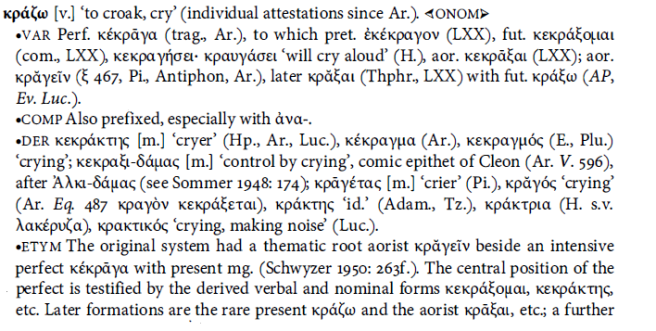
The representation of birdsong tends to be onomatopoetic for fairly obvious reasons. There are other examples to add, but below are just a few instances of what birds say in ancient Greek. In English, birds caw; roosters cockle-doodle-do. In Greek, crows and ravens kro and krag-; roosters and cuckoos kokku kokku. Birds in general pip pip while birds giving birth go kakka.
Ammonius, On Improper Speech 2
“There is a difference between speaking and howling—speaking is used for humans; howling is for wolves. We should not the proper name for each of the rest, for example, we say goats mâ, sheep bleat, cows moo, donkeys bray, horses whinny, lions roar, a dog barks among the Athenians from the sound ar of his voice, while we say they howl. For other birds: ravens and crows crow [krôzein], roosters go kok kuo as do the cuckoo birds. Doves [trugonoi] trill. The rest of the animals are similar.”
The following terms are also likely onomatopoetic and may be similar to English “quack”. Note the reduplication common of other animal sounds. Also, note the strange assertion that there is a sound particular of birds producing offspring.
Photius
“Kakkazein: an imitation of the sound of birds producing young.”
Κακκάζειν: μίμησις τικτουσῶν ὀρνίθων φωνῆς.
“Kikkabizein: Aristophanes uses this sound for the noise of owls”
This is yet another entry in the search for Greek animal sounds. You can find earlier notes on goats, pigs, sheep, donkeys and cows.
Aristophanes Wasps, 902-3
Ph.“Where is the plaintiff, the Kudathênaian dog?
Dog: Ow, Ow!
ποῦ δ’ ὅ γε διώκων, ὁ Κυδαθηναιεὺς κύων;
ΚΥΩΝ αὖ αὖ.
When I was in graduate school I had a few table lecterns built by my late father who used to spend time under the influence working in the woodshop in his later years. He made a series of unfinished lecterns that worked to various degrees. One of them had some of my favorite lines from Greek scrawled on them—as I worked my way through the PhD reading list, I would throw fragments on it when they entertained me. (This practice, if any, represents the extreme origin of this blog and the twitter feed).
The dog’s comment above from the Wasps was one of a dozen on it. For years, I thought of ancient Greek dogs as saying au au until, last week, in a fit of fancy over animal noises, I posted this on twitter and was corrected. Ancient Greek dogs don’t say au au. They probably spoke the same language our dogs do and said Βαὺ Ϝαύ.
There was a lively twitter conversation about this.
LSJ also lists βαύ, βαύ for dogs and βαυβύζω/βαύζω as the verb.
As usual, the Suda would have helped explain the confusion. According to it (and a comment repeated in the scholion to Aristophanes’ Wasps), “au au is the imitation of the howling of dogs” (αὖ αὖν: μίμημα ὑλακῆς κυνῶν). The verb ὑλακτεῖν—a secondary formation from the onomatopoetic ὑλάω—is, as any student of Athenaze would know, used at times to mean “bark”, but it more properly means to howl. From Beekes:
Aristonicus, De Signis Iliadis ad 21.575
“The howl is the special sound of dogs.”
ὁ γὰρ ὑλαγμὸς ἴδιος κυνῶν.
Zonaras, beta 379
“Barking: ulaktôn: In Aristophanes [Thesm. 173] “Barking, for I was like this….”
That Greek dogs likely said bau wau like our own is confirmed by a few fragments and the existence of another onomatopoetic verb, βαΰζειν. The loss of the digamma in Greek obscures the similarity, but, as we have seen from other Greek words for animal sounds, there is a tendency to represents them through reduplication. There is probably something interesting to say about this and Greek phonetic representations of linguistic otherness, as in the reduplicated bar-bar-os.
FCG Anonymous Fragments, Fr. 195 (=IEG fr. 50)
“Bau, bau—you also utter the sound of a dog!”
Βαὺ βαὺ καὶ κυνὸς φωνὴν ἱείς.
Pseudo-Herodian, De prosida Catholica 3.1.495
“The bau is accented in imitation of a dog….from this too comes the word “to bark”
We also have independent confirmation that cows may have said mu as early as the Mucynean period:
The Linear A (l) and B (r) sign AB23 had the value mu in LB. It's also used as the ideogram for ox, suggesting Myc. and Min. cows went mu. pic.twitter.com/K2PtFLlDnJ
This nominal root, likely onomatopoetic from the sound of animals, has a few verbal reflexes in Greek, including μυκάομαι and μύζω. There are additional derivatives: μυκητής (“bellower”, μυκήμων “bellow”, μύκημα (“lowing, bellowing”; used of lions and thunder too). The upsilon is long to contrast with the short vowel in μύκης (“mushroom”) and Μυκήνη (Mycenae). Here’s Beekes again:
Perhaps this is not a sound exclusive to cattle, however. Consider Suda mu 1390:
“Mycalê and Mukalêsos: name for a city. It comes from the fact that the Gorgons bellowed here.”
The verb is also used to indicate the low sound of objects or the roar of a lion. See Suda, mu 1394
“Mukêsantos: “after it sounded”—Homer has “on their own, the gates of heaven sounded, the gates the seasons hold” and in the Epigrams, “after the drum sounded deeply, the boldest of the rest of the animals ran off faster than a deer.”
And the sound moo seems to be used for non-verbal soundmaking for humans too:
Aristophanes, Thesm. 231-231
Kê: Moo, Moo
Eu: Why are you mootering? Everything has been done well.
ΚΗ. Μῦ μῦ.
ΕΥ. Τί μύζεις; Πάντα πεπόηται καλῶς.
There might be multiple layers of onomatopoetic derivatives here—one for the cow and another for the human moan, and even this is probably a simplification.
Zonaras, s.v. Μῦ (=Etymologicum Magnum s.v)
“Moo: a simple sound, this utterance imitates a moan. A moan is an echo of moo, a sound coming from the nose.”
“He is about to sacrifice me and he is telling me to say “baa”.”
θύειν <με> μέλλει καὶ κελεύει βῆ λέγειν.
Aelian, On Animals, 16.16
τῶν δὲ οἰῶν βληχή, “The bleating of sheep”
Hermippus, fr. 19
“Baa”
[βᾶ]
Suda, s.v. Βή (beta, 240)
Baa: This is the imitation of the sound of sheep—since Attic speakers do not say bai. Cratinus in his Dionysalexandros says “the last one walks forward saying “baa baa” like a sheep.”
“It was [Geta’s] habit to pose questions to grammarians, for instance, how they might name the way various animals make sounds: sheep bleat, pigs grunt, doves coo, boars grunt, boars growl, lions roar, leopards sneer, elephants sound horns, frogs croak, horses whinny, donkeys bray, bulls low. He would prove each of these with ancient writers.”
Familiare illi fuit has quaestiones grammaticis proponere, ut dicerent singula animalia quomodo vocem emitterent, velut: agni balant, porcelli grunniunt, palumbes minurriunt, porci grunniunt, ursi saeviunt, leones rugiunt, leopardi rictant, elephanti barriunt, ranae coaxant, equi hinniunt, asini rudunt,1 tauri mugiunt, easque de veteribus adprobare.
It seems likely to me that Ancient Greek pigs said γρῦ γρῦ
Hesychius
“goggrusai: to make noise like a pig”
γογγρύσαι· ὡς χοῖρος φωνῆσαι
“The noise of a pig
γρύλλη· ὑῶν φωνή
Cf. Photius gogggruzein and grulizein: “swine sounds”
“Among Attic speakers gru is used to describe something small and accidental. For they call both the dirt under a fingernail gru and the bric-a-brac of a home grutaria. The man who sells the bric-a-brac is a grutopolos.”




 FCG Anonymous Fragments, Fr. 195 (=IEG fr. 50)


