Skatokhasm: Another Word You Know You Need

How does one say “shithole” in Ancient Greek? As with other such esoteric considerations, this takes us into the depths of metaphor and meaning. Is a “shithole” a place whence shit emerges or one in which shit properly settles to age? To be more pointed, when we say “shithole”, do we mean the rectum (so is it a synonym for “asshole”) or do we mean a receptacle too primitive and unformed to be graced with the designation ‘toilet’?

I think when the leader of what was once the free world uses the term , he probably means the second meaning–that the countries designated so are “primitive”, bereft of proper sanitation, and, as such, both filled with excrement (in his excitable mind) and a worthy place for excrement to stay. Thanks to the magic of the conceptual metaphor, of course, the “shithole” can simultaneously indicate both origin and receptacle. One reason it is terribly racist is that the people who move from one to the other or inhabit them are, by extension, excrement.

Because I process trauma and horror through ancient Greek and lexicography, I need to ‘own’ this word by putting it in Greek. I think the stronger force of this metaphor is the location of discarded shit not the organ of excretion. Ancient Greek does not have a clear parallel (and believe me, gentle reader, I looked). I would love to hear some other suggestions. I put the call on Twitter.

The best suggestion, I think, is σκατοχάσμα (skatokhasma, see below). I like it because it has clear parallels (e.g. skatophage). Also, it sounds like “shit-gasm” which is what I think happens every time a certain chief executive speaks. Weaknesses: khasma is not very productive in ancient Greek compounds and is also rather ‘epic’ in scope. In English, “hole” is dimunitive a small. Shitholes are thus additionally awful because of their insignificance.

Honorable Mentions: τὸ σκατώρυγμον (skatorugmon). this has the sense of something hastily and poorly made by people. Also, κοπροβάραθρον is, as one correspondent declared, totally “metal” and, really epic. (Also, coprophilia is something the captain of our ship might cop to). The Lexicographer Zonaras treats all three of these nouns as synonyms (“Barathron: A ditch. A depth. The maw of the earth.” Βάραθρον. ὄρυγμα· βάθος· χάσμα γῆς). For me, barathron is mythical; orugmon is man-made, and khasma is more generic and ‘natural’. I prefer it, in sum, because of its huuugeness. It is really big. And the speaker mentioned above doesn’t do anything small.

Some Instructive Compounds

κοπρόνους: “manure-minded”
κοπράγωγεω: “to collect crap”
κόπρειος: “full of crap”
κοπρολογεῖν: “to gather crap”
κοπροφαγεῖν: “to eat crap”
κοπροστόμος: “foul-mouthed”
σκατοφάγος: “shit-eater”
κόπρανα: “excrements”
κοπραγωγός: “shit-bearer”
κοπρία: “dung-heap”
κοπρίζω: “to make dung”
κοπρικός: “full of it”
κοπροθέσιον: “a place where dung is put”. ‘Shit-bucket”
κοπροδοχεῖον: “cess pool”
κοπροποιός: “dung-making”
σκατοφάγος: “shit eater”
σκαταιβάτης: “shit-walker”
σκωραμὶς: “shit pot”; cf. Ar.Lys. 371: σκωραμὶς κωμῳδική: “comedic shitpot”

Image result for medieval manuscript toilet

From Beekes:

chasm

Soul. Cold.

ψυχή, ἡ: soul, life

ψύχωσις: life-giving/generating

ψυχοανάκαλυπτος: soul-baring, revealing

ψυχοκλέπτης: soul-thief

ψυχοκτόνος:soul-killing

ψυχοπλανής: soul-wandering

ψυχοπότης: soul drinker (drinking of life, i.e. blood)


ψῦχος, τό: cold

ψυχρία: cold

ψυχκρασία: growing cold

ψυχολογία: frigid talking

ψυχροποιός: making cold

ψυχροπότης: cold drinker (one who drinks cold water)

ψυχρόσαρκος: with cold flesh

soulCOld1

cold 2

Procrastination: A Greek and Roman Tradition

Our word ‘procrastination’ is pretty much a direct borrowing from Latin (first attested in English in 1548, according to the OED–we really delayed in adopting it!). There was also a brief-lived adaptation of Latin cunctatio (delay) in English cunctation, cunctatory, cunctatious (etc.) but, thankfully, that fell into disuse. Eventually.

Here are some Greek and Roman thoughts on delay:

From the Suda:

Ἀμβολία: ἡ ὑπέρθεσις: Hesitation: postponement
Ἀναβάλλειν: To Delay
Ἀνάθεσις: ἡ ὑπέρθεσις: A delay: postponement
Διαμέλλει: ἀναβολῇ χρῆται: He/she put something off: to employ procrastination.

A few proverbs from the Suda

“The wings of Daidalos”: used of those who employ delay because they lack a prosthetic.

Δαιδάλου πτερά: ἐπὶ τῶν δι’ ἀπορίαν προσθήκης χρωμένων παρελκύσει.

“The hedgehog would put off childbirth.” This proverb is applied to situations that become worse with delay”

Ἐχῖνος τὸν τόκον ἀναβάλλῃ: λέγεται ἐφ’ ὧν τὸ ἀναβάλλεσθαι πρὸς χείρονος γίνεται.

Image result for Medieval manuscript hedgehog

Terence, Andria 206

“Dave, this is no place for sluggishness or procrastination.”

Dave, nil locist segnitiae neque socordiae,

Propertius, 1.12

“Why can’t you stop flinging a charge of laziness at me—
The claim that Rome, Ponticus, is making me procrastinate?”

Quid mihi desidiae non cessas fingere crimen,
quod faciat nobis, Pontice, Roma moram?

Achilles Tatius, Leucippe and Clitophon 18

“For when beauty, wealth and sex converge upon you, you better not sit or procrastinate!”

κάλλος γὰρ καὶ πλοῦτος καὶ ἔρως εἰ συνῆλθον ἐπὶ σέ, οὐχ ἕδρας οὐδὲ ἀναβολῆς

Cicero, Letters (to Atticus) 10.9

“Fearing this, I fell into this delay. But I might achieve everything if I hurry—if I procrastinate, I lose.”

hoc verens in hanc tarditatem incidi. sed adsequar omnia si propero: si cunctor, amitto.

Cicero, Letters to Friends (Caelius Rufus to Cicero, 87)

“You know how slow and barely effective Marcellus is. And Servius too, the procrastinator….”

nosti Marcellum, quam tardus et parum efficax sit, itemque Servium, quam cunctator

Thucydides, 2.18

“The Peloponnesians believed that when they arrived they would have captured everything outside still immediately, except for his procrastination…”

καὶ ἐδόκουν οἱ Πελοποννήσιοι ἐπελθόντες ἂν διὰ τάχους πάντα ἔτι ἔξω καταλαβεῖν, εἰ μὴ διὰ τὴν ἐκείνου μέλλησιν

Demosthenes, Second Olynthiac 23

“It is no surprise that Philip, when he goes on campaign himself, toiling and present at every event, overlooking no opportunity or season, outstrips us as we procrastinate, vote on things, and make official inquiries.”

οὐ δὴ θαυμαστόν ἐστιν, εἰ στρατευόμενος καὶ πονῶν ἐκεῖνος αὐτὸς καὶ παρὼν ἐφ᾿ ἅπασι καὶ μήτε καιρὸν μήθ᾿ ὥραν παραλείπων ἡμῶν μελλόντων καὶ ψηφιζομένων καὶ πυνθανομένων περιγίγνεται.

Plato, Critias 108d

“I need to do this already, I can’t procrastinate anymore!”

τοῦτ᾿ οὖν αὐτὸ ἤδη δραστέον, καὶ μελλητέον οὐδὲν ἔτι.

Minucius Felix, Octavius 13

“Shouldn’t everyone should respect and imitate the procrastination of Simonides, the lyric poet? When he was asked by the tyrant Hiero what he thought about the nature of the gods, first he asked for a day to think about it. On the next day, he asked for two more days. And he requested another two when reminded again!

Finally, when the tyrant asked the cause of so much delay, he responded that to him “the truth became as much more obscure as the time spent pursuing it”. To my taste, matters that are uncertain should be let as they are. When so many impressive minds disagree, decisions should not be made rashly or speedily for either side to avoid entertaining an old woman’s superstition or the loss of all religion.”

Simonidis Melici nonne admiranda omnibus et sectanda cunctatio? Qui Simonides, cum de eo, quid et quales arbitraretur deos, ab Hierone tyranno quaereretur, primo deliberationi diem petiit, postridie biduum prorogavit, mox alterum tantum admonitus adiunxit. Postremo, cum causas tantae morae tyrannus inquireret, respondit ille ‘quod sibi, quanto inquisitio tardior pergeret, tanto veritas fieret obscurior.’Mea quoque opinione quae sunt dubia, ut sunt, relinquenda sunt, nec, tot ac tantis viris deliberantibus, temere et audaciter in alteram partem ferenda sententia est, ne aut anilis inducatur superstitio aut omnis religio destruatur.”

Martial, 5.58

“Postumus, you always say that you will live tomorrow, tomorrow!
But that ‘tomorrow’ of yours – when does it ever come?
How far off is that ‘tomorrow’! Where is it, or where should it be sought?
Does it lie hidden among the Parthians, or the Armenians?
That ‘tomorrow’ is as old as Priam or Nestor.
For how much can ‘tomorrow’ be purchased?
You will live tomorrow, you say?
Postumus, even living today is too late;
he is the wise man, who lived yesterday.

Cras te uicturum, cras dicis, Postume, semper:
dic mihi, cras istud, Postume, quando uenit?
Quam longe cras istud! ubi est? aut unde petendum?
Numquid apud Parthos Armeniosque latet?
Iam cras istud habet Priami uel Nestoris annos.              5
Cras istud quanti, dic mihi, possit emi?
Cras uiues? Hodie iam uiuere, Postume, serum est:
ille sapit quisquis, Postume, uixit heri.

Plouthugeia: “Wealth and Health”

Some Words:

πλουθυγίεια: “wealth and health”

πλούταξ: “a rich churl”

πλούταρχος: “master of riches”

πλουτογαθής: “delighting in riches”

πλουτοκρατέομαι: “to live in a state governed by the rich”

πλουτοκρατία: “an oligarchy of wealth

πλουτοποιός: “enriching”

πλουτοτραφής: “raised on wealth”

πλουτόχθων: “rich in things of the earth”

Image result for ancient greek wealth

Some Ideas

Xenophon, Memorabilia 4.16.12

“[Socrates] believed that kingship and tyranny were both governments but that they differed from one another. For he believed that kingship was government of a willing people and according to the laws of the city, while tyranny was when people were unwilling and against the laws, but instead according to the wishes of the ruler. Whenever leaders were selected from those who meet the standards of the law, the governement is in aristocracy. When they are chosen from those who have enough property, it is a plutocracy. When they are elected from everyone, it is a democracy.”

Βασιλείαν δὲ καὶ τυραννίδα ἀρχὰς μὲν ἀμφοτέρας ἡγεῖτο εἶναι, διαφέρειν δὲ ἀλλήλων ἐνόμιζε. τὴν μὲν γὰρ ἑκόντων τε τῶν ἀνθρώπων καὶ κατὰ νόμους τῶν πόλεων ἀρχὴν βασιλείαν ἡγεῖτο, τὴν δὲ ἀκόντων τε καὶ μὴ κατὰ νόμους, ἀλλ᾿ ὅπως ὁ ἄρχων βούλοιτο, τυραννίδα. καὶ ὅπου μὲν ἐκ τῶν τὰ νόμιμα ἐπιτελούντων αἱ ἀρχαὶ καθίστανται, ταύτην μὲν τὴν πολιτείαν ἀριστοκρατίαν ἐνόμιζεν εἶναι, ὅπου δ᾿ ἐκ τιμημάτων, πλουτοκρατίαν, ὅπου δ᾿ ἐκ πάντων, δημοκρατίαν.

Sallust, Second Letter to Caesar 4

“Greed, however, is a feral beast, huge and not to be tolerated—wherever it wanders, it lays waste to cities, fields, places of worship and homes. It mixes up the human and the divine. No armies or walls can stand up to it when it pierces with its force. It despoils all portals of repute, shame, children, country and parents.”

Ceterum avaritia belua fera, immanis, intoleranda est; quo intendit, oppida, agros, fana atque domos vastat, divina cum humanis permiscet, neque exercitus neque moenia obstant, quo minus vi sua penetret; fama, pudicitia, liberis, patria atque parentibus cunctos mortalis spoliat

Dicta Catonis, 32

“Greed always loves lies, theft, and rape.”

Semper avarus amat mendacia furta rapinas

(Pseudo-)Aristotle, On Virtues and Vices

“There are three types of injustice: impiety, greed and arrogance. Impiety is offense against the gods and powers or even to those who have died, parents and country, Greed is taken what is against contracts, what is under dispute despite what one deserves. Arrogance is what makes people pursue pleasures for themselves while heaping reproach upon others.”

Ἀδικίας δέ ἐστιν εἴδη τρία, ἀσέβεια πλεονεξία ὕβρις. ἀσέβεια μὲν ἡ περὶ θεοὺς πλημμέλεια καὶ περὶ δαίμονας, ἢ περὶ τοὺς κατοιχομένους καὶ περὶ γονεῖς καὶ πατρίδα· πλεονεξία δὲ ἡ περὶ τὰ συμβόλαια, παρὰ τὴν ἀξίαν αἱρουμένη τὸ διάφορον· ὕβρις δὲ καθ᾿ ἣν τὰς ἡδονὰς αὑτοῖς παρασκευάζουσιν εἰς ὄνειδος ἄγοντες ἑτέρους,

Overindulged Yesterday? Greek and Roman Words on Vomiting

Greek Puking

ἐξεμέω, ἐξερεύγομαι: “vomit”

κατεξεράω: “vomit upon”

κοπριήμετος: “shit-puking”

προεξεμέω: “to puke beforehand”

ἐμεσία: “pukey”; i.e., a disposition to vomit

ἔμεσμα: “puke”, i.e. “that which is vomited

ἐμετηρίζω: “to administer an emetic”

ἐμετικός: “something that causes vomiting; an emetic”

ἀκρητόχολος: “bilious vomiting”

δυσεμής: “Difficult to vomit”

εὐέμετος: “Vomiting easily”

χολημετέω: “to vomit bile”

Image result for Ancient greek vomit vase

Herodotus, 1.133

“They can’t puke or piss in front of another”

καί σφι οὐκ ἐμέσαι ἔξεστι, οὐκὶ οὐρῆσαι ἀντίον ἄλλου

Revelations, 3.16

“I’m going to puke you from my mouth.”

μέλλω σε ἐμέσαι ἐκ τοῦ στόματός μου

Cicero, For King Deiotauros 7.22

“When you said you wanted to puke after dinner, they began to lead you into the bathroom”

‘cum’ inquit ‘vomere post cenam te velle dixisses, in balneum te ducere coeperunt

Plautus, Rudens 27

“By the god, I wish too much that you’d puke up your lungs!”

Pulmoneum edepol nimis velim vomitum vomas.

From P. Chantraine, an etymology. Did someone choke on a digamma?

chantraine (2)

The Roman Side of Things

Vomax, “given to vomiting”

Vomer, “ploughshare”; “membrum virile

Vomica: “sore, boil”; “an evil”

Vomicosus: “full of sores or tumors”

Vomicus: “ulcerous”

Vomificus: “that which causes vomiting”

Vomifluus: “flowing with pus”

Vomitio: “a spewing”

Vomitor: “one who vomits”

Vomitorious: “that produces vomiting, emetic”

Vomitus: “a vomiting”

Vomo: “to puke”, cf. Greek ἐμέω, *ϝεμ-

Image result for Ancient Roman Vomiting

Hard To Stomach: Some Useful Words This Afternoon

A proverb

“A fat stomach does not bear a subtle mind”

Γαστὴρ παχεῖα λεπτὸν οὐ τίκτει νόον.  (Arsenius, 5.22a1)

Od. 18.54-56

“Friends, it is in no way good for an old man
In the clutches of sorrow to fight a younger man.
But my no-good stomach compels me, that I might fall beneath his blows.”

“ὦ φίλοι, οὔ πως ἔστι νεωτέρῳ ἀνδρὶ μάχεσθαι
ἄνδρα γέροντα δύῃ ἀρημένον· ἀλλά με γαστὴρ
ὀτρύνει κακοεργός, ἵνα πληγῇσι δαμείω.

γαστήρ, ἡ: “stomach”

γαστραία: A type of turnip

γαστρίδουλος: “slave to one’s stomach”

γαστρίον: “sausage”

γαστρίζω: “to punch someone in the belly”

γραστριμαργία: “gluttony”

γαστροβαρής: “stomach-heavy”, i.e. “heavy with child”

γαστροκνημία: lit. “shin-stomach”, so “calf”

γαστρολογία: An almanac for gourmands, so “foodie-book”

γαστρομαντεύομαι: “to divine by the stomach”

γαστροπίων: “a fat-bellied fellow”

γαστρορραφία: “sewing a stomach wound”

γαστρόρροια: “diarrhea”

γαστροτόμος: “stomach cutting”

Image result for ancient greek comic vase

γαστροχάρυβδις: “having a gaping maw of a belly”

γαστρόχειρ: lit. “stomach-hand”, so “living by hand” or “hand to mouth”

γαστρώδης: “pot pellied”

A Greek Compound You Just Might Need Today

Suetonius Tranquillus, Peri Blasphemon 11.12

“According to Hipponax [fr. 114c] the “messêgudorpoxéstês” is one who often relieves himself during a meal so that he may fill himself up again”

<Κατὰ δὲ ῾Ιππώνακτα (fr. 114 c Masson), καὶ ὁ> μεσσηγυδορποχέστης, ὁ μεσοῦντος τοῦ δείπνου πολλάκις ἀποπατῶν, ὅπως πάλιν ἐμπίπληται ὁ αὐτός.

For the word-builders: messêgu (“in the middle of”) + dorpos (“dinner, meal”)+ khestês (a nomina agentis—agentive noun—from the Greek verb χέζω, “to shit”).

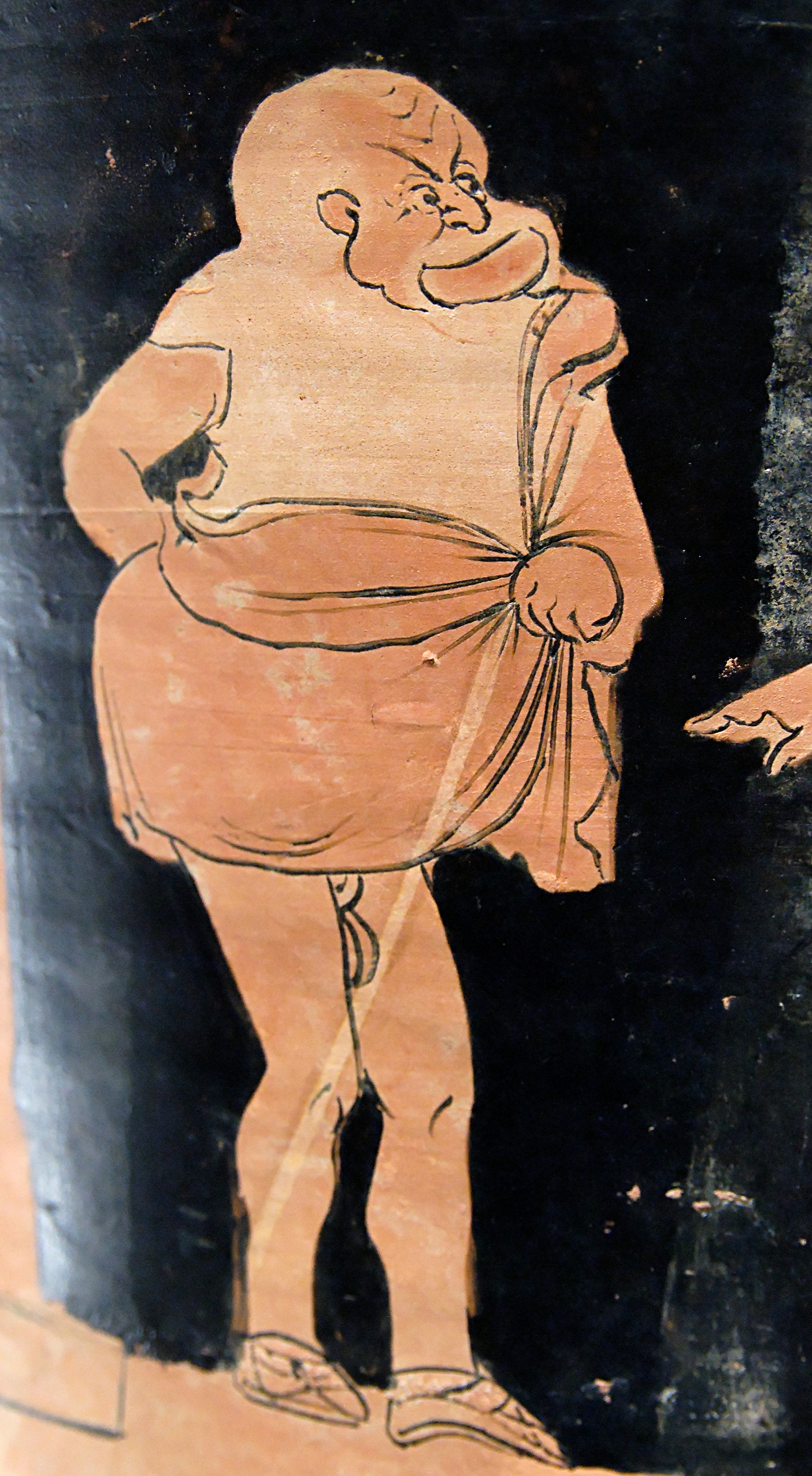
This is a real vase at the Museum of Fine Arts

Cf.

And another from the Walters Art Museum:


pl9_482050_detc_bw_t90

Some Phage Compounds to Get You in the Holiday Mood

Very soon we will be eating too much for like a month straight. This is the start of occasional posts for the duration on feasting, over-indulgence, and, of course, drinking.

Telegony, fr. 1

“He consumed the endless meat and sweet wine greedily”

ἤσθιεν ἁρπαλέως κρέα τ’ ἄσπετα καὶ μέθυ ἡδύ.

fish vase

Some phage compounds and their explanations.

Adêphagia: “Endless-eating”: This means insatiable. We also find the adjective adêphagos (“eating constantly”), polyphagos (“eating everything”) and gastrimargos (gourmand).
᾿Αδηφαγία: ἡ ἀπληστία. καὶ ᾿Αδηφάγος, ἀθρόως ἐσθίων, πολυφάγος, γαστρίμαργος. ᾿

Αἰγοφάγος· aigophagos, “goat-eater”. An epithet of Hera in Sparta

αὐτοφάγος: autophagos, “self-feeder” (not someone who eats himself)

βουφάγος: bouphagos, “cow-eater”

κοπροφάγος: koprophagos, “dung-eater”

Σκατοφάγος: skatophagos, “dung-eater”. For this, Hesychius comments “but skatophagos is especially mean” (᾿Αλλὰ σκατοφάγος ἐστι καὶ λίαν πικρός). Why? Skatos is the genitive of skôr (σκῶρ), which has a closer resonance with human excrement.

ὀψοφάγος: opsophagos, “delicacy eater”, i.e. foodie

λαθροφάγος: lathrophagos “secret-eater” (eating in secret)

θυμβροφάγος: thumbrofagos, “eating the herb savory”, a metaphor for having a bitter expression. Compare to δριμυφάγος “bitter-eating”, cf. the expression, “leaves a bad taste in the mouth”

ἰχθυοφάγος, ikhthuophagos, “fish-eater”. This is an insult, the Suda explains that Theôros was maligned as a “seducer, fish-eater, and rogue” (ὡς μοιχὸς καὶ ἰχθυοφάγος καὶ πονηρός). Fish-eating seems to be an indication of a dedication to luxury and excess.

Καπροφάγος: kaprophagos, “boar-eater”, an epithet of Artemis in Samos

καταφαγᾶς: kataphagas, “one who eats bent over”, i.e. birds and gourmands

κραδοφάγος: kradophagos, “twig-eater”, a derogatory epithet for a country-dweller

συκοφάγος: sukophagos, “fig eater,” a derogatory epithet for a country-dweller

ἰσχαδοφάγος: iskhadophagos, “fig-eater”, a derogatory epithet for a country-dweller

κριοφάγος: kriophagos, “fat-eater”, an epithet for a god receiving a sacrifice

Λωτοφάγος: lôtophagos, “lotus-eater”

μικροφάγος: mikrophagos, “small-eater”, someone who doesn’t eat much

παμφάγος: pamphagos, “all-eater”, someone who eats everything

ταυροφάγος: tauorophagos, “bull-eater”, an epithet of Dionysus

A Typology of Fear, In Anticipation of Halloween

Halloween is right around the corner. In what is becoming an annual tradition, we are going to post Greek and Roman passages in the spirit of the season. Over the next few weeks you can expect vampires, brain-eaters and a lot of werewolves. But first, fear. (Going well with Seneca’s ruminations on the fear of death.)

Stobaeus 2.7.10c [=Diogenes Laertius 7.113]

“Hesitation is fear of future action. Agony is fear of failure and otherwise fear of worse outcomes. Shock is fear of an uncustomary surprise. Shame is fear of a bad reputation. A ruckus is fear pressing down with sound. Divine fright is fear of gods or divine power. Terror is fear of a terrible thing. A fright is fear that comes from a story.”

     ῎Οκνος δὲ φόβος μελλούσης ἐνεργείας· ἀγωνία δὲ φόβος διαπτώσεως καὶ ἑτέρως φόβος ἥττης· ἔκπληξις δὲ φόβος ἐξ ἀσυνήθους φαντασίας· αἰσχύνη δὲ φόβος ἀδοξίας· θόρυβος δὲ φόβος μετὰ φωνῆς κατεπείγων· δει-σιδαιμονία δὲ φόβος θεῶν ἢ δαιμόνων· δέος δὲ φόβος δεινοῦ· δεῖμα δὲ φόβος ἐκ λόγου.

Suda

“Fear: flight or cowardice. Fear is expecting evil. These emotions are categorized as fear: terror, hesitation, shame, shock, commotion, anxiety. Terror is fear that brings dread. Hesitation is fear about future action. Shame is fear about a bad reputation. Shock is fear from an unusual thing. Commotion is fear from a striking sound. Anxiety is fear of an uncertain matter.”

Φόβος: φυγή. καὶ ἡ δειλία. Φόβος δέ ἐστι προσδοκία κακοῦ. εἰς δὲ τὸν φόβον ἀνάγεται ταῦτα· δεῖμα, ὄκνος, αἰσχύνη, ἔκπληξις, θόρυβος, ἀγωνία. δεῖμα μὲν οὖν ἐστι φόβος δέος ἐμποιῶν, ὄκνος δὲ φόβος μελλούσης ἐνεργείας, αἰσχύνη δὲ φόβος ἀδοξίας, ἔκπληξις δὲ φόβος ἐκ φαντασίας ἀσυνήθους πράγματος, θόρυβος δὲ φόβος μετὰ κατεπείξεως φωνῆς· ἀγωνία δὲ φόβος ἀδήλου πράγματος.

Image result for Ancient Greek monster vase

Tawdry Tuesday: Suetonius and His Defamatory Words

Antiquity has bequeathed to us On Defamatory Words and Where they Come from (ΠΕΡΙ ΒΛΑΣΦΗΜΙΩΝ ΚΑΙ ΠΟΘΕΝ ΕΚΑΣΤΗ) attributed to Gaius Suetonius Tranquillus. Yes, that Suetonius. It seems rather fragmentary, but it produces some gems. A large section include insults about women, but here’s a nice one for a man:

nôthouros: I guess is one who has a bastard ‘tail’ for intercourse. For they use this in respect to male genitals. The kind of man described this way is also called impotent [astutos] and his household is called impotent. For example in Xenarkhos, “the impotent house of the Pelopides”. And there is also “fruitless” [akarpos] and “childless” [agonos] “the house perishes because it experiences the flaccid fates of its masters”.

Νώθουρος, <ἤγουν ὁ νωθὴν ἔχων τὴν οὐρὰν ἐν τῷ συγγίνεσθαι·οὕτω γὰρ ἔλεγον τὸ κατ’ ἄνδρας αἰδοῖον. ῾Ο δὲ τοιοῦτος ἀνὴρ καὶ ἄστυτος ἐλέγετο, καθὰ καὶ οἶκος ἄστυτος>—<οἷον παρὰ Ξενάρχῳ (fr. 1 Kock)·«Πελοπιδῶν ἄστυτος οἶκος», ἤγουν ἄκαρπος, ἄγονος, καί (id. ibid.)· «φθίνει δόμος ἀστύτοισι δεσποτῶν κεχρημένος τύχαις«>—

Astutus, literally “without an erection”. I covered this last week….

Hesychius agrees with the definition

Nôthouros: one who is incapable of having intercourse. Or a donkey.

νώθουρος· ὁ ἀδύνατος συγγίνεσθαι (Com. ad. 1367). ἢ ὄνος

note: συγγιγνώσκω means “agree with”: συγγίγνομαι can mean “talk with” or “communicate with” but also to “have sex with”. Don’t confuse them.

LSJ is just too precious on this:

nothouros

I think that nôthouros might be the equivalent of “limp-dick”, although I would like to suggest “fake-dick” or “counterfeit-cock” vel sim. (but that comes from a fake etymology with the short vowel omicron for “bastard” (νόθος). This, of course, is impossible. Tell me, Beekes:

etymnoth

Image result for Ancient Greek Sculpture penis