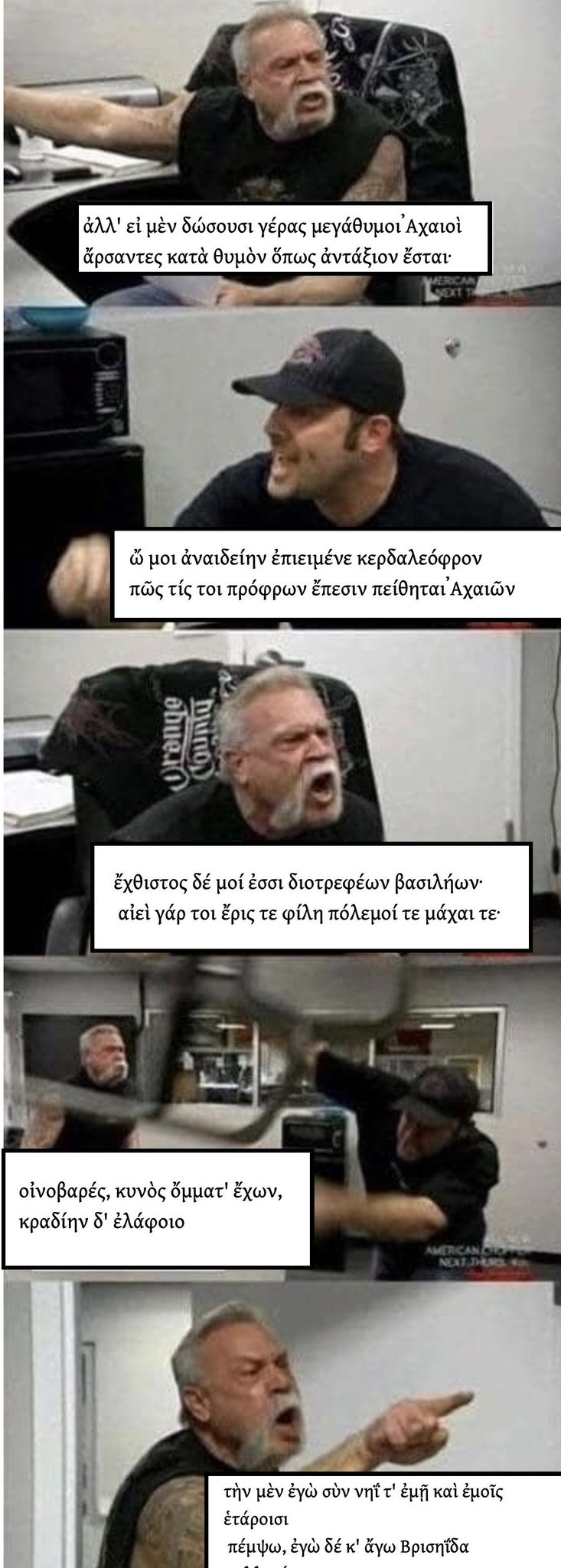
“Glaring at him, shining-helmed Hektor answered:
Poulydamas, you never announce things dear to me in public.
You know how to make a different, better speech than this one.
If you are really arguing this out loud earnestly,
Well then the gods have ruined your thoughts themselves,
You who order me to forget the counsels of loud-thundering Zeus,
What he himself promised and assented to for me.
Now you ask me to listen to some tender-winged bird?
I don’t notice or care at all about these birds,
Whether they go to the right to dawn and the sun
Or whether they go to the left to the dusky gloom.
We are obeying the plan of great Zeus.
He rules over all the mortals and the immortal too.
One bird omen is best: defend your fatherland.
Why do you fear the war and strife so much?
If all the rest of us are really killed around
The Argive ships, there’s no fear for you in dying.
Your heart is not brave nor battle-worthy.
But if you keep back from the fight, or if you turn
Any other away from the war by plying him with words,
Well you’ll die straight away then, struck down by my spear.”
So he spoke and led on, and they followed him
With a divine echo. Zeus who delights in thunder
Drove a gust of wind down from the Idaian slopes,
Which carried dust straight over the ships. It froze the minds
Of the Achaeans and gave hope to the Trojans and Hektor.
Trusting in these signs and their own strength,
They were trying to break through the great wall of the Achaeans.”
“you order me to obey bird signs: the prudent person will both honor the gods and obey birdsigns, like Odysseus does. This is obeying instead of believing.
“As long as they were stripping them of their gleaming weapons,
The young men who were the best and the greatest in number were following
Poulydamas and Hektor, they were especially eager to break the wall
And set fire to the ships. They were still struggling standing before the wall
When a bird went over them as they were struggling to cross it,
A high-flying eagle moving its way over the left side of the army
Holding in its talons a huge dark red snake
Still alive, breathing: it had not yet lost its fighting spirit.
For it struck back at the bird who held him in the skin along the chest
As it bent double. And the bird tossed him away to the ground
tortured with pains. It dropped the snake in the middle of the throng
But flew away on the breath of the wind, sounding out in pain.
The Trojans shivered when they saw the winding serpent
Lying there, a sign from Aegis-bearing Zeus.
Then Polydamas stood aside and addressed bold Hektor:
“Hektor, you are always threatening me in the public assemblies for some reason,
Even when I advise well, since it is not ever deemed proper
For some member of the people to advise differently, either in council
Or in war. Instead, we must always increase your strength.
But now I will tell you what seems to me to be best.
Let’s not go to fight the Danaans around their ships.
I think that it will turn out this way, if truly this bird
Came over the Trojans as we struggled to cross the wall,
A high-flying eagle moving its way over the left side of the army
Holding in its talons a huge dark red snake
Still alive. For it dropped it before it could return to its dear home
And did not complete the task of giving it to his children.
In the same way we, if we break through the gates and walls
Of the Achaeans by means of great strength and the Achaeans yield
So too we will not find the same paths in order among the ships.
We will lose many Trojans there as the Achaeans
Strike them down with bronze will defending the ships/
This is how a prophet would interpret, one who clearly understands
In his heart divine signs and one the people obey.”
“Mêrionês then killed Phereklos, the son of the carpenter,
Son of Joiner, who knew who to fashion all sorts of intricate tings
With his hands. Pallas Athena loved him especially.
He is the one who designed Alexander’s fantastic ships,
Those kindlers of evil which brought evil on all the Trojans
And on him especially, since he understood nothing of the divine prophecies.
Well, Mêrionês, once he overtook him in pursuit,
Struck him through the right buttock. The sharp point
Went straight through his bladder under the bone.
He fell to his knee and groaned. Then death overtook him.
Whole Schol. bT ad Il.5.59 glosses the name Phereklos as “one who brings the turmoil of war through the ships” (Φέρεκλος ὁ φέρων κλόνον διὰ τῶν νέων), I would also like to believe that name Phere-klos, might make someone think of ‘fame-bringer’. And the connection between poetic fame and the activity of the war arises elsewhere in this passage two.
Note that the this Phere-klos is the son of Harmonidês, a man who, according to the passage, is the one who build the ships “the bringers of evil” (ἀρχεκάκους) for Paris (those ships which carried him from Troy to Sparta…). The name Harmonidês is not insignificant: Gregory Nagy has etymologized Homer as “one who fits the song together”. Phereklos’ father is a “craftsman” (“tektôn”) who built the very ships that allowed his son (and Paris) to bring the conflict to Troy and generate the fame of the songs it generated. Here, the ships are positioned as the first steps in evil, but I would suggest, that as the means by which the songs themselves travel across the sea, the ships are, as products of specialized craftsmen, both metonymns for the stories themselves and necessary vehicles for their transmission.
If this is not too blinkered or mad a suggestion, perhaps Phereklos’ death here is a reassertion of the poetic power of song over the pragmatic craft of shipwrights….
“Sing the rage..” [People] ask why the poem begins from rage, so ill-famed a word. It does for two reasons. First, so that it might [grab the attention] of that particular portion of the soul and make audiences more ready for the sublime and position us to handle sufferings nobly, since it is about to narrate wars.
A second reason is to make the praises of the Greeks more credible. Since it was about to reveal the Greeks prevailing, it is not seemly to make it more worthy of credibility by failing to make everything contribute positively to their praise.”
“It begins with rage, which itself was a summary for the events. Otherwise, [the poet] would have found a tragic introduction for tragedies. For the narration of misfortunes makes us more attentive, just as the best doctor exposes maladies of the spirit and then later applies treatment. So, the Greek anticipates the pleasures near the end.”
Menis, “rage” is a big deal in Greek epic and myth thematically. The ancient scholiasts may not have it all figured out. But my first Greek teacher, Lenny Muellner, has some pretty good ideas on this one.
A: “Soul and ghost, “but the thoughts were not completely present inside them”
Patroklos converses thoughtfully and with understanding. This line, then, is inserted from the Odyssey [where it does not exist]. For there [Homer] makes the psykhai into shadowy ghosts with no share of understanding.
Either he means that thoughts [phrenes] are not perceptive, but they are some part of the organs within the body as is said elsewhere: “they kept the phrenes and liver inside” and elsewhere “there really where the thoughts go/are”. Therefore this is the whole body from a part. Thus says Aristophanes the grammarian. But there is a diplê: Homer depicts the souls of the unburied as still preserving thought.”
[lemma] Some [say] that phrenes are the body. For the phrenes are a portion of the body. But he means that he did not obtain them as long as he was stretched out. But, it is better that the dead do not have thoughts. For he criticizes [Achilles] that he does not care. And, certainly, the unburied often give prophecies. Or, it could also be, that they are present, but not completely.”
“The rest of them were sitting, and they had taken their seats.
Only Thersites, a man of measureless speech, was still declaring–
A man who knew many disordered things in his thoughts and who
Strived pointlessly with kings out of order,
–whatever he thought would be amusing to the Argives.
And he was the most shameful man who came to Troy.
He was cross-eyed and crippled in one foot. His shoulders
Were curved, dragged in toward his chest. And on top
His head was mishapen, and the hair on his head was sparse.
He was most hateful to both Achilles and Odysseus
For he was always reproaching them. Then he was shrilly cawing
At lordly Agamemnon again, as he spoke reproaches. The Achaeans
Were terribly angry at him and were finding fault in their heart.
As he shouting greatly, he was reproaching Agememnon.”
Homer presents a overlap between ‘beautiful body’ and ‘beautiful mind’. This physiognomic category error pervades a great deal of classical Greek culture. In the Iliad, Thersites transgresses physical boundaries through his unheroic body and ethical boundaries by using the genre of rebuke upward in the social hierarchy. He is hateful to both Achilles and Odysseus because they exemplify in a complementary fashion the ‘center’ or ideal of the heroic person—Achilles is the beautiful body, Odysseus is a beautiful mind. But both of them stay within the boundaries of ‘normal’ in their own deviance (Achilles’ political straying, Odysseus’ aging, imperfect body). Thersites, labelled by many as a comic scapegoat, functions as an inferior in order to define the center as non-transgressive. This is, in particular, why he is hateful to Achilles and Odysseus: without him, their persons might be monstrous or disabled. And this also helps explain why Odysseus must physical beat Thersites in public.
Thomson, Rosemarie Garland. 1997. Extraordinary Bodies: Figuring Physical Disability in American Culture and Literature. New York.
5: “related perceptions of corporeal otherness” includes mutilation, deformation, crippledness, or physical disability…”
7: “..the meanings attributed to extraordinary bodies reside not in inherent physical flaws but in social relationships in which one group is legitimated by possessing valued physical characteristics and maintains its ascendency and its self-identity by imposing the role of cultural or corporeal inferiority on others.”
Mitchell, David T. and Sharon L. Snyder. Narrative Prosthesis: Disability and the Dependency of Discourse. Ann Arbor. 2000. Cf. Wills, David. 1995. Prosthesis. Stanford.
57: “Whereas the “unmarred” surface enjoys its cultural anonymity ad promises little more than a confirmation of the adage of a “healthy” mind in a “healthy” body, disability signifies a more variegated and sordid series of assumptions and experiences. Its unruliness must be tamed by multiple mappings of the surface. If form leads to content or “embodies” meaning, then disability’s disruption of acculturated bodily norms also suggests a corresponding misalignment of subjectivity itself.”
59: “If the “external effect” led directly to a knowledge of the “internal faculty,” then those who inhabited bodies deemed “outside the norm” proved most ripe for a scrutiny of their moral or intellectual content. Since disabled people by definition embodied a form that was identified as “outside” the normal or permissible, their visages and bodily outlines became the physiognomist’s (and later the pathologist’s) object par excellence. Yet, the “sinister capability” of physiognomy proves more complex than just the exclusivity of interpretive authority that Stafford suggests. If the body would offer a surface manifestation of internal symptomatology, then disability and deformity automatically preface an equally irregular subjectivity. Physiognomy proves a deadly practice to a population already existing on the fringes of social interaction and “humanity.””
60: “Elizabeth Cornelia Evans argues that physiognomic beliefs can be traced back as far as ancient Greece. She cites Aristotle as promoting physiognomic reasoning when he proclaims, “It is possible to infer character from physique, if it is granted that body and soul change together in all natural affections . . . For if a peculiar affection applies to any individual class, e.g., courage to lions, there must be some corresponding sign for it; for it has been assumed that body and soul are affected together” (7). In fact, one might argue that physiognomics came to be consolidated out of a general historical practice applied to the bodies of disabled peoples. If the extreme evidence of marked physical differences provided a catalog of reliable signs, then perhaps more minute bodily differentiations could also be cataloged and interpreted. In this sense, people with disabilities ironically served as the historical locus for the invention of physiognomy.”
See Odyssey: 1.302: “I see that you are really big and noble, and be brave / that a man born in the future might speak well of you” μάλα γάρ σ’ ὁρόω καλόν τε μέγαν τε, / ἄλκιμος ἔσσ’, ἵνα τίς σε καὶ ὀψιγόνων ἐὺ εἴπῃ =3.199–200 (Nestor addressing Telemachus). Cf. 4.141–147 where Helen recognizes Telemachus because he looks like his father and Menelaos responds “I was just now thinking this too, wife, as you note the similarity: / these are the kinds of feet and hands / the eye glances, and head and hair belonging to that man” (οὕτω νῦν καὶ ἐγὼ νοέω, γύναι, ὡς σὺ ἐΐσκεις· / κείνου γὰρ τοιοίδε πόδες τοιαίδε τε χεῖρες / ὀφθαλμῶν τε βολαὶ κεφαλή τ’ ἐφύπερθέ τε χαῖται, 4.148–150).
Cf. Achilles to Lykaon, Il. 21.108: “Don’t you see what kind of man I am, beautiful and big?” οὐχ ὁράᾳς οἷος καὶ ἐγὼ καλός τε μέγας τε;
167–8: Rebuke is a speech genre highly marked for social position: Penelope rebukes Eurykleia, Nausikaa rebukes her handmaidens. Melanthô should not rebuke Odysseus because it would transgress the normative boundaries for a slave to reproach a master.
On Thersites as a “bona fide satirist”, see Rosen 2003:123. Halliwell 1991:281 too draws attention to Thersites’ role as a “habitual entertainer”, and points to Plato’s shrewd description of him as a γελωτοποιός (Rep.10.620c3). For Thersites as a blame-poet, see Nagy 1979: 211-75. For Thersites’ in general see Lowry 1991 and Postelthwaite 1998.
Lowry, E. R. Thersites: A Study in Comic Shame.
Marks, Jim. 2005. “The Ongoing Neikos: Thersites, Odysseus, and Achilleus.” AJP 126:1–31.
Nagy, G. 1979. The Best of the Achaeans. Baltimore.
Postlethwaite, N. 1998.Thersites in the Iliad, in Homer: Greek and Roman Studies, eds. I. McAuslan and P. Walcot, Oxford, = 83-95.
Rose, P. W. 1997. “Ideology in the Iliad: Polis, Basileus, Theoi.” Arethusa 30:151-199.
Rosen, R. M. 2003. “The Death of Thersites and the Sympotic Performance of Iambic Mock-ery.” Pallas 61:21–136.
Thalmann, W. G. 1988. “Thersites: comedy, scapegoats and heroic ideology in the Iliad.” TAPA 118:1-28.
Vodoklys, E.1992.. Blame-Expression in the Epic Tradition. New York.
Special thanks to David M. Perry for giving me a starter Bibliography for Disability Studies and to Dimitri Nakassis for adding to the bibliography on Thersites.
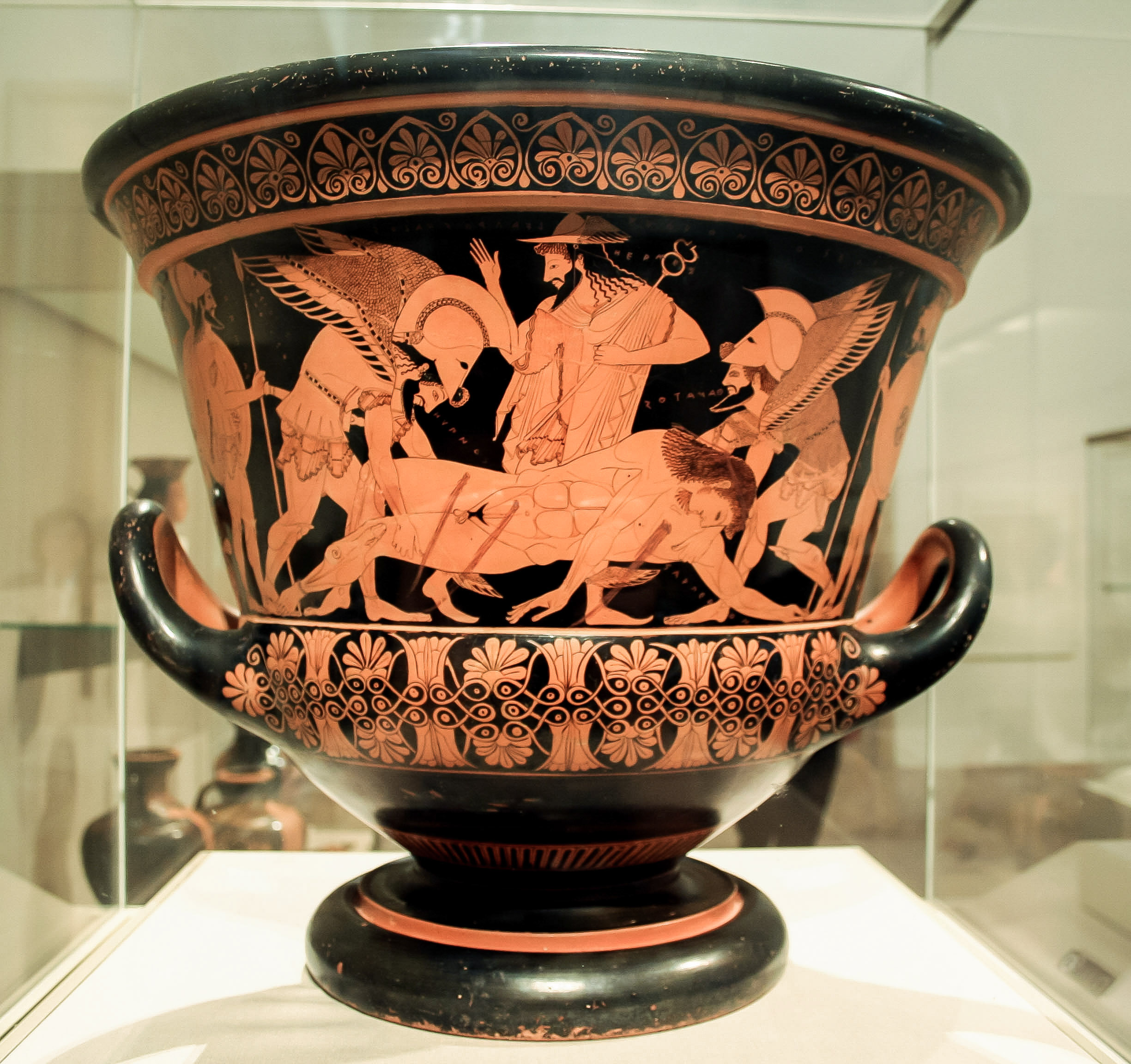
“And then cloud-gathering Zeus addressed Apollo:
‘Come now, dear Phoebus, cleanse the dark blood
From the wounds, once you get to Sarpedon, and then
Bring him out and wash him much in the river’s flows
And anoint him with ambrosia and put ambrosial clothes around him.
Send him to be carried by those quick heralds,
The twins sleep and death, and have them swiftly
Place him in the rich land of wide Lykia.
There his relatives and friends will bury him
With a mound and a stele. This is the rightful possession of the dead.”
So he said and Apollo did not disobey his father.”
“The fact is that Zenodotus has at this place changed the line, writing instead “and then Zeus addressed his dear son from Ida” so that he addresses his son from Ida in the meadow. For it would be ridiculous if Zeus shouted from Ida. For he did not recognize that it was necessary to accept that these kinds of details happened without being mentioned, just as in those scenes about Hera below.”
A: “Soul and ghost, “but the thoughts were not completely present:
Patroklos converses thoughtfully and with understanding. This line, then, is inserted from the Odyssey [where it does not exist]. For there [Homer] makes the psykhai into shadowy ghosts with no share of understanding.
Either he means that thoughts [phrenes] are not perceptive, but some part of the organs within the body as is said elsewhere: “they kept the phrenes and liver inside” and elsewhere “there really where the thoughts go/are”. Therefore this is the whole body from a part. Thus Aristophanes the grammarian. But there is a diplê: Homer depicts the souls of the unburied as still preserving thought.”
[lemma] Some [say] that phrenes are the body. For the phrenes are a portion of the body. But he means that he did not obtain them as long as he was stretched out. But, it is better that the dead do not have thoughts. For he criticizes [Achilles] that he does not care. And, certainly, the unburied often give prophecies. Or, it could also be, that they are present, but not completely.”
“The rest of them were sitting, and they had taken their seats.
Only Thersites, a man of measureless speech, was still declaring–
A man who knew many disordered things in his thoughts and who
Strived pointlessly with kings out of order,
–whatever he thought would be amusing to the Argives.
And he was the most shameful man who came to Troy.
He was cross-eyed and crippled in one foot. His shoulders
Were curved, dragged in toward his chest. And on top
His head was mishaped, and the hair on his head was sparse.
He was most hateful to both Achilles and Odysseus
For he was always reproaching them. Then he was shrilly cawing
At lordly Agamemnon again, as he spoke reproaches. The Achaeans
Were terribly angry at him and were finding fault in their heart.
As he shouting greatly, he was reproaching Agememnon.”
Homer presents a overlap between ‘beautiful body’ and ‘beautiful mind’. This physiognomic category error pervades a great deal of classical Greek culture. In the Iliad, Thersites transgresses physical boundaries through his unheroic body and ethical boundaries by using the genre of rebuke upward in the social hierarchy. He is hateful to both Achilles and Odysseus because they exemplify in a complementary fashion the ‘center’ or ideal of the heroic person—Achilles is the beautiful body, Odysseus is a beautiful mind. But both of them stay within the boundaries of ‘normal’ in their own deviance (Achilles’ political straying, Odysseus’ aging, imperfect body). Thersites, labelled by many as a comic scapegoat, functions as an inferior in order to define the center as non-transgressive. This is, in particular, why he is hateful to Achilles and Odysseus: without him, their persons might be monstrous or disabled. And this also helps explain why Odysseus must physical beat Thersites in public.
Thomson, Rosemarie Garland. 1997. Extraordinary Bodies: Figuring Physical Disability in American Culture and Literature. New York.
5: “related perceptions of corporeal otherness” includes mutilation, deformation, crippledness, or physical disability…”
7: “..the meanings attributed to extraordinary bodies reside not in inherent physical flaws but in social relationships in which one group is legitimated by possessing valued physical characteristics and maintains its ascendency and its self-identity by imposing the role of cultural or corporeal inferiority on others.”
Mitchell, David T. and Sharon L. Snyder. Narrative Prosthesis: Disability and the Dependency of Discourse. Ann Arbor. 2000. Cf. Wills, David. 1995. Prosthesis. Stanford.
57: “Whereas the “unmarred” surface enjoys its cultural anonymity ad promises little more than a confirmation of the adage of a “healthy” mind in a “healthy” body, disability signifies a more variegated and sordid series of assumptions and experiences. Its unruliness must be tamed by multiple mappings of the surface. If form leads to content or “embodies” meaning, then disability’s disruption of acculturated bodily norms also suggests a corresponding misalignment of subjectivity itself.”
59: “If the “external effect” led directly to a knowledge of the “internal faculty,” then those who inhabited bodies deemed “outside the norm” proved most ripe for a scrutiny of their moral or intellectual content. Since disabled people by definition embodied a form that was identified as “outside” the normal or permissible, their visages and bodily outlines became the physiognomist’s (and later the pathologist’s) object par excellence. Yet, the “sinister capability” of physiognomy proves more complex than just the exclusivity of interpretive authority that Stafford suggests. If the body would offer a surface manifestation of internal symptomatology, then disability and deformity automatically preface an equally irregular subjectivity. Physiognomy proves a deadly practice to a population already existing on the fringes of social interaction and “humanity.””
60: “Elizabeth Cornelia Evans argues that physiognomic beliefs can be traced back as far as ancient Greece. She cites Aristotle as promoting physiognomic reasoning when he proclaims, “It is possible to infer character from physique, if it is granted that body and soul change together in all natural affections . . . For if a peculiar affection applies to any individual class, e.g., courage to lions, there must be some corresponding sign for it; for it has been assumed that body and soul are affected together” (7). In fact, one might argue that physiognomics came to be consolidated out of a general historical practice applied to the bodies of disabled peoples. If the extreme evidence of marked physical differences provided a catalog of reliable signs, then perhaps more minute bodily differentiations could also be cataloged and interpreted. In this sense, people with disabilities ironically served as the historical locus for the invention of physiognomy.”
See Odyssey: 1.302: “I see that you are really big and noble, and be brave / that a man born in the future might speak well of you” μάλα γάρ σ’ ὁρόω καλόν τε μέγαν τε, / ἄλκιμος ἔσσ’, ἵνα τίς σε καὶ ὀψιγόνων ἐὺ εἴπῃ =3.199–200 (Nestor addressing Telemachus). Cf. 4.141–147 where Helen recognizes Telemachus because he looks like his father and Menelaos responds “I was just now thinking this too, wife, as you note the similarity: / these are the kinds of feet and hands / the eye glances, and head and hair belonging to that man” (οὕτω νῦν καὶ ἐγὼ νοέω, γύναι, ὡς σὺ ἐΐσκεις· / κείνου γὰρ τοιοίδε πόδες τοιαίδε τε χεῖρες / ὀφθαλμῶν τε βολαὶ κεφαλή τ’ ἐφύπερθέ τε χαῖται, 4.148–150).
Cf. Achilles to Lykaon, Il. 21.108: “Don’t you see what kind of man I am, beautiful and big?” οὐχ ὁράᾳς οἷος καὶ ἐγὼ καλός τε μέγας τε;
167–8: Rebuke is a speech genre highly marked for social position: Penelope rebukes Eurykleia, Nausikaa rebukes her handmaidens. Melanthô should not rebuke Odysseus because it would transgress the normative boundaries for a slave to reproach a master.
On Thersites as a “bona fide satirist”, see Rosen 2003:123. Halliwell 1991:281 too draws attention to Thersites’ role as a “habitual entertainer”, and points to Plato’s shrewd description of him as a γελωτοποιός (Rep.10.620c3). For Thersites as a blame-poet, see Nagy 1979: 211-75. For Thersites’ in general see Lowry 1991 and Postelthwaite 1998.
Lowry, E. R. Thersites: A Study in Comic Shame.
Marks, Jim. 2005. “The Ongoing Neikos: Thersites, Odysseus, and Achilleus.” AJP 126:1–31.
Nagy, G. 1979. The Best of the Achaeans. Baltimore.
Postlethwaite, N. 1998.Thersites in the Iliad, in Homer: Greek and Roman Studies, eds. I. McAuslan and P. Walcot, Oxford, = 83-95.
Rose, P. W. 1997. “Ideology in the Iliad: Polis, Basileus, Theoi.” Arethusa 30:151-199.
Rosen, R. M. 2003. “The Death of Thersites and the Sympotic Performance of Iambic Mock-ery.” Pallas 61:21–136.
Thalmann, W. G. 1988. “Thersites: comedy, scapegoats and heroic ideology in the Iliad.” TAPA 118:1-28.
Vodoklys, E.1992.. Blame-Expression in the Epic Tradition. New York.
Special thanks to David M. Perry for giving me a starter Bibliography for Disability Studies and to Dimitri Nakassis for adding to the bibliography on Thersites.
Agamemnon criticizes Diomedes for not rushing into battle by telling him a story of his father. As a side note, Tydeus might not be the best example: he ate human brains.
“Oh man, son of wise-minded Tydeus the horse-tamer,
Why are you lurking, why are you peeping over the bridges of war?
It wasn’t dear to Tydeus, at least, to lurk like this,
But he fought with his enemies far in front of his companions—
That’s what those who saw him toiling say. I never met the man myself
Nor saw him. But they say he was better than the rest.
For, certainly, he went to Mycenae outside of war
As a guest when he was gathering an army with godly Polyneikos.
Then, they went on an expedition to the sacred walls of Thebes,
And they were begging that famous allies would join them.
They were willing to go and they were assenting to what they asked
Until Zeus changed their minds by revealing fateful signs.
So then, after they left and were on the road,
They arrived at the Asopos, deep in reeds and grass
And the Achaeans Tydeus forward on embassy.
There, stranger though he was, horse-driver Tydeus
was not frightened, alone among many Cadmeans.
But he challenged them to contests and won victory in all
easily. Such a guardian was Athena for your father!
But the Cadmeans, drivers of horses, were angered
and, as he departed from the city, they set up a close ambush
of fifty youths; there were two leaders,
Maeon, son of Haemon, peer of the immortals,
and Autophonus’ son, Polyphontes, staunch in fight.
But Tydeus let loose on them a unseemly fate:
he slew them all and only one man he sent to return home:
he sent Maion, trusting in the signs of the gods.
Such a man was Aitolian Tydeus; but he fathered a son
weaker than he in battle, but better in the assembly.”
“[but you] are better in the assembly”: For Tydeus had no part of speech. Antimakhos claims that Tydeus was raised among swineherds; Euripides [says] “he was not clever with words, but with the shield” (Suppl. 902). [Agamemnon] speaks persuasively because he is taking precautions against this speaker, in order that he might be reluctant to respond in defense. For this reason, Diomedes says nothing.”