“Now I am going to leave this speech behind. I have mourned the kind of thing that I need to do After this: For I will kill my children. There is no one who will save them.”
I have not done a scientific survey on this, but I am pretty sure that Medea is one of the most famous women from Greek myth. And I also know that what most people think they know about her comes from (or around) this week’s play, Euripides’ Medea. In this play, w find a wronged wife, a foreign sorceress, a sorrowful mother–and they are all the same, powerful person. But the message people carry with them is that Medea killed her children.
Euripides is never a simple poet. Medea is easy to remember as a villain, but less so to see or hare as one who is simply so. read again; listen to the performances; see Medea for the first time
Euripides, Medea 535-541
“You profited more than you sacrificed for saving me. I’ll explain: first, you now live in Greece Instead of a barbarian land and you know justice And how to follow laws instead of serving strength. Second, all the Greeks have learned that you are clever And you’ve earned fame. If you lived beyond the borders Of the civilized world, no one would know who you are.”
Artistic Director: Paul O’Mahony (Out of Chaos Theatre) Associate Director: Liz Fisher Director of Outreach: Amy Pistone (Gonzaga University) Dramaturg: Emma Pauly Executive Producer: Lanah Koelle (Center for Hellenic Studies) Producers: Keith DeStone (Center for Hellenic Studies), Hélène Emeriaud, Janet Ozsolak, and Sarah Scott (Kosmos Society) Poster Artist: John Koelle Poster Designer: Allie Marbry (Center for Hellenic Studies)
Euripides, Medea 235-240
“The greatest contest in our life is this: getting a good husband Or a bad one. For divorces do not bring women A good reputation and it is impossible to refuse a husband. When she enters the new ways and laws of his house She needs to be a prophet, since she has not learned at home How best to live with this partner. ”
November 18 Heracleidae, Euripides with Helene Foley (Columbia University)
November 25 Special Edition: Tragic Fragments with Melissa Funke (University of Winnipeg) and Charlotte Parkyn (University of Notre Dame)
December 2 Oedipus at Colonus, Sophocles – 3:30pm EST with Laura Slatkin (New York University)
Euripides, Medea 1090-1111
“I say that mortals who have no experience Of and have never had children Have a better chance for happiness Than those who bear them. The childless are ignorant from inexperience Whether children bring pleasure or pain Because they do not have them they Avoid many toils But those whose comes receive the sweet Surprise of children, I watch all their time Worn down by care— First who they will raise them well And then what kind of life they leave to them. And then from these it remains unclear Whether they labored over good Or weak worries. But one final suffering of all I will speak remains for all mortals. Once they have found enough of a living, And they make it to adulthood whole And good. If fate so chooses then, Death just takes them to Hades Carrying their children’s corpses.”
“After the dust has soaked up the blood
Of a dying man, there is no resurrection.
My father can’t cast a spell on this
But all other things he can turn back and forth
Without losing his breath at all.”
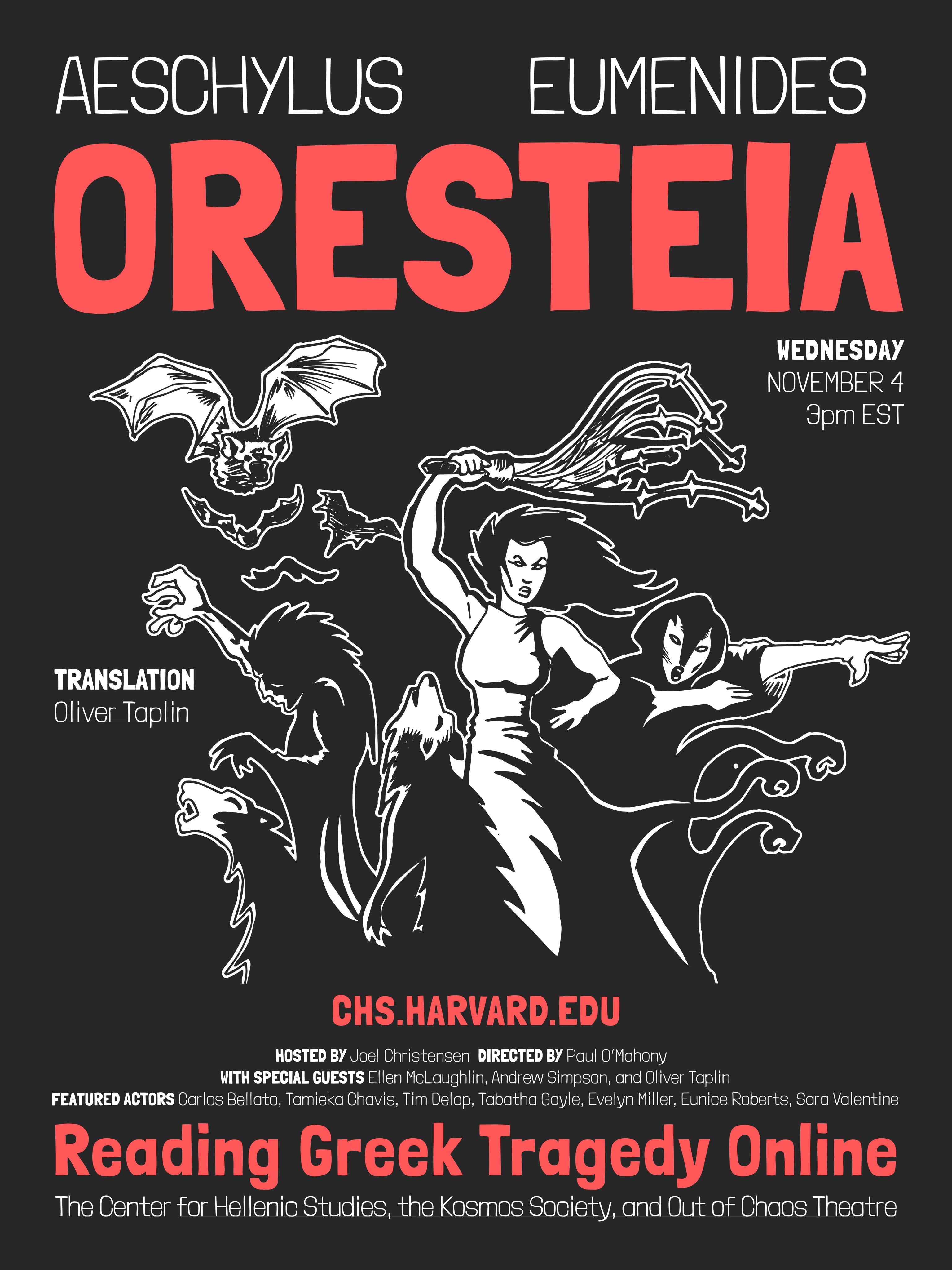
This week brings us the final play of Aeschylus’ Oresteia, the Eumenides. In it. We find a maddened, battered Orestes who fled from his brief ‘victory’ in killing his mother and Aegisthus, hounded by the earth-bound goddesses of vengeance, the Furies. At the start of this play, Orestes manages to evade them in Athens, but they too are chased by the ghost of Klytemnestra who demands vengeance for her murder.
This takes us to the final and elemental conflict of the trilogy, the face-off between justice and vengeance and the creation of trial by jury at Athens. One set of divine mandates insisted that Orestes kill his mother for her murder of his father; another set demands his suffering for killing her. How is this cycle of suffering and vengeance in any way ‘just’?
The Oresteia, like the end of the Odyssey, acknowledges that a cycle of vengeance is ultimately irresolvable and that human anger and suffering demands some other remedy. In this particular version of the tale, the solution arises at Athens, where Athena and Apollo introduce a trial by peers as a solution for the retributive strife that tears states apart.
Aeschylus, Eumenides 696-698
“I advise the citizens to revere
Neither anarchy nor despotism
And never to cast fear out of the city completely.”
Artistic Director: Paul O’Mahony (Out of Chaos Theatre) Associate Director: Liz Fisher Director of Outreach: Amy Pistone (Gonzaga University) Dramaturg: Emma Pauly Executive Producer: Lanah Koelle (Center for Hellenic Studies) Producers: Keith DeStone (Center for Hellenic Studies), Hélène Emeriaud, Janet Ozsolak, and Sarah Scott (Kosmos Society) Poster Artist: John Koelle Poster Designer: Allie Marbry (Center for Hellenic Studies)
Aeschylus, Eumenides 368-369
“Humankind’s delusions so sacred under the sky
Shrink as they melt on the earth without honor.”
October 28 Libation Bearers, Aeschylus; translation by O. Taplin
November 4 Eumenides, Aeschylus
with Ellen McLaughlin (Barnard College) and Andrew Simpson (Catholic Univeristy of America); translation by O. Taplin
November 11 Medea, Euripides
with Fiona Macintosh (University of Oxford)
Orestes Pursued by the Furies by William-Adolphe Bouguereau (1862)
Aeschylus, Eumenides 977-987
“I pray that the insatiable evil
Of civil strife
Will never burn through this state.
May the dust never drink deep the dark blood of our citizens
As it terrorizes the country
In the endless rage of murder meted out for murder.
May we have joy
In our shared view of friendship
And hate with a single focus.
This is a cure of many problems mortals have.”
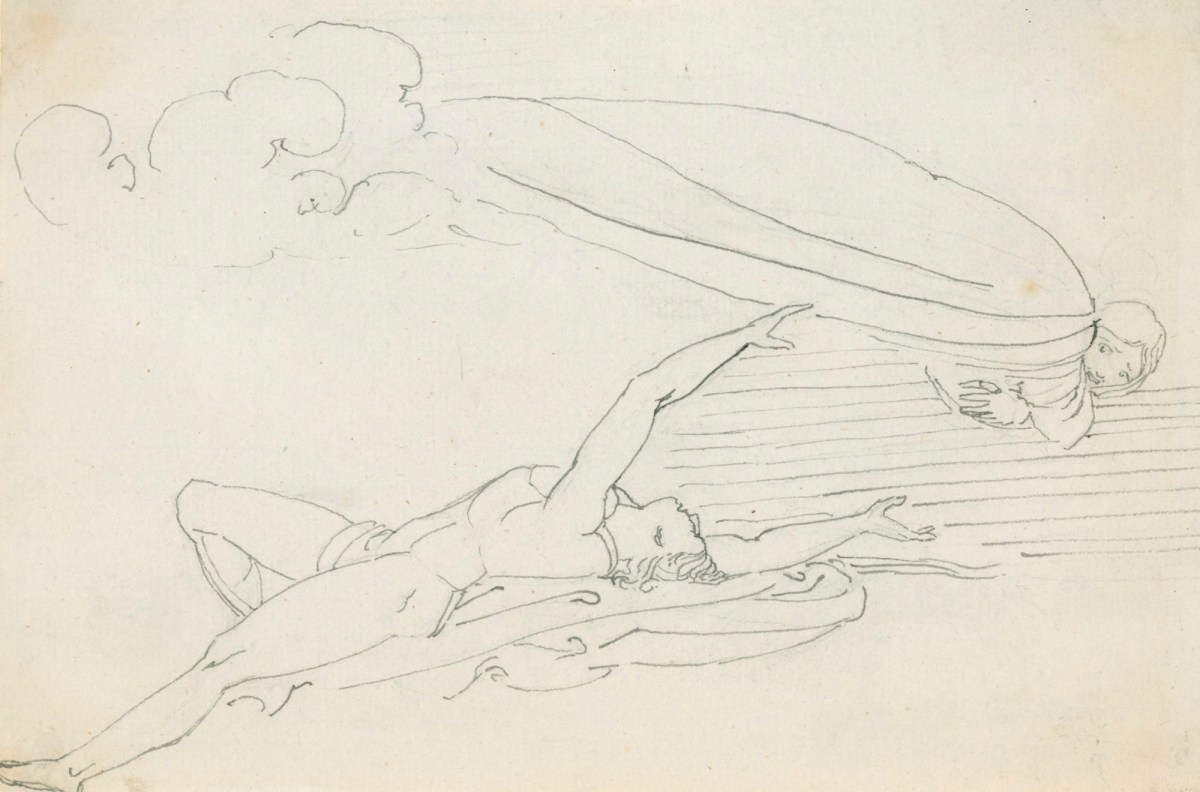
John Flaxman; The Ghost of Patroclus Appearing to Achilles; 1792-3 (c) Royal Academy of Arts
Homer, Iliad 23.65-76
And there appeared to him the ghost of poor Patroclus all in his likeness for stature, and the lovely eyes, and voice, and wore such clothing as Patroclus had worn on his body. The ghost came and stood over his head and spoke a word to him: You sleep, Achilles; you have forgotten me; but you were not careless of me when I lived, but only in death. Bury me as quickly as may be, let me pass through the gates of Hades. The souls, the images of dead men, hold me at a distance, and will not let me cross the river and mingle among them, but I wander as I am by Hades’ house of the wide gates. And I call upon you in sorrow, give me your hand; no longer shall I come back from death, once you give me my rite of burning.
Ghosts, apparitions, miracles, supernatural events, to what extent do we believe in them? And if they were to be real, how much would they differ from each other? At first we need to begin by establishing what we understand by supernatural. If we refer to occurrences that fall outside the laws of nature, then the scope of these events has immediately enlarged, considering that we do not live in nature, but in a world – a human product. Nowadays many things have gone missing from that world; people, places, events. And these disappearances, through quarantine, incarceration or simply prolonged absence, are a kind of supernatural event in reverse – a sudden dis-apparition. But the missing haven’t been abandoned, instead, they lie in a state of abeyance, without being immediately present. With the irresistible and ceaseless flow of time — paraphrasing here Anna Komnene — we begin to question their reality.
Have these things and persons in abeyance then become ghostly presences or apparitions? I like Derrida’s idea that ghosts today are but the return or persistence of elements from the past, because it instantly complicates matters around ghostliness: Since elements from the past are always around us, can we really talk about absence or ghosts? Would it be correct to identify all absences as ghostly? Not sure here what it is exactly that returns or reappears.
We need to turn to dictionaries now, but they aren’t of much help. The only antonyms of ghostly (what is the opposite of a ghost?) that I could find, were the terms ‘natural’ and ‘angelic’, both of which do little in reference to the world, so that there’s not an exact territory of coincidence between ghosts and death. A dictionary of classical literature, on the other hand, tells us that ghosts are difficult to distinguish from supernatural entities or delusions, and yet the really striking part of the definition is that while ghosts seem generally ‘powerless and ineffectual’, they are persistent. I am fascinated by this combination of both persistence and powerlessness in the ghost, because of what it has to say to us about contemporary political narratives.
An example of this persistence comes down to us from the Iliad: Without a proper burial, the ghost of Patroclus, Achilles’ companion, is condemned to wander around the house of Hades for eternity. It would be hard to overstate how important burials were for antiquity (and continue to be so for us, for no clear reason, accounting for the shock at the mass graves of Bergamo and Hart Island during the pandemic) but I don’t want this commonplace trope to distract us from the mysterious apparition. It is one of the strangest dreams in classical literature and the only ghost to appear in the Iliad: Breaking away from the pattern of Homeric dreams, which generally involve divinities that bring knowledge of the future (following a structure of apparition at night when the person has retired, speech, departure, reaction and then dawn), dead Patroclus’ apparition in book XXIII makes no real sense, and it doesn’t bring any new information or steer the narrative in any direction.
The strangeness begins earlier, when Achilles himself performs two unusual tasks one after another (18.316-317): First, he attempts to summon Patroclus back to life by the uncommon gesture of placing his hand on the chest of the dead body as if it were alive and then he greets Patroclus with the formal χαῖρέ (hail!), establishing a distance between himself and Patroclus, implying a separation between them that is hard for Achilles to grasp — is he alive or dead? This attention to detail might seem pesky but given that the repertory of epic is so limited, any deviation in patterns of speech and behavior is telling us something; an innovation is taking place. After the funeral feast, Achilles slumbers into sleep by the seashore, and Patroclus appears to him ‘all in his likeness’ (23.66) with a puzzling request to be buried as soon as possible, given that Achilles had already decided to bury him the next day.
Gregory Buchakjian, photograph of Istanbul’s Tarlabaşı neighborhood that was due to be demolished. May 2013, a few weeks before the Gezi Park demonstrations started. Courtesy of the artist.
Patroclus is dead (at the hand of Hector, who was in turn subsequently slain by Achilles — the heart of the epic) but he hasn’t entered Hades yet. He finds himself in an in-between space, a uniquely hybrid dream/underworld scene where, far from heroic convention, this meeting about memory and the past, is still possible. And yet Patroclus asks Achilles to give him his hand for the last time for he’s nevermore to return from Hades after his burial (23.75). In spite of the immense affection between them, when Achilles tries to embrace him, the shadow suddenly turns into nothingness and dissolves into air (23.99-101), ‘with a shrill cry’. This extraordinary moment of tenderness, apparently innocuous, happens at a pivotal moment in the epic, when the death of Achilles is near – this was no news. Achilles himself is too baffled, and speaks with sadness about Patroclus’ weeping and wailing (23.106), before lighting the funeral pyre, followed by the long funeral games, a series of competitions held in honor of Patroclus and that take up most of the book.
The ghost appears thrice in the book, however on the last appearance (23.221-225), there’s a heartbreaking scene: a distraught Achilles is said to call upon Patroclus’ ghost for a last time, ‘as a father mourns the bones of a son, who was married only now, and died to grieve his unhappy parents’ and ‘[Achilles] dragged himself by the fire in close lamentation’. It seems as if the span of the apparition has come to an end, yet something is about to occur that makes the brief encounter with Patroclus gain immense depth. In book XXIV, Achilles is still agonizingly mourning Patroclus and abusing Hector’s body, dragging it around his friend’s tomb – Hector’s mother Hecuba remarks that even that did not bring Patroclus back to life (24.755-57). The apparition of Patroclus in fact restored Achilles’ humanity which had been buried in his anger and pain. A moment of reckoning arrives here: now he begins to see all the desolation that his anger has caused and there’s a final encounter with mortality in which Achilles accepts Patroclus’ death and also his own.
Commentary on the Iliad is long and intricate – it is a song about war and its disastrous consequences, but also one about political foundations and origins. But I want to dwell on the neglected figure of the ghost. Homeric terminology for the ghost is complex and “Psyché” encompasses meanings as diverse as both life and departed life, and is also used indistinguishably with other terms for soul and mind. As we had earlier seen, the status of the ghost is undefinable, and therefore it stands outside of and sometimes in opposition to the order of memory that establishes a polis upon return to the homeland from the battlefield. In the world of epic, commemoration of great deeds from the past is caught between two temporal modes: Remembering the life of a hero who has already died (remembrance of Achilles from a future standpoint) and preserving that memory as something not forgotten (the lasting permanence of the past), therefore the appearance of the ghost of Patroclus breaks down here the collective recollections of victory and turns inwards, towards remembrance of the past together with Achilles but not collectively with others (23.78).
Though we speak a lot about memory-narratives in the present, collective memory is a function of the regime of history, where things and events have already consolidated into a foundation (or against foundations). Whether the permanence of the memory that founded the body politic in the first place undergoes change, the substance of the space of the polis goes back to a single source. What I want to propose here is an idea of ghosts as communities of memory, distinct from but parallel to political foundations. What if it were possible for memory to become fragmented into different filaments of remembrance of things past and future articulated around the present and stemming from different sources?
A notion of ghosts as communities of memory came from recent work by Turkish sociologists Cihan Erdal (a young scholar now imprisoned in Turkey alongside thousands of other students on bogus charges of political activities) and Derya Fırat, on ‘presentism’ and the temporality of Gezi, the popular uprising that took place in Turkey in 2013 and after which the political landscape of the country has significantly deteriorated into authoritarian rule. Erdal and Fırat question the defeatism of the Western and Turkish Left in regard to utopian moments and whether something remains from them? Has the defeat of Gezi in anyway affected our sense of temporality?
Gezi Park protests graffiti, “The solution is Gandalf, what’s up Derrida?”, Istanbul, June 2013, photograph by the author
On a close reading of Enzo Traverso’s work on the melancholy of the Left, and his assertion that utopias have become a historical form of the past, they speak about the presentism after 1989 that absorbs the past and the future through the opening up of a self-dissolving, sparse present tense, so that this present-timeism builds a thick wall between the present and the past, putting an end to the transference of experience […] particularly in the absence of an alternative model of society. Following from that, their central argument is that the Gezi Park protests attempted to establish a new radical imagination of time (moving simultaneously between past and present, memory and expectation) that disrupted the current neoliberal presentism, and that they did so by imagining utopias both past and future – as a dialogue between different moments of mourning and memory, and between different ghosts that return and persist.
A few words on presentism would help to clarify the extent to which the Iliad as a foundational narrative is able to time-travel in order to tell us something about the present: Admittedly there’s no concept of linear time in Homer, in the same way that our fractured temporality — the temporariness of life under presentist authoritarian regimes, we’ve been ejected from time — attempts to grasp the past in order to imagine other possibilities: The subject of the Iliad is time itself and the durability of memory that withstands the withering flow of this ever-present time. Achilles’ most famously referred description as κλέος ἄφθιτον (of unwithering glory) expresses this desire as an action yet to be completed (9.410-416) simultaneously in the past and future. Time might be abstract but it is also a force that produces change, and this is what presentism (in Homer as the returning cycles of nature and in our times as the capitalist eternity of markets and the internet) is attempting to erase by collapsing the future-orientation of utopia or memory into an obsolete historical form, predicated on the ends of history: This is the best of all possible worlds.
While it’s been constantly argued that memory and mourning is the way out of the amnesia of presentism (why are we so shocked about Bergamo and Hart Island but not so much about the mass graves of wars elsewhere within the same time period?), the politics of ghosts proposed by Erdal and Fırat reframes this work of memory beyond both static remembrance of the past and restoration of past utopias. Remembrance becomes here a different orientation, which created means of communication between different historical moments and social movements, preventing the present or the past from exercising authority over each other. Ghosts from the past are speaking to each other in the here-and-now, expressing not only the”no longer” that has passed, but a sense of continuity anchored in “not yet” and “would be” referred towards the future — a typology of Iliadic time.
The ghosts that we are dealing with in here are moments of upheaval, uprising and utopia that have been deeply buried in the collective imagination but that have the power to return any time – the function of latency – without destroying the fabric of time by attempting futile restorations. These ghosts are not only moments of political action, but also catalysts thereof, such as commemorations of events and memories of violence. In the context of Gezi, for example, Erdal and Fırat mention that when Taksim Square was banned for workers in 1979, the symbols of the left factions were hung on Konak Square in the city of Izmir, a gesture that was repeated in 2013 on the facade of the Atatürk Cultural Center in Istanbul. As a checkpoint in political memory, the building was subsequently demolished, and yet this doesn’t guarantee that these ghosts will not return again and again: Apparently, the trade-free shopping between ghosts continues. Within the world of the Iliad, physical objects, decaying structures — of ships and tombs, and moments lost in time provide a record of the past that continues to exert force upon the present.
The fundamental problem that Erdal and Fırat see with with the work of mourning (over utopian pasts) is that it requires a dead body and a burial, but how can something be buried if it is absent or has never been completed? For Derrida, the ghost cannot even be called a being, because it doesn’t exist – it is both present and non-existent, and therefore one cannot enter into mourning with ghosts, because ghosts never die, they always keep coming back. The recognition of the presence of the ghost in its unburied state, is also a call for practical justice and therefore, a reinscription of experience within time, rather than against it: This proposal is also a formulation of justice so that time out of joint can be rectified. It is one that will provide an exit from the present in crisis and will bring us to justice by building this new relationship with both past and future. It is a politics of ghosts that, on the one hand, aims to put an end to the violence of the present against the past, and on the other hand, it will overcome the possibility of the past and future to dominate / erode the present.
Atatürk Cultural Center, Gezi Park protests, Istanbul, June 2013, photograph by the author
In a time of global upheaval, although we are still trapped in the presentism of catastrophe and disaster which is one of the most common narratives of capitalism — the emergency, the possibility of closing the distance between the present and a horizon of expectation about the future has not been completely closed. The future is still a latent possibility that might awake again at some undefined point. Is this future coming from the past? There’s no assurance, sometimes the future arises out of itself, but the cancellation of movement inside historical planes is not a viable solution when the present alone is too fragile to hold institutions and moral reflexions. In a world replete with ghosts – paraphrasing Derrida – the supernatural is no longer an extraordinary occurrence, but the nature of all political action. Insofar as all human action remains unpredictable, in both motive and intended goal, it is always miraculous and supernatural in the sense that it is highly improbable and yet actual.
But if all worldly existence and political life is invaded by ghosts, how to distinguish then between the ghost and reality? We think that memory should be reconstructed today and considered as a radical invitation to democratize the relationship between generations in political space. Political space is always a term that brings us back to the Iliad again: This isn’t only a concept of memory, since physical spaces as the containers of memory, are replete with debris that functions as “clocks” measuring time through both deterioration and durability. The constant apparitions of the past in these spaces remind us that although encounters with ghosts are ephemeral, they can serve as markers of the short distance between no longer and not yet, as expressed in the “now” emphasis in the words of Menelaus in the Iliad, while remembering Patroclus in such a way that this now, although stemming from the present, becomes a memory for a would-be future:
Homer, Iliad 17.670-672
Now let each one of you remember poor Patroclus who was gentle, and understood how to be kindly toward all men while he lived. Now death and fate have closed in upon him.
Here the conversation about ghosts and the supernatural is also a conversation about very long spans of memory across time: While all politics is grounded in human action and all human action is supernatural, our standard liberal model of society attempts to dovetail action and do away with politics by reducing it to bureaucratic administration and the satisfaction of human needs in nature, therefore its alleged emphasis on the social and economic question. But it was at the very beginning of our tradition of politics, in the Iliad, when the ability to change the flow of time in any direction, was considered the benchmark of rising above the cycles of nature, and therefore making action and speech identical with freedom. Anthropologists David Graeber and David Weingrow speak about freedoms that were common to many early human societies in the past and that we have abandoned: The freedom to refuse orders, to move away and to create entirely new social orders or move between different ones. This ability for new beginnings is at the heart of the Iliad‘s struggle against the destructive influence of time.
Little did they know (they couldn’t), Cihan Erdal and Derya Fırat, at the time their work was published in the end of 2019, that the politics of ghosts would become a mainstay of political life only a few months later when we would temporarily lose the world, and become entirely surrounded by ghosts. But interestingly enough, they do mention at the end of their essay the songs of Victor Jara rising from the squares and balconies in the capital Santiago in Chile or the yellow vests in the streets of Paris as a part of the conversation between ghosts. Only a few days ago, a referendum in Chile overthrew the constitution from the Pinochet dictatorship, even as many other uprisings are taking place and failing elsewhere. The ghost dialogue about new beginnings continues…
‘Being here, today, is accepting to live with our ghosts, to long for them, to feed them’ said Lebanese artists Joana Hadjithomas and Khalil Joreige years ago (I know the quote is real, but I cannot locate its source, therefore it remains itself a ghost), speaking about incomplete mourning: these ghosts are present among us, and the spaces they occupy are irredeemable – a gap that cannot be closed, but they can suddenly break out of the present by throwing us back into the future, a future that can be remembered and over which it is also possible to act. In a fragment from the Myrmidons, a lost play of Aeschylus, recounting aspects of the story of Achilles and Patroclus, unknown or too obvious to the Iliad, Achilles scolds his comrade Antilochus, reversing the nature of mourning over his companion Patroclus – we are not in mourning over the missing, but over ourselves:
Scholia to Aristophanes
Antilochus, bewail me, the living, rather than him, the dead; for I have lost my all.
᾿Αντίλοχ’, ἀποίμωξόν με τοῦ τεθνηκότος τὸν ζῶντα μᾶλλον.
[Fragments in italics, from Cihan Erdal and Derya Fırat, “Toplumsal Hareketler ve Bellek İlişkisi: Yas ve Anmadan Hayaletler Siyasetine” (The Relationship Between Social Movements and Memory: From Mourning and Remembrance to the Politics of Ghosts) Birikim, December 2019, translated and paraphrased by the author]
Cihan Erdal, courtesy of Omer Ongun
On September 25, 2020, Cihan Erdal, a 32-years-old PhD researcher in the Department of Sociology and Anthropology at Carleton University in Canada, was arrested in Istanbul. The charges stem from events back in 2014, which are being used to continue persecuting members of the leftist HDP political party. Erdal and 81 others have been targeted because they are all signatories to a letter calling for the government to protect a Kurdish town under ISIS attacks. He was placed in solitary confinement in Ankara until October 23, 2020. No indictment and no hearing date has been announced yet. If convicted, he might be facing a potential life sentence. Some 2500 academics worldwide have signed a petition for his release. As an LGBT person, he is at risk of additional persecution over his sexuality. Cihan has been based in Canada since 2017 and his research is largely focused on youth-led social movements in Europe, including Turkey. Learn more about the case at https://freecihanerdal.wordpress.com/
Send letters to Cihan Erdal:
Cihan Erdal adına Sincan 2 Nolu F Tipi Yüksek Güvenlikli Kapalı Ceza İnfaz Kurumu 06930 Yenikent/Sincan-ANKARA
Acknowledgements: Gregory Buchakjian & Joana Hadjithomas in Beirut for (almost) a decade of conversations, both present and absent, about ghosts, our own and others’. Dedicated to Cihan Erdal, for your prompt liberation.
Demolition of Atatürk Cultural Center, Istanbul, May 2018, photograph by the author
Arie Amaya-Akkermans is a writer and art critic based in Istanbul. He’s also tweeting about Classics, continental philosophy, contemporary art and Turkey/Greece.
Bibliography:
Arie Amaya-Akkermans, “Revolution or Redemption? The Middle East” in Revolutions: Finished and Unfinished, from Primal to Final, ed. P. Caringella, W. Cristaudo & G. Hughes, Cambridge Scholars Publishing, 2012, pp 329-249
Hannah Arendt, “Introduction to Politics” in The Promise of Politics, Schocken Books, 2005, pp 93-200
Hannah Arendt, “What is Freedom?” in Between Past and Future, Penguin Classics, 2006, pp 142-169
Hannah Čulík-Baird, “The Fragment as Form”, UT Austin Lecture, 25th September 2020, online.
Cihan Erdal & Derya Fırat, “Toplumsal Hareketler ve Bellek İlişkisi: Yas ve Anmadan Hayaletler Siyasetine” (The Relationship Between Social Movements and Memory: From Mourning and Remembrance to the Politics of Ghosts) in Birikim, 368, December 2019, 35-43
R.K. Fischer, “The Concept of Miracle in Homer”, Antichthon, 29 (1995), pp 1-14
Lorenzo F. Garcia, Homeric Durability: Telling Time in the Iliad, Hellenic Studies Series 58, Center for Hellenic Studies, 2013, online.
George Alexander Gazis, Homer and the Poetics of Hades, Oxford University Press, 2018
David Graeber, Debt: The First 5000 Years, Melville House, 2012
Agnes Heller, A Philosophy of History in Fragments, Wiley-Blackwell, 1993
Nat Muller, “What Was Lost: Joana Hadjithomas and Khalil Joreige in conversation with Nat Muller” Ibraaz, 2012, online.
W.B. Stanford, “Ghosts and Apparitions in Homer, Aeschylus and Shakespeare” in Hermathena, No. 56 (November, 1940), pp 84-92
David Wengrow, What Makes Civilization: The Ancient Near East and the Future of the West, Oxford University Press, 2018
“When you see me you, fail to recognize me
But when you glanced at this lock of hair
Or followed along the shape of my feet,
You took flight and imagined me there!”
Today we come to the second play of the Oresteia, the Libation-Bearers, which follows the death of Agamemnon some time later with the return of his son Orestes. Motifs from this play remained well-known enough that audiences of the later Elektras by Sophocles and Euripides could be relied upon to recall its moments of recognition and the tension between the expectations placed on Euripides and his hesitation when finally facing the deed.
Along with the rest of the trilogy, the Libation-Bearers earned first prize at the City Dionysia in 458 BCE. But what was it about these plays that charmed the judges and audiences? This play certainly does not present the heroic narrative one might expect from the Homeric Odyssey, where Orestes is repeated hailed as a returning avenger and a model for Telemachus. This Orestes reunites joyously with his sister and joins her in a shared song of lament that takes up the central portion of the play. When the time to act arrives, pushed on by Apollo’s prophecies, Orestes hesitates before taking his mother’s life. And then he is cursed by the furies, pushing him into the exile resolved in the Eumenides.
The story of Agamemnon and Orestes hinges on the balance of justice and vengeance. The horrible logic of the later faces up to the demands of the former and comes up short. In the distance between the two, humankind continues to suffer.
Aeschylus, Libation-Bearers 387-394
“May I sing a song of victory
Over a slaughtered man
And a woman as she dies—
Why should I hide
The kind of plan floating in my mind?
Before my heart’s prow
A driving anger blows,
Hatred’s rage.”
Chorus – Carlos Bellato, Tamieka Chavis, and Sara Valentine
Slave – Sara Valentine
Special Guests: Anna Uhlig and Oliver Taplin
Special Director: Liz Fisher
Aeschylus, Libation-Bearers 585-95
“The earth feeds many things,
Terrible griefs of fear,
And the folds of the sea
Are full with similar monsters.
Lights burning between
Sky and earth cause harm
To creatures on wing and on foot.
You might even mention the wind-borne rage of hurricanes.
But who can speak of the arrogant
Mind of a man or the all-daring
Lusts in a woman’s thoughts,
The joined paths of mortal ruin?”
Artistic Director: Paul O’Mahony (Out of Chaos Theatre) Associate Director: Liz Fisher Director of Outreach: Amy Pistone (Gonzaga University) Dramaturg: Emma Pauly Executive Producer: Lanah Koelle (Center for Hellenic Studies) Producers: Keith DeStone (Center for Hellenic Studies), Hélène Emeriaud, Janet Ozsolak, and Sarah Scott (Kosmos Society) Poster Artist: John Koelle Poster Designer: Allie Marbry (Center for Hellenic Studies)
Aeschylus, Libation-Bearers 434-438
“You speak of complete dishonor!
She will payback the dishonoring of my father
With willing gods
With my willing hands.
When I have cut her out, may I die too.”
October 28 Libation Bearers, Aeschylus; translation by O. Taplin
November 4 Eumenides, Aeschylus
with Ellen McLaughlin (Barnard College) and Andrew Simpson (Catholic Univeristy of America); translation by O. Taplin
November 11 Medea, Euripides
with Fiona Macintosh (University of Oxford)
Pieter Lastman – De offerstrijd tussen Orestes en Pylades
Aeschylus, Libation-Bearers 548-550
“It is right—because she raised a terrible monster—
For her to die violently. Once transformed into a snake,
I kill her. That’s what this dream is telling us.”
After the death of Hektor in Iliad 22, the poem moves to Andromache who gives a remarkable speech, most of which is occupied with thoughts of their son.
Iliad 22.482-507
“And now you go under the hidden places of the earth to Hades’ home,
But you leave me in hateful grief, a widow in our home—
And your child too, still an infant, the one we bore
You and I, ill-fated, Hektor, you will not be of any use to him
Since you have died, and he won’t be to you.
For even if he should escape the Achaeans’ war of many tears,
Still there would be toil and griefs for this child afterward.
For others will deprive him of his lands.
The day that makes a child an orphan separates him from his peers.
He looks down all the time; his cheeks are covered in tears;
And the child goes in need to his father’s friends,
Asking one for a cloak and another for a tunic.
He holds out his little cup while they pity him—
He can moisten his lips but never fill his hunger.
A luckier child chases him from the feast,
Striking him with his hands and laying into him with words:
“Go away—your father doesn’t dine with us.”
And the cheerful child will return to his widowed mother,
Atsyanax, who used to eat only marrow and the rich fat
Of sheep as he sat on his father’s needs.
Then when sleep would come over him, he would stop playing
And rest on a bed in the arms of a nurse, his heart full
Of everything good on that soft bed.
But now, he would suffer much once he has lost this dear father,
Astyanax, as the Trojans call him as a nickname,
For you alone defended their bulwarks and great walls.”
I was profoundly moved by this speech for its vividness and terrible irony long before I was a parent myself. The first time I read this passage in Greek as I prepared for my PhD exams, I wept while completing it. As a parent now, I struggle even to think about reading it. The terrible irony of course is that Astyanax is actually killed by the victors before he can suffer the deprivations his mother predicts, although she does fear this fate:
Iliad 24.732–738
“You, child, will also either follow me
Where you will toil completing the wretched works
Of a cruel master or some Achaean will grab you
And throw you from the wall to your evil destruction
Because he still feels anger at Hektor killing his brother
Or father or son, since many a man of the Achaeans dined
On the endless earth under Hektor’s hands.”
In the popular tradition the one who carries out the killing of Astyanax is Odysseus, that ‘hero’ of that other epic who gets to go home to his own son and father. If the way we talk about and treat our enemies dehumanizes them—and us—what does it mean when we murder, torture, or harm children?
In the future Andromache imagines, Astyanax is marginalized even among his own people by the loss of his father–he loses his status, his friends, and his former happiness. But in a foreign land, he loses all hope of happiness–he is a slave to another if he is lucky to be alive. I have to ask myself every time I read this whether or not an orphaned child is significantly better off today.
I can’t stop thinking about some of the details that surfaced last week about the separation of children from families by the US Government at our borders and within them. This is not some new legacy of course—from slavery through the devastation of indigenous families up into the modern judicial system and its enforcement of the new (and old) “Jim Crows”, we have a powerful and inescapable legacy of separating children from families. This creates an essential cognitive dissonance. You cannot be ‘pro-family’ and tear families apart.
I know that there has been extensive prevarication about the extent and severity of these separations. I don’t want to hear more of this because it all just amounts to fragile attempts of denial and blame shifting. We are obliterating families for being unlucky, brown-skinned, poor, and on the wrong side of man-made borders. We can’t comfort ourselves that our essential goodness has changed much in a few thousand years.
“My son was crying as I put him in the seat. I did not even have a chance to try to comfort my son, because the officers slammed the door shut as soon as he was in his seat. I was cry, too. I cry even now when I think about that moment when the border officers took my son away.” pic.twitter.com/2EmdndFIKo
“Citizens, this elder pride of Argives,
I will feel not shame at revealing
my spousal love to you. In time, human fear
turns to dust. I will tell you of my own
miserable live, not something I learned from others,
all that time when this man was below the city of Troy.”
This week we turn to the first play of Aeschylus’ Oresteia, the Agamemnon. How famous is the story of Orestes and his father? So famous that it is the story Zeus contemplates at the beginning of the Homeric Odyssey as he looks down in frustration on the man who murdered Agamemnon. Atreus’ son, Agamemnon, appears in the middle of the epic (book 11) and at its end, complaining at each point bitterly about his disloyal wife, Klytemnestra, and praising the vengeance meted out by his son Orestes.
The story of the family of Agamemnon, however, extends before the Trojan War and then after until the death of Achilles’ son Neoptolemos. it starts back with Tantalos and Pelops in Asia Minor before it moves to the Peloponnese through sacrilegious meals, infanticide and fraternal war, all themes highlighted in the main cause of Klytemnestra’s rage, the killing of their daughter Iphigenia at Aulis.
If this story sounds familiar, it is because it is! In this series, we have heard variations of this tale from Sophocles and Euripides, contemplating both its beginnings and its ends. Indeed, ancient audiences would have been as familiar with the story as Zeus at the beginning of the Odyssey, shaking their heads and wondering how this version will play out.
This play begins with Agamemnon’s return home, but focuses on Klytemnestra’s anger and her power. It features some of the most challenging and memorable choral odes extant from the ancient world. It has a raving, yet lucid Kassandra. And at the core of the play, a murderous king’s bloody return home.
Aeschylus, Agamemnon 914-917
“Child of Leda, guardian of my home,
“You have spoken aptly to my absence,
Since you have gone on at length. But proper praise
Ought to be a prize won from different sources.”
Agamemnon/Aegisthus – Tim Delap
Watchman/Cassandra – Evelyn Miler
Clytemnestra – Eunice Roberts
Chorus – Carlos Bellato and Tamieka Chavis
Special Guests: Fiona Macintosh and Oliver Taplin
Special Director: Toph Marshall
Aeschylus, Agamemnon 684-696
“Whoever pronounced a name
So thoroughly true?
Wasn’t it someone we’d not see
Guiding the tongue with luck
From a foreknowledge of fate?
Who named the spear-bride,
Struggled-over woman
Helen?
For, appropriately,
That ship-killer [hele-nas], man-killer [hel-andros]
City-killer [hele-ptolis], sailed
From her fine-spun, curtains
On the breath of great Zephyr
and many-manned bands
Of shield-bearers followed
The vanished journey struck
By the oars to the banks
Of leafy Simois
Artistic Director: Paul O’Mahony (Out of Chaos Theatre) Associate Director: Liz Fisher Director of Outreach: Amy Pistone (Gonzaga University) Dramaturg: Emma Pauly Executive Producer: Lanah Koelle (Center for Hellenic Studies) Producers: Keith DeStone (Center for Hellenic Studies), Hélène Emeriaud, Janet Ozsolak, and Sarah Scott (Kosmos Society) Poster Artist: John Koelle Poster Designer: Allie Marbry (Center for Hellenic Studies)
Aristophanes, Assemblywomen 176-183
“[Zeus] puts mortals on
The journey of comprehension.
And made this the powerful law:
We learn by suffering.
Pain-recalling trouble trickles
Through the heart in sleep—
And wisdom comes just so
To the unwilling.
The gods seated on their sacred seats
Bestow a hard grace I think.”
If then in Sophocles the play is concentrated in the figures themselves, and in Euripides is to be retrieved from flashes of poetry and questions far flung and unanswered, Aeschylus makes these little dramas (the Agamemnon has 1663 lines; Lear about 2600) tremendous by stretching every phrase to the utmost, by sending them floating forth in metaphors, by bidding them rise up and stalk eyeless and majestic through the scene. To understand him it is not so necessary to understand Greek as to understand poetry. It is necessary to take that dangerous leap through the air without the support of words which Shakespeare also asks of us. For words, when opposed to such a blast of meaning, must give out, must be blown astray, and only by collecting in companies convey the meaning which each one separately is too weak to express. Connecting them in a rapid flight of the mind we know instantly and instinctively what they mean, but could not decant that meaning afresh into any other words. There is an ambiguity which is the mark of the highest poetry; we cannot know exactly what it means. Take this from the Agamemnon for instance–
ὀμμάτων δ’ ἐν ἀχηνίαις
ἔρρει πᾶσ’ ᾿Αφροδίτα.
The meaning is just on the far side of language. It is the meaning which in moments of astonishing excitement and stress we perceive in our minds without words; it is the meaning that Dostoevsky (hampered as he was by prose and as we are by translation) leads us to by some astonishing run up the scale of emotions and points at but cannot indicate; the meaning that Shakespeare succeeds in snaring.
Aeschylus thus will not give, as Sophocles gives, the very words that people might have spoken, only so arranged that they have in some mysterious way a general force, a symbolic power, nor like Euripides will he combine incongruities and thus enlarge his little space, as a small room is enlarged by mirrors in odd corners. By the bold and running use of metaphor he will amplify and give us, not the thing itself, but the reverberation and reflection which, taken into his mind, the thing has made; close enough to the original to illustrate it, remote enough to heighten, enlarge, and make splendid.
Aeschylus, Agamemnon, 37-39
“This house itself, if it found a voice,
Would be able to speak most clearly. I am talking
Willingly to those who know and forget for those who know nothing.”
“He said a lot of other nice things about women too That they don’t betray people or sue them That they don’t overthrow democracy, and many other good things too.”
This weekend in the spirit of everything horrifying and electoral, we bring you a break from the normal routine: tragedy on Wednesdays, but comedy tonight! Aristophanes’ Assemblywomen (Ekklesiazusai) was performed in 391 BCE in critique of the Athenian government. It has everything a good Old Comedy should: surprisingly ribald sex jokes and a run of flatulence and defecation humor any grown-up toddler could love.
Despite the less-than-elevated content of the play, this comedy is not for the young or the light-hearted. The basic premise–that women take over the state to run it better than the men–weaponizes misogyny to criticize the running of the state. So, Aristophanes uses the worst ridicule of women to highlight the absurdity and danger of Athenian politics. Sticks and stones may break your bones, but Aristophanes is going to crush them.
This performance will bring the majority of the play to the virtual stage with tricks, gags, and a slight softening of the play’s more hateful tendencies. Come for the fart-jokes but stay for the political resonance as we all hope desperately for something to change
2020 is starting to make me think that maybe strange women lying in ponds distributing swords may be worth a try for a more stable form of government
Praxagora – Vivien Carter First Women/Mrs Lush – Jessica Toltzis Second Women/ Mrs Generous – Tamieka Chavis Third Women/ Mrs Happy – Ursula Early Belpyrus – Paul Westwood Neighbour – Kyle Stockburger Chremes – Paul O’Mahony Maid – Noree Victoria Chorus – Lanah Koelle
Special Guest, Francisco Barrenechea
Aristophanes, Assemblywomen 173-179
“My share of this country is equal to yours. I am worn down and annoyed By how this state’s affairs are going. I watch as we always choose scoundrels As leaders. Even if one turns out good for a day Then he’s downright corrupt for another ten. Then we trust another? He makes our suffering worse.
Artistic Director: Paul O’Mahony (Out of Chaos Theatre) Associate Director: Liz Fisher Director of Outreach: Amy Pistone (Gonzaga University) Dramaturg: Emma Pauly Executive Producer: Lanah Koelle (Center for Hellenic Studies) Producers: Keith DeStone (Center for Hellenic Studies), Hélène Emeriaud, Janet Ozsolak, and Sarah Scott (Kosmos Society) Poster Artist: John Koelle Poster Designer: Allie Marbry (Center for Hellenic Studies)
Aristophanes, Assemblywomen 473-475
“There’s some ancient saying of our founding fathers: However many foolish and stupid things we plan, Everything will turn out better to our advantage anyway.”
October 21 Agamemnon, Aeschylus with Fiona Macintosh (University of Oxford); translation by O. Taplin
October 28 Libation Bearers, Aeschylus; translation by O. Taplin
November 4 Eumenides, Aeschylus with Ellen McLaughlin (Barnard College) and Andrew Simpson (Catholic Univeristy of America); translation by O. Taplin
Aristophanes, Assemblywomen 590-592
“I suggest that everyone should share everything in common And to live equally: this man won’t be rich, that one won’t be poor, No more one man farming a massive field while another has too little for a grave”
Last week, we turned to the most tragic of epics (according to Aristotle, at least), Homer’s Iliad.
This week we remain in Trojan War material but return to tragedy with the Rhesus, traditionally attributed to Euripides. This play covers the same basic events of Iliad 10 where Diomedes and Odysseus go out to spy on the Trojans at night and end up slaughtering the Thracian king Rhesus and his men to steal his horses. Euripides’ play give us a little more from both sides: we see a somewhat more monstrous Hektor, get to hear from Rhesus himself and are invited to see the slaughter as a calamity worthy of attention on its own.
In performing the play. we are less interested in whether or not it is genuinely Euripides–and its authenticity has been doubted for some time because of its contents and its style–than we are in how and why this play may have appealed to ancient audiences and what it has to tell us about the reception of Trojan War figures on the Athenian stage. We see Odysseus in many different plays, but having Hektor and his allies in a performance is a rare thing indeed. This play also invites us to think about the fixity of scenes from the Iliad we possess and the complex relationship between performative genres and audience expectations.
Euripides’ Rhesus 182
“It is right to cast your life in the dice game of fate For things that are worthy.”
“…I love to speak the truth All the time and I am never a duplicitous man. Long, long ago it would have been right for you to come And share our pain…”
“Ajax doesn’t seem to me to be any lesser than him Nor does Tydeus’ son. But that Odysseus, He is the most twisted crook, a man bold enough to be arrogant, One who has outraged this land most of all.”
Artistic Director: Paul O’Mahony (Out of Chaos Theatre) Associate Director: Liz Fisher Director of Outreach: Amy Pistone (Gonzaga University) Dramaturg: Emma Pauly Executive Producer: Lanah Koelle (Center for Hellenic Studies) Producers: Keith DeStone (Center for Hellenic Studies), Hélène Emeriaud, Janet Ozsolak, and Sarah Scott (Kosmos Society) Poster Artist: John Koelle Poster Designer: Allie Marbry (Center for Hellenic Studies)
Euripides, Rhesus 756-57
“In addition to our suffering, this has been handled With the greatest shame. This doubles the pain.”
Saturday, October 17 Assemblywomen, Aristophanes with Francisco Barrenechea (University of Maryland, College Park)
October 21 Agamemnon, Aeschylus with Fiona Macintosh (University of Oxford); translation by O. Taplin
October 28 Libation Bearers, Aeschylus; translation by O. Taplin
November 4 Eumenides, Aeschylus with Ellen McLaughlin (Barnard College) and Andrew Simpson (Catholic Univeristy of America); translation by O. Taplin
Euripides, Rhesus 938-942
“Athena, you deserve the blame for this. Odysseus and the son of Tydeus didn’t do it Don’t imagine you sneaked by me. Still, my sister Muses and I honor your city Most of all….”
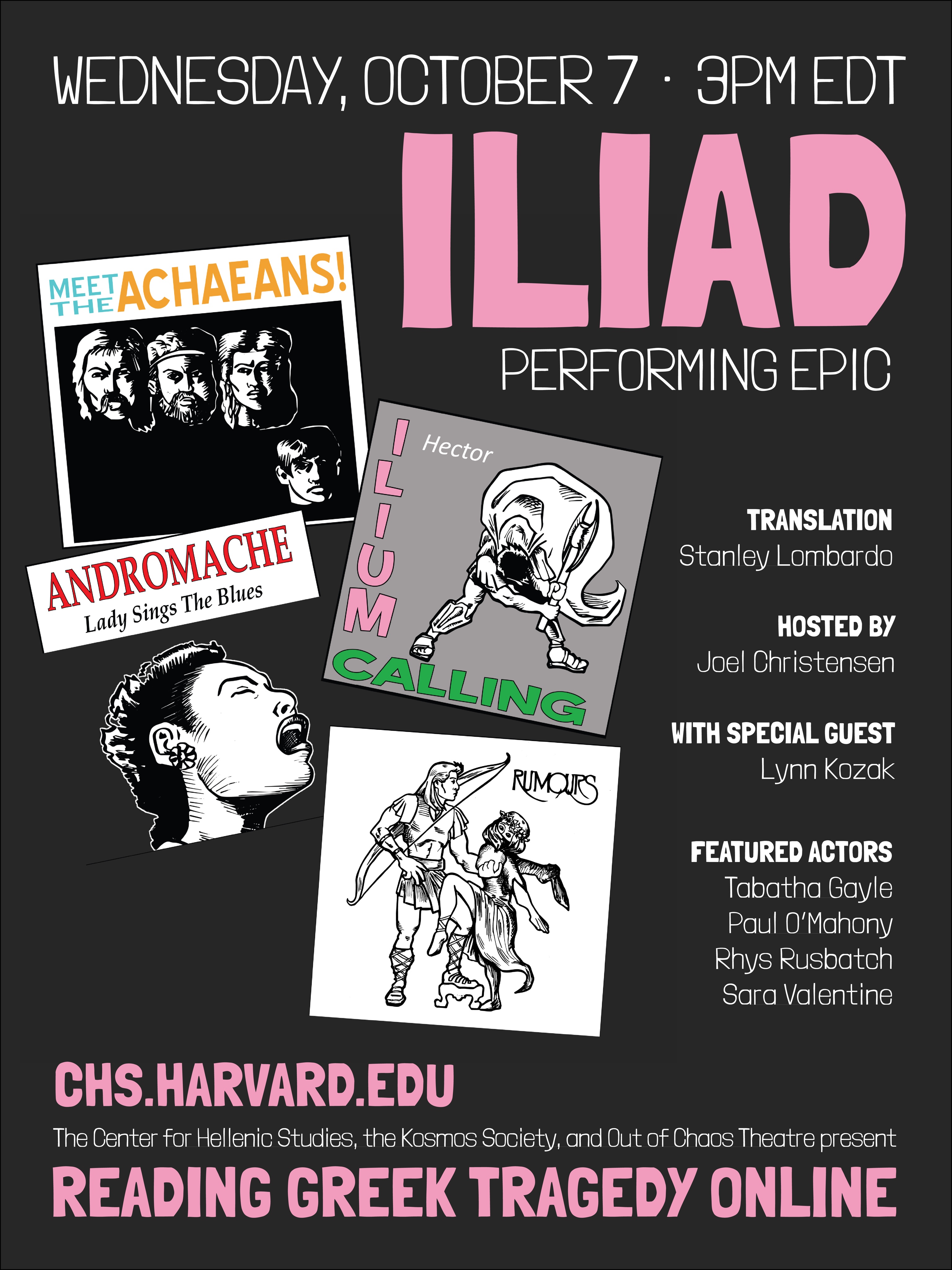
This week, we turn to the most tragic of epics (according to Aristotle, at least), Homer’s Iliad
As everyone knows, the Iliad begins with the rage of Achilles. As many of us forget, it ends not with the Trojan Horse or the death of Achilles, but instead with the burial of horse-taming Hektor. I think it is probably dangerous to ask a Homerist to tell you about the Iliad, because so often we don’t know where to start, whether it should be in thinking about its relationship with the Odyssey or about what it means to say the word “Homer”. True Story: many years ago, while patronizing a drinking establishment in Queens, my wife asked me to tell her what the Iliad was about. After about 45 minutes, she asked how much more there was to it. I had not even finished book 1 yet…
Ancient performers of the epics didn’t have these challenges because audiences grew up hearing stories about most of the events and characters they would be singing about and because the performance contexts didn’t expect them to tell the whole story. We don’t know a lot about the actual performance contexts and practices of Homeric poetry in the ancient world (see the work of José Gonzalez on rhapsodes, Casey Dué’s work on multiformity, Egbert Bakker’s From Formula to Poetics or any of Gregory Nagy’s Poetry as Performanceor Plato’s Rhapsogy and Homer’s Music), but it seems likely that the stories were performed in episodes at various occasions and at times in monumental performances at festivals. How these performances were prepared is another issue: some think they were memorized from a script, others think they were composed in performance. I tend towards the latter belief with the acknowledgement that even when something is composed in performance, there are various degress of fixity from one performance to another and one singer to another…
And, here again, I have started to trail off. Often people talk about performance of song within Homer to start us thinking about epic performance (the songs of Demodokos and Phemios in the Odyssey; Achilles singing to his lyre in the Iliad) but there’s some evidence outside the poems too. One passage comes from Plato’s Ion:
Plato, Ion 535d-e
Ion: Now this proof is super clear to me, Socrates! I’ll tell you without hiding anything: whenever I say something pitiable, my eyes fill with tears. Whenever I say something frightening, my hair stands straight up in fear and my heart leaps!
Socrates: What is this then, Ion? Should we say that a person is in their right mind when they are all dressed up in decorated finery and gold crowns at the sacrifices or the banquests and then, even though they haven’t lost anything, they are afraid still even though they stand among twenty thousand friendly people and there is no one attacking him or doing him wrong?
Ion: Well, by Zeus, not at all, Socrates, TBH.
Socrates: So you understand that you rhapsodes produce the same effects on most of your audiences?
Ion: Oh, yes I do! For I look down on them from the stage at each moment to see them crying and making terrible expressions, awestruck by what is said. I need to pay special attention to them since if I make them cry, then I get to laugh when I receive their money. But if I make them laugh, then I’ll cry over the money I’ve lost!”
Note in this passage that Plato’s Socrates assumes that Ion is faithfull performing a ‘text’ ascribed to Homer and that they both identify as salient features of the performance the context (“sacrifices” and “festivals”) the emotional affect (crying and carrying on, channeling the emotive content of the scenes) and the impact on the audience (making them cry too) all while emphasizing the material benefit accruing to a rhapsode who pleases his audiences.
When I think about Homeric performance, I think a lot about how little we know about the audiences and their responses and how crucial this was to the shape of the poems we have. I too often forget that the performers were an important part of this process in shaping the reception through their use of intonation, voice, gesture, and tune. So, in our readings from the Iliad today, I will be thinking about the parts, and not the whole, and how performance creates a new text of its own.
We’ve selected some passages today for performance from different parts of the epic to give an idea of the power of the whole and to provide a range of characters for our actors. We will get some of the debate in book 1, some family scenes in Troy, and a whole range of lament and regret. What more could one ask for a Wednesday?
“But, you great shamepot, we follow you so that you feel joy, As we collect honor for Menelaos and you, dog-face, From the Trojans—you don’t shudder at this, you don’t care.”
Selected Passages (Using the Stanley Lombardo translation with permission from Hackett)
Iliad 1 Agamemnon and Achilles’ argument
Iliad 6 Hector and Andromache
Iliad 19 Agamemnon and Achilles reconcile – may be cut for time
Iliad 22 Andromache’s first lament for Hector
Iliad 24 Achilles and Priam
Iliad 24 Priam, Hecuba, Andromache and Helen laments for Hector
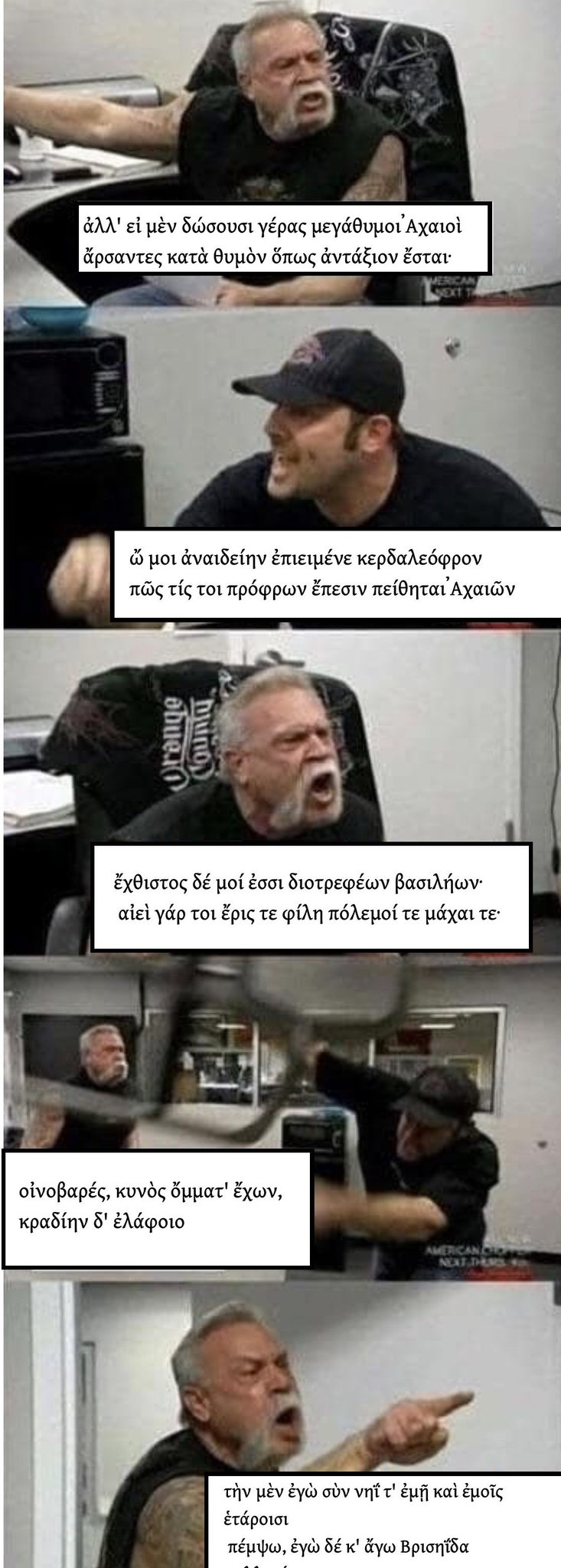
Iliad 1.224–228 [Achilles Addressing Agamemnon]
“Wine-sod! Dog-eyes! You have the heart of a deer! You never suffer to arm yourself to enter battle with the army Nor to set an ambush with the best of the Achaeans. That seems like death itself to you!”
“After a while, Diomedes good-at-the warcry, addressed them: “I will fight with you first because you are being foolish, son of Atreus, Which is right, Lord, in the assembly. So don’t get angry at all.”
Artistic Director: Paul O’Mahony (Out of Chaos Theatre) Associate Director: Liz Fisher Director of Outreach: Amy Pistone (Gonzaga University) Dramaturg: Emma Pauly Executive Producer: Lanah Koelle (Center for Hellenic Studies) Producers: Keith DeStone (Center for Hellenic Studies), Hélène Emeriaud, Janet Ozsolak, and Sarah Scott (Kosmos Society) Poster Artist: John Koelle Poster Designer: Allie Marbry (Center for Hellenic Studies)
Iliad 21.461-465
“Then lord Apollo the far-shooter answered, “Earthshaker, you would not think that I would be prudent If indeed I fought with you over mortals, Wretched men who are like the leaves now flourish Until they grow full, eat the fruit of fields, And then they diminish until they die…”
October 14 Rhesus, Euripides with Mary Ebbott (College of the Holy Cross)
Saturday, October 17 Assemblywomen, Aristophanes with Francisco Barrenechea (University of Maryland, College Park)
October 21 Agamemnon, Aeschylus with Fiona Macintosh (University of Oxford)
Iliad 24.503-6
“Achilles, respect the gods and take pity, Once you think of your own father. I am even more pitiable, Since I endure what no other mortal person ever has, To reach my hands to the lips of the man who slaughtered my child.”
“You, child, will also either follow me Where you will toil completing the wretched works Of a cruel master or some Achaean will grab you And throw you from the wall to your evil destruction Because he still feels anger at Hektor killing his brother Or father or son, since many a man of the Achaeans dined On the endless earth under Hektor’s hands.”
“After heaping up the mound [sêma] they returned. Then Once they were well gathered they shared a fine feast In the halls of the god-nourished king, Priam. Thus they were completing the burial of horse-taming Hektor.”
“So they were saying these kinds of things to one another. And a dog who was lying there raised his head and ears. It was Argos, enduring Odysseus’ dog the man himself Had raised but never used before he went to sacred Ilion. In earlier years young men used to lead him to hunt Wild goats and hares and deer. But now he was lying there, put aside in his master’s absence on a pile of manure heaped up from mules and oxen right in front of the door waiting for the slaves to take it away to fertilize Odysseus’ great dominion. There Argos the dog was lying full of ticks and fleas”
I have always had mixed feelings about this very famous passage from the Odyssey. I side in part with Plutarch who notes that Odysseus seems to shed more tears (one) for his dog than he does his wife. And I also bristle at how much empathy people seem to be able to generate for the aged hunting dog when they can muster so little for the mutilated Melanthios or the hanged enslaved women at the epic’s end.
If I have to be honest with myself, this scene does not inspire contempt in me as much as a deep sorrow. We talk much of Argos’ loyalty, but his loyalty is a mere prop to aggrandize Odysseus and increase the value of his return home. I care far less about Odysseus’ tear than I do about the neglect: Argos, abandoned by Penelope, Telemachus, and Laertes. Argos, infested with fleas and sleeping on a mound of shit.
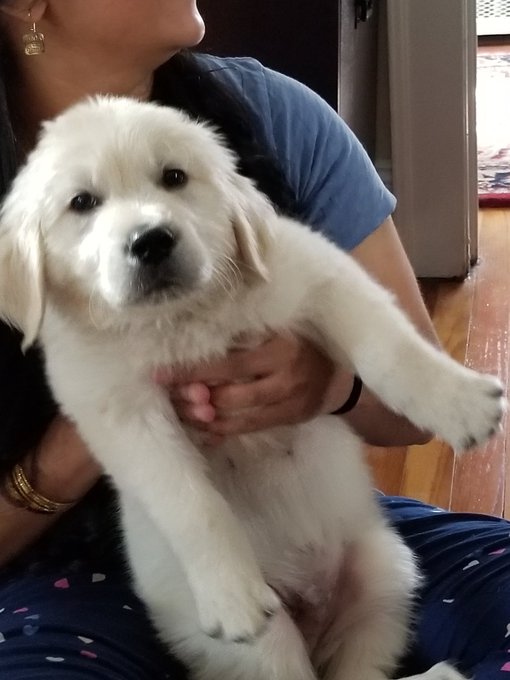
My wife wants us to get a puppy and name him Zeus. The second half of that sentence is calculating because she knows that I would enjoy nothing more than training a dog to follow commands in ancient Greek and shouting the vocative O Zeu in city parks. She also made this argument after watching me play with her sister’s dog, Apollo: down on the floor wrestling with an energetic English cream retriever of over 70 pounds, she said I looked happy.
Apollo as a puppy
I have been saying no to pets for a decade. After our daughter and son were born our first cat together, Chineh had to be put to sleep. She had been on hormone supplements for a year and was suffering from congestive heart failure three weeks after our son was born. I took her to the vet knowing it would be the last time and did not know that the Dr. would ask me to stay and hold her while he administered the drugs. I told myself that would be the last time. And I had to say that, because it was not the first by far.
Anyone who follows the twitter feed for this account knows that my promise went unfulfilled. Last year, we capitulated and got a cat from a shelter. He’s a polydactyl tuxedo cat named Mowgli. He might be the sweetest cat I have ever known. But he was so sweet that he ruined our family. There was just not enough cat to go around.
One day, I came home from some summer meetings at work and the family was huddled around a computer. The three of them (with Mowgli in hand at 10 weeks) had been watching cat videos all day. My wife informed me that we had to drive to Maine. My first thought was that someone had died (I grew up in Maine). When I asked what was wrong, she told me, “Oh, nothing, we have to go put a deposit on a cat and choose which one we want.”
I do not talk a lot about my wife in essays because she is not a social media person and values her privacy. But anyone who knows her also knows her powers. We were in a car and looking at Maine Coon Cat kittens within three hours. Three weeks later, we returned.
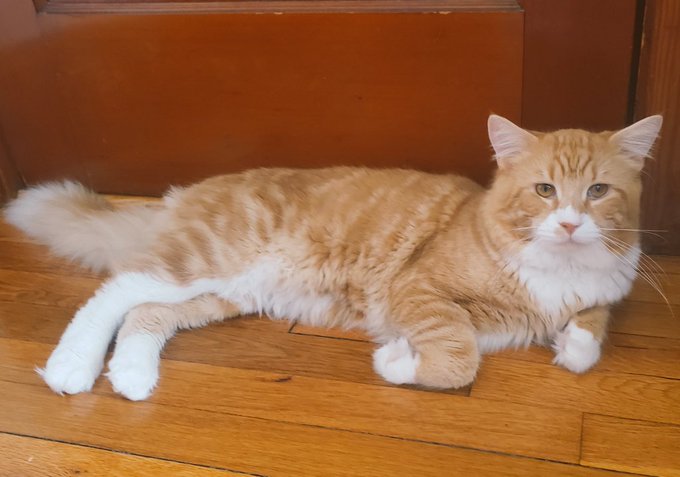
Again, anyone who follows this account on twitter knows Hermes, his attempts to escape our home, his eye infections, and his surgery. (Oh, the cat birthday parties too.) What people do not know is that when I can’t sleep at night and lay on the couch wondering what the fuck is happening to the world, Hermes comes over and starts grooming me. He licks my hair from root to end and then, if I do not start petting him, he bonks me in the cheek with his massive hairy paw.
If we get a dog, it’s Hermes’ fault. He’s, well, unleashed something that’s hard to explain.
Homer, Od. 17.301-305
“Then, indeed, [Argos] noticed that Odysseus was near And he wagged his tail and relaxed both ears, But he wasn’t able to go any closer to his master then. Odysseus saw him to the side and wiped away a tear, Keeping it secret from Eumaios….”
When I talk about the Odyssey’s crucial recognition scenes, I always forget about this one. Odysseus needs his scar to be known to Eurykleia; he needs the story of the bed to finally prove himself to Penelope; and he has to tell the story of generations of trees to calm his father’s suspicions. Argos seems to need no sign, he just knows (ὡς ἐνόησεν). All that worry about some other Odysseus coming home dissipates with a wag of the tail.
I came from one of those families that always had a dog. I do not think it was possible for my parents to conceive of a family that did not have a dog. Before I was born, that had an Irish Setter named Duchess and a St. Bernard named Sam who used to follow the kids to the school bus and ride around town to the school (it was the 1970s, the world was different). When I was born, in a rare show of unity, my grandmothers made them give Sam away because they thought he was too dangerous. I used to see him at my godfather’s farm, tied up on a heavy chain, laying a distance from the house, flies swirling around him.
One of the things that is hard for me to explain to my spouse and impossible for me to talk about to my kids is that my life with pets is not a source of happy memories. My earliest memories of Duchess are of fear. And not fear of her, but fear for her. My parents, unlike Odysseus it seems, never trained their dogs well. Duchess used to run away and return after some time. It was such a regular occurrence that once my grandfather showed up in a pickup with someone else’s Irish Setter because he thought she was ours.
Duchess used to have accidents in the house because she was never walked and she was poorly trained. Every time, my father would scream, swear (“duchess, you fucking stupid bitch” is probably the earliest profanity I ever heard), and often hit or kicked her. More than once, he opened the door to the basement and threw her down the stairs. These are some of my earliest memories of my father and they do not add up to the man my wife met nearly 20 years later. And my siblings never saw him that way either.
When Duchess was a decade old, she gave birth to a single puppy. I must have been too young for kindergarten at the time, but I remember the utter confusion this inspired in our household but I do not quite remember my parents’ response. I was enchanted with this little squealing thing, this new life in our home. I named him Mud.
Three days later, I found Mud stiff and dead in the basement. My parents tried to explain to me that Duchess was too old to take care of a puppy and that Mud wasn’t meant to be born to begin with. We buried him in our back yard not too far off from where we grew squash and green beans.
We moved a few years later. Duchess was alive when we were getting ready to sell our home. Then, she was not when we moved. I have no memory of what happened to her. My father died almost ten years ago and I never asked him about it.
Homer, Od. 17.305-310
“…then Odysseus asked him ‘Eumaios, it is a great wonder that this dog lies in the manure. His form is beautiful and I do not know clearly Whether his speed was equal to his looks, Or he was like those table dogs of certain men, Those ones their masters raise for appearances.”
When Odysseus is asking about Argos, he wants to know if he grew up to be the dog he trained him to be. Odysseus applies an epic physiognomy here he also assumes for people: beauty should translate into good deeds; beauty without action makes you a useless suitor (or Phaeacian prince). But Odysseus also taps into an ancient distinction between working animals and, well, ‘pets’. Do we keep animals close to us just for show?
Hermes is a “show” cat, for sure. He’s handsome, it’s true. Part of the reason I am so undone by Hermes is that he’s not like other cats I have been around. Where other cats are skittish, he is still. Where Mowgli and other cats I have had have rushed to the sound of cat food being opened, Hermes takes his time, eats a little and then walks away. He watches me do everything. My wife says I anthropomorphize his actual limited intelligence as contemplative. But who knows the thoughts of a quiet cat?
I did not grow up with cats. The first cat we ever had was an accident. We moved to 3 or 4 acres on the age of a large re-forested area in southern Maine (some of the land had been farmland in the late 19th century; some of it had been logged before the second World War; much had been burned in a famous fire mid-century). We had no neighbors by sight and few within a quarter mile.
One day, a small white and brown kitten was sitting, meowing at our door. Honest to goodness, I don’t know if there is anything cuter in the universe than a kitten. My mother was allergic to cats and forbade us to bring it in the house, but my sister and I took out a saucer of milk for the kitten creatively named, “Kitty”. When we returned from school, she was still there. At great urging from three children, my mother got some cat food and we fed her more.
The next day? Kitty was still there. We fed her and played with her outside, losing time the way only kids and new pets can. When we returned from school, she was still there. Later, after dinner, I went out to check on her and she was running strangely in the driveway. I caught her, and something was coming out of her rear end: a lot of something, most of her intestines. I called to my dad, who had recently returned home, and he looked at me, at the kitten and went inside.
He came out with a loaded .22, took the kitten, and walked into the woods. I have no idea how far he walked but there’s no way I wouldn’t have heard the report of the gun firing. I didn’t realize until later than Kitty had probably been hit by a car. It took me years to really think about which car that most likely was.
Homer, Od. 17.311-317
“Eumaios, my swineherd, you answered: “Yes, this is the dog of a man who died far away. If he were the way he was in looks and speed When Odysseus left him to go to Troy, You’d soon observe his great speed and valor. Nothing ever escaped him in the deep forest When he pursued. And he was clever at tracking too.
Argos has heroic qualities, even specifically Iliadic ones. Speed and valor (ταχυτῆτα καὶ ἀλκήν)? You have an Achillean dog there, sir. But he’s also smart, like Odysseus: he is preeminent at tracking (ἴχνεσι γὰρ περιῄδη) and nothing ever escaped him in the deep darks of the wood. I don’t know if this is some foreshadowing of the murder of the suitors, but if a student claimed it on a paper, I’d give it a nice big check.
I stayed home the next day from school and generally made enough of a nuisance of myself that we got a kitten I named Nina the next week. Nina was the first pet who was almost solely mine. (My sister got a cat the next year named Jackie, mainly to taunt my father whose nickname was Jack.) I tried to establish the rule that she could not go outside, and this held for a while. When she was a month home, I was dropped off by a family friend early from school at the end of our dirt road. I came home to someone breaking into our home and stealing my father’s firearms.
The man in our driveway told me my mother was inside (which I knew to be a lie) and I silently stood at the end of the driveway. I probably scared the thief more than anything, and I certainly never felt myself in danger. He got in his car and drove off. I ran inside, through the door that had been kicked in, and called 911. The dispatcher was, in retrospect understandably, quite concerned about my safety. But I told her I had to put the phone down to find my cat. She was outside and in danger.
(I found her. She was fine, that day.)
My attachment to cats at that moment was linked to our trouble with dogs. After we moved, we had a new home so of course we needed a new dog. We picked up a shepherd-retriever mix from a shelter and named her Alfie after the ever present television Alien. Alfie was pure joy for three kids living on the edge of a forest with no friends around. My strongest memory of the time is just running around that house chased by that adorable puppy.
Puppies grow up to be dogs and when they are not fixed and are let to wander around outside, they get pregnant. Alfie gave birth to a litter of puppies a year later. Neither of my parents talked about her being pregnant and when she started giving birth to puppies, I was the only one down in the basement with her. She had six puppies. Over the next few months, we found homes for four of them.
No one who hasn’t spent time with a half dozen puppies understands how exhilarating and exhausting they are. We named each puppy and trounced around in the Maine snow with them until each one left. The two who remained, stayed for good. And it did not go well with Alfie. My parents built a pen outside and a large shed and the dogs were kept there, rain, snow or otherwise. They got loose once, attacked a neighbor’s dog, and nearly ripped his leg off. Alfie kept trying to run away from her puppies.
One day, I tried to corral the three dogs in the basement. Alfie would not go down the stairs with her offspring. She turned on me and attacked, leaving a four-inch gash in my leg. I don’t think I was mad at that dog for even a second because I never thought she was mad at me. My parents called the game warden. They told us Alfie was getting a “new home”. At age 11, I knew this was not how these stories ended.
I have no memory of what happened to the other two dogs. I do know they were still around two years later when a friend from junior high came to visit. Upon seeing the dogs, chained to trees a 100 feet from the house, dirty and ragged, he asked me how we could treat animals that way. I don’t know if I answered.
Homer, Od. 17.318-323
“But now he is overcome by evil and his master has died Far away in another land. These shameless women don’t care for him. The Enslaved women, whenever their rulers are gone, Aren’t willing to do the right thing any longer. Wide-browed Zeus strips a person of half their worth Whenever slavery’s day overcomes them.”
Argos serves here, I think, to represent some of the general entropy of the household in Odysseus’ action and as part of a process of vilifying the enslaved women before their deaths. I don’t understand why Eumaios says nothing of the rest of the family. (I mean, Telemachus parades around the island with two dogs.) Perhaps his place as the “good slave” makes it impossible for him to criticize family-Odysseus. But I’ve always thought a pet, because it depends on us, is a family’s shared responsibility.
I don’t usually get to the part of my story where Alfie is put to sleep. And I don’t know if I ever mention her puppies because even though I was not yet a teenager, I feel guilt for their lives and their ends. It is harder to tell the whole story because it is long and it seems embellished. And that’s before the next part.
Our second cat Nina eventually got to go outside. We lived on a large lot and we spent all our time outside in the summers. My mother was a school teacher and now I understand that she was suffering from depression and other issues. At the time, what I knew was that in summers, she slept a lot and spent the rest of the time in her bedroom, with the only air conditioner on, and the door closed. My siblings and I did what kids did then in the summer: we watched TV, we wandered in the woods, and we tried not to bring ticks in the house.
Nina turned out to be pregnant at the beginning of one summer vacation. I don’t know if my parents ever took her to a vet and we had gotten her from someone in the southern part of our town. She gave birth to seven kittens and they were just the cutest things I had ever seen.
The problem was that that summer saw the worst plague of fleas in decades. Our cats brought them home and the infestation was so bad when you stepped on the carpet, you could see dozens of fleas jump up and start to crawl up your leg. A day or two after they were born, the kittens were covered. I would pick one up and they would drip off them like water. And Nina stopped feeding them.
I told my mother. I told my father. Eventually, they called the vet and let me speak to them. I was told to use a comb and rubbing alcohol to try to get the fleas off the kittens. I did this with each one. Multiple times. The fleas came back. Then Nina stopped caring for the litter. One by one, the kittens stopped moving.
I don’t know what was going on between my parents. My father was gone for long days and overnight trips; my mother was distant as always. Neither of them came done to the basement to see the kittens. And I didn’t even think of asking how I would know if they were really dead. Even when I was burying them in our yard, I kept thinking I could hear them meow. We never discussed it.
We had the house fumigated, but the fleas came back. And you know what else? Nina came back, pregnant at the end of the summer. This is the part of the story I shake my head at even now. She gave birth again in a house covered in fleas. The kittens each died again one by one even after I combed them clean and tried to feed them with a washcloth dipped in milk. No one called the veterinarian the second time. Neither of my parents ever talked to me about that summer. That was three decades ago. I still feel nauseous when I think about it.
Homer, Od. 17.324-328
“So he spoke and went inside the inhabited home.
He went straight among the arrogant suitors in the hall.
But then the fate of dark death overtook Argos
Right after he saw Odysseus in his twentieth year.”
Does Argos count as blessed in Solon’s words because he had a happy moment before he died? Does that one moment of relief at his master’s return make up for two decades of neglect? Will Odysseus go and get a puppy after the epic’s end?
There was another cat named Skye who lost an eye in a fight with a raccoon and like my sister’s cat Jackie just ended up wandering away one day as cats on the edge of a forest sometime do. Now I know that the cats probably fell prey to some predator or disease. But then, well, pets just kind of disappeared.
Once the last two of Alfie’s offspring were gone—wherever they went—my parents wanted another dog. This time, they went to a breeder with the plans of doing things right. We got a male chocolate lab and for reasons that are too convoluted to explain but include community theater, he was named Tevye.
We must have gotten Tevye in late spring or early summer, because by the fall he was a good-sized dog, but not yet full grown. My parents tried to keep this dog inside, closer to us, but they never put in the work to train him not to go to the bathroom in the house. He would go sometimes, my dad would explode and open the door and kick him outside. This went on until Tevye mostly whined at the door until someone let him out.
While we lived on a dirt road on one side of our property, the other side was bounded by a state road that ran north-south. There wasn’t a lot of traffic on the road and at night you could hear a car coming from a mile away. Our mailbox was a good walk from the front door to this main road. Tevye would go down there and look over the stone wall. My father would scream if he got too close.
One day, we were outside repairing the stone wall because some car had skidded off the road. As my father and I levered stones back into position, Tevye jumped over the wall and neared the road. My father started screaming and went after the dog, but I stepped in front of him and just said “no.” I pushed him back. I was in eighth grade and I was nearly the height I am now and the same weight. It was the only time in my life that I thought he would hit me and I wanted him too. But he didn’t.
On Thanksgiving, we were racing around the house trying to get everyone ready to go to my grandmother’s when there was a knock on the door. We rarely received door knocks, rarely enough in fact that my father was as likely to answer the door with a gun as he was to answer at all (he was deaf). At the door were two young men. They asked if we had a brown dog and said that one had jumped in front of their car.
They did not have a dog with them. My mother started screaming at them. My younger brother and sister started crying. I don’t know where my father went. But I was silent. I didn’t see any sense of losing it when we knew nothing. The world has more than one brown dog.
The walk from our home to the place where the dog was on the side of the road is three to five minutes, depending on your speed. Tevye was there, definitely dead, near the stone wall we had repaired. I had never handled a corpse that large before. My father hand grown up hunting, but when he took me out to learn to shoot at age six, I had no interest in the firearm or what you might do with it. Tevye was almost 50 pounds of deadweight and carrying him over that wall to a stand of pine trees felt like a lifetime.
No one else had exited the house yet. I walked the same distance back to the garage and got a shovel and then back to the stand of pine trees near the road. I started to dig near a large stone and had a large enough hole dug by the time my father came out to see what I was doing that there was no work left to be done. When I think of this now, I tremble, still confused: it was at least 20 minutes from when I left the house and started digging the hole before either of my parents came to see if their dog was really dead.
I finished the job alone. I went to three funerals that year and one of them was a cousin who died at age 16 in a car accident. I remember that fourth funeral the most, standing alone over Tevye’s shallow grave.
In similar tone to Odysseus’ dismissal of “table dogs”, Greek and Latin words for “pets” tend to emphasize their status as a luxury or adornment. In a fragment, Euripides calls a dog a “decoration [agalma] of Hekate” (Ἑκάτης ἄγαλμα φωσφόρου κύων ἔσῃ, fr. 968). Catullus’ Lesbia has a delicia; Martial’s Stella has a delicium (Ep. 1.7; cf. Seneca Apocolyntosis 13, subalbam canem in deliciis habere adsueverat). Exotic pets are signs of decadence: Theophrastus sees an obsequious person as likely to have a pet monkey (Characters 5); Plutarch records that comic poets slandered Perikles’ friend for his pet birds (Perikles 13.14). Diogenes Laertius tells of Heraclides and his pet snake (5.6, 89-90 These animals are different from foodstock and working animals: Alciphron calls his mistress’ Maltese puppy a “delight” (ἄθυρμα, Letters of Farmers 3.22) an here, as in Lucian (Assembly of the Gods, 5) and elsewhere the pet dog gets a diminutive: κυνίδιον.
In ancient literature, we see animals functioning as reflections for human characters. When Achilles’ horse Xanthus talks to him in the Iliad, he has the same color hair as his master and speaks to give a very Achillean message: you’re going to die. Alexander is paired in legend with Bucephalus, a horse who could be tamed only by the man who tamed the world. And Odysseus comes home to a loyal dog he forgot when he went to war. Bucephalus exists in narrative only to confirm Alexander’s greatness. Xanthus would speak for no other hero. Epic Argos exists only to increase Odysseus’ sense of loss and meaning.
My family got a Newfoundland puppy after Tevye’s death. I kept a cautious distance from that dog and was off to college by the time she was four years old. I never had a conversation with my father about dogs and their deaths. I know he grew up with hunting dogs and my mother grew up with barn cats and farm animals and that both of them saw animals come and go in a way I never would. When my father died, he left behind a golden retriever and a wish that any donations in his name be made to the ASPCA. I bit my tongue at the irony.
When I turned 21 my future wife got me a kitten for my birthday. In truth, I think she really wanted a pet because she had never had one, but she also said that the way I talked about animals made her want to get one. I couldn’t tell her why getting a kitten caused me so much pain because I did not want to detract at all from the joy she experienced at getting one.
Chineh—which was a bastardized version of Tamil for “small”—was a feral cat who hated everyone except for my wife and me. When we went to the shelter, she put her paw outside the cage at us and meowed and it was over. My roommates and parents called her a devil cat. When I was in graduate school, my apartment burned out in an electric fire and somehow she survived. We put several thousand dollars on a credit card and spent a month cupping her rib cages to get her to cough up the smoke. I don’t know if that caused her health problems later, but it may have.
Chineh was 11 when our daughter was born. She was already having serious hormonal problems and was already less friendly than before. But I swear she changed around the baby. As our daughter grew and started to move, she would follow the cat around, pulling her tail, abusing her at every chance. And Chineh, who had scratched and bitten dozens of people before never hurt her at all.
When I left the clinic where Chineh was put to sleep, I gave them two different cat carriers and other accessories (they specialized in cats). They were hesitant because they thought I might get another cat someday. I told them I wouldn’t.
And here we are, a decade later, with two cats and hundreds of pictures on twitter to prove that I am, as my wife declares, obsessed with Hermes. Yes, he follows me to get a treat near dawn every morning. Yes, I brush him every night so his long hair won’t get matted. During the day, though, we stick to our own business.
I didn’t want to get more pets because I didn’t want to fail them. I resisted getting them because I don’t want to feel the grief of loss again. I didn’t want to get pets because I don’t want to see the pain in my children’s eyes when they die. But, as my wife says, that’s really no way to live at all.
I am going to resist getting a puppy named Zeus. Right now, my argument is that it will upset Hermes, because I can’t get these old stories out fast enough to make sense.