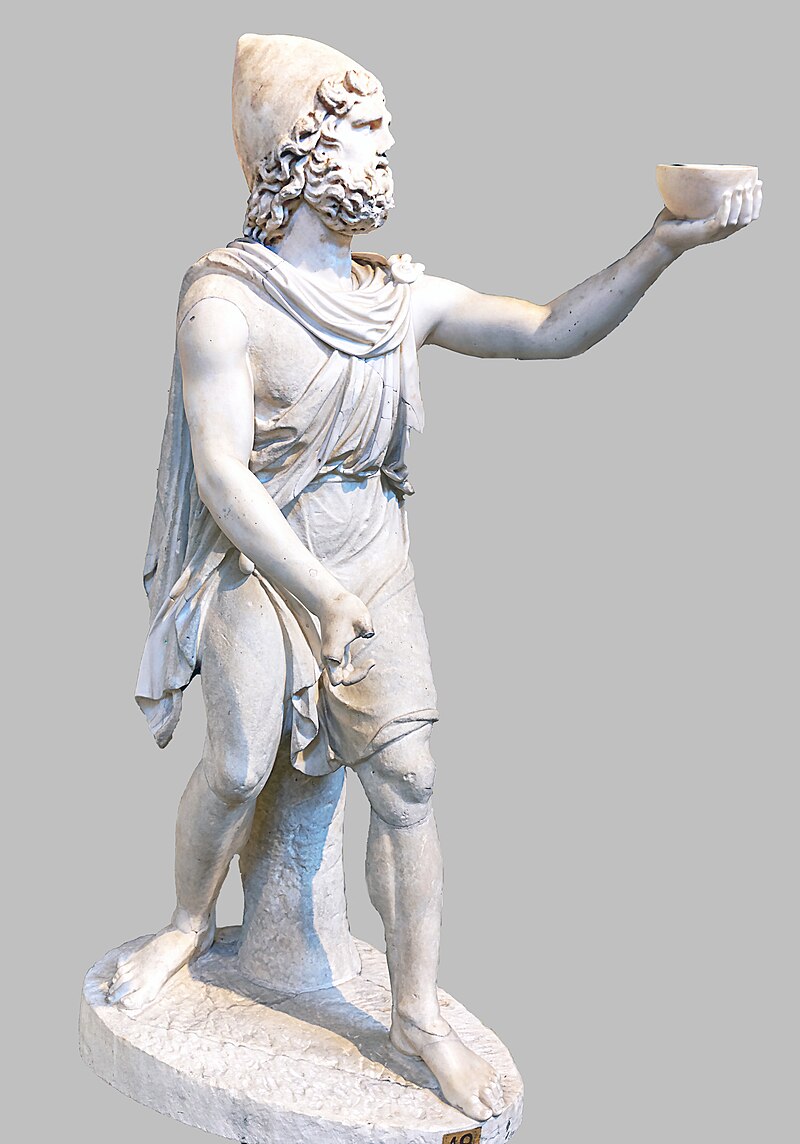
“Just as when someone hides a firebrand in black ash
On the farthest edge of the wilderness where there are no neighbors
And saves the seed of fire when there is no other way to kindle it,
Just so Odysseus covered himself in leaves. Then Athena
Poured sleep over his eyes so he might immediately rest
From his exhausting toil, once she closed his dear lashes.”
This is one of the two greatest similes in the Odyssey, in my humblest of opinions. The other occurs right before the slaughter in book 21 (407-409):
“Just as a man who knows both lyre and song
easily stretches a string on a new peg
as he attaches the twisted sheep-gut to both sides
just so, without haste, Odysseus strung the great bow”
Someone asked me to put together a post on nostos. Here’s what I got. I am happy to add anything someone else can find. This is far from exhaustive.
The Greek noun nostos (“homecoming”) is mostly reconstructed as a reflex of a verbal root neomai (“to come or go”) but its semantic range drifts to include ideas of salvation and rescue.
From Beekes’ Etymological Dictionary of Ancient Greek (2010)
In early Greek poetry, nostos is a song that is about homecoming. On this, see Nagy 1999 [1997], 97; Murnaghan 2002, 147. Douglas Frame (1978) argues that it also means “return to light and life” whereas Anna Bonifazi adds “salvation not death”. For more on the nostoi as a tradition, see the discussion and bibliography in Barker and Christensen 2015. Gregory Nagy surveys the meaning of the term nostos in the Odyssey as return and a song of homecoming in his Ancient Greek Hero in 24 Hours.
In later Greek, the term retained much of this meaning but, as I will show below, it can also mean “sweetness”. The thematic and proverbial power of the poetic tradition seems to have kept this specialized meaning as primary as the language developed.
From E.A. Sophocles “Dictionary of Byzantine Greek”
Our English word nostalgia comes from a post-classical Latin compound which has deep resonance with Greek epic, especially Odysseus. Odysseus has thematic associations with algea (neuter plural for algos, “grief, pain”). Our modern meaning of “acute longing for familiar surroundings” or “sentimental longing for a period of the past (OED online)” may draw on ancient poetic associations. A nostos is a return to the home, which is symbolically a return to the past. Ultimately, it is partly a futile wish because neither home nor person (neither the past, nor the rememberer) remain the same.
Nostalgia was originally coined by Johannes Hofer in 1688 for a pathological mental disorder, a type of mania that involved longing for the past. Some modern psychological studies still examine the phenomenon. It has been described as both parafunctional in undermining a sense of well-being and rootedness in the future (Verplanken 2012) and as a useful resource of memory which can help reinforce identity against existential threats (Routledge et al 2012 and Sedikedis and Wildschut 2016).
The ancient etymological dictionaries pretty much provide the same information as the Byzantine Suda:
Suda, Nu 500
“Nostos: The return to home. From the sweetness of a homeland. Or it comes from the giving of flavor. But also “the poets who sang the songs of Return follow Homer to the extent they are capable. It seems that not only one poet composed and wrote the homecoming of the Achaeans, but some others did too.
“Homecoming: in regular use it is “sweetness”, applied to edibles. This comes from the [sweetness] of returning and coming back again home. From the sweetness of your homeland, for nothing is sweeter than your fatherland, according to Homer. From nostos in customary use we also have nostimon, which can mean “pleasant”, “sweet”. And there is a certain god, Eunostos, a divinity of the mill. The poetic term nostos comes from neô [to go], in, for example “now I am not going home.” This means “I do not return” [epanerkhomai]. There is also the form nostô, which provides the compounds palinostô, and aponostô.”
Barker, Elton T. E. and Christensen, Joel P. 2015. “Odysseus’s Nostos and the Odyssey’s Nostoi,” in G. Scafoglio, Studies on the Epic Cycle. Rome. 85–110.
Bonifazi, A. 2009. “Inquiring into nostos and its cognates.” American Journal of Philology 130: 481–510.
Routledge, Clay, Wildschut Tim, Sedikides, Constantine, Juhl, Jacob, , and Arndt, Jamie. 2012”The power of the past: Nostalgia as a meaning-making resource.” Memory, 1-9.
Sedikides, Constantine and Wildschut, Tim. 2016. ”Nostalgia: A Bittersweet Emotion that Confers Psychological Health Benefits.” The Wiley Handbook of Positive Clinical Psychology, 126–136.
Verplanken, Bas. 2012. “When bittersweet turns sour: Adverse effects of nostalgia on habitual worriers.” European Journal of Social Psychology, 42, 285–289.
Students often complain about the lack of verisimilitude in the heroic diet–even though the Odyssey mentions that Odysseus’ companions fish and hunt birds before they kill the cattle in Thrinacia, students find something odd about a diet of meat, bread and wine.
Apparently ancient comic poets did too–and they were concerned about the reality of heroic sexual habits as well. Obviously, as the beginning of book 1 of the Iliad makes clear, eligible ladies were not in excess supply.
[Warning: this next passage is a little, well, explicit] Athenaeus, Deipnosophists 1.46
“Sarpedon makes it clear that they ate fish when he says that being captured is similar to hunting with a fishing net. In the comic charm, Eubolos also says jokingly:
Where dies Homer say that any of the Achaeans Ate fish? They only ever roast meat—he never has Anyone of them boil it at all! And not a one of them sees a single prostitute— They were stroking themselves for ten years! They knew a bitter expedition, those men who After taking a single city went back home With assholes much wider than the city they captured.
The heroes also didn’t allow freedom to the birds in the air, but they set snares and nets for thrushes and doves. They practices for bird hunting when they tied the dove to the mast of the ship and shot arrows at it, as is clear from the Funeral Games. But Homer leaves out their consumption of vegetables, fish and birds because of gluttony and because cooking is inappropriate, he judged it inferior to heroic and godly deeds.”
In the Odyssey Telemachus goes from Ithaka to Sparta (via Pylos) and back. When he travels in both directions, he makes a stop for the night in a scene that I think most of us often forget:
Od. 15.185-188 (=3.486-490)
“All day long they shook the yoke around their necks.
The sun set and the wide ways were shadowed.
They arrived at Phêrai, the home of Diokles,
The son of Ortilokhos, the child whom Alpheios fathered.
There they spent the night and he gave them guest-gifts.”
Though he stops at this town twice, we get very little information about it from the epic itself. The scholia do provide some information:
Scholia HQ Ad Od. 15.186-193:
“Phêrai: the name of a town in Laconia. The journey from Sparta to Phêrai is one day; and it is nearly another day from Phêrai to Pylos… This is the same night that Odysseus sleeps at Eumaios’ place.”
Most interesting for me here is the almost throw-away line from the scholiast that this night spent in Phêrai is the same night during which Odysseus is entertained by Eumaios. Although some scholars entertain this seriously (e.g. Olson 1995, 91ff) a more standard take is presented by De Jong in her Narratological Commentary… (2001, 588):
If we count the days from Odysseus’ return to Ithaca (when Athena leaves him to go find Telemachus (13.439-440: ἡ μὲν ἔπειτα / ἐς Λακεδαίμονα δῖαν ἔβη μετὰ παῖδ’ ᾿Οδυσῆος.), we get a slightly different timeline for the second half of the Odyssey:
Day 1
14: Odysseus goes to Eumaios, they sleep (14.523)
15: Telemachus leaves Sparta, sleeps at Diokles’ house (Simultaneous action shown in parallel)
Day 2
15.301-494: Eumaios and Odysseus dine again and talk through most of the night
15: Telemachus bypasses Pylos for his ship,(15.296-300) (Simultaneous action shown in parallel)
Day 3
15.495-500: Telemachus arrives arrives in Ithaca and goes to Eumaios’ home (16); the suitors return from their ambush; Eumaios, Telemachus and Odysseus sleep (16)
Day 4
17: Telemachus and Odysseus go to their home separately; the suitors go home to sleep (18.427-428); Penelope sleeps (19.600-604); Odysseus sleeps (20.54-55)
Day 5
20.91: Dawn comes and the suitors return; 21: The Bow; 22: Mnesterophonia; 23.342-43: They sleep
Day 6
23.345-349 Dawn comes, Odysseus wakes and goes to see his father; the second Nekyuia; Testing of Laertes; Ithacan Assembly; Final showdown
Of course, thanks to a thing called “Zielinski’s Law” (see De Jong 2001, 590 for a bibliography and Cook 2009, 148 for a brief discussion) Homerists tend not to believe that Homeric narrative shows simultaneous actions…
Who is Diokles? Why do we care if the end of the Odyssey takes 6 or 7 days? Tune in next week….
“Tell me of the father and son I left behind,
does my geras still belong to them or does some other man
already have it because they think I will not come home?”
“… Eurymakhos, the shining son of sharp-minded Polyboios,
whom the Ithakans now look upon the way they would a god.
He is by far the best man remaining and the best
to marry my mother and receive my father’s geras.”
“Then Antinoos, the son of Eupeithes, answered him,
“Telemachus, the gods themselves have taught you
to be a big speaker and to address us boldly. May Zeus never make you king in sea-girt Ithaca which is your inheritance by birth.”
“Antinoos, even if you are annoyed at whatever I say,
I would still pray to obtain this should Zeus grant it.
Do you really think that this is the worst thing among people? To be king is not at all bad. A king’s house grows rich quickly
and he is more honored himself. But, certainly, there are other kings of the Achaeans, too, many on sea-girt Ithaka, young and old,
who might have this right, since shining Odysseus is dead.
But I will be master of my household and my servants,
the ones shining Odysseus obtained for me.”
Elton Barker. Entering the Agôn: Dissent and Authority in Homer, Historiography and Tragedy. Oxford, 2009.
Colleen Chaston. “Three Models of Authority in the “Odyssey”.” CW 96 (2002) 3-19.
J. Halverson. “The Succession Issue in the Odyssey.” Greece and Rome 33 (1986) 119–28.
Johannes Haubold. Homer’s People: Epic Poetry and Social Formation. Cambridge: 2000.
Daniel Silvermintz. “Unravelling the Shroud for Laertes and Weaving the Fabric of the City: Kingship and Politics in Homer’s Odyssey.” Polis 21 (2004) 26-41.
“He was like someone speaking many lies similar to the truth.”
ἴσκε ψεύδεα πολλὰ λέγων ἐτύμοισιν ὁμοῖα·
Homer, Odyssey 15.398–401
“Let us take pleasure in calling to mind each other’s terrible pains while we drink and dine in my home. For someone may even find pleasure among pains when they have suffered many and gone through much.”
Now that we have finished all of the extant Greek tragedies, we are turning to a truly epic day: 24 hours of performances of the Odyssey around the world. We will start at 4 pm EST (9 PM UK) today (December 8th) with book 1 and each book will be performed by a different group around the world, culminating in a dramatic reading of book 24 at our usual time, 3 pm EST on Wednesday. December 9th. Check out the list of participants.
We know less about the performance of Homeric epic than we’d like to. The evidence of singers in the poems and references in works like Plato’s Ion imply that episodes of each epic were performed independently. Similar evidence supports the idea of competitive, monumental performances of the Iliad and the Odyssey at festivals like the Panathenaia. While good evidence supports a performance of the poems in a festival contest with rhapsodes working in sequence, many have also argued for a three-part performance of the Iliad, with breaks happening at thematically significant moments.
Whatever the context and length, the most salient thing of Homeric epic in performance was the presence of the audience, of people enjoying these narratives together. We can’t gather for a symposium or crowd into an amphitheater for a festival, but even remotely we can share the same words at the same time. So, for one day we invite you to escape your isolation into a worldwide community, taking the Odyssey on a global tour.
Homer, Odyssey 6.205-210
“We live at a great distance from others amid the much-sounding sea, Far away, and no other mortals visit us. But this man who has wandered here, who is so ill-starred, It is right to care for him now. For all are from Zeus, The strangers and the beggars, and our gift is small but dear to them. Come, handmaidens, give the stranger food and drink; Bathe him in the river, where there is shelter from the wind.”
“So she spoke, and his longing for mourning swelled within him— He wept holding the wife fit to his heart, a woman who knew careful thoughts.
As when the land appears welcome to men as the swim Whose well-made ship Poseidon has dashed apart on the sea, As it is driven by the wind and a striking wave. Then few men flee from the grey sea to the shore As they swim and the bodies are covered with brine on their skin, They happily climb on the shore, escaping evil.
So welcome a sight was her husband to her as she looked upon him And she would not pull her white arms away from his neck.”
“Just as a man who knows both lyre and song easily stretches a string on a new peg as he attaches the twisted sheep-gut to both sides just so, without haste, Odysseus strung the great bow”
Artistic Director: Paul O’Mahony (Out of Chaos Theatre) Director of Outreach: Amy Pistone (Gonzaga University) Dramaturg: Emma Pauly Executive Producer: Lanah Koelle (Center for Hellenic Studies); help from Madeleine Cahn
Producers: Keith DeStone (Center for Hellenic Studies), Hélène Emeriaud, Janet Ozsolak, and Sarah Scott (Kosmos Society) Poster Artist: John Koelle Poster Designer: Allie Marbry (Center for Hellenic Studies)
Odyssey 5.488-493
“Just as when someone hides a firebrand in black ash On the farthest edge of the wilderness where there are no neighbors And saves the seed of fire when there is no other way to kindle it, Just so Odysseus covered himself in leaves. Then Athena Poured sleep over his eyes so he might immediately rest From his exhausting toil, once she closed his dear lashes.”
December 9 Performing Epic: The Odyssey with Suzanne Lye (University of North Carolina at Chapel Hill), Leonard Muellner (Brandeis University), Sheila Murnaghan (University of Pennsylvania), and Greg Nagy (Harvard University); translation by Stanley Lombardo, courtesy of Hackett Publishing Company
December 16 Cyclops, Euripides with Carl Shaw (New College of Florida)
I will speak to you an obvious sign [sêma] and it will not escape you. Whenever some other traveler meets you and asks Why you have a winnowing fan on your fine shoulder, At that very point drive the well-shaped oar into the ground
In the following passage Kassandra prophesies Odysseus’ travails in returning home. Although she seems to refer to a few events not in our Odyssey (fast rocks, talking meat), what I find interesting is the possible poetic engagement with Kassandra’s presentation in the Odyssey where she is not mentioned as the cause of Athena’s anger or marked as a prophet.
Euripides, Trojan Women 424–447
“Really, a clever servant. Why do heralds have
the name they have, when one hatred is common to people:
the servants of tyrants and their regimes?
You say that my mother will arrive at
Odysseus’ home? Where then are Apollo’s words
which say—when I have translated them—
that she will die here? I will not insult her with the rest.
The wretched man, he doesn’t know what suffering awaits him—
how even these Phrygian horrors of mine will seem
golden to him. For ten years after sailing out added to ten
spent here he will finally arrive at his fatherland alone
< >
where the swiftest rocks [make] the passage narrow,
and dreadful Charybdis, near the man-eating, cliff-walking [Skyla],
The Kyklops, and the Ligurian, swine-witch
Kirkê, and shipwrecks over the salted-sea,
lusts for lotus, and the sacred cattle of Helios,
whose flesh will sing in human voice one day
a bitter song for Odysseus—I will cut this short:
he will go into Hades still alive and though feeling the water’s flow
he will come home and find countless evils at home.
But why do I enumerate the toils of Odysseus?
Take me right away, let me marry a bridegroom for Hades’ home.
You are evil and you will be evilly buried at night, not at day
Captain of the Danaid women, believing you are doing something good.”
Kassandra is most famous in ancient art and myth for the sexual violence she suffers at Oilean Ajax’s hands. But when there is an opportunity to refer to this, the Odyssey avoids it. Instead, it creates a new reason for Ajax to suffer:
After over 35 episodes, we return this week to Thebes with Sophocles’ Oedipus at Colonus. Although this play was written near the end of Sophocles’ life, it takes place between the events of his earlier Antigone and Oedipus Tyrannos. Often people casually assume that these three plays are part of the same trilogy, when in fact they were written in very different periods: Antigone appeared 10 years before the Peloponnesian War (441 BCE) as Pericles became the pre-eminent Athenian politician while Tyrannos was performed after the onset of the war and, likely, at the beginning of the famous plague. Colonus comes nearly a generation later. While scholars debate its exact performance and composition dates, it seems likely that it was one of the final plays Sophocles wrote before his death in 406/5 and that his son produced the play after the fall of Athens (perhaps as late as 401 BCE).
There is a belatedness to this play, an air of revision and reconsideration as we find Oedipus reflecting on his actions and the limits of his agency. It part, like many Athenian plays, this tragedy is about the reception of the mythical past. Its themes, moreover, also respond to contemporary (and modern) concerns from the crisis of immigration and exile to the very notion of what constitutes a community in times of struggle and civil strife. Within this, however, there remains the essential Oedipal question about identity and knowledge. How do we know who we are and understand our place in the world? What is our responsibility to our community? How do we define our community? And, perhaps most important for Oedipus, Athens, and our world today: how do we stay who we are when everything falls apart?
Sophocles, Oedipus at Colonus 258-259
“What use is a good reputation? What good is Fame flowing off to no end?”
“….for you do not fear My name or my actions, since you know That I suffered the actions instead of doing them, If you must speak of what my mother and father did— These are the reasons you fear me. I know this well. How could I be evil in nature When I acted after being hurt so that even if I understood what I was doing, I could not have been bad? I got to where I did understanding nothing, But I was ruined by those who understood what was happening.”
“Would you say that the city agreed properly then To give me the one gift I wanted? No, not at all, when on the day itself when My rage was burning, and it was my sweetest wish To die by stoning—well, No one was trying to help me with that desire.”
Chorus – Petra McGregor, Jesse McLaughlin, Vincent Agnello
Special Guests: Laura Slatkin
Sophocles, Oedipus at Colonus 562-568
“I know that I was raised as an exile, Like you, and as man in exile I toiled In the face of the greatest risks to my life– That’s why I would never turn away an exile like you are now, since I know I am only a man And I have no greater share of tomorrow than you.”
Artistic Director: Paul O’Mahony (Out of Chaos Theatre) Associate Director: Liz Fisher Director of Outreach: Amy Pistone (Gonzaga University) Dramaturg: Emma Pauly Executive Producer: Lanah Koelle (Center for Hellenic Studies) Producers: Keith DeStone (Center for Hellenic Studies), Hélène Emeriaud, Janet Ozsolak, and Sarah Scott (Kosmos Society) Poster Artist: John Koelle Poster Designer: Allie Marbry (Center for Hellenic Studies)
Sophocles, Oedipus at Colonus 1211-1223
“Whoever longs for a greater portion Of living beyond what is enough Will seem clearly to me To be guarding foolishness. Since the long days set out Many things closer to pain And you can’t see where pleasure is, Whenever someone stumbles into more Than is needed. But as an ally equal to all, Hades is a revelation Without a song, a dance, or a wedding, That fate of death at the end.
Tuesday, December 8 – Wednesday, December 9Odyssey ‘round the world – a special 24-hour event featuring performances of every rhapsody of the Odyssey recorded by students, faculty, and actors around the world. View the schedule.
December 9 Performing Epic: The Odyssey with Suzanne Lye (University of North Carolina at Chapel Hill), Leonard Muellner (Brandeis University), Sheila Murnaghan (University of Pennsylvania), and Greg Nagy (Harvard University); translation by Stanley Lombardo, courtesy of Hackett Publishing Company
December 16 Cyclops, Euripides with Carl Shaw (New College of Florida)
December23 Series Finale: Frogs, Aristophanes
Sophocles, Oedipus at Colonus 607-615
“Most dear son of Aegeus, only the gods don’t age Or ever die, but that wrestler time Eventually wears everything else out. The earth’s strength wanes, the body’s strength fades, Trust dies and distrust waxes stronger, Breath never lands the same among friends Nor between cities who were once allied. Some things that are pleasing now turn bitter In later time, but then friendship comes again in turn.”
“I am nothing now, apart. But often
I have examined the nature of women like this,
How we are nothing. As girls we live the sweetest life
of all human beings, I think, in our father’s house.
But ignorance nurses children always with pleasure.
When we come with full wits to adolescence,
We are sent out and made ready for sale,
Away from our paternal gods and our parents,
Some sent to foreign husbands, some sent to barbarians;
Some are sold to unhappy homes, some are wed to horrors.
And then, once a single evening has joined us,
We need to praise it and think that this is living well.”
As HANNAH ČULÍK-BAIRD explores in a recent essay, what we call ‘fragments’ come from either a process of destruction or from selection and preservation in other ancient texts. We have under 40 ancient tragedies in their entirety, but we have fragments and titles for many more. The numbers of what we don’t have can be startling; what I find fascinating is how what we do have shapes our perception of what might have been.
Seven plays for Aeschylus; Seven for Sophocles; three times and more that number for Euripides. These selections are not the product of accidental survival but instead creations of choice and taste. In the same way, the fragments we have of their plays and other lost authors exists because they were useful as proof in a rhetorical exercise, as demonstration of culture and erudition, as illustration of some story or style that was lost.
In truth, even our whole text our fragments, as we have explored in this series, because they are transcripts of performances, mere written records of songs and dances communicating through audience and performers messages about their history, their futures, and the worlds they experienced together. In a way, then, exploring the conditions and characters of other fragments is a metonym for what we do with ancient texts all the time: we reconstruct, reconstrue, and try to make sense of their place among changing worlds.
Today we bring together some longer fragments of Greek plays with some later texts, to see what happens and what doesn’t and what we need to provide to make them whole.
Euripides, Stheneboia Fr. 661-662
“There is no man who is lucky in all things.
Either a man born noble has no livelihood
Or the baseborn ploughs fertile fields.
And many who boast of their wealth or birth
Are shamed by a foolish woman in their homes.”
“Is there anyone who thinks there are gods in heaven?
There are not. There are not, for any man who wishes
Not to be a fool and trust some ancient story.
Look at it yourselves, don’t make up your mind
Because of my words. I think that tyranny
Kills so many men and steals their possessions
And that men break their oaths by sacking cities.
But the men who do such things are more fortunate
Than those who live each die piously, at peace.
I know that small cities honor the gods,
Cities that obey stronger more impious men
Because they are overpowered by the strength of their arms.”
“…with his current fortune
He announces for all mortals a clear thing to learn,
Do not envy someone who seems to be lucky
Before you see them die. For each day is its own fortune.”
Artistic Director: Paul O’Mahony (Out of Chaos Theatre) Associate Director: Liz Fisher Director of Outreach: Amy Pistone (Gonzaga University) Dramaturg: Emma Pauly Executive Producer: Lanah Koelle (Center for Hellenic Studies) Producers: Keith DeStone (Center for Hellenic Studies), Hélène Emeriaud, Janet Ozsolak, and Sarah Scott (Kosmos Society) Poster Artist: John Koelle Poster Designer: Allie Marbry (Center for Hellenic Studies)
Euripides, Fr. 462
“I both know and have experienced the hard way
that all people are the friends of men who have.
No one slinks about where there is no food,
But they go where there is wealth and a gathering.
To be ‘well-born’ is also the property of the rich;
But the poor man does well if he dies.”
December 2 Oedipus at Colonus, Sophocles – 3:30pm EST
with Laura Slatkin (New York University)
Tuesday, December 8 – Wednesday, December 9Odyssey ‘round the world – a special 24-hour event featuring performances of every rhapsody of the Odyssey recorded by students, faculty, and actors around the world. View the schedule.
December 9 Performing Epic: The Odyssey
with Suzanne Lye (University of North Carolina at Chapel Hill), Leonard Mullener (Brandeis University), Sheila Murnaghan (University of Pennsylvania), and Greg Nagy (Harvard University); translation by Stanley Lombardo, coutesy of Hackett Publishing Company
December 16 Cyclops, Euripides
with Carl Shaw (New College of Florida)
December23 Series Finale: Frogs, Aristophanes
Euripides, fr. 580
“Agamemnon, human beings have every kind
Of luck—but it comes together in this one thing.
Everyone—both those who love art and those
Who live without it toil over money
And whoever has the most is the wisest.”
Euripides’ Heracleidae, the “Children of Herakles”, was performed around 430 BCE, just as the Athenians were beginning their 3 decade war against the Spartans. It may not be Euripides’ most famous play, but it has just about everything you’d ask for in a tragedy: theme of Xenia, suppliancy, noble bloodlines, battle, human sacrifice, gender, a war scene described in a messenger speech, revenge.
Like any good tragedy, it focuses on the choices human beings make outside of their fate and divine meddling. But its end is troubling, perhaps reflecting the world outside of the play, where violence is far from distant and death for many is certain. For while this is the year that Athens repels a Spartan invasion and attacks the Peloponnese, it is also the first year of the famous plague. This play, so focused on the descendants of Herakles and the end of feuds, seems so precariously set at the beginnings of things.
Euripides, Heracleidae 427-430
“Children, we are like sailors who have fled
A savage storm’s blows to touch the land
With their hand only to be pounded back
From the shore to the sea by the winds again.”
Kopreus/Servant – Aldo Bringas
Makaria – Evelyn Miller
Alcmene – Maria Goycoolea
Chorus – Paul O’Mahony
Demophon/Eurystheus – Rhys Rusbatch
Iolaus – Tim Delap
Special Guest: Helene Foley
Euripides, Heracleidae, Medea 863-866
“…with his current fortune
He announces for all mortals a clear thing to learn,
Do not envy someone who seems to be lucky
Before you see them die. For each day is its own fortune.”
Artistic Director: Paul O’Mahony (Out of Chaos Theatre) Associate Director: Liz Fisher Director of Outreach: Amy Pistone (Gonzaga University) Dramaturg: Emma Pauly Executive Producer: Lanah Koelle (Center for Hellenic Studies) Producers: Keith DeStone (Center for Hellenic Studies), Hélène Emeriaud, Janet Ozsolak, and Sarah Scott (Kosmos Society) Poster Artist: John Koelle Poster Designer: Allie Marbry (Center for Hellenic Studies)
Euripides, Heracleidae 1016-1017
“Although I don’t long for death,
I wouldn’t be annoyed at leaving life behind.”
November 25 Special Edition: Tragic Fragments
with Melissa Funke (University of Winnipeg) and Charlotte Parkyn (University of Notre Dame)
December 2 Oedipus at Colonus, Sophocles – 3:30pm EST
with Laura Slatkin (New York University)
Euripides, Heracleidae 1-6
“For a long time now this has been my belief
One man is born just those near him
While another’s heart lusts after profit
And he is useless to the city, a heavy burden to bear,
The ‘best’ to himself…”