No Dice: Murder, Starvation, and Games in Ancient Greece

Schol. D ad Il. 12.1 [see Apollodorus 3.13.8]

“Menoitios’ son Patroklos grew up in Opos in Locris but was exiled for an involuntary mistake. For he killed a child his age, the son of the memorable Amphidamas Kleisonumos, or, as some say, Aianes, because he was angry over dice. He went to Phthia in exile for this crime and got to know Achilles there because of his kindship with Peleus. They cemented a deep friendship with one another before they went on the expedition against Troy. This story is from Hellanicus.”

SCHOL. A HOM. Il. Μ 1: Μενοιτίου ἄλκιμος υἱός] Πάτροκλος ὁ Μενοιτίου
τρεφόμενος ἐν ᾿Οποῦντι τῆς Λοκρίδος περιέπεσεν ἀκουσίωι πταίσματι· παῖδα γὰρ
ἡλικιώτην ᾿Αμφιδάμαντος οὐκ ἀσήμου Κλ<ε>ισώνυμον, ἢ ὥς τινες Αἰάν<ην>, περὶ
ἀστραγάλων ὀργισθεὶς ἀπέκτεινεν· ἐπὶ τούτωι δὲ φυγὼν εἰς Φθίαν ἀφίκετο, κἀκεῖ
κατὰ συγγένειαν Πηλέως ᾿Αχιλλεῖ συνῆν. φιλίαν δὲ ὑπερβάλλουσαν πρὸς ἀλλήλους διαφυλάξαντες ὁμοῦ ἐπὶ ῎Ιλιον ἐστράτευσαν. ἡ ἱστορία παρὰ ῾Ελλανίκωι.


Patroklos tells the story himself at Il. 23.83-92

“Don’t inter your bones apart from mine, Achilles,
We were raised together in your home once
Menoitios sent me from Opos when I was small
To your home because of a terrible man-slaying.
There was that day when I killed the child of Amphidamas,
Not willingly because I was a child enraged over dice.
There the horseman Peleus received me into his home
And he raised me kindly and named me your companion.
So now let a single container, a golden amphora
Contain both our bones, the one your mother has given you.”

μὴ ἐμὰ σῶν ἀπάνευθε τιθήμεναι ὀστέ’ ᾿Αχιλλεῦ,
ἀλλ’ ὁμοῦ ὡς ἐτράφημεν ἐν ὑμετέροισι δόμοισιν,
εὖτέ με τυτθὸν ἐόντα Μενοίτιος ἐξ ᾿Οπόεντος
ἤγαγεν ὑμέτερον δ’ ἀνδροκτασίης ὕπο λυγρῆς,
ἤματι τῷ ὅτε παῖδα κατέκτανον ᾿Αμφιδάμαντος
νήπιος οὐκ ἐθέλων ἀμφ’ ἀστραγάλοισι χολωθείς·
ἔνθά με δεξάμενος ἐν δώμασιν ἱππότα Πηλεὺς
ἔτραφέ τ’ ἐνδυκέως καὶ σὸν θεράποντ’ ὀνόμηνεν·
ὣς δὲ καὶ ὀστέα νῶϊν ὁμὴ σορὸς ἀμφικαλύπτοι
χρύσεος ἀμφιφορεύς, τόν τοι πόρε πότνια μήτηρ.


Herodotus 1.94

“During the reign of Manes’ son, a massive food shortage struck all of Lydia. The Lydians endured this living as they could, but after a while, when it did not stop, they sought cures, and different men devised different solutions. At that time they invented the ideas of dice, and knucklebones, and ball, and every other kind of game except for draughts. For the Lydians do not claim the invention of these games. They invented the games they did for the famine. They played their games on alternate days when they could not seek food and on others they stopped their games and ate. They lived this way for eighteen years.”

᾿Επὶ ῎Ατυος τοῦ Μάνεω βασιλέος σιτοδείην ἰσχυρὴν ἀνὰ τὴν Λυδίην πᾶσαν γενέσθαι· καὶ τοὺς Λυδοὺς τέως μὲν διάγειν λιπαρέοντας, μετὰ δέ, ὡς οὐ παύεσθαι, ἄκεα δίζησθαι, ἄλλον δὲ ἄλλο ἐπιμηχανᾶσθαι αὐτῶν. ᾿Εξευρεθῆναι δὴ ὦν τότε καὶ τῶν κύβων καὶ τῶν ἀστραγάλων καὶ τῆς σφαίρης καὶ τῶν ἀλλέων πασέων παιγνιέων τὰ εἴδεα, πλὴν πεσσῶν· τούτων γὰρ ὦν τὴν ἐξεύρεσιν οὐκ οἰκηιοῦνται Λυδοί. Ποιέειν δὲ ὧδε πρὸς τὸν λιμὸν ἐξευρόντας· · τὴν μὲν ἑτέρην τῶν ἡμερέων παίζειν πᾶσαν, ἵνα δὴ μὴ ζητέοιεν σιτία, τὴν δὲ ἑτέρην σιτέεσθαι παυομένους τῶν παιγνιέων. Τοιούτῳ τρόπῳ διάγειν ἐπ’ ἔτεα δυῶν δέοντα εἴκοσι.

dice

Cicero the Literary Critic

Cicero, ad Atticum 2.20

“I received some books from Vibius. He really is a terrible poet, and knows nothing: but he is not entirely useless. I am copying them down, and will send them back.”

a Vibio libros accepi. Poeta ineptus et tamen scit nihil, sed non est inutilis. Describo et remitto.

ῥαφανιδόω: Never Look at A Radish in the Same Way Again

Aristophanes, Clouds 1083-104

Just Argument: “What if he should have a radish shoved up his ass because he trusted you and then have hot ashes rip off his hair? What argument will he be able to offer to prevent himself from having a gaping-anus?”

Δίκαιος Λόγος: τί δ᾽ ἢν ῥαφανιδωθῇ πιθόμενός σοι τέφρᾳ τε τιλθῇ,
ἕξει τινὰ γνώμην λέγειν τὸ μὴ εὐρύπρωκτος εἶναι;

Yes, the Greek dictionary does explain this verb:

The scholion usefully explains “[having a radish shoved up the ass] was the way they punished adulterers when they were caught. They would grab them, and shove radishes into their anuses, and then they would spread hot ash over them, ripping out their hair, working it in for sufficient torments.”

τί δ’ ENM ἢν ῥαφανιδωθῇ RENM: τοὺς ἁλόντας μοιχοὺς οὕτω ᾐκίζοντο· ῥαφανῖδας λαμβάνοντες καθίεσαν εἰς τοὺς πρωκτοὺς τούτων, καὶ παρατίλλοντες αὐτοὺς τέφραν θερμὴν ἐπέπασσον βασάνους ἱκανὰς ἐργαζόμενοι. RVENMNp

And there is another explanation:

Tzetzes, Commentary on the Clouds

“Adulterers, if they were rich and caught could resolve the issue with money; but they really got vengeance against poor men: they took them out publicly in the middle of the agora and burned the hair from their balls by working in hot ash from the fire and they shoved the length of radishes deep into their rectums many times.”

τί δ’ ἢν ῥαφανιδωθῇ: μοιχοὶ πρὶν οἱ πλούσιοι ἁλισκόμενοι ἀπελύοντο χρήμασι, τοὺς πένητας δὲ πανδήμως τιθέμενοι μέσον τῆς ἀγορᾶς τὰς τῶν διδύμων τρίχας ἀνέσπων ἐκ πυρὸς θερμὴν στακτὴν ἐπιπάττοντες καὶ ῥαφανίδων οὐραῖα ἐνέβαλλον εἰς τὰς ὀπὰς τῶν πρωκτῶν ἄλλα πολλὰ προτιμωρησάμενοι.

Image result for Super mario radish

UPDATE: I have been wondering, “why radishes”? This made me remember a ridiculous etymology Palaiophron posted from Athenaeus

RADISHES: These are so called because they “easily appear” (“raidios phainesthai”).

ΡΑΦΑΝΙΔΕΣ. αὗται κέκληνται διὰ τὸ ῥᾳδίως φαίνεσθαι.

Based on the testimony for this particular punishment (appearing almost exclusively to explain Aristophanes),  I suspect that it is a bit of a legend. Radishes appear a lot in comedy (Aristophanes and the fragments). There is something intrinsically funny about them….

Lending Books, Equal Rights and Bad Poets: Some Cicero on His Birthday

Equal Rights for All Citizens

Cicero, de re publica I.49

“Since law constitutes the bond of civil society, and the authority of the law is equal, how can the society of citizens be maintained when their condition is not equal? If it be not pleasing to place their wealth on equal footing, and if everyone is endowed with unequal abilities, certainly all of those who are citizens of the same republic ought to have equal rights. For, what is the state but the shared rights of its citizens?”

quare cum lex sit civilis societatis vinculum, ius autem legis aequale, quo iure societas civium teneri potest, cum par non sit condicio civium? si enim pecunias aequari non placet, si ingenia omnium paria esse non possunt, iura certe paria debent esse eorum inter se qui sunt cives in eadem re publica. quid est enim civitas nisi iuris societas civium?

Turning thought into speech

Tusculan Disputations 1.3.

“But it can happen that someone may have a good thought which he cannot express well.”

fieri autem potest, ut recte quis sentiat et id quod sentit polite eloqui non possit

The Human condition

Tusculan Disputations 1.7.1

“Are we not wretched, we who live though we must die? What joy can there be in life, when we must think day and night that we must at some time die?”

qui vivimus, cum moriendum sit, nonne miseri sumus? quae enim potest in vita esse iucunditas, cum dies et noctes cogitandum sit iam iamque esse moriendum?

Tusc. Disp. 1.1.

“I thought it better to illustrate this in Latin, not because philosophy cannot be understood from Greek writers and Greek teachers, but it was always my opinion that the Romans have either discovered all things with more wisdom by themselves, or have improved those things which they received from the Greeks and deemed worthy of their labor.”

hoc mihi Latinis litteris inlustrandum putavi, non quia philosophia Graecis et litteris et doctoribus percipi non posset, sed meum semper iudicium fuit omnia nostros aut invenisse per se sapientius quam Graecos aut accepta ab illis fecisse meliora, quae quidem digna statuissent, in quibus elaborarent.

On lending books

Letters to Atticus, 8

“Beware of lending your books to anyone; save them for me, as you write that you will. The greatest excitement for them has gripped me, along with a contempt for everything else.”

libros vero tuos cave cuiquam tradas; nobis eos, quem ad modum scribis, conserva. summum me eorum studium tenet, sicut odium iam ceterarum rerum.

Image result for Cicero

On Plato, the murderer

Tusc. Disp. 1.33-4

“But death takes us away from the evils of life, not its joys, if we are truthful. This position, indeed, was so thoroughly explored by Hegesias of Cyrene that he was banned by king Ptolemy from speaking in the schools, because so many went to seek their deaths after hearing him. There is, in fact, an epigram of Callimachus written against Theombrotus of Abracia, who, although nothing bad had happened to him, hurled himself from a wall into the sea, after reading Plato. This Hegesias, whom I just mentioned, wrote a book calld the Apokarteron, in which a man dying of hunger, after being called back to life by his friends, responds to them by enumerating the many ills of human life.”

a malis igitur mors abducit, non a bonis, verum si quaerimus. et quidem hoc a Cyrenaico Hegesia sic copiose disputatur, ut is a rege Ptolomaeo prohibitus esse dicatur illa in scholis dicere, quod multi is auditis mortem sibi ipsi consciscerent.

Callimachi quidem epigramma in Ambraciotam Theombrotum est, quem ait, cum ei nihil accidisset adversi, e muro se in mare abiecisse, lecto Platonis libro. eius autem, quem dixi, Hegesiae liber est apokarteron, quo a vita quidem per inediam discedens revocatur ab amicis; quibus respondens vitae humanae enumerat incommoda.

On a bad poet

Letters to Atticus, 2.20

“I received some books from Vibius. He really is a terrible poet, and knows nothing: but he is not entirely useless. I am copying them down, and will send them back.”

a Vibio libros accepi. Poeta ineptus et tamen scit nihil, sed non est inutilis. Describo et remitto.

On a threat to the state

Against Catiline, 2.20

“They have even driven some of our rural men, who are poor and needy, into the very same hope of renewing the old mode of land seizure. I place both of them in the same class of predators and thieves, but I warn them to stop raving and thinking about proscriptions and dictatorships. The painful memory of those former times is so sewn into the fabric of our state that the people – nay, not even cows are likely to tolerate it!”

… qui etiam non nullos agrestis homines tenuis atque egentis in eandem illam spem rapinarum veterum impulerunt. Quos ego utrosque in eodem genere praedatorum direptorumque pono, sed eos hoc moneo, desinant furere ac proscriptiones et dictaturas cogitare. Tantus enim illorum temporum dolor inustus est civitati ut iam ista non modo homines sed ne pecudes quidem mihi passurae esse videantur.

Some shorter bits

Epist. ad Fam. 6.6.6

“I would prefer the most unfair peace to the justest war”

iniquissimam pacem iustissimo bello anteferrem

Philippics 12.5

“All men make mistakes; but it is fools who persist in them”

cuiusvis hominis est errare; nullius nisi insipientis perseverare in errore

On Old Age, 24

“No one is so old that he thinks he could not live another year”

nemo enim est tam senex qui se annum non putet posse vivere

In Verrem, 1.1.4

“There is nothing so sacred that it cannot be sullied, nor anything so protected that it cannot be overcome by money”.

nihil esse tam sanctum quod non violari, nihil tam munitum quod non expugnari pecunia possit.

Tusculan Disputations, 2.47

“Reason is the mistress and queen of all things”

domina omnium et regina ratio

De Oratore, 3.7

“O, how misleading is the hope of men”

O fallacem hominum spem

Do You Like Preposterous Etymology? Then Read On!

Macrobius, Saturnalia 1.17.64

“They call Apollo Delphios because he shows obscure things in the clarity of light, from making clear (to deloun) things unseen (aphane). Alternatively, as Numenius thinks, they name him so because he is one and alone. For, he says that in the early Greek language, delphon meant one; for this reason, the word for brother is adelphos, as if to signify ‘not one’ [a-delphos].

ἀπόλλωνα Δέλφιον vocant, quod quae obscura sunt claritudine lucis ostendit, ἐκ τοῦ δηλοῦν ἀφάνῆ, aut, ut Numenio placet, quasi unum et solum. Ait enim prisca Graecorum lingua δέλφον unum vocari: unde et frater, inquit, ἀδελφὸς dicitur, quasi iam non unus.

(NSFW) Famous Indulgences

Martial 2.89

“Gaurus, I can pardon you when you have fun drawing out your night with too much wine: that was Cato’s vice too. You ought to be praised when you write poems without the blessing of Apollo or the Muses, for that was Cicero’s vice. When you vomit, you share Antonius’ vice, and when you indulge yourself, that of Apicius. But tell me: whose vice do you share when you gorge yourself on cock?”

Quod nimio gaudes noctem producere uino
ignosco: uitium, Gaure, Catonis habes.
Carmina quod scribis Musis et Apolline nullo
laudari debes: hoc Ciceronis habes.
Quod uomis, Antoni: quod luxuriaris, Apici.
Quod fellas, uitium dic mihi cuius habes?


NOTE: Cato, despite his censorious attitude, was a heavy drinker. Cicero’s poetry was much reviled in antiquity. Marc Anthony was known for partying, and even composed a treatise on his own drunkenness. Apicius was a Roman gourmet.

Angry, Sarcastic Grammarians Try to Write Funny Poems

Loukianos, Greek Anthology 11.400

“Praise, Grammar, Giver of life, Praise, you
Who found as a cure for hunger “Goddess, sing the rage.”
It would be right to build a beautiful temple for you too,
And with it an altar with sacrifices always smoking.
For the roads are full of you, the sea is full of you,
And the harbors are full of you—Grammar, mistress of all.”

῞Ιλαθι, Γραμματικὴ φυσίζοε, ἵλαθι, λιμοῦ
φάρμακον εὑρομένη „Μῆνιν ἄειδε, θεά.”
νηὸν ἐχρῆν καὶ σοὶ περικαλλέα δωμήσασθαι
καὶ βωμὸν θυέων μή ποτε δευόμενον.
καὶ γὰρ σοῦ μεσταὶ μὲν ὁδοί, μεστὴ δὲ θάλασσα
καὶ λιμένες, πάντων δέκτρια Γραμματική.

Apollonarios, 11.399

A grammarian who was riding on a donkey fell down
And, as the story goes, forgot everything of grammar.
Then he lived a normal life after like a commoner [idiotês]
Remembering not a thing of what he previously taught.
But Glukôn suffered the opposite: he was ignorant
Even of the common tongue, and nothing of grammar,
But now that he is riding and falling from Libyan donkeys,
He has suddenly become quite the grammarian.”

Γραμματικός ποτ’ ὄνῳ ἐποχούμενος ἐξεκυλίσθη
καὶ τῆς γραμματικῆς, ὡς λόγος, ἐξέπεσεν·
εἶθ’ ἑξῆς ἐβίου κοινὸν βίον ὡς ἰδιώτης,
ὧν ἐδίδασκεν ἀεί, μηδὲν ἐπιστάμενος.
ἀλλὰ Γλύκων ἔπαθεν τοὐναντίον· ὢν γὰρ ἄπειρος
καὶ κοινῆς γλώττης, οὐχ ὅτι γραμματικῆς,
νῦν Λιβυκοὺς κάνθωνας ὀχούμενος, εἶτ’ ἀποπίπτων
πολλάκις ἐξαίφνης γραμματικὸς γέγονεν.


medieval-grammarian

Commanding the Free

Macrobius, Saturnalia 1.11.42-44

Diogenes the Cynic, although born free, had once been sold into slavery. When Xeniades the Corinthian had a mind to purchase Diogenes and asked him what skill he knew, Diogenes responded, ‘I know how to command free men.’ Xeniades was amazed at this response, so he purchased Diogenes, freed him, and entrusting his sons to him said, ‘Here are my sons for you to command.’”

Diogenes etiam Cynicus, licet ex libertate in servitutem venum ierat. 43 Quem cum emere vellet Xeniades Corinthius et, quid artificii novisset, percontatus esset: Novi, inquit Diogenes, hominibus liberis imperare. Tunc Xeniades responsum eius demiratus emisit manu, filiosque suos ei tradens: 44 Accipe, inquit, liberos meos quibus imperes.

A Suggestion for a Friday Night: Propertius, 2.1.43-46

“The sailor talks about the winds, and the ploughman about the bulls; the soldier counts his wounds, and the shepherd his sheep. We engage in our own little battles on a narrow bed. People should grind away the day doing what they’re good at.”

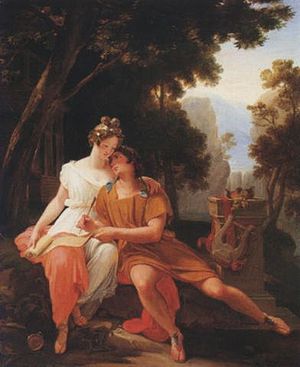
“Propertius And Cynthia At Tivoli” – Auguste Jean-Baptiste Vinchon

navita de ventis, de tauris narrat arator;

enumerat miles vulnera, pastor oves;

nos angusto versamus proelia lecto:

qua pote quisque, in ea conterat arte diem.

New Year’s Resolution Advice from Macrobius and Friends

Macrobius, 1.11.8-11

“Some are slaves to desire, others to greed, others to ambition; all are enthralled to hope, all to fear. To be sure, there is no slavery more base than one voluntarily undertaken. But we walk all over the man subjected to the yoke imposed by fortune as though he were a wretched and worthless character, but we do not suffer the yoke which we place upon our own necks to be jeered at. You will find among servants one with a deeper purse than the others, you will even find a lord himself kissing the hands of another man’s servants in the hope of financial gain; I do not, therefore, form my opinion of people based on their fortune, but on their character. Chance assigns you a condition, but you give yourself a character.”

alius libidini servit, alius avaritiae, alius ambitioni, omnes spei, omnes timori. et certe nulla servitus turpior quam voluntaria. at nos iugo a fortuna imposito subiacentem tamquam miserum vilemque calcamus, quod vero nos nostris cervicibus inserimus non patimur reprehendi. invenies inter servos aliquem pecunia fortiorem, invenies dominum spe lucri oscula alienorum servorum manibus infigentem: non ergo fortuna homines aestimabo sed moribus. sibi quisque dat mores, condicionem casus adsignat.

Or, you could start a new workout routine like Socrates:


Aulus Gellius, Attic Nights, 1.1

The way that Socrates developed the endurance of his body; and also on the temperance of that man.

“Among the voluntary actions and bodily exercises for enhancing his endurance against any possible event, we have heard that Socrates used to do this regularly: it is reported that Socrates was in that habit of standing all day long in one position, from the first shine of light one day until the next sunrise, without moving from the same footprints, keeping his eyes directed in a single place and in deep thought, as if his mind and spirit were separated from his body. This is why, when Favorinus was mentioning the strength of that man and his other qualities, he added: “He often stood from sunrise to sunrise, more solid than tree-trunks” (fr. 97.1).
His temperance was so great, as it is reported, that he lived his entire life with uncompromised health. Even during the ruin of that plague, which at the beginning of the Peloponnesian war destroyed the Athenian state with an unknown type of disease, he is said to have avoided the dangers of pleasure and to have maintained the health of his body with his habits of abstention and moderation to such a degree that he was not at all afflicted by the disaster touching everyone else.”

Quo genere solitus sit philosophus Socrates exercere patientiam corporis; deque eiusdem viri temperantia.

1 Inter labores voluntarios et exercitia corporis ad fortuitas patientiae vices firmandi id quoque accepimus Socraten facere insuevisse: 2 stare solitus Socrates dicitur pertinaci statu perdius atque pernox a summo lucis ortu ad solem alterum orientem inconivens, immobilis, isdem in vestigiis et ore atque oculis eundem in locum directis cogitabundus tamquam quodam secessu mentis atque animi facto a corpore. 3 Quam rem cum Favorinus de fortitudine eius viri ut pleraque disserens attigisset: πολλάκις ἐξ ἡλίου εἰς ἥλιον εἱστήκει ἀστραβέστερος τῶν πρέμνων (Fav. Fr. 97.1).

4 Temperantia quoque fuisse eum tanta traditum est, ut omnia fere vitae suae tempora valitudine inoffensa vixerit. 5 In illius etiam pestilentiae vastitate, quae in belli Peloponnesiaci principis Atheniensium civitatem internecivo genere morbi depopulata est, is parcendi moderandique rationibus dicitur et a voluptatum labe cavisse et salubritates corporis retinuisse, ut nequaquam fuerit communi omnium cladi obnoxius.

Earlier in the Attic Nights Aulus reports a difference type of exercise to keep the philosopher sharp.

roman-death-mosaic

Also, get rich and work less, like Seneca:

“Labor is not a good thing. What then is a good thing? The contempt of labor.”

labor bonum non est. quid ergo est bonum? laboris contemptio.

Seneca, Epistles to Lucilius 4.2 (31)