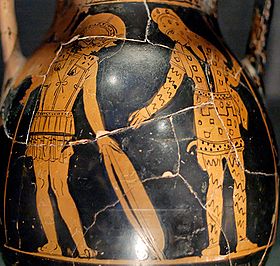
Myth and Metamorphosis: The Story of Kêuks and Alkuonê

[For Ovid’s version, see the Metamorphoses 11.410-749; Ancient testimonia attribute a Wedding of Kêuks poem to Hesiod]

Hes. Fr. 10d

“Kêuks, the son of the star the Light-Bringer, married Alkuonê, the daughter of Aiolos. They were both arrogant. Because they loved each other, she called him Zeus and he addressed her as Hera. In rage at this, Zeus changed them both into birds, as Hesiod records in the Catalogue of Women.”

᾿Αλκυόνην τὴν Αἰόλου ἔγημε̣ Κή̣[ϋξ ὁ Φωσφό]ρου τ̣ο̣ῦ ἀστέρος
υἱός. ἄμφω δ’ ἦσα[ν ὑπερή]φ̣α[νοι, ἀλ]λήλων δ’ ἐρασθέντ̣ες ἡ
[μὲν .].α̣.[.]κ̣[.]ρνα[…..] Δία κ̣α[λ]εῖ, <ὁ δὲ> αὐτ̣ὴν ῞Ηραν
προσ̣η̣γ̣ό̣[ρε]υεν· ἐφ’ [ὧι ὀργι]σθεὶ[ς] ὁ Ζεὺς μετεμόρφωσε̣ν̣
ἀ̣μ̣φοτέρους [εἰς ὄρ]νε[α,] ὡς ῾Ησίοδος ἐν Γυναικῶν καταλόγωι.

Apollodorus 1.52

“Kêuks, the son of the Dawn-star, married Alkuonê. These two were destroyed because of their sacrilege. For, he used to call his wife Hera and she called her husband Zeus. Zeus turned them into birds, he made her into a halcyon (kingfisher) and him into a keuks (gannet?)”

᾿Αλκυόνην δὲ Κῆυξ ἔγημεν ῾Εωσφόρου παῖς. οὗτοι δὲ δι’ ὑπερηφάνειαν ἀπώλοντο· ὁ μὲν γὰρ τὴν γυναῖκα ἔλεγεν ῞Ηραν, ἡ δὲ τὸν ἄνδρα Δία, Ζεὺς δὲ αὐτοὺς ἀπωρνέωσε, καὶ τὴν μὲν ἀλκυόνα ἐποίησε τὸν δὲ κήυκα.

Schol. ad Arist. Aves 250

“This is the wife of the king of the Trachinians, Kêuks. They enjoyed the greatest prosperity, but they came to such a point of arrogance, that they did not think it right to be called by their proper names. So he used to call himself Zeus, and she called herself Hera. Once, when he was sailing out to sea, Zeus became enraged and destroyed him and the ship. She wept over the death of her husband with the greatest sorrow along the shore and Zeus turned her into a bird because he pitied her. He turned him into a bird too, the one people call a kêrulos. When she was weeping over her eggs breaking in the sea, Zeus took pity on her and established a number of calm days each year which are called Halcyon days in which she might give birth to and carry out her young.”

ἔστι δὲ ἡ Κήϋκος τοῦ Τραχινίων βασιλέως γυνή. οἳ ὄλβῳ μεγίστῳ ἐπαρθέντες, εἰς τοσοῦτον ἦλθον φρυάγματος, ὡς ἀπαξιοῦν τοῖς ἰδίοις ὀνόμασι καλεῖσθαι. καὶ ὁ μὲν ἐκάλεσεν αὑτὸν Δία, ἡ δὲ ῞Ηραν. καί ποτε ἐν θαλάσσῃ αὐτοῦ πλέοντος ὁ Ζεὺς ὀργισθεὶς αὐτόν τε διέφθειρε καὶ τὴν ναῦν. ἡ δὲ ἄγαν περιπαθῶς ὠδύρετο τὸν τοῦ ἀνδρὸς θάνατον παρὰ τῷ αἰγιαλῷ, ἣν ἐλεήσας ὁ Ζεὺς ἀπωρνέωσε. καὶ ἐκεῖνον δὲ εἰς ὄρνεον μετέβαλεν, ὃν κηρύλον καλοῦσιν. ἐθρήνει δὲ τῶν ᾠῶν αὑτῆς ἐν τῇ θαλάσσῃ κλωμένων. διὸ κατὰ Διὸς οἶκτον ιδ′ ἡμέρας ἀλκυονίτιδας καλουμένας εὐδιεινὰς ἔχει τοῦ ἔτους, ἐν αἷς τίκτουσα ἐκβάλλει τοὺς νεοττούς.]

Eusthathius. Comm. Ad Il. II.2.8

“The story goes that there was a union of a man and women—the husband was named Kêuks. They came to such a level of arrogance, that he wanted to be called Zeus’ name and she submitted herself to be called Hera. Then they started actually doing this. Zeus, because he was outraged by such hubris, changed the people into birds and increased the punishment by compelling them to give birth to their young during winter and near the sea. This is why they are called Al-kuones, because they give birth [kuein] along the sea [ala]. But when their eggs were breaking and offspring were not being provided, and as a result there was no future generation, a great grief overcame them. Zeus, then, because pity overcame him and changed his mind, pitied the pathetic birds, and assigned a peaceful time of the hear for them and it turned out that the birds could lay eggs and bring their young to life. Once that happened in later years he declared that these days should remain Halcyon days.”

Φέρεται γὰρ λόγος, ὅτι συζυγία τις ἀνδρὸς καὶ γυναικός—Κῆϋξ δὲ ὁ ἀνὴρ ἐκαλεῖτο. —ἐς τοσοῦτον ἦλθε φυσήματος, ὡς ἐθέλειν τὸν μὲν Διὸς καλεῖσθαι ὀνόματι, τὴν δὲ τῇ τῆς ῞Ηρας κλήσει καλλωπίζεσθαι. καὶ ἐποίουν μὲν αὐτοὶ οὕτω. Ζεὺς δὲ ἀχθεσθεὶς τῆς ὕβρεως μετάγει τοὺς ἀνθρώπους εἰς ὄρνις καὶ τὸ κακὸν προσαύξων ἀναγκάζει χειμῶνός τε νεοττεύειν αὐτοὺς καὶ περὶ αἰγιαλόν. ὅθεν καὶ ἀλκυόνες ἐκλήθησαν διὰ τὸ παρὰ τὴν ἅλα κύειν. ᾿Επεὶ δὲ τὰ ᾠά σφισιν ἐκλύζοντο καὶ ἦν ὁ τόκος ἀτελεσφόρητος καὶ οὐκ εἶχε τὸ γένος διαδοχήν, ἦν αὐτοῖς πολὺ πένθος, καὶ τοῦτο ἐπὶ πολύ. ὁ Ζεὺς οὖν, ἀλλὰ καὶ αὐτὸν οἶκτος εἰσέρχεται καὶ ἐπαναστρέφει τοῦ θυμοῦ καὶ κατελεεῖ τοὺς γοεροὺς ὄρνις καὶ ἐπιτάττει τῷ καιρῷ γαλήνην καὶ
γίνεται, καὶ οἱ ὄρνις ἐπωάζουσι καὶ εἰς φῶς ἐκφαίνουσι νεοσσούς. Καὶ τοῦτο
γενόμενον καὶ εἰς ὀπίσω καὶ ἐπὶ πολλοὺς παραμεῖναν ἐνιαυτοὺς τὰς ἀλκυονίδας
ἡμέρας ἔφηνε.

Image result for Ceyx and Alcyone
“Ceyx et Alcyone”, 18th Century Oil Painting

This story was likely part of the Hesiodic Catalogue of Women as attested by fr. 10d above. Several Papyri have suggestive remains;

Fr. 71a = P. Oxy. 2999, ed. Parsons

η̣[
ε̣[
Κη̣[ϋ
῾Ιππ̣[
Κ̣ηϋ̣[
τ̣ὴ̣ν̣ ο̣[
του[σ]θ̣[
Βουτ̣[
τοὶ κού̣[ρας ἀγάγοντο
῾Υλλίδα̣[ς
τῶν γέ̣[νετ
ἠ’ οἵη Σχ[

Fr. 71a may not look like much, but if compared to fr. 10a 89-98 (=P. Oxy. 2075 fr. 2) it is interesting. Here we have the collocation of Zeus, Alkuonê, Kêuks.

Ζ̣[εὺς δὲ ἰδὼν νεμ]έ̣σ̣ησεν ἀπ’ αἰγλήεντ̣ος̣ ᾿Ολύ̣μ̣π̣[ου,
καὶ τὴν μ̣ὲ̣ν ποί̣[ησε πατὴρ ἀνδρῶν τε θεῶν τε
ἀλκυ̣ό̣ν’, ἥ τ̣[
ἀνθρώπων̣ [
ναίει καί ῥ’ ἁλίοι[
Κήϋξ δ’ οὔτε π̣[
παύεται ἀΐσσω̣[ν
ἵεται ᾿Αλκυόνη[ς
ἀλλὰ Διὸς κρυπ[τὸς πέλεται νόος, οὐδέ τις ἀνδρῶν
φράζ̣ε̣σ̣θαι δύ[ναται

Do You Hate Absurd Etymologies?

Kallierges, Etymologicum Magnum 615

“The name Odysseus has been explained through the following story. For they claim that when Antikleia, Odysseus’ mother, was pregnant she was travelling [hodeuousan] on Mt. Neritos in Ithaka, and it began to rain [husantos] terribly Because of her labor and fear she collapsed and gave birth to Odysseus there. So, he obtained is name in this way, since Zeus, on the road [hodon] rained [hûsen].”

᾿Οδυσσεύς: Εἴρηται ἀπὸ ἱστορίας. ᾿Αντίκλειαν γάρ φασι τὴν ᾿Οδυσσέως μητέρα ἐγκύμονα ὁδεύουσαν τὸ Νήριτον τῆς ᾿Ιθάκης ὄρος, ὕσαντος πολὺ τοῦ Διὸς, ὑπὸ ἀγωνίας τε καὶ φόβου καταπεσοῦσαν ἀποτεκεῖν τὸν ᾿Οδυσσέα. Οὕτω ταύτης τῆς ὀνομασίας ἔτυχεν, ἐπειδὴ κατὰ τὴν ὁδὸν ὗσεν ὁ Ζεύς.

It is more typical to derive Odysseus’ name from the verb odussomai, which means something like “being hateful, being hated”.  Autolykos, Odysseus’ maternal grandfather, is reported to have named him in the Odyssey (19.407–409).

“I have come to this point hated [odussamenos] by many—
Both men and women over the man-nourishing earth.
So let his name be Ody[s]seus…”

πολλοῖσιν γὰρ ἐγώ γε ὀδυσσάμενος τόδ’ ἱκάνω,
ἀνδράσιν ἠδὲ γυναιξὶν ἀνὰ χθόνα βωτιάνειραν·
τῷ δ’ ᾿Οδυσεὺς ὄνομ’ ἔστω ἐπώνυμον…

Even in antiquity there was debate about how to interpret odussamenos. A scholion offers three explanations: “[someone] who is hated. Or who has rage. Or has harmed [someone]” (ὀδυσσάμενος] μισηθείς· ἢ ὀργὴν ἀγαγών· ἢ βλάψας.)

And many have seen playing with this name-verb accord earlier in the epic when Athena asks Zeus (1.60-62)

“…Didn’t Odysseus please you
By making sacrifices along the ships of the Argives
In broad Troy? Why are you so hateful [ôdusao] to him, Zeus?”

… οὔ νύ τ’ ᾿Οδυσσεὺς
᾿Αργείων παρὰ νηυσὶ χαρίζετο ἱερὰ ῥέζων
Τροίῃ ἐν εὐρείῃ; τί νύ οἱ τόσον ὠδύσαο, Ζεῦ;”

Sophocles gets in on this (Fr. 965):

“I am called Odysseus for evil deeds correctly:
For many who have been my enemy hate [ôdusanto] me.”

ὀρθῶς δ’ ᾿Οδυσσεύς εἰμ’ ἐπώνυμος κακῶν•
πολλοὶ γὰρ ὠδύσαντο δυσμενεῖς ἐμοί

Modern scholars get in on the game too Marót in Acta Antiqua 8 (1960) 1-6 suggests that the name is developed from the scar (οὐλή=oulê) by which Odysseus is recognized, thus explaining in part the Latin (and Etruscan) variant Ulysses.

Image result for Odysseus ancient Greek

For a succinct discussion, see Norman Austin 2009, 92-93 from his essay “Name Magic in the Odyssey” in Lillian Doherty’s Oxford Readings in Classical Studies: Homer’s Odyssey (originally printed in California Studies in Classical Antiquity 5 (1972) 1-19, available through JSTOR). See also W. B. Stanford’s “The Homeric Etymology of the Name Odysseus.” Classical Philology 47 (1952) 209-213.

He Killed Her Father, then Married Her: A Love Story

Hes. fr. 195.1-23 (= Hes. Aspis 1-23)

“Or, as she did, when she left her home and paternal land
And came to Thebes to warlike Amphitryon,
Alkmênê, the daughter of host-rallying Êlektruôn.
She, really, surpassed the whole race of women
In appearance and stature. And no one could rival her mind
Of the women who were born from mortal women who slept with mortal men.
From her head and dark eyebrows [it shone]
Just like from the sight of golden Aphrodite.
And in her heart she honored her husband as
None of the female women had ever honored before.
But he killed her noble father after overcoming him in force,
After he was enraged over some cattle. He left his paternal land
And came to supplicate the shield-shaking Kadmeans.
He lived in a home there with his revered wife
But he did not have sex with her, he could not climb
Into the bed of Êlektruôn’s fine-ankled daughter, until he
Atoned for the murder of her great-hearted brothers
And burned down the villages of the heroes
The Taphians and Têleboans with fire.
For this is how it was decided, and the gods were witnesses.
He feared their rage, and pushed as fast as possible
To complete the great task Zeus had set for him.”

Image result for alcmene and amphitryon

… ῍Η οἵη προλιποῦσα δόμους καὶ πατρίδα γαῖαν
ἤλυθεν ἐς Θήβας μετ’ ἀρήιον ᾿Αμφιτρύωνα
᾿Αλκμήνη, θυγάτηρ λαοσσόου ᾿Ηλεκτρύωνος·
ἥ ῥα γυναικῶν φῦλον ἐκαίνυτο θηλυτεράων
εἴδεΐ τε μεγέθει τε· νόον γε μὲν οὔ τις ἔριζε
τάων ἃς θνηταὶ θνητοῖς τέκον εὐνηθεῖσαι.
τῆς καὶ ἀπὸ κρῆθεν βλεφάρων τ’ ἄπο κυανεάων
τοῖον ἄηθ’ οἷόν τε πολυχρύσου ᾿Αφροδίτης.
ἣ δὲ καὶ ὣς κατὰ θυμὸν ἑὸν τίεσκεν ἀκοίτην,
ὡς οὔ πώ τις ἔτισε γυναικῶν θηλυτεράων·
ἦ μέν οἱ πατέρ’ ἐσθλὸν ἀπέκτανε ἶφι δαμάσσας,
χωσάμενος περὶ βουσί· λιπὼν δ’ ὅ γε πατρίδα γαῖαν
ἐς Θήβας ἱκέτευσε φερεσσακέας Καδμείους.
ἔνθ’ ὅ γε δώματ’ ἔναιε σὺν αἰδοίῃ παρακοίτι
νόσφιν ἄτερ φιλότητος ἐφιμέρου, οὐδέ οἱ ἦεν
πρὶν λεχέων ἐπιβῆναι ἐυσφύρου ᾿Ηλεκτρυώνης
πρίν γε φόνον τείσαιτο κασιγνήτων μεγαθύμων
ἧς ἀλόχου, μαλερῷ δὲ καταφλέξαι πυρὶ κώμας
ἀνδρῶν ἡρώων Ταφίων ἰδὲ Τηλεβοάων.
τὼς γάρ οἱ διέκειτο, θεοὶ δ’ ἐπὶ μάρτυροι ἦσαν·
τῶν ὅ γ’ ὀπίζετο μῆνιν, ἐπείγετο δ’ ὅττι τάχιστα
ἐκτελέσαι μέγα ἔργον, ὅ οἱ Διόθεν θέμις ἦεν.

“Ox-Skinning Days”: Hesiod’s Strange View of Winter

[Lenaion is the month that occupies the end of January and beginning of February.]

 Hesiod, Works and Days 504-528

“Avoid the month of Lenaion, terrible days, all of them ox-skinning,
Avoid it and the frosts which grow cruelly
Over the earth as Boreas blows them on.
Boreas, through horse-breeding Thrace and the wide sea
Raises the cold, blowing on, and the earth and trees whimper.
He fells many high-headed oaks and broad pines
As he leaps over the much-nourishing earths and forest glens,
And the whole forest roars then in anguish.
The beasts bristle, they tuck their tails beneath their legs,
Even those with skin covered in fur. He goes cold
Straight threw them, even when they are covered in wool.
He pierces an ox-hide which cannot hold him;
He blows straight through a thin-coated got. But not sheep—
No, because their hair is lush and thick, the might
Of the wind Boreas cannot pierce it. But it makes an old man
Curved. Boras does not touch the tender maiden’s skin
If she stays at home, inside, next to her dear mother,
Where she does not know the deeds of golden Aphrodite
As she bathes her fine skin and anoints with olive oil,
Rubbing herself down in the deepest room of her home,
On that day when the boneless cold grates his foot
In his fireless home and his harsh pastures.
No sun promises to rise on his pastures,
But he turns slowly on the countries and cities of
The darker men, and shines sluggishly for all the Greeks.”

Μῆνα δὲ Ληναιῶνα, κάκ’ ἤματα, βουδόρα πάντα,
τοῦτον ἀλεύασθαι καὶ πηγάδας, αἵ τ’ ἐπὶ γαῖαν
πνεύσαντος Βορέαο δυσηλεγέες τελέθουσιν,
ὅς τε διὰ Θρῄκης ἱπποτρόφου εὐρέι πόντῳ
ἐμπνεύσας ὤρινε, μέμυκε δὲ γαῖα καὶ ὕλη·
πολλὰς δὲ δρῦς ὑψικόμους ἐλάτας τε παχείας
οὔρεος ἐν βήσσῃς πιλνᾷ χθονὶ πουλυβοτείρῃ
ἐμπίπτων, καὶ πᾶσα βοᾷ τότε νήριτος ὕλη·
θῆρες δὲ φρίσσουσ’, οὐρὰς δ’ ὑπὸ μέζε’ ἔθεντο·
τῶν καὶ λάχνῃ δέρμα κατάσκιον· ἀλλά νυ καὶ τῶν
ψυχρὸς ἐὼν διάησι δασυστέρνων περ ἐόντων·
καί τε διὰ ῥινοῦ βοὸς ἔρχεται οὐδέ μιν ἴσχει,
καί τε δι’ αἶγα ἄησι τανύτριχα· πώεα δ’ οὔτι,
οὕνεκ’ ἐπηεταναὶ τρίχες αὐτῶν, οὐ διάησι
ἲς ἀνέμου Βορέω· τροχαλὸν δὲ γέροντα τίθησιν
καὶ διὰ παρθενικῆς ἁπαλόχροος οὐ διάησιν,
ἥ τε δόμων ἔντοσθε φίλῃ παρὰ μητέρι μίμνει,
οὔπω ἔργα ἰδυῖα πολυχρύσου ᾿Αφροδίτης,
εὖ τε λοεσσαμένη τέρενα χρόα καὶ λίπ’ ἐλαίῳ
χρισαμένη μυχίη καταλέξεται ἔνδοθι οἴκου,
ἤματι χειμερίῳ, ὅτ’ ἀνόστεος ὃν πόδα τένδει
ἔν τ’ ἀπύρῳ οἴκῳ καὶ ἤθεσι λευγαλέοισιν·
οὐ γάρ οἱ ἠέλιος δείκνυ νομὸν ὁρμηθῆναι,
ἀλλ’ ἐπὶ κυανέων ἀνδρῶν δῆμόν τε πόλιν τε
στρωφᾶται, βράδιον δὲ Πανελλήνεσσι φαείνει.

Boreas the north-wind | Athenian red-figure pelike C5th B.C. | Martin von Wagner Museum, University of Würzburg

Eunus Likes to Lick (NSFW!)

Ausonius, Epigram 126

“Lilly, Irene, Cassie and Karl; if you write out these names, and take the first letter of each, you can form the word which describes what you do, master Eunus! But I can’t mention something so scandalous in Latin.”

Λαὶς, Ἔρως et Ἴτυς Χείρων, et Ἔρως  Ἴτυς alter,

Nomina si scribis, prima elementa adime,

Ut facias verbum, quod facis, Eune magister.

Dicere me Latium non decet opprobrium.

Ausonius, Epigram 127:


“Eunus, when you’re licking your pregnant wife’s rotten vagina, you’re hurrying to give your unborn children some tongue.”

Eune, quod uxoris gravidae putria inguina lambis,

festinas glossas non natis tradere natis.

Resisting Tyranny

Herodotus, Histories 7.102.1-7

“After he heard these things, Dêmarêtos was saying the following: “King, since you order me to tell the truth completely and to say things that someone might not be caught in a lie by you later, poverty has always been Greece’s companion, but virtue is acquired, nurtured by wisdom and strong custom. By cultivating this excellence, Greece has warded off both poverty and tyranny.”

῾Ως δὲ ταῦτα ἤκουσε Δημάρητος, ἔλεγε τάδε· «Βασιλεῦ, ἐπειδὴ ἀληθείῃ διαχρήσασθαι πάντως κελεύεις ταῦτα λέγοντα τὰ μὴ ψευδόμενός τις ὕστερον ὑπὸ σέο ἁλώσεται, τῇ ῾Ελλάδι πενίη μὲν αἰεί κοτε σύντροφός ἐστι, ἀρετὴ δὲ ἔπακτός ἐστι, ἀπό τε σοφίης κατεργασμένη καὶ νόμου ἰσχυροῦ· τῇ διαχρεωμένη ἡ ῾Ελλὰς τήν τε πενίην ἀπαμύνεται καὶ τὴν δεσποσύνην.

8.144.1-3

“To the Spartan representatives, the Athenians answered as follows: “It was a very human response that the Spartans feared we might make an agreement with the Barbarian. But because we believe it shameful that the Athenian spirit should shudder so, know that there is no amount of gold anywhere or land so exceeding in beauty and location which we would ever wish to take to align with the Persians and enslave Greece.

“There are many, serious reasons which would prevent us from doing these things, even if we were willing: first and greatest are the temples and dedications to the gods which were burned and destroyed. This compels us to seek extreme vengeance rather than making agreements with the man who contrived it. Second, is our common Hellenic blood, our shared language, the shrines of the gods and the sacrifices, customs and ways of living we keep in common—never would it be right for the Athenians to betray these things.

Know this too if you did not happen to know it before, as long as a single Athenian survives there will never be a treaty with Xerxes. Still, we give you thanks for your concern about us, that you have worried for out destroyed home enough that you are willing to supply and feed our people.”

πρὸς δὲ τοὺς ἀπὸ Σπάρτης ἀγγέλους τάδε. ‘τὸ μὲν δεῖσαι Λακεδαιμονίους μὴ ὁμολογήσωμεν τῷ βαρβάρῳ, κάρτα ἀνθρωπήιον ἦν: ἀτὰρ αἰσχρῶς γε οἴκατε ἐξεπιστάμενοι τὸ Ἀθηναίων φρόνημα ἀρρωδῆσαι, ὅτι οὔτε χρυσός ἐστι γῆς οὐδαμόθι τοσοῦτος οὔτε χώρη κάλλεϊ καὶ ἀρετῇ μέγα ὑπερφέρουσα, τὰ ἡμεῖς δεξάμενοι ἐθέλοιμεν ἂν μηδίσαντες καταδουλῶσαι τὴν Ἑλλάδα. ’

‘ [2] πολλά τε γὰρ καὶ μεγάλα ἐστι τὰ διακωλύοντα ταῦτα μὴ ποιέειν μηδ᾽ ἢν ἐθέλωμεν, πρῶτα μὲν καὶ μέγιστα τῶν θεῶν τὰ ἀγάλματα καὶ τὰ οἰκήματα ἐμπεπρησμένα τε καὶ συγκεχωσμένα, τοῖσι ἡμέας ἀναγκαίως ἔχει τιμωρέειν ἐς τὰ μέγιστα μᾶλλον ἤ περ ὁμολογέειν τῷ ταῦτα ἐργασαμένῳ, αὖτις δὲ τὸ Ἑλληνικὸν ἐὸν ὅμαιμόν τε καὶ ὁμόγλωσσον καὶ θεῶν ἱδρύματά τε κοινὰ καὶ θυσίαι ἤθεά τε ὁμότροπα, τῶν προδότας γενέσθαι Ἀθηναίους οὐκ ἂν εὖ ἔχοι. ’

‘ [3] ἐπίστασθέ τε οὕτω, εἰ μὴ πρότερον ἐτυγχάνετε ἐπιστάμενοι, ἔστ᾽ ἂν καὶ εἷς περιῇ Ἀθηναίων, μηδαμὰ ὁμολογήσοντας ἡμέας Ξέρξῃ. ὑμέων μέντοι ἀγάμεθα τὴν προνοίην τὴν πρὸς ἡμέας ἐοῦσαν, ὅτι προείδετε ἡμέων οἰκοφθορημένων οὕτω ὥστε ἐπιθρέψαι ἐθέλειν ἡμέων τοὺς οἰκέτας. ’

Peloponnesus, Presently the Kingdom of Morea, Clearly Divided into All Its Provinces, Both Contemporary and Ancient, and to which is Added the Islands of Cefalonia, Zante, Cerigo, and St. Maura

Homeric Advice for Starting a Conversation at #AIASCS

There is a useful and interesting debate about Class and Classics which was initiated by Eric Adler’s article on Eidolon. Across the academy, conferences are famous for being hierarchical, expensive, humiliating, of questionable worth, and a general venue for all sorts of debauchery. (There are papers too.)

Professional conferences often require social engagement. But talking to new people can be hard. If you find yourself at a loss for words this conference season, why not try something new by using an old script?

Diomedes: Il. 6.123-129

“Bestie, who are you of mortal humans?
For I have never seen you before in this ennobling battle.
But now you stride out far ahead of everyone
In your daring—where you await my ash-wood spear.
Those who oppose my might are children of miserable parents!
But, if you are one of the immortals come down from the sky,
I don’t wish to fight with the sky-dwelling gods!”

τίς δὲ σύ ἐσσι φέριστε καταθνητῶν ἀνθρώπων;
οὐ μὲν γάρ ποτ’ ὄπωπα μάχῃ ἔνι κυδιανείρῃ
τὸ πρίν· ἀτὰρ μὲν νῦν γε πολὺ προβέβηκας ἁπάντων
σῷ θάρσει, ὅ τ’ ἐμὸν δολιχόσκιον ἔγχος ἔμεινας·
δυστήνων δέ τε παῖδες ἐμῷ μένει ἀντιόωσιν.
εἰ δέ τις ἀθανάτων γε κατ’ οὐρανοῦ εἰλήλουθας,
οὐκ ἂν ἔγωγε θεοῖσιν ἐπουρανίοισι μαχοίμην.

Glaukos, 6.145-151

“Oh, you great-hearted son of Tydeus, why are you asking about pedigree?
The generations of men are just like leaves on a tree:
The wind blows some to the ground and then the forest
Grows lush with others when spring comes again.
In this way, the race of men grows and then dies in turn.
But if you are willing, learn about these things so you may know
My lineage well—many are the men who know me.”

Τυδεΐδη μεγάθυμε τί ἢ γενεὴν ἐρεείνεις;
οἵη περ φύλλων γενεὴ τοίη δὲ καὶ ἀνδρῶν.
φύλλα τὰ μέν τ’ ἄνεμος χαμάδις χέει, ἄλλα δέ θ’ ὕλη
τηλεθόωσα φύει, ἔαρος δ’ ἐπιγίγνεται ὥρη·
ὣς ἀνδρῶν γενεὴ ἣ μὲν φύει ἣ δ’ ἀπολήγει.
εἰ δ’ ἐθέλεις καὶ ταῦτα δαήμεναι ὄφρ’ ἐὺ εἰδῇς
ἡμετέρην γενεήν, πολλοὶ δέ μιν ἄνδρες ἴσασιν

Then switch nametags!

Image result for diomedes and glaucus

This post was inspired by the ever dynamic Rogue Classicist:

If you are serious about getting to know new people (and there are always a lot of nice, interesting people at the annual meeting), Zeno has some great advice:

“We have two ears but one mouth so that we may listen more and talk less”

δύο ὦτα ἔχομεν, στόμα δὲ ἕν, ἵνα πλείω μὲν ἀκούωμεν, ἥττονα δὲ λέγωμεν

More Preposterous Etymologies: “Lipless” Achilles

While most Homerists (I think) accept the argument advanced by L. R. Palmer and Gregory Nagy that Achilles’ name (Akhilleus) derives from akhos (“woe”, “grief”) and laos (“host, people, army”), some ancient authors had different ideas.

Apollodorus. 3.172.4-5

“After Thetis gave birth to a child with Peleus, she wanted to make him immortal—without Peleus knowing, she used to cover him in fire at night to destroy his mortal inheritance from his father, and at day she rubbed him down with ambrosia. After Peleus discovered this and saw his son struggling in the fire, he cried out. And Thetis, prevented from completing her plan, abandoned her child and went to the daughters of Nereus. But Peleus took his child to Kheiron. Kheiron accepted him and fed him the innards of lions wild boars and with the marrow of bears. And he named him Achilles, because his lips (kheile) never touched [her] breasts. Previously, his name was Ligurôn.”

So the explanation here, is that his name is ‘alpha-privative’, meaning something like “Lipless”

ὡς δὲ ἐγέννησε Θέτις ἐκ Πηλέως βρέφος, ἀθάνατον θέλουσα ποιῆσαι τοῦτο, κρύφα Πηλέως εἰς τὸ πῦρ ἐγκρύβουσα τῆς νυκτὸς ἔφθειρεν ὃ ἦν αὐτῷ θνητὸν πατρῷον, μεθ’ ἡμέραν δὲ ἔχριεν ἀμβροσίᾳ. Πηλεὺς δὲ ἐπιτηρήσας καὶ σπαίροντα τὸν παῖδα ἰδὼν ἐπὶ τοῦ πυρὸς ἐβόησε·  καὶ Θέτις κωλυθεῖσα τὴν προαίρεσιν τελειῶσαι, νήπιον τὸν παῖδα ἀπολιποῦσα πρὸς Νηρηίδας ᾤχετο. κομίζει δὲ τὸν παῖδα πρὸς Χείρωνα Πηλεύς. ὁ δὲ λαβὼν αὐτὸν ἔτρεφε σπλάγχνοις λεόντων καὶ συῶν ἀγρίων καὶ ἄρκτων μυελοῖς, καὶ ὠνόμασεν ᾿Αχιλλέα (πρότερον δὲ ἦν ὄνομα ὠνόμασεν ᾿Αχιλλέα (πρότερον δὲ ἦν ὄνομα αὐτῷ Λιγύρων) ὅτι τὰ χείλη μαστοῖς οὐ προσήνεγκε.

Kallierges, Etymologicum Magnum 182

“Akhilleus: [this name comes from] lessening grief, for Achilles was a doctor. Or it is because of the woe, which is pain, he brought to his mother and the Trojans. Or it is from not touching his lips to food [khilê]. For he had no serving of milk at all, but was fed with stag-marrow by Kheiron. This is why he was hailed by the Myrmidons in the following way, according to Euphoriôn:

He came to Phthia without ever tasting any food
This is why the Myrmidons named him Achilles.”

᾿Αχιλλεύς: Παρὰ τὸ ἄχος λύειν· ἰατρὸς γὰρ ἦν. ῍Η διὰ τὸ ἄχος (ὅ ἐστι λύπην) ἐπενεγκεῖν τῇ μητρὶ καὶ τοῖς ᾿Ιλιεῦσιν. ῍Η διὰ τὸ μὴ θίγειν χείλεσι χιλῆς, ὅ ἐστι τροφῆς· ὅλως γὰρ οὐ μετέσχε γάλακτος, ἀλλὰ μυελοῖς ἐλάφων ἐτράφη ὑπὸ Χείρωνος. ῞Οτι ὑπὸ Μυρμιδόνων ἐκλήθη, καθά φησιν Εὐφορίων,

᾿Ες Φθίην χιλοῖο κατήϊε πάμπαν ἄπαστος.
τοὔνεκα Μυρμιδόνες μιν ᾿Αχιλέα φημίξαντο.

Image result for achilles and chiron

From the Suda: Tribônianos, A Complicated Man


“Tribônianus, son of Makedonianos, from a family of advocates for the prefects. This Tribônianos was Greek and an Atheist, hostile to the Christian faith in general. He was a flatterer and a cheat. He convinced the emperor Justinian that he would not die but would be raised up into heavens with his flesh. He was also a quaestor for Justinian.

This man had natural strength and attained a peak of education inferior to no other at his time. He was also peculiarly passionate about money and was always willing to sell justice for profit. When it came to laws, on each day he would cancel some and write others, selling either service to men who asked for them. After serving for many years in this office, he died because of a disease and had suffered nothing unfavorable from anyone.  He was both clever and charming in every way and was most capable of overshadowing his sickness of greed with his surfeit of education.”

Justinian.jpg
Justinian

Τριβωνιανός, Μακεδονιανοῦ, ἀπὸ δικηγόρων τῶν ὑπάρχων. οὗτος ὁ Τριβωνιανὸς Ἕλλην ὑπῆρχε καὶ ἄθεος, ἀλλότριος κατὰ πάντα τῆς τῶν Χριστιανῶν πίστεως: κόλαξ δὲ καὶ ἀπατεὼν καὶ πείθων Ἰουστινιανὸν τὸν βασιλέα, ὡς ὅτι οὐκ ἀποθανεῖται, ἀλλ’ εἰς τοὺς οὐρανοὺς μετὰ σαρκὸς ἀναληφθήσεται. ἦν δὲ κοϊαίστωρ Ἰουστινιανοῦ. οὗτος φύσεως μὲν δυνάμει ἐχρῆτο καὶ παιδείας ἐς ἄκρον ἀφίκετο τῶν κατ’ αὑτὸν οὐδενὸς ἧσσον: ἐς δὲ φιλοχρηματίαν δαιμονίως ἐσπουδακὼς οἷός τε ἦν κέρδους ἀεὶ τὸ δίκαιον ἀποδίδοσθαι, τῶν τε νόμων ἡμέρᾳ οἱ ἐκ τοῦ ἐπιπλεῖστον ἑκάστῃ τοὺς μὲν ἀνῄρει, τοὺς δὲ ἔγραφεν, ἀπεμπολῶν τοῖς δεομένοις κατὰ τὴν χρείαν ἑκάτερον. ἔτη δὲ πολλὰ ἐπιβιοὺς τῇ τιμῇ ἐτελεύτησε νόσῳ, οὐδὲν ἄχαρι πρὸς οὐδενὸς παθών. ἦν γὰρ αἱμύλος τε καὶ τἄλλα ἡδὺς καὶ τῆς φιλοχρηματίας τὸ νόσημα ἐπισκιάσαι ἱκανώτατος τῆς παιδείας περιουσίᾳ.

Motto of Mediocrity: Nequid Nimis

Simo: Of these things, he pursued none with more distinction than the others, yet he applied himself to everything with a middling effort. I was overjoyed.

Sosia: There’s nothing wrong with that! I think that this is the most expedient plan in life: ‘nothing too much!’

(Terence, Andria, 31-34)

Simo: horum ille nil egregie praeter cetera

studebat et tamen omnia haec mediocriter.

gaudebam.

Sosia: non iniuria; nam id arbitror

adprime in vita esse utile, ut nequid nimis.