Arrogant, Lawless and Abnormal: Judging Homer’s Kyklôpes

Earlier we posted about the ancient debate of whether or not the Kyklôpes only had a single eye. Here is a longer post about Homer’s depiction of their character and customs.

Homer, Odyssey 105–115

“From there we went on sailing, even though our hearts were pained,
To the land of the overbearing, lawless Kyklôpes
Who especially rely on the immortal gods
And do not grow plants or plow the land
But everything grows for them, unplanted and unplowed:
The grain, barley and vines which bear
Thick wine, and Zeus’ rain makes them grow.
They don’t have council-bringing assemblies nor laws,
But they inhabit the peaks of high mountains
In their hollow caves, and each governs his
Children and wives—they do not care for one another.”

ἔνθεν δὲ προτέρω πλέομεν ἀκαχήμενοι ἦτορ.
Κυκλώπων δ’ ἐς γαῖαν ὑπερφιάλων ἀθεμίστων
ἱκόμεθ’, οἵ ῥα θεοῖσι πεποιθότες ἀθανάτοισιν
οὔτε φυτεύουσιν χερσὶν φυτὸν οὔτ’ ἀρόωσιν,
ἀλλὰ τά γ’ ἄσπαρτα καὶ ἀνήροτα πάντα φύονται,
πυροὶ καὶ κριθαὶ ἠδ’ ἄμπελοι, αἵ τε φέρουσιν
οἶνον ἐριστάφυλον, καί σφιν Διὸς ὄμβρος ἀέξει.
τοῖσιν δ’ οὔτ’ ἀγοραὶ βουληφόροι οὔτε θέμιστες,
ἀλλ’ οἵ γ’ ὑψηλῶν ὀρέων ναίουσι κάρηνα
ἐν σπέεσι γλαφυροῖσι, θεμιστεύει δὲ ἕκαστος
παίδων ἠδ’ ἀλόχων, οὐδ’ ἀλλήλων ἀλέγουσι.

Image result for Ancient Greek sculpture Cyclops

Schol. ad Od. 9.106 31-58 (Some of which is attributed to Porphyry)

Overbearing, lawless: The phrase has double significance: the great size of their bodies and the lawlessness of not following customs. For they say that “Each one governs his own children and wives”. For if they were lawless instead of unjust, how would he add “they rely on the gods”? But, then, someone might add how Polyphemos says “the Kyklôpes don’t care about aegis-bearing Zeus”. We should, of course, consider the proposal that it comes from Polyphemos, the flesh-eating, beast.  Hesiod also says “[Zeus] made it right for fish, beast and birds to eat one another because they do not have justice. Justice he gave to men” [see below]. Thus he depicts only Polyphemos as arrogant and unjust, while the rest of the other Kyklôpes are righteous, just people who obey the gods. This is why the earth gives them crops of its own accord.”

ὑπερφιάλων ἀθεμίστων] ἢ τῶν μεγαλοφυῶν τῷ σώματι, τῶν δισήμων γὰρ ἡ λέξις, ἀθεμίστων δὲ τῶν νόμοις μὴ χρωμένων· φησὶ γὰρ “θεμιστεύει δὲ ἕκαστος παίδων ἠδ’ ἀλόχων.” εἰ γὰρ ἦν ἀθεμίστων ἀντὶ τοῦ ἀδίκων, πῶς λέγει “οἵ ῥα θεοῖσι πεποιθότες;” εἰ δ’ εἴπῃ τις, καὶ πῶς ὁ Πολύφημός φησιν “οὐ Κύκλωπες Διὸς αἰγιόχου ἀλέγουσι,” (275.) σκοπείτω τὸ πρόσωπον, ὅτι Πολυφήμου ἐστὶ  τοῦ ὠμοφάγου καὶ θηριώδους. καὶ ῾Ησίοδος “ἰχθύσι μὲν καὶ θηρσὶ καὶ οἰωνοῖσι πετεινοῖς ἔσθειν ἀλλήλους, ἐπεὶ οὐ δίκη ἐστὶν ἐν αὐτοῖς, ἀνθρώποισι δ’ ἔδωκε δίκην.” ὥστε Πολύφημον μόνον λέγει ὑπερήφανον καὶ ἄδικον, τοὺς δὲ λοιποὺς πάντας Κύκλωπας εὐσεβεῖς καὶ δικαίους καὶ πεποιθότας τοῖς θεοῖς, ὅθεν καὶ ἀνῆκεν αὐτοῖς αὐτομάτως ἡ γῆ τοὺς καρπούς. H.

“When he claims that the Kyklôpes are arrogant, lawless and abnormal, how can [the poet] claim that they have good things from the gods freely? We must concede that they are “overbearing” because of the excessive size of their bodies, that they are “lawless”, because that do now use an established law but govern through their individual private interest: “each governs his own children and wife”, which is a sign of lawlessness. And Antisthenes says that only Polyphemos is unjust. For this one is even dismissive of Zeus. Therefore, the rest are just. For this reason, the earth provides to them everything of its own accord. And it is their just task not to work it. But they face violence violently, for “they attacked them” just as the giants.” “and who ruled as king of the arrogant giants” and, the fact that Phaeacians were forced to move because they were harmed by them.”

πῶς ὑπερφιάλους καὶ ἀθεμίστους καὶ παρανόμους εἰπὼν τοὺς Κύκλωπας ἄφθονα παρὰ θεῶν αὐτοῖς ὑπάρχειν λέγει τὰ ἀγαθά; ῥητέον οὖν ὅτι ὑπερφιάλους μὲν διὰ τὴν ὑπεροχὴν τοῦ σώματος, ἀθεμίστους δὲ τοὺς μὴ νόμῳ χρωμένους ἐγγράφῳ διὰ τὸ ἕκαστον ἴδιον ἄρχεσθαι· “θεμιστεύει δὲ ἕκαστος παίδων ἠδ’ ἀλόχου” (115), ὅπερ ἀνομίας σημεῖον. ᾿Αντισθένης δέ φησιν ὅτι μόνον τὸν Πολύφημον εἶναι ἄδικον· καὶ γὰρ οὗτος τοῦ Διὸς ὑπερόπτης ἐστίν.  οὐκοῦν οἱ λοιποὶ δίκαιοι· διὰ τοῦτο γὰρ καὶ τὴν γῆν αὐτοῖς τὰ πάντα ἀναδιδόναι αὐτόματον, καὶ τὸ μὴ ἐργάζεσθαι αὐτὴν δίκαιον ἔργον ἐστίν. ἀλλ’ ἔμπροσθεν βιαίως βιαίους, “οἵ σφεας σινέσκοντο” (Od. ζ, 6), ὥσπερ καὶ τοὺς Γίγαντας· “ὅσπερ ὑπερθύμοισι Γιγάντεσσιν βασίλευεν” (Od. η, 59), ὥσπερ καὶ τοὺς Φαίακας βλαπτομένους ὑπ’ αὐτῶν μεταναστῆναι. T.

“The Kyklôpes are just except for Polyphemos. The mention of their “overbearing” character is about their size; their “lawlessness” is due to the fact that they each privately govern their wives and children. How then did they also bring grief to the Phaeacians? It is because of the lawlessness of their state.”

δίκαιοι οὗτοι πλὴν Πολυφήμου. ὅθεν τὸ μὲν ὑπερφιάλων, νῦν μεγάλων, τὸ δὲ θεμίστων, μὴ ἐχόντων χρείαν νόμων διὰ τὸ θεμιστεύειν ἕκαστον παίδων ἠδ’ ἀλόχων. πῶς οὖν ἠδίκουν τοὺς Φαίακας καὶ ἐλύπουν (ζ, 5. 6.); διὰ τὸ ἀνόμοιον τῆς πολιτείας. V.

Hesiod, Works and Days 274-281

“Perses, put these thoughts in your mind
And heed justice, banish force altogether.
Kronos’ son assigned this right to human beings—
It is permitted for the fish, beasts and winged birds
To eat one another, since they don’t have justice.
But Kronos’ son gave humans, which is the best thing by far.
For if someone who understands argues cases publicly,
Wide-browed Zeus will grant him good fortune…”

῏Ω Πέρση, σὺ δὲ ταῦτα μετὰ φρεσὶ βάλλεο σῇσι
καί νυ δίκης ἐπάκουε, βίης δ’ ἐπιλήθεο πάμπαν.
τόνδε γὰρ ἀνθρώποισι νόμον διέταξε Κρονίων,
ἰχθύσι μὲν καὶ θηρσὶ καὶ οἰωνοῖς πετεηνοῖς
ἔσθειν ἀλλήλους, ἐπεὶ οὐ δίκη ἐστὶ μετ’ αὐτοῖς·
ἀνθρώποισι δ’ ἔδωκε δίκην, ἣ πολλὸν ἀρίστη
γίνεται· εἰ γάρ τίς κ’ ἐθέλῃ τὰ δίκαι’ ἀγορεῦσαι
γινώσκων, τῷ μέν τ’ ὄλβον διδοῖ εὐρύοπα Ζεύς·

How Many Eyes Did The Cyclops Have?

Earlier Palaiophron wrote a beautiful post about the Cyclops Polyphemos. I am reading Odyssey 9 with one of my classes and have been reading over the scholia. There are some debates about what exactly a Cyclops looks like. Expect some more Cyclops related posts in coming days.

Schol. ad Od. 9.106

“Aristotle examines how the Cyclops Polyphemos came to be a cyclops when neither his father—nor his mother was a cyclops. He resolved the issue with a different myth. For, he asserted, horses came from Boreas but Pegasos was born from Poseidon and Medousa. Why, then, would it be strange that this wild beast be born from Poseidon? Similarly, other wild beasts were born from him in the sea, as well as marvels and unusual things.

Hesiod laughably etymologizes [the Kyklopes], saying “They were given the nickname Kyklopes / because they have one single circle eye in the middle of their forehead.” But Homer clearly describes about their nature. For, if it was of that sort, just as he described the other particular features of the Cyclops, like his size, his cruelty, he would have also described his eye! Philoxenos says that he diverged from Hesiod in that the fact he could not see because he was blinded in one eye. For Homer does not say this about all the other Cyclopes. It is likely that Polyphemos lost his other eye for some other reason before Odysseus’ arrival.

Others oppose this, claiming that if he had two eyes and Odysseus blinded one, how would he say what is attributed to him, “Cyclops, if any mortal man asks you who is the blinder of your eye…” He does not say eyes. And in return the Cyclops says “My father is able to heal my eye.” For if he had another eye, properly, and Odysseus were speaking to him in this way, how would he not have taken care of the other eye? But he said “the earth-shaker will not heal [my] eye.” For this very reason people argue about his eye being completely pierced, because of what is said here, if he did not take care of the eye when it was first compromised, he would never be able to heal it.”

Image result for Ancient Greek Cyclops


ζητεῖ ᾿Αριστοτέλης πῶς ὁ Κύκλωψ ὁ Πολύφημος μήτε πατρὸς ὢν Κύκλωπος, Ποσειδῶνος γὰρ ἦν, μήτε μητρὸς, Κύκλωψ ἐγένετο. αὐτὸς δὲ ἑτέρῳ μύθῳ ἐπιλύεται. καὶ γὰρ ἐκ Βορέου ἵπποι γίνονται, καὶ ἐκ Ποσειδῶνος καὶ τῆς Μεδούσης ὁ Πήγασος ἵππος. τί δ’ ἄτοπον ἐκ Ποσειδῶνος τὸν ἄγριον τοῦτον γεγονέναι; ὥσπερ καὶ τὰ ἄλλα ἐξ αὐτοῦ ἀναλόγως τῇ θαλάσσῃ ἄγρια γεννᾶται ἢ τερατώδη ἢ παρηλλαγμένα. γελοίως δ’ αὐτοὺς ἐτυμολογεῖ ῾Ησίοδος “Κύκλωπες δ’ ὄνομ’ ἦσαν ἐπώνυμον, οὕνεκ’ ἄρω σφέων κυκλοτερὴς ὀφθαλμὸς ἕεις ἐνέκειτο μετώπῳ.” ὁ δ’ ῞Ομηρος φαίνεται φύσιν αὐτῶν λέγων· εἰ γὰρ ἦν τι τοιοῦτον, ὥσπερ τὰς ἄλλας ἰδιότητας τῶν ὀφθέντων ἔγραψεν ἐπ’ αὐτοῦ Κύκλωπος, τὸ μέγεθος, τὴν ὠμότητα, οὕτω κἂν τὸ περὶ ὀφθαλμοῦ ἔγραψε. φησὶ δὲ ὁ Φιλόξενος ὅτι ἐπλάνησε τὸν ῾Ησίοδον τὸ τὸν ἕνα ὀφθαλμὸν τυφλωθέντα μηκέτι ὁρᾶν. οὔτε δὲ περὶ πάντων τῶν Κυκλώπων εἶπε τοῦτο ῞Ομηρος, εἰκός τε τὸν Πολύφημον κατά τινα ἄλλην αἰτίαν τὸν ἕτερον τῶν ὀφθαλμῶν ἀπολωλεκέναι πρὸ τῆς ᾿Οδυσσέως ἀφίξεως. οἱ δὲ ἀντιλέγοντες τούτῳ φασὶν, εἰ δύο εἶχεν ὀφθαλμοὺς καὶ τὸν ἕνα ᾿Οδυσσεὺς ἐτύφλωσε, πῶς συμφωνήσει τὸ ὑπ’ αὐτοῦ λεγόμενον, “Κύκλωψ, εἰ καί τίς σε καταχθονίων ἀνθρώπων ὀφθαλμοῦ εἴρηται ἀεικελίην ἀλαωτύν” (502.); οὐκ εἶπεν ὀφθαλμῶν. ἔτι δὲ καὶ τὸ προκείμενον παρὰ τοῦ Κύκλωπος, ὅτι δύναταί μου ὁ Ποσειδῶν ἰάσασθαι τὸν ὀφθαλμόν. εἰ γὰρ ἦν ἑτερόφθαλμος ἤδη ὑπάρχων, ἔλεγεν ἂν αὐτῷ ᾿Οδυσσεὺς, καὶ πῶς τὸν ἕτερον οὐκ ἐθεράπευσεν; ἀλλ’ εἶπεν “ὡς οὐκ ὀφθαλμόν γ’ ἰήσεται οὐδ’ ἐνοσίχθων” (525.). δι’ αὐτοῦ δὲ τούτου ἀπολογοῦνται περὶ τοῦ εἶναι αὐτὸν διόφθαλμον, διὰ τοῦ εἰπεῖν, εἰ τὸν πρῶτον πηρωθέντα ὀφθαλμὸν οὐκ ἐθεράπευσεν, οὐδὲ τοῦτον ἰάσεται. H.Q.

A Predator and His Advisor: Another Fable for Our Time

Phaedrus 2.6: The Eagle and the Crow

“Against those in power, no one has enough defense
If a wicked advisor also enters the scene
His power and malice ruins their opposition.
An eagle carried a tortoise on high,
When he pulled his body in his armored home to hide,
And rested hidden untouched by any attack,
A crow came on a breeze flying near them:
“You have well seized a precious prize with you talons,
But, if I don’t show what you need to do,
It will pointlessly wear you out with its heavy weight.”
Promised a portion, the crow instructs the eagle to drop
The hard shell from the stars upon a cliff’s rock.
It would be easy to feed on the broken flesh!
The eagle followed up these wicked instructions
And also split the feast with her teacher.
Just so, the tortoise who was safe by nature’s gift.
Was ill-matched to those two and died a sad death.”

Contra potentes nemo est munitus satis;
si vero accessit consiliator maleficus,
vis et nequitia quicquid oppugnant, ruit.
Aquila in sublime sustulit testudinem:
quae cum abdidisset cornea corpus domo,
nec ullo pacto laedi posset condita,
venit per auras cornix, et propter volans
“Opimam sane praedam rapuisti unguibus;
sed, nisi monstraro quid sit faciendum tibi,
gravi nequiquam te lassabit pondere.”
promissa parte suadet ut scopulum super
altis ab astris duram inlidat corticem,
qua comminuta facile vescatur cibo.
inducta vafris aquila monitis paruit,
simul et magistrae large divisit dapem.
sic tuta quae naturae fuerat munere,
impar duabus, occidit tristi nece.

Image result for medieval manuscript eagle and crow and tortoise

Lips, Eyeballs, Well-Formed Breasts: Everybody Knows the Rest

Dioscorides I (Greek Anthology 5.56):

“I am driven mad by those rose-red, discursive, soul-melting lips – the gateway of that nectar-sweet mouth; and those eyeballs darting under those bushy eyebrows – nets and traps for my affections; and those milky-white, well-joined, well-formed, voluptuous breasts, more delightful than every flower. But why am I showing bones to dogs? You reeds of Midas are witnesses of what happens to loquacity.”

᾿Εκμαίνει χείλη με ῥοδόχροα, ποικιλόμυθα,
ψυχοτακῆ, στόματος νεκταρέου πρόθυρα,
καὶ γλῆναι λασίαισιν ὑπ’ ὀφρύσιν ἀστράπτουσαι,
σπλάγχνων ἡμετέρων δίκτυα καὶ παγίδες,
καὶ μαζοὶ γλαγόεντες, ἐύζυγες, ἱμερόεντες,
εὐφυέες, πάσης τερπνότεροι κάλυκος.
ἀλλὰ τί μηνύω κυσὶν ὀστέα; μάρτυρές εἰσι
τῆς ἀθυροστομίης οἱ Μίδεω κάλαμοι.

Poems and Drugs: From Hesiod to R. M. Van Winkle

Hesiod, Theogony 93-104

Thanks to the Muses and far-shooting Apollo
People are singers and musicians across the land,
Though kings are from Zeus. The one the muses love
Is blessed. For a sweet voice flows from his mouth,
And if anyone has pain in a newly-aggrieved heart
and he chews over his thoughts in sorrow, then a singer,
the Muses’ assistant, will praise the famous deeds generations
before and then the gods who live on Olympos
and quickly that man will forget his troubles, he won’t remember
a bit of grief. The gifts of the gods change us quickly.”

ἐκ γάρ τοι Μουσέων καὶ ἑκηβόλου ᾿Απόλλωνος
ἄνδρες ἀοιδοὶ ἔασιν ἐπὶ χθόνα καὶ κιθαρισταί,
ἐκ δὲ Διὸς βασιλῆες· ὁ δ’ ὄλβιος, ὅντινα Μοῦσαι
φίλωνται· γλυκερή οἱ ἀπὸ στόματος ῥέει αὐδή.
εἰ γάρ τις καὶ πένθος ἔχων νεοκηδέι θυμῷ
ἄζηται κραδίην ἀκαχήμενος, αὐτὰρ ἀοιδὸς
Μουσάων θεράπων κλεῖα προτέρων ἀνθρώπων
ὑμνήσει μάκαράς τε θεοὺς οἳ ῎Ολυμπον ἔχουσιν,
αἶψ’ ὅ γε δυσφροσυνέων ἐπιλήθεται οὐδέ τι κηδέων
μέμνηται· ταχέως δὲ παρέτραπε δῶρα θεάων.

Schol. ad Hes. Th. 95

“men [are] singers: Here the poet teaches us learnedly since he means that men are singers and musicians thanks to the shared voice of the stars and the good course of the sun through the sky…”

ἄνδρες ἀοιδοί: ἐνταῦθα μαθηματικῶς διδάσκει καὶ λέγει ὅτι ἐκ τῆς συμφωνίας τῶν ἀστέρων καὶ τῆς ἀγαθῆς συνδρομῆς τοῦ ἡλίου γίνονται οἱ ἄνδρες σοφοὶ καὶ μουσικοί…

Vanilla Ice, “Ice Ice Baby”
“If my rhyme was a drug, I’d sell it by the gram”

giphy

Homer, Odyssey 4.219–232

“But then Zeus’ daughter Helen had different plans.
She immediately cast into the wine they were drinking a drug,
A pain neutrilizer and anger reducer, an eraser of all evils.
Whoever consumes this drug once it is mixed in the wine,
Could not let a single tear loose upon their cheeks for a whole day.
Not even if their mother or father died,
Nor again if they lost their brother and dear son,
Cut down by bronze right their in front of their own eyes.
These are the kinds of complex drugs, good ones, Zeus’s daughter
Possesses. Polydamna, the wife of Thôn, gave them to her
In Egypt where the fertile land grows the most drugs—
Many there are mixed fine; but many cause pain too.
Each man there is a doctor whose knowledge surpasses most men,
For they are the offspring of Paieon.”

ἔνθ’ αὖτ’ ἄλλ’ ἐνόησ’ ῾Ελένη Διὸς ἐκγεγαυῖα·
αὐτίκ’ ἄρ’ εἰς οἶνον βάλε φάρμακον, ἔνθεν ἔπινον,
νηπενθές τ’ ἄχολόν τε, κακῶν ἐπίληθον ἁπάντων.
ὃς τὸ καταβρόξειεν, ἐπὴν κρητῆρι μιγείη,
οὔ κεν ἐφημέριός γε βάλοι κατὰ δάκρυ παρειῶν,
οὐδ’ εἴ οἱ κατατεθναίη μήτηρ τε πατήρ τε,
οὐδ’ εἴ οἱ προπάροιθεν ἀδελφεὸν ἢ φίλον υἱὸν
χαλκῷ δηϊόῳεν, ὁ δ’ ὀφθαλμοῖσιν ὁρῷτο.
τοῖα Διὸς θυγάτηρ ἔχε φάρμακα μητιόεντα,
ἐσθλά, τά οἱ Πολύδαμνα πόρεν, Θῶνος παράκοιτις,
Αἰγυπτίη, τῇ πλεῖστα φέρει ζείδωρος ἄρουρα
φάρμακα, πολλὰ μὲν ἐσθλὰ μεμιγμένα, πολλὰ δὲ λυγρά,
ἰητρὸς δὲ ἕκαστος ἐπιστάμενος περὶ πάντων
ἀνθρώπων· ἦ γὰρ Παιήονός εἰσι γενέθλης.

Image result for Apollo and Asclepius

Thomas Jefferson, Punmaster General:

Thomas Jefferson, Thoughts on English Prosody:

“Those who have undertaken to frame a prosody for the English language have taken quantity for their basis and have mounted the English poetry on Greek and Latin feet.”

The Development of Eloquence

Cicero, Brutus 26-29:

“Greece is a witness to this fact: although it was inflamed by the pursuit of eloquence and has long established its excellence and precedence in that art, yet it considers all other arts more ancient, and they were all not only discovered but even perfected long before the strength and facility of speaking was worked out. When I look at Greece, Atticus, your city of Athens occurs and even shines forth to me the most; in that city, the public speaker first shone forth, and it was the first place in which oration first came to be committed to monuments and literature.

Yet, before Pericles (to whom some writings are attributed) and Thucydides, who lived not during the birth of Athens but at its maturity, there was no writing which had ornamentation or would appear to have been that of an orator. There was, however, the opinion that Pisistratus (who lived many years before them), and even the slightly-older Solon and later Cleisthenes had tremendous power of speech for those times.

After this age, as one can readily see from the monuments of Atticus, there was Themistocles, who is universally agreed to have excelled in both wisdom and eloquence. Later Pericles, although he possessed the bloom of every type of virtue, was most famous in this respect. It is even agreed that Cleon, a factious citizen at the time to be sure, was nevertheless an eloquent speaker.

Nearly equal at this time were Alcibiades, Critias, and Theramenes. The type of speaking which then prevailed may readily be gleaned from the writings of Thucydides, who was himself alive at the time. They were grand in their words, thick in sententious utterance, brief by tight compression of the facts; and for that very reason they were on occasion terribly obscure.”

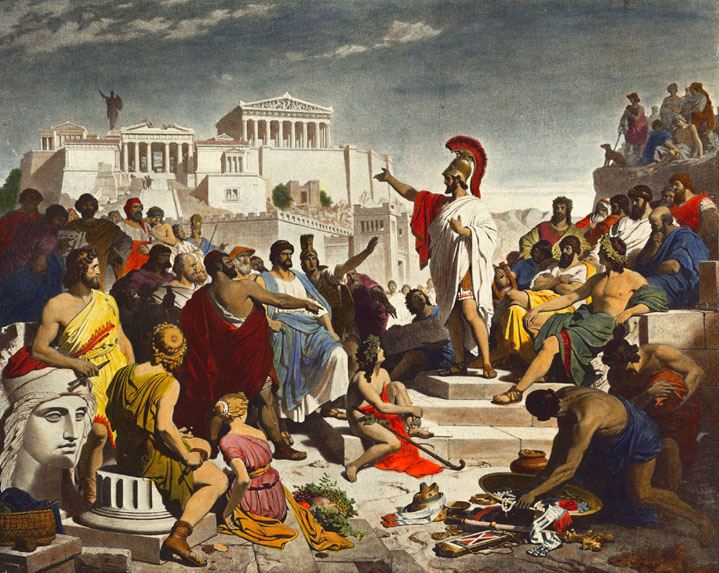
Philipp Foltz, ‘Perikles hält die Leichenrede’

[26] Testis est Graecia, quae cum eloquentiae studio sit incensa iamdiuque excellat in ea praestetque ceteris, tamen omnis artes vetustiores habet et multo ante non inventas solum, sed etiam perfectas, quam haec est a Graecis elaborata dicendi vis atque copia. in quam cum intueor, maxime mihi occurrunt, Attice, et quasi lucent Athenae tuae, qua in urbe primum se orator extulit primumque etiam monumentis et litteris oratio est coepta mandari.

[27] Tamen ante Periclem, cuius scripta quaedam feruntur, et Thucydidem, qui non nascentibus Athenis sed iam adultis fuerunt, littera nulla est, quae quidem ornatum aliquem habeat et oratoris esse videatur. quamquam opinio est et eum, qui multis annis ante hos fuerit, Pisistratum et paulo seniorem etiam Solonem posteaque Clisthenem multum, ut temporibus illis, valuisse dicendo.

[28] Post hanc aetatem aliquot annis, ut ex Attici monumentis potest perspici, Themistocles fuit, quem constat cum prudentia tum etiam eloquentia praestitisse; post Pericles, qui cum floreret omni genere virtutis, hac tamen fuit laude clarissumus. Cleonem etiam temporibus illis turbulentum illum quidem civem, sed tamen eloquentem constat fuisse.

[29] Huic aetati suppares Alcibiades Critias Theramenes; quibus temporibus quod dicendi genus viguerit ex Thucydidi scriptis, qui ipse tum fuit, intellegi maxume potest. grandes erant verbis, crebri sententiis, compressione rerum breves et ob eam ipsam causam interdum subobscuri.

Ancient Prosody: That Old Presidential Pursuit

Thomas Jefferson, Thoughts on English Prosody:

“It is for foreigners principally that Prosody is necessary; not knowing the accustomed measures of words, they require the aid of rules to teach them those measures and to enable them to read verse so as to make themselves or others sensible of its music. I suppose that the system of rules or exceptions which constitutes Greek and Latin prosody, as shown with us, was unknown to those nations, and that it has been invented by moderns to whom those languages were foreign. I do not mean to affirm this, however, because you have not searched into the history of this art, nor am I at present in a situation which admits of that search. By industrious examination of the Greek and Latin verse it has been found that pronouncing certain combinations of vowels and consonants long, and certain others short, the actual arrangement of those long and short syllables, as found in their verse, constitutes a rhythm which is regular and pleasing to the ear, and that pronouncing them with any other measures, the run is unpleasing, and ceases to produce the effect of verse. Hence it is concluded and rationally enough that the Greeks and Romans pronounced those syllables long or short in reading their verse and as we observe in modern languages that the syllables of words have the same measures both in verse and prose, we ought to conclude that they had the same also in those ancient languages, and that we must lengthen or shorten in their prose the same syllables which we lengthen or shorten in their verse, Thus, if I meet with the word praeteritos in Latin prose and want to know how the Romans pronounced it, I search for it and find it in the line of Virgil, ‘O mihi praeteritos referat si Jupiter annos!’ where it is evident that prae is long and te short in direct opposition to the pronunciation which we often hear. The length allowed to a syllable is called its quantity, and hence we say that the Greek and Latin languages are to be pronounced according to quantity.”

“The Criminal We Selected”: Another Fable for Our Time

Phaedrus 1.31 Kite and doves

“Whoever trusts a dishonest man to keep him safe,
Discovers ruin where he thought he would find aid.
When the doves were often fleeing from the kite
And were avoiding death by wings’ rapid flight
The kite turned his plans toward deceit
And tricked the silly race with this conceit:
“Why do you live a live with so much worrying,
When with a simple oath, you could make me king?
I would keep you safe from every harm?”
Believing him, they put their safety in his arms.
Once he gained the realm he ate them one by one
And exercised his power with the harshest talons.
Then one of the remaining doves reflected,
“We deserve this: we gave our life to a criminal we selected.”

kite

I.31 Milvus et Columbae

Qui se committit homini tutandum improbo,
auxilia dum requirit, exitium invenit.
Columbae saepe cum fugissent milvum,
et celeritate pinnae vitassent necem,
consilium raptor vertit ad fallaciam,
et genus inerme tali decepit dolo:
“Quare sollicitum potius aevum ducitis
quam regem me creatis icto foedere,
qui vos ab omni tutas praestem iniuria?”
Illae credentes tradunt sese milvo.
Qui regnum adeptus coepit vesci singulas,
et exercere imperium saevis unguibus.
Tunc de reliquis una “Merito plectimur,
huic spiritum praedoni quae commisimus”.

Words To Make You Sick: Vomiting in Ancient Greek

A friend of mine and his family recently suffered food poisoning. Of course, I started to read about vomiting in Greek. And then I realized that I have been feeling nauseous for a few months now….(I will happily post any other vomit-related content)

ἐξεμέω, ἐξερεύγομαι: “vomit”

κατεξεράω: “vomit upon”

κοπριήμετος: “shit-puking”

προεξεμέω: “to puke beforehand”

ἐμεσία: “pukey”; i.e., a disposition to vomit

ἔμεσμα: “puke”, i.e. “that which is vomited

ἐμετηρίζω: “to administer an emetic”

ἐμετικός: “something that causes vomiting; an emetic”

ἀκρητόχολος: “bilious vomiting”

δυσεμής: “Difficult to vomit”

εὐέμετος: “Vomiting easily”

χολημετέω: “to vomit bile”

Image result for Ancient greek vomit vase

Herodotus, 1.133

“They can’t puke or piss in front of another”

καί σφι οὐκ ἐμέσαι ἔξεστι, οὐκὶ οὐρῆσαι ἀντίον ἄλλου

Revelations, 3.16

“I’m going to puke you from my mouth.”

μέλλω σε ἐμέσαι ἐκ τοῦ στόματός μου

Cicero, For King Deiotauros 7.22

“When you said you wanted to puke after dinner, they began to lead you into the bathroom”

‘cum’ inquit ‘vomere post cenam te velle dixisses, in balneum te ducere coeperunt

Plautus, Rudens 27

“By the god, I wish too much that you’d puke upn your lungs!”

Pulmoneum edepol nimis velim vomitum vomas.

From P. Chantraine, an etymology. Did someone choke on a digamma?

chantraine (2)