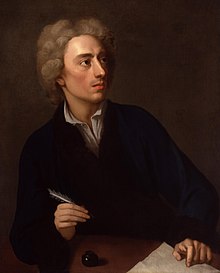
A.E. Housman is famous for three things: his scholarship, his poetry, and his scorn. He directed his venomous criticism at countless people over the years, but one of the early targets of his youth was Benjamin Jowett:
“The Regius Professor of Greek throughout Housman’s time was Jowett, and from the single lecture of Jowett’s which he attended, Housman came away disgusted by the Professor’s disregard for the niceties of scholarship.” [A.S.F. Gow, A.E. Housman: A Sketch (Cambridge : Cambridge University Press) p.5]
In his review of Gow’s book, G.L. Hendrickson circulates a rather embarrassing story about Jowett:
“The story is current in Oxford, I am told, that the particular offense of the Regius Professor was a false quantity, that cardinal crime of English tradition, the pronunciation of ἀκριβῶς, which from the English habit of applying Latin rules to Greek pronunciation yielded a monstrosity…” [G. L. Hendrickson, The American Journal of Philology, Vol. 58, No. 4 (1937), pp. 463]
This is not the only instance of Housman’s contempt for Jowett, who produced translations of Plato’s works, as well as a large commentary on The Republic. Housman noted of Jowett’s Platonic endeavours:
“Jowett’s Plato: the best translation of a Greek philosopher which has ever been executed by a person who understood neither philosophy nor Greek.” [C.O. Brink, English Classical Scholarship (Cambridge: James Clarke, 1986), p. 130]
In a more poetical vein, the following rhyme was popularly circulated when Jowett was Master of Balliol College:
“Here come I, my name is Jowett.
All there is to know I know it.
I am Master of this College,
What I don’t know isn’t knowledge!”
“The first thing philosophy promises is a shared communion, humanity and friendship with others. Our differences from others will keep us from this promise. We must examine that those very values through which we hope to create admiration do not become laughable and hateful”
Hoc primum philosophia promittit, sensum communem,humanitatem et congregationem. A qua professione dissimilitudo nos separabit. Videamus, ne ista, per quae admirationem parare volumus, ridicula et odiosa sint.
Orphica fr. 334
“I will sing to those who understand: blockheads, close your doors.”
ἀείσω ξυνετοῖσι, θύρας δ᾿ ἐπίθεσθε βεβήλοι
Epicurus’ Maxims
“Nature’s wealth is the finest and easiest to obtain. But the ‘wealth’ of empty beliefs trails endlessly away.”
“It seemed to him that all of creation was boundless, unchangeable, unmoveable, and a single thing, uniform and multiple. That there was no actual movement, only the appearance of motion. He also thought we should not talk about the gods since we have no knowledge about them.”
“It is needless to say that he never became a scholar in the strict sense of the term. Voltaire declared that he could hardly read or speak a word of French; and his knowledge of Greek would have satisfied Bentley as little as his French satisfied Voltaire. Yet he must have been fairly conversant with the best known French literature of the time, and he could probably stumble through Homer with the help of a crib and a guess at the general meaning. He says himself that at this early period, he went through all the best critics; all the French, English and Latin poems of any name; ‘Homer and some of the greater Greek poets in the original,’ and Tasso and Ariosto in translations.”
By chance a fox had seen a tragic mask:
What a sight, he has no brains inside!–he gasped.
To whomever fortune grants honor and glory,
It deprives of common sense, as in this story.
Personam tragicam forte vulpes viderat:
O quanta species, inquit, cerebrum non habet!
Hoc illis dictum est, quibus honorem et gloriam
Fortuna tribuit, sensum communem abstulit.
“If we descend from hence to the expression, we see the bright imagination of Homer shining out in the most enlivened forms of it. We acknowledge him the father of poetical diction; the first who taught that “language of the gods” to men. His expression is like the colouring of some great masters, which discovers itself to be laid on boldly, and executed with rapidity. It is, indeed, the strongest and most glowing imaginable, and touched with the greatest spirit. Aristotle had reason to say, he was the only poet who had found out “living words;” there are in him more daring figures and metaphors than in any good author whatever. An arrow is “impatient” to be on the wing, a weapon “thirsts” to drink the blood of an enemy, and the like, yet his expression is never too big for the sense, but justly great in proportion to it. It is the sentiment that swells and fills out the diction, which rises with it, and forms itself about it, for in the same degree that a thought is warmer, an expression will be brighter, as that is more strong, this will become more perspicuous; like glass in the furnace, which grows to a greater magnitude, and refines to a greater clearness, only as the breath within is more powerful, and the heat more intense.”
“An account of Euclides, a socratic, whose example the philosopher Taurus used to offer to students to encourage them to pursue philosophy doggedly.
The philosopher Taurus, a man praised in recent memory in Platonic studies, when he was encouraging students to apply themselves to philosophy with many wholesome and useful examples, especially used to stimulate young minds with an anecdote about what Euclides the Socratic used to do. He said “the Athenians had warned with a decree that if anyone who was a citizen of Megara set foot in Athens he should be arrested and that the punishment would be death. That is how great,” he continued, “a hatred was burning among the Athenians for their neighbors the Megarians. Then Euclides, who was in fact from Megara also, and who, before that decree, was in the habit of traveling to Athens to hear Socrates, after the decree, at night, when darkness was falling, would don the long tunic of a woman, and wrapped in a multicolor cloak with a veil across his face, he would travel from his own home in Megara to see Socrates so that he might spent at least some of the night present for his teaching and conversations. Again, before dawn, he used to return again from a distance a little more than twenty miles, clothed in the same way. But now,” Taurus continued,” it is more likely to see philosophers running to the doors of rich young men to teach them, only to set and wait until midday at their doors, until their students sleep off the last night’s wine.”
Historia super Euclida Socratico, cuius exemplo Taurus philosophus hortari adulescentes suos solitus ad philosophiam naviter sectandam.
1 Philosophus Taurus, vir memoria nostra in disciplina Platonica celebratus, cum aliis bonis multis salubribusque exemplis hortabatur ad philosophiam capessendam, tum vel maxime ista re iuvenum animos expergebat, Euclidem quam dicebat Socraticum factitavisse. 2 “Decreto” inquit “suo Athenienses caverant, ut, qui Megaris civis esset, si intulisse Athenas pedem prensus esset, ut ea res ei homini capitalis esset; 3 tanto Athenienses” inquit “odio flagrabant finitimorum hominum Megarensium. 4 Tum Euclides, qui indidem Megaris erat quique ante id decretum et esse Athenis et audire Socratem consueverat, postquam id decretum sanxerunt, sub noctem, cum advesperasceret, tunica longa muliebri indutus et pallio versicolore amictus et caput rica velatus e domo sua Megaris Athenas ad Socratem commeabat, ut vel noctis aliquo tempore consiliorum sermonumque eius fieret particeps, rursusque sub lucem milia passuum paulo amplius viginti eadem veste illa tectus redibat. 5 At nunc” inquit “videre est philosophos ultro currere, ut doceant, ad fores iuvenum divitum eosque ibi sedere atque opperiri ad meridiem, donec discipuli nocturnum omne vinum edormiant.”
Last year we posted a lot of fables. Why? Because they are fabulous. But, also, because they are fun, fascinating, and a fine way to seek shelter from current events (while still doing some thinking). Ancient literature does not include a great deal of critical reflection on the Fable, but we do find it prized at the beginning of an education (by Quintilian) and the end of Socrates’ life.
Quintilian, Inst. Orat. 1.9.1-3
“Therefore, let children learn to relay Aesop’s fables—which follow closely the stories of the nursery, in a simple speech and without adding too much and then to write them down in the same unadorned fashion. They should first analyze the verse, then interpret it in their own words, and finally expand it in their own version in which they may either compress some parts or elaborate others with without losing the poet’s meaning.”
[2] igitur Aesopi fabellas, quae fabulis nutricularum proxime succedunt, narrare sermone puro et nihil se supra modum extollente, deinde eandem gracilitatem stilo exigere condiscant; versus primo solvere, mox mutatis verbis interpretari, tum paraphrasi audacius vertere, qua et breviare quaedam et exornare salvo modo poetae sensu permittitur.
Do you think Cheiron taught Achilles fables?
Diogenes Laertius, Vita Philosophorum 2.5.45
“Then they sentenced[Socrates] to death, adding 80 additional votes to this tally. After he was imprisoned for just a few days, he drank the hemlock, but not without having a few exemplary conversations which Plato describes in the Phaedrus. He also composed a paian which begins: “Hail, Delian Apollo, and Artemis, famous children”. Dionysodôros says that this paian is not his. He also composed Aesopic tales in verse, though not completely well, one of which begins:
“Aesop once said to the men who live in Korinth,
Do not judge virtue according to a jury’s opinion”
And then he was taken from the world of men. Soon, the Athenians changed their minds and closed the wrestling floor and gymnasium. They banished the accusers but put Meletos to death. They honored Socrates with a bronze statue which they placed in the Pompeion. It was mad by Lysippos. As soon as Anytos visited Heracleia, the people expelled him. Not only did the Athenians suffer concerning Socrates, but according to Heracleides they fined Homer fifty drachmae because he was insane and they said Tyrtaeus was out of his mind and they even honored Astydamas and others more than Aeschylus with a bronze statue. Euripides rebukes them in his Palamedes when he says:
“You have butchered/ you have butchered
The all-wise nightingale of the muses
Who caused no harm”
This is one story. But Philochorus claims that Euripides died before Socrates.”
Diogenes is not completely fabricating material here. Plato’s Phaedo records that Socrates while imprisoned composed “poems, arranged versions of Aesop’s tales and a prooimon to Apollo” (ποιημάτων ὧν πεποίηκας ἐντείνας τοὺς τοῦ Αἰσώπου λόγους καὶ τὸ εἰς τὸν Ἀπόλλω προοίμιον, 60d). When asked why he was occupying his time in this way, Socrates responds (Phaedo 60e-61a):
“The same dream often came to me in my past life, appearing in different forms from time to time, but saying the same things: “Socrates, make music and work on it.” In earlier time, I believe that it was compelling me and encouraging me to do what I was doing—just as some cheer on runners, in the same way the dream was telling me to do what I was doing, to make music, since philosophy is the greatest music of all and I was working on that. But now that the trial is complete and the festival has delayed my death, it seemed right to me, if the frequent dream really meant for me to make what is normally called music, not to disobey it but to compose.”
“It is clear then that Plato, and not Athena – the mother of morals and education – decided that poets were to be expelled. Though six other cities claimed for themselves the honor of Homer’s birthplace, Athens itself, the seventh city of Greece, renowned for so many philosophers, glorified by so many citizens, and decorated by so many generals, most strenuously defended its own claim to be the birthplace of one man, who was blind while he lived, because he was a poet. Therefore, let not senseless garrulity condemn poets; first let people learn what poetry is, or what the business of poets is. Then, if they are so inclined, they may reprehend it. For the beginnings of poetic are are believed to have sprung forth from the most eloquent men, who were without doubt the most religious of their time and country. When it came to checking the savagery of those people whom they had raised to the sky more from admiration of their merits and virtues rather than considering anything human, the poets thought it useful that these men be cultivated by religion, and exerted themselves through praising them to persuade the people of this. They offered the most sublime style and the most ornate character of speech to this project, and wishing to excite the popular multitude to admiration of the men whom they praised, they did not employ a plain mode of speech, but changed words for other words and things for other things in the sweetest way, and thus led the listening people away from their senses to such a degree that, forgetting entirely about mortality, they believed with certainty that even those mortals whom they had seen themselves were not dead, but lifted into the heavens for their virtuous merits.”
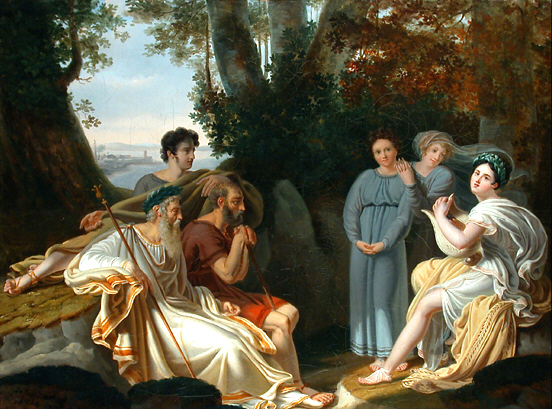
Charles Lafond, Sappho Sings for Homer
Censuit itaque Plato, non morum et doctrine mater Athene, pellendos esse poetas. Nam cum alie sex civitates ortum sibi vendicarent Homeri, ipse Athene, septima Grecie civitas, tot clara philosophis, tot civibus inclita, totque ducibus exornata, unius ceci dum viveret hominis, quia poeta fuit, nativitatem post eius fata sibi contentiosissime defendebant. Non ergo damnet poetas insensata garrulitas, sed prius addiscant quid poesis quodve poetarum officium, deinde, si videbitur, reprehendant. Nam huius artis initium a viris eloquentissimis atque secundum sua tempora et nationem religiosissimis sine dubio creditur provenisse. Cum enim ad cohibendam feritatem populorum eos quos illi meritorum atque virtutum admiratione plus quam humanum aliquid cogitantes extulerunt in celum, putarent utile religione colendos idque decernentibus populis suaderi ipsorum laudibus insudabant. Cui quidem rei sublimem stilum et ornatissimum dicendi caractherem adhibuerunt et volentes popularem multitudinem in eorum quos laudabant admirationem inducere non plano orationis genere sed verba pro verbis et res pro rebus suavissime commutantes audientes populos a sensibus taliter traducebant quod etiam quos viderant fuisse mortales non mortuos sed translatos in celum pro virtutum meritis mortalitatis illorum obliti certissima opinatione tenerent.
“Allegorically, he considers the cows of Helios to be days which the companions of Odysseus endure terribly, after which they wish to return home at last,
“According to myth, they claim that Poseidon went to the Aithiopians at a specific time to be honored by them; allegorically, Poseidon is said to be water. Since he is water, he is certainly the ocean which circles the earthy and, because the Nile waters the land of the Aithiopians at a specific time and grows their trees, they say that Poseidon as the water is honored among them as the provider of their many blessings.”
Allegorically, an uttered speech is called Hermes because of his hermeneutic nature and he is the director because he manages the soul’s thoughts and the mind’s reflections. He is Argeiphontes because he is bright and pure of murder. For he teaches, and evens out and calms the emotional part of the soul. Or, it is because he killed the dog Argos, which stands for madness and disordered thoughts. He is the one who makes the reflections of the mind appear bright and clean.
“The winds and every sort of breeze”: Some allegorize Proteus as matter itself. For without matter, they claim that the creator [could not] have made everything distinct. For, although matter is never clear to us, men, trees, water and all things come from it. Eidothea, you see, is thought. Matter produces thought once it is condensed. Others allegorize Proteus as the right part of the spring when the earth first begins to make the shapes of grapes and offspring. Menelaos, since it was not the right time for sailing and he missed the spring, sailed in the wrong direction. The name Proteus is suitable for allegory.”
“Tithonos is the son of Laomedon, Priam’s brother. He is a husband of Dawn [Eos]. Endumiôn is said to have married Selenê and Tithonos, the Day. The allegory works like this. Endumiôn is concerned with hunting man, and he goes to bed at night, but not so much at day because he is occupying his time with hunting affairs. Tithonos is appropriate for those interested in the stars and who take to bed at day but stay awake at night because they are occupying themselves with the stars.”
There are other interpretations. Some allegorize Aiolos as the year and his children as the twelve months. Some say that he that he paid special attention, because he was knowledgeable of astrology, of when the sun was blowing in the west in the bull position. Some winds blow sometimes and then move against themselves, as many do….