This is probably the briefest version of the Teiresias story I know. Here’s another paradoxographical account.
31 “Teiresias the son of Euêros, after he witnessed two snakes having sex, killed them and immediately turned into a woman. After not much time he was a man and was selected as a judge of the pleasure of a man and woman in sex before Zeus and Hera. He said that a woman has more.”
14 “In a certain part of Olympos near Prousa they record that Daphne was overcome as she was pursued by a lusting Apollo. And even to this day, the leaves of laurel can be found mixed among those rocks.”
30 “Pherecydes of Syros became extremely prophetic after drinking water from a certain spring on the island of Syros. He then predicted some earthquakes and other things.”
“There has been no civil war in our state which I can remember in which, regardless of which side was victorious, there was not some hope for a government in the future. In this conflict, however, I could not easily confirm what government we would have if we are victorious, but there will surely never be another if we lose.
This is why I put forth harsh legislation against Antony and Lepidus too, not so much for the sake of vengeance as to frighten the lawless citizens among us from besieging their own country and to prepare for posterity a reason why no one should desire to emulate such insanity.
Although this idea certainly was not more mine than everyone’s, in one way it seems cruel: the fact that children, who have earned none of this, suffer the same punishment as their parents. But this is an ancient practice which has existed in every kind of state. Even the children of Themistocles lived in deprivation! If the same penalty attends citizens condemned in court, how could we possibly be easier against our enemies? And what can anyone complain about me when he would have to admit that if he had defeated me he would have treated me worse?”
nullum enim bellum civile fuit in nostra re publica omnium quae memoria mea fuerunt, in quo bello non, utracumque pars vicisset, tamen aliqua forma esset futura rei publicae: hoc bello victores quam rem publicam simus habituri non facile adfirmarim, victis certe nulla umquam erit. dixi igitur sententias in Antonium, dixi in Lepidum severas, neque tam ulciscendi causa quam ut et in praesens sceleratos civis timore ab impugnanda patria deterrerem et in posterum documentum statuerem ne quis talem amentiam vellet imitari. quamquam haec quidem sententia non magis mea fuit quam omnium. in qua videtur illud esse crudele, quod ad liberos, qui nihil meruerunt, poena pervenit. sed id et antiquum est et omnium civitatum, si quidem etiam Themistocli liberi eguerunt. et si iudicio damnatos eadem poena sequitur civis, qui potuimus leniores esse in hostis? quid autem queri quisquam potest de me qui si vicisset acerbiorem se in me futurum fuisse confiteatur necesse est?
Siege of Montargis. Chroniques de France ou de Saint Denis (from 1422 to 1460) France, N. (Calais?); 1487. ff. 1-299v. British Library, Royal 20 E VI f. 22
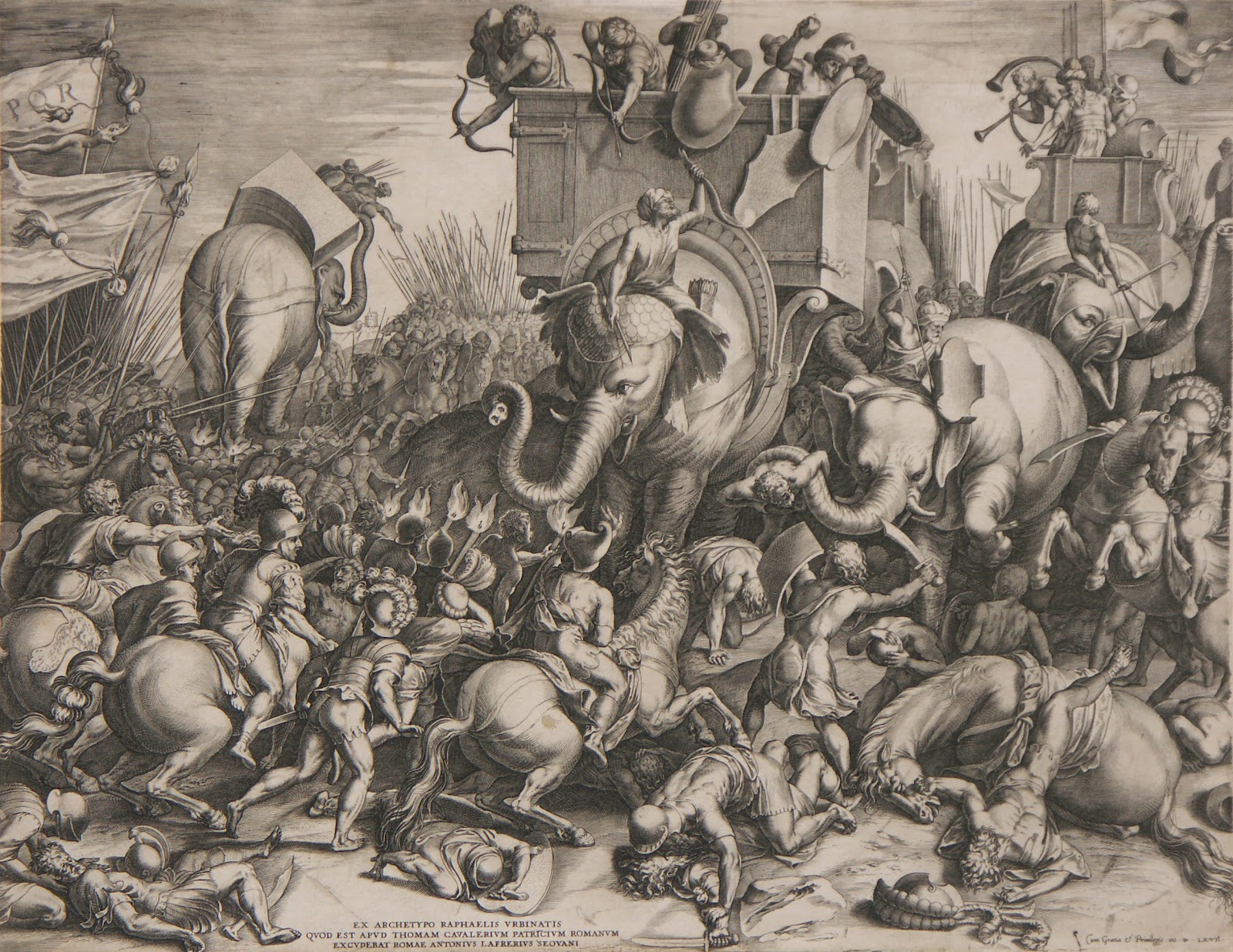
“Hannibal, the Carthaginian general, once delivered a most delightful witticism to Antiochus, the king among whom he was living in exile. The joke ran like this. Antiochus was showing him the huge forces which he had marshaled in the field to make war against the Romans, and he was ordering the army, resplendent in gold and silver, to turn around this way and that. He even brought in hooked chariots and elephants with towers and a cavalry with reins and fancy equipage, shining with collars and plates. There, the king, glorying in the contemplation of such a huge and well-equipped army, looked at Hannibal and asked, ‘Do you think that all of this is enough for the Romans?’ Hannibal, jesting about the idleness and weakness of the soldiers so expensively arrayed, responded, ‘I think that this should be enough for the Romans, even if they are the greediest people around.'”
Engraving of the Battle of Zama by Cornelis Cort, 1567
Hannibal Carthaginiensis apud regem Antiochum profugus facetissime cavillatus est. Ea cavillatio huiuscemodi fuit. Ostendebat Antiochus in campo copias ingentes quas bellum populo Romano facturus conparaverat, convertebatque exercitum insignibus argenteis et aureis florentem: inducebat etiam currus cum falcibus et elephantos cum turribus equitatumque frenis et ephippiis, monilibus ac faleris praefulgentem. Atque ibi rex contemplatione tanti et tam ornati exercitus gloriabundus Hannibalem aspicit et: Putasne, inquit, satis esse Romanis haec omnia? Tunc Poenus eludens ignaviam inbelliamque militum eius pretiose armatorum: Plane, inquit, satis esse credo Romanis haec, etsi avarissimi sunt.
Many are the forms of divine powers
Many are the acts the gods unexpectedly make.
The very things which seemed likely did not happen
but for the unlikely, some god found a way.
This turned out to be that kind of story.
[but also at the end of Alcestis, Medea, Andromache, Helen]
Lucian in The Symposium 48
“That, my dear Philo, was the end of that party. But it is better to intone that tragic phrase: ‘Many are the forms of divine powers / Many are the acts the gods unexpectedly make. / The very things which seemed likely did not happen’
For all these things too turned out to be unexpected. I have still learned this much now: it is not safe for a man who is unaccomplished to share a meal with clever men like this.”
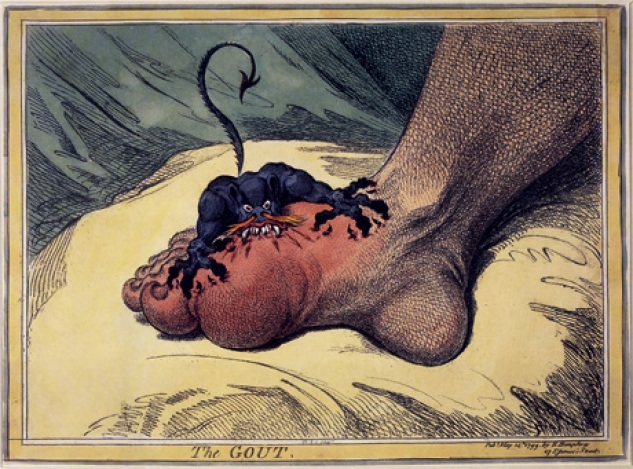
“Many are the forms of the unlucky
but let the care and habit of pains
bring some comfort to men with gout.
This is how, my fellow sufferers,
you will forget our toils,
if the very things which seemed likely did not happen
but for the unlikely, some god found a way.
Let every person who suffers endure
being taunted and being mocked.
For this affair is that kind of thing.”
J.E. Sandys, A History of Classical Scholarship, Vol. III – Lessing:
“The services rendered by Winckelmann, in bringing the old Greek world into connexion with modern life, were continued in a still larger measure by Gotthold Ephraim Lessing (1729 1781). His father was curate of Kamenz, a small town N.E. of Dresden. At the age of five, when it was proposed to paint his portrait with a bird-cage beside him, the future scholar vehemently protested: ‘you must paint me with a great, great heap of books, or I won’t be painted at all’. At thirteen, he was sent to the famous school of St Afra at Meissen, N.W. of Dresden. The education there given was mainly classical, and the boy’s private reading included Anacreon and the Characters of Theophrastus, as well as Plautus and Terence. He was only seventeen when he entered the university of Leipzig, where J. F. Christ was already lecturing on ancient art, and on Plautus and Horace, and Ernesti was ‘extraordinary professor of Eloquence’, while Kastner, the young professor of mathematics, was soon to give proof of his special interest in literature, and in Lessing. At Leipzig the young student became convinced that ‘books might make him learned, but could never make him a man’, and it was there that he produced his earliest play, a satire on the conceited self-complacency of a youthful pedant. The author had just become conscious of his own pedantry, his horizon had been widened, and the spirit of modern ‘enlightenment ‘ had breathed life into the dry bones of scholarship.”
13 “Herakleides says that there is a lake among the Sauromati which does not support any birds; any bird which approaches dies because of a smell. For this reason, indeed, [other lakes?] seem to be birdless throughout Italy.”
Kadmos
Oh, gods. Once you all understand what you have done,
You will feel a terrible pain. But if you stay permanently
forever as you are now
You will not be happy but you will not seem to be cursed.
Agave
What of this is not noble or is painful?
Kadmos
First move your gaze to the sky.
Agave
Look! What is this you are telling me to see?
Kadmos
Is this the same or does it seem to you to have changed?
Agave
It shines brighter than before and it is clearer
Kadmos
Is this high still there in your mind?
Agave
I don’t understand what you’re saying. But I think
I am somewhat aware, that I am coming down from my earlier thoughts.
Kadmos
Would you hear then and answer me clearly?
Agave
Father, I have forgotten what we said earlier.
Kadmos
To what home did you go after you were married?
Agave
You gave me to Ekhiôn, one of the sewn-men, people say.
Kadmos
Who is the child born to your husband at home?
Agave
Pentheus, the son shared by his father and me.
Kadmos
Whose face do you hold then in your hands?
Agave
A lion’s…that’s what my fellow hunters say…
Kadmos
Look again, carefully. It is a small labor to see.
Agave
Ah, what do I see? What is this I hold in my hands?
Kadmos
Examine it and learn it more clearly.
Agave
I see the greatest pain, what kind of wretch am I…
Kadmos
Does it seem to look like a lion to you?
Agave
No…but, oh wretched me I am holding Pentheus’ head…
Kadmos
This was mourned before you could see it, at least.
Agave
Who killed him? How did he end up in my hands?
Kadmos
How horrible a truth appears at the wrong time.
“Mortals! They are always blaming the gods
and saying that evil comes from us when they themselves
suffer pain beyond their lot because of their own recklessness.”