Parenting While Teaching Greek Badly

This week Eidolon started a special series on “Parenting and Classics”. I thought about submitting a proposal when they put out a call for this subject, but I was too busy finishing a book and spending the waning days of summer with my children. When I read Donna Zuckerberg’s moving series of impressions of learning to be a parent and a writer in “This is How I have It All“, I remembered those earlier days of parenting with both fondness and frustration. And Jason Nethercut’s piece “Her Absence is Like the Sky”, reflecting on the loss of his mother, took me back to how I found comfort in reading and teaching the Odyssey after my father passed.

I am interested to see what others write in this series because my life has been defined over the past decade by being a parent and a Classicist. And, for me, there have been ways in which playing these two roles has made me better at both. I re-learned wonder and patience from parenting–so much so that students who had me before I became a father noted the difference in the way I paced classes and engaged with students.

I also think that what Eidolon is doing with this series is critical. As ‘scholars’ we often assume a falsely objective pose that denies we inhabit experiences and bodies which shape the way we see the world. Being a parent as a fact and a process shapes us critically as readers, writers and teachers. And classicists with children occupy a wide range of positions in the precarious academic economy.

Euripides, Supp. 1101-2

“Nothing is sweeter to an old father than a daughter”

πατρὶ δ᾽ οὐδὲν †ἥδιον† / γέροντι θυγατρός

I also hesitated to submit a proposal to Eidolon because I feel guilty about claiming much credit or authority for my story. I have been really lucky in my career and exceptionally fortunate to meet a life partner before graduate school who has been a constant and positive presence for over 20 years. Like most couples of our generation, my wife and I have a two-career household. One of us is a dentist and works year round, earning considerably more than the other. Dentistry is a physically demanding job; being a professor gets us good health insurance. On paper, this is a sweet deal.

In real life, however, we often face gendered questions about parenting from friends, family members, colleagues and our children’s teachers. Even though my wife is the one with the Ivy-league credentials and the social cache of being a ‘real’ doctor, expectations still weigh more heavily on her as a mother: she is expected to be the primary parent. But given the demands of our jobs and the eminently flexible schedule I have, this is not how it works.

Early on when our daughter was 2 months old or so, we had that conversation most couples do in the deep AM. It was definitely my wife’s turn to get up and tend to the infant. When I mentioned this, she said “if I am too tired when I go to work tomorrow and make a mistake, I can paralyze someone’s face. What’s the worst that you can do, teach Greek badly?”

One of the reasons I always found being a teacher attractive is that it is one of the few careers that lets us be parents. I always knew I wanted to have children and when I thought about other careers I couldn’t imagine that all of the sacrifice of time and human experience was worth the money they paid.

Euripides, Fr. 685 (Phaedra)

“Children are the anchors of a mother’s life”

ἀλλ’ εἰσὶ μητρὶ παῖδες ἄγκυραι βίου

As our children have grown older, parenting has been less about getting up in the middle of the night and more about actually thinking about how these little beings are developing. My own work as a classicist has been deeply affected by this process because it has led me to think more about cognitive development, education, and how the stories we tell shape us.

About a month ago my daughter (7, now 8) tried to jump from a dresser to a bed and missed. She lacerated her leg 5 inches long and down to the bone. The wound had trouble healing and it took almost four weeks and several visits with plastic surgeons to get it closed and all the stitches out

I told her the scar gives her character and told her the story of Odysseus and the boar, how the scar he won as a child became the marker of who he was and the beginning of his famous story.

I also told her that some people think that the Roman name Ulysses may be related to the Greek word for scar (oulê) and that who he is was tied to this mark on his body. Now she sees the scar as something that is uniquely hers as something that marks her out as special, as giving her her own story.

Arsenius 12.42a

“Whatever love you bear for your parents expect the same kind in old age from your children”

Οἵους ἂν ἐράνους ἐνέγκῃς τοῖς γονεῦσι, τούτους αὐτοὺς ἐν τῷ γήρᾳ παρὰ τῶν παίδων προσδέχου Πιττακοῦ.

It is hard to write about being a parent while being a classicist without also acknowledging the extent to which my ability to do so and my experience of doing so is marked by privilege. As a man, I get to be a parent without undergoing the primary physical and emotional labor of pregnancy and birth. I also avoid nearly all the secondary labor of recovery and social/emotional stigma of going back to work and not being an ideal mother. What has been clear to me for a long time has been backed up by research—men in the workplace earn social and economic capital from having children while women lose it. This is equally true in the University where men are expected to do less service and get more of a pass for attending to parenting.

The gendered structure of our society lingers with us individually and shapes our institutions. When I bring my children to a meeting or to a class, people smile and think what a good father I am. And I do often get questions about what my spouse is doing. Women in the same position, however, receive fewer smiles and rarely a question about why a partner is not available for childcare.

Euripides, Suppliant Women, 913-917

“For even an infant learns to speak
And listen to things he has no understanding of.
Whatever someone learns, he wants to save
For old age. So, teach your children well.”

..εἴπερ καὶ βρέφος διδάσκεται
λέγειν ἀκούειν θ᾿ ὧν μάθησιν οὐκ ἔχει.
ἃ δ᾿ ἂν μάθῃ τις, ταῦτα σῴζεσθαι φιλεῖ
ἐς γῆρας. οὕτω παῖδας εὖ παιδεύετε.

So, for me, talking about being a parent and a professor is over-determined. I ‘win’ if I talk about it; I win if I don’t. Yes, I am a primary caregiver; yes being a professor is mostly a full time job. But I am privileged again because I have never been outside the tenure track and was already in a secure position vis a vis tenure when we had our first child. I have had to be bad at my job at times to be an acceptable parent; I have often been a mediocre parent in order to be competent at my job. The two worlds I inhabit are always intersecting and overlapping. But this is the type of life I wanted.

In all the talk of the casualization of academic labor and the lives the majority of our PhDs are given to live, we do not acknowledge enough that there is a human cost in lives foreclosed. A generation of PhDs in precarious financial and social positions face difficult and sometimes impossible choices when it comes to starting and raising families.

Seneca, EM 3.3 (24)

“What you see happen to children happens to us, too, who are but slightly greater children.”

quod vides accidere pueris, hoc nobis quoque maiusculis pueris evenit.

I don’t really know where I meant to end up when I started writing this. I am really, really happy to be a parent and almost equally so to actually have a career as a classicist. I am often exhausted and I find myself sometimes anxious that I am not doing either thing equally well, but I know that my experiences in each have enriched my enjoyment of the other.

My lament is that we do not endeavor as a society and in the academy to ensure that everyone has the same opportunity to live both lives fully. There are hundreds of changes we as a society need to make, such as guaranteeing paid maternity leave (longer than 8 weeks by at least 42 more), providing universal health care, universal early childhood care for parents who choose to go to work, and universal pre-k nationwide. We cannot be a nation that cares about families while also legislating to punish (non-wealthy) people who choose to have them.

Many of these needs are outside our influence in the academy. But we can do more in our home institutions. We need more support for adjunct labor and graduate students who have families (or, let’s do away with adjunct labor in general and just pay college teachers living wages). We need childcare centers on all campuses for students, staff and faculty. We need to treat our staff with the same dignity we treat our faculty. We need to be models of the fully lived and enlightened lives we think the humanities can guide us to live.

Lucretius, De Rerum Natura 5.218-227

“Why does nature nourish and increase the races
of horrible beasts, enemies to humankind on land and sea?
Why do the seasons of the year bring diseases?
Why does an early death come suddenly?
So a child, just like a shipwrecked man tossed by savage waves,
lies naked and speechless on the ground needing everything required
to support life at the very moment when nature pours him
from his mother’s womb into the world of light,
he fills the room with a sorrowful wail, as if he knows
the measure of troubles that still remain for him to endure in life.”

praeterea genus horriferum natura ferarum
humanae genti infestum terraque marique
cur alit atque auget? cur anni tempora morbos
adportant? quare mors inmatura vagatur?
tum porro puer, ut saevis proiectus ab undis
navita, nudus humi iacet infans indigus omni
vitali auxilio, cum primum in luminis oras
nixibus ex alvo matris natura profudit,
vagituque locum lugubri complet, ut aequumst
cui tantum in vita restet transire malorum.

20180824_120552
Children make a new friend at Delphi Museum.

Marius Says: F**k Greek Literature!

Sallust, Bellum Iugurthinum (85)

[Marius speaking:]

“My words are not artfully chosen. I don’t give a shit about that. Virtue shows herself without any help. Only those who want to hide their shameful conduct with rhetoric have need of artifice. I also didn’t learn Greek literature: I had no desire to learn that, since it apparently never did anything to enhance the virtue of its teachers. Instead, I learned all about the things which do the best for the Republic: to assault the enemy, to move the defenses, to fear nothing except a bad reputation, to suffer summer blazes and winter frosts equally, to sleep on the ground, and to tolerate neediness and labor at the same time. I will exhort my soldiers with these precepts, but I will not coddle them with art, and I will make myself, not my glory, their work. This is useful, this is civic power. For, when you conduct the army safely through idle softness and drive it on with punishment, that is to be a master, not a general.”

Image result for marius roman general
John Vanderlyn, Marius Amid the Ruins of Carthage

Non sunt composita verba mea: parvi id facio. Ipsa se virtus satis ostendit; illis artificio opus est, ut turpia facta oratione tegant. Neque litteras Graecas didici: parum placebat eas discere, quippe quae ad virtutem doctoribus nihil profuerant. At illa multo optima rei publicae doctus sum: hostem ferire, praesidia agitare, nihil metuere nisi turpem famam, hiemem et aestatem iuxta pati, humi requiescere, eodem tempore inopiam et laborem tolerare. His ego praeceptis milites hortabor, neque illos arte colam, me opulenter, neque gloriam meam, laborem illorum faciam. Hoc est utile, hoc civile imperium. Namque cum tute per mollitiem agas, exercitum supplicio cogere, id est dominum, non imperatorem esse.

Sweetest in Life: Exploring the Unknown

Sayings Attributed to Socrates in the Gnomologium Vaticanum.

470

“Socrates, when asked what is sweetest in life, said “education, virtue, and the investigation of the unknown”

Σωκράτης ὁ φιλόσοφος ἐρωτηθεὶς τί ἥδιστον ἐν τῷ βίῳ εἶπε· „παιδεία καὶ ἀρετὴ καὶ ἱστορία τῶν ἀγνοουμένων”.

471

“Socrates, when asked what possession is the most advantageous, said “a steadfast friend.”

Σωκράτης ἐρωτηθεὶς τί κτῆμα συμφορώτατον εἶπε· „φίλος βέβαιος.”

478

After he had been condemned to die by the Athenians and when his wife Xanthippe was weeping and saying “Socrates, you are dying unjustly”, Socrates the Athenian said to her “would you want me to die justly?”

Σωκράτης ᾿Αθηναῖος καταδικασθεὶς ὑπὸ ᾿Αθηναίων κατακρημνισθῆναι τῆς γυναικὸς Ξανθίππης κλαιούσης καὶ λεγούσης· „ὦ Σώκρατες, ἀδίκως ἀποθνήσκεις” εἶπε πρὸς αὐτήν· „σὺ οὖν ἐβούλου με δικαίως ἀποθνήσκειν;”

484

“When Socrates saw an uneducated wealthy man he said “Look, a golden sheep!”

<Σ>ωκράτης ἰδὼν πλούσιον ἀπαίδευτον „ἰδού,” φησί, „τὸ χρυσοῦν πρόβατον.”

485

“Socrates used to say that jealousy is a wound from the truth.”

Σωκράτης ἔλεγε τὸν φθόνον ἕλκος εἶναι τῆς ἀληθείας.

489

“When Socrates was asked if the world is spherical he said “I haven’t examined it from every side.”

Ὁ αὐτὸς ἐρωτηθεὶς εἰ σφαιροειδής ἐστιν ὁ κόσμος ἔφη· ” οὐχ ὑπερέκυψα.”

499

“When he was asked why he was not writing any treatises, Socrates said “because I see the unwritten selling for more than the written.”

῾Ο αὐτὸς ἐρωτηθεὶς διὰ τί συντάγματα οὐ γράφει ἔφη· „ὅτι τὰ ἄγραφα τῶν γεγραμμένων ὁρῶ πλείονος πωλούμενα.”

Image result for Socrates ancient Greek

Or, there’s this:


Homer Lies! And He was Poor!

Dio Chrysostom, Oration 11. 15-19

“First, men claim that Homer was a beggar in Greece because of poverty and lack of means. But they believe that this sort of a man is incapable of lying for the sake of those who gave him things, that he would not say the sorts of things he would intend only to please them!

Yet people say that beggars today say nothing credible, no one ever provides one as a witness on anything, nor do they ever accept praise from them as something true. For they know that beggars say everything to manipulate, by necessity. And then they say that some people gave money to a beggar while others gave money to a madman and that they think the people then decided he was crazy when he was speaking truth rather than lying.

Really, I am not so much rebuking Homer in these things. For nothing prevents a wise man from begging or seeming insane. But I am saying that, according to the belief people hold about Homer and these sort of men, nothing they say is believable.”

“Furthermore, they do not believe that lying is in Homer’s nature or that he employs this sort of thing at all. Yet he makes Odysseus lie the most, a man he praises, and he says that Autolykos even breaks an oath and that this was granted to him by Hermes! Nearly everyone agrees that Homer says nothing true about the gods, even those who praise him, and they try to offer various defenses, that he does not say these things because he means them but because he is riddling and using metaphor. What keeps him from speaking this way about men too?

For, whoever speaks nothing manifestly true about the gods, but so much to the contrary that that people who encounter them take them as lies—and which bring no help to the singer—how would he hesitate to utter any kind of falsehood about men too? Many have previously noted that he has created gods grieving and groaning, wounded and nearly dying, and has added divine adulteries, bonding, and vows. I don’t wish to prosecute Homer, only to show what the truth was. I will also defend the matters as they seem to me. I say that he showed no hesitation in lying and did not think it a shame. I will move now to consider whether he was right or not.”

πρῶτον μὲν οὖν φασι τὸν ῞Ομηρον ὑπὸ πενίας τε καὶ ἀπορίας προσαιτεῖν ἐν τῇ ῾Ελλάδι· τὸν δὲ τοιοῦτον ἀδύνατον ἡγοῦνται ψεύσασθαι πρὸς χάριν τῶν διδόντων, οὐδ’ ἂν τὰ τοιαῦτα λέγειν ὁποῖα ἔμελλεν ἐκείνοις καθ’ ἡδονὴν ἔσεσθαι· τοὺς δὲ νῦν πτωχοὺς οὐδέν φασιν ὑγιὲς λέγειν, οὐδὲ μάρτυρα οὐδεὶς ἂν ἐκείνων οὐδένα ποιήσαιτο ὑπὲρ οὐδενός, οὐδὲ τοὺς ἐπαίνους τοὺς παρ’ αὐτῶν ἀποδέχονται ὡς ἀληθεῖς. ἴσασι γὰρ ὅτι πάντα θωπεύοντες ὑπ’ ἀνάγκης λέγουσιν. ἔπειτα δὲ εἰρήκασι τοὺς μὲν ὡς πτωχῷ, τοὺς δὲ ὡς μαινομένῳ ἀπάρχεσθαι, καὶ μᾶλλον οἴονται τοὺς τότε καταγνῶναι αὐτοῦ μανίαν τἀληθῆ λέγοντος ἢ ψευδομένου. οὐ μὴν ὅσον γε ἐπὶ τούτοις ψέγω ῞Ομηρον· κωλύει γὰρ οὐθὲν ἄνδρα σοφὸν πτωχεύειν οὐδὲ μαίνεσθαι δοκεῖν· ἀλλ’ ὅτι κατὰ τὴν ἐκείνων δόξαν, ἣν ἔχουσι περὶ ῾Ομήρου καὶ περὶ τῶν τοιούτων, εἰκός ἐστι μηθὲν ὑγιὲς εἶναι τῶν εἰρημένων ὑπ’ αὐτοῦ.

οὐ τοίνυν οὐδὲ τόδε νομίζουσιν, οὐκ εἶναι ἐν τῇ ῾Ομήρου φύσει τὸ ψεῦδος οὐδὲ ἀποδέχεσθαι αὐτὸν τοιοῦτον <οὐδέν>· πλεῖστα γοῦν τὸν ᾿Οδυσσέα πεποίηκε ψευδόμενον, ὃν μάλιστα ἐπῄνει, τὸν δὲ Αὐτόλυκον καὶ ἐπιορκεῖν φησι, καὶ τοῦτ’ αὐτῷ παρὰ τοῦ ῾Ερμοῦ δεδόσθαι. περὶ δὲ θεῶν πάντες, ὡς ἔπος εἰπεῖν, ὁμολογοῦσι μηθὲν ἀληθὲς λέγειν ῞Ομηρον καὶ οἱ πάνυ ἐπαινοῦντες αὐτόν, καὶ τοιαύτας ἀπολογίας πειρῶνται πορίζειν, ὅτι οὐ φρονῶν ταῦτ’ ἔλεγεν, ἀλλ’ αἰνιττόμενος καὶ μεταφέρων. τί οὖν κωλύει καὶ περὶ τῶν ἀνθρώπων αὐτὸν οὕτως εἰρηκέναι; ὅστις γὰρ περὶ θεῶν οὐ φανερῶς τἀληθῆ φησιν, ἀλλὰ τοὐναντίον οὕτως ὥστε τὰ ψευδῆ μᾶλλον ὑπολαμβάνειν τοὺς ἐντυγχάνοντας, καὶ ταῦτα μηδὲν ὠφελούμενος, πῶς ἂν περί γε ἀνθρώπων ὀκνήσειεν ὁτιοῦν ψεῦδος εἰπεῖν; καὶ ὅτι μὲν πεποίηκεν ἀλγοῦντας τοὺς θεοὺς καὶ στένοντας καὶ τιτρωσκομένους καὶ ἀποθνῄσκοντας σχεδόν, ἔτι δὲ μοιχείας καὶ δεσμὰ καὶ διεγγυήσεις θεῶν, οὐ λέγω, πρότερον εἰρημένα πολλοῖς. οὐδὲ γὰρ βούλομαι κατηγορεῖν ῾Ομήρου, μόνον δὲ ἐπιδεῖξαι τἀληθὲς ὡς γέγονεν· ἐπεί τοι καὶ ἀπολογήσομαι περὶ αὐτοῦ τὰ ἐμοὶ δοκοῦντα. ὅτι δὲ τὸ ψεῦδος οὐκ ὤκνει πάντων μάλιστα οὐδὲ αἰσχρὸν ἐνόμιζε, τοῦτο λέγω· πότερον δὲ ὀρθῶς ἢ μὴ παρίημι νῦν σκοπεῖν.


Image result for Dio Chrysostom
Trojan-War Truther Types on Tablet

Caesarean Section: Thoughts on Reception and Teaching

Let me get into character – doing my best Ray Liotta – to tell you that as far back as I can remember, I always wanted to be a scholar. Though Henry Hill may have achieved his  mafioso dreams, I did not have the courage to pursue mine, and so in 2008 I had a lowly B.A. in Classics, a head full of preposterously impractical ideas, and an urgent need to secure gainful employment. You will not be surprised, then, to read that I found myself seated on the opposite side of the headmaster’s desk at a small private school, one of the chief resorts for unemployed Classics majors who would like to remain in some small way connected to the field. My interview with the headmaster went spectacularly well until she asked whether I was the sort of Latinist who read anything simply because it was written in Latin. Without hesitation, I responded that I avoided some large chunks of the surviving corpus, most especially Caesar, whom I would not even read in English.

Perhaps it is idle folly to wish for a different past, and perhaps I would have hated that job, which you may be sure was not offered to me. Indeed, my heroic Catonian stand against the Caesarean tyranny of the Latin prose canon could scarcely have earned me any points on the hiring ledger. Yet, for the longest time, I struggled with appreciating Caesar, whose writing literally put me to sleep on countless occasions.

A year or two later, a friend who did manage to secure a Latin teaching post told me that he was ‘savoring Caesar’s delicious prose.’ This was enough to make a man spew. But simultaneously, the judgment of generations of critics, culminating in the aesthetic pronouncements of a trusted friend, can at least be granted some consideration, and I began to wonder whether I was missing something. Of course, I did not follow up on this thought, and forgot about Caesar until I myself became a highschool teacher and was forced to teach him just as the students are forced to read him.

If we take Suetonius’ word for it, Cicero and other contemporaries admired Caesar’s prose style:

“Certainly, Cicero, in numbering the orators to Brutus, denied that he saw anyone to whom Caesar should yield, and he said that had an elegant, shining, and even magnificent and in some way noble mode of speaking. And he once wrote to Cornelius Nepos about Caesar: ‘What? What orator, among those who have done nothing but public speaking, would you place above Caesar? Who was sharper or more well-endowed in his phrases? Who was more ornate or more elegant in his words?”

Certe Cicero ad Brutum oratores enumerans negat se videre, cui debeat Caesar cedere, aitque eum elegantem, splendidam quoque atque etiam magnificam et generosam quodam modo rationem dicendi tenere; et ad Cornelium Nepotem de eodem ita scripsit: ‘quid? oratorem quem huic antepones eorum, qui nihil aliud egerunt? quis sententiis aut acutior aut crebrior? quis verbis aut ornatior aut elegantior?’

[Suetonius, Caesar 55]

Cicero seems to have supposed that Caesar would have been by far the greatest Latin writer had he not applied himself to other matters: capax scribendi nisi imperasset or something of the sort. Caesar seems to have been known for his wit as well, and Macrobius cites him for his popular stylistic advice:

“I would avoid an uncommon and unusual word as a sailor avoids the rocks.”

tamquam scopulum, sic fugiam infrequens atque insolens verbum

In this way, Caesar seems to resemble Samuel Johnson. Boswell’s Life of Johnson is replete with wit, pointed phrasing, and wonderful critical remarks which are much harder to find in Johnson’s own essays. When contrasted with his famous one liners and other assorted remarks, Johnson’s essays feel turgid and flat. Surely, some of this may be attributed to the shifting standards of prose fashion, but it is hard not to get the sense that the Johnsoniana are far better testaments to his genius than his considered prose. We have some scraps of Caesareana, but it is in some cases difficult to determine just how seriously to take this. A few of the best pieces are from Suetonius, as for example the quip about Sulla not knowing his ABC’s.

The high school teacher must take the man who butchered a nation and wrote a lucid prose account of it and make him appeal to teenagers. Naturally enough, they go in for the stories about his adultery and sensational murder, but all of this is external to the text itself. The opposite seems to be the case with Cicero. Students seem to love him until reading biographical details and Ciceroniana; they have much the same reaction as Petrarch, who was so saddened to discover from Cicero’s letters that he was just as petty as the rest of us. Similarly, they find that Caesar is just as boring as their teacher!

Yet, the cruel irony of all of this is that I myself have begun to enjoy reading Caesar, perhaps most of all because he is not the sort of author that I usually understand, sympathize with, or appreciate. As I begin my fourth year teaching AP Latin, I find that Caesar has at least substantially improved my knowledge of geography and ancient warfare. I recall having a similar experience when I first read the Odyssey in Greek and realized that I had no knowledge of nautical terminology. (I should note here that I have learned the English words, but have no idea what the English means. This is a state of ignorance with which I can feel reasonably content.)

My students know about my own history of Caesarean reception, if only because I would have them remember that we despise much of what we read when we are young, but this is simply a step in the development of a more refined judgment which, paradoxically, may embrace more as it advances. Never would I have re-crossed the Rubicon if not under compulsion. Few of my students keep up with their Latin immediately after graduation, and I would still hope that if they took Latin back up in middle age they would pick something a bit more lively than the world’s second most famous J.C. Yet, if they return at all, if they remember to keep revisiting those dusty and long-dismissed old codices, they may find that the cobwebs give way to a certain luster, and they may realize that the Elder Pliny was right when he said that no book was so bad that it didn’t have at least one good passage.

Image result for julius caesar
“We hated your book!”

Don’t Spend the Whole Day in Study

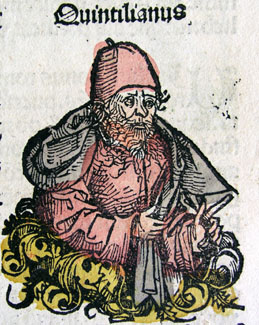
Quintilian, Institutio Oratoria 1.12:

“Therefore, since a teacher is unable and really ought not to take up the whole day, lest they turn away the learner’s mind with tedium, with what studies should we endow our free time? For, I would not have the student consumed in these arts: let them not dance or take up songs in musical modes, and let them not descend all the way to the most minute geometrical works. I do not make a comedian in pronunciation nor a dancer in movement. If I were to work through all of this, there was nevertheless plenty of time. The age suited to learning is long, and I am not speaking of slow intellects. Then why did excel in all of these things which I think should be learned by the future orator? He was not content with the studies which Athens was able to offer, and not content with the studies of the Pythagoreans, whom he had sailed to in Italy, he at last traveled even to the priests of Egypt, and learned their secret mysteries.”

Image result for quintilian

Ergo cum grammaticus totum diem occupare non possit, nec debeat ne discentis animum taedio avertat, quibus potius studiis haec temporum velut subsiciva donabimus? Nam nec ego consumi studentem in his artibus volo: nec moduletur aut musicis notis cantica excipiat, nec utique ad minutissima usque geometriae opera descendat; non comoedum in pronuntiando nec saltatorem in gestu facio. Quae si omnia exigerem, suppeditabat tamen tempus; longa est enim quae discit aetas, et ego non de tardis ingeniis loquor. Denique cur in his omnibus quae discenda oratori futuro puto eminuit Plato? Qui non contentus disciplinis quas praestare poterant Athenae, non Pythagoreorum, ad quos in Italiam navigaverat, Aegypti quoque sacerdotes adiit atque eorum arcana perdidicit.

Hey Man, Is That a Mustache or a Wine Strainer?

Diodorus Siculus 5.28:

“The Gauls possess good bodily proportions, their skin is wet and white, and their hair is blonde not just from nature, but also on account of the preparation which they employ to increase the peculiar nature of that color. They constantly wash their hair with chalk diluted in water, and use this from the ends of their bangs all the way to the top of their scalp and the outer reaches of their hair, in such a way that they seem in appearance like Satyrs or Pans. Their hair is thickened by this routine, such that it seems little different from the hair on a horse’s mane.

Some of them shave their cheeks, and others will let their beards grow a bit. The nobles shave their cheeks, but let their moustaches grow out to the point that they cover their lips. For that reason, their mustaches get full of food, and when they drink, it is as though their beverages are run through a strainer.”

Image result for vercingetorix

Οἱ δὲ Γαλάται τοῖς μὲν σώμασίν εἰσιν εὐμήκεις, ταῖς δὲ σαρξὶ κάθυγροι καὶ λευκοί, ταῖς δὲ κόμαις οὐ μόνον ἐκ φύσεως ξανθοί, ἀλλὰ καὶ διὰ τῆς κατασκευῆς ἐπιτηδεύουσιν αὔξειν τὴν φυσικὴν τῆς χρόας ἰδιότητα. Τιτάνου γὰρ ἀποπλύματι σμῶντες τὰς τρίχας συνεχῶς {καὶ} ἀπὸ τῶν μετώπων ἐπὶ τὴν κορυφὴν καὶ τοὺς τένοντας ἀνασπῶσιν, ὥστε τὴν πρόσοψιν αὐτῶν φαίνεσθαι Σατύροις καὶ Πᾶσιν ἐοικυῖαν· παχύνονται γὰρ αἱ τρίχες ἀπὸ τῆς κατεργασίας, ὥστε μηδὲν τῆς τῶν ἵππων χαίτης διαφέρειν. Τὰ δὲ γένεια τινὲς μὲν ξυρῶνται, τινὲς δὲ μετρίως ὑποτρέφουσιν· οἱ δ´ εὐγενεῖς τὰς μὲν παρειὰς ἀπολειαίνουσι, τὰς δ´ ὑπήνας ἀνειμένας ἐῶσιν, ὥστε τὰ στόματα αὐτῶν ἐπικαλύπτεσθαι. Διόπερ ἐσθιόντων μὲν αὐτῶν ἐμπλέκονται ταῖς τροφαῖς, πινόντων δὲ καθαπερεὶ διά τινος ἡθμοῦ φέρεται τὸ πόμα.

Sleep, Death, and Dying: Some Anecdotes for a Monday

These sayings come from the Gnomologium Vaticanum

128 “When Aesop was asked by someone how the greatest trouble might occur among people he responded “If the dead return and ask for their stuff back.”

῾Ο αὐτὸς ἐρωτώμενος ὑπό τινος πῶς ἂν μεγίστη ταραχὴ γένοιτο ἐν ἀνθρώποις ἔφη· „εἰ οἱ τετελευτηκότες ἀναστάντες ἀπαιτοῖεν τὰ ἴδια.”

160 “Biôn used to say that [we have] two teachers for death: the time before we were born and sleep.”

Βίων ἔλεγε δύο διδασκαλίας θανάτου εἶναι, τόν τε πρὸ τοῦ γενέσθαι χρόνον καὶ τὸν ὕπνον.

446 “Plato said that sleep was a short-lived death but death was a long-lived sleep.”

῾Ο αὐτὸς ἔφησε τὸν μὲν ὕπνον ὀλιγοχρόνιον θάνατον, τὸν δὲ θάνατον πολυχρόνιον ὕπνον.

64 “Anaxarkhos, the natural philosopher, when king Alexander said to him “I will hang you” responded: “Threaten others. It is no difference to me whether I rot above or below the earth.”

᾿Ανάξαρχος, ὁ φυσικὸς φιλόσοφος, ᾿Αλεξάνδρου τοῦ βασιλέως εἰπόντος αὐτῷ· „κρεμῶ σε”, „ἄλλοις”, ἔφη, „ἀπείλει· ἐμοὶ δὲ οὐδὲν διαφέρει ὑπὲρ γῆς ἢ κατὰ γῆς σήπεσθαι.”

Image result for ancient greek sleep and death vase
Sleep and Death on the Euphronios Krater

Some Sunsets and Sunrises in Greece

ἡ ἡλίου ἀνατολή: “sunrise”

ἅμ᾿ ἡλίῳ ἀνέχοντι: “at sunrise”

ἡ ἡλίου δύσις: “sunset

πρὸ ἡλίου δύντος: “before sunset”


 ῏Ημος δ’ ἠριγένεια φάνη ῥοδοδάκτυλος ᾿Ηώς,

“When mist-born, rosy-toed Dawn appeared again…” Il. 24.788

I was in Greece last week for the first time (I know, I know) and I tried to follow my own advice for living, so I was up early and out late. In a handful of days we were in Athens and Santorini, but we also visited Cape Sounion and Delphi. I will post some pictures from Delphi separately.

Here is the sunset from a restaurant in Fira (Thera), Santorini

20180821_192242

10 minutes or so later.

20180821_195552


Here is the Parthenon around sunrise from an early morning run.20180823_061209[1]

From the same day, the Acropolis at sunset from the Galaxy bar in the Hilton

20180823_200136

After sunset, the lights came on

20180823_202955

Here is the view from Cape Sounion an hour or so before sunset.

IMG_4202

The temple to Poseidon on Cape Sounion

20180825_184134

20180825_184053

From God-Fearing to Atheist

Two Stories about the god-hating Diagoras

Sext. Emp. Against the Scientists 9. 53

“People say that Diagoras the Melian poet of Dithyramb was early on as god-fearing as any other person, since he began his own poem in this way: “everything happens thanks to god and chance.” But when he was harmed by someone who made a false oath and his assailant suffered nothing because of this, he began to say that “there is no god”.

Schol. in Ael. Arist. Rhet= ii 80 Dindorf

“The Diagoras in question was a philosopher. Once, when he was invited to a dinner-party by another philosopher, while his host was boiling lentil and was outside for some reason, the lentils could not be completely boiled because there was no fuel for the fire underneath them. So, Diagoras searched around and, once he found a statue of Herakles nearby, he broke it and tossed it in the fire, intoning “in addition to his twelve labors, divine Herakles now completes this thirteenth.”

Sext. Emp. Against the Scientists 9. 53

Διαγόρας δὲ ὁ Μήλιος διθυραμβοποιὸς ὥς φασι τὸ πρῶτον γενόμενος ὡς εἴ τις καὶ ἄλλος δεισιδαίμων, ὅς γε καὶ τῆς ποιήσεως ἑαυτοῦ κατήρξατο τὸν τρόπον τοῦτον· κατὰ δαίμονα καὶ τύχην πάντα τελεῖται· ἀδικηθεὶς δὲ ὑπό τινος ἐπιορκήσαντος καὶ μηδὲν ἕνεκα τούτου παθόντος μεθηρμόσατο εἰς τὸ λέγειν μὴ εἶναι θεόν.

Schol. in Ael. Arist. Rhet= ii 80 Dindorf

Διαγόρας οὗτος φιλόσοφος ἦν. κληθεὶς δέ ποτε εἰς ἑστιάσιν ὑφ᾿ ἑτέρου φιλοσόφου, ἕψοντος ἐκείνου φακῆν καὶ κατά τινα χρείαν ἔξω 〚ἐκείνου〛 χωρήσαντος, τῆς φακῆς μὴ τελέως ἑψηθῆναι δυναμένης διὰ τὸ μὴ ὑπέκκαυμα ἔχειν τὸ ὑποκείμενον πῦρ, αὐτός τε περιστραφεὶς ὧδε κἀκεῖσε καὶ τὸ τοῦ Ἡρακλέους ἄγαλμα προχείρως εὑρὼν καὶ συντρίψας ἐνίησι τῷ πυρὶ ἐπειπὼν ἐπ᾿ αὐτό· δώδεκα τοῖσιν ἄθλοις τρισκαιδέκατον τόνδ᾿ ἐτέλεσεν Ἡρακλῆς δῖος.

Image result for Ancient Greek Wooden statue hercules