‘Humanitas’ or Slavery?

Tacitus, Agricola (21):

“The following winter was sent in the most salutary counsels. For, as people who live spread out, uncultured, and every ready for war will in peace grow accustomed to leisure through its pleasures, they urge privately and help publicly to erect temples, forums, and homes by praising the industrious and censuring the lazy: so was the eager striving after honor something of a necessity. Now indeed they began to educate the sons of the chief men in the liberal arts, and to prefer the natural intelligence of the British to the studies of the Gauls, such that those who recently declined to learn the Latin language now desired eloquence. From there proceeded the honor of our clothing and the frequent wearing of the toga. Gradually, there was a departure to various incitements to vice, such as the porticoes, the baths, and the elegance of dinner parties. Among the ignorant, this was called humanity, when it was really just a part of their slavery.”

Image result for tacitus agricola

Sequens hiems saluberrimis consiliis absumpta. Namque ut homines dispersi ac rudes eoque in bella faciles quieti et otio per voluptates adsuescerent, hortari privatim, adiuvare publice, ut templa fora domos extruerent, laudando promptos, castigando segnis: ita honoris aemulatio pro necessitate erat. Iam vero principum filios liberalibus artibus erudire, et ingenia Britannorum studiis Gallorum anteferre, ut qui modo linguam Romanam abnuebant, eloquentiam concupiscerent. Inde etiam habitus nostri honor et frequens toga; paulatimque discessum ad delenimenta vitiorum, porticus et balinea et conviviorum elegantiam. Idque apud imperitos humanitas vocabatur, cum pars servitutis esset.

The Athenians are Nice! (A Roman Writes From Athens)

Cicero, Letters to Atticus, 5.10 27 (June 51)

“What else besides? Nothing really except for this. Athens has been a delight to me, when it comes to the city and its decoration and the love that its people show you, a certain kind of goodwill they have for us. But many things have been changed and philosophy is disordered this way and that. If there is anything left, it is Aristos’ and I am staying with him.

I left your, or rather ‘our’, friend Zeno to Quintus even though he is close enough that we are together the whole day. I wish that you will write me of your plans as soon as you can so I may know what you are doing and where you will be at which time and, especially, when you will be in Rome.

Quid est praeterea? nihil sane nisi illud: valde me Athenae delectarunt, urbe dumtaxat et urbis ornamento et hominum amore in te, in nos quadam benevolentia; sed mu<tata mu>lta.6 philosophia sursum deorsum. si quid est, est in Aristo, apud quem eram; nam Xenonem tuum vel nostrum potius Quinto concesseram, et tamen propter vicinitatem totos dies simul eramus. tu velim cum primum poteris tua consilia ad me scribas, ut sciam quid agas, ubi quoque tempore, maxime quando Romae futurus sis.

Image result for Roman Athens
The Roman Agora

The Boots of Maximinus (Plus Some Disparaging Remarks on Tall People)

Erasmus, Adagia 1.1.21:

The boots of Maximinus is said commonly of those who are both coarse and rather tall. Julius Capitolinus relates this adage in his life of the emperor Maximinus, saying, ‘For since Maximinus was eight feet tall (nearly eight and a half), some people placed his shoes – that is, his military boots – in a grove which lies between Aquileia and Aritia (some read Arzia here, but others prefer Anagnia and Aritia), because it is agreed that it was in its track and measure greater than the foot of any human. From this fact the adage the boots of Maximinus is commonly drawn when talking about tall and bumbling people.’ So says Julius.

The proverb will therefore be more correctly employed if it be spoken with hatred or contempt, because that Maximinus (from whom the proverb is agreed to stem) was the most hateful both to the senate and the people of Rome, certainly because he was a native of Thrace, and of a lowly extraction, and finally because he was a man of barbarous and wild manners. Indeed, even now, it is common for people of outstanding height to hear poorly, as though they are careless and lazy.”

Image result for maximin emperor

Caliga Maximini (XXI)

Caliga Maximini vulgo dictitatum est in homines insulsos et immodicae proceritatis. Id adagii refert Julius Capitolinus in vita Maximini imperatoris Nam cum esset, inquiens, Maximinus pedum, ut diximus, octo et prope semis, calciamentum ejus, id est campagium regium, quidam in luco qui est inter Aquileiam et Aritiam, (Arziam legunt quidam, alii malunt inter Anagniam et Aritiam) posuerunt, quod constat pede majus fuisse hominis vestigio atque mensura. Unde etiam vulgo tractum est, cum de longis atque ineptis hominibus diceretur : Caliga Maximini. Hactenus Julius. Ergo proverbium rectius usurpabitur, si cum odio contemptuve dicatur, propterea quod is Maximinus (unde natum esse constat) invisissimus esset pariter et populo Romano et senatui, quippe Thrax natione, deinde sordido genere, postremo moribus barbaris ac feris. Quinetiam nunc homines insignitae proceritatis vulgo male audiunt, tanquam socordes atque inertes.

Drinking Songs for Harmodios and Aristogeiton

The Athenian democracy had a fraught history that included sometimes attractive ideas like ostracism and frighteningly volatile features that led them to vote for the destruction of Mytilene one day only to rescind the order the next. Just in case we forget it in our own fraught times, one of their founding narratives also included the near-beatification of the killers of the tyrant Hipparchus, Harmodios and Aristogeitôn.

The following poems are taken from traditions of drinking songs in their honor. As frightening as frustrating as our public discourse is and as alarming the rise of hatred and the quasi-normalized re-emergence of white supremacy is, I hope I don’t find myself wishing to sing songs such as these. Don’t get me wrong, we need to fight against these forces and stand together with those who are targeted by bigoted opportunists, cowards, and fools

PMG 893-897

“I will wrap my sword in a crown of myrtle
As Harmodius and Aristogeiton did
When they killed the tyrant
And made the Athenians equal under the law.”

ἐν μύρτου κλαδὶ τὸ ξίφος φορήσω
ὥσπερ ῾Αρμόδιος καὶ ᾿Αριστογείτων
ὅτε τὸν τύραννον κτανέτην
ἰσονόμους τ’ ᾿Αθήνας ἐποιησάτην.

“Dearest Harmodius, you have never died,
But they say you live in the isles of the blest
Where swift-footed Achilles
And Tydeus’ fine son Diomedes are”

φίλταθ’ ῾Αρμόδι’, οὔ τί πω τέθνηκας,
νήσοις δ’ ἐν μακάρων σέ φασιν εἶναι,
ἵνα περ ποδώκης ᾿Αχιλεὺς
Τυδεΐδην τέ †φασι τὸν ἐσθλὸν† Διομήδεα.

“I will wrap my sword with a branch of myrtle,
Just as Harmodius and Aristogeiton did
When at the Athenian sacrifices
They killed the tyrant, a man named Hipparchus”

ἐν μύρτου κλαδὶ τὸ ξίφος φορήσω
ὥσπερ ῾Αρμόδιος καὶ ᾿Αριστογείτων
ὅτ’ ᾿Αθηναίης ἐν θυσίαις
ἄνδρα τύραννον ῞Ιππαρχον ἐκαινέτην.

“Fame will always be yours in this land,
Dearest Harmodios and Aristogeiton,
Because you killed the tyrant
And made the Athenians equal under the law.”

αἰεὶ σφῶιν κλέος ἔσσεται κατ’ αἶαν,
φίλταθ’ ῾Αρμόδιε καὶ ᾿Αριστόγειτον,
ὅτι τὸν τύραννον κτανέτην
ἰσονόμους τ’ ᾿Αθήνας ἐποιησάτην.

Classical literature, history and art are filled with objects of wonder and horror.

My deepest gratitude to to the executive committee of CAMWS for their clear and timely message today. I am also awed by the bravery, brilliance and clarity of Donna Zuckerberg who is taking too much abuse for making a stand for the rest of us.

Here is a nice article on the pair.

harmodius

The Razor Against the Whetstone

Erasmus, Adagia, 1.1.20:

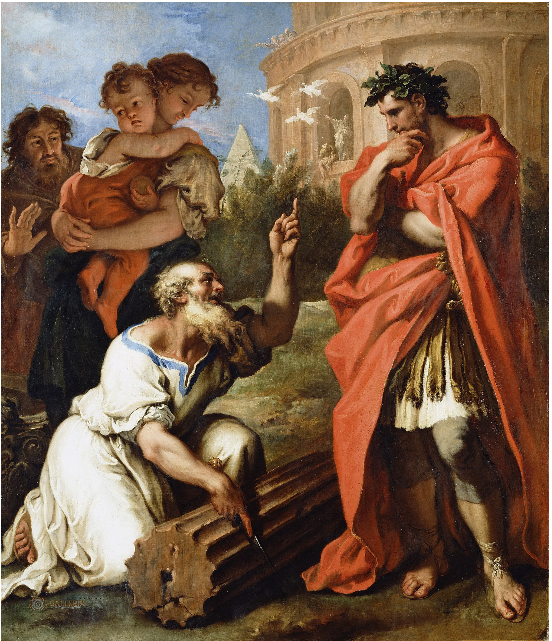
Ξυρὸς εἰς ἀκόνην, that is, the razor to the whetstone. This is usually said of those who have fallen by chance into those states of affairs which they did not desire. A razor is not able to fall more unfavorably than if it comes against the whetstone. The old saying of Horace is not dissimilar to this: ‘one seeking to slide his teeth against the coin ends up breaking them.’ This would be readily suited to one who, desirous of doing someone else harm finds someone by whom he is harmed in turn, and whom he cannot harm himself. Since indeed, a razor, if it run up against anything soft, cuts it apart; but if it runs against the whetstone, it is beaten back. Tarquinius considered this, when he said that he had in his mind that Actius Navius, the augur, would cut a whetstone with a razor, intending that the razor would have no power against the whetstone. Yet, the augur did what Tarquinius thought was impossible. Livy relates this in his first book.

Sebastiano Ricci, Tarquin the Elder consulting Attus Nevius the Augur

Novacula in cotem (XX)

Ξυρὸς εἰς ἀκόνην, id est Novacula in cotem. Dici solitum in hos, qui forte in eas res inciderunt, in quas minime volebant. Neque novacula potest incommodius cadere, quam si in cotem incurrat. Ab hoc non ita multum abhorret illud Horatianum : Et fragili quaerens illidere dentem / infringet solido. Recte accommodabitur et in eum, qui laedendi cupidus tandem hominem nactus est a quo vicissim laedatur, cum illi nocere non possit. Siquidem novacula, si in molle quippiam inciderit, dissecat ; si in cotem, retunditur. Huc respexit Tarquinus, qui dixit sibi in animo esse, ut Actius Navius augur novacula cotem discinderet, significans in cotem nihil posse novaculam, quanquam ab augure factum quod ille fieri posse non credebat. Refert Livius libro primo.

Diogenes Laertius on Crates, Opener of Doors

Diogenes Laertius, 6.86

“Crates was called the “Door-Opener” because of his custom of entering every house and warning them. This is one of his lines:

“I have as much as I have learned and thought and the sacred things
I observed with the muses. But delusion overtakes great riches.”

And he said that all he got from philosophy was “a liter of heat and to care for no one”.

This is also recorded as his: “hunger stops love, and if it doesn’t, time will / if you can’t use these, a noose”

᾿Εκαλεῖτο δὲ καὶ Θυρεπανοίκτης διὰ τὸ εἰς πᾶσαν εἰσιέναι οἰκίαν καὶ νουθετεῖν· ἔστιν αὐτοῦ καὶ τόδε (PPF 10 B 8)·

ταῦτ’ ἔχω ὅσσ’ ἔμαθον καὶ ἐφρόντισα καὶ μετὰ Μουσῶν
σέμν’ ἐδάην· τὰ δὲ πολλὰ καὶ ὄλβια τῦφος ἔμαρψεν.

καὶ ὅτι ἐκ φιλοσοφίας αὐτῷ περιγένοιτο (PPF 10 B 18)
θέρμων τε χοῖνιξ καὶ τὸ μηδενὸς μέλειν.

φέρεται δ’ αὐτοῦ κἀκεῖνο (PPF 10 B 14)·
ἔρωτα παύει λιμός. εἰ δὲ μή, χρόνος·
ἐὰν δὲ τούτοις μὴ δύνῃ χρῆσθαι, βρόχος.

Image result for Crates the philosopher

That Rarified Athenian Air

Cicero, de Fato 7-8 [discussing ideas of Chrysippus and Posidonius]

“We observe how much of a difference there is between the characters of various places: some are healthy, others are unhealthy; we see that people in some places are phlegmatic and like people who have too much moisture while others are dried out and thirsty. There are many other significant differences between different places.

Athens has a rare climate from which the residents of Attica are considered to be smarter than others; it is humid at Thebes, and so the Thebans are thick and strong. Nevertheless, that sterling Athenian environments will not ensure that anyone listens to Zeno or Arcesilas or Theophrastus any more than the thick Theban air will prepare someone better to win at Nemea than in Corinth.”

Inter locorum naturas quantum intersit videmus: alios esse salubres, alios pestilentes, in aliis esse pituitosos et quasi redundantes, in aliis exsiccatos atque aridos; multaque sunt alia quae inter locum et locum plurimum differant. Athenis tenue caelum, ex quo etiamacutiores putantur Attici, crassum Thebis, itaque pingues Thebani et valentes. Tamen neque illud tenue caelum efficiet ut aut Zenonem quis aut Arcesilam aut Theophrastum audiat, neque crassum ut Nemea

Image result for Athens environment

Virtue and the Arts: Some Aristotle to Start Your Day

Some Aristotle for this morning. I don’t think I actually believe the third point–because I suspect that insisting that human character is constant and consistent is actually (1) wrong and (2) impacts mental health negatively. But I like the beginning and the emphasis on that Aristotelian notion that doing something makes you something...

Aristotle, Nicomachean Ethics 2.2-4

“Or is this also true in the arts? For spelling a word accidentally or with someone else guiding you is possible. Then, one will be a scholar if he spells something the way a scholar does, by which I mean according to the scholarly art itself. In addition, there is no real similarity between the arts and virtue. For the products of art are good in themselves—it suffices if they develop while having their own quality.

But acts of virtue don’t have their own intrinsic quality and are performed wisely or justly, but if the person who does them acts in a certain way. First, he must understand what he does. Second, he must choose to do it and for its own nature. And, third, he must act from a fixed and constant character. None of these conditions are necessary for the other arts apart from understanding the act. But knowledge is of little or no importance for the virtues while the other conditions are not minor but rather everything, if truly [virtue] emerges from repeatedly doing just and wise things.”

ἢ οὐδ᾿ ἐπὶ τῶν τεχνῶν οὕτως ἔχει; ἐνδέχεται γὰρ γραμματικόν τι ποιῆσαι καὶ ἀπὸ τύχης καὶ ἄλλου ὑποθεμένου· τότε οὖν ἔσται γραμματικός, ἐὰν καὶ γραμματικόν τι ποιήσῃ καὶ γραμματικῶς, τοῦτο δ᾿ ἐστὶ [τὸ] κατὰ τὴν ἐν αὑτῷ γραμματικήν. ἔτι οὐδ᾿ ὅμοιόν ἐστιν ἐπὶ τῶν τεχνῶν καὶ τῶν ἀρετῶν· τὰ μὲν γὰρ ὑπὸ τῶν τεχνῶν γινόμενα τὸ εὖ ἔχει ἐν αὑτοῖς, ἀρκεῖ οὖν αὐτά πως ἔχοντα γενέσθαι· τὰ δὲ κατὰ τὰς ἀρετὰς γινόμενα οὐκ ἐὰν αὐτά πως ἔχῃ, δικαίως ἢ σωφρόνως πράττεται, ἀλλὰ καὶ ἐὰν ὁ πράττων πως ἔχων πράττῃ, πρῶτον μὲν ἐὰν εἰδώς, ἔπειτ᾿ ἐὰν προαιρούμενος, καὶ προαιρούμενος δι᾿ αὐτά, τὸ δὲ τρίτον καὶ ἐὰν βεβαίως καὶ ἀμετακινήτως ἔχων πράττῃ. ταῦτα δὲ πρὸς μὲν τὸ τὰς ἄλλας τέχνας ἔχειν οὐ συναριθμεῖται, πλὴν αὐτὸ τὸ εἰδέναι· πρὸς δὲ τὸ τὰς ἀρετὰς τὸ μὲν εἰδέναι μικρὸν ἢ οὐδὲν ἰσχύει, τὰ δ᾿ ἄλλα οὐ μικρὸν ἀλλὰ τὸ πᾶν δύναται, εἴπερ ἐκ τοῦ πολλάκις πράττειν τὰ δίκαια καὶ σώφρονα περιγίνεται.

Image result for Medieval manuscript aristotle ethics papyrus
Brtitish Library, Constitution of the Athenians

Determining the Greek Point of View

Louise Ropes Loomis, The Greek Renaissance in Italy:

“Thus even in philosophy the influences from antiquity which helped to shape fifteenth-century thought were derived more directly from the Empire than from Hellas. A knowledge of the Greek tongue remained in the main an accomplishment for professional men of letters, elegant and to that degree desirable. Through the recommendations of Quintilian the study of Greek was introduced into two or three of the best Italian schools and the argument was brought forward that one could understand and appreciate the Latin tongue far better by the help of some knowledge of Greek. But there was no serious effort to determine the Greek point of view, which was supposed as a matter of course to have been the same as the Roman, nor to utilize Greek literature save as a storehouse of pedantic quotations and ethical examples. The practical value of Greek in exposing errors of Scriptural interpretation and in waging theological controversy was realized only after the knowledge of it had been carried into northern Europe. Such writing as was produced in Italy, comparable at all in straight-forward originality and acumen to the Greek, was prompted by the stress and stir of contemporary life and except in surface embellishments shows little effect of the Greek Renaissance.”

Image result for louise ropes loomis

The Matter Is on the Hinge

Erasmus, Adagia 1.1.19

“The matter is on the hinge.”

“This saying is not wholly dissimilar to the last: the matter is on the hinge, which Servius suggested was a proveb as he related that of Vergil: ‘she will hardly withdraw from such a hinge of affairs’ and he thinks that it has this sense, as if one were to say, ‘The matter is at the deciding point.’ Cicero says instead, ‘the hinge turns on that,’ by which he means ‘the whole affair depends upon that.’ Quintilian, in his tenth book, writes, ‘I may remain silent concerning those (about whom I do not care) who neglect to consider where the hinge of the cases is turned.’

Quintilian also says in his fifth book, ‘If he confesses, he could argue that his garment could have been bloody for many other reasons; if he denies that his garment is bloody, he lays the hinge of the affair out on this claim, in which – if he be convicted of falsehood – he will be ruined in the rest of his subsequent claims.

The proverb is taken from doors, which are held up and turned about upon hinges.”

Image result for cardo hinge

Res est in cardine (xix)

Huic non omnino diversum est illud : Res est in cardine, quod Servius proverbium esse admonuit enarrans illud Maronis : Haud tanto cessabit cardine rerum, putatque perinde valere, quasi dicas Res est in articulo. M. Tullius In eo cardo rei vertitur dixit pro eo, quod est : ex hoc tota res pendet. Quintilianus libro decimo : Nam ut taceam de negligentibus, quorum nihil refert, ubi litium cardo vertatur. Idem libro quinto : Nam si fatetur, multis ex causis potuit cruenta esse vestis ; si negat, hic causae cardinem ponit, in quo si victus fuerit, etiam in sequentibus ruit. Sumptum ab ostiis, quae cardinibus sustinentur volvunturque.