“I admit that I now have a bit of a different opinion from what I believed before. Perhaps it would be safest for my reputation to change nothing which I not only believed but also approved for many years. But I cannot endure knowing that I misrepresent myself, especially in this work which I compose as some help for our good students. For even Hippocrates, famous still for his skill in medicine, seems to have conducted himself very honorably when he admitted his own errors so his followers would not make a mistake. Marcus Tullius did not hesitate to condemn some of his own books in subsequent publications, the Catulus and Lucullus, for example.
Prolonged effort in research would certainly be useless if we were not allowed to improve upon previous opinions. Nevertheless, nothing of what I taught then was useless. These things I offer now, in fact, return us to basic principles. Thus it will cause no one grief to have learned from me. I am trying only to collect and lay out the same ideas in a slightly more sensible fashion. I want it made known to all, moreover, that I am showing this to others no later than I have convinced myself.”
Ipse me paulum in alia quam prius habuerim opinione nunc esse confiteor. Et fortasse tutissimum erat famae modo studenti nihil ex eo mutare quod multis annis non sensissem modo verum etiam adprobassem. Sed non sustineo esse conscius mihi dissimulati, in eo praesertim opere quod ad bonorum iuvenum aliquam utilitatem componimus, in ulla parte iudicii mei. Nam et Hippocrates clarus arte medicinae videtur honestissime fecisse quod quosdam errores suos, ne posteri errarent, confessus est, et M. Tullius non dubitavit aliquos iam editos libros aliis postea scriptis ipse damnare, sicut Catulum atque Lucullum et… Etenim supervacuus foret in studiis longior labor si nihil liceret melius invenire praeteritis. Neque tamen quicquam ex iis quae tum praecepi supervacuum fuit; ad easdem enim particulas haec quoque quae nunc praecipiam revertentur. Ita neminem didicisse paeniteat: colligere tantum eadem ac disponere paulo significantius conor. Omnibus autem satis factum volo non me hoc serius demonstrare aliis quam mihi ipse persuaserim.
“When Demetrius the Cynic observed an uneducated person reading the most beautiful book in Korinth—and I think it was Euripides’ Bacchae near the spot where the messenger is narrating what happened to Pentheus and what Agave did—he grabbed the book and tore it up, saying, “It is better for me to shred Pentheus just once than for you to do it over and over again.”
This line is something I bounce around twitter every few months or so. As with many of our tweets, it is divorced from its context and takes on a new meaning in our own time (one, I think, which is less than positive since people are motivated more by an acquisitive, begrudging impulse than one of empathy).
A twitter correspondent (@History_Twerp) noted that this line was echoed in Herodotus.
Herodotus 3.52
Periander speaks to his son and says “since you have learned how much being envied is better than being pitied, and also what it is like to be angry at your parents and your betters, come home…”
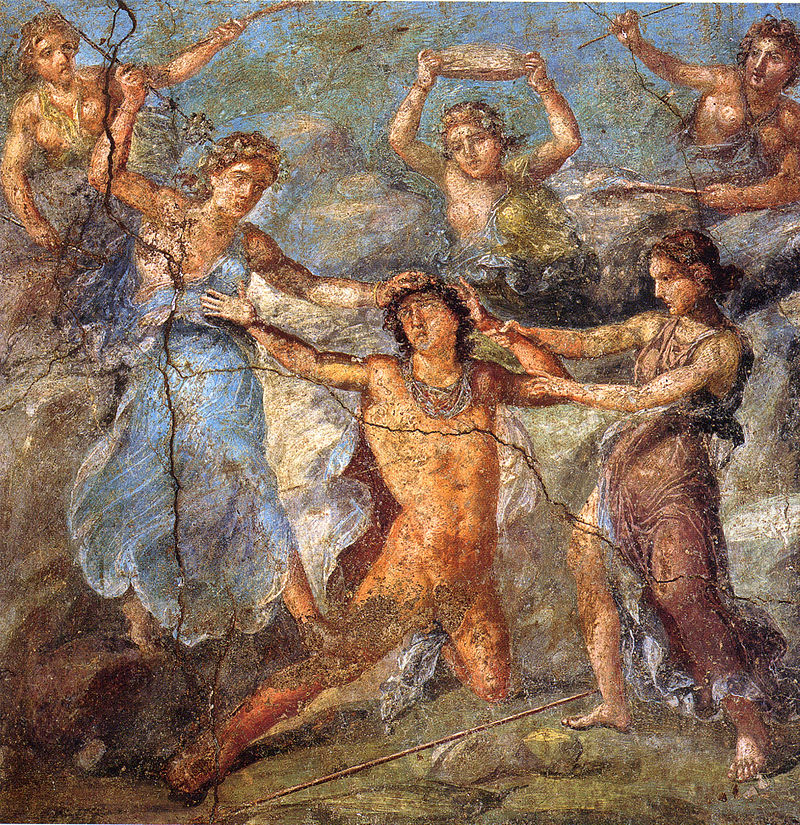
The notes on Perseus for Pindar’s Pythian 1 refer to the passage from Herodotus as “proverbial” without any additional evidence. The passages do seem proverbial since they use the same basic lexical items to express the same basic idea. Nevertheless, there is not additional evidence for a proverb. Instead, I think we probably have evidence of a general cultural value immanent among aristocratic classes during the early Classical period.
Here’s a fuller context for Pindar, Pyth. 1.84-86
“Satiety reshapes
Fast and easy expectations—
And the citizens’ secret witness grows especially burdened over foreign wealth.
But still, since envy is stronger than pity,
Do not overlook noble things, but guide the people
With a just rudder. Make your tongue
Bronze on an truthful anvil.”
In the context of the Pythian ode, the brevity of the statement along with the epexegetical γὰρ gives the impression of a proverb drawn from elsewhere. But it is my sense, from reading through a lot of Pindar and Bacchylides, that the epinician genre is in the business of sounding proverbial (it lends itself towards gnomic utterances because of the lyric brevity of expression, lack of epic-style repetition, and limited syntax). The trick of epinician poetry is to sound old and authoritative without actually being so.
The positive valence attributed to envy over pity is present as well in Hesiod’s Works and Days where two types of Strife are distinguished in order to mark one type of human conflict as good and one type as bad.
Hesiod, Works and Days, 26-7
“And a potter is angry with a potter, and a carpenter with a carpenter;
Even a beggar will envy a beggar and a singer a singer.”
So the general attitude projected by Herodotus’ Periander and Pindar is harmonious with the Archaic Greek notion that ‘envy’ produces a type of rivalry that has positive effects. It is better than pity because pity is something which people in a stronger position have over those in a weaker position (and who wants to be in the weaker position?). For Pindar, envy is better because it imbues Hiero’s people with a spirit of rivalry; for Periander, who uses the statement in an attempt to get his son to come home, it is an attempt to convince him to give up the ways of a mendicant and return the palace. Interestingly, according to Herodotus, Periander fails.
The relationship between pity and envy appears in Diogenes as well.
Diogenes Laertius, Life of Zeno of Citium 7.111
“[they claim] that grief is an irrational reaction. Its variations include: pity, envy, jealousy, rivalry, annoyance, bitterness, anger, and distraction. Pity is pain for someone who suffers evil unworthily; envy is grief over someone else’s good fortunes; jealousy is pain over what another possesses when you want it yourself; and rivalry is pain over what another has and which you possess too…”
At first sight, there is little value judgment in this summary. But pity and envy are collocated as emotional or unreasoning impulses distinguished by their frames of reference but united by the fact that both are a type of pain. The comparison between pity and envy, does not seem otherwise common in Greek literature. (But this conclusion is extremely tentative. Please let me know of any other passages.)
A fragment of Plutarch (quoted in Stobaeus) established what turns out to be somewhat proverbial, that envious people risk two sources of pain.
Hippias says that there are two types of envy. One is just, whenever someone envies evil men who have been honored. The other is unjust, whenever someone envies good people who are honored. Men who envy suffer twice as much as others; for they are troubled not only by their own evils, but by others’ good fortunes.”
This sentiment is rather similar to one attributed to Anacharsis the Skythian by the Gnomologium Vaticanum:
“When asked by someone why envious men are always in pain, he said “because not only do their own evils bite them, but the good fortunes of those near them cause them grief too…”
“You ask me what I think you should study while you enjoy your current vacation? It is really useful—as many propose—to translate Greek into Latin or Latin into Greek. By this kind of exercise you gain the proper and decorative use of words, an abundance of rhetorical devices, a forceful manner of explication, and, importantly, an ability to compose similar works due to the imitation of the best models. The things which escape a reader, moreover, do not evade a translator. From this practice one acquires intelligence and critical judgment.
[…]
From time to time, I want you to pick some passage from a history or perhaps write a letter more carefully. For sometimes even in speech the situation requires not only a bit of historical but even poetic description—a pure and compact style can be found in letters. It is also right to take a break for poetry—I am not talking about a long, continuous poem, since that cannot be completed without a lot of time—but in that sharp and brief style which aptly breaks up your cares and duties however important they are. This is called playing with verse, but these games often attract no less glory than serious pursuits.”
Quaerisquemadmodum in secessu, quo iam diu frueris, putem te studere oportere. Utile in primis, et multi praecipiunt, vel ex Graeco in Latinum vel ex Latino vertere in Graecum. Quo genere exercitationis, proprietas splendorque verborum, copia figurarum, vis explicandi, praeterea imitatione optimorum similia inveniendi facultas paratur; simul quae legentem fefellissent, transferentem fugere non possunt. Intellegentia ex hoc et indicium adquiritur.
[…]
Volo interdum aliquem ex historia locum adprendas, volo epistulam diligentius scribas. Nam saepe in oratione quoque non historica modo sed prope poetica descriptionum necessitas incidit, et pressus sermo purusque ex epistulis petitur. Fas est et carmine remitti, non dico continuo et longo (id enim perfici nisi in otio non potest), sed hoc arguto et brevi, quod apte quantas libet occupationes curasque distinguit. Lusus vocantur; sed hi lusus non minorem interdum gloriam quam seria consequuntur.
“Mr. Knight could not be called an ideal tutor. He was sluggish, and had no sympathy for boys. Yet he was a sound scholar of the old type, and essentially a gentleman. He let me browse, much as I liked, about the pastures of innocuous Greek and Latin literature. He taught me to write Latin verses with facility. If I did not acquire elegance, that was the defect of my own faculty for style. I think he might have grounded me better in grammar than he did; and it would have been an incalculable advantage to me if he had been able to direct my keen, though latent, enthusiasm for books. In this respect, I owe him one only debt of gratitude. We were reading the sixth book of the Aeneid. He noticed what a deep hold the description of Elysium took on my imagination, and lent me Warburton’s ‘Divine Legation of Moses.’ A chapter in that book about the Mysteries opened dim and shadowy vistas for my dreaming thoughts. I cannot remember any other instance of my tutor s touching the real spring of thirst for knowledge in my nature. For the rest, he took care that I should understand the Odes of Horace and be capable of reproducing their various metres. This gave me a certain advantage when I came to Harrow. With Mr. Knight I read a large part of the Iliad. When we came to the last books I found a passage which made me weep bitterly. It was the description of Hermes, going to meet Priam, disguised as a mortal:
κούρῳ αἰσυμνητῆρι ἐοικὼς
πρῶτον ὑπηνήτῃ, τοῦ περ χαριεστάτη ἥβη.
The Greek in me awoke to that simple, and yet so splendid vision of young manhood, ‘In the first budding of the down on lip and chin, when youth is at her loveliest.’ The phrase had all Greek sculpture in it, and drew my tears forth. I had none to spare for Priam prostrate at the feet of his son’s murderer; none for Andromache bidding a last farewell to Hector of the waving plumes. These personages touched my heart, and thrilled a tragic chord. But the disguised Hermes, in his prime and bloom of beauty, unlocked some deeper fountains of eternal longing in my soul. Somewhat later, I found another line which impressed me powerfully, and unsealed hidden wells of different emotion. It was in the Hippolytus of Euripides:
ἡ γλῶσσ’ ὀμώμυχ’, ἡ δὲ φρὴν ἀνώμοτος
[“My tongue has sworn, but my heart is uncommitted…”]
The sense of casuistry and criticism leapt into being at that touch. I foresaw, in that moment, how pros and cons of moral conduct would have to be debated, how every thesis seeks antithesis and resolution in the mental sphere. These were but vague awakenings of my essential self For the most part, I remained inactive, impotent, somnambulistic, touching life at no edged point, very slowly defining the silhouette of my eventual personality.”
“Noble Xenokleia.
After leaving behind two young daughters
Xenokleia the daughter of Nikarkhos lies here dead—
Even after she grieved the death of her son Phoinix
Who died at eight in the wide sea.
[….]
Who is inexperienced of mourning, Xenokleia
And does not pity your fate? You left two daughters
And died because of longing for a son who
Has a pitiless grave where he lies in the dark sea.”
“The spirit must be warned that it loves things which will one day leave—no, they are already leaving. Whatever is granted to you by fortune, take it as if it has no guaranty. Seize up the pleasures of your children and allow your children to enjoy you in turn. And drink down every bit of joy without stopping.
Nothing is promised to you for this evening—I have granted too much a pledge—nothing is promised for this hour. You must hurry, we are being chased from behind. Soon this friend will be elsewhere, soon these friendships will be lost lost when the battle’s cry is raised. In truth, everything is stolen away. Poor are you fools who do not know how to live in flight.”
Saepe admonendus est animus, amet ut recessura, immo tamquam recedentia. Quicquid a fortuna datum est, tamquam exempto auctore possideas. Rapite ex liberis voluptates, fruendos vos in vicem liberis date et sine dilatione omne gaudium haurite; nihil de hodierna nocte promittitur—nimis magnam advocationem dedi—, nihil de hac hora. Festinandum est, instatur a tergo. Iam disicietur iste comitatus, iam contubernia ista sublato clamore solventur. Rapina verum omnium est; miseri nescitis in fuga vivere!
“Moderation was missing from this enthusiastic person in two ways. He did not know how to take a break from work nor how to start it again. When he brought himself to write, the days used to join with nights and he was pushing himself mercilessly without a break, stopping only when he was completely worn out. But when he stopped then, he would lose himself in every kind of game and distraction. Indeed, when he entrusted himself to the forest and the mountains, he was the equal to those born to the forests and mountains, those wild men, in endurance of labor and expertise of the hunt. He was so completely engaged with the embrace of that lifestyle that he could scarcely be dragged back to his former life.
But when he did get himself under control and took himself from alluring leisure, he used to fall into his studies with such passions that he seemed not so much to have lost nothing as to have gained much.
It is clear that everyone benefits from a mental vacation—energy is gathered in leisure and all the sadness which is developed through endless pursuit of work can be dispelled though the enjoyment of distractions. But no one benefited more from a vacation than Latro. Every time he used to speak after a break, he would speak more sharply and with more force—he used to glory in how his mind was refreshed and his strength made whole. And he would squeeze as much from himself as he desired. He did not know how to portion out his powers—but he was a master of unrestrained tyranny—his eagerness had to be stopped because it was not able to be controlled…”
In utramque partem vehementi viro modus deerat: nec intermittere studium sciebat nec repetere. Cum se ad scribendum concitaverat, iungebantur noctibus dies, et sine intervallo gravius sibi instabat, nec desinebat nisi defecerat: rursus cum se remiserat, in omnes lusus, in omnes iocos se resolvebat; cum vero se silvis montibusque tradiderat, in silvis ac montibus natos, homines illos agrestis, laboris patientia et venandi sollertia provocabat, et in tantam perveniebat sic vivendi cupiditatem ut vix posset ad priorem consuetudinem retrahi. At cum sibi iniecerat manum et se blandienti otio abduxerat, tantis viribus incumbebat in studium ut non tantum nihil perdidisse sed multum adquisisse desidia videretur. Omnibus quidem prodest subinde animum relaxare; excitatur enim otio vigor, et omnis tristitia, quae continuatione pertinacis studii adducitur, feriarum hilaritate discutitur: nulli tamen intermissio manifestius proderat. Quotiens ex intervallo dicebat, multo acrius violentiusque dicebat; exultabat enim <animo>2 novato atque integro robore, et tantum a se exprimebat quantum concupierat. Nesciebat dispensare vires suas, sed inmoderati adversus se imperii fuit, ideoque studium eius prohiberi debebat quia regi non poterat…
Seneca the Younger, De Tranquillitate Animi, 5
“Our minds must be allowed a break—once rested, they will rise better and sharper. Just as fertile fields must not be overworked—for endless productivity will exhaust them soon—so too continuous work crushes the force of our minds; but rested and relaxed they restore their own powers. Weakness and weariness are born to minds from constant efforts.”
Danda est animis remissio; meliores acrioresque requieti surgent. Ut fertilibus agris non est imperandum—cito enim illos exhauriet numquam intermissa fecunditas,—ita animorum impetus adsiduus labor franget, vires recipient paulum resoluti et remissi; nascitur ex assiduitate laborum animorum hebetatio quaedam et languor.
Bonus Quotation
Fragments of Dio Chrysostom, Stob. Flor. 4, XIX
“It is right, then, to be be proper master and to permit those who want to rest sometimes. For breaks are preparation for toil—the both, the lyre and human kind become their best through resting.”
This text was discovered inside the hollow of a golden branch. On top was written, Pius Aeneas hoc scripsit (“Pious Aeneas wrote this”). On a separate document was a message written by one P.V.M. that said, carmen tam horribile est ut cum inhumata turba vagari malim.” (“This poem is so terrible that I prefer to wander with the unburied masses”). An earlier fragment seems obsessed with a certain Ioannes Nix.
It is thought that after Aeneas encountered Marcellus in the underworld, he received poetry lessons from Vergil himself. From a close reading of this text, we can also infer that Aeneas met the disembodied soul of George R.R. Martin and saw a performance of Game of Thrones. Edited by Dani Bostick.
“And just as constipated infants contort their miserable Faces but cannot manage to liberate their bowels, In this way, Jon Snow with a worried expression, Miserable, looks on the overturned city and kills the Mother of dragons in a sneaky way with his sword. Then, the Unhappy monster carries her body on his toenail into the ether. Snow speaks with these words: “Love is the death of duty.” But Dido gave herself a wound voluntarily with a sword, This queen is dead because of herself; it is not my fault, For I am remarkable in piety, but Snow rules In no kingdom.”
Ac veluti torquent ora infantes miseranda Crudi sed nequeunt compressos solvere alvos. Sic Nix sollicito vultu eversam miser urbem Aspicit et matrem draconum ensi necat furtim. Tum monstrum infelix corpus vehit ungula in aether. Nix tali ore refert: “Amor est finis pietatis.” At Dido vulnus dedit sponte sua sibi ferro, Regina moritur propter se; non mihi culpa est. Sum pietate insignis, et rex; Nix regit nullo In loco.
“Next, let’s consider the way we learn, since learning happens wither through experience or through speech. But of these two approaches, experience comes from this which are demonstrable, the demonstrable is clear, and the clear—because it is obvious—is available to all in common. Such perception which is available to all in common is unteachable. Hence, anything apprehended through experience is not teachable.
Speech either corresponds to some meaning or it does not. If it corresponds to no meaning at all, then it teaches nothing. When it does correspond to some meaning it does it either by intrinsic nature or by established convention. It cannot, in truth correspond to meaning by intrinsic nature since not all people understand the same meaning when they hear it (as when the Greeks listen to barbarians or the barbarians listen to Greeks).
If speech signals meaning by convention, it is clear that people who have absorbed before the meanings to which these words correspond will also comprehend them now, and not because they have learned from them something which was not known—it is more like they are resuscitating what they knew before, while those who lack learning of what they don’t know will not do the same.”