“Dear Luchino, you seem to progress and grow stronger in eloquence every day, even every hour! Would that the gods loved me as they do you – I really marvel both at your accurate and noble sentiments, and also at the charm of your speech. So go on, dear Luchino, so that you can be an honor to yourself, a benefit to your friends, and a profit to Pavia. Indeed, you even confer some glory upon me when you call me your teacher, and you engender a wondrous benevolence. How much do you think my favor has increased for you when I see you so learned, so eloquent, so full of humanity and of some kind of piety toward me? Indeed, I grieve that I didn’t give you an extra little polishing for a few short months and place the finishing touches on your ability.
Scarcity of time prevents me from writing much, for I am distracted by many different affairs which don’t even allow me time to breathe. But keep writing to me as elegantly as you do now: I will show your letters to all who listen to me, and they always praise and admire you in the highest terms, and agree with me when I heap the accolades on you. Farewell, my great hope!
LAURENTIUS VALLA LUCHINO BELBELLO SALUTEM PLURIMAM DICIT.
In dies atque adeo in horas, mi Luchine, in eloquentia progredi et convalescere videris. Ita dii me ament ut te vehementer admiror, cum propter accuratas gravesque sententias, tum propter orationis venustatem. Quare perge, mi Luchine, ut et tibi honori et amicis utilitati et Papiensi reipublice emolumento esse possis. Nam mihi tu quidem et gloriam comparas, quem tuum preceptorem appellas, et miram tui benivolentiam ingeneras. Quid enim putas et quantum benivolentie mee in te accrevisse, cum videam te ita doctum, ita facundum, ita plenum humanitatis ac cuiusdam in me quasi pietatis? Doleo equidem quod te non etiam aliquot pauculis mensibus expoliam et tue facultati extremam manum imponam.
Temporis brevitas facit ut non possim multa scribere; distringor enim multis variisque occupationibus, que me respirare non sinunt. Tu tamen persevera scribere ad me eleganter, ut facis; quas tuas litteras auditoribus meis ostendam, qui te summopere laudant et admirantur et mihi te impense laudanti assentiuntur. Vale, spes magna.
“Those who go to bed with their wives for the sake of making children should do so while sober or at least only moderately intoxicated. For those whose fathers happened to be drunk at the moment of first sowing their seed tend to be wine-loving and prone to drunkenness. For this reason, when Diogenes saw a man raving and quite out of his mind, said, ‘Young man, your father must have begotten you when he was drunk!'”
“You can understand from the two popular lines which Epictetus wrote about himself that the gods do not completely hate those who suffer because of a range of miseries in this life, but that there are some secret causes which the curiosity of a few may be able to sense:
“I, Epictetus, was born a slave with a crippled body
both an Irus in poverty and dear to the gods.
You have, I believe, sufficient argument why the name “servant” should not be despised or taboo, since concern for a slave affected Jupiter and because it turns out that many of them are faithful, intelligent, brave, and even philosophers!”
45. cuius etiam de se scripti duo versus feruntur, ex quibus illud latenter intellegas, non omni modo dis exosos esse qui in hac vita cum aerumnarum varietate luctantur, sed esse arcanas causas ad quas paucorum potuit pervenire curiositas:
46. habes, ut opinor, adsertum non esse fastidio despiciendum servile nomen, cum et Iovem tetigerit cura de servo et multos ex his fideles providos fortes, philosophos etiam extitisse constiterit.
“Shitting in the Pythian temple”: Peisistratos built the temple to Pythian Apollo. But when some Athenians were present and they hated him and had nothing else to do, some pissed on the enclosure and shat near the building, effectively annoying the people who were working on it…”
“Shitting in the Pythian Temple”: this means to risk danger. For the tyrant Peisistratos, when he was building the temple, discovered some resident alien shitting there, and drove him off. For he posted that no one could shit there.”
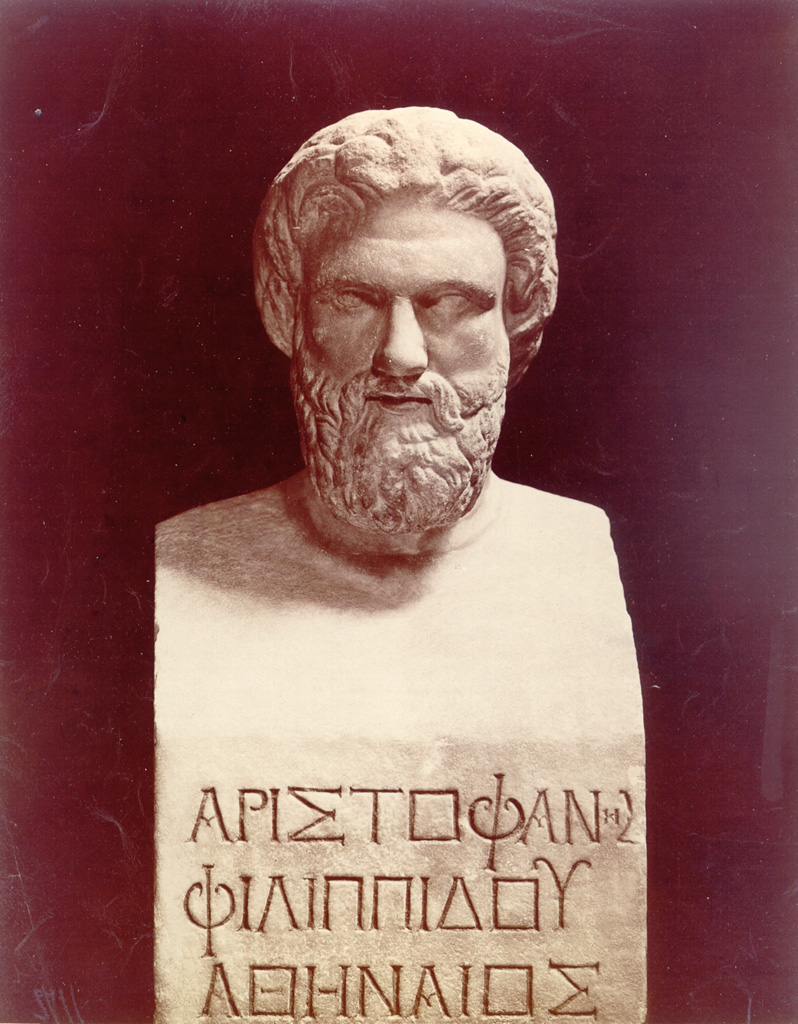
“The books of Aristophanes—divine labor—over which
Archanean ivy dangled its massive green hair.
See how much of Dionysus a page holds, how the stories
Echo, full of frightening charms.
Comic poet, best of heart, equal to the characters of Greece,
You both hated and mocked things that deserved it.”
Years ago, in the innocent haze of late youth, I lay in bed on a perfect, sun-lit spring afternoon, and drifted pleasantly to sleep as I read The Decline and Fall of the Roman Empire. You may be surprised that this is by way of a recommendation of the book, and not chiefly for its soporific qualities. Our memories are hardly continuous or sequenced narratives. Rather, they are dotted constellations of individual events, and this event stands forth as one of my most charming and pleasant recollections. As I fell asleep, setting aside that narrative of imperial corruption, I thought “this is life.”
Of all Dickens’ novels, my favorite apart from The Pickwick Papers (but is it even a novel?) is Our Mutual Friend. This aesthetic preference can no doubt be reduced to my fondness for the scenes in which Silas Wegg reads The Decline and Fall to Mr. Boffin:
Mr Boffin seemed a little unprepared for this conclusion, but assented, with the remark, ‘You know better what it ought to be than I do, Wegg,’ and again shook hands with him upon it.
‘Could you begin to night, Wegg?’ he then demanded.
‘Yes, sir,’ said Mr Wegg, careful to leave all the eagerness to him. ‘I see no difficulty if you wish it. You are provided with the needful implement—a book, sir?’
‘Bought him at a sale,’ said Mr Boffin. ‘Eight wollumes. Red and gold. Purple ribbon in every wollume, to keep the place where you leave off. Do you know him?’
‘The book’s name, sir?’ inquired Silas.
‘I thought you might have know’d him without it,’ said Mr Boffin slightly disappointed. ‘His name is Decline-And-Fall-Off-The-Rooshan-Empire.’ (Mr Boffin went over these stones slowly and with much caution.)
‘Ay indeed!’ said Mr Wegg, nodding his head with an air of friendly recognition.
‘You know him, Wegg?’
‘I haven’t been not to say right slap through him, very lately,’ Mr Wegg made answer, ‘having been otherways employed, Mr Boffin. But know him? Old familiar declining and falling off the Rooshan? Rather, sir! Ever since I was not so high as your stick. Ever since my eldest brother left our cottage to enlist into the army.’
Wegg and Boffin were familiar to me long before Gibbon was, and so I cannot help but wonder whether my general sense that this was an important book was set by casual reading as a teen.
My first experience of the book was an abridged Penguin Classics version which I held in my hands in the scene above. I saw a full (closely packed) set of the work for sale and purchased it in 2011, and made a few attempts at reading it through, but rarely found the time or hardihood to do it. Four summers ago, I cracked it open and gave it a fair amount of attention, but it was something of a struggle in my then-distracted state to get through all of it, but I at least finished. Last year, I found a deluxe version, edited by J.B. Bury with supplemental notes, maps, and indices (in seven volumes!) for only $50. A few weeks ago, I set out to read it, and – yes, dear reader – I gave it the heroic forced-march treatment, reading through all ~3,400 pages of it over the past three weeks. I don’t know why I decided to read through the book again, but it exercises over me something like the fascination of the ancient mariner’s eye, and I always find myself mysteriously drawn back to it.
The Decline and Fall is not fashionable today, and perhaps for good reason. Anyone who has read the book with a knowing eye can tell you that it is problematic in various ways. The treatment of various periods and figures is wildly uneven. Julian’s rise to power and brief tenure on the throne occupies a good chunk of a volume, while most of the Byzantine emperors after Heraclius are given the hyper epitome treatment in one chapter which does little more than provide the basic vice/virtue character sketch and the circumstances of their death. In some instances, the reasons for the imbalance are likely due to personal inclination (Gibbon’s fondness for Julian), but in others, it may simply reflect the availability of materials.
Gibbon’s style is also very much out of fashion. Clive James, though an omnivorous reader, nevertheless confessed that he could never read much of Gibbon because it was all style and too ‘rococo’. Indeed, it is interesting that Gibbon himself regularly inveighs against the rhetorical-sophistic prose of various ancient authors whom he himself suspects of being all style. But criticisms of Gibbon’s prose date back as far as Porson, who suggested that there was no better exercise for the young student than to turn a page of The Decline and Fall into English.
Yet, for all of that, I am an utterly unapologetic fan of Gibbon’s prose. Some of its quirks stem, I suspect, from the infusion of Gallic idiom dating to his years writing and thinking in French. His reckless abandon in the use of commas is pretty characteristic of 18th century English prose, and once can profitably compare Gibbon’s deployment of that workhorse of punctuation to Jane Austen’s. Perhaps the most admirable synthesis achieved by Gibbon is the admirable mixture of two classical modes: the sonorous periods of Cicero, and the pointed antitheses of Tacitus. Gibbon is not nearly as diffuse as Cicero, but his periods always manage to be perfectly balanced, and he cannot resist the temptation of a well-regulated tricolon. He hasn’t the clipped and telegraphic brevity of Tacitus, but he managed to imbibe that author’s utter cynicism, and he regularly employs that hallmark of Tacitean style, imputing in an entirely non-committal way the darkest designs and most sinister motives to almost every action.
For all of the care and attention which he has given his subject, he cannot but approach it with a sense of contempt and disgust. As he himself writes, “History is indeed little more than the register of the crimes, follies and misfortunes of mankind.” Yet he also indulges in a dangerous inclination to see a more distant past as a kind of idyllic utopia of good character and good government. Famously, he assigns the happiest period of the entire history of the world to the period under the adoptive and Antonine emperors. Throughout the history, later Italians and Greeks are conceived as semi-barbaric and wholly unworthy successors to their “manly” and “virtuous” ancestors.
The standard trope seems to be: perfection on a grand scale was achieved in the past through virtue, but it insensibly (Gibbonian style!) gave way to vice, and the declining state of the world reflected that; there is an inevitability to the collapse, but the decline can be slowed by virtuous (or effective) individuals. This explains why, for example, the western empire fell much sooner than the eastern: the west was overrun by barbarians, but the east was propped up by the heroics of Justinian and Belisarius, whose exploits helped the system to coast for a while longer. When scrutinized, this view is simplistic, but it does at any rate make for a fun and engaging narrative.
Gibbon’s original intent in writing The Decline and Fall was much more narrowly circumscribed by the limits of the city Rome itself, but it quickly expanded outward to include more or less everything with some bearing on any of the lands once controlled by the Romans. But Gibbon is only as good as his guides. For example, his narrative of the period between Commodus and Constantine is pretty faithful to the Historia Augusta, going so far as to incorporate the moral censures included in that work. (Of course, Gibbon did not know that it was an elaborate forgery.) Yet, once he reaches the end of the reign of Justinian, Gibbon goes off the rails a bit. His panoptic survey takes in a lot of eastern history, but for all of this, he relies on an admixture of Byzantine authors and later treatments by European scholars (since he did not know Arabic, Farsi, etc. himself). The separation from primary sources for the latter half of the work, combined with Gibbon’s manifest contempt for the Byzantine intellectual in general, result in a narrative that can be tedious, confusing, and in many instances requiring substantial correction. Added to this is the casual racism and contemptuous xenophobia of the 18th century Englishman. One can readily see why almost no one reads the work in full, and why abridgements generally summarize most of what happened following the reign of Justinian.
Yet, for all of the problems which the work manifests, it is nevertheless an incredible monument to heroic reading. In his Memoirs, Gibbon downplays the time which he spent reading and working in earnest in any given day, but surely this is just the awkward affectation of an English gentleman’s sprezzatura. A survey of Gibbon’s footnotes is enough to assure us that he was always reading. Everywhere we hear that one can read more about such and such a topic in x number of thick folio volumes or dense octavos. A.E. Housman once remarked that being a scholar involved countless hours reading what was not really worth reading, and this seems to have been the case with Gibbon. As noted before, he has more or less just synthesized what he read in various ancient and secondary sources. (Though it’s true that this is more or less what writing history is.)
We should not be surprised if we find the book riddled with faults, given that it spans a tremendous temporal and geographical expanse and was one of the first real attempts at a scholarly but engaging narrative history in English. That is, it may fall short by today’s standards of scholarship, but as a work of popular history, it still holds up pretty well. Gibbon was allowed the leisure to read and write so much because he was, though not rich, at least a gentleman of sufficient means, but one must bear in mind that he was also in modern parlance a college dropout. Having left Oxford during his brief conversion to Catholicism, he never returned to take his degree. Yet he certainly read more widely than many of the formally-trained scholars of his time and ours.
In sum, I know that Gibbon is problematic, and likely to become more and more unfashionable with time, but I find something entirely irresistible in his work. Perhaps the most shocking confession I could make to my friends and peers is that Gibbon’s collected works would be my “desert island book.” (Does that make it my favorite? I don’t even know.) Unlike most fanboys, I am not willfully ignorant of its faults, and I can definitely see why people hate The Decline and Fall of the Roman Empire. But goddammit, I love it.
“If you were sick, you would break from personal affairs and neglect your work responsibilities—you would not care enough for an client to work on his case during a brief respite from illness. No, you would work with all your mind to free yourself from sickness as soon as possible.
What then? Won’t you do the same thing now? Dismiss all obstacles and dedicate yourself to a healthy mind. No one who is distracted can achieve this. Philosophy rules her own realm: she makes the time and does not accept appointments. She is not a random assignment but a regular obligation. She is master: she is here and commands.
Alexander, to a certain state who promised him half of their possessions and lands, said “I came into Asia not with the plan of me taking what you offered but for you to have whatever I left behind.” In the same way, philosophy says to all other affairs: “I am not going to accept the time you don’t need, but you may have the time I don’t take.”
Si aeger esses, curam intermisisses rei familiaris et forensia tibi negotia excidissent nec quemquam tanti putares cui advocatus in remissione descenderes; toto animo id ageres ut quam primum morbo liberareris. Quid ergo? non et nunc idem facies? omnia impedimenta dimitte et vaca bonae menti: nemo ad illam pervenit occupatus. Exercet philosophia regnum suum; dat tempus, non accipit; non est res subsiciva; ordinaria est, domina est, adest et iubet. [10] Alexander cuidam civitati partem agrorum et dimidium rerum omnium promittenti ‘eo’ inquit ‘proposito in Asiam veni, ut non id acciperem quod dedissetis, sed ut id haberetis quod reliquissem’. Idem philosophia rebus omnibus: ‘non sum hoc tempus acceptura quod vobis superfuerit, sed id vos habebitis quod ipsa reiecero’.
This reminds me of a passage from Epictetus:
Epictetus, Treatises Collected by Arrian, 2.15: To those who cling to any judgments they have made tenaciously
“Whenever some people hear these words—that it is right to be consistent, that the moral person is free by nature and never compelled, while everything else may be hindered, forced, enslaved, subjected to others—they imagine that it is right that they maintain every judgment they have made without compromising at all.
But the first issue is that the judgment should be a good one. For, if I wish to maintain the state of my body, it should be when it is healthy, well-exercised. If you show me that you have the tone of a crazy person and brag about it, I will say ‘Dude, look for a therapist. This is not health, but sickness.’ “
“A countryman of mine, a dear friend, is of an extremely frail and emaciated figure. When someone wondered at this and asked the cause, a jokester among us said, ‘Why are you wasting your time wondering about what is plain to see? He sits there and takes half an hour to eat; then he spends two hours on the toilet taking a shit.’ For indeed, it was his habit to demand quite a bit of time for relieving himself.”
De gracili quodam faceta responsio
Civis noster, mihi amantissimus, est admodum gracili corpore ac macilentus. Admirante quodam huius rei causam, facetus quidam: “Quid miraris” inquit “quod est in promptu? Semihoram quippe hic in cibo capiendo sedet: in secessu ad emittendum duas”. Mos enim illi est, ut plurimum temporis in purgando ventrem impertiat.
“Once, when I asked how to avoid getting cold in bed, a certain bystander said to me, ‘In the way which my friend employed when he was a student. For, though he was always in the habit of clearing his bowels after dinner, he sometimes abstained from that practice, arguing that the shit which he held in heated his body at night.’ This is a remedy for cold which has fallen out of use.”
Quaerenti aliquando mihi, quomodo frigus in lecto vitaretur: ‘Eo,’ quidam a circumstantibus ait, ‘quo socius meus dum vacaret studiis, utebatur. Nam cum semper solitus esset post coenam ventrem purgare, quandoque eo usu abstinebat, asserens retentum stercus calefacere noctu corpus. Remedium frigoris desuetum.
Poggio Bracciolini, Historiae de Varietate Fortunae:
“When we ascended the Capitoline, Antonius being tired from riding and seeking some rest, we got off of our horses and sat down on the very ruins of the Tarpeian citadel, behind which was a huge marble threshold of the gate of a certain temple (as I think), and several broken columns, from a great part of which the prospect of the city lay open. Here, Antonius, when he had aimed his glance here and there, was breathing hard and looked stupefied. ‘O Poggio,’ he said, ‘how much this capitol differs from that which our Vergil sang about,
Now golden, once bristling with sylvan brambles
This verse could well be rendered: Once golden, but now squalid with thickets and packed with thorns. The story of the famous Marius came into my mind. Rome’s power once stood because of him, but he was driven from his home, a needy exile, and they say that when he had come to Africa, he sat among the ruins of Carthage and wept as he compared the fortunes of each city, hesitating to declare which of them produced a greater spectacle of Fortune. For my part, I can compare the destruction of this city to no other, so much does the calamity of this city exceed that of all others, whether brought about by nature or human hands. You can read through all the histories, you can pore over all of the monuments of literature, you can scrutinize all the annals of human affairs, but Fortune has produced no greater examples of its own mutability than the city of Rome, once the most beautiful and most magnificent of all cities which ever were or ever will be, and called not a city, but almost a certain part of heaven by Lucian, that most learned Greek author, as he was writing to a friend who wanted to see Rome.”
Quum autem conscendissemus aliquando Capitolinum collem, Antonius obequitando paulum fessus, cum quietem appeteret, descendentes ex equis consedimus in ipsis Tarpeiae arcis ruinis, pone ingens portae cuiusdam, ut puto, temple marmoreum limen, plurimasque passim confractas columnas, unde magna ex parte prospectus Urbis patet. Hic Antonius, cum aliquantum huc illuc oculos circumtulisset, suspirans stupentique similis: O quantum, inquit, Poggi, haec capitolia ab illis distant, quae noster Maro cecinit,
Aurea nunc, olim silvestribus horrida dumis
Ut quidem is versus merito possit converti: Aurea quondam, nunc squallida spinetis vepribusque referta. Venit in mentem Marii illius, per quem olim Urbis imperium stetit, quem pulsum patria, profugum atque egentem, quum in Africam appulisset, supra Carthaginis ruinas insedisse ferunt, admirantem sui et Carthaginis vicem, simulque fortunam utriusque conferentem, addubitantemque utrius fortunae maius spectaculum extitisset. Ego vero immensam huius Urbis stragem nulli alteri possum conferre, ita caeterarum omnium, vel quas natura tulit rerum, vel quas manus hominum conflavit, haec una exsuperat calamitatem. Evolvas licet historias omnes, omnia scriptorium monumenta pertractes, omnes gestarum rerum annals scruteris, nulla umquam exempla mutationis suae maiora fortuna protulit, quam urbem Romam, pulcherrimam olim et magnificintessimam omnium, quae aut fuere, aut futurae sunt, et ab Luciano doctissimo Graeco auctore, cum ad amicum suum scriberet Romam videre cupientem, non urbem, sed quasi quondam caeli partem appellatam.