“I often yearn to take you at night, Thaleia,
And fill my heart with your warm lust-madness.
But now when you are naked next to me with sweet limbs,
I am spent, and my limb is worn with sleepy exhaustion.
Cowardly heart, what have you suffered? Rise up, don’t be weary!
Someday you will seek such excessive good luck again.”
“This mistake, this minor madness, still possesses
This many advantages—consider them. The poet is
Not one with a greedy heart. He loves his lines, and desires
This alone. He mocks lost money, the flight of slaves and fires
There’s no thought of fraud against his friend or his ward
He lives as well as thin gruel and dry bread can afford.
Although he’s slow and a bad soldier, he’s still of use,
If you believe this: that grand affairs are helped by small matters too.”
Hic error tamen et levis haec insania quantas
virtutes habeat, sic collige. vatis avarus
non temere est animus; versus amat, hoc studet unum;
detrimenta, fugas servorum, incendia ridet;
non fraudem socio puerove incogitat ullam
pupillo; vivit siliquis et pane secundo;
militiae quamquam piger et malus, utilis urbi,
si das hoc, parvis quoque rebus magna iuvari.
“Odysseus properly, as he speaks to the public, offers the prophecy of Kalkhas to please the people, since he was hateful to the sons of Atreus but sweet to the masses. Nestor, because he is trying to please the king, offers the signs of the king of the gods. For this reason Odysseus is praised by the Greeks but Nestor is praised by the king.”
“Endure, friends, and wait some time so we may learn,
Whether Kalkhas prophesied truly or not.
For we all know this well in our minds: you were all
Witnesses, at least those of you the fates of death have not carried off.
On that day long ago when the ships of the Achaeans gathered
At Aulis preparing troubles for Priam and the Trojans:
We were all around the sacred altars along a spring
Completing sacrifices to the immortal gods
Under a beautiful plane tree from where the sparkling water issued.
A great omen appeared there: a serpent with a deep-red back,
Terrible, which the Olympian himself sent to the light,
Crept up from under the altar and moved toward the plane tree.
There were newborn sparrow-chicks, immature ones
Were peering out under the leaves on the topmost bow.
There eight of them but the mother who bore them made it nine.
Then the serpent gulped them all down as they tweeted pitifully.
Their mother hopped around mourning over her dear offspring.
Well, he coiled up and grabbed her by the wing as she cried over them.
When it had swallowed the sparrow’s children and her too.
Then the god who exposed the serpent made it disappear—
The son of crooked-minded Kronos made it into stone.
We all stood in awe at the thing that happened,
That’s how terrible the portents of the gods were over our sacrifices.
Kalkhas immediately addressed us, offering his interpretation:
“Why are you silent, you long-haired Achaeans?
The great counsellor Zeus has shown us this sign:
Late coming, late completed, and its’ fame will never die.
Just as it ate up the sparrow’s children and her too,
Eight of them and the mother who bore them was the ninth,
So too we will war here for that many years
And in the tenth we will take the wide-wayed city.”
That’s how Kalkhas interpreted. Now all these things are being completed.”
“I say that the over-powering son of Kronos assented
On that day when the Argives took to the fast-faring ships
Bringing murder and death to the Trojans,
Showing clear and favorable signs by flashing lightning.
So let no one be compelled to return home,
Because each one has taken a Trojan wife to bed
As payback for Helen’s writhing and moans.”
“With the exception of that dream about Marius, I don’t remember any one clearly. How many of the nights during my long life have been useless! Now too, thanks to a break in my political work, I have stopped studying at night and I have added daytime napping—which I never used to do at all. But I am neither bothered by any dream in so much sleep—and certainly not concerning these great affairs, and nor do I ever think more to myself that must be dreaming when I actually see the magistrates in the forum and the senators in the senate.”
Mihi quidem praeter hoc Marianum nihil sane, quod meminerim. Frustra igitur consumptae tot noctes tam longa in aetate! Nunc quidem propter intermissionem forensis operae et lucubrationes detraxi et meridiationes addidi, quibus uti antea non solebam, nec tam multum dormiens ullo somnio sum admonitus, tantis praesertim de rebus, nec mihi magis umquam videor, quam cum aut in foro magistratus aut in curia senatum video, somniare.
Theocritus, Epigram 19
“Be bold and sit down—if you want, take a nap”
θαρσέων καθίζευ, κἢν θέλῃς ἀπόβριξον
Philostratus, Heroicus 16
“For he happened to be sleeping there at midday…”
ὁ μὲν γὰρ ἔτυχε καθεύδων μεσημβρίας ἐνταῦθα
Warning…
Apuleius, Metamorphoses 4.27
“To start with, only false dreams accompany naps during the day and, in addition, even nighttime dreams often prophesy the opposite facts. For example, crying, being beaten or even sometimes having your throat slit in dreams actually predicts profitable or prosperous futures. Laughing or scarfing down honey-sweet treats or having sex, on the contrary, will foretell someone being troubled by depression, physical exhaustion and other kinds of curses.”
Nam praeter quod diurnae quietis imagines falsae perhibentur, tunc etiam nocturnae visiones contrarios eventus nonnumquam pronuntiant. Denique flere et vapulare et nonnumquam iugulari lucrosum prosperumque proventum nuntiant; contra ridere et mellitis dulciolis ventrem saginare vel in voluptatem Veneriam convenire tristitie animi, languore corporis, damnisque ceteris vexatum iri praedicabunt.
Martial, Epigram 3.44.16
“Exhausted, I am trying to sleep—you keep waking me when I lie down.”
lassus dormio: suscitas iacentem.
Lucian, A True Story 2. 26
“I was not there for I happened to be taking a nap at the dinner party”
“I would not be able to live here, where the night and day return and depart in equal turn, if I did not split the difference with my customary midday nap.”
Ego hic, ubi nox et dies modice redit et abit, tamen aestivo die, si non diffinderem meo insiticio somno meridie, vivere non possum. Illic in semenstri die aut nocte quem ad modum quicquam seri aut alescere aut meti possit?
Give me a verdict, Horace….
Horace, Epistle 2.31-36
“Come now, what disturbs the sound of our shared song?
One who once wore finely made and beautiful hair
One you know was pleasing to thirsty Cinara,
And who would drink bright Falernian in the middle of the day,
Now a small meal pleases him followed by a nap in the soft plants by a river–
It is not shameful to have been a fool, but only not to stop being one.”
Nunc age, quid nostrum concentum dividat audi.
quem tenues decuere togae nitidique capilli,
quem scis immunem Cinarae placuisse rapaci,
quem bibulum liquidi media de luce Falerni,
cena brevis iuvat et prope rivum somnus in herba;
nec lusisse pudet, sed non incidere ludum.
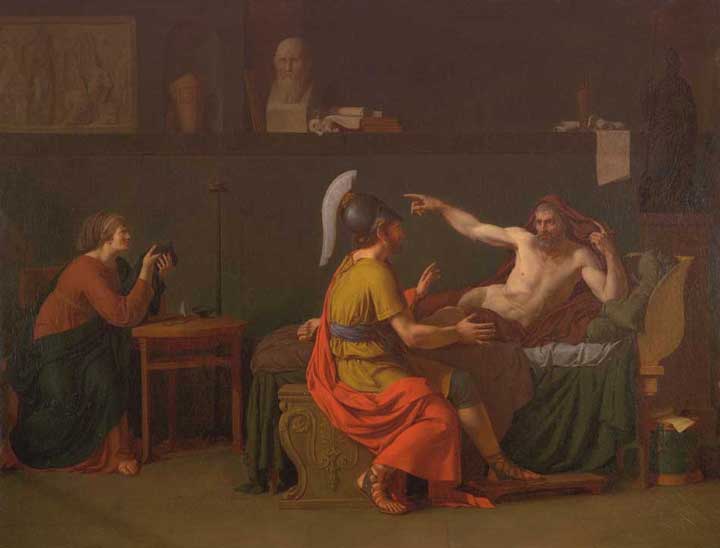
Diogenes Laertius, Lives of the Eminent Philosophers Anaxagoras 2.3
“There are different accounts about the trial of Anaxagoras. Sotion claims in his Succession of the Philosophers that he was taken to court for impiety because he claimed that the sun was molten metal. When his student Perikles made his defense, he was penalized five talents and sent into exile.
But Satyros in his Lives says that he was prosecuted by Thucydides who was working against Perikles and that in addition to impiety he was charged with treason with Persia. He was sentenced to death in absentia. When it was announced to him both that his sons were dead and he was sentenced, he said concerning the judgment that, “nature condemned me and my judges to death long ago” and on his sons, “well, I knew they they were born mortal.” But there are those who attribute this story to Solon while others say it was Xenophon.
Demetrius of Phalerum, in his On Old Age, says that Anaxagoras buried his sons with his own hands. Hermippos in his Lives says that he was locked up before he was about to die and that Perikles came forward and asked if they could accuse him of anything in his life. When they said nothing, he said, “Well, I am his student. Do not be overwhelmed by slanders and kill this person, but listen to me and let him go.” And he was freed. But because he could not endure the outrage, he killed himself.”
Greek Drama depends greatly on the hearer or reader knowing Homer. It is my firm opinion that there are a great many defects in Greek drama. I should never try to stop a man’s reading Aeschylus or Sophocles. There· is nothing in this book that ought in any way to curtail a man’s reading or to prevent his reading anything he enjoys.
Ultimately, I suppose, any man with decent literary curiosity read the Agamemnon of Aeschylus, but if he has seriously considered drama as a means of expression he will see that whereas the medium of poetry is WORDS, the medium of drama is people moving about on a stage and using words. That is, the words are only a part of the medium and the gaps between them, or deficiencies in their meaning, can be made up by ‘action’.
People who have given the matter dispassionate and careful attention are fairly convinced that the maximum charge of verbal meaning cannot be used on the stage, save for very brief instants. ‘It takes time to get it over’, etc.
This is not a text-book of the drama, or of dramatic criticism. It is unfair to a dramatist to consider his WORDS, or even his words and versification, as if that were the plenum of his performance. Taken as READING MATTER, I do NOT believe that the Greek dramatists are up to Homer. Even Aeschylus is rhetorical. Even in the Agamemnon there are quantities of words which do not function as reading matter, i.e., are not necessary to our understanding of the subject.”
“My Rome praises, loves, and sings my little books—
Every pocket, every hand holds me.
Look: someone turns red, yellow, is dumbstruck, looks again, and hates!
This is what I long for: now my songs have pleased even me.”
Laudat, amat, cantat nostros mea Roma libellos,
meque sinus omnes, me manus omnis habet.
Ecce rubet quidam, pallet, stupet, oscitat, odit.
Hoc uolo: nunc nobis carmina nostra placent.
Perhaps shit-talking is a trope in Roman poetry
Catullus, Carmen 83
“Lesbia talks a lot of shit about me when her husband is around
This brings the greatest pleasure to that fool.
Ass, do you know nothing? She would be sound
If she forgot us in silence—but she rants and she squawks.
She not only remembers me but—a thing sharper to touch,
She’s enraged: it’s like this, she’s burning and talks.”
Lesbia mi praesente viro mala plurima dicit:
haec illi fatuo maxima laetitia est.
mule, nihil sentis? si nostri oblita taceret,
sana esset: nunc quod gannit et obloquitur,
non solum meminit, sed, quae multo acrior est res,
irata est. hoc est, uritur et loquitur.
This variation on the put down “those who can, do, those who can’t, teach” does not seem to appear before the last decade or so. It is almost just pointed enough to sound like it might come from Greek, but just clearly superficial enough that it can’t be Aristotle. It does not appear to have multiple attributions, so I had to look. It is fake. Peisistratos Level Fake.
But there may be something to its sense. In the Eudemian Ethics, Aristotle explores how some people are good at things without understanding them and that “those people will succeed even though they are witless and without reason, just as some people sing well enough even though they cannot teach others how to sing” (οὗτοι κατορθώσουσι κἂν τύχωσιν ἄφρονες ὄντες καὶ ἄλογοι, ὥσπερ καὶ εὖ ᾄσονται οὐ διδασκαλικοὶ ὄντες, 1247b). In the Metaphysics, Aristotle elaborates (981b8-12):
“In general, an indication of knowledge or ignorance is whether you can teach a thing. This is why we believe that skill rather than experience is understanding. For, the skilled craftsperson can teach, but others cannot.”
This is, I think, about the fact that some people are just good at certain things while others actually understand the things they do. Someone who just happens to be good at one kind teaching, for example, because they are charismatic, or persuasive, or just really enthusiastic about one discipline, might not be good at teaching people how to teach.
And some people are just wrong, like the quote above.
Aristotle, Nicomachean Ethics 10 (1131a)
“But the sophists who claim that they teach [politics] prove to be quite far off from doing so. They actually don’t know what it is or what it pertains to.”
This is fake. What is it about fake quotes and numbers?
The quote above is so fake that it made me create an eighth category: Motivational Poster Fake. It ain’t real; it also ain’t deep. It shows up in print inspiration books in the 1980s. Somehow we can blame this on boomers, I think
The Real Deal: A quotation from an ancient text which is extant.
Aegis Real: Like the head of the Gorgon Medusa, these quotations have been decontextualized and passed down embedded in some other ancient author. They have been attributed to the same author for a long time, but who really knows.
Delphian Graffiti: A quote of real antiquity, but whose attribution has been shifted for different valence in modern contexts (e.g., “know thyself” has been attributed to almost everyone)
Rhetorica ad Fictum Fake: (with thanks to Hannah Čulík-Baird) Aristotle and Quintilian think it is just fine to make up quotations for persuasive reasons. This actually undermines many of the attributions we have from antiquity. So, this is the kind of fake that is really old and may just be too good to be true.
Cylon-Helen: Just as Herodotus and Stesichorus report that ‘real’ Helen was replaced with a near-exact copy for the ten years of the Trojan War, so too some quotations are transformed through translation (Latin into Greek, Greek into Latin; or into Modern languages). The intervention of an outside force changes the cultural status of the words.
Peisistratos Fake: A quote that is not misattributed or transformed, but merely just dressed up and falsely claimed as antique for political reasons (the tyrant Peisistratos pulled some pretty crazy stunts to get into power). These quotations have no sources in antiquity and are used to enforce modern points of view.
Racist Fake: Quotations of the Peisistratus type but with the particular intention of enforcing a racist world view.
Motivational Poster Fake: This kind of quote sounds good, but has nothing to it. It is anti-Philosophical in its gooey sententiousness which values seeming over being to such an extent that it makes us all dumber. Also, it is fake without any roots in antiquity
Some real quotations;
Aristotle,Rhetoric 2 1381 a
“A friend is someone who loves and is loved back. Friends believe they are friends and see their relationship to one another in this way. Because of this, a friend is someone who is a partner in our happiness and a partner in our sorrow not for any other reason but for friendship.”
“Someone claims that we made a promise to each other with money, he gave it and I took it. Was it only a little? Is it not likely that I took only a little money in exchange for tremendous efforts on my part? Or, was it a lot? How did I get it? How could he have brought it to me? Or did many people do it? If many people had done it, there would have been many witnesses of the conspiracy. But if one person did it, then he could not have carried much. Did they bring during the day or the night? There were many guards close together—it would have been hard to evade them. So it was at day? Well, daylight is hostile to these kinds of things.
Ok, let’s imagine this. Did I come out and take the money or did the man who brought it come inside? Both have their challenges. If I took it, how did I hide the fact from people inside and outside? Where could I have placed it? How would I have guarded it? If I used it, it would have been clear as day! If I didn’t use it, than what would I have gained from it?”






 ‘
‘

#/media/File:Ilias_Kodex.jpg)

