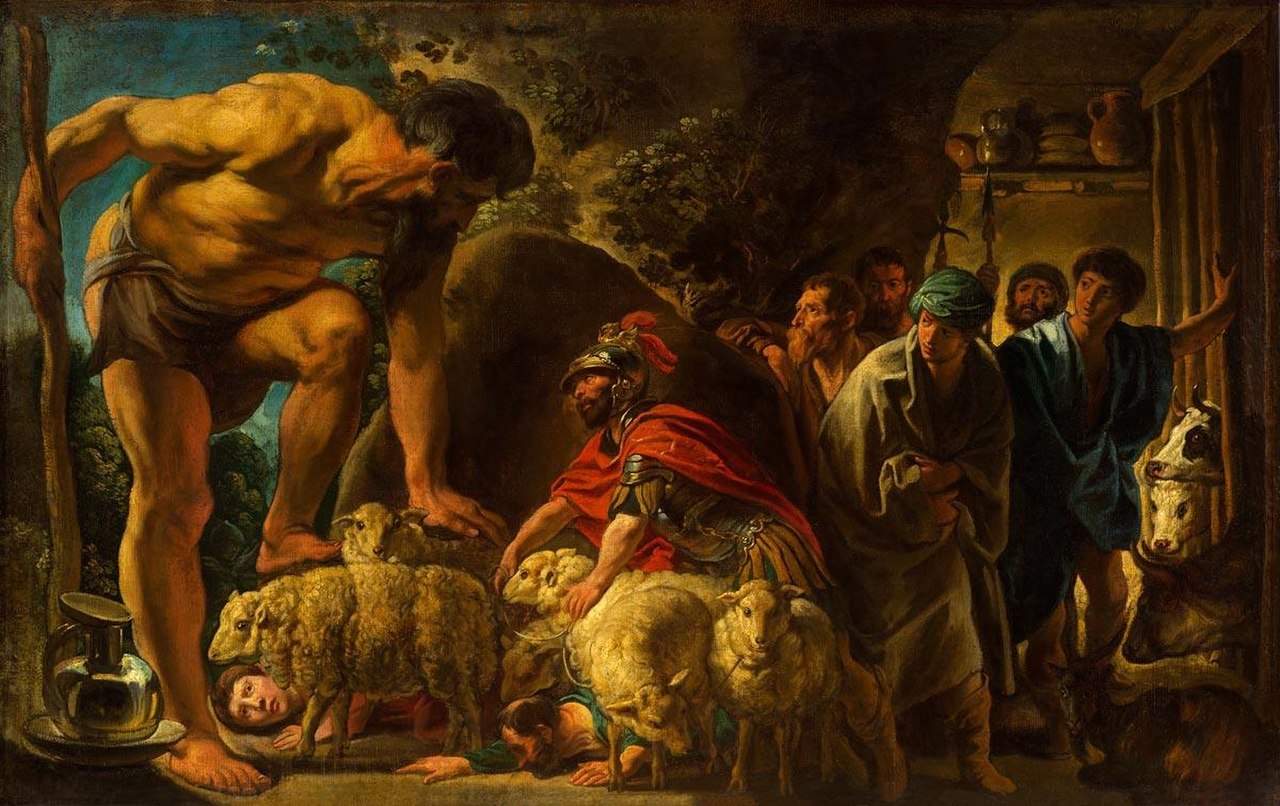
“To Athanasios, wine-diluter: Odysseus was persuading Polyphemos to release him from the cave: “I am a sorcerer and it is the right time for me to help you in your lack of success in maritime love. I certainly know chants, binding spells, and love-magic which it is unlikely for Galateia to resist for long. Just promise to move the door, or, more, the door stone. It seems the size of a cliff to me. I’ll swim back faster than this word itself, once I have compelled the girl. What do I mean by compelling her? I will show her here to you once she is easier because of the magic.
She will beg you and plead with you and you will act shy and be bashful. But something still gives me pause here. I am worried that the goat-reek of your blankets will be displeasing for a girl used to luxury, who bathes often during the day. It would be great if you cleaned everything up, sweeping, washing, and fumigating your place. It would be even better if you readied some ivy and bindweed to crown yourself and the girl when she gets here. Why are you wasting time? Why don’t you open the door now?”
In response to this, Polyphemos cackled as loud as he could and clapped his hands. Odysseus believed that because he was expecting to gain this girl quickly he was not able to restrain his joy. But Polyphemos rubbed his own chin and said, “No-man, you seem like the slickest fellow, a polished little businessman. Work on some other elaborate scam. You will never get out of here.”
“Superstitions make many moderate sufferings deadly. That ancient Midas, as it seems, was so disturbed and troubled by some dreams that he became upset enough to kill himself by drinking the blood of a bull. And the king of the Messenian, Aristodêmos, in that war against the Spartans, when the dogs were howling like wolves, the grass began to grow up over his ancestral hearth and some of the seers were frightened by the signs, was completely disheartened and extinguished all hopes when he took his own life.
It might have been best for Nikias the general of the Athenians to free himself of his superstition following Midas and Aristodêmos. Since he was afraid of the shadow of a moon in eclipse, rather than to sit there while he was walled in by the enemy only to get captured by them with forty thousand men who were slaughtered or taken alive and then die in infamy.”
“There are three kinds of governments: monarchy, aristocracy, and democracy. There is bad form which corresponds to each: Tyranny is the worse form of monarchy; oligarchy and also plutocracy are the bad form of aristocracy; and mob rule is the worse kind of democracy. In addition to these, sometimes there is one with elements from all of them, like the Roman Empire or ancient Sparta….
“Where offices are occupied by those who fulfill what is needed by the law, then he considered the state to be an aristocracy. Where they were filled by those who had the most money, a plutocracy; where everyone could serve, a democracy.”
“[Socrates] believed that kingship and tyranny were both governments but that they differed from one another. For he believed that kingship was government of a willing people and according to the laws of the city, while tyranny was when people were unwilling and against the laws, but instead according to the wishes of the ruler. Whenever leaders were selected from those who meet the standards of the law, the government is in aristocracy. When they are chosen from those who have enough property, it is a plutocracy. When they are elected from everyone, it is a democracy.”
“If election based on wealth is oligarchic while election according to excellence is aristocratic, there can be a third system according to which a state is organized as the Carthaginian polity is constructed. For they choose their leaders looking at two issues, especially the most significant offices, that of kings and generals.
But it is right to think that this departure from aristocracy is an error by the lawmaker. For among the most critical issues to consider from the beginning is how the best citizens might be able to have the free time and to refrain from anything inappropriate, both in office and in their private life. If it is right to consider furnishing the means for free time [to rule], it is bad for the most significant positions to be for sale (the kingship and the generalship).
For this law makes wealth more important than virtue and makes the whole state structured around money. Whatever the power structure considers valuable, the opinion of the rest of the citizens will follow. Wherever virtue is not honored above all else, the constitution cannot be aristocratic. It is also likely that those who purchase their offices will make a profit from them when they rule after spending their own money. For, it would be strange if a respectable man who is poor will want to profit but a corrupt man who has spent his own money would be disinclined to do the same.”
πλουτοκρατέομαι: “to live in a state governed by the rich”
πλουτοκρατία: “an oligarchy of wealth
πλουτοποιός: “enriching”
πλουτοτραφής: “raised on wealth”
πλουτόχθων: “rich in things of the earth”
Polybius, Histories 6.4
“The proof that what I have said is true comes from the following. It must not be asserted that every well-made government is a principality, but only the government which is assented to voluntarily and which is governed by reason rather than fear and force. Nor should we consider every oligarchy to be an aristocracy: the latter emerges only when men rule because they are the most just and the most prudent. In a similar way, a true democracy is not that in which the majority has the power to do whatever it wants, but what counts is if the will of the majority enforces observance of its traditional laws, honor to the customary laws, duty to parents, respect to elders, obedience to the laws—then it is right to call a state a democracy.
From this, we can isolate six types of government: the three I have just mentioned and three additional, related forms, monarchy, oligarchy, and mob rule. The first of these, monarchy, arises naturally, and without machination. The second follows it and develops from it with preparation and adjustment. Once this has transformed into the evil form akin to it, tyranny, and aristocracy develops from the dissolution of both. When aristocracy devolves into oligarchy as is natural, and the people turn into rage over the injustice of their leaders, democracy emerges. Over time, mob-rule develops from outrage and illegality. Anyone can understand clearly from this pattern that the things I am saying now are true, based on the nature of each government in its origins and its evolution.”
“The person who sends rather weighty gifts causes no less grief than the one who throws the ball too hard to his teammate or offers a big cup to his fellow drinker in toast. For the latter seems to toast not for pleasure but for getting drunk. Just as in wise drinking parties we see that the wine is mixed with a little pure alcohol and a lot of water, so too are gifts mixed best with a lot of thought and a little expenditure.
For who should we say gets the benefit from expensive gifts? Is it the poor? They are not capable of giving them. The rich? They don’t need to get them. In addition, it is not possible to constantly give expensive gifts—there will be a failure of resources if someone should often send out immense gifts. It is possible, however, to give small gifts endlessly and without regret—since someone owes only small thanks to the one who gave a small gift.”
Diodoros, Excerpta de virtutibus et vitiis 305.19–27 [=BNJ 87 F 108]
“There was another rebellion of fugitive slaves and a resistance of some renown. For a certain Cleon, a Cilician from the area near Tauros, was accustomed since childhood to a life of robbery. When he became a shepherd in Sicily, there was no end to his attacks on travelers and his constant murders. Once he heard of Eunous’ success and the achievement of his rebellion, he created his own revolt and convinced many nearby to join his madness. They took over the city of Akragas and all of the land nearby.”
Ye gods, what havoc does ambition make among your works!
Joseph Addison, Cato 1.1
As news reports make clear that the grim specter of despotism has begun to prevail all the world over, it may be a salutary exercise to remember that tyrannical abuse of authority is enshrined and even championed in some of our oldest literature. In the Iliad, when Agamemnon makes a trial of the Achaeans under his command, he finds that – contrary to his expectation – all are eager to abandon the field and head home after years of fruitless war. (Perhaps the Trojan War can be viewed as a precursor of America’s foreign adventures – military quagmires waged for dubious motivation, entailing that unpalatable combination of wholesale slaughter and crime at which humanity seems to excel.)
Odysseus rallies round and attempts to stop the men by doubling down on this cheerfully antidemocratic sentiment:
Let there be one ruler, one king…
…εἷς κοίρανος ἔστω, εἷς βασιλεύς… [Iliad 2.204-5]
Perhaps we ought to be more surprised that the men are recalled to their martial project not by a speech calling for common effort or reminding them of the chance for personal emolument which may follow a successful siege, but a miniature disquisition on their personal inferiority to the king. Thersites is meant to be a reviled character, and Homer paints an unflattering portrait of him, but he is the only one to advocate for what a dispassionate observer of the facts might call common sense.
After pointing out that Agamemnon has already appointed to himself a hefty share of plunder and captive women, he notes that Agamemnon had erred in affronting Achilles, who was a better man than himself. Thersites urges the men to return home and let Agamemnon finish the war on his own, when Odysseus strikes him. This violence inflicted upon their champion actually instills a sense of delight in the men for whose benefit Thersites had just advocated.
This acceptance of personal despotism may strike the attentive reader as unrealistic, but it is easy for to be idly carried away by this propaganda, and Odysseus’ soundbite formulation, “Let there be one ruler,” has the sort of captivating quality which all propagandistic sloganeering is meant to. “Drill Here. Drill Now. Pay Less.” has such a harshly commonsensical sound about it that all more prudent alternatives are gracefully elided by its elegant tricolonic balance of six syllables.* Sideshow Bob, in a Simpsons episode in which he steals the mayoral election, explains why the citizens of Springfield need him:
Your guilty conscience may force you to vote Democratic, but deep down inside, you secretly long for a cold-hearted Republican to lower taxes, brutalize criminals, and rule you like a king.
Many (I am among them) have expressed surprise that so many Republicans have abased themselves to such a shocking degree for a man who seems so patently unworthy of it. The subtext of this is of course that we could, though still appalled, understand the fervor to defend him if he were more intelligent, more charming, less loathsome and vile. Yet this seems to miss the point that loathsome and vile is what Republicans have been shilling for over the past several decades. Who are the mainstream figureheads of their public outreach? Hannity, O’Reilly, Tucker Carlson, Rush Limbaugh. They are loud, obnoxious, and perfectly content to advertise their stupidity as a kind of common-man credential. Roger Ailes developed the Fox News model with the specific intention, not of vying with CNN for straightforward news coverage, but of appealing to an audience who would find ready comfort in propaganda already prepackaged for their prejudices.
After Romney’s defeat in 2012, the Republican party reportedly did some strategizing, and decided that they may need to jettison racism, misogyny, and other forms of unregenerate barbarism in order to win elections. Four years later, Trump offered a kind of catharsis for real Republican values, and became so beloved because, like so many reality stars and social media figures before him, he showed that it’s okay – nay, even profitable – to be a vile piece of shit. Trump ungirded the belt of restraint imposed by the fastidious managerial class of Republicans (like William F. Buckley, Romney, etc.), and urged Republicans to stop sucking it in, to let the fatty accretion of 19th century prejudice hang free.
If only yesterday were farther away.
In his Decline and Fall of the Roman Empire, Gibbon explains that Commodus was killed by his domestics once they had reason to fear his violence. Commodus was succeeded by Pertinax:
Such an uniform conduct had already secured to Pertinax the noblest reward of a sovereign, the love and esteem of his people. Those who remembered the virtues of Marcus were happy to contemplate in their new emperor the features of that bright original; and flattered themselves that they should long enjoy the benign influence of his administration. A hasty zeal to reform the corrupted state, accompanied with less prudence than might have been expected from the years and experience of Pertinax, proved fatal to himself and to his country. His honest indiscretion united against him the servile crowd, who found their private benefit in the public disorders, and who preferred the favour of a tyrant to the inexorable equality of the laws.
Chafing under the virtuous discipline of Pertinax, and missing the vicious and licentious indulgence of Commodus, the praetorian guards murdered Pertinax in turn and literally sold the office of emperor to Didius Julianus. In much the same way, the Republican base, molded by years of racist, misogynist, and crackpot ranting, was eager to throw off the oppressive yoke of feigned civility, and return to the gilded age of honest and forthright evil.
Having lived my entire life in the south (Texas, Arkansas, Tennessee), I remember friends’ dads who were still ardent enthusiasts for the Confederacy, the “lost cause”. Of course, this was peppered with the sort of apologetics (developed during Reconstruction) which insisted that the Civil War was a conflict about states’ rights. Though we may lament the “rise” in white supremacy, I suspect that the old Pertinacious restraint has simply been removed, and that these guys are just happy that Trump allows them to be honest (a privilege which he rarely affords himself). That is, we have experienced, not a rise in racism, but simply a revelation of it.
The narrative of the “lost cause” is central to the current crisis. Much has been made of the kompromat which may have induced certain once reluctant Republicans (like Lindsey Graham) to lodge their lips on the Trumpian sphincter, and there may be something to that notion. Yet the simplest explanation is that they are simply engaged in the bald and unapologetic pursuit of power. One may modify Samuel Johnson:
Greek, sir, is like lace despotic power; every man gets as much of it as he can.
Any sensible and cynical power broker could easily see that the base won’t go away, even if Trump does. They have become unshakeable in their faith, and regard him as something close to a savior. (Lest this seem exaggerated, just watch Rick Perry talk about him as God’s Chosen One, or look up the videos of the Trumpians saying that they would pick Trump over Jesus.) One day he will be gone. But the damage won’t. His ideas won’t. His base won’t. And what began as but a recrudescence of infantile barbarism will be revealed as one of the dominant forces in our politics for some time to come. Trump himself will be “the lost cause.” Whether he is impeached or voted out, he will always be a martyr to his acolytes. Every time his swamp monsters abase themselves in public, they are simply auditioning for the role of St. Peter to Trump’s Christ. Trump revealed that what had begun as a base loosely organized around talk radio and cable news talking points could be transformed into an intensely loyal hive mind ready to give obeisance to one person.
It may be time to consider altogether abandoning executive power as a governing instrument. Even Agamemnon was ostensibly just primus inter pares, serving as something like a president of the Trojan expedition (seeing that the other kings did not owe him hereditary fealty or anything of the sort). Yet, his wanton abuse of power in his conflict with Achilles lay at the root of the suffering in the Iliad. Had all decisions been made by a council of equals rather than an irresponsible executive, it is likely that the conflict would not have led to Achilles’ withdrawal. Yet, Agamemnon’s position as executive meant that he stood as a metonym for the war effort itself, and so Achilles justified renouncing what was at root a communal and cooperative endeavor because he could not brook the insolence of the man presiding over it. (It is moreover clear that the problem was not simply the intransigence of the two men, but the wanton abuse of power on Agamemnon’s part.)
Much of our popular entertainment is devoted to the pursuit of power in the hands of one person. Audiences who wasted the better part of a decade on Game of Thrones were eager to see who would finally sit on the Iron Throne, despite the fact that the internal logic established by the narrative itself showed a.) that it actually didn’t matter to practically everyone in Westeros who sat on the throne, and b.) that there is no finality implied by that first sedentary moment upon the throne, since several rulers were killed off in the course of the series. Amidst all of the other interesting narratives, we really just wanted to know who would seize power – the very possession of it has the power to enchant us.
Similarly, our contests for president have resulted in a twisted political system which rewards organizing, not around an idea, but around a person, and regarding that person as the captain or figurehead of the team. This was true even during the Clinton years, when Democrats mounted a defense of a man who really didn’t need or warrant defending simply because he was the boss.
Of course, the presidency, like all of the basic elements of our government, was a contrivance of the founders, some of whom floated the idea that it (along with senate seats) should be a lifetime appointment. It was intentionally designed to be limited to a small elite (indeed, so petty were many of the founding generation, the requirement that a candidate be a citizen born within the U.S. was designed to exclude Alexander Hamilton from ever attaining the office) and was not intended to be a democratically elected office.
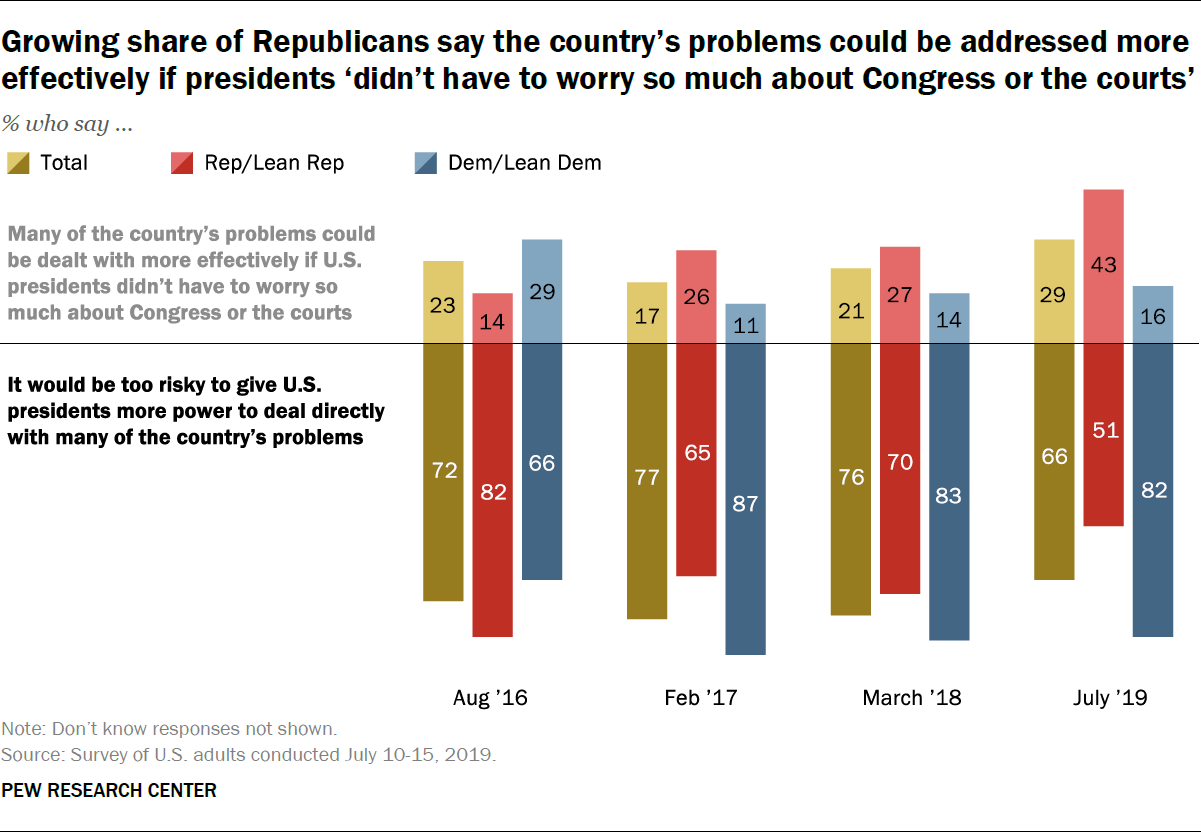
It was a bad idea then, and it is a bad idea now, especially given the size of the population governed by this one person, and the immense power which they have at their disposal. No individual, irresponsible to the will of the nation, should be trusted with such power, especially as it has apparently become the operative norm that no president can be held accountable for any crime. What is this but semi-elective, short term despotism? Indeed, a recent Pew Research poll suggests that Republicans in particular have become more keen on eliminating the system of checks and balances altogether, granting presidents more absolute and unrestrained power in order to “address the country’s problems.” Naturally, this is because they think that their man (and by extension, their team or even they) will be the conductor of the old tyranny train as it takes off from despotism depot.
Naturally, like most critics, I have no useful schemes to suggest as alternatives, if for no other reason than that I suspect that the human drive for individual power is too deeply entrenched to allow for such a radical shift in political organization. In America, the popular will has repeatedly been thwarted by design. It is a truth universally acknowledged that the founders had something of a fond partiality for classical learning and exempla. Although Classics department websites may tout knowledge of Greek as some introduction to “the civilization that invented democracy,” one would be hard pressed to find a literature as virulently anti-democratic as the classics. And to think, it all started with Odysseus’ assault on Thersites. Maybe it is time to reconsider Thersites as the true tragic hero of the Iliad – the one man who, in arguing that the common soldier’s subservience to Agamemnon primarily benefited Agamemnon, could have saved countless lives had his counsel prevailed. In this light, maybe Odysseus deserved another ten years of suffering. I only fear that we can expect at least as many for ourselves.
What need we fear who knows it, when none can call our power to account? (Lady Macbeth in Macbeth, 5.1)
As Augustus knew, despotic power is most effective when disguised as republican government.
*I confess that this is Joel’s favorite example, and I have used it here as a tribute to his sagacity in analyzing political rhetoric.
“Lydia is as wide as the ass of a bronze rider’s horse,
Or a fast hoop that sounds its clattering bronze,
Or a wheel crossed untouched by an acrobat,
Or an old shoe wet with muddy water,
Or as the wide nets that wait for wandering birds,
Or the awnings which close Pompey’s theater to the South Wind,
Or as arm-jewelry slipped off a diseased male-hooker,
Or a mattress separated from its Leuconian stuffing,
Or the old trousers of a British pauper,
Or the foul throat of a Revennian Pelican.
I am reputed to have fucked her in a salty fishpond.
I am not sure: I think I fucked the fishpond.”
Lydia tam laxa est equitis quam culus aeni,
quam celer arguto qui sonat aere trochus,
quam rota transmisso totiens inpacta petauro,
quam vetus a crassa calceus udus aqua,
quam quae rara vagos expectant retia turdos,
quam Pompeiano vela negata Noto,
quam quae de pthisico lapsa est armilla cinaedo,
culcita Leuconico quam viduata suo,
quam veteres bracae Brittonis pauperis, et quam
urpe Ravennatis guttur onocrotali.
Hanc in piscina dicor futuisse marina.
Nescio; piscinam me futuisse puto.
7.2 “When [Mary] was twelve years old, the priests held a council where they were saying: “Look, Mary is twelve years old in the Temple of the Lord. What shall we do about her, since we don’t want her to defile the Temple of the Lord when women’s matters come to her.” And they said to the chief-priest: “you, you preside over the sacred place of the god—go there and pray about her and let us do whatever the Lord God reveals to you.
So the priest entered, once he took the twelve-belled cloak, the clothing of a priest, into the Most Holy of Holy Places and he prayed about her. And, look, an angel of the lord appeared, saying to him: “Zacharias, Zacharias, go out and hold an assembly of the people’s widowers and have every man carry a staff. To whomever the lord shows a sign, she will be his husband.” So, the heralds went throughout the land of Judea and the Lord’s trumpet sounded, and every one ran there.
Joseph dropped his sickle and hurried to the assembly too. And when they were all gathered, they approached the priest. The priest took all of their staves, went into the temple and prayed. Once he finished the prayer, he came out and gave each man his staff back. There was no sign upon any of them. But when Joseph received his staff last, look!, a dove came out if it and alighted upon Joseph’s head.
Then the priest said, “It is your fate to take the Lord’s virgin. Take her and keep her as your own.” Joseph responded, “I have two sons and I am an old man; she is a young girl. Should I become a joke among the sons of Israel?” Then the priest said to him, “Joseph, fear the Lord God and the things he did to Datham and Koreh and Abêrôm—how the earth opened in two and they were all drowned inside because of their refusals.You should fear too, now, Joseph, that these things will happen in your house too.” So, because he was afraid, Joseph took her into his own care. And he said to her, “Mary, look, I took you from the Temple of the Lord, My God, and now I will leave you in my home. I am leaving to build some of my buildings. And I will come back to you in turn. May the Lord keep you safe.”
This is reflected in the iconography for Nativity (Christmas.) Joseph is lower left (being tempted by Satan in the guise of an old man.) Even though the gospel of James as a whole isn’t “canon” there are elements that both Orthodox and Catholics believe. pic.twitter.com/0ny8U32vPf
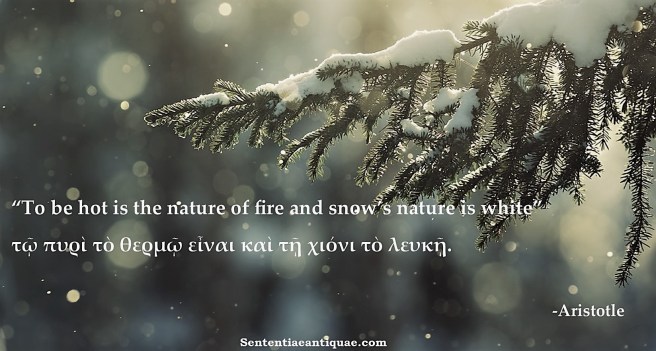
“Have you ever seen a pomegranate seed in drifts of snow?”
ἤδη τεθέασαι κόκκον ἐν χιόνι ῥόας;
Pindar, Pythian 1. 20
“Snowy Aetna, perennial nurse of bitter snow”
νιφόεσσ᾿ Αἴτνα, πάνετες χιόνος ὀξείας τιθήνα
Plutarch, Moralia 340e
“Nations covered in depths of snow”
καὶ βάθεσι χιόνων κατακεχωσμένα ἔθνη
Herodotus, Histories 4.31
“Above this land, snow always falls…
τὰ κατύπερθε ταύτης τῆς χώρης αἰεὶ νίφεται
Diodorus Siculus, 14.28
“Because of the mass of snow that was constantly falling, all their weapons were covered and their bodies froze in the chill in the air. Thanks to the extremity of their troubles, they were sleepless through the whole night”
“I stood on a high mountain and I saw one tall person and another short one. And I heard something like a thunder’s sound and I went closer to hear it. He addressed me and said: “I am you and you are me and wherever you are I am there; and I am implanted in all things. So you can gather me from wherever you want. And when you harvest me, you harvest yourself.”







.jpg)

