The Sorrow of Times Like These

Lucretius, De Rerum Natura 6.1230-1251

“This thing alone had to be mourned the most,
This lamented: how when anyone would give up
when they realized they had contracted the disease
As condemned to die, they would stretch out with a sad heart,
Surrendering their spirit while considering the rites of the dead.

For the spread of that greedy sickness did not stop
Even for a single moment from one to another,
Thick together as woolly flocks and horned heads—
That’s the reason why grave was piling on grave.
Whoever was reluctant to see their own sick,
For this very excessive love of life and fear of death
They were punished eventually with a foul and evil end,
As deserters without help, paid back for their neglect.

But those who stayed to help faced contagion too,
And the suffering which shame compelled them to meet.
The pleading voice of the weary mixed with cries of complaint.
Well, the best kinds of souls met death like this.

…Then some falling upon others, fighting to bury their masses
Of dead, worn out by tears and grief as they returned.
They surrendered to their beds for the better part.

No one could be found anywhere who was untouched by the disease
By the death, by the sorrow of times like these.”

Illud in his rebus miserandum magnopere unum
aerumnabile erat, quod ubi se quisque videbat
implicitum morbo, morti damnatus ut esset,
deficiens animo maesto cum corde iacebat,
funera respectans animam amittebat ibidem.

quippe etenim nullo cessabant tempore apisci
ex aliis alios avidi contagia morbi,
lanigeras tamquam pecudes et bucera saecla;
idque vel in primis cumulabat funere funus.
nam quicumque suos fugitabant visere ad aegros,
vitai nimium cupidos mortisque timentis
poenibat paulo post turpi morte malaque,
desertos, opis expertis, incuria mactans.

qui fuerant autem praesto, contagibus ibant
atque labore, pudor quem tum cogebat obire
blandaque lassorum vox mixta voce querellae.
optimus hoc leti genus ergo quisque subibat.
. . . . . . .
inque aliis alium, populum sepelire suorum
certantes; lacrimis lassi luctuque redibant;
inde bonam partem in lectum maerore dabantur.
nec poterat quisquam reperiri, quem neque morbus
nec mors nec luctus temptaret tempore tali.

 

Palermo-trionfo-della-morte-bjs.jpg
Triumph of Death Fresco, Palermo
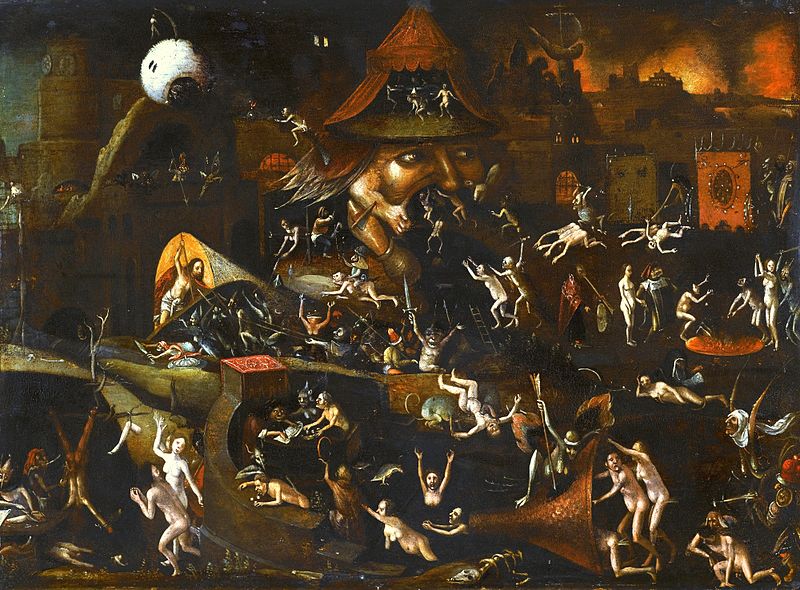
File:Follower of Jheronimus Bosch - The Harrowing of Hell.jpg
“The Harrowing of Hell” Hieronymus Bosch

Fate-Breaker or Bag-boy? Some Odd Etymologies for the Trojan Paris

Major names in the Homeric tradition have some pretty opaque etymological origins. But folk etymologies (really any ‘false’ etymologies that are important to the reception of myths in performance) are viable objects of study both for what they tell us about Greek thoughts on language and for what they tell us about the life of myths outside our extant poems. Some of these are ridiculous–as in “lipless Achilles” or the story of an Odysseus who was born on the road in the rain. But they all tell us something about how audiences responded to traditional tales.

Here are some etymologies for Paris. (and credit to @spannycat for asking about this)

Photios

“Ill-passing” [Dusparis] someone named for evil, for example when Paris was born. A bad-nickname. Also, a place that is difficult to pass through [duspariton], unpassable. Xenophon uses it this way in the Anabasis.

Δύσπαρι (Γ 39)· ἐπὶ κακῷ ὠνομασμένε, οἷον ζήσας ὡς Πάρις, δυσώνυμε. καὶ δυσπάριτον χωρίον· τὸ ἄβατον. οὕτως Ξενοφῶν ἐν τῇ ᾿Αναβάσει (4, 1, 25).


Etym. Gud. 454.39

“Paris, of Paris [Paridos], the son of Hekabê who was called Alexander and also Paris. The name comes from the fire [Fire] in Ida. For Hekabê believed in a dream that she was giving birth to a torch which would consume the city with fire and the forest on Ida too. For this reason, she exposed him on Ida after he was born.”

Πάρις, Πάριδος, ὁ υἱὸς ῾Εκάβης ἐκλήθη ᾿Αλέξανδρος, ὁ καὶ Πάρις. παρὰ τὸ πῦρ καὶ τὴν ῎Ιδην. ἐν ὁράματι γὰρ ἡ ῾Εκάβη ἐνόμισε δάλον τίκτειν, ὅστις κατέφλεγε τὴν πόλιν, καὶ τὴν ἐν τῇ ῎Ιδη ὕλην· καὶ τούτου χάριν τεχθέντα ἐν τῇ ῎Ιδῃ ἀπέῤῥιψεν.

Etymologicum Magnum 654.37

“Paris: this is from going against [parienai] fate, which means to escape death. Or it is from a pêra which is a kind of bag. It comes from the fact that he was taken care of in a shepherd’s bag.”

Πάρις: Παρὰ τὸ παριέναι τὸν μόρον, τουτέστιν ἐκφυγεῖν τὸν θάνατον· ἢ παρὰ τὴν πήραν, ὃ σημαίνει τὸ μαρσίπιον· ἀπὸ τοῦ ἐν τῇ ποιμαντικῇ πήρᾳ ἀνατραφῆναι.

What is up with all the variant etymologies? It seems that the name Paris is not from Greek origins. As with other famous names, once the origins of a word become obscure, later audiences re-analyze them in some fantastic ways.

“The hero ’ s other name, Paris, is clearly non-Greek. Watkins indicated a possible Luvian attestation of it and related it to the name of his father Priam, which is allegedly of the same etymology (Luvian: Pariyamuvas ‘ supreme in force ’ , from pari(ya)-, which is contracted in the case of Priam).³² It may thus seem that the name Paris is equivalent in sense to Alexandros. However, it is very doubtful that the poem appreciated the meaning of a name in a foreign language…” Kanavou 2015, 85)

Kanavou, Nikoletta. The Names of Homeric Heroes : Problems and Interpretations, De Gruyter, Inc., 2015


Image result for greek vase paris
A Judgment of Paris Vase at the MFA.

Go Ahead, Fart at Dinner!

Petronius, Satyricon 47:

“Pardon me, friends. My stomach has not been well for days, and the doctors don’t know what they’re about. Yet, pomegranate and pine with vinegar have done me good. Yet, I hope that my bowels will resume their old sense of shame. Otherwise, my stomach will sound so loud that you’d think it was a bull! So, if any of you wish to attend to personal business, don’t feel ashamed. No one of us is solidly born, and I think that there is no greater torment than to hold it in. Farting is the one thing which even Jupiter cannot forbid. I see you laughing, Fortunata, but you often wake me up at night with your blasts. So, I don’t forbid anyone in the dining room to do what will come as a relief, and doctors urge us not to hold it in. And, if anything more than just a fart should come upon you, everything is ready outside: water, some pots, and other accessories. Believe me, if a vapor wafts up into your brain, it will make a wave in your entire body. I know that many have died because they did not wish to speak the truth.”

Image result for ancient roman farting

“Ignoscite mihi, inquit, amici, multis iam diebus venter mihi non respondit. Nec medici se inveniunt. Profuit mihi tamen maleicorium et taeda ex aceto. Spero tamen, iam veterem pudorem sibi imponet. Alioquin circa stomachum mihi sonat, putes taurum. Itaque si quis vestrum voluerit sua re causa facere, non est quod illum pudeatur. Nemo nostrum solide natus est. Ego nullum puto tam magnum tormentum esse quam continere. Hoc solum vetare ne Iovis potest. Rides, Fortunata, quae soles me nocte desomnem facere? Nec tamen in triclinio ullum vetuo facere quod se iuvet, et medici vetant continere. Vel si quid plus venit, omnia foras parata sunt: aqua, lasani et cetera minutalia. Credite mihi, anathymiasis si in cerebrum it, et in toto corpore fluctum facit. Multos scio periisse, dum nolunt sibi verum dicere.”

Reading Aeschylus’ “Persians” Online

Aeschylus, Persians 93-100

“What mortal person will escape
A god’s crooked deception?
Who steps with a light enough foot
To leap away through the air?
For destruction is at first friendly, even fawning
As it draws someone aside into a trap
From which it is impossible for any mortal to escape
Or even avoid.”

δολόμητιν δ᾿ ἀπάταν θεοῦ
τίς ἀνὴρ θνατὸς ἀλύξει;
τίς ὁ κραιπνῷ ποδὶ πηδή-
ματος εὐπετέος ἀνάσσων;
φιλόφρων γὰρ ποτισαίνουσα τὸ πρῶτον παράγει
βροτὸν εἰς ἀρκύστατ᾿ Ἄτα,
τόθεν οὐκ ἔστιν ὑπὲκ θνατὸν ἀλύξαντα φυγεῖν.

RGTO.Persians.poster.20200511-01 (1)

I have been helping  the Center for Hellenic Studies , the Kosmos Society and Out of Chaos Theatre to present scenes from Greek tragedy on the ‘small screen’  in our time of isolation. As Paul O’Mahony, whose idea this whole thing was said in an earlier blog post, Since we are “unable to explore the outside world, we have no option but to explore further the inner one.” But this experience also helps us thing about how changes we understand the tragic genre and its performance, how the themes and concerns of ancient tragedy communicate to us today, especially in a time of crisis, and, most importantly, how important it is to stay occupied and engaged with one another.

Each week we select scenes from a play, actors and experts from around the world, and put them all together for 90 minutes or so to see what will happen. This process is therapeutic for us; and it helps us think about how tragedy may have had similar functions in the ancient world as well.

This week we turn to our only surviving tragedy based on historical events: Aeschylus’ Persians which commemorates the Greek victory at Salamis, from the Persians’ point of view.

266-7

“I was present there—not merely hearing other’s words
Persians, I can tell you what kinds of terrible things occurred.”

καὶ μὴν παρών γε κοὐ λόγους ἄλλων κλυών,
Πέρσαι, φράσαιμ᾿ ἂν οἷ᾿ ἐπορσύνθη κακά.

File:Greek-Persian duel.jpg
Greek and Persian duel on vase

Scenes (from Ian Johnston’s translation)

625-689, Chorus and Chorus Leader
690-1027, Atossa, Chorus, Chorus Leader, Darius
1028-1076, Chorus
1077-1254, Chorus, Chorus Leader, Xerxes

This Week’s Actors and Crew

Chorus – Tim Delap and Evelyn Miller
Atossa – Tabatha Gayle
Darius – Tony Jayawardena
Xerxes – Martin K Lewis

Special Guest: Erika Weiberg

Dramaturgical assistance: Emma Pauly

Direction: Paul O’Mahony

Posters: John Koelle

Technical, Moral, Administrative Support: Lanah Koelle, Allie Mabry, Janet Ozsolak, Helene Emeriaud, Sarah Scott, Keith DeStone

290-295

“I have been silent for a while, struck with pains
By these evils. The disaster runs over all bounds
of speaking or asking about its suffering.
Still, necessity forces mortals to endure the pains
The gods send us. Pull yourself together,
Tell us everything that happened…”

σιγῶ πάλαι δύστηνος ἐκπεπληγμένη
κακοῖς· ὑπερβάλλει γὰρ ἥδε συμφορά,
τὸ μήτε λέξαι μήτ᾿ ἐρωτῆσαι πάθη.
ὅμως δ᾿ ἀνάγκη πημονὰς βροτοῖς φέρειν
θεῶν διδόντων· πᾶν δ᾿ ἀναπτύξας πάθος
λέξον καταστάς, κεἰ στένεις κακοῖς ὅμως·

Upcoming Readings(Wednesdays at 3PM EDT, Unless otherwise noted)

Euripides, Trojan Women, May 20th

Sophocles, Ajax, May 29th

Euripides, Andromache, June 3rd

Sophocles, Oedipus Tyrannos, June 10th

Euripides, Ion, June 17th[10 AM EDT/3PM GMT]

Euripides, Hecuba, June 24th

Aeschylus, Prometheus Bound, July 1st

588-603

“Friends, whoever gains some practice in troubles
Understands that when a wave of troubles come
We mortals tend to fear everything.
But when a god makes things easy, you think
You’ll always sail under the same favorable wind.”

φίλοι, κακῶν μὲν ὅστις ἔμπειρος κυρεῖ,
ἐπίσταται βροτοῖσιν ὡς ὅταν κλύδων
κακῶν ἐπέλθῃ, πάντα δειμαίνειν φιλεῖ,
ὅταν δ᾿ ὁ δαίμων εὐροῇ, πεποιθέναι
τὸν αὐτὸν αἰὲν ἄνεμον οὐριεῖν τύχης.

Videos of Earlier Sessions
Euripides’ Helen, March 25th
Sophocles’ Philoktetes, April 1st
Euripides’ Herakles, April 8th 
Euripides’ Bacchae, April 15th
Euripides’ Iphigenia , April 22nd
Sophocles, Trachinian Women, April 29th
Euripides, Orestes  May 6th

Stoicism is Bullshit

Bartolomeo Scala, Dialogue of Consolation §19:

One must think differently about grief, to be sure, differently from the Stoics, who call themselves manly men because they don’t want to be seen to feel pain, if they are – as I said above – understood correctly. While they produce a resplendent speech ornamented with magnificent words, they seem to abandon and forget about nature and the matter at hand. For that reason, Dionysius of Heraclea argued against them in the most excellent way. He had been a student of Zeno, and had drunk deep of the learning of the Stoics, but finally when his kidneys were racked with pain, he said that everything he learned in the Stoa was a lie, while his fellow student Cleanthes stood nearby and called Zeno back from hell with this line: Do you hear this under the earth, Amphiaraus?

Zeno_of_Citium_Nuremberg_Chronicle

Aliter profecto, aliter quam Stoici, qui etiam propterea quod dolere videri nolunt se appellant masculos, aliter, inquam, de dolore, si recte, ut supra dixi, interpretantur, sentiendum est. Afferunt enim praeclaram duntaxat quandam magnificisque ornatam verbis orationem, rem autem ipsam ac naturam deserere obliviscique videntur. Quapropter et Dionysius ille Heracleotes optime illos arguit. Cum enim fuisset Zenonis discipulus Stoicorumque disciplinam imbibisset, tandem vero renum vexaretur doloribus, falsa illa esse omnino quae in porticu didicisset asserebat, astante etiam atque acclamante condiscipulo eius Cleanthe Zenonemque ipsum tragico versu ab inferis excitante: ‘Audisne haec sub terra, Amphiaraè abdite?”

Tawdry Tuesday: Two Scenes of Post-Coital Remorse

Ovid, Remedia Amoris, 413–424

“But as soon as pleasure, spent, comes to its goal
And bodies lie thoroughly exhausted with the mind
When it gets annoying and you prefer to have touched no girl
And you seem unlikely to touch one again for a while,
Then gather in your mind whatever faults are in her flesh
And hold each of her imperfections in your eyes.
Perhaps someone else will consider them small—as they are,
But what is no advantage alone aids in numbers.
A viper slays a giant bull will a small bite;
A boar is often held by a hound of no great size.
Make sure you fight with such a number: collect your judgments,
A mountain will grow from so much sand.”

At simul ad metas venit finita voluptas,
Lassaque cum tota corpora mente iacent,
Dum piget, et malis nullam tetigisse puellam,
Tacturusque tibi non videare diu,
Tunc animo signa, quaecumque in corpore menda est,
Luminaque in vitiis illius usque tene.
Forsitan haec aliquis (nam sunt quoque) parva vocabit,
Sed, quae non prosunt singula, multa iuvant.
Parva necat morsu spatiosum vipera taurum:
A cane non magno saepe tenetur aper.
Tu tantum numero pugna, praeceptaque in unum
Contrahe: de multis grandis acervus erit.

Homeric Hymn to Aphrodite, 168–176

“But when the shepherds gather back to the fold
Their cattle and strong sheep from the blooming meadows,
Then over Anchises she was pouring sweet sleep
Gently and she wrapped her shining cloths around her.
Once clothed well over her entire body, the shining goddess
Stood near the bed, and her head touched the well-made roof,
And the immortal beauty shone from her cheeks
As it does from well-crowned Kytherea.
And she woke him from sleep and spoke his name:
“Get up, Dardanian. Why do you still stretch out in deep sleep?…”

῏Ημος δ’ ἂψ εἰς αὖλιν ἀποκλίνουσι νομῆες
βοῦς τε καὶ ἴφια μῆλα νομῶν ἐξ ἀνθεμοέντων,
τῆμος ἄρ’ ᾿Αγχίσῃ μὲν ἐπὶ γλυκὺν ὕπνον ἔχευε
νήδυμον, αὐτὴ δὲ χροῒ ἕννυτο εἵματα καλά.
ἑσσαμένη δ’ εὖ πάντα περὶ χροῒ δῖα θεάων
ἔστη ἄρα κλισίῃ, εὐποιήτοιο μελάθρου
κῦρε κάρη, κάλλος δὲ παρειάων ἀπέλαμπεν
ἄμβροτον, οἷόν τ’ ἐστὶν ἐϋστεφάνου Κυθερείης.
ἐξ ὕπνου τ’ ἀνέγειρεν, ἔπος τ’ ἔφατ’ ἔκ τ’ ὀνόμαζεν·
῎Ορσεο Δαρδανίδη· τί νυ νήγρετον ὕπνον ἰαύεις;

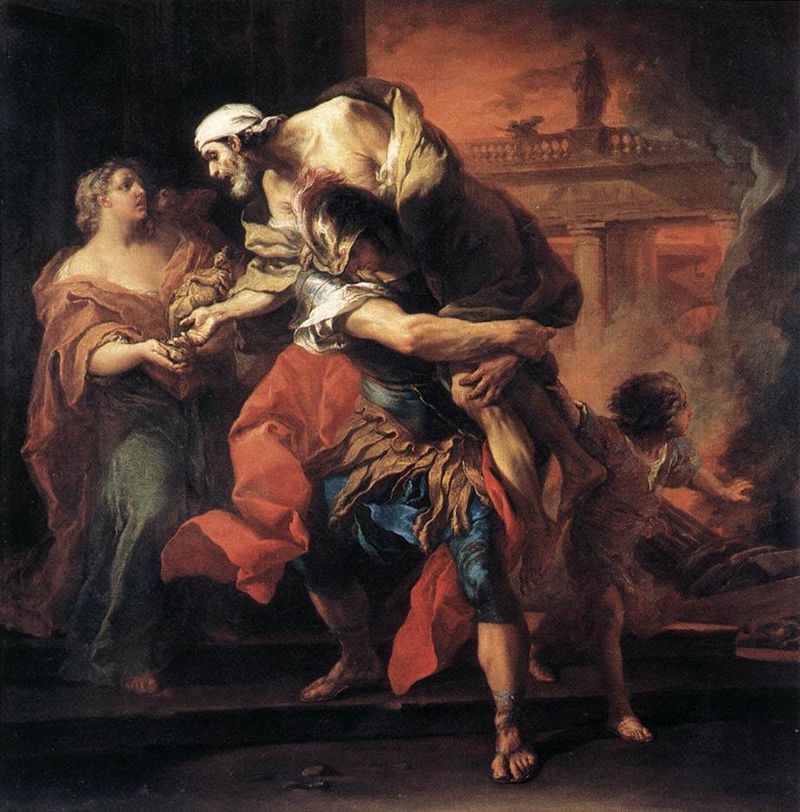
Aeneas Bearing Anchises from Troy, by Carle van Loo, 1729 (Louvre).

He Abounds with Agreeable Faults

David Hume, Of Simplicity and Refinement in Writing:

“We may also observe, that those compositions, which we read the oftenest, and which every man of taste has got by heart, have the recommendation of simplicity, and have nothing surprizing in the thought, when divested of that elegance of expression, and harmony of numbers, with which it is cloathed. If the merit of the composition lie in a point of wit; it may strike at first; but the mind anticipates the thought in the second perusal, and is no longer affected by it. When I read an epigram of MARTIAL, the first line recalls the whole; and I have no pleasure in repeating to myself what I know already. But each line, each word in CATULLUS, has its merit; and I am never tired with the perusal of him. It is sufficient to run over COWLEY once: But PARNEL, after the fiftieth reading, is as fresh as at the first. Besides, it is with books as with women, where a certain plainness of manner and of dress is more engaging than that glare of paint and airs and apparel, which may dazzle the eye, but reaches not the affections. TERENCE is a modest and bashful beauty, to whom we grant every thing, because he assumes nothing, and whose purity and nature make a durable, though not a violent impression on us.

But refinement, as it is the less beautiful, so is it the more dangerous extreme, and what we are the aptest to fall into. Simplicity passes for dulness, when it is not accompanied with great elegance and propriety. On the contrary, there is something surprizing in a blaze of wit and conceit. Ordinary readers are mightily struck with it, and falsely imagine it to be the most difficult, as well as most excellent way of writing. SENECA abounds with agreeable faults, says QUINTILIAN, abundat dulcibus vitiis; and for that reason is the more dangerous, and the more apt to pervert the taste of the young and inconsiderate.”

Image result for david hume

Love Of Quotations is not Erudition, It is Only…

Here’s another decontextualize gem from Seneca popular online

For love of bustle is not industry – it is only the restlessness ...

” For love of bustle is not industry,—it is only the restlessness of a hunted mind.”

This sounds like a Dale Carnegie line or some sententious dollop in dialogue written now for a movie set in the 1930s. To be fair, the translation is copyrighted to 1917 by Richard M. Gummere (the Loeb translation).

Here’s the Latin:

Nam illa tumultu gaudens non est industria, sed exagitatae mentis concursatio

In the translation above, there’s no sense of what the demonstrative Illa is doing, and there is definitely something off about the “hunted” for exagitatae, which I think is something closer to “thoroughly bothered/distracted/agitated.” To my taste it is something closer to:

“Taking pleasure in that chaos is not diligence, but the anxiety/movement of a thoroughly troubled mind”

This is decidedly less quotable than the passage above. And it is so because it needs the larger context, which actually, as usual, tells a more complicated, and I think richer, story.

Seneca, Moral Epistle 3.4-6

“There are certain kinds of people who tell things which ought to be entrusted only to friends to anyone they meet and they unload on just any ears whatever has bothered them. Another group of people in turn hesitates at trusting their most dear friends and, if they could, would suppress every secret inside because they do not trust themselves.

But we should do neither thing. It is a mistake both to trust everyone and no one. The first mistake, however, I think is more honest while the second is safer. So, you should criticize both types in this way, those who are always boisterous and those who are always reserved.

For taking pleasure in such disturbance is not diligence, but the anxiety of a troubled mind. And it is not peace to believe that every movement is annoying, but lethargy and apathy. For this, commend to mind this line I have read in Pomponius: “Some people retreat so far into the shadows that they think they are in darkness when in the light.”

People need to mix these habits and one who is resting should move and one who is moving should rest! Take this up with the nature of things: she will explain that she made both the daytime and night. Goodbye!”

Quidam quae tantum amicis committenda sunt, obviis narrant et in quaslibet aures, quicquid illos urserit, exonerant. Quidam rursus etiam carissimorum conscientiam reformidant, et si possent, ne sibi quidem credituri interius premunt omne secretum. Neutrum faciendum est. Utrumque enim vitium est, et omnibus credere et nulli. Sed alterum honestius dixerim vitium, alterum tutius: sic utrosque reprehendas, et eos qui semper inquieti sunt, et eos qui semper quiescunt. Nam illa tumultu gaudens non est industria, sed exagitatae mentis concursatio. Et haec non est quies, quae motum omnem molestiam iudicat, sed dissolutio et languor. Itaque hoc, quod apud Pomponium legi, animo mandabitur: “quidam adeo in latebras refugerunt, ut putent in turbido esse, quicquid in luce est.” Inter se ista miscenda sunt, et quiescenti agendum et agenti quiescendum est. Cum rerum natura delibera; illa dicet tibi et diem fecisse se et noctem. Vale.

I totally understand why people select parts of ancient works to excerpt. I mean, that’s kind of what we do on this blog every day. But the line quoted out of context above completely subverts Seneca’s meaning in service of a modern flat and unsophisticated understanding of Stoicism. It is ok to be busy and troubled, just not all the time! It is no better to be completely withdrawn! For each quality Seneca discusses above in its extreme form, there is an extreme opposite which is no better.

This is another Cylon-Helen fake.Seneca EM3


Senecan Social Distancing: Avoid the Crowd!

Seneca, Epistulae ad Lucilium 1.7:

“You ask me what I think chiefly to be avoided? A crowd. You cannot yet be safely entrusted to it. I will certainly confess my own weakness: I never bring back the habits which I took with me. Something which I previously ordered is disturbed, something which I previously banished simply returns. As it happens with the sick, whom a long illness has affected to such a degree that they can no longer go out without harm, so it happens with us whose minds are recovering from a long disease. Association with many people is a hateful thing: in the crowd, there is no one who will not commend his vice to us, or even impress and smear it upon us without our knowing. In every case, the greater the crowd with whom we mingle, the greater the danger. But nothing is so dangerous to good morals as to loiter around at a show, where our vices steal upon us all the more readily on account of their pleasure. What do you think I am saying? That I come back more avaricious, ambitious, and prone to luxury? Nay, rather, I return more cruel and inhumane because I have been among humans.”

Quid tibi vitandum praecipue existimes quaeris? turbam. Nondum illi tuto committeris. Ego certe confitebor imbecillitatem meam: numquam mores quos extuli refero; aliquid ex eo quod composui turbatur, aliquid ex iis quae fugavi redit. Quod aegris evenit quos longa imbecillitas usque eo affecit ut nusquam sine offensa proferantur, hoc accidit nobis quorum animi ex longo morbo reficiuntur. [2] Inimica est multorum conversatio: nemo non aliquod nobis vitium aut commendat aut imprimit aut nescientibus allinit. Utique quo maior est populus cui miscemur, hoc periculi plus est. Nihil vero tam damnosum bonis moribus quam in aliquo spectaculo desidere; tunc enim per voluptatem facilius vitia subrepunt. [3] Quid me existimas dicere? avarior redeo, ambitiosior, luxuriosior? immo vero crudelior et inhumanior, quia inter homines fui.

“I Defecated Because of Fear”

See here for our ongoing skatokhasm and the sheer variety of excremental words in ancient Greek.

Suda, Epsilon 93 [referring to Aristophanes, Frogs 479]

“I shat myself”: I defecated because of some fear. I pooped. Aristophanes says this in the Frogs. He is calling the god to help.”

᾿Εγκέχοδα: ἀπεπάτησα διὰ φόβον τινά, ἔχεσον. ᾿Αριστοφάνης Βατράχοις. κάλει θεὸν εἰς βοήθειαν.

Principal parts: χέζω, χεσοῦμαι, ἔχεσα, κέχοδα, κέχεσμαι….

Strattis, fr. 1.3

“If he will not have the leisure to shit,
Nor to visit a profligate man’s home, nor if he meets
Anyone, to talk to them at all…”

Εἰ μηδὲ χέσαι γ’ αὐτῷ σχολὴ γενήσεται,
μηδ’ εἰς ἀσωτεῖον τραπέσθαι, μηδ’ ἐάν
αὐτῷ ξυναντᾷ τις, λαλῆσαι μηδενί.

Image result for medieval manuscript defecation
Add_ms_49622_f061r_detail

Aristophanes, Clouds, 391

“When I shit, it’s like thunder: pa-pa-pa-papp-AKS!

χὤταν χέζω, κομιδῇ βροντᾷ “παπαπαππάξ,”

thunder dance