Peoples of Much Suffering: Look

Euripides, Orestes 1-3

“There is nothing so terrible, as the saying goes,
No suffering or affliction sent by the gods
No burden that a human cannot naturally endure.”

Οὐκ ἔστιν οὐδὲν δεινόν, ὧδ᾿ εἰπεῖν ἔπος,
οὐδὲ πάθος οὐδὲ ξυμφορὰ θεήλατος,
ἧς οὐκ ἂν ἄραιτ᾿ ἄχθος ἀνθρώπου φύσις.

100

“You have spoken rightly, but you don’t speak kindly to me”

ὀρθῶς ἔλεξας· οὐ φίλως δέ μοι λέγεις.

200-207

“We are ruined, like corpses, we are dead.
This one goes among the dead and the greater share
Of my life goes there too
In weeping and mourning
And tears in the night
Unmarried without children I drag out
An unlivable life for the rest of my time.”

ὀλόμεθ᾿ ἰσονέκυες ὀλόμεθα.
ὅδε γὰρ ἐν νεκροῖς τό τ᾿ ἐμὸν οἴχεται
βίου τὸ πλέον μέρος· ἐν
στοναχαῖσι δὲ καὶ γόοισι
δάκρυσί τ᾿ ἐννυχίοις
ἄγαμος ἄτεκνος ἔτι <βίον ἀ>βίοτον ἁ
μέλεος ἐς τὸν αἰὲν ἕλκω χρόνον.

231-1

“Sit me up again. Turn my body around.
It is hard to make the sick feel better because of this helplessness.”

αὖθίς μ᾿ ἐς ὀρθὸν στῆσον, ἀνακύκλει δέμας·
δυσάρεστον οἱ νοσοῦντες ἀπορίας ὕπο.

418

“We are slaves of the gods, whatever it is that “gods” are.”

δουλεύομεν θεοῖς, ὅ τι ποτ᾿ εἰσὶν οἱ θεοί.

977-981

“Peoples of much suffering: look how fate
Tramples on your hopes.
Different pains visit different people
Over the span of time:
The whole expanse of mortal lives cannot be measured”

ἔθνη πολύπονα, λεύσσεθ᾿ ὡς παρ᾿ ἐλπίδας
μοῖρα βαίνει.
ἕτερα δ᾿ ἕτερον ἀμείβεται
πήματ᾿ ἐν χρόνῳ μακρῷ,
βροτῶν δ᾿ ὁ πᾶς ἀστάθμητος αἰών.

Death and the Miser, Hieronymus Bosch

Heraclitus on the True Story of Lamia

This story probably needs trigger warnings. Here, the legend of the Lamia is explained by the Paradoxographer Heraclitus (not the same figure as the philosopher).  Antiquity has bequeathed to us a collection of works on ‘wonders’: some are mere lists of amazing things; others are rationalizing explanations of myths (for which the Hellenistic Palaephaetus is most famous). This summer I am going to post material from the paradoxographers periodically since there is very little of it translated and free online.

From Heraclitus the Paradoxographer 34: On Lamia

“They tell the story that after Zeus had sex with [Lamia], Hera turned her into a beast and further, when she went crazy, she ripped out her eyes and threw them into a cup and, in addition, that she ate flesh and dined on human beings.

It really could have gone this way: Zeus, who was a king, got intimate with her because she was pretty. Then Hera abducted her, gauged out her eyes, and left her on a mountain. For this reason she was living a painful life and had no help at all. Because she was living unwashed and unhealed in desolate places, she seemed to be a beast.”

Περὶ Λαμίας.

     ῾Ιστοροῦσιν ὅτι, Διὸς αὐτῇ συμμιγέντος, ῞Ηρα ἀπεθηρίωσεν αὐτήν, καὶ ὅτι ἡνίκα ἂν μανῇ, τοὺς ὀφθαλμοὺς ἐξαιρεῖ καὶ εἰς κοτύλην βάλλει, καὶ ὅτι σαρκοφαγεῖ καὶ ἀνθρώπους ἐσθίει. εἴη δ’ ἂν τάδε. καλῇ αὐτῇ οὔσῃ ὁ Ζεὺς ἐπλησίασε βασιλεύων, ῞Ηρα δὲ συναρπάζουσα αὐτήν, τοὺς ὀφθαλμοὺς ἐξώρυξε καὶ εἰς τὰ ὄρη ἔρριψεν· ὅθεν ἐπιπόνως ἔζη ἐπικουρουμένη δὲ οὐδέν· <διὰ δὲ τὸ> ὑπὸ ταῖς ἐρημίαις καταγινομένην αὐτὴν ἄλουτον καὶ ἀθεράπευτον εἶναι, ἐδόκει θηρίον ὑπάρχειν.

Here is another account:

Duris, BNJ 76 F17 [= Photios s.v. Lamia]

“In the second book of his Libyan History, Duris reports that Lamia was a fine looking woman but after Zeus had sex with her, Hera killed the children she bore because she was envious. As a result she was disfigured by grief and would seize and kill the children of others.”

ταύτην ἐν τῆι Λιβύηι Δοῦρις ἐν δευτέρωι Λιβυκῶν ἱστορεῖ γυναῖκα καλὴν γενέσθαι, μιχθέντος δ᾽ αὐτῆι Διὸς ὑφ᾽ ῞Ηρας ζηλοτυπουμένην ἃ ἔτικτεν ἀπολλύναι· διόπερ ἀπὸ τῆς λύπης δύσμορφον γεγονέναι καὶ τὰ τῶν ἄλλων παιδία ἀναρπάζουσαν διαφθείρειν.

Lamia and the Soldier, John William Waterhouse

Apollo, Python, and Turner’s Art

John Ruskin, Modern Painters 5.11:

Color is, therefore, in brief terms, the type of love. Hence it is especially connected with the blossoming of the earth; and again, with its fruits; also, with the spring and fall of the leaf, and with the morning and evening of the day, in order to show the waiting of love about the birth and death of man.

And now, I think, we may understand, even far away in the Greek mind, the meaning of that contest of Apollo with the Python. It was a far greater contest than that of Hercules with Ladon. Fraud and avarice might be overcome by frankness and force; but this Python was a darker enemy, and could not be subdued but by a greater god. Nor was the conquest slightly esteemed by the victor deity. He took his great name from it thenceforth—his prophetic and sacred name—the Pythian.

It could, therefore, be no merely devouring dragon—no mere wild beast with scales and claws. It must possess some more terrible character to make conquest over it so glorious. Consider the meaning of its name, “THE CORRUPTER.” That Hesperid dragon was a treasure-guardian. This is the treasure-destroyer,—where moth and rust doth corrupt—the worm of eternal decay.

Apollo’s contest with him is the strife of purity with pollution; of life, with forgetfulness; of love, with the grave.

I believe this great battle stood, in the Greek mind, for the type of the struggle of youth and manhood with deadly sin—venomous, infectious, irrecoverable sin. In virtue of his victory over this corruption, Apollo becomes thenceforward the guide; the witness; the purifying and helpful God. The other gods help waywardly, whom they choose. But Apollo helps always: he is by name, not only Pythian, the conqueror of death; but Pæan—the healer of the people.

Well did Turner know the meaning of that battle: he has told its tale with fearful distinctness. The Mammon dragon was armed with adamant; but this dragon of decay is a mere colossal worm: wounded, he bursts asunder in the midst, and melts to pieces, rather than dies, vomiting smoke—a smaller serpent-worm rising out of his blood.

Changing Nature and Isolation’s End

Philo, On Rewards and Punishments 89-90

“At that time, it seems likely that bears, lions, panthers and those animals in India—elephants and tigers—and however many other creates have unconquerable valor and strength will shift from loneliness and isolation to a shared life. From imitating herd animals they will slowly become tame in the presence of human beings.

After this, they will no longer coil in anger as before, but some will be flabbergasted and behave humbly as if before a leader or natural master and others will get happily excited, showing domesticated affection and love just like those little dogs who signal their giddiness with wagging tails. Then, too, the races of scorpions and snakes and the other creepy critters will leave their venom unused.”

τότε μοι δοκοῦσιν ἄρκτοι καὶ λέοντες καὶ παρδάλεις καὶ τὰ παρ᾿ Ἰνδοῖς, ἐλέφαντές τε καὶ τίγρεις, καὶ ὅσα ἄλλα τὰς ἀλκὰς καὶ τὰς δυνάμεις ἀήττητα μεταβαλεῖν ἐκ τοῦ μονωτικοῦ τε καὶ μονοτρόπου πρὸς τὸ σύννομον· κἀκ τοῦ πρὸς ὀλίγον μιμήσει τῶν ἀγελαίων ἡμερωθήσεται πρὸς τὴν ἀνθρώπου φαντασίαν, μηκέτι ὡς πρότερον ἀνερεθισθέντα, καταπλαγέντα δ᾿ ὡς ἄρχοντα καὶ φύσει δεσπότην εὐλαβῶς ἕξει, ἔνια δὲ καὶ τοῦ χειροήθους ἅμα καὶ φιλοδεσπότου τῇ παραζηλώσει, καθάπερ τὰ Μελιταῖα τῶν κυνιδίων ταῖς κέρκοις μεθ᾿ ἱλαρωτέρας κινήσεως προσσαίνοντα. τότε καὶ τὰ σκορπίων γένη καὶ ὄφεων καὶ τῶν ἄλλων ἑρπετῶν ἄπρακτον ἕξει τὸν ἰόν·

British Library, Sloane MS 1975, Folio 13r

Wounds Healed Just in Time

Ovid, Ex Ponto 1.3 83-94

“While I should tell all the tales, in no age
Has anyone been sent to a more horrible place so far from their home.
For this reason, let your wisdom overlook someone in sorrow
Who does not do so much of what you ask in your words.

I still confess that if my wounds could heal
Then they could heal only with your orders.
But I fear that you pointlessly labor to help me
And that your aid will not heal my sick ruin.

I do not claim these things because I have special wisdom,
But I am more familiar with myself than a doctor.
Despite all this, your willing kindness has come to me
Just when I needed something good.”

persequar ut cunctos, nulli datus omnibus aevis
tam procul a patria est horridiorve locus.
quo magis ignoscat sapientia vestra dolenti
qui facit ex dictis, non ita multa, tuis.
nec tamen infitior, si possint nostra coire
vulnera, praeceptis posse coire tuis.
sed vereor ne me frustra servare labores
nec iuver admota perditus aeger ope.
nec loquor haec, quia sit maior prudentia nobis,
sed sum quam medico notior ipse mihi.
ut tamen hoc ita sit, munus tua grande voluntas
ad me pervenit consuliturque boni.

More from Hieronymus Bosch

English Seneca By Candlelight

Thomas Nashe, To the Gentlemen Students of Both Universities

But least I might seeme with these night crowes “Nimis curiosus in aliena republica,” I’le turne backe to my first text, of studies of delight, and talke a little in friendship with a few of our triviall translators. It is a common practise now a daies amongst a sort of shifting companions, that runne through every arte and thrive by none, to leave the trade of “Noverint,” whereto they were borne, and busie themselves with the indevors of Art, that could scarcelie latinize their necke-verse if they should have neede; yet English Seneca read by candle light yeeldes manie good sentences, as “Bloud is a begger,” and so foorth: and, if you intreate him faire in a frostie morning, he will affoord you whole Hamlets, I should say handfulls of tragical speaches.

But O griefe! “tempus edax rerum,” what’s that will last alwaies? The sea exhaled by droppes will in continuance be drie, and Seneca let bloud line by line and page by page, at length must needes die to our stage: which makes his famisht followers to imitate the Kidde in Aesop, who, enamored with the Foxes newfangles, forsooke all hopes of life to leape into a new occupation; and these men renowncing all possibilities of credit or estimation, to intermeddle with Italian translations: wherein how poorelie they have plodded (as those that are neither provenzall men nor are able to distinguish of Articles,) let all indifferent Gentlemen that have travailed in that tongue discerne by their twopenie pamphlets: and no mervaile though their home-born mediocritie be such in this matter; for what can be hoped of those, that thrust Elisium into hell, and have not learned so long as they have hued in the spheares, the just measure of the Horizon without an hexameter.

I Had to Put Myself In Power

Lucian, Phalaris 1.2

“I was not one of the invisible people in Akragas, if anyone was well born, liberally raised, and fully educated, I was. I always made sure to demonstrate my own public nature to the city, a proper and moderate character to my fellow citizens, and no one ever accused me in that previous period of my life of being violent, or inappropriate, or arrogant, or insulting at all.

But once I saw that people who were in the opposing political faction were conspiring against me and trying everything they could to bring me down—when our city was split in strife—I could find only this escape and safety, the very same preservation for the city too: I had to put myself in power so I could stop the conspirators and compel the city to be more sensible.  Since there was no small number of people who approved these things—those reasonable and patriotic men who knew my plan and the necessity of the attempt, I took over easily with them as my helpers.”

Ἐγὼ γὰρ οὐ τῶν ἀφανῶν ἐν Ἀκράγαντι ὤν, ἀλλ᾿ εἰ καί τις ἄλλος εὖ γεγονὼς καὶ τραφεὶς ἐλευθερίως καὶ παιδείᾳ προσεσχηκώς, ἀεὶ διετέλουν τῇ μὲν πόλει δημοτικὸν ἐμαυτὸν παρέχων, τοῖς δὲ συμπολιτευομένοις ἐπιεικῆ καὶ μέτριον, βίαιον δὲ ἢ σκαιὸν ἢ ὑβριστικὸν ἢ αὐθέκαστον οὐδεὶς οὐδὲν ἐπεκάλει μου τῷ προτέρῳ ἐκείνῳ βίῳ. ἐπειδὴ δὲ ἑώρων τοὺς τἀναντία μοι πολιτευομένους ἐπιβουλεύοντας καὶ ἐξ ἅπαντος τρόπου ἀνελεῖν με ζητοῦντας—διῄρητο δὲ ἡμῶν τότε ἡ πόλις—μίαν ταύτην ἀποφυγὴν καὶ ἀσφάλειαν εὕρισκον, τὴν αὐτὴν ἅμα καὶ τῇ πόλει σωτηρίαν, εἰ ἐπιθέμενος τῇ ἀρχῇ ἐκείνους μὲν ἀναστείλαιμι καὶ παύσαιμι ἐπιβουλεύοντας, τὴν πόλιν δὲ σωφρονεῖν καταναγκάσαιμι· καὶ ἦσαν γὰρ οὐκ ὀλίγοι ταῦτα ἐπαινοῦντες, ἄνδρες μέτριοι καὶ φιλοπόλιδες, οἳ καὶ τὴν γνώμην ᾔδεσαν τὴν ἐμὴν καὶ τῆς ἐπιχειρήσεως τὴν ἀνάγκην· τούτοις οὖν συναγωνισταῖς χρησάμενος ῥᾳδίως ἐκράτησα.

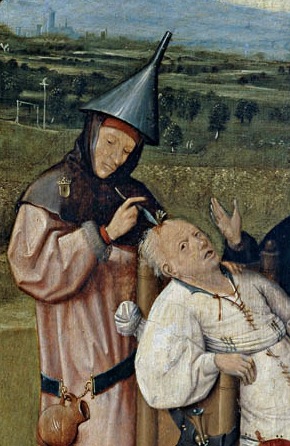
Hieronymus Bosch, “Removing the Rocks from the Head

A Reminder: One Who Is Disordered Cannot Create Order

Plutarch’s “To the Uneducated Ruler” has no relevance today, at all (780a-c)...

“The majority of kings and rulers are stupid–they imitate those artless sculptors who believe that their over-sized figures seem large and solid if they make them with a wide stance, flexing their muscles, mouths gaped open. For these types of rulers seem merely to be imitating the impressiveness and seriousness of leadership with their deep voice, severe glance, bitter manners and their separate way of living: but they are not really any different from the sculpted colossus which is heroic and godly on the outside, but filled with dirt, stone or lead within.

The real difference is that the weight of the statue keeps it standing straight, never leaning; these untaught generals and leaders often wobble and overturn because of their native ignorance. For, because they have built their homes on a crooked foundation, they lean and slide with it. Just as a carpenter’s square, if it is straight and solid, straightens out everything else that is measured according to it, so too a leader must first master himself and correct his own character and only then try to guide his people. For one who is falling cannot lift others; one who is ignorant cannot teach; one who is simple cannot manage complicated affairs; one who is disordered cannot create order; and one who does not rule himself cannot rule.”

Ἀλλὰ νοῦν οὐκ ἔχοντες οἱ πολλοὶ τῶν βασιλέων καὶ ἀρχόντων μιμοῦνται τοὺς ἀτέχνους ἀνδριαντοποιούς, οἳ νομίζουσι μεγάλους καὶ ἁδροὺς φαίνεσθαι τοὺς κολοσσούς, ἂν διαβεβηκότας σφόδρα καὶ διατεταμένους καὶ κεχηνότας πλάσωσι· καὶ γὰρ οὗτοι βαρύτητι φωνῆς καὶ βλέμματος τραχύτητι καὶ δυσκολίᾳ τρόπων καὶ ἀμιξίᾳ διαίτης ὄγκον ἡγεμονίας καὶ σεμνότητα μιμεῖσθαι δοκοῦσιν, οὐδ᾿ ὁτιοῦν τῶν κολοσσικῶν διαφέροντες ἀνδριάντων, οἳ τὴν ἔξωθεν ἡρωικὴν καὶ θεοπρεπῆ μορφὴν ἔχοντες ἐντός εἰσι γῆς μεστοὶ καὶ λίθου καὶ μολίβδου· πλὴν ὅτι τῶν μὲν ἀνδριάντων ταῦτα τὰ βάρη τὴν ὀρθότητα μόνιμον καὶ ἀκλινῆ διαφυλάττει, οἱ δ᾿ ἀπαίδευτοι στρατηγοὶ καὶ ἡγεμόνες ὑπὸ τῆς ἐντὸς ἀγνωμοσύνης πολλάκις σαλεύονται καὶ περιτρέπονται· βάσει γὰρ οὐ κειμένῃ πρὸς ὀρθὰς ἐξουσίαν ἐποικοδομοῦντες ὑψηλὴν συναπονεύουσι. δεῖ δέ, ὥσπερ ὁ κανὼν αὐτός, ἀστραβὴς γενόμενος καὶ ἀδιάστροφος, οὕτως ἀπευθύνει τὰ λοιπὰ τῇ πρὸς αὑτὸν ἐφαρμογῇ καὶ παραθέσει συνεξομοιῶν, παραπλησίως τὸν ἄρχοντα πρῶτον τὴν ἀρχὴν κτησάμενον ἐν ἑαυτῷ καὶ κατευθύναντα τὴν ψυχὴν καὶ καταστησάμενον τὸ ἦθος οὕτω συναρμόττειν τὸ ὑπήκοον· οὔτε γὰρ πίπτοντός ἐστιν ὀρθοῦν οὔτε διδάσκειν ἀγνοοῦντος οὔτε κοσμεῖν ἀκοσμοῦντος ἢ τάττειν ἀτακτοῦντος ἢ ἄρχειν μὴ ἀρχομένου·

Image result for Ancient Roman Statue colossus

782b-c

“Among the weak, base and private citizens, ignorance when combined with a lack of power yields little wrongdoing, as in nightmares some trouble upsets the mind, making it incapable of responding to its desires. But when power has been combined with wickedness it adds energy to latent passions. And so that saying of Dionysus is true—for he used to say that he loved his power most when he could do what he wanted quickly. It is truly a great danger when one who wants what is wrong has the power to do what he wants to do.

As Homer puts it “When the plan was made, then the deed was done.” When wickedness has an open course because of its power, it compels every passion to emerge, producing rage, murder, lust, adultery, and greedy acquisition of public wealth.”

Ἐν μὲν γὰρ τοῖς ἀσθενέσι καὶ ταπεινοῖς καὶ ἰδιώταις τῷ ἀδυνάτῳ μιγνύμενον τὸ ἀνόητον εἰς τὸ ἀναμάρτητον τελευτᾷ, ὥσπερ ἐν ὀνείρασι φαύλοις τις ἀνία τὴν ψυχὴν διαταράττει συνεξαναστῆναι ταῖς ἐπιθυμίαις μὴ δυναμένην· ἡ δ᾿ ἐξουσία παραλαβοῦσα τὴν κακίαν νεῦρα τοῖς πάθεσι προστίθησι· καὶ τὸ τοῦ Διονυσίου ἀληθές ἐστιν· ἔφη γὰρ ἀπολαύειν μάλιστα τῆς ἀρχῆς, ὅταν ταχέως ἃ βούλεται ποιῇ. μέγας οὖν ὁ κίνδυνος βούλεσθαι ἃ μὴ δεῖ τὸν ἃ βούλεται ποιεῖν δυνάμενον· αὐτίκ᾿ ἔπειτά γε μῦθος ἔην, τετέλεστο δὲ ἔργον (Il. 19.242). ὀξὺν ἡ κακία διὰ τῆς ἐξουσίας δρόμον ἔχουσα πᾶν πάθος ἐξωθεῖ, ποιοῦσα τὴν ὀργὴν φόνον τὸν ἔρωτα μοιχείαν τὴν πλεονεξίαν δήμευσιν.

782

“It is not possible to hide wickedness in power. But, as when someone with vertigo* might go up in a high place and move around, only to become dizzy and uncertain, thus revealing their suffering, so fortune amplifies the untaught and ignorant a little with some wealth, reputation or offices and, once they have risen up, it shows them falling. Or rather, it is the same as when you cannot tell which of some containers is solid and which is cracked but when you pour water into them, the culprit leak is clear: rotten minds cannot manage power, but they ooze out random desires, rages, improprieties, and base manners.”

Οὐδὲ γὰρ λαθεῖν οἷόν τε τὰς κακίας ἐν ταῖς ἐξουσίαις· ἀλλὰ τοὺς μὲν ἐπιληπτικούς, ἂν ἐν ὕψει τινὶ γένωνται καὶ περιενεχθῶσιν, ἴλιγγος ἴσχει καὶ σάλος, ἐξελέγχων τὸ πάθος αὐτῶν, τοὺς δ᾿ ἀπαιδεύτους καὶ ἀμαθεῖς ἡ τύχη μικρὸν ἐκκουφίσασα πλούτοις τισὶν ἢ δόξαις ἢ ἀρχαῖς μετεώρους γενομένους εὐθὺς ἐπιδείκνυσι πίπτοντας· μᾶλλον δ᾿, ὥσπερ τῶν κενῶν ἀγγείων οὐκ ἂν διαγνοίης τὸ ἀκέραιον καὶ πεπονηκός, ἀλλ᾿ ὅταν ἐγχέῃς, φαίνεται τὸ ῥέον· οὕτως αἱ σαθραὶ ψυχαὶ τὰς ἐξουσίας μὴ στέγουσαι ῥέουσιν ἔξω ταῖς ἐπιθυμίαις, ταῖς ὀργαῖς, ταῖς ἀλαζονείαις, ταῖς ἀπειροκαλίαις.

*The original Greek seems to be about people with epilepsy (tous epilêptikous)

Parasitical Vergil, Dismal Sophocles, Stupid Terence

John Ruskin, Praeterita *:

It is extremely curious to me to find that from my earliest years, whatever stuff I might be writing myself, or whatever nonsense I might be thinking, I never liked a bad book — and even began very early indeed to rank the good ones at their true value. I sometimes disliked, or did not value, a good one — yet never without some right cause. Both Virgil and Milton were too rhetorical and parasitical for me; Sophocles I found dismal, and in subject disgusting, Tacitus too hard, Terence dull and stupid beyond patience ; — but I loved my Plato from the first line I read — knew my Ethics for what they were worth, (which is not much) and detested with all my heart and wit the accursed and rascally Rhetoric, — which my being compelled to work at gave me a mortal contempt for the whole University system, which little helped my Oxford labours in general.

The quantity of that work which my being able already so to judge of all these books meant, must have been considerable, and partly accounts for my having no spare energy for the pursuit of such English history as the buildings of Oxford and its within-walk district ought to have provoked me, and pleaded with me, to know. If any of my tutors had only had the sense to stop off the books I did not like, see that I mastered the dialects of those I did, and taken two or three summer afternoon walks with me to Godstow and Abingdon, telling me what the places meant, I count that it would have saved me good seven years of strong life, spent in finding out for myself what I might have been told in a summer term.

*[From manuscript, deleted in published edition, but found in The Works of John Ruskin (Library Edition) Vol. XXXV]

John_Ruskin-head.jpg.860x0_q70_crop-scale

Hexameter Fury and Hissed Barbarism

Thomas Nashe, To the Gentlemen Students of Both Universities

Who ever my private opinion condemneth as faultie, Master Gascoigne is not to bee abridged of his deserved esteeme, who first beate the path to that perfection which our best Poets have aspired too since his departure; whereto he did ascend by comparing the Italian with the English, as Tullie did “Graeca cum Latinis.” Neither was Master Turbervile the worst of his time, although in translating he attributed too much to the necessitie of rime. And in this page of praise, I cannot omit aged Arthur Golding, for his industrious toile in Englishing Ovids Metamorphosis, besides manie other exquisite editions of Divinitie, turned by him out of the French tongue into our own.

Master Phaer likewise is not to be forgot in regard of his famous Virgil, whose heavenly verse had it not bin blemisht by his hautie thoghts England might have long insulted in his wit, and “corrigat qui potest” have been subscribed to his workes. But fortune the Mistres of change with a pitying compassion respecting Master Stanihursts praise, would that Phaer shoulde fall that hee might rise, whose heroicall Poetrie infired, I should say inspired, with an hexameter furie, recalled to life whatever hissed barbarisme hath bin buried this hundred yeare; and revived by his ragged quill such carterlie varietie, as no hodge plowman in a countrie but would have held as the extremitie of clownerie; a patterne whereof, I will propounde to your judgements, as neere as I can, being parte of one of his descriptions of a tempest, which is thus:

Then did he make heavens vault to rebounde, with rounce robble hobble

Of ruffle raffe roaring, with thwick thwack thurlery bouncing.

Which strange language of the firmament never subject before to our common phrase, makes us that are not used to terminate heavens moveings, in the accents of any voice, esteeme of their triobulare interpreter, as of some Thrasonical huffe snuffe, for so terrible was his stile, to all milde eares, as would have affrighted our peaceable Poets, from intermedling hereafter with that quarrelling kinde of verse; had not sweete Master France, by his excellent translation of Master Thomas Watsons sugred Amintas, animated their dulled spirits to such high witted endevors.

But I knowe not how, their over timerous cowardise, hath stoode in awe of envie, that no man since him durst imitate any of the worste, of those Romane wonders in english, which makes me thinke that either the lovers of medocritie are verie many, or that the number of good Poets, are very small: and in trueth, (Master Watson except, whom I mentioned before) I knowe not almost any of late dayes that hath shewed himselfe singular in any speciall Latin Poem, whose Amintas, and translated Antigone may march in equipage of honour with any of our ancient Poets.

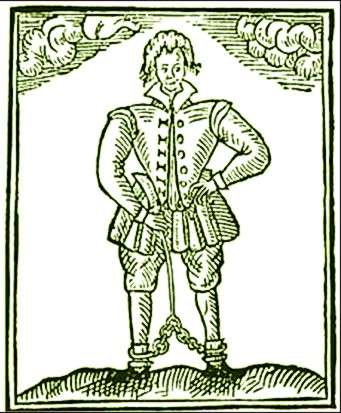
A crudely printed, full-length picture of a standing man. He is in Elizabethan-style clothing and chains are around his ankles