* Peacocks! * Pythagoras! * Homer! * Ennius! * (Featuring the Loser Euphorbus)

Cornutus, Commentary on Persius 6.10:

Thus writes Ennius in the beginning of his Annals, where he says that in a dream he saw Homer claiming that he had once been a peacock, and that his soul had been transferred from there into Ennius according to the doctrine of Pythagoras, who said that human souls, through a process of palingenesis (that is, a repeated birth) are able to enter new bodies as they leave their old ones behind. He used the phrase ‘the fifth’ in accordance with the opinion that the soul of Pythagoras was moved into a peacock, from the peacock to Euphorbius, from Euphorbius to Homer, and from Homer to Ennius. Or, to be sure, he said ‘the fifth’ because Ennius was named Quintus.

A large presence of the peacock in Roman mosaics

sic Ennius in Annalium suorum principio, ubi se dicit vidisse in somnis Homerum dicentem fuisse quondam pavonem et ex eo translatam in se animam esse secundum Pytagorae philosophi definitionem, qui dicit animas humanas per palingenesiam, id est per iteratam generationem, exeuntes de corporibus in alia posse corpora introire. ideo autem, “quintus” dixit propter eam opinionem quae dicit animam Pytagorae in pavonem translatam, de pavone vero ad Euphorbium, de Euphorbio ad Homerum, de Homero autem ad Ennium. vel certe quod cognomento Ennius dicitur.
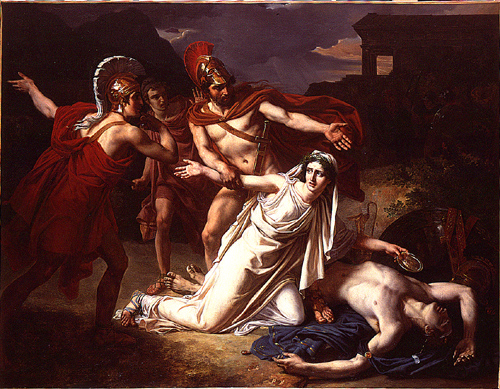
Dishonoring the Gods

Sophocles, Antigone 280–288

“Stop speaking before you fill me with rage!
And you’re revealed as a fool as well as an old man.

You speak of unendurable things, claiming that the gods
Have some plan for this corpse.
Did they do it to honor him so greatly for his fine work,
Concealing him, the man who came here
To burn their temples and their statutes,
To ruin their land and their laws?
Do you see the gods honoring evil people?”

παῦσαι, πρὶν ὀργῆς καί με μεστῶσαι λέγων,
μὴ ᾿φευρεθῇς ἄνους τε καὶ γέρων ἅμα.
λέγεις γὰρ οὐκ ἀνεκτὰ δαίμονας λέγων
πρόνοιαν ἴσχειν τοῦδε τοῦ νεκροῦ πέρι.
πότερον ὑπερτιμῶντες ὡς εὐεργέτην
285ἔκρυπτον αὐτόν, ὅστις ἀμφικίονας
ναοὺς πυρώσων ἦλθε κἀναθήματα
καὶ γῆν ἐκείνων καὶ νόμους διασκεδῶν;
ἢ τοὺς κακοὺς τιμῶντας εἰσορᾷς θεούς;

 Sophocles, Antigone 72–77

“It is noble for me to do this and then die.
I will lie with him because I belong to him, with him,
Once I have completed my sacred crimes. There’s more time
When I must please those below than those here,
Since I will lie there forever. You? Go head,
Dishonor what the gods honor if it seems right.”

… καλόν μοι τοῦτο ποιούσῃ θανεῖν.
φίλη μετ᾿ αὐτοῦ κείσομαι, φίλου μέτα,
ὅσια πανουργήσασ᾿· ἐπεὶ πλείων χρόνος
ὃν δεῖ μ᾿ ἀρέσκειν τοῖς κάτω τῶν ἐνθάδε·
ἐκεῖ γὰρ αἰεὶ κείσομαι. σὺ δ᾿ εἰ δοκεῖ
τὰ τῶν θεῶν ἔντιμ᾿ ἀτιμάσασ᾿ ἔχε.

Sébastien Norblin, Antigone donnant la sépulture à Polynice

Reasons for Revolutions: Wanting To Be Equal Vs. Wanting Just More

Aristotle, Politics 1302 a

“We have already happened to discuss the reason why people are predisposed towards a revolution. People who desire equality rise up in strife when they believe that they have less even though they are allegedly equal to those they oppose. But those who want inequality or their own superiority imagine that even though they are unequal that don’t have more but merely an equal amount. (Of course, these feelings may exist both justly and unjustly. People who are in a lesser position engage in strife in order to become equal; those who are merely equal, do it to become superior.”

Τοῦ μὲν οὖν αὐτοὺς ἔχειν πως πρὸς τὴν μεταβολὴν αἰτίαν καθόλου μάλιστα θετέον περὶ ἧς ἤδη τυγχάνομεν εἰρηκότες. οἱ μὲν γὰρ ἰσότητος ἐφιέμενοι στασιάζουσιν ἂν νομίζωσιν ἔλαττον ἔχειν ὄντες ἴσοι τοῖς πλεονεκτοῦσιν, οἱ δὲ τῆς ἀνισότητος καὶ τῆς ὑπεροχῆς ἂν ὑπολαμβάνωσιν ὄντες ἄνισοι μὴ πλέον ἔχειν ἀλλ᾿ ἴσον ἢ ἔλαττον (τούτων δ᾿ ἔστι2 μὲν ὀρέγεσθαι δικαίως, ἔστι δὲ καὶ ἀδίκως)· ἐλάττους 30τε γὰρ ὄντες ὅπως ἴσοι ὦσι στασιάζουσι, καὶ ἴσοι ὄντες ὅπως μείζους. πῶς μὲν οὖν ἔχοντες στασιάζουσιν, εἴρηται.


Plutarch, Solon 94

“The city was following the laws, but they were already expecting a revolution and longing for a different kind of government, not because they were hoping for equality, but because they would have more in a revolution and they would rule over their opposition in every way.”

ὥστε χρῆσθαι μὲν ἔτι τοῖς νόμοις τὴν πόλιν, ἤδη δὲ πράγματα νεώτερα προσδοκᾶν καὶ ποθεῖν ἅπαντας ἑτέραν κατάστασιν, οὐκ ἴσον ἐλπίζοντας, ἀλλὰ πλέον ἕξειν ἐν τῇ μεταβολῇ καὶ κρατήσειν παντάπασι τῶν διαφερομένων.

An Assessment of Byzantine Scholars

Ulrich von Wilamowitz-Moellendorff,

History of Classical Scholarship (trans. Alan Harris):

“John Tzetzes, that most unpleasant man, pretended to wider reading than he possessed and was a complete failure as a critic; but he had some advantages that we have not. The three princes of the church, Eustathius of Thessalonica, Michael Choniates of Athens and Gregory of Corinth (c. 1200), rank much higher. From Acominatus we learn that, apart from the Acropolis, the ancient monuments of Athens were already in his day as ruined, and her ancient traditions as forgotten, as when exploration began in the seventeenth century. The amount of material on Homer amassed by Eustathius is astounding, and his commentary, one of the first printed books, dominated Homeric studies for years; we possess it in the author’s own hand. At home it would not have found a public, even if the disastrous Fourth Crusade had not brought about a general decline and made havoc of the still ample heritage of ancient literature.

The damage was irreparable. Henceforth it was only small groups, mostly in monasteries, who exerted themselves to save the last remains.”

Image result for john tzetzes

Laws and Fear of the State

Sophocles, Ajax 1071-1086

“The laws are never taken well in a city
Where fear has not been planted too.
Nor can any army be ruled wisely
If it has no foundation of fear and shame.

But even if someone has a powerful body
He can seem to fall because of some minor evil.
Understand this: whoever has shame and fear
That’s the person who has safety.

But wherever it is that someone can be outrageous and do what they want
Know that this city eventually will sink to the depth
Even if it was running smoothly for years.

Let me have some fear then at the right time
And let us not imagine that if we do what makes us happy
We won’t pay the penalty of grief in turn.”

οὐ γάρ ποτ᾿ οὔτ᾿ ἂν ἐν πόλει νόμοι καλῶς
φέροιντ᾿ ἄν, ἔνθα μὴ καθεστήκοι δέος,
οὔτ᾿ ἂν στρατός γε σωφρόνως ἄρχοιτ᾿ ἔτι,
μηδὲν φόβου πρόβλημα μηδ᾿ αἰδοῦς ἔχων.
ἀλλ᾿ ἄνδρα χρή, κἂν σῶμα γεννήσῃ μέγα,
δοκεῖν πεσεῖν ἂν κἂν ἀπὸ σμικροῦ κακοῦ.
δέος γὰρ ᾧ πρόσεστιν αἰσχύνη θ᾿ ὁμοῦ,
σωτηρίαν ἔχοντα τόνδ᾿ ἐπίστασο·
ὅπου δ᾿ ὑβρίζειν δρᾶν θ᾿ ἃ βούλεται παρῇ,
ταύτην νόμιζε τὴν πόλιν χρόνῳ ποτὲ
ἐξ οὐρίων δραμοῦσαν ἐς βυθὸν πεσεῖν.
ἀλλ᾿ ἑστάτω μοι καὶ δέος τι καίριον,
καὶ μὴ δοκῶμεν δρῶντες ἃν ἡδώμεθα
οὐκ ἀντιτείσειν αὖθις ἃν λυπώμεθα.

Sophocles


Want to Read Thucydides? Get Yourself a Commentary!

Dionysius of Halicarnassus, On Thucydides 51:

“Against those who think that it is reserved for the well-educated alone to make sense of and understand the words of Thucydides, I am able to say this, that they take the part of the work which is necessary and beneficial to all (indeed, nothing could be more necessary or beneficial) away from common life by thus making it the province of a few men, as happens in oligarchic and tyrannical states. One could easily count the number of people who are able to understand all of Thucydides, and even these people need to rely on a commentary from time to time.”

   Πρὸς μὲν οὖν τοὺς οἰομένους μόνων εἶναι τῶν εὐπαιδεύτων ἀναγνῶναί τε καὶ συνεἷναι τὴν Θουκυδίδου διάλεκτον ταῦτα λέγειν ἔχω, ὅτι τὸ τοῦ πράγματος ἀναγκαῖόν τε καὶ χρήσιμον ἅπασιν (οὐδὲν γὰρ <ἂν> ἀναγκαιότερον γένοιτο οὐδὲ πολυωφελέστερον) ἀναιροῦσιν ἐκ τοῦ κοινοῦ βίου, ὀλίγων παντάπασιν ἀνθρώπων οὕτω ποιοῦντες, ὥςπερ ἐν ταῖς ὀλιγαρχουμέναις ἢ τυραννουμέναις πόλεσιν· εὐαρίθμητοι γάρ τινές εἰσιν οἷοι πάντα τὰ Θουκυδίδου συμβαλεῖν, καὶ οὐδ’ οὗτοι χωρὶς ἐξηγήσεως γραμματικῆς ἔνια.

Homer, a Big Fan of Achilles

Eustathius, Commentary to Homer’s Iliad, 1.14

“That Homer was an Achilles-lover will appear in thousands of ways. Homer would have readily named the Iliad the Achillea, just as he named the Odysseia (Odyssey) after Odysseus, if it were not for the fact that he would thus slight and insult the rest of the Greek nobility by naming the poem after one person.”

Achilles - Greek Hero, Trojan War & Facts - HISTORY

῞Οτι δὲ φιλοαχιλλεὺς ὁ ποιητής, μυριαχοῦ φανήσεται, ὃς τάχα, ὥσπερ ἐξ ᾿Οδυσσέως τὴν ᾿Οδύσσειαν, οὕτω καὶ τὴν ᾿Ιλιάδα ἐξ ᾿Αχιλλέως ᾿Αχίλλειαν ἐπέγραψεν ἄν, εἰ μὴ τὸ πρεσβεῖον τῆς ῾Ελλάδος οὕτως ἤμελλε καταβαλεῖν  καὶ ταπεινῶσαι τῇ ἐξ ἑνός τινος ἐπιγραφῇ.

Sidelined from Writing by Pain

Fronto to Praecilius Pompeianus [Ad Amicos, i. 15 (Naber, p. 184).]

“In the intervening period, the neuritis overtook me even more powerful than usual, and it has lasted longer and been harder to bear than is typical. I am not able to pay any attention to letters that need to be written and read when my limbs hurt so much. And I have not as yet dared to expect so much from myself.

When those magnificent specimens of philosophers make the claim that the wise man would still be happy even if he were trapped in the Bull of Phalaris, it is easier for me to believe that he could be happy than he would be able to think carefully about some introduction or turn a pithy phrase all while roasting within the brass.”

Interea nervorum dolor solito vehementior me invasit, et diutius ac molestius solito remoratus est. Nec possum ego membris cruciantibus operam ullam litteris scribendis legendisque impendere; nec umquam istuc a me postulare ausus sum. Philosophis etiam mirificis hominibus dicentibus, sapientem virum etiam in Phalaridis tauro inclusum beatum nihilominus fore, facilius crediderim beatum eum fore quam posse tantisper amburenti in aheno prohoemium meditari aut epigrammata scribere.

What’s up with the bull? Check out the story here.

Image from here

Death at Eighteen Years Old

SEG 54:788 Kos, 2nd/1st Century BCE

Funerary epigram for Stibos. White marble stele with upper molding.

“Stibos, before when you were still among the living
You took pleasure delighting in many valleys in glorious hunts.
But now that you’re dead the dark earth covers over you,
Hades brought death at only eighteen years old.
But you, Kyllenian god…
Take this child at the height of his youth to the reverent dead.”

πρὶν μὲν ἐνὶ ζωοῖσιν ἔτ’ ὤν, Στίβε, πολλὰ κατ’ ἄγκη
τέρπεο γαυριόων κυδαλίμοισιν ἄγραις, vacat
νῦν δέ σε τεθνειῶτα μέλαν νέφος ἀμφικαλύπτει·
ὀκτωκαιδεχέτη μοῖραν ἐπερχόμενον vacat
5 <– ⏑ ⏑ –>ν Ἀΐδας· ἀλλ’ <ὦ> Κυλλάνιε δαῖμον, vacat
παῖδα τὸν ἀκρήβην πέμψον ἐπ’ εὐσεβέας.

Related image
A different Epitaph


Bold Tongues and Barbarian Words

Sophocles, Ajax 1142-149

“I once before saw a man with a bold tongue
Railing on sailors to sail in a storm.
But when the storm fell, you couldn’t find a single word
From him as he hid beneath his cloak
And just let any sailor who wanted to walk over him.
This is how some great storm might blow in
Over you and your braying mouth
Ending your loud cry with a bit of cloud.”

ἤδη ποτ᾿ εἶδον ἄνδρ᾿ ἐγὼ γλώσσῃ θρασὺν
ναύτας ἐφορμήσαντα χειμῶνος τὸ πλεῖν,
ᾧ φθέγμ᾿ ἂν οὐκ ἐνηῦρες, ἡνίκ᾿ ἐν κακῷ
χειμῶνος εἴχετ᾿, ἀλλ᾿ ὑφ᾿ εἵματος κρυφεὶς
πατεῖν παρεῖχε τῷ θέλοντι ναυτίλων.
οὕτω δὲ καὶ σὲ καὶ τὸ σὸν λάβρον στόμα
σμικροῦ νέφους τάχ᾿ ἄν τις ἐκπνεύσας μέγας
χειμὼν κατασβέσειε τὴν πολλὴν βοήν.

For the full text, check out the version in Perseus’ new Scaife Viewer

1259-63

“Won’t you come to your senses? Won’t you learn your nature
And ask some other person who is free here
Who can tell us your affairs instead of you?
I can’t understand anything at all when you talk.
I don’t understand this barbarian tongue.”

οὐ σωφρονήσεις; οὐ μαθὼν ὃς εἶ φύσιν
ἄλλον τιν᾿ ἄξεις ἄνδρα δεῦρ᾿ ἐλεύθερον,
ὅστις πρὸς ἡμᾶς ἀντὶ σοῦ λέξει τὰ σά;
σοῦ γὰρ λέγοντος οὐκέτ᾿ ἂν μάθοιμ᾿ ἐγώ·
τὴν βάρβαρον γὰρ γλῶσσαν οὐκ ἐπαΐω.

1345

“Acting rightly is not easy for a tyrant.”

τόν τοι τύραννον εὐσεβεῖν οὐ ῥᾴδιον.

Achilles and Ajax