Statues and Canons

“You’re the carpenter’s square ” A proverb instead of a straight-rule [kanôn] and precise weight.”

Γνώμων εἶ: ἀντὶ τοῦ κανὼν καὶ ἀκριβὴς σταθμή.  Arsenius, 5.56f


What do we mean when we talk about a canon?

Over the past few years we have seen a return in public discourse to a question of “the canon”. To be honest, calling this a return is a bit dishonest because the issue has been central to discussions about public and university education, the rise and fall of the humanities, and the problematic (re)-construction of “western civilization” since the culture wars of the 1980s. Each iteration is a reactive reassertion in response to justified pressure to question the canon, to open it up, to break it down, and to make space for the majority of people some canons exclude.

One of the most frustrating things about this conversation is that reactions to disassembling or even questioning the canon are basically recycled spasms with different words. Today we hear panic about “cancel culture” and attacks on Aristotle or Homer. Such complaints present the canon as part history, part DNA, but almost always something which unites and forms us. Earlier conversations (e.g. the first period of Bloom) at least debated what belonged in this canon; the recent commentariat is mostly just enraged at the hubris of women and BIPOC students and scholars daring to ask serious questions instead of just imitating and emulating white scholars of old.

This post is already another tired rehearsal, but here’s where we can still do some work. Our discussions rarely ever follow some of the basic tenets of this so-called canon and start with definitions. What is a canon? How long have we had the canon.

In ancient Greek a kanôn is an instrument of measurement. It seems to have non-Greek origins.

Beekes canon

As fans of Robert Beekes will undoubtedly report, he often says that unclear roots are non-Greek in origin. The Mycenaean reflex demonstrates that the word—and perhaps the concept—was available in Greece long before the Classical period, so there’s an extent to which the ultimate etymological origins really don’t matter.

From the Archaic period on, we find the kanôn as a tool for measuring, a standard for building, and then, following the broader cultural discourse around the cognitive metaphor of crooked and straight, symbolic uses for right/just behavior and other kinds of rectitude. A clear and potentially ‘canonized version of this appears in Aristotle (Nicomachean Ethics, 1113a 29-1113b):

“The good person judges everything rightly, both how things seem and are in truth. For in each thing in particular there are noble and pleasing aspects and a good person differs most in being able to observe what is true for each thing, as if they are a kanôn and measure of these things. It seems that most people are deceived by pleasure. For even though it is not good, it seems to be so and they choose what is pleasing as good and they avoid what causes pain as an evil.”

ὁ σπουδαῖος γὰρ ἕκαστα κρίνει ὀρθῶς, καὶ ἐν ἑκάστοις τἀληθὲς αὐτῷ φαίνεται· καθ᾿ ἑκάστην γὰρ ἕξιν ἴδιά ἐστι καλὰ καὶ ἡδέα, καὶ διαφέρει πλεῖστον ἴσως ὁ σπουδαῖος τῷ τἀληθὲς ἐν ἑκάστοις ὁρᾶν, ὥσπερ κανὼν καὶ μέτρον αὐτῶν ὤν. τοῖς πολλοῖς δὲ ἡ ἀπάτη διὰ τὴν ἡδονὴν ἔοικε γίνεσθαι· οὐ γὰρ οὖσα ἀγαθὸν φαίνεται·αἱροῦνται οὖν τὸ ἡδὺ ὡς ἀγαθόν, τὴν δὲ λύπην ὡς κακὸν φεύγουσιν.

Here a philosophically informed person demonstrates the intelligence and wisdom—what some today might rephrase as taste or good sense—to judge a thing for its worth and to guide their behavior based on this. Of course, one might make the mistake of imagining that different folks might have different takes on what is pleasing and good. Aristotle addresses this elsewhere (On the Soul  411a):

“If the soul must be made out of the elements, it doesn’t need to be from all of them! It is enough for only one pair of opposites to judge itself and its counterpart. Thus we understand the straight and the crooked by the same method: the kanon is the test for them both—but neither the crooked nor the straight provides its own proof. Some might think that the soul is mixed up in everything, which is perhaps why Thales believed that everything was full of gods.”

εἴ τε δεῖ τὴν ψυχὴν ἐκ τῶν στοιχείων ποιεῖν, οὐθὲν δεῖ ἐξ ἁπάντων· ἱκανὸν γὰρ θάτερον μέρος τῆς ἐναντιώσεως ἑαυτό τε κρίνειν καὶ τὸ ἀντικείμενον. καὶ γὰρ τῷ εὐθεῖ καὶ αὐτὸ καὶ τὸ καμπύλον γινώσκομεν· κριτὴς γὰρ ἀμφοῖν ὁ κανών, τὸ δὲ καμπύλον οὔθ᾿ ἑαυτοῦ οὔτε τοῦ εὐθέος. καὶ ἐν τῷ ὅλῳ δέ τινες αὐτὴν μεμῖχθαί φασιν, ὅθεν ἴσως καὶ Θαλῆς ᾠήθη πάντα πλήρη θεῶν εἶναι. τοῦτο δ᾿ ἔχει τινὰς ἀπορίας

Here, he uses kanôn as a metaphor. As any amateur carpenter knows, just because something looks straight or level, does not mean that it is. This passage seems to imply that our soul or mind has the ability to judge things outside of it. But Aristotle makes how these kinds of judgments might work more interesting in a different passage (Nicomachean Ethics 1138a26-35):

“This is the nature of equity itself: it is a correction of the law where it is deficient because it is too general. This is the reason that not all things exist according to law: there are some cases in which it is impossible to establish a law so that we need some kind of vote. For the kanôn of the undefined can only be undefined itself. This is how it is with the lead kanôn used by builders in Lesbos. Just as that kanôn does not stay the same but is reshaped to the curve of a stone, so too a vote/ordinance is made to fit the affairs at hand.  This makes it clear what equitable is, that it is just, and that it is better than certain kinds of justice.”

καὶ ἔστιν αὕτη ἡ φύσις ἡ τοῦ ἐπιεικοῦς, ἐπανόρθωμα νόμου ᾗ ἐλλείπει διὰ τὸ καθόλου. τοῦτο γὰρ αἴτιον καὶ τοῦ μὴ πάντα κατὰ νόμον εἶναι, ὅτι περὶ ἐνίων ἀδύνατον θέσθαι νόμον, ὥστε ψηφίσματος δεῖ. τοῦ γὰρ ἀορίστου ἀόριστος καὶ ὁ κανών ἐστιν, ὥσπερ καὶ τῆς Λεσβίας οἰκοδομῆς ὁ μολίβδινος κανών· πρὸς γὰρ τὸ σχῆμα τοῦ λίθου μετακινεῖται καὶ οὐ μένει ὁ κανών, καὶ τὸ ψήφισμα πρὸς τὰ πράγματα. τί μὲν οὖν ἐστὶ τὸ ἐπιεικές, καὶ ὅτι δίκαιον, καὶ τινὸς βέλτιον δικαίου, δῆλον.

In a passage one could argue is potentially revolutionary, Aristotle notes the slippage between descriptive measures and prescriptive measures and that standards of judgment will need to be changed for different circumstances, especially in search of what is equitable.

During the Roman imperial period, Dio Chrystosom calls law “a straight-edge [kanôn] for affairs, against which we must each align our own manner. Otherwise, we will be crooked and wrong.” (Ἔστι δὲ ὁ νόμος τοῦ βίου μὲν ἡγεμών, τῶν πόλεων δὲ ἐπιστάτης κοινός, τῶν δὲ πραγμάτων κανὼν δίκαιος, πρὸς ὃν ἕκαστον ἀπευθύνειν δεῖ τὸν αὑτοῦ τρόπον· εἰ δὲ μή, σκολιὸς ἔσται καὶ πονηρός, Discourse 75: On Law). Longinus echoes a similar use when he quotes Demosthenes’ On the Crown as complaining that those who betrayed their countries to Philip and then Alexander transgressed “the boundaries and measures [kanones] of all that the Greeks used to hold as good” (, ἃ τοῖς πρότερον Ἕλλησιν ὅροι τῶν ἀγαθῶν ἦσαν καὶ κανόνες, ἀνατετροφότες, Longinus, On the Sublime 1 32, quoting De Corona 96).

The idea of the kanôn as a thing we measure ourselves against overlaps with the philosophical notion of a kanôn as presenting rudimentary basics necessary for a discipline: Epicurus is said to have composed a Kanôn where he “says that our perceptions, preconceptions and feelings provide the criteria for truth. So, Epicureans also make perceptions of imagined ideas function in the same way” (ἐν τοίνυν τῷ Κανόνι λέγων ἐστὶν ὁ Ἐπίκουρος κριτήρια τῆς ἀληθείας εἶναι τὰς αἰσθήσεις καὶ προλήψεις καὶ τὰ πάθη, οἱ δ᾿ Ἐπικούρειοι καὶ τὰς φανταστικὰς ἐπιβολὰς τῆς διανοίας, Diogenes Laertius, Life of Epicurus 30). Such definitions are questioned by Sextus Empiricus as the “Kanon of the verifiable truth” (κανόνος τῆς κατ᾿ ἀλήθειαν τῶν πραγμάτων ὑπάρξεως,) which underlies the positions of Dogmatists and the subtraction of would undermine their belief system (Against the Logicians 1 27).

In philosophy, canonical principles of a discipline can also be extended to principles of canonical behavior, satirized by Lucian (Hermotimus 76):

“If you ever met the kind of Stoic who is at the peak, that kind who neither feels pain nor is attracted by pleasure and never feels anger, but is stronger than envy, looks down on wealth and is completely happy, we need some straight-edge and square for a life of virtue from this sort of person. If this stoic is imperfect in even the smallest way, even though possessing more of everything else, well then they’re not yet happy.”

εἴ τινι ἐντετύχηκας τοιούτῳ Στωϊκῷ τῶν ἄκρων, οἵῳ μήτε λυπεῖσθαι μήθ᾿ ὑφ᾿ ἡδονῆς κατασπᾶσθαι μήτε ὀργίζεσθαι, φθόνου δὲ κρείττονι καὶ πλούτου καταφρονοῦντι καὶ συνόλως εὐδαίμονι. ὁποῖον χρὴ τὸν κανόνα εἶναι καὶ γνώμονα τοῦ κατὰ τὴν ἀρετὴν βίου—ὁ γὰρ καὶ κατὰ μικρότατον ἐνδέων ἀτελής, κἂν πάντα πλείω ἔχῃ—εἰ δὲ τοῦτο οὐχί, οὐδέπω εὐδαίμων.

The applications of canonical standards move easily from description to prescription and are not merely philosophical and ethical, but they also move into the aesthetic. Do just a little searching and you will find reference to the kanôn of Polyclitus, a description about the “proper” proportions of a human body described by Lucian (The Dance, 75)

“I am planning to show the body which is aligned with the kanon of Polycltius. Let it be neither too tall and long now short and dwarfish in shape, but a precisely correct proportion, not being fat, which makes the dance unbelievable, or too thin, which would be skeletal or corpse-like.”

τὸ δὲ σῶμα κατὰ τὸν Πολυκλείτου κανόνα ἤδη ἐπιδείξειν μοι δοκῶ· μήτε γὰρ ὑψηλὸς ἄγαν ἔστω καὶ πέρα τοῦ μετρίου ἐπιμήκης μήτε ταπεινὸς καὶ νανώδης τὴν φύσιν, ἀλλ᾿ ἔμμετρος ἀκριβῶς, οὔτε πολύσαρκος, ἀπίθανον γάρ, οὔτε λεπτὸς ἐς ὑπερβολήν· σκελετῶδες τοῦτο καὶ νεκρικόν.

A tool for measuring, metaphorically or literally, can function to describe the qualities of a thing but can also prescribe the boundaries of a thing itself. A measuring tape can be used to find the length of a thing but a measuring rod can also be used to indicate that something fails to adhere to some externally imposed model. In the example of Polyclitus’ kanôn the ‘ideal’ body is used to mark other bodies as deformed. In the Greek tradition of Aristotle we could say that the male body functions as a kanôn against which the female body is judged monstrous or sub-standard. In the same way, an aesthetic and intellectual canon demarcates space around it outside of which other forms, contents, and peoples are found lacking.

An additional problem comes from the dangers of exemplification: learning from representative models must be done with care. If they are haphazardly offered as “great” and admirable, audiences can be led astray. Plutarch notes this in his How to Study Poetry (25e):

“And so, the young should understand when we urge them to read poems not to have such high beliefs about them and their impressive names because they believe that they are wise and just men, the best kinds and models [kanones] of virtue and rightness.”

Οὕτως οὖν τούτων ἐχόντων ἐπάγωμεν τοῖς Eποιήμασι τὸν νέον μὴ τοιαύτας ἔχοντα δόξας περὶ τῶν καλῶν ἐκείνων καὶ μεγάλων ὀνομάτων, ὡς ἄρα σοφοὶ καὶ δίκαιοι οἱ ἄνδρες ἦσαν, ἄκροι τε βασιλεῖς καὶ κανόνες ἀρετῆς ἁπάσης καὶ ὀρθότητος

Oftentimes, the process of canonization tends to level with an upgrade: people who do big things (in fiction or real life) are never simply one thing or another.

Implicit then in the metaphorical use of the canon is the meaning we have in the modern world, but before we get to these meanings, it is worth considering some more recent history. Following the rise of Christianity, canon came to mean that which was authorized as legitimate by the Church (which Biblical books were divinely inspired; and these are some of the first definitions in the OED) and, eventually, laws and judgments issues by Ecclesiastical authorities. Our first use of the term canon to denote a group of authors seems to be by David Ruhnken in 1768 (Historia Critica Oratorum Graecorum see Montanari in Brill’s New Pauly, s.v. Canon and Easterling in the OCD3 and this blogpost).

Ruhnken uses the term to refer to the groups of lyric poets, orators, and tragedians who were handed down from antiquity. His use seems to have been prescriptive: if we follow his career in Sandys or Rudolph Pfeiffer, he seemed to have been dedicated to working with texts that were not in these groups. As Pat Easterling notes, however, the prescriptive meaning was long latent in scholarly circles: Photios uses it to denote the earlier model on which a later author based his work. As an authoritative, evenly divinely inspired model, the use of canon which emerges in the 19th century probably has more to do with Biblical studies than Aristotelian ethics.

How does any of this matter today? If you search google books or other sources there are very few uses of the term Canon to refer to a collection of ‘Western Great Books’ prior to the 1980s. So let’s be clear about what a canon is and what it does in this post-Biblical tradition: it provides a model with the hope of directing behavior, including ethics and aesthetics. This canon works by excluding one thing from another, by de-authorizing some traditions and burying them, and by rendering the selected object as sacred.

This, I suspect, is central to Harold Bloom’s use of the word canon in 1994’s The Western Canon: The Books and School of the Ages which functions almost entirely to exclude certain kinds of things from the halls of good taste (most often meaning any works not by European men). Regular mentions of the Western Canon at All prior to the culture wars of the 1980s/90s are further evidence of a very reactionary stance: in 1870, the Western Canon is used to refer to the imposition of the selection of New Testament Books on African Bishops. And it seems that century’s use of the phrase focused on the traditions of the Roman Catholic Church to the exclusion of others. (Although, to be honest, I would really prefer a church historian to confirm some of these assertions.)

If we can, we need to think about the other phrases people seem to use to mean something similar: in the early 20th century there was an effort to great curricula based on Great Books motivated by the overall concern that education had become too specialized and that students were missing out on the broader interdisciplinary tradition of the liberal arts and “western civilization”.

Both this movement and the subsequent culture wars of the humanities in the 1980s are reactions to higher education being opened up to new audiences: the middle classes of growing universities in the west before and after WW2 and the increasingly class, gender, and race diverse classrooms of the 1960s-1980s. Great books, Western Civilization, and The Western Canon are reactive creations, attempts to impose strict measures and rules on a world in flux.

The problem with the prescriptive canon is it obscures, I think, the aesthetic rule, responsibility of judgment, and any acknowledgment that both aesthetics and judgment are subject to experience and context.

The bigger problem is that our public discussions about canons do not acknowledge the religious and authoritative history of the term and that earlier debates about the canon—even the attempt to establish a singular one—are intentional attempts to create an authoritative culture that privileges a 19th century, Eurocentric, white supremacist, colonialist world view

A few weeks ago, I started asking myself how a canon is like a statue. Both are purportedly erected to honor something which has been lost. But both are much more about the present than they are about the past: they are raised to project a certain view of the world. And while some memorials of this kind are certainly aspirational, even these can be constrictive: those who don’t fit into that view are excluded. The implicit and explicit aesthetic and normative rules of a canon of literature of art has the same impact on expression, belief, and belonging.

A canon is unlike a statue because it cannot be brought down easily and parts of it are so thoroughly knit into our culture that it would be impossible. But we can talk about what it is, we can acknowledge the disproportionate impact canons can have, and we can broaden them understanding, following Aristotle, that to achieve equity, sometimes you need to change the measures you use.


Unknown Roman after Polykleitos Pentelic marble, Minneapolis Museum of Art

Read Cicero and Go to Hell!

Jerome, Epistula ad Eustochium (§30)

Though many years earlier I had separated myself from my home, my parents, my sister, my relations, and – what is still more difficult – from the habit of eating gourmet food, all for the sake of Heaven; and when I was heading to fight in Jerusalem, I was yet not able to go wholly  without my Library, which I had put together in Rome with the greatest industry and effort. And so, in my wretchedness, I would fast before reading Cicero. After the many periods of insomnia, after my tears which the recollection of my past sins was summoning from the depths of my body, I took up Plautus in my hands. If ever I returned to myself, I had begun to read the Prophets, but the uneducated speech made me bristle; and because I could not see the light with my blind eyes, I did not think that it was the fault of my eyes, but of the sun.

While the ancient serpent this toyed with me, sometime in the middle of Lent a fever infused my marrow and invaded my exhausted body; and without any rest (which is also incredible to say), it fed upon my unfortunate limbs such that I barely clung to my bones. Meanwhile, my funeral was being prepared, and the vital heat of my soul was palpitating only in my tepid little heart as the rest of my body went cold. Suddenly, seized in spirit, I was dragged to the tribunal of the judge, where there was such light, such resplendence from the clarity of the bystanders, that as I was thrown upon the ground, I dared not look back up. When I was asked about my condition, I responded that I was a Christian. The one who was presiding said, ‘You lie! You are a Ciceronian, not a Christian! For where your treasure is, there too is your heart.’ I went silent, and in the midst of my beatings (for he had ordered me to be struck down), I was being tortured by the fire of conscience, thinking over that little verse, ‘Who shall confide in you in hell?’ I began to shout and say, ‘Have mercy on me, Lord, have mercy on me!’ My voice resounded among the beatings. Finally, those who were standing by turned to the knees of the judge and prayed that he grant some pardon to my youth and accommodate some bit of penitence to my error, with the intention of exacting torture from me if I ever afterward read books of pagan literature. I, constricted by such a bind would have been willing to swear to even greater things. I began to swear, and calling upon his name, said, ‘Lord, if I ever have worldly books, if I ever read them, I have denied you!’

Dismissed upon these words of the sacrament, then, I returned to the living. Everyone marveled as I opened my eyes soaked with such a torrent of tears that I even produced faith in the faithless with my suffering. For that indeed, that was not just sleep or the empty dreams by which were are often deluded. The witness to this is that tribunal before which I lay, the witness to this is that sad judgment, which I feared: I hope that it never falls to me to face such an inquisition again. I confess that I had bruised shoulder blades, that I felt the blows after the sleep, and that from then on I read divinity with such zeal as I had not applied to pagan literature before.

Saint Jerome, Doctor of Biblical Studies - Catholicism.org

Cum ante annos plurimos domo, parentibus sorore, cognatis, et quod his difficilius est, consuetudine lautioris cibi, propter coelorum me regna castrassem, et Jerosolymam militaturus pergerem, Bibliotheca, quam mihi Romae summo studio ac labore confeceram, carere omnino non poteram. Itaque miser ego lecturus Tullium, jejunabam. Post noctium crebras vigilias, post lacrymas, quas mihi praeteritorum recordatio peccatorum ex imis visceribus eruebat, Plautus sumebatur in manus [al. manibus]. Si quando in memetipsum reversus, Prophetas legere coepissem, sermo horrebat incultus; et quia lumen caecis oculis non videbam, non oculorum putabam culpam esse, sed solis. Dum ita me antiquus serpens [al. hostis] illuderet, in media ferme Quadragesima medullis infusa febris, corpus invasit exhaustum: et sine ulla requie (quod dictu quoque incredibile sit) sic infelicia membra depasta est, ut ossibus vix haererem. Interim parantur exequiae, et vitalis animae calor, toto frigescente jam corpore, in solo tantum tepente pectusculo palpitabat: Cum subito raptus in spiritu, ad tribunal judicis pertrahor; ubi tantum luminis, et tantum erat ex circumstantium claritate fulgoris, ut projectus in terram, sursum aspicere non auderem. Interrogatus de conditione, Christianum me esse respondi. Et ille qui praesidebat: Mentiris, ait, Ciceronianus es, non Christianus: ubi enim thesaurus tuus, ibi et cor tuum (Matth. 6. 21). Illico obmutui, et inter verbera (nam caedi me jusserat) conscientiae magis igne torquebar, illum mecum versiculum reputans: “In inferno autem quis confitebitur tibi” (Ps. 6. 6)? Clamare tamen coepi, et ejulans dicere: Miserere mei, Domine, miserere mei. Haec vox inter flagella resonabat. Tandem ad praesidentis genua provoluti qui astabant, precabantur, ut veniam tribueret adolescentiae, et errori locum poenitentiae commodaret, exacturus deinde cruciatum, si Gentilium litterarum libros aliquando legissem. Ego qui in tanto constrictus articulo, vellem etiam majora promittere, dejerare coepi, et nomen ejus obtestans, dicere, Domine, si unquam habuero codices saeculares, si legero, te negavi. In haec sacramenti verba dimissus, revertor ad superos; et mirantibus cunctis, oculos aperto tanto lacrymarum imbre perfusos, ut etiam, incredulis fidem facerem ex dolore. Nec vero sopor ille fuerat, aut vana somnia, quibus saepe deludimur. Testis est tribunal illud, ante quod jacui, testis judicium triste, quod timui: ita mihi nunquam contingat in talem incidere quaestionem. Liventes fateor habuisse me scapulas, plagas sensisse post somnum, et tanto dehinc studio divina legisse, quanto non ante mortalia legeram.

#NANAIHB Final Results, Diomedes Wins! (Or, does he?)

Welcome to the semifinal of the #NANAIHB (the Non-Atreid, Non-Achilles Iliadic hero Bracket), the definitive tournament to decide who really is the second best of the Achaeans. The first round saw six contests, most of which were blowouts. The second round was equally lopsided, leaving us with two ‘classic’ matches. Odysseus vs. Ajax and Patroklos vs. Diomedes. Ajax prevailed in the first match. Today, the final left Tydeus’ son at 52.5% and Ajax the Great behind at 47.5.

NANAIHB Day 12

In nearly a decade of war and distractions only Muse-blessed singers can imagine, the Achaeans had previously believed that they had witnessed every wonder available for mortal witnesses. But as the day turned to night and Ajax and Diomedes stood facing each other in arms, they stood  and yelled loudly to one another about the fight between Telamon’s giant of a son, and the city-sacking, horse-taming son of Tydeus. To think, what short memories mortals have when they quickly forget the wonders that have come before!

Ajax pushed his brother Teucer and Ajax away from him and motioned for Agamemnon to leave the circle, speaking first: “Diomedes, strong son of Tydeus, let’s skip the boasting and taunting and save our breaths. No mortal knows what the next way will bring. So let us fight now and then join again in wine as friends before this day is over.” The Achaeans cheered at Ajax’s greeting and Diomedes smiled, yelling in response, “Aye, you massive tower of an Achaean, proud Telamon’s son. It is no boast to claim that one of us will win, any more than it is to say that one day we both will die. May Athena who loves Argos and Poseidon who watches the Salaminian straits favor each of us today!”

The two heroes entered battle without spears and immediately clashed together. The sound of bronze striking bronze rang out once, twice, and then three times, echoing over the fields no less than when Typhoeus came rushing down from the Sky or when the Hundred-handers scoured the Titans from the earth. On the walls of Troy, Priam trembled as he watched, that such warriors awaited his people and Hektor cried tears of sorrow that he was not a champion on that day. Only Helen was still, lost in thoughts that with such two heroes alive, she had married Menelaos and Paris in turn.

Again and again sword struck shield and the only difference anyone could see was the slow changes in speed. Ajax’s massive shield was not meant for leaping and defending against Tydeus’ furious son. With each clash, the Telamonian’s left fell slightly lower. Diomedes knew and he rushed. Again and again he struck his opponent’s shield with sword and shield of his own. Ajax roared and slipped back too slow. Diomedes leapt over his shield, drew a long line of blood from Ajax’s shoulder and stood facing him from behind.

Ajax nodded his head and knelt, yielding. Patroklos shouted out*:

“Telamonian Ajas was indeed best of men
As long as Achilles was in rage. For he is so strong!
But now, see here one who seems to be the best of the Achaeans
And of the rest of the Danaans after Peleus’ blameless son.
This overawing son of Tydeus, Diomedes!

ἀνδρῶν αὖ μέγ’ ἄριστος ἔην Τελαμώνιος Αἴας,
ὄφρ’ ᾿Αχιλεὺς μήνιεν· ὃ γὰρ πολὺ φέρτατος ἦεν,
νῦν δ’ ἴδεν ὃς μέγ’ ἄριστος ᾿Αχαιῶν φαίνεται εἶναι,
τῶν τ᾿ἄλλων Δαναῶν μετ’ ἀμύμονα Πηλεΐωνα·
οὕτος τε Τυδέος υἱὸς ὑπέρθυμος Διομήδης

The Achaeans roared in assent to Patroklos’ declaration and they all marveled at godlike Diomedes as he stood like a pillar in the middle of the assembly.

Diomedes with the Palladion

Amid the fervor, Nestor heard what sounded like distant weeping. He looked to see Odysseus sitting apart from the men, covering his face to muffle the sound of his groaning. Diomedes also heard and approached Odysseus, drawing the Achaeans’ attention along with him. Exuberant from his win, Diomedes briskly slapped his comrade on the arm and said “Wily Odysseus! Why do you heave these tears? You may have lost the day, but this war will be a song for men to come! Troy has not yet fallen. Perhaps one day they will sing how you became the best of the Achaeans—after Achilles and myself!”

Odysseus and Diomedes Steal the Palladion

Some men laughed, but Odysseus wept even louder. He now had the whole army’s attention, and they all fell silent as the contest slipped into memory. Achilles alone understood and whispered to Diomedes “My mother told me more than my own fate. He does not weep for his loss, but for theirs.” As Odysseus collected himself and rose he said “Friends, I am not accustomed to defeat, but Diomedes has proven to be the better of us. No man among men will soon overshadow this day.” Odysseus then embraced Diomedes and only Achilles caught his smile over other the hero’s shoulder.

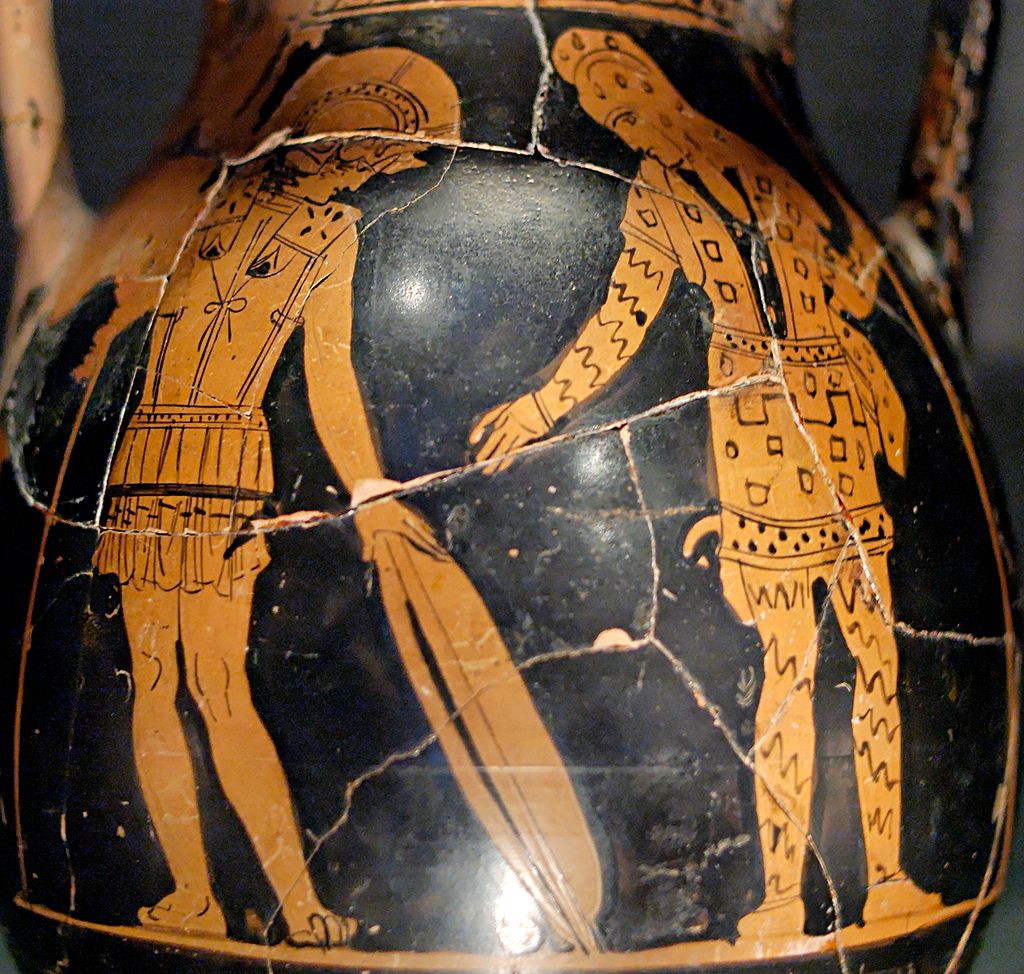
Diomedes (on the left) exchanging weapons with Glaucus, a captain of the Lycian army. Attic red-figure pelike by the Hasselmann Painter, ca. 420 BC. 

*These lines are creatively adapted from the Iliad

**Special thanks to Justin Arft for helping with the ending

Odysseus slays Diomedes?

The Debt All Mortals Owe: Reading Euripides’ “Alcestis” Online

Euripides, Alcestis 745

“I am dead to you”

τέθνηκα γὰρ δὴ τοὐπὶ σ᾿.

Euripides, Alcestis  196-198

“These are what Admetos’ sufferings are like.
If he died, he would leave; but since he’s alive
He lives with the kind of grief he will never forget.”

τοιαῦτ᾿ ἐν οἴκοις ἐστὶν Ἀδμήτου κακά.
καὶ κατθανών τἂν ᾤχετ᾿, ἐκφυγὼν δ᾿ ἔχει
τοσοῦτον ἄλγος, οὔποθ᾿ οὗ λελήσεται.

RGTO Alcestis

Euripides, Alcestis, 141

“You could say that she’s dead and alive.”

καὶ ζῶσαν εἰπεῖν καὶ θανοῦσαν ἔστι σοι.

The Center for Hellenic Studies , the Kosmos Society and Out of Chaos Theatre has been presenting scenes from Greek tragedy on the ‘small screen’ with discussion and interpretation during our time of isolation and social distancing. As Paul O’Mahony, whose idea this whole thing was said in an earlier blog post, Since we are “unable to explore the outside world, we have no option but to explore further the inner one.

Each week we select scenes from a play, actors and experts from around the world, and put them all together for 90 minutes or so to see what will happen. This process is therapeutic for us; and it helps us think about how tragedy may have had similar functions in the ancient world as well.

Euripides, Alcestis 71

“You can’t gain anything more by saying much.”

πόλλ᾿ ἂν σὺ λέξας οὐδὲν ἂν πλέον λάβοις·

This play is dated as one of Euripides’ earliest extant dramas, coming from around 438. It tells the story of a king in Thessaly who impressed Apollo with his reverence and whose death Apollo is trying to prevent by having his wife Alcestis take his place. The tone and content of this mythical Romance of sorts has challenged readers for some time. As a scholion introducing the play complains:

“This drama is rather like a satyr play because it mixes in joy and pleasure and and those things rejected as ill-fit to tragic poetry, which is the same thing in the Orestes and the Alkestis, they begin from misfortune and end in good fortune and ending in joy, which is more proper of comedy. [Many of this kinds of things are in tragedy]”

τὸ δὲ δρᾶμά ἐστι σατυρικώτερον ὅτι εἰς χαρὰν καὶ ἡδονὴν κατστρέφει [παρὰ τοῖς τραγικοῖς] <καὶ> ἐκβάλλεται ὡς ἀνοίκεια τῆς τραγικῆς ποιήσεως ὅ τε ᾿Ορέστης καὶ ἡ ῎Αλκηστις, ὡς ἐκ συμφορᾶς μὲν ἀρχόμενα, εἰς εὐδαιμονίαν <δὲ> καὶ χαρὰν λήξαντα, <ἅ> ἐστι μᾶλλον κωμῳδίας ἐχόμενα. <πολλὰ δὲ τοιαῦτα παρὰ τοῖς τραγικοῖς>:

Of course, this play comes before Aristotle codified what a tragedy and comedy should be! It could not have been too strange, because Euripides won second place with this play, bested again by Sophocles. In the Alkestis, again, we find Euripides challenging modern assumptions about what a tragedy should provide. But what if we ignore Aristotle for a bit, and ask what a play should do instead?

Scenes (Using this translation)

1-76: Apollo and Thanatos
77-135: Chorus
238-392: Chorus, Alcestis, Admetus
509-568: Admetus, Heracles, Chorus
747-860: Servant and Heracles
1008-1158: Heracles, Admetus, Alcestis (silent)

Euripides, Alcestis  252-7

“I see the double-oared skiff
In the lake, the ferryman of the corpses
Kharon keeps his hand on the rudder
And calls to me, “Why do you put this off?
Press on, you are holding me back.”
He hurries me on, fast with these words.”

ὁρῶ δίκωπον ὁρῶ σκάφος ἐν
λίμνᾳ· νεκύων δὲ πορθμεὺς
ἔχων χέρ᾿ ἐπὶ κοντῷ Χάρων
μ᾿ ἤδη καλεῖ· Τί μέλλεις;
ἐπείγου· σὺ κατείργεις. τάδε τοί
με σπερχόμενος ταχύνει.

Actors

Thanatos – Noelia Antweiler
Alcestis – Tabatha Gayle
Admetus – Martin Lewis
Chorus – Toph Marshall
Apollo/Servant – Paul O’Mahony
Heracles – René Thornton Jr

Special Guest: Maria Xanthou

Dramaturgical assistance: Emma Pauly

Direction: Beth Burns with production assistance by Paul O’Mahony

Posters: John Koelle

Technical, Moral, Administrative Support: Lanah Koelle, Allie Mabry, Janet Ozsolak, Helene Emeriaud, Sarah Scott, Keith DeStone

Euripides, Alcestis 780-784

“Do you understand the nature of mortal affairs?
I don’t think so. How would you? Listen to me.
Dying is the debt that all mortals owe
And no one who is mortal will know
Whether they will be alive on the coming day.”

τὰ θνητὰ πράγμαθ᾿ ἥντιν᾿ οἶσθ᾿ ἔχει φύσιν;
οἶμαι μὲν οὔ· πόθεν γάρ; ἀλλ᾿ ἄκουέ μου.
βροτοῖς ἅπασι κατθανεῖν ὀφείλεται,
κοὐκ ἔστι θνητῶν ὅστις ἐξεπίσταται
τὴν αὔριον μέλλουσαν εἰ βιώσεται·

Upcoming Readings (Go here for the project page)

The Chorus, July 29th [Special 10 AM time]

Sophocles, Antigone August 5

Sophocles, Electra, August 12

Euripides, Alcestis 349-355

“A statue of you shaped by the wise hand
Of craftsmen will be laid out in our bed.
I will cast myself into her arms while embracing
Call our your name, believing that I have
My dear wife in my arms, even though I don’t.
I believe this is a cold pleasure, but still
It will balance the weight in my soul…”

σοφῇ δὲ χειρὶ τεκτόνων δέμας τὸ σὸν
εἰκασθὲν ἐν λέκτροισιν ἐκταθήσεται,
ᾧ προσπεσοῦμαι καὶ περιπτύσσων χέρας
ὄνομα καλῶν σὸν τὴν φίλην ἐν ἀγκάλαις
δόξω γυναῖκα καίπερ οὐκ ἔχων ἔχειν·
ψυχρὰν μέν, οἶμαι, τέρψιν, ἀλλ᾿ ὅμως βάρος
ψυχῆς ἀπαντλοίην ἄν.

Videos of Earlier Sessions (Go here for the project page)
Euripides’ Helen, March 25th
Sophocles’ Philoktetes, April 1st
Euripides’ Herakles, April 8th
Euripides’ Bacchae, April 15th
Euripides’ Iphigenia , April 22nd
Sophocles, Trachinian Women, April 29th
Euripides, Orestes May 6th
Aeschylus, Persians, May 13th
Euripides, Trojan Women May 20th
Sophocles’ Ajax, May 27th
Sophocles, Oedipus Tyrannos, June 10th

Euripides, Ion,  June 17th

Euripides, Hecuba June 24th

Aeschylus, Prometheus Bound June 30th

Euripides, Andromache 

Aristophanes, Clouds July 15th

Euripides, Alcestis  689-774

“How have I wronged you? What have I taken from you?
Don’t die for this man and I won’t for you.
You delight seeing the light. Don’t you imagine your father does too?
Really, I reckon that the time below stretches out
And that living is short but still sweet.

But you have shamefully fought not to die
And you live, passing the fate allotted to you
By killing her…”

“τί δῆτά σ᾿ ἠδίκηκα; τοῦ σ᾿ ἀποστερῶ;
μὴ θνῇσχ᾿ ὑπὲρ τοῦδ᾿ ἀνδρός, οὐδ᾿ ἐγὼ πρὸ σοῦ.
χαίρεις ὁρῶν φῶς· πατέρα δ᾿ οὐ χαίρειν δοκεῖς;
ἦ μὴν πολύν γε τόν κάτω λογίζομαι
χρόνον, τὸ δὲ ζῆν σμικρὸν ἀλλ᾿ ὅμως γλυκύ.
σὺ γοῦν ἀναιδῶς διεμάχου τὸ μὴ θανεῖν
καὶ ζῇς παρελθὼν τὴν πεπρωμένην τύχην,
ταύτην κατακτάς…

The Sense of a Beginning

As this lame opening sentence itself attests, beginnings are hard to do. Everyone likes to focus on the near impossibility of producing a satisfactory ending, both in life and in art. Breakups, divorces, and death are the most common conclusions to relationships. Usually an author can find some way to pad the blow, and as disappointing as literary conclusions can be, they are at any rate rarely as disappointing as conclusions in life. Literary beginnings must necessarily involve an even greater degree of artificiality than endings, if only because we are never conscious of beginnings in our lives. Nothing gets a preface or an introduction, and while you could pithily epigrammatize some lived experience, you can only do it retrospectively.

In antiquity, you could botch an ending just as badly as people do today, but the beginning had to be good for the simple reason that the earliest literature, that is to say poetry, was often remembered by reference to its first line. When that poetry was recited and heard, the audience needed a hook or a preview – something to prime the old pump. When transcribed onto scrolls, the impossibility of flipping casually through the contents for something appealing required that the first unfurling reveal some treasure.

We all know that the Iliad begins in dramatic fashion with the word wrath. As an opening word, it couldn’t be more heavily-weighted, and it’s clear that the anger precedes the singing of it. One would think that anyone possessed of any admiration for Homeric poetry would think that it admits of no improvement, but Aristoxenus records a flat variant to the famous proem:

Tell me now Muses having Olympian homes, how wrath and anger seized the offspring of Peleus and the shining son of Leto; for he was angry with the king…

῎Εσπετε νῦν μοι, Μοῦσαι ᾿Ολύμπια δώματ’ ἔχουσαι,
ὅππως δὴ μῆνίς τε χόλος θ’ ἕλε Πηλεΐωνα,
Λητοῦς τ’ ἀγλαὸν υἱόν· ὁ γὰρ βασιλῆι χολωθείς.

The only thing which can be said for this opening is the interest which stems from the parallelism between Achilles and Apollo, both of whom are taken by anger, both of whom work destruction on the Greeks, and both of whom feature in the post-Iliadic episode in which Apollo guides Paris’ arrow to slay Achilles. But by achieving this parallelism, the tragedy of specifically human experience is undermined as comparatively more power over the narrative’s direction is granted to the gods.

Homer was not the only epic artist to suffer some flattening in the hands of improving versifiers. For the choice of thematic opening words, you cannot beat Vergil:

Arma virumque cano Troiae qui primus ab oris…

Step aside Muses, Vergil is singing here! We will forgive the man – he was a paid pen, and it takes a remarkable man to own his hackwork instead of attributing it to other sources. Perhaps we shouldn’t put too fine a point on it, but Vergil’s shift from the imperative to the bold first person singular contains in itself the loss of religious feeling effected by seven centuries of philosophy. Ironically, the arma portion of the poem is mostly forgettable, and probably would be entirely forgotten if it hadn’t received top billing in the opening credits. At any rate, the Vergil syllabus from antiquity onward has been heavily weighted toward the virum end of things, and most readers seem most thrilled with a rehash of the greatest hits (the retrospective about the fall of Troy and Aeneas’ Odyssey in books 2&3), the romantic tragedy (Dido and Aeneas in book 4), or the curious admixture of occult arcana and SPQR propaganda theater in book 6.

But even all of the resounding majesty of good old arma virumque has not been granted unquestioned primacy of place. Here is the alternative opening to the Aeneid:

It is I, who once measured out my song on the slender reed, and setting out from the forests compelled the neighboring fields to yield to the farmer, however greedy, that work so pleasing to the people of the fields, but now I sing Mars’ horrible arms and a man…

Ille ego, qui quondam gracili modulatus avena 
carmen, et egressus silvis vicina coegi
ut quamvis avido parerent arva colono
gratum opus agricolis, at nunc horrentia Martis
arma virumque cano

If the phrase at nunc horrentia Martis were left in this fragmentary form without the other baggage weighing it down, it would suggest so much more, and make for a far more enticing opening. The mystery – what came before ‘at nunc’ – would have heightened our enjoyment of the passage. Yet the banality of what comes before should remind us that maybe some of our most enticing and suggestive fragments are better off in their fragmentary form. Indeed, maybe Kubla Kahn achieves in its incomplete form a kind of perfection which would have been impossible had Coleridge not been hurried off to Porlock.

Milton, though steeped in ancient learning, flouted the weightier classical models in one bold respect. Homer and Vergil both began their poems with potent thematic words: wrath, a man, arms. Milton takes a cue from Ovid and uses a preposition to begin Paradise Lost:

OF Mans First Disobedience, and the Fruit

Of that Forbidden Tree, whose mortal tast

Brought Death into the World, and all our woe,

With loss of Eden, till one greater Man

Restore us, and regain the blissful Seat,

Sing Heav’nly Muse, that on the secret top

Of Oreb, or of Sinai, didst inspire

That Shepherd, who first taught the chosen Seed,

In the Beginning how the Heav’ns and Earth

Rose out of Chaos: or if Sion Hill

Delight thee more, and Siloa’s brook that flow’d

Fast by the Oracle of God; I thence

Invoke thy aid to my adventrous Song,

That with no middle flight intends to soar

Above th’ Aonian Mount, while it pursues

Things unattempted yet in Prose or Rhime.

Milton yielded nothing to the ancients in his ability to begin a sentence with what is properly a subordinate element and then string them into quite a page-buster of a sentence. But nevertheless, the opening is memorable, and more interesting than the poem when taken as a whole. Some things are better in prospect, or in trailer form. Homer and Vergil had their endings down, but even in them we can detect a tendency for the epic middle to sag under its own weight. The buckling knees of the epic form finally gave way under Milton, who can still be read profitably for anyone in search of language. But as the long-spun proem may suggest, the language is all there is.

As in literature, so in life. The middle portion is an amorphous mass without always possessing an apparent structure, direction, or point – it is just there for us to experience. Literary beginnings are hard to manage because the beginning of life is hard to manage. We – that is, our conscious selves – are never around for the inception of life, so we are forced to begin our own narratives at some arbitrary and dimly-remembered point. What is my first memory? I don’t know. I can think of several early recollections, but it would be hopeless to impose any sequence or time stamp on them. They simply were experiences, re-experienced and likely transformed over time through the very process of recollection, just as any copy of anything gradually becomes a less faithful representation of its early exemplar.

When the poet brings us abruptly in medias res, he is faithfully representing the experience of life itself, which surely had a beginning, but is not experienced or remembered that way. The scholar’s urge to systematize, to ask where it all began and deduce the history from that point – all of that is impossible and played-out. Forget about the Bible and its “In the beginning…”s. Forget about the universal history of systematizers like Zonaras. Forget about Ovid’s primaque ab origine mundi (“from the first origin of the world…”). But don’t forget about the forgetting – about the fact that your memory is more lacuna than recollection. That middle might sag quite a bit, and the waters of Lethe might wash clean most of what lies between the cradle and the headstone, but you can still keep searching for the perfect word to open that narrative.

File:Barthel (Bartholomäus) Bruyn - Vanitas.JPG
Barhel Bruyn, Vanitas

Homer’s Tales and The Narrative Animal

Strabo, Geography 1.2.7-8

Homer tells precisely of not merely the neighboring lands and Greece itself—as Eratosthenes has claimed—but many other places farther afield too and he tells his myths better than those who followed him. For he does not offer every tale for wonder only, but also to contribute to knowledge—especially in the wanderings of Odysseus—he allegorizes, provides warnings, and delights [his audiences]. This is something [Eratosthenes] is really wrong about when he asserts that the poet and his interpreters are fools. This is a subject worth speaking on to a much greater extent.”

The first point is that it is not only poets who used myths, but cities and lawmakers did too for the sake of their usefulness, once they noted the native disposition of the story-oriented animal. For Humans love to learn; loving stories is a prelude to this. This is why children start by listening and making a common ground in stories.

The reason for this is that story/myth is a novel-kind-of-thought [to them] which helps them thing not about what they already know but about different kinds of things too. To children we are obliged to hold out such enticements, in order that in riper years, when the mind is powerful, and no longer needs such stimulants, it may be prepared to enter on the study of actual realities.

There is sweetness in novelty and what someone does not already know, This is the very thing that also creates a love-of-learning. Whenever something amazing and ominous is present, it nurtures pleasure, which is a magic charm for learning. In the early years it is necessary to use these types of attractions, but when age increases toward the study of things as they really are, then the understanding has advanced and no longer requires flatteries.”

᾿αλλ᾽ οὐδὲ τὰ σύνεγγυς μόνον, ὥσπερ Ἐρατοσθένης εἴρηκε, καὶ τὰ ἐν τοῖς Ἕλλησιν, ἀλλὰ καὶ τῶν πόρρω πολλὰ λέγει καὶ δι᾽ ἀκριβείας Ὅμηρος καὶ μᾶλλόν γε τῶν ὕστερον μυθολογεῖται, οὐ πάντα τερατευόμενος, ἀλλὰ καὶ πρὸς ἐπιστήμην ἀλληγορῶν ἢ διασκευάζων ἢ δημαγωγῶν ἄλλα τε καὶ τὰ περὶ τὴν Ὀδυσσέως πλάνην, περὶ ἧς πολλὰ διαμαρτάνει τούς τ᾽ ἐξηγητὰς φλυάρους ἀποφαίνων καὶ αὐτὸν τὸν ποιητήν: περὶ ὧν ἄξιον εἰπεῖν διὰ πλειόνων.

καὶ πρῶτον ὅτι τοὺς μύθους ἀπεδέξαντο οὐχ οἱ ποιηταὶ μόνον, ἀλλὰ καὶ αἱ πόλεις πολὺ πρότερον καὶ οἱ νομοθέται τοῦ χρησίμου χάριν, βλέψαντες εἰς τὸ φυσικὸν πάθος τοῦ λογικοῦ ζῴου: φιλειδήμων γὰρ ἅνθρωπος, προοίμιον δὲ τούτου τὸ φιλόμυθον. ἐντεῦθεν οὖν ἄρχεται τὰ παιδία ἀκροᾶσθαι καὶ κοινωνεῖν λόγων ἐπὶ πλεῖον.

αἴτιον δ᾽, ὅτι καινολογία τίς ἐστιν ὁ μῦθος, οὐ τὰ καθεστηκότα φράζων ἀλλ᾽ ἕτερα παρὰ ταῦτα: ἡδὺ δὲ τὸ καινὸν καὶ ὃ μὴ πρότερον ἔγνω τις: τοῦτο δ᾽ αὐτό ἐστι καὶ τὸ ποιοῦν φιλειδήμονα. ὅταν δὲ προσῇ καὶ τὸ θαυμαστὸν καὶ τὸ τερατῶδες, ἐπιτείνει τὴν ἡδονήν, ἥπερ ἐστὶ τοῦ μανθάνειν φίλτρον. κατ᾽ ἀρχὰς μὲν οὖν ἀνάγκη τοιούτοις δελέασι χρῆσθαι, προϊούσης δὲ τῆς ἡλικίας ἐπὶ τὴν τῶν ὄντων μάθησιν ἄγειν, ἤδη τῆς διανοίας ἐρρωμένης καὶ μηκέτι δεομένης κολάκων.

Jerome Bruner, Actual Minds, Possible Worlds. Cambridge: Harvard University Press, 1986.

123: “The most general implication is that a culture is constantly in process of being recreated as it is interpreted and renegotiated by its members. In this view, a culture is as much a forum for negotiating meaning and for explicating action as it is a set of rules or specifications for action. Indeed, every culture maintains specialized institutions or occasions for intensifying this “forum-like” feature. Storytelling, theater, science, even jurisprudence are all techniques for intensifying this function—ways of exploring possible worlds out of the context of immediate need. Education is (or should be) one of the principal forums for performing this function—though it is often timid in doing so. It is the forum aspect of a culture that gives its participants a role in constantly making and remaking the culture…”

Bern Le Hunte and Jan A. Golembiewski. “Stories Have the Power to Save Us: A Neurological Framework for the Imperative to Tell Stories.” Arts and Social Sciences Journal 5.2 (2014) 73-76.

73: “The claim that stories have the power to save us is audacious, yet it is one that can be validated by neuroscience. This article demonstrates that the brain is hard-wired to process stories in a most fundamental way, indicating the evolutionary priority that storytelling has had in human development, and the importance it has in forging a future humanity.”

Edward O. Wilson. “On Free Will and How the Brain is Like a Colony of Ants.” Harper’s September 2014, 49-52.

51: “The final reason for optimism is the human necessity for confabulation, which offers more evidence of a material basis to consciousness. Our minds consist of storytelling.”

Jonathan Gottschall. The Storytelling Animal: How Stories Make Us Human. Boston: Mariner Books, 2012.

58: “The psychologist and novelist Keith Oakley calls stories the flight simulators of human social life.”

Mark Turner. The Literary Mind: The Origins of Thought and Language. Oxford: 1996.

4-5: “narrative imagining—story—is the fundamental instrument of thought. Rational capacities depend upon it. It is our chief means of looking into the future, of predicting, of planning, and of explaining. It is a literary capacity indispensable to human cognition generally. This is the first way in which the mind is essentially literary.”

[Large Figures on the North Porch, Chartres Cathedral]
A story waiting to be told…

#NANAIHB The Final Smackdown: Ajax vs. Diomedes

Welcome to the semifinal of the #NANAIHB (the Non-Atreid, Non-Achilles Iliadic hero Bracket), the definitive tournament to decide who really is the second best of the Achaeans. The first round saw six contests, most of which were blowouts. The second round was equally lopsided, leaving us with two ‘classic’ matches. Odysseus vs. Ajax and Patroklos vs. Diomedes. Ajax prevailed in the first match. Today, the match we were all waiting for.

NANAIHB Day 12

Ajax

In the Odyssey, Ajax is best in size and looks / of all the Danaans after Peleus’ blameless son” Αἴαντός θ’, ὃς ἄριστος ἔην εἶδός τε δέμας τε / τῶν ἄλλων Δαναῶν μετ’ ἀμύμονα Πηλεΐωνα. (11.469-470) and in the Iliad he is curiously the “best of men while Achilles was raging” (ἀνδρῶν αὖ μέγ’ ἄριστος ἔην Τελαμώνιος Αἴας ὄφρ’ ᾿Αχιλεὺς μήνιεν, 1.768-769). I think that these moments acknowledge how important Ajax is in the Trojan War, but indicate, perhaps, that this importance is softened in the Iliad. In iconography of the 6th and 5th Centuries BCE, Ajax appears in some of the most memorable repeated images: seated, playing a game with Achilles; carrying Achilles’ corpse from the battle field; fighting with Odysseus over Achilles’ weapons; and taking his own life on Hektor’s sword. In the Iliad, he is really important in book 9 (when he is part of the embassy to Achilles) but on the battle field, he lags behind Diomedes, Odysseus, Patroklus, and Achilles (check this info-graphic). Ajax is a versatile killer: in the Iliad he slays with spear, sword and stone. Compared to Diomedes, however, Ajax may be just a replacement level Achilles.

So, maybe Ajax’s secondariness was always important in the Homeric tradition? Well, now we have a chance to make it official

Achilles Ajax dice Louvre MNB911 n2.jpg
Achilles (on the left) and Ajax the Great (on the right) playing dice, identified by inscriptions. Detail of a white-figure Attic lekythos.

Diomedes has some important presence in myth outside of the Iliad too, most famously for taking Thebes with the Epigonoi (a lost epic), giving him the right to claim himself better than his father. He is important following the events of the Iliad where he helps Odysseus get the palladion from Troy (only to almost get murdered for it.

Homer seems to have a special place for Diomedes. He is there doing what Achilles should be when Peleus’ son is absent; and he mostly disappears when Achilles is gone. (He even gets wounded in the foot by Paris!) He has the greatest number of kills of all the Achaeans, but, a good third of them are against unarmed men. There may be a little two much Odysseus to this figure—which may be the point. Diomedes is, in a way, something of a compromise between the ruthless intelligence of Odysseus and the brute force of Achilles. Importantly, Diomedes accomplishes a lot of his action through speech, perhaps allowing him to become the kind of political figure Achilles could have been, if not for his overpowering rage.


May the (second) best hero win.

Aias Carrying Body of Achilles - detail from Francois vase c 565 BCE fForence Italy Arch Museum.jpg
Large Attic Black-figure volute-krater dating to c. 570-565 BC
Ajax body Achilles Louvre F201.jpg
Ajax carrying the dead Achilleus, protected by Hermes (on the left) and Athena (on the right). Side 1 from an Attic black-figure neck-amphora, ca. 520-510 BC.

Cancel This! Isocrates Navigates Freedom of Speech

Isocrates, To Nicocles 3

“There are many ways people are educated in private life. Most importantly, avoiding luxury and being forced to think every day about their life. Then, they have the laws which we happen to live by civically. Finally, we are educated by freedom of speech and the right given to friends to openly criticize and to enemies to attack one another’s faults.”

Τοὺς μὲν γὰρ ἰδιώτας ἐστὶ πολλὰ τὰ παιδεύοντα, μάλιστα μὲν τὸ μὴ τρυφᾶν ἀλλ᾿ ἀναγκάζεσθαι περὶ τοῦ βίου καθ᾿ ἑκάστην τὴν ἡμέραν βουλεύεσθαι, ἔπειθ᾿ οἱ νόμοι καθ᾿ οὓς ἕκαστοι πολιτευόμενοι τυγχάνουσιν, ἔτι δ᾿ ἡ παρρησία καὶ τὸ φανερῶς ἐξεῖναι τοῖς τε φίλοις ἐπιπλῆξαι καὶ τοῖς ἐχθροῖς ἐπιθέσθαι ταῖς ἀλλήλων ἁμαρτίαις·

Isocrates, On the Peace 14

“I know that it is hard to stand against your opinions and that that there is no freedom of speech when there is democracy except that which is employed here among these great fools who don’t care about you and in the theater among the comic poets.

You know that is most shocking of all? You give those who let the rest of Greece know about our state’s failures so much more gratitude than those who do good things for us. And you are as annoyed to those who correct you and warn you as you are with those who contrive evil against the state!”

Ἐγὼ δ᾿ οἶδα μὲν ὅτι πρόσαντές ἐστιν ἐναντιοῦσθαι ταῖς ὑμετέραις διανοίαις, καὶ ὅτι δημοκρατίας οὔσης οὐκ ἔστι παρρησία, πλὴν ἐνθάδε μὲν τοῖς ἀφρονεστάτοις καὶ μηδὲν ὑμῶν φροντίζουσιν, ἐν δὲ τῷ θεάτρῳ τοῖς κωμῳδοδιδασκάλοις· ὃ καὶ πάντων ἐστὶ δεινότατον, ὅτι τοῖς μὲν ἐκφέρουσιν εἰς τοὺς ἄλλους Ἕλληνας τὰ τῆς πόλεως ἁμαρτήματα τοσαύτην ἔχετε χάριν ὅσην οὐδὲ τοῖς εὖ ποιοῦσι πρὸς δὲ τοὺς ἐπιπλήττοντας καὶ νουθετοῦντας ὑμᾶς οὕτω διατίθεσθε δυσκόλως ὥσπερ πρὸς τοὺς κακόν τι τὴν πόλιν ἐργαζομένους.

Ostracism! That’s Cancel Culture for you!

Your Ignorance of My Suffering

Libanius, Letters 155

“You don’t know, dear Heortius, the number or the severity of the sicknesses which are assailing me nor how long this has plagued me. For you would not disregard sympathy and criticize me if you did. But ignorance is harmful to human beings everywhere and it has forced you to accuse instead of console. I will not call you out for not knowing about my suffering.

But someone of those who easily criticize you might still say that you were ignorant because you failed to inquire and that you did not inquire because of antipathy, and by attracting a suspicion of arrogance to yourself you risk greater accusations. But I will not do this because I don’t think it is right to ruin a strong friendship through nonsense. But whenever something like this happens, once I search around or a likely cause for events, I make a defense to myself on others’ behalf.”

1. Οὐκ οἶσθα, ὦ φίλε Ἐόρτιε, τῶν προσβαλόντων μοι νοσημάτων οὔτε τὸ πλῆθος οὔτε τὸ μέγεθος οὔτ᾿ ἐφ᾿ ὅσον προῆλθε τοῦ χρόνου. οὐ γὰρ ἄν ποτε ὑπερβὰς τὸ συναλγεῖν ἐμέμφου. νῦν δὲ ἡ ἄγνοια πανταχοῦ τοῖς ἀνθρώποις βλαβερὸν καὶ δὴ καὶ σὲ κατηγορεῖν ἐπῆρεν ἀντὶ τοῦ παραμυθεῖσθαι. ἐγὼ δέ σοι οὐκ ἐγκαλῶ τὸ τὰς δυσκολίας ἡμῶν ἀγνοεῖν.

2. καίτοι φαίη τις ἂν τῶν ὥσπερ σὺ ῥᾳδίως ἐπιτιμώντων, ὡς ἀγνοεῖς μὲν τῷ μὴ πυνθάνεσθαι, οὐ πυνθάνῃ δὲ τῷ μισεῖν, καὶ οὕτως ἂν ὑπεροψίαν προφέρων αὐτὸς ἐνέχοιο μείζοσιν. ἐγὼ δὲ τοῦτο οὐ ποιήσω φιλίαν ἰσχυρὰν ὑβρίζειν οὐκ ἀξιῶν συκοφαντίᾳ. ἀλλ᾿ ὅταν τι γένηται τοιοῦτον, ζητήσας αἰτίαν τοῖς πράγμασιν ἐπιεικεστέραν οὕτω πρὸς ἐμαυτὸν ὑπὲρ ἐκείνων ἀπολογοῦμαι.

Image result for medieval manuscript sickness
Bibliothèque Municipale de Lyon, MS P.A. 78, Folio 36r

#NANAIHB Semifinals, Match 2: Patroklos vs. Diomedes

Welcome to the semifinal of the #NANAIHB (the Non-Atreid, Non-Achilles Iliadic hero Bracket), the definitive tournament to decide who really is the second best of the Achaeans. The first round saw six contests, most of which were blowouts. The second round was equally lopsided, leaving us with two ‘classic’ matches. Odysseus vs. Ajax and Patroklos vs. Diomedes. Ajax prevailed in the first match. Today Diomedes meets Patroklos

NANAIHB Day 12

Semifinal 2 Results: Diomedes Prevails!

The Achaean assembly was buzzing like a hive in adoration of its queen as Patroklos and Diomedes prepared to face one another. In the seasdie corner, Achilles helped Patroklos put on his armor, talking constantly with encouragement and advice about Diomedes’ tendency to drop his shield arm when parrying to the left. Those near him could hear Achilles tell Patroklos that Diomedes was far superior with his sword and it would be best to finish him quickly.

Aged Nestor and Sthenelos stood next to Diomedes as he watch the preparations. Tydeus’ son had been standing in full armor for over an hour. Many of the Achaeans had arrived at the assembly to find him already there, staring out towards the sea.

As Agamemnon stepped into the center to call the contest’s start, those near Diomedes could hear him praying:

“Hear me, Atrutônê, dear child of Aegis bearing Zeus.
If ever you also stood alongside my father in concern
Amid the violent battle, care for me now in turn, Athena.”

κλῦθί μευ αἰγιόχοιο Διὸς τέκος ᾿Ατρυτώνη,
εἴ ποτέ μοι καὶ πατρὶ φίλα φρονέουσα παρέστης
δηΐῳ ἐν πολέμῳ, νῦν αὖτ’ ἐμὲ φῖλαι ᾿Αθήνη·

Across from him, Patroklos turned and raised his hands to the sea, intoning:

“Hear me, fine haired Thetis, mother of Achilles,
Hear me, goddess, come as a good helper for my feet.”

κλῦθί μευ καλλιπλοκάμε Θέτι μῆτερ Ἀχιλῆος
κλῦθι θεά, ἀγαθή μοι ἐπίρροθος ἐλθὲ ποδοῖιν.

As Agamemnon called out, Patrklos hurled his spear first and Diomedes redirected it with his shield only to barely dodge the next spear headed for his right thigh. Patroklos had sent the first spear wide left to draw Diomedes’ spear arm. Tydeus’ son was saved from a quick injury by a gust of wind that left the errant spear to graze the strong belt near his hip.

Diomedes took careful aim and launched one spear after another, missing easily each time as Patroklos sped from side to side, racing towards him. Diomedes leaned down and picked up a stone with one hand so large two men with a cart and a bar could not move it today and he waited. Patroklos was closing on him and when he was two strides away, Diomedes launched the stone in the air, dropped his shield and punched Patroklos square in the chest. As the hero fell back, the stone plummeted, narrowly missed Patroklos’ head, but landing on the end of his left foot, crushing the toes.

Diomedes vaunted, “Patroklos, yield, the fame of your fury will reach your father’s ears.” And the Achaeans laughed because Diomedes’ wordplay had exceeded Agamemnon’s earlier attempts as much as his valor in war surpassed the Atreids’. Patroklos, yelled back “Son of Tydeus, you are certainly strong in war, but you have not beat me yet.” As Patroklos got to his feet, Achilles roared from the sideline, “Be careful Diomedes, you can scar his face, but I don’t want another wound to his legs!” And, as expected, the gathered Achaeans started laughing again.

Patroklos drew his sword and the two began to circle, feinting and parrying. Diomedes kept pressing him to move on his injured foot, and Menoitios’ son stayed light and fast, but his sword work was slower and his shield arm was wearing from the relentless strikes meted out by Tydeus’ son.NANAIHB Day 12 (2)

The crowd was restless and calling out to Diomedes to finish it. But Patroklos kept fighting. To everyone’s surprise, Patroklos faked slipping on his injured foot and came around to cut deeply into Diomedes’ left arm. Diomedes dropped his shield and stood there, surprised and suddenly still. Patroklos roared in victory and rushed at him. Diomedes stepped aside, parried the charge, and let Patrklos’ speed take him forward. He brought the butt of his sword back around and smashed it into his opponent’s helmet. Patroklos crumpled to the ground.

Achilles yelled, “Stay your sword, violent son of Tydeus. My Patroklos yields.” The Achaeans erupted in cheers as Sthenelos helped Diomedes tend to his wound and Achilles came over to lift Patroklos from the ground.

*τὸ κλέος μένεος ὦτα εἰς πατρὶδος ἔρχοιτο! Diomedes echoed the name of Menoitios in “fury to ears” [Meneos ota] while also echoing Patroklos’ name with “fame [kleos] to your father [patridos]”

Achilles tending Patroclus’ wound

The final round starts tomorrow: Ajax vs. Diomedes for the title of Second best of theAchaeans!