Less Human Apart: Isolation and Civilization in Myth, Science Fiction and RL

I am reposting this entry from early in the pandemic in honor of the panel “The Powers and Perils of Solitude in Greek Literature” at the SCS Annual Meeting. My paper “Being Human, Being Alone: Isolation and Heroic Exceptionality in the Odyssey” draws on it.

Here’s the roster of talks

The Post


Iliad, 2.721–723

“Philoktetes lies there on the island suffering harsh pains
In holy Lemnos where the sons of the Achaeans left him
suffering with an evil wound from a murderous watersnake.”

ἀλλ’ ὃ μὲν ἐν νήσῳ κεῖτο κρατέρ’ ἄλγεα πάσχων
Λήμνῳ ἐν ἠγαθέῃ, ὅθι μιν λίπον υἷες ᾿Αχαιῶν
ἕλκεϊ μοχθίζοντα κακῷ ὀλοόφρονος ὕδρου

Odyssey 5.13–15

“He lies there on the island suffering harsh pains
In the halls of Calypso the nymph who holds him
under compulsion. He is not capable of returning to his paternal land.”

ἀλλ’ ὁ μὲν ἐν νήσῳ κεῖται κρατέρ’ ἄλγεα πάσχων
νύμφης ἐν μεγάροισι Καλυψοῦς, ἥ μιν ἀνάγκῃ
ἴσχει· ὁ δ’ οὐ δύναται ἣν πατρίδα γαῖαν ἱκέσθαι
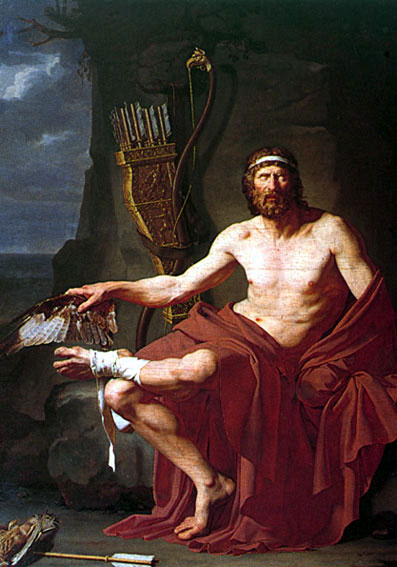
Isolation. “Philoctetes on the Island of Lemnos,” By Jean Germain Drouais

The figure of the isolated hero in ancient Greek myth and poetry is one who is set apart, on an island, separated from other humans and, by extension, from human culture. The impact of isolation is often communicated through the heroic body, even if it is offered in some way as a cause: Philoktetes’ dehumanization is reflected in the wound whose antisocial attributes cause him to be abandoned (described like a disease in Sophocles’ play). Odysseus seems arguably less human insofar as he is stripped of agency and, until Hermes comes to move him, clearly more an object of interest than a subject of his own.

Indeed, the Odyssey has deep ethnographic concerns, focusing on how people make their livings and how they live their lives. When Odysseus describes the island of the Cyclopes, he remarks on how it might be a good place to live, but the Cyclopes themselves are “arrogant and lawless” (ὑπερφιάλων ἀθεμίστων, 9.106). They aren’t human because of the  way they live (they do not cultivate the land, 108-111). And they are less than human because of how they organize their lives (Odyssey 9.112–115):

 “They don’t have council-bearing assemblies or laws,
But instead they inhabit homes on high hills
In hollow caves, and each one makes laws
For his children and wives—they do not have concern for one another.”

τοῖσιν δ’ οὔτ’ ἀγοραὶ βουληφόροι οὔτε θέμιστες,
ἀλλ’ οἵ γ’ ὑψηλῶν ὀρέων ναίουσι κάρηνα
ἐν σπέεσι γλαφυροῖσι, θεμιστεύει δὲ ἕκαστος
παίδων ἠδ’ ἀλόχων, οὐδ’ ἀλλήλων ἀλέγουσι.

In a way, Odysseus anticipates here the later Greek use of the term idiotês for the person who fails to understand that the commonwealth directly impacts individual possessions—indeed, it makes possible the existence of individual goods. The ancient idiot, in this political sense, is a kind of naïve libertarian who is incapable of conceiving of shared human society as the very thing that makes life possible and also worth living.

*          *          *          *

Current events are forcing us to explore some of the same tensions: inasmuch as some are aghast that we are not willing to die to preserve the economy, the rest of us remain horror stricken at how much our public health and collective good have been sacrificed to prop up the wealth of a very few. Even though my training directs my thoughts consistently to the past for parallels to cope with the present, my own reading history and proclivity for speculative fiction keep taking me to narrative futures. In my impatience to be done with the now, I am busy manufacturing anxieties about what will become of us later.

In Isaac Asimov’s Robot novel The Naked Sun (1957), the detective Elijah Bailey is dispatched to one of the “spacer” worlds to investigate a murder. In Asimov’s world, humankind lives in a mixed future where billions are crowded into cities on earth while a select elite escape to fifty “Spacer” worlds. Over time, the antagonism between Spacer and Earther expands as the former use their greater resources and technology to dominate the latter. And Earthers suffer from a fear of the outside, a reluctance to leave the comfort of their cities.

The Spacers, those libertarian techno-overlords, fear contagion and disease and contact with the human rabble left on earth. When Baily meets with the widow of the murdered scientist on her planet Solaria, Gladia, she will at first only see him through “viewing” (a video screen). Eventually she breaks Solarian taboo and comes to him in person and to help solve the crime. (No spoiler, but it wasn’t a robot.)

Many years later (in our world) Asimov returns to Solaria generations later in his Foundation and Earth (1986). In the intervening years, the Spacer planets were eclipsed by the rapid expansion of the population of Earth into the galaxy, fading quickly into obsolescence and obscurity. The Solaria found here is populated by a few human beings who intentionally developed hermaphroditic qualities so they would never have to encounter other human beings in person again. The Solarian world is expansive—each person lives on massive estates, engaging with others only through mediated viewing and using technology to ritualize isolation.

E. M. Forster in his short story “The Machine Stops” (1909, 1928) puts humankind in a sub-terrestrial, dystopic future. People must live in isolation, in basic rooms from which they engage in the world only through video conferencing. One of the main characters, Vashti, spends a great deal of her time broadcasting her ideas over this ersatz internet, recycling and repackaging ideas for consumption and replacing most human relationship with a distanced presentation of the ‘self’. The main plot of this tale, of course, is about the “machine” which supports all of this life collapsing, but the lingering sense it leaves is one of the panopticon in which the ability to broadcast, to send a message, is traded for being watched and people live separate from one another both out of fear and out of habit.

I have been thinking about both of these speculative narratives over the past few weeks as my work has converted online completely and my social life has blended into it. I “zoom” with colleagues, skype with friends, and merely text-message with my extended family. I watch as my children are habituated to the same kind of mediated existence. There is an hour each day when three of us are on zoom simultaneously, in the same house but in separate rooms, sometimes irked that the sound of another intrudes on our distanced engagement.

We have been living with some of the rapid consequences of these kinds of mediated communication networks for years. Is something as bizarre as pizza-gate possible without facebook or other online fora? Do these media ever produce anything but the strangest and saddest common denominator?

Modern science fiction is no stranger to this too. In his post-apocalpytic Seveneves, Neal Stephenson—an author a bit too libertarian and soft on techo-capitalists generally—puts a surviving remnant of humanity in space, isolated in a network of space capsules connected by a communication network dubbed “spacebook”. In order to survive, these clutches of life have to preserve resources and follow a very basic plan. But paranoia explodes in the social network: one week, a thought leader proposes that in space humans do not need legs, so they should cut them off and eat them to preserve the protein. Soon, a critical number of people depart with precious resources to try to make it to Mars because they convinced themselves in their echo chamber of madness that this was a good plan, despite every bit of evidence to the contrary.

Neal Stephenson's SEVENEVES — Dennis D. McDonald's Web Site

(they all die. A mere handful of people survive their stupidity.)

Of the many ways in which COVID-19 will change our lives, one is how it will accelerate our embrace of life online. Children are having playdates online: ours have had dance classes, piano lessons, and speech therapy in just the last week to go along with 2-3 ‘Montessori’ zoom lessons a day. Although I am deeply grateful to these teachers and instructors for bringing some sense of normalcy to our children’s days, I worry that this will be their baseline: no playgrounds, no playmates, but video-streamed encounters and mediated experiences. They will be open to the supercharged pathways of disinformation that propagate quack cures for plagues and easy arguments for denying collective action against global warming.

Asimov’s Solarians are independent-minded elitists whose fear of disease and love of long lives pushes them further and further apart; Forster’s subterraneans are addicted to the comfort of their regulated lives and distracted by the ability to be ‘experts’ and temporary celebrities in the global machine. Stephenson’s human race barely survives an apocalypse followed by human caused ruin thanks to individual heroics and fantastic evolutionary science. The Coronavirus won’t suddenly turn us into any of these groups, but it may make us just that much less human.

*          *          *          *

Modern studies in narrative emphasize how our identity develops from social relationships and studies in cognitive psychology show how isolation can have damaging effects on us emotionally and mentally. When separated from others we can experience an increase in fear and paranoia (See Andersen et al. 2000, 19.); studies in the impact of solitary confinement on prisoners demonstrate a marked increase in the development of psychopathology under the influence of isolation which can eventuate in neurobiological transformations. The brain of an isolated human being may demonstrate fewer neural connections and correlate with distortions in memory and a deterioration of language abilities. Isolation, to put it simply, can break down those very things that make people who they are. (see Ravindran 2014, Gilmore and Nanon 2014; Kaba et al. 2014)

Ancient Greek myth and poetry seems to communicate this through figures like Philoktetes—who languishes for a decade after being marooned on the island of Lemnos—and Odysseus, who suffers in quasi-isolation for seven years, weeping on the edge of the sea (but having sex with Calypso at night). Odysseus cannot return home directly from this. His journey home requires him to repeatedly tell stories about himself and to reaffirm his identity step-by-step through reunions with the important people in his life. It is Odysseus too who brings Philoktetes back into society in Sophocles’ play.

I think ancient audiences saw the sufferings of both figures as a result from their isolation, from their separation from communion with other human beings. Both Homer’s epic and Sophocles’ play emphasize political themes and social consequences: Odysseus and Philoktetes are at times calculating and full of rage, leaving characters in the poems (and audiences outside them) unsure of if or when they will lash out.

What each narrative emphasizes, however, is that the isolated figure needs fellowship and partnership to return to human society. Odysseus’ return home is not complete until he is recognized—and recognizes himself—in his son, spouse, and father. Philoktetes needs to be persuaded to return, to be cajoled and guided and distracted from the fact he is being used.

This is, perhaps, cold comfort for those of us isolated now. But it does remind us that having other people around us is important and that, when the time comes to reintegrate, it won’t be simple or easy. We will have to tell each other our stories and listen to who we confirm in each other we are.

And perhaps it will force us to think about the world we create for ourselves. The plot which drives Asimov’s Foundation and Earth is a choice about the future of life in the galaxy: whether it will continue on as it has, with everyone charting separate courses of self interest or it will change radically, adopting the life-form model of a planet called Gaia where all inhabitants shared consciousness and fate, yielding some sense of free will.

When I read this choice to its conclusion in the late 80s, I was horrified because it seemed (spoiler alert) that the protagonist was choosing communism! But it did not take many years for the wisdom of this choice to make a little more sense. At the end of the Odyssey, Odysseus returns home and murders 108 suitors. The epic almost ends with a civil war but for the intervention of Athena and Zeus who declare an amnesty, insisting that the Ithakans and Odysseus need to live together (24.486, πλοῦτος δὲ καὶ εἰρήνη ἅλις ἔστω). In this, the individual leader is forced to change his ways; but the people have to submit to forgetting and forgetting the violence and malice which brought a generation to ruin.

What choices will we face? Which ones will we be able to make?

Some things to read

Andersen, H. S., Sestoft, D. D., Lillebæk, T. T., Gabrielsen, G. G., Hemmingsen, R. R., & Kramp, P. P. 2000. “A Longitudinal Study of Prisoners on Remand: Psychiatric Prevalence, Incidence and Psychopathology in Solitary vs. Non-Solitary Confinement.” Acta Psychiatrica Scandinavica, 102:19.

Foundation and Earth (Foundation #5) by Isaac Asimov

Barker, E.T.E. and Christensen J. P. Homer’s Thebes. Washington, D.C. 2019.

Gilmore, Betty and Williams, Nanon M. 2014. The Darkest Hour: Shedding Light on the Impact of Isolation and Death Row in Texas Prisons. Dallas.

Kaba, Fatos et al. 2014. “Solitary Confinement and Risk of Self-Harm Among Jail Inmates.” American Journal of Public Health: March 2014, Vol. 104, No. 3, pp. 442–447.

Ravindran, Shruti 2014. “Twilight in the Box.” Aeon 27.

Shay, Jonathan. 2002. Odysseus in America: Combat Trauma and the Trials of Homecoming. New York.

Thiher, Allen. 1999. Revels in Madness: Insanity in Medicine and Literature. Ann Arbor.

Underwood, Charles. 2018. Mythos and Voice: Displacement, Learning, and Agency in Odysseus’ World. Lanham: Lexington Books

Harmless, Useless Sophistry

Diogenes Laertius, Lives of the Eminent Philosophers  [Chrysippus] 7.7

“If someone is in Megara he is not in Athens. If a body is in Megara there is nobody in Athens. If you say something, then something moves through your mouth. So, you say “wagon”. And then a wagon moves through your mouth. Also, if you did not lose anything, then you have it. You never lost horns, so you have horns.” Some say Euboulides said this.”

“εἴ τίς ἐστιν ἐν Μεγάροις, οὐκ ἔστιν ἐν Ἀθήναις· ἄνθρωπος δ᾿ ἐστὶν ἐν Μεγάροις· οὐκ ἄρ᾿ ἐστὶν ἄνθρωπος ἐν Ἀθήναις.” καὶ πάλιν· “εἴ τι λαλεῖς, τοῦτο διὰ τοῦ στόματός σου διέρχεται· ἅμαξαν δὲ λαλεῖς· ἅμαξα ἄρα διὰ τοῦ στόματός σου διέρχεται.” καί· “εἴ τι οὐκ ἀπέβαλες, τοῦτ᾿ ἔχεις· κέρατα δ᾿ οὐκ ἀπέβαλες· κέρατ᾿ ἄρ᾿ ἔχεις.” οἱ δ᾿ Εὐβουλίδου τοῦτό φασι.

Seneca, Moral Epistle 45.8

“Again, the one who is asked whether he has horns is not so foolish as to search his own brow nor also so incompetent or limited that you may persuade him that he doesn’t know this with that most sophisticated logic. These kinds of things deceive without harm in the same way as the dice and cup of a juggler in which the deception itself entertains me. But explain how the trick works, and I lose my interest. I say that same thing about these word tricks, for by what name might I better call sophistries? They are harmless if you don’t understand them, and useless if you do.”

Ceterum qui interrogatur, an cornua habeat, non est tam stultus, ut frontem suam temptet, nec rursus tam ineptus aut hebes, ut ne sciat tu illi subtilissima collectione persuaseris. Sic ista sine noxa decipiunt, quomodo praestigiatorum acetabula et calculi, in quibus me fallacia ipsa delectat. Effice, ut quomodo fiat intellegam; perdidi usum. Idem de istis captionibus dico; quo enim nomine potius sophismata appellem? Nec ignoranti nocent nec scientem iuvant.

Image result for Ancient Roman Philosophy paradox
Bronze head of a Philosopher from a shipwreck near Antikythera

Staging Epic and Tragedy: A Workshop

In March of 2020, as pandemic lockdowns started in the US and the UK, Paul O’Mahony and I met with Keith DeStone and Lanah Koelle of the Center for Hellenic Studies to try to figure out some way to stay sane and to keep ‘working’ at something. A few days later we tried our very first recording of Reading Greek Tragedy Online, sketched out around the basic idea of bringing professional actors and academics into conversation about the performance of ancient tragedy. Early on, we were supported by the production team at the Center for Hellenic Studies and Kosmos Society with the creative direction of Out of Chaos Theatre. We also eventually received a grant from the Society for Classical Studies “Classics Everywhere” Initiative.

What happened next basically stayed true to our original idea, but also showed how limited our understanding of it was. We recorded over 40 videos between March and December, including segments from every full Greek tragedy, selections of fragments, three comedies, parts of the Iliad , a 24 hour performance of the Odyssey across six continents, and a competition for high school and college students with cash prizes (guided with help from Amy Pistone). We learned a lot from each other about Greek theater, interpreting Greek myth, and performing in the confines of the small screen. But I think we also learned a lot about why performing and interpreting these ancient texts together matters, especially during times of uncertainty and crisis.

Beyond all else, I learned how much a larger community can enrich this process. Part of our working practice from the beginning was to bring in as many people as possible and listen to their directions, reactions, and ideas. This week at the annual meeting of the AIA/SCS, Paul and I are holding a workshop to try to see where we can go next. We will be talking about the experience of performing these plays online with actors and other guests, but we will also be seeking advice for what we do next.

The workshop will be split into two halves, one reflective and instructive followed by an opportunity to engage in performance and staging itself. We are also eager to hear feedback about our work and have conversations about what happens next.

Prior registration is not required (although AIA/SCS Registration is!); no experience is required. Come and share a few hours reading and performing Greek tragedy.

 How it started

how it’s going

SCS-15: Staging Epic and Tragedy 9am-12pm CST [official description]

The format of this workshop will be practical, based on performing ancient texts and stories. It will focus in particular on staging ideas for tragedy and epic in theatre today and it will explore the positive impact of performance in academic settings. There will be practical exercises for those who would like to get involved and there will be discussion between the two panellists (the two organizers). This will be an opportunity to explore collaboration between academic and artistic practitioners, and to discover how such work can enrich their respective fields. There will be particular attention paid to the Aeneid, exploring the challenges posed by staging epic, and the opportunities created by ancient stories illuminating ongoing political and social upheaval within Europe (and beyond).

Here’s a podcast covering the creation of this series.

BADA is launching a program in part inspired by this series: Greek Theatre: From the Ancient World to the Modern, Through Theory and Performance 


“I Saved the Republic, Everyone Agrees”

Res Gestae 1-2

Augustus composed (or had composed?) his public accomplishments before his death and they were published on his mausoleum and temples soon thereafter. We have Latin and Greek versions from  the Temple to Rome and Augustus in Ancyra (Modern Turkey).

(The Full text in Greek, English and Latin from the 1924 Loeb is made available by Lacus Curtius. A simpler Latin text is on The Latin Library.)

“1 When I was nineteen I raised an army on my own counsel and at my own expense, with which I restored the republic, then best by the oppression of a faction, to freedom. In recognition of this, the senate enrolled me in its order with honorific decrees during the consulship of Gaius Pansa and Aulus Hirtius, granting me as well the consular place in the declaration of opinion and they also gave me military command [imperium]. The senate ordered me, along with the consuls, to ensure that the Republic suffer no injury. When, in the same year, both consuls died in war, the People elected me consul and a triumvir, because I preserved the state.

2 I drove the men who murdered my father [Julius Caesar] into exile as a punishment for their crime according to legitimate legal judgments. And later when they waged war on the Republic, I defeated them twice.”

[1] Annos undeviginti natus exercitum privato consilio et privata impensa comparavi, per quem rem publicam a dominatione factionis oppressam in libertatem vindicavi. [Ob quae] senatus decretis honorificis in ordinem suum me adlegit, C. Pansa et A. Hirtio consulibus, consularem locum sententiae dicendae tribuens, et imperium mihi dedit. Res publica ne quid detrimenti caperet, me propraetore simul cum consulibus providere iussit. Populus autem eodem anno me consulem, cum cos. uterque bello cecidisset, et triumvirum rei publicae constituendae creavit.

Qui parentem meum trucidaverunt, eos in exilium expuli iudiciis legitimis ultus eorum facinus, et postea bellum inferentis rei publicae vici bis acie

1 Ἐτῶν δεκαεννέα ὢν τὸ στράτευμα ἐμῆι γνώμηι καὶ ἐμοῖς ἀναλώμασιν ἡτοίμασα, δι᾽ οὗ τὰ κοινὰ πράγματα ἐκ τῆς τῶν συνομοσαμένων δουλήας ἠλευθέρωσα. Ἐφ᾽ οἷς ἡ σύνκλητος ἐπαινέσασά  με ψηφίσμασι προκατέλεξε τῆι βουλῆι Γαϊωι Πάνσᾳ  Αὔλωι Ἱρτίωι ὑπάτοις, ἐν τῆι τάξει τῶν ὑπατικῶν 7 ἅμα τὸ συμβουλεύειν δοῦσα, ῥάβδους τ᾽ ἐμοὶ ἔδωκεν. Περὶ τὰ δημόσια πράγματα μή τι βλαβῆι, ἐμοὶ μετὰ τῶν ὑπάτων προνοεῖν ἐπέτρεψεν ἀντὶ στρατηγοῦ ὄντι. § Ὀδὲ δῆμος τῶι αὐτῶι ἐνιαυτῶι, ἀμφοτέρων τῶν ὑπάτων πολέωι πεπτωκότων, ἐμὲ ὕπατον ἀπέδειξεν καὶ τὴν τῶν τριῶν ἀνδρῶν ἔχοντα ἀρχὴν ἐπὶ τῆι καταστάσει τῶν δημοσίων πρα γμάτων εἵλατο.

2 Τοὺς τὸν πατέρα τὸν ἐμὸν φονεύσαντας ἐξώρισα κρίσεσιν ἐνδίκοις τειμωρησάμενος αὐτῶν τὸ 17 ἀσέβημα καὶ μετὰ ταῦτα αὐτοὺς πόλεμον ἐπιφέροντας τῆι πατρίδι δὶς ἐνείκησα παρατάξει.


Shining Fame and Deceptive Tales: Pindar’s First Olympian

N. B. This is a guest post from Larry Benn, who has a fine site already and offers translations and other posts.

Pindar, Olympian  1 (go here for original post)

water is best,
although gold is like fire blazing in the night:
it stands out, the most eye-catching of great-man wealth.
but if you wish to sing of the athletic games,
my dear heart, look no further than the sun for a more warming star
shining in the day through the lonely aether,

and let us not proclaim a contest greater than Olympia.
it is from there comes the famous ode encircling
the thoughts of the skillful artists
who have come to praise the son of Kronos
at the rich blessed hearth of Hieron,
the man who wields the scepter of law in sheep-rich Sicily,
plucking the best of every excellent thing,
and as such he delights in the best of music,
such as we men often play
around his welcoming table.

take the Dorian lyre from the peg
if the beauty of Pisa and Pherenicus
placed your mind under the sweetest musings
when his horse rushed along the Alpheus
giving itself to the race without need of the spur,
and it wedded victory to its master,
the horse-loving king of Syracuse!

fame shines for him in the populous colony of Lydian Pelops,
he for whom mighty Earth-bearer Poseidon lusted
when Klotho lifted him from the immaculate cauldron,
his shoulder, fitted with ivory, gleaming.
true, there are many wonders;
yet it cannot be doubted
what men say is also,
to some degree,
beyond the factual account.

stories embroidered with intricately woven falsehoods deceive.
but grace, which presents all things to mortals as pleasant,
by bestowing honor oftentimes makes even the unreliable become the trusted thing.
but, the days to come are the wisest witnesses.

it is proper for a man to speak well of the gods
as it lessens their negative judgment.
but son of Tantalus, contrary to my predecessors, I will tell you:
when your father summoned to that well-ordered feast and to dear Sipylus,
offering the gods a meal in return for theirs,
it was then that Radiant-Trident grabbed you,
overwhelmed by his soul’s desire
to carry you off on golden horses
up to the loftiest home of widely honored Zeus.
there, at a later time,
Ganymede also went to Zeus
for the same purpose.
but when you disappeared,
and the men searching hard did not fetch you to your mother,
one of the envious neighbors at once whispered
that with a knife they cut you limb from limb
into water at boil on the fire,
and around the tables,
for the last course,
they divided and ate your flesh.
impossible—for me to call any of the blessed ones gluttonous!
I will stay away from that.
privation often makes off with slanderous men.

if indeed the keepers of Olympus
honored any mortal man, it was this Tantalus.
but as he was unable to stomach his great good fortune,
for his insolence a punishment seized on the overweening man
in the form of a huge stone which his father hung over him.
always needing to swat it away from his head,
he was banished from joy.
he bore this unmanageable, ever-distressing life with its three labors—
and a fourth: for stealing from the immortals nectar and ambrosia
with which they had made him deathless,
and which he gave to his drinking companions.
if any man supposes he conceals what he’s doing from the gods,
he’s mistaken.

this is why the immortals sent his son back
among the short-lived race of men again.
when nearing the age of youth’s blossoming,
the first showings of a beard covering his chin with black,
he, the son, pondered how to win marriage–
already planned by her Pisan father–
to famous Hippodameia.
drawing near the grey sea,
alone in the dark of night,
he called out to the loud-roaring Trident-Bearing One,
who then appeared, right by his foot.
he said to him: “if the beloved gifts of Cypris
end in any gratitude, Poseidon, come!
stay Oinomaos’s bronze spear;
carry me into Elis in the swiftest chariots;
and draw me close to victory.
seeing that he’s killed thirteen men (the suitors),
he’s putting off his daughter’s marriage.
the great undertaking does not possess a weak man.
but since to die is destiny for men,
why would one nurse an undistinguished old age,
idling in the shadow lacking purpose,
having no share in all that is noble?
no, this struggle will be my future.
bestow on me a pleasing success!”
thus he spoke and had not fixed on fruitless words.
indeed, honoring him,
the god bestowed a golden chariot
and untiring winged horses as well.

and so he defeated strong Oinomaos
and took the maiden as his consort.
he fathered sons striving for glory;
first in rank among men.
and now he is included in the splendid blood rites
as he reclines by the stream of the Alpheus.
his well-attended tomb is beside the altar most often visited by strangers.
the glory of Pelops shine from afar
in the racecourses of the Olympic festivals
where there are contests in swiftness of foot
and grueling efforts of strength.

for the remainder of his life the winner of the contests has sweet tranquility,
as far as games can provide.
in contrast, the highest blessing comes to all men,
all of the time in the daily course of things.
still, I’m obliged to crown that man
with the equine tune in Aeolian song.
I’m sure there isn’t some other host
experienced in noble things
and more distinguished in power (today at any rate)
to embroider in the splendid folds of hymns.
a god, being a guardian,
attends to your ambitions, Hieron.
this he has as a concern.
if, as I hope, he does not depart in a rush,
I expect to celebrate your even sweeter ambition with the swift chariot,
finding the road an ally of words as I come to the sunny hill of Kronos.
although the Muse jealously guards a most potent dart for me,
and different people are great at different things,
it is with kings the peak caps itself!
look no further.
may you walk your time on high
and may I consort with victors just as long,
far-famed for wisdom among the Hellenes everywhere.

File:Vatican G 23 Group - Black-figure Pseudo-Panathenaic Amphora - Walters 482105 - Detail B.jpg
Black-figure Pseudo-Panathenaic Amphora https://commons.wikimedia.org/wiki/File:Vatican_G_23_Group_-_Black-figure_Pseudo-Panathenaic_Amphora_-_Walters_482105_-_Detail_B.jpg

Olympian 1 ΙΕΡΩΝΙ ΣΥΡΑΚΟΥΣΙΩι ΚΕΛΗΤΙ

ἄριστον μὲν ὕδωρ, ὁ δὲ χρυσὸς αἰθόμενον πῦρ
ἅτε διαπρέπει νυκτὶ μεγάνορος ἔξοχα πλούτου:
εἰ δ᾽ ἄεθλα γαρύεν
ἔλδεαι, φίλον ἦτορ,
5μηκέθ᾽ ἁλίου σκόπει
[10] ἄλλο θαλπνότερον ἐν ἁμέρᾳ φαεννὸν ἄστρον ἐρήμας δι᾽ αἰθέρος,
μηδ᾽ Ὀλυμπίας ἀγῶνα φέρτερον αὐδάσομεν:
ὅθεν ὁ πολύφατος ὕμνος ἀμφιβάλλεται
σοφῶν μητίεσσι, κελαδεῖν
10Κρόνου παῖδ᾽ ἐς ἀφνεὰν ἱκομένους
μάκαιραν Ἱέρωνος ἑστίαν,
θεμιστεῖον ὃς ἀμφέπει σκᾶπτον ἐν πολυμάλῳ
[20] Σικελίᾳ, δρέπων μὲν κορυφὰς ἀρετᾶν ἄπο πασᾶν,
ἀγλαΐζεται δὲ καὶ
15μουσικᾶς ἐν ἀώτῳ,
οἷα παίζομεν φίλαν
ἄνδρες ἀμφὶ θαμὰ τράπεζαν. ἀλλὰ Δωρίαν ἀπὸ φόρμιγγα πασσάλου
λάμβαν᾽, εἴ τί τοι Πίσας τε καὶ Φερενίκου χάρις
[30] νόον ὑπὸ γλυκυτάταις ἔθηκε φροντίσιν,
20ὅτε παρ᾽ Ἀλφεῷ σύτο, δέμας
ἀκέντητον ἐν δρόμοισι παρέχων,
κράτει δὲ προσέμιξε δεσπόταν,
Συρακόσιον ἱπποχάρμαν βασιλῆα. λάμπει δέ οἱ κλέος

ἐν εὐάνορι Λυδοῦ Πέλοπος ἀποικίᾳ:
25τοῦ μεγασθενὴς ἐράσσατο γαιάοχος
[40] Ποσειδᾶν, ἐπεί νιν καθαροῦ λέβητος ἔξελε Κλωθὼ
ἐλέφαντι φαίδιμον ὦμον κεκαδμένον.
ἦ θαυματὰ πολλά, καί πού τι καὶ βροτῶν φάτις ὑπὲρ τὸν ἀλαθῆ λόγον
δεδαιδαλμένοι ψεύδεσι ποικίλοις ἐξαπατῶντι μῦθοι
30Χάρις δ᾽, ἅπερ ἅπαντα τεύχει τὰ μείλιχα θνατοῖς,
[50] ἐπιφέροισα τιμὰν καὶ ἄπιστον ἐμήσατο πιστὸν
ἔμμεναι τὸ πολλάκις:
ἁμέραι δ᾽ ἐπίλοιποι
μάρτυρες σοφώτατοι.
ἔστι δ᾽ ἀνδρὶ φάμεν ἐοικὸς ἀμφὶ δαιμόνων καλά: μείων γὰρ αἰτία.
υἱὲ Ταντάλου, σὲ δ᾽, ἀντία προτέρων, φθέγξομαι,
[60] ὁπότ᾽ ἐκάλεσε πατὴρ τὸν εὐνομώτατον
ἐς ἔρανον φίλαν τε Σίπυλον,
ἀμοιβαῖα θεοῖσι δεῖπνα παρέχων,
40τότ᾽ Ἀγλαοτρίαιναν ἁρπάσαι
δαμέντα φρένας ἱμέρῳ χρυσέαισί τ᾽ ἀν᾽ ἵπποις
ὕπατον εὐρυτίμου ποτὶ δῶμα Διὸς μεταβᾶσαι,
ἔνθα δευτέρῳ χρόνῳ
[70] ἦλθε καὶ Γανυμήδης
45Ζηνὶ τωὔτ᾽ ἐπὶ χρέος.
ὡς δ᾽ ἄφαντος ἔπελες, οὐδὲ ματρὶ πολλὰ μαιόμενοι φῶτες ἄγαγον,
ἔννεπε κρυφᾶ τις αὐτίκα φθονερῶν γειτόνων,
ὕδατος ὅτι σε πυρὶ ζέοισαν εἰς ἀκμὰν
μαχαίρᾳ τάμον κάτα μέλη,
50[80] τραπέζαισί τ᾽, ἀμφὶ δεύτατα, κρεῶν
σέθεν διεδάσαντο καὶ φάγον.

ἐμοὶ δ᾽ ἄπορα γαστρίμαργον μακάρων τιν᾽ εἰπεῖν. ἀφίσταμαι.
ἀκέρδεια λέλογχεν θαμινὰ κακαγόρους.
εἰ δὲ δή τιν᾽ ἄνδρα θνατὸν Ὀλύμπου σκοποὶ
55ἐτίμασαν, ἦν Τάνταλος οὗτος: ἀλλὰ γὰρ καταπέψαι
μέγαν ὄλβον οὐκ ἐδυνάσθη, κόρῳ δ᾽ ἕλεν
[90] ἄταν ὑπέροπλον, ἅν οἱ πατὴρ ὑπερκρέμασε καρτερὸν αὐτῷ λίθον,
τὸν αἰεὶ μενοινῶν κεφαλᾶς βαλεῖν εὐφροσύνας ἀλᾶται.

ἔχει δ᾽ ἀπάλαμον βίον τοῦτον ἐμπεδόμοχθον,
60μετὰ τριῶν τέταρτον πόνον, ἀθανάτων ὅτι κλέψαις
ἁλίκεσσι συμπόταις
[100] νέκταρ ἀμβροσίαν τε
δῶκεν, οἷσιν ἄφθιτον
θῆκαν. εἰ δὲ θεὸν ἀνήρ τις ἔλπεταί τι λαθέμεν ἔρδων, ἁμαρτάνει.

τοὔνεκα προῆκαν υἱὸν ἀθάνατοί οἱ πάλιν
μετὰ τὸ ταχύποτμον αὖτις ἀνέρων ἔθνος.
πρὸς εὐάνθεμον δ᾽ ὅτε φυὰν
[110] λάχναι νιν μέλαν γένειον ἔρεφον.
ἑτοῖμον ἀνεφρόντισεν γάμον
70Πισάτα παρὰ πατρὸς εὔδοξον Ἱπποδάμειαν
σχεθέμεν. ἐγγὺς ἐλθὼν πολιᾶς ἁλὸς οἶος ἐν ὄρφνᾳ
ἄπυεν βαρύκτυπον
Εὐτρίαιναν: ὁ δ᾽ αὐτῷ
πὰρ ποδὶ σχεδὸν φάνη.

[120] τῷ μὲν εἶπε: ‘φίλια δῶρα Κυπρίας ἄγ᾽ εἴ τι, Ποσείδαον, ἐς χάριν
τέλλεται, πέδασον ἔγχος Οἰνομάου χάλκεον,
ἐμὲ δ᾽ ἐπὶ ταχυτάτων πόρευσον ἁρμάτων
ἐς Ἆλιν, κράτει δὲ πέλασον.
ἐπεὶ τρεῖς τε καὶ δέκ᾽ ἄνδρας ὀλέσαις
80ἐρῶντας ἀναβάλλεται γάμον
[130] θυγατρός. ὁ μέγας δὲ κίνδυνος ἄναλκιν οὐ φῶτα λαμβάνει.
θανεῖν δ᾽ οἷσιν ἀνάγκα, τί κέ τις ἀνώνυμον
γῆρας ἐν σκότῳ καθήμενος ἕψοι μάταν,
ἁπάντων καλῶν ἄμμορος; ἀλλ᾽ ἐμοὶ μὲν οὗτος ἄεθλος
85ὑποκείσεται: τὺ δὲ πρᾶξιν φίλαν δίδοι.’

ὣς ἔννεπεν: οὐδ᾽ ἀκράντοις ἐφάψατ᾽ ὦν ἔπεσι. τὸν μὲν ἀγάλλων θεὸς
[140] ἔδωκεν δίφρον τε χρύσεον πτεροῖσίν τ᾽ ἀκάμαντας ἵππους.
ἕλεν δ᾽ Οἰνομάου βίαν παρθένον τε σύνευνον:
τέκε τε λαγέτας ἓξ ἀρεταῖσι μεμαότας υἱούς.
90νῦν δ᾽ ἐν αἱμακουρίαις
ἀγλααῖσι μέμικται,
Ἀλφεοῦ πόρῳ κλιθείς,
[150] τύμβον ἀμφίπολον ἔχων πολυξενωτάτῳ παρὰ βωμῷ. τὸ δὲ κλέος
τηλόθεν δέδορκε τᾶν Ὀλυμπιάδων ἐν δρόμοις
95Πέλοπος, ἵνα ταχυτὰς ποδῶν ἐρίζεται
ἀκμαί τ᾽ ἰσχύος θρασύπονοι:

ὁ νικῶν δὲ λοιπὸν ἀμφὶ βίοτον
ἔχει μελιτόεσσαν εὐδίαν
[160] ἀέθλων γ᾽ ἕνεκεν. τὸ δ᾽ αἰεὶ παράμερον ἐσλὸν
100ὕπατον ἔρχεται παντὶ βροτῶν. ἐμὲ δὲ στεφανῶσαι
κεῖνον ἱππίῳ νόμῳ
Αἰοληΐδι μολπᾷ
χρή: πέποιθα δὲ ξένον

μή τιν᾽, ἀμφότερα καλῶν τε ἴδριν ἁμᾷ καὶ δύναμιν κυριώτερον,
105τῶν γε νῦν κλυταῖσι δαιδαλωσέμεν ὕμνων πτυχαῖς.
[170] θεὸς ἐπίτροπος ἐὼν τεαῖσι μήδεται
ἔχων τοῦτο κᾶδος, Ἱέρων,
μερίμναισιν: εἰ δὲ μὴ ταχὺ λίποι,
ἔτι γλυκυτέραν κεν ἔλπομαι
110σὺν ἅρματι θοῷ κλεΐξειν, ἐπίκουρον εὑρὼν ὁδὸν λόγων
[180] παρ᾽ εὐδείελον ἐλθὼν Κρόνιον. ἐμοὶ μὲν ὦν
Μοῖσα καρτερώτατον βέλος ἀλκᾷ τρέφει:
ἐπ᾽ ἄλλοισι δ᾽ ἄλλοι μεγάλοι. τὸ δ᾽ ἔσχατον
κορυφοῦται βασιλεῦσι. μηκέτι πάπταινε πόρσιον.
115εἴη σέ τε τοῦτον ὑψοῦ χρόνον πατεῖν, ἐμέ τε τοσσάδε νικαφόροις
ὁμιλεῖν, πρόφαντον σοφίᾳ καθ᾽ Ἕλλανας ἐόντα παντᾷ.

Larry Benn as a B.A. in English Literature from Harvard College, an M.Phil in English Literature from Oxford University, and a J.D. from Yale Law School. Making amends for a working life misspent in finance, he’s now a hobbyist in ancient languages and blogs at featsofgreek.blogspot.com.

New Years Resolutions with Plato: Don’t Write Anything Down

Plato, Epistle 7 344c-e

“For this reason it is necessary that every serious person does not write about serious subjects so that they might not end up an object of envy or confusion among regular people. Simply, when you look at someone’s written work, whether it is a law by a legislator or anything by anyone else, you need to understand that this is not the person’s most serious work even if the author is very serious. Instead, his best works remain in the most noble part of his own realm. But if it turns out that the most serious works are those they have been written down, it is surely not the gods, but mortals themselves “who have totally ruined their senses.”

Anyone who has been following this story and my digression will clearly know that whether Dionysus has written anything about the ultimate and primary truths of nature or some lesser or greater mind has done the same, according to my argument nothing of what he has written is sound thanks to what he has learned or what he has heard. For, he would have the same respect for these things as I do and would not dare to make them available for inappropriate or unacceptable reception.

Dionysius did not write those things for the sake of reminding himself. For there is no danger of anyone forgetting a thing once he has obtained it with his soul, where it is settled among the smallest of all places. But it was for shameful pride, if truly he did write, either as a way of establishing the ideas as his own or to demonstrate that he was an initiate in great learning for which he proved himself unworthy by delighting in the reputation he might gain from it. If this happened to Dionysius because of our single interaction, it could be the case. But how, Only Zeus knows, as the Theban says. For, as I said before, I went through my ideas with him only once and never again afterwards.”

Διὸ δὴ πᾶς ἀνὴρ σπουδαῖος τῶν ὄντως σπουδαίων πέρι πολλοῦ δεῖ μὴ γράψας ποτὲ ἐν ἀνθρώποις εἰς φθόνον καὶ ἀπορίαν καταβάλῃ· ἑνὶ δὴ ἐκ τούτων δεῖ γιγνώσκειν λόγῳ, ὅταν ἴδῃ τίς του συγγράμματα γεγραμμένα εἴτε ἐν νόμοις νομοθέτου εἴτε ἐν ἄλλοις τισὶν ἅττ᾿ οὖν, ὡς οὐκ ἦν τούτῳ ταῦτα σπουδαιότατα, εἴπερ ἔστ᾿ αὐτὸς σπουδαῖος, κεῖται δέ που ἐν χώρᾳ τῇ καλλίστῃ τῶν τούτου· εἰ δὲ ὄντως αὐτῷ ταῦτ᾿ ἐσπουδασμένα ἐν γράμμασιν ἐτέθη, Ἐξ ἄρα δή οἱ ἔπειτα, θεοὶ μὲν οὔ, βροτοὶ δὲ φρένας ὤλεσαν αὐτοί.

Τούτῳ δὴ τῷ μύθῳ τε καὶ πλάνῳ ὁ ξυνεπισπόμενος εὖ εἴσεται, εἴτ᾿ οὖν Διονύσιος ἔγραψέ τι τῶν περὶ φύσεως ἄκρων καὶ πρώτων εἴτε τις ἐλάττων εἴτε μείζων, ὡς οὐδὲν ἀκηκοὼς οὐδὲ μεμαθηκὼς ἦν ὑγιὲς ὧν ἔγραψε κατὰ τὸν ἐμὸν λόγον· ὁμοίως γὰρ ἂν αὐτὰ ἐσέβετο ἐμοί, καὶ οὐκ ἂν αὐτὰ ἐτόλμησεν εἰς ἀναρμοστίαν καὶ ἀπρέπειαν ἐκβάλλειν. οὔτε γὰρ ὑπομνημάτων χάριν αὐτὰ ἔγραψεν· οὐδὲν γὰρ δεινὸν μή τις αὐτὸ ἐπιλάθηται, ἐὰν ἅπαξ τῇ ψυχῇ περιλάβῃ, πάντων γὰρ ἐν βραχυτάτοις κεῖται· φιλοτιμίας δὲ αἰσχρᾶς, εἴπερ, ἕνεκα, εἴθ᾿ ὡς αὑτοῦ τιθέμενος εἴθ᾿ ὡς παιδείας δὴ μέτοχος ὤν, ἧς οὐκ ἄξιος ἦν ἀγαπῶν δόξαν τὴν τῆς μετοχῆς γενομένην. εἰ μὲν οὖν ἐκ τῆς μιᾶς συνουσίας Διονυσίῳ τοῦτο γέγονε, τάχ᾿ ἂν εἴη· γέγονε δ᾿ οὖν ὅπως, ἴττω Ζεύς, φησὶν ὁ Θηβαῖος· διεξῆλθον μὲν γὰρ ὡς εἶπόν τότε ἐγὼ καὶ ἅπαξ μόνον, ὕστερον δὲ οὐ πώποτε ἔτι.

enough about plato

A Tunic of Flesh and Kirke as an Allegory

Plutarch’s Moralia Fr. 200

“Our fated nature is identified by Empedocles as the force behind this remaking, “wrapping [us] in a tunic of strange flesh” and transferring souls to a new place. Homer has called this circular revolution and the return of rebirth by the name Kirke, a child of Helios, the one who unites every destruction with birth and destruction again, binding it endlessly.

The Island Aiaia is that place which revives the person who dies, a place where the souls first step when they are wandering and feel like strangers to themselves as they mourn and cannot figure out which direction is west nor where the “sun which brings life to people over the land / descends again into the earth.”

These souls long for their habits of pleasure and their life in the flesh and the way they lived with their flesh and they fall again into that mixture where birth swirls together and truly stirs into one the immortal and moral, the material of thought and experience, elements of heaven and earth. The souls are enchanted but also weakened by the pleasures that pull them to birth again. At that time, souls require a great amount of good luck and much wisdom to find some way to resist and depart from their worst characters and become bound to their most base parts or passions and take up a terrible and beastly life.”

Αὐτῆς γὰρ τῆς μετακοσμήσεως εἱμαρμένη καὶ φύσις ὑπὸ Ἐμπεδοκλέους δαίμων ἀνηγόρευται σαρκῶν ἀλλογνῶτι περιστέλλουσα χιτῶνι καὶ μεταμπίσχουσα τὰς ψυχάς, Ὅμηρος δὲ τὴν ἐν κύκλῳ περίοδον καὶ περιφορὰν παλιγγενεσίας Κίρκην προσηγόρευκεν, Ἡλίου παῖδα τοῦ πᾶσαν φθορὰν γενέσει καὶ γένεσιν αὖ πάλιν φθορᾷ συνάπτοντος ἀεὶ καὶ συνείροντος. Αἰαίη δὲ νῆσος ἡ δεχομένη τὸν ἀποθνήσκοντα μοῖρα καὶ χώρα τοῦ περιέχοντος, εἰς ἣν ἐμπεσοῦσαι πρῶτον αἱ ψυχαὶ πλανῶνται καὶ ξενοπαθοῦσι καὶ ὀλοφύρονται καὶ οὐκ ἴσασιν ὅπῃ ζόφος οὐδ᾿ ὅπῃ ἠέλιος φαεσίμβροτος εἶσ᾿ ὑπὸ γαῖαν,ποθοῦσαι δὲ καθ᾿ ἡδονὰς τὴν συνήθη καὶ σύντροφον ἐν σαρκὶ καὶ μετὰ σαρκὸς δίαιταν ἐμπίπτουσιν αὖθις εἰς τὸν κυκεῶνα, τῆς γενέσεως μιγνύσης εἰς ταὐτὸ καὶ κυκώσης ὡς ἀληθῶς ἀίδια καὶ θνητὰ καὶ φρόνιμα καὶ παθητὰ καὶ ὀλύμπια καὶ γηγενῆ, θελγόμεναι καὶ μαλασσόμεναι ταῖς ἀγούσαις αὖθις ἐπὶ τὴν γένεσιν ἡδοναῖς, ἐν ᾧ δὴ μάλιστα πολλῆς μὲν εὐτυχίας αἱ ψυχαὶ δέονται πολλῆς δὲ σωφροσύνης, ὅπως μὴ τοῖς κακίστοις ἐπισπόμεναι καὶ συνενδοῦσαι μέρεσιν ἢ πάθεσιν αὑτῶν κακοδαίμονα καὶ θηριώδη βίον ἀμείψωσιν.

Related image
Wright Barker (British, 1863-1941) – “Circe” c.1889

“I’m a Big Deal” Augustus and Pirates

Res Gestae 25 (Column V)

“I cleared the sea of pirates. The nearly thirty thousand slaves who fled their masters in the war and carried arms against the Republic, I captured and handed over to their masters to be punished. All of Italy willingly swore an oath to me and requested me as leader in the war at Actium in which I prevailed. They swore the same oath to me in the provinces of Gaul, Hispania, Africa, Sicily and Sardinia. More than seven hundred senators were among those who marched under my banners at the time and among those eighty-three served as consul and 170 have been priests either before or after as of the day on which this is written.”

Mare pacavi a praedonibus. Eo bello servorum qui fugerant a dominis suis et arma contra rem publicam ceperant triginta fere millia capta dominis ad supplicium sumendum tradidi. Iuravit in mea verba tota Italia sponte sua, et me belli quo vici ad Actium ducem depoposcit; iuraverunt in eadem verba provinciae Galliae, Hispaniae, Africa, Sicilia, Sardinia. Qui sub signis meis tum militaverint fuerunt senatores plures quam DCC, in iis qui vel antea vel postea consules facti sunt ad eum diem quo scripta sunt haec LXXXIII, sacerdotes circiter CLXX

Θάλασσαν πειρατευομένην ὑπὸ ἀποστατῶν δούλων εἰρήνευσα· ἐξ ὧν τρεῖς που μυριάδας τοῖς  δεσπόταις εἰς κόλασιν παρέδωκα. § Ὤμοσεν εἰς τοὺς ἐμοὺς λόγους ἅπασα ἡ Ἰταλία ἑκοῦσα κἀ18 μὲ πολέμου, ὧι ἐπ᾽ Ἀκτίωι ἐνείκησα, ἡγεμόνα ἐξῃτήσατο. Ὤμοσαν εἰς τοὺς αὐτοὺς λόγους ἐπαρ20 χεῖαι Γαλατία Ἱσπανία Λιβύη Σικελία Σαρδῶ. Οἱ ὑπ᾽ ἐ21 μαῖς σημέαις τότε στρατευσάμενοι ἦσαν συνκλητικοὶ πλείους ἑπτακοσίων· ἐν αὐτοῖς οἳ ἢ πρότερον ἢ  μετέπειτα ἐγένοντο ὑπατοι εἰς ἐκείνην τὴν ἡμέραν, ἐν ἧι ταῦτα γέγραπται, ὀγδοήκοντα τρεἲς, ἱερεἲς 1 πρόσπου ἑκατὸν ἑβδομήκοντα

As always, the full text has been made available by the indefatigable Lacus Curtius.

Why Does Apollo Kill the Mules and Dogs First?

Hint: Either because he likes people. Or, animals have a good sense of smell.

Schol. A ad Il. 1.50c ex.

“First he [attacked] the mules and the fast dogs”

“Because the god is well-disposed toward human beings, he kills mules, dogs, and the other irrational beasts first, so that, by inducing fear through these [deaths], he might nurture proper reverence in the Greeks.

Or, it is because the mules and dogs have a more powerful perception of smell. For, dogs are really good at tracking beasts because of their sense of smell, and mules, when they are left behind, often rediscover their paths thanks to their sense of smell.”

<οὐρῆας μὲν πρῶτον ἐπῴχετο καὶ κύνας ἀργούς:>

φιλάνθρωπος ὢν ὁ θεὸς πρῶτον τὰς ἡμιόνους καὶ τοὺς κύνας καὶ τὰ ἄλογα ζῷα ἀναιρεῖ, ἵνα διὰ τούτων εἰς δέος ἀγαγὼν τοὺς ῞Ελληνας ἐπὶ τὸ εὐσεβεῖν παρασκευάσῃ. ἢ ὅτι αἱ ἡμίονοι καὶ οἱ κύνες τὴν αἴσθησιν τῆς ὀσφρήσεως ἐνεργεστέραν ἔχουσιν· οἱ μὲν γὰρ κύνες ἀπὸ τῆς ὀσφρήσεως τῶν ἰχνῶν ἐν αἰσθήσει τῶν θηρίων γίνονται, αἱ δὲ ἡμίονοι πολλάκις ἀπολειφθεῖσαι τινων ἀπὸ τῆς ὀσφρήσεως καὶ τὰς ὁδοὺς ἀνευρίσκουσιν.

Additional note: On 1.50, Aristonicus denies the claims by by some rogues that “mules” here is a word for “guards”; the bT scholia make the quasi-scientific claim that these animals are more susceptible to diseases than humans. I like the idea of Apollo trying to teach people a lesson before just murdering them all.

What are some bad things that the Greek god Apollo did? - Quora

Lessons.

Splendid Ignorance

Ulrich Von Wilamowitz-Moellendorff, History of Classical Scholarship (trans. Hugh Lloyd-Jones):

“Lachmann, by common consent, was already the greatest living master of textual criticism in the domain of early German literature, where his immortality is assured, and his Berlin friends appealed to him to deal with such exceptionally difficult texts as those of Gaius and the Agrimensores. He acquitted himself well, but the verdict of Mommsen, who once called him ‘the great master of language’ was: ‘His emendations are splendid – if only he had known something about the subject!’”

Image result for lachmann