The names of Proteus and Eidothea are made up, as your main man Tzetzes has long thought. Look at what he has to say to you: Proteus is the water, the foremost of all the elements; thus he receives the titles of old man and of themighty. If he took human form, he would say that he was an old man, but wise or something else like that, but certainly not of the mighty. Thus old uncle Tzetzes thinks that Proteus is water, while Eidothea is a name fitting the most prophetic, such as astrologers and all of the other people in the prognosticating line. For Eidothea knows everything like a god or a knowing goddess; professor Tzetzes is telling you that she is the diviner. The daughter of Proteus is so called because she knows everything in advance from hydromancy. In the Homeric telling, she is said to have foretold everything to Menelaus, explaining how Proteus was her father, so that he could do a bit of prophecy for him. He says that this is just what happened. Tzetzes notes that she’s the one who saw Menelaus.
“Even though I have recorded these things faithfully, I do recognize that some things have probably escaped me. And if, although I have applied great thought and effort trying to compose a continuous and clear history of the lives of the best philosophers and rhetoricians, I did not obtain my goal, I have suffered much the same kind of thing as those who love madly and obsessively. For they, when they see the one they love and witness her overwhelming beauty in real life, they look down, too weak and dazed to gaze upon the one they desire.”
“Ah, but that poet seems to talk nonsense to me. Still, Homer’s line upsets me because, even though he is wise, he has this kind of opinion about mankind.
Response: Why is it strange? He does not claim that all human beings are terrible but that there is no creature more wretched than a human being when they are wretched, just we would say I think. For perhaps humans are not the only unlucky creatures, just as we are not the only lucky ones. But only a human is “senseless” just as only a human is “thoughtful”. Clearly, a horse can’t be unjust or immoderate and neither can a pig or a lion, just as they can’t lack culture or be illiterate.”
“Let the memory of murderer and gladiator be destroyed; have the statues of the murder and the gladiator be destroyed. Let the memory of the disgusting gladiator be destroyed. Send the gladiator to the butcher-block. Listen, Caesar: have that killer dragged with the hook. Have that senate-slayer dragged with a hook in the custom of our ancestors.
More of an animal than Domitian, more unclean than Nero: May he suffer what he did to others. Preserve the memories of the innocent. Restore the place of the innocent. We beg you: drag the body of the murderer with a hook. Drag the body of the gladiator with a hook. Put the gladiator’s body in the slaughterhouse. Call the vote, Call the vote: we all believe that he needs to be dragged with the hook.”
XIX. Parricidae gladiatoris memoria aboleatur, parricidae gladiatoris statuae detrahantur. impuri gladiatoris memoria aboleatur. gladiatorem in spoliario. exaudi Caesar: carnifex unco trahatur. carnifex senatus more maiorum unco trahatur. saevior Domitiano, impurior Nerone. sic fecit, sic patiatur. memoriae innocentium serventur. honores innocentium restituas, rogamus. parricidae cadaver unco trahatur. gladiatoris cadaver unco trahatur. gladiatoris cadaver in spoliario ponatur. perroga, perroga: omnes censemus unco trahendum. qui omnes occidit, unco trahatur.
Detail of The Emperor Commodus Leaving the Arena at the Head of the Gladiators by American muralist Edwin Howland Blashfield (1848-1936) in the permanent collection of The Hermitage Museum and Gardens in Norfolk, Virginia (USA)
“Even though he lies in the ground, pour out pitch
In the filthy mouth of Parthenius
Because he puked meaningless myriad floods on the muses
And his refuse of his repugnant poems.
”He was so absolutely crazy that he called
The Odyssey mud and the Iliad a mess.
That’s why he is chained by the dusky Furies
In the middle of hell with a dog collar on his neck”
“So he spoke, and a dark cloud of grief covered Achilles.”
῝Ως φάτο, τὸν δ’ ἄχεος νεφέλη ἐκάλυψε μέλαινα·
I don’t know why I’m surprised that I find it hard to write about the Iliad. Or rather, why I find it so much harder to write about the Iliad than I do to write about the Odyssey.
Everything around the Iliad has always been harder and heavier for me as a classicist and a modern bard. And as a human being.
From the first time I read it as an undergrad studying Classics at UW-Madison, I’ve felt that the Iliad punishes the reader in a way that the Odyssey (which to be sure, itself has plenty of punishment) doesn’t.
To be sure, the context in which I’m writing about performing my Homer-inspired musical works has changed. “A Penis on the Screen” was written at the beginning of the first full escalation of the pandemic, more than nine months and three hundred thousand US deaths ago.
It was also written after only a single virtual performance of my one-man musical Odyssey, and before any virtual performances of my one-man musical Iliad, “The Blues of Achilles. Since that initial phallus-inscribed voyage I have completed fourteen virtual Odysseys and eleven virtual Blues of Achilles shows.
In a way these two blogs mirror how the creation of my two epic works unfolded. I wrote “Joe’s Odyssey” in the naive afterglow of my undergraduate studies when I didn’t know any better, when I was too young to understand how audacious it was to create a thirty-five minute non-narrative modern folk opera telling of the Odyssey, let alone to ask folks to sit still for it. That actually worked in my favor, as youthful ignorance sometimes does. I wrote a prompt in my songwriting book that read “create a one-man 24 song folk opera retelling of Homer’s Odyssey” and three months later I premiered it in my parents’ living room, with a full performance for a group of students less than two months after that.
Heracles and Geryon on an Attic black-figured amphora with a thick layer of transparent gloss, c. 540 BC, now in the Munich State Collection of Antiquities.
By contrast, sixteen years later when I decided to take on the Iliad, I spent almost a full year reading, researching, even interviewing veterans, before I wrote a single song. Once I composed the songs that comprise “The Blues of Achilles,” I played small samplings of them in modest workshop scenarios for another year before I finally debuted the full cycle in San Francisco in early March just as the pandemic took hold (a selection of songs from that performance can be viewed here on YouTube).
All of this is to say that these two pieces came from and were in two wildly different places in March as I started to consider how I would continue to perform them in a streaming environment: on the one hand, I had 300 plus Odyssey shows under my belt, on the other I had the Blues of Achilles with… one single show (and one in which I performed with an ensemble).
In reading my initial impressions of performing virtually as detailed in the Penis on the Screen blog, I have to give myself a little credit: almost all of what I wrote there about the Zoom performance environment bore itself out as correct over the course of repeated performances of my Odyssey.
(NB: I am so infrequently right about things I have to make a big deal of times when I am. For instance, as she will vouch for, I saw where the pandemic was going early on and told my wife to stock up on canned goods and alcohol for quarantine in early-February. I also correctly predicted that Dwyane Wade would be an NBA Hall-of-Famer after watching the 2003 NCAA tournament. Take that, Calchas).
But while my routines around my virtual Odyssey shows were immediately informed by the hundreds of previous live shows and discussions, The Blues of Achilles was a blank slate. Would I perform all the songs without stopping? Would I work in spoken narrative passages as I did in the public debut in San Francisco? Would I talk about all the works that informed my songs ahead of the performance, or let the audience lead me to such considerations in a discussion?
My Odyssey performance had years and years to develop organically along with my abilities, going from a living room to high school classrooms to university settings over the course of more than a decade. In contrast, The Blues of Achilles had immediate opportunities with very high level college audiences.
Luckily, I had the songs I wrote for the characters we know most intimately from Homer’s Iliad: a number of songs for Achilles of course, but also songs sung by Chryseis, Bryseis, Agamemnon, Hector, Hecuba, Priam, Helen, Andromache, Patroklus, and Thetis. Songs sung by the bard (me in this case) telling the story as well as other more impartial observers to the human suffering portrayed in the poem.
I had these songs that I loved very deeply and I felt said something interesting, deep and most importantly true about the characters and story, something that modern audiences might have a harder time accessing when considering them in millenia old translated texts.
And these songs I wrote about warriors and war were mostly love songs, a fact with which I was uncomfortable until, after I’d written them, I read Simone Weil’s influential 1940 essay The Iliad or The Poem of Force in which she writes “there is hardly any form of pure love known to humanity of which the Iliad does not treat…”
(There should be a word for when you read a sentiment similar to one which you’ve arrived at entirely independently, especially when it is confirmed by a lauded source. Joel suggested “serendipity” which is true and good but doesn’t quite capture the validation and confidence boost such an occurrence can confer upon an artist or intellectual.)
If excavating love from the grief of the Iliad was good enough for Simone Weil, it was certainly good enough for me. I thought perhaps this relationship between love and grief was the heaviness that had created such apprehension in me about considering the Iliad.
It was actually several months into these pandemic performances of The Blues of Achilles that I fully realized why adapting the Iliad scared me more and was so much harder for me than adapting the Odyssey.
In April, the songwriter John Prine died of Covid complications. In a beautiful New York Times tribute to this amazing artist, Jason Isbell (a brilliant songwriter in his own right) wrote about the genius of Prine’s writing in general but in particular the song “Angel From Montgomery,” which opens with Prine singing “I am an old woman/named after my mother.” Isbell has this epiphany: “songwriting allows you to be anybody you want to be, so long as you get the details right.”
When it came to the Iliad, my anxiety was (and is) rooted in the fear that I couldn’t get the details right. And I knew that for these characters deep inside the machine of war and their legacies, the details were a matter of life and death. This was why I spent a year reading any war literature I could get my hands on from All Quiet on the Western Front to Catch-22 to Slaughterhouse Five. I read Achilles in Vietnam and The Things They Carried and Letters Home from Vietnam and Dispatches. I interviewed veterans who served in the Korean War, the Vietnam War, Operation Enduring Freedom. I interviewed a Gold Star father who lost his son in Operation Iraqi Freedom. I found myself by chance in a hazy whiskey-fueled late night conversation with a veteran military journalist who turned me on to the album Soldier’s Heart, a set of songs by Jacob George, a veteran of OEF who wrote and recorded this album of the truest war stories I’ve ever heard before he died by suicide in 2014.
And with these details and a new vocabulary, I went back to the text and as is the case over and over with Homeric epic I found truths hovering in the spaces around the words, waiting for me. I thought about some of the other Iliad adaptations I read: Memorial by Alice Oswald, The Silence of the Girls by Pat Barker, The Song of Achilles by Madeline Miller, the play An Iliad by Denis O’Hare and Lisa Peterson. Casey Dué’s Achilles Unbound helped me recognize the multiplicity inherent in oral tradition and gave me even more confidence to find my own Achilles.
And out of me in less than 30 days in early 2019 came tumbling my 17 love songs. If Homer’s Iliad tells of the Anger of Achilles, my Blues of Achilles makes its focus the Grief that is prominent in the first syllable of Achilles’ name and the Love that is so inextricably connected to Grief (for more “serendipity,” see Emily Austin’s work in particular the forthcoming Grief and the Hero.)
Frank Zappa purportedly said “writing about music is like dancing about architecture,” and whether or not he actually did, the sentiment is correct. I write songs to capture something that other types of writing cannot convey so I won’t try to describe what my online Blues of Achilles shows are like in detail other than to say they are heavy, connected, and beautiful. I break the songs up to allow for audiences to ask questions and contribute to the meaning as we go rather than waiting until the end for them to participate and engage. Pandemic audiences seem particularly attuned to the less central characters to whom I try to give voice, to the characters who have been pulled into the grievous orbit of the principle tragic figures of the story.
I’ll be doing these shows (both Odyssey and Blues of Achilles) online for at least the first half of 2021: while I’m hoping that later in the year conditions might allow for safe travel and gatherings, it might be even into 2022 before that’s possible. But I know that eventually I’ll be able to bring The Blues of Achilles (and my Odyssey) to audiences in-person.
Whereas my online Odyssey shows were informed by live in-person performances, my live in-person Blues of Achilles shows (when they happen) will be informed by my online performances and I’m interested to see how this inversion impacts the futures of both pieces.
I return to one of my first impressions of performing online which is that these stories are so durable and rich and full of possibility that they can thrive in any sort of performance environment. Maybe better put: making the change from in-person to virtual is no big deal when a story has survived the transition from oral performance to written text and the thousands of years since.
Warning: Any resemblance to current events is not accidental.
Hesiod, Works & Days, 202-212
now I will tell a fable to rulers;
they can think it through for themselves:
this is how Hawk addressed mottled-throat Nightingale,
carrying her high up into the clouds
gored on his talons,
as she, in the grips of two hooked claws,
plaintively wept.
he spoke to her like one who holds all the cards:
“dearie, why the hollering?
one much stronger
has you now.
you’ll go here, there . . .
wherever I take you,
even with your talent for song.
if it pleases me, I’ll make a meal of you.
or, I’ll let you go.
silly, she who thinks to say no to her superior in strength.
she won’t win.
and along with disgrace,
there’s the pain she’ll suffer.”
thus spoke Hawk,
fast flyer–
a bird stretching its wings.
Schol. ad. Od. 8.17 (On why Odysseus is only responsible for the companions in his particular ship)
“According to the proverb “Common ship, common safety”
κατὰ τὴν παροιμίαν “κοινὴ ναῦς κοινὴ σωτηρία,”
Sophocles, Antigone 175–190 (Creon speaking)
“It is impossible to really learn a man’s
mind, thought and opinion before he’s been initiated
into the offices and laws of the state.
Indeed—whoever attempts to direct the country
but does not make use of the best advice
as he keeps his tongue frozen out of fear
Seems to me to be the worst kind of person now and long ago.
Anyone who thinks his friend is more important than the country,
I say that they live nowhere.
May Zeus who always sees everything witness this:
I could never be silent when I saw ruin
Overtaking my citizens instead of safety.
And I could never make my country’s enemy a friend
For myself, because I know this crucial thing: The state is the ship which saves us And we may make friends only if it remains afloat.”
Heraclitus the Commentator, in defending the application of allegorical readings to Homer, argues that allegory is of considerable antiquity—used clearly by Archilochus when he compares the troubles of a war (fr. 54) and by Alcaeus when he compares the troubles of a tyranny to a storm at sea. He writes that Alcaeus “compares the troubles of a tyranny to the turmoil of a stormy sea.” (τὰς γὰρ τυραννικὰς ταραχὰς ἐξ ἴσου χειμερίῳ προσεικάζει καταστήματι θαλάττης, Homeric Problems 5.8)
Alcaeus fr. 326
“I cannot make sense of the clash of the winds
One wave whirls from this side,
Another wave comes from the other, and we in the middle
Are borne in our dark ship
Toiling ever on in this great storm.
The swell has taken he mast
And the sail is completely transparent—
There are great tears through it
And the anchors have broken free…”
Alcaeus, fr. 6a [P. Oxy. 1789 1 i 15–19, ii 1–17, 3 i, 12 + 2166(e)4]
“Now this higher wave comes harder than the one before
And will bring us much toil to face
When it overcomes the ship
Let us strengthen the ship’s sides
As fast as we can and hurry into a safe harbor.
Let no weak hesitation take anyone.
For a great contest is clearly before us.
Recall your previous toil.
Today, let every man be dedicated.
And may we never cause shame
To our noble parents who lie beneath the earth”
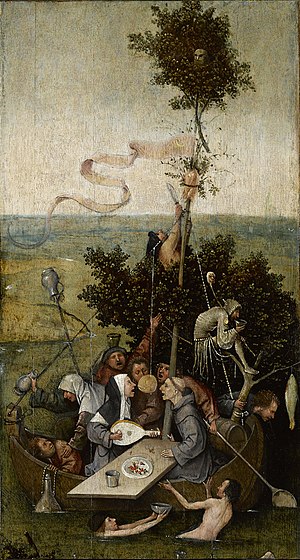
Consider this how this could turn out on many ships or even just one: there is a captain of some size and strength beyond the rest of the men in the ship, but he is deaf and similarly limited at seeing, and he knows as much about sailing as these qualities might imply. So, the sailors are struggling with one another about steering the ship, because each one believes that he should be in charge, even though he has learned nothing of the craft nor can indicate who his teacher was nor when he had the time to learn. Some of them are even saying that it is not teachable, and that they are ready to cut down the man who says it can be taught.
They are always hanging all over the captain asking him and making a big deal of the fact that he should entrust the rudder to them. There are times when some of them do not persuade him, and some of them kill others or kick them off the ship, and once they have overcome the noble captain through a mandrake, or drugs, or something else and run the ship, using up its contents drinking, and partying, and sailing just as such sort of men might. In addition to this, they praise as a fit sailor, and call a captain and knowledgeable at shipcraft the man who is cunning at convincing or forcing the captain that they should be in charge. And they rebuke as useless anyone who is not like this.
Such men are unaware what a true helmsman is like, that he must be concerned about the time of year, the seasons, the sky, the stars, the wind and everything that is appropriate to the art, if he is going to be a leader of a ship in reality, how he might steer the ship even if some desire it or not, when they believe that it is not possible to obtain art or practice about how to do this, something like an art of ship-steering. When these types of conflicts are occurring on a ship, don’t you think the one who is a true helmsman would be called a star-gazer, a blabber, or useless to them by the sailors in the ships organized in this way?
“For me, this was frightening to see,
And for you to hear. Know well that my child
Would be wondrous to behold if he did well but,
He’s not beholden to the state:
he will rule the land if he merely survives.”
“When strong winds carry sailors forward
Divergent opinions steering the ship
Or a mob thick with wise men is feebler
Than a single mind with self-control.
In city and under a single
Authority should be one person’s
Whenever we want to find success.”
“My speech is lacking one thing still.
I wish I had the voice in my limbs
And hands and hair and the march of my feet
Or the skills of Daidalos or some god
So I could completely grasp you by your knees
Wailing, laying about you with every kind of argument.
Master, great hope of life for the Greeks,
Heed me—lend an avenging hand to an old woman
Even if she is nothing at all.
For it is right that a good man serve justice
And always do evil everywhere to evil men.”




.jpg)
