Anger, Insult, and Wounds

Seneca, De Ira, 28

“Anger hobbles many, it makes many disabled even when it finds ready material. Add to this the fact that nothing is born so submissive that it will pass on without any threat for its destroyer. Pain and danger make some of the weak equal to the strongest. What, don’t most of the things we get angry about insult us more than they wound?

Indeed, there is a great difference whether someone resists my will, steals it from me, or does not agree with it. But we attach equal value to each, whether someone takes something or denies it, whether he crushes our hope or puts it off, whether he acts against us or for himself, and whether because of love or out of hate.”

Multos iracundia mancos, multos debiles fecit, etiam ubi patientem est nancta materiam. Adice nunc quod nihil tam imbecille natum est, ut sine elidentis periculo pereat; imbecillos valentissimis alias dolor, alias casus exaequat. Quid, quod pleraque eorum, propter quae irascimur, offendunt nos magis quam laedunt? Multum autem interest, utrum aliquis voluntati meae obstet an desit, eripiat an non det. Atqui in aequo ponimus, utrum aliquis auferat an neget, utrum spem nostram praecidat an differat, utrum contra nos faciat an pro se, amore alterius an odio nostri. Quidam vero non tantum iustas causas standi contra nos, sed etiam honestas habent.

Image result for medieval manuscript anger
Angry Fish The Hague, KA 16, 14th c.


Cicero’s Cool – Aristotle Sucks

Montesquieu, Diverse Thoughts:

Cicero, in my opinion, is one of the greatest minds who have ever lived: his soul was always beautiful when it wasn’t weak.

Two masterpieces: the death of Caesar in Plutarch, and that of Nero in Suetonius. In one, we begin to feel for the conspirators whom we see in danger, and then for Caesar, whom we see killed. In the death of Nero, one is astonished to see him obliged by degrees to kill himself, without any cause to restrict him, and yet in a way that he cannot avoid.

Vergil, inferior to Homer in variety and grandeur of his characters, is equally admirable for his invention, and for the beauty of his poetry.

A nice phrase of Seneca: Enjoy present pleasures in a way that doesn’t ruin future ones.

The same error of the Greeks saturates all of their philosophy: bad physics, bad morals, bad metaphysics. They don’t perceive the difference which exists between positive and relatives qualities. Aristotle fooled himself with his dry, his humid, his warm, his cold. Plato and Socrates fooled themselves with their beautiful, their good, their wise. It was a grand discovery that there was no positive quality.

The terms the beautiful, the good, the noble, the grand, the perfect, these are all attributes of objects, and are relative to the beings who consider them. One must set this principle firmly in one’s head. It is the sponge of nearly every prejudice. It is the scourge of ancient philosophy, of Aristotle’s physics, of Plato’s metaphysics. And if you read the dialogues of that philosopher, you would find that they are nothing but a tissue of sophisms made from ignorance of this principle. Malebranche was done in with a thousand sophisms for his ignorance of it.

Cicéron, selon moi, est un des plus grands esprits qui aient jamais été : l’âme toujours belle lorsqu’elle n’était pas faible.

Deux chefs-d’œuvre : la mort de César dans Plutarque, et celle de Néron dans Suétone. Dans l’une, on commence par avoir pitié des conjurés qu’on voit en péril, et ensuite de César qu’on voit assassiné. Dans celle de Néron, on est étonné de le voir obligé par degrés de se tuer, sans aucune cause qui l’y contraigne, et cependant de façon à ne pouvoir l’éviter.

Virgile, inférieur à Homère par la grandeur et la variété des caractères, par l’invention admirable, l’égale par la beauté de la poésie.

Belle parole de Sénèque : Sic prœsentibus utaris voluptatibus, ut futuris non noceas.

La même erreur des Grecs inondait toute leur philosophie : mauvaise physique, mauvaise morale, mauvaise métaphysique. C’est qu’ils ne sentaient pas la différence qu’il y a entre les qualités positives et les qualités relatives. Comme Aristote s’est trompé avec son sec, son humide, son chaud, son froid, Platon et Socrate se sont trompés avec leur beau, leur bon, leur sage : grande découverte qu’il n’y avait pas de qualité positive.

Les termes de beau, de bon, de noble, de grand, de parfait, sont des attributs des objets, lesquels sont relatifs aux êtres qui les considèrent. Il faut bien se mettre ce principe dans la tête ; il est l’éponge de presque tous les préjugés ; c’est le fléau de la philosophie ancienne, de la physique d’Aristote, de la métaphysique de Platon ; et si on lit les dialogues de ce philosophe, on trouvera qu’ils ne sont qu’un tissu de sophismes faits par l’ignorance de ce principe. Malebranche est tombé dans mille sophismes pour l’avoir ignoré

Writing about the Cause of Madness

Pseudo-Hippocrates. Epist. 17 9.352, 354, 356 

“When I [Hippocrates] was near [Democritus], he happened to be writing something eagerly and forcefully when I arrived. So I said. “First, tell me what you are writing about.” And, after he paused for a bit, said “madness.”

So I said, “But what are you writing about madness?” He responded, “What would I write except what it may be, how it afflicts human beings, and in what way it may be treated. This is why,” he continued, “I cut up all these animals you are looking at. It is not because I hate god’s works, but because I am researching the nature and the function of the bile.

For you know that the bile is the cause of madness in humans most of the time, since it appears naturally in most people, even though some have less of it and others have more. Illnesses emerge from an unbalanced amount, implying that the material is sometimes helpful and sometimes harmful.”

I added, “By Zeus, Democritus, you are speaking truthfully and prudently and this is why I think you are blessed for having achieving such a sense of peace. This has certainly not been allotted to me.”

Then he asked, “Why, Hippocrates, has it not?” I responded, “Because fields, my home, children, debts, illnesses, deaths, servants, marriages and all these kinds of things cut off any chance for it.”

At this, that man fell into his customary behavior—he laughed deeply and mocked me and then was silent for the rest of the time.”

ἐπεὶ δὲ ἐπλησίαζον, ἔτυχεν ὅτε ἐπῆλθον αὐτέῳ, τι1 δή ποτε γράφων ἐνθουσιωδῶς καὶ μεθ’ ὁρμῆς. [. . .]

[ΙΠ.] “καὶ πρῶτόν γε τί τοῦτο τυγχάνεις γράφων φράζε.” [. . .]

ὁ δ᾽ ἐπισχὼν ὀλίγον, “περὶ μανίης,” ἔφη. [. . .]

[ΙΠ.] “ἀλλὰ τί περὶ μανίης γράφεις;”

“τί γάρ,” εἶπεν, “ἄλλο, πλὴν ἥτις τε εἴη, καὶ ὅκως ἀνθρώποισιν ἐγγίνεται, καὶ τίνα τρόπον ἀπολωφέοιτο· τά τε γὰρ ζῷα ταῦτα ὁκόσα, ἔφη, ὁρῇς, τουτέου μέντοι γε ἀνατέμνω εἵνεκα, οὐ μισέων θεοῦ ἔργα, χολῆς δὲ διζήμενος φύσιν καὶ θέσιν· οἶσθα γὰρ ἀνθρώπων παρακοπῆς ὡς αἰτίη ἐπιτοπολὺ αὕτη πλεονάσασα, ἐπεὶ πᾶσι μὲν φύσει ἐνυπάρχει, ἀλλὰ παρ’ οἷς μὲν ἔλαττον, παρ’ οἷς δέ τι πλέον· ἡ δ’ ἀμετρίη αὐτέης νοῦσοι τυγχάνουσιν, ὡς ὕλης ὅτε μὲν ἀγαθῆς, ὁτὲ δὲ φαύλης ὑποκειμένης.”

κἀγὼ, “νὴ Δία,” ἔφην, “ὦ Δημόκριτε, ἀληθέως γε καὶ φρονίμως λέγεις, ὅθεν εὐδαίμονά σε κρίνω τοσαύτης ἀπολαύοντα ἡσυχίης· ἡμῖν δὲ μετέχειν ταύτης οὐκ ἐπιτέτραπται.”

ἐρεομένου δὲ “διὰ τί, ὦ Ἱππόκρατες, οὐκ ἐπιτέτραπται;” “ὅτι,” ἔφην, “ἢ ἀγροὶ ἢ οἰκίη ἢ τέκνα ἢ δάνεια ἢ νοῦσοι ἢ θάνατοι ἢ δμῶες ἢ γάμοι ἢ τοιαῦτά τινα τὴν εὐκαιρίην ὑποτάμνεται.” ἐνταῦθα δὴ ὁ ἀνὴρ εἰς τὸ εἰωθὸς πάθος κατηνέχθη, καὶ μάλα ἀθρόον τι ἀνεκάγχασε, καὶ ἐπετώθασε, καὶ τὸ λοιπὸν ἡσυχίην ἦγεν.

Dosso Dossi, 1540

Fronto’s Regrets: Neck Pain Kept Me from Your Party

Fronto To Antonius Pius, 5 (Naber, p. 167).

“I would pay more than a part of my own life to embrace you on this happiest and most anticipated anniversary of your imperial accession—a day which I consider to be the birthday of my health, dignity, and security.

But serious shoulder pain and even worse neck pain afflict me so badly that I can barely bend, straighten up, or turn because I have to keep my neck so still. But I have returned to my Lares, Penates, and Family gods and have taken up my vows and I have prayed that next year I can embrace you twice on this day, twice to kiss your chest and hands, simultaneously completing the duty of this year and next.”

| Antonino Pio Augusto Fronto.

Carius <quam> vitae meae parte adpicisci cupio ut te complecterer felicissimo et optatissimo initi imperii die, quem ego diem natalem salutis dignitatis securitatis meae existimo. Sed dolor humeri gravis, cervicis vero multo gravissimus ita me adflixit, ut adhuc usque vix inclinare me vel erigere vel convertere possim: ita immobili cervice utor. Sed apud Lares Penates deosque familiares meos et reddidi et suscepi vota, et precatus sum, uti anno insequenti bis te complecterer isto die, bis pectus tuum et manus exoscularer praeteriti simul et praesentis anni vicem perficiens.

Image result for Antoninus Pius
Antonius Pius

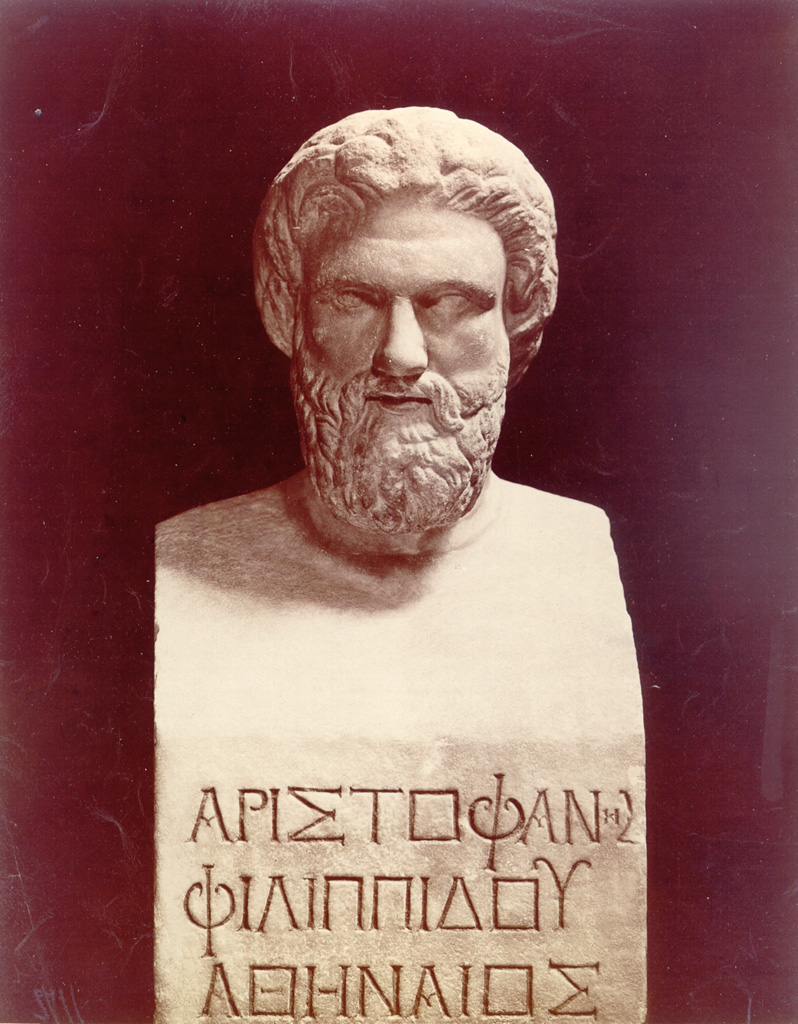
An Epitaph for Aristophanes

Greek Anthology, Antipater of Thessaloniki 9. 186

“The books of Aristophanes—divine labor—over which
Archanean ivy dangled its massive green hair.
See how much of Dionysus a page holds, how the stories
Echo, full of frightening charms.
Comic poet, best of heart, equal to the characters of Greece,
You both hated and mocked things that deserved it.”

Βίβλοι Ἀριστοφάνευς, θεῖος πόνος, αἷσιν Ἀχαρνεὺς
κισσὸς ἐπὶ χλοερὴν πουλὺς ἔσεισε κόμην.
ἠνίδ᾿ ὅσον Διόνυσον ἔχει σελίς, οἷα δὲ μῦθοι
ἠχεῦσιν, φοβερῶν πληθόμενοι χαρίτων.
ὦ καὶ θυμὸν ἄριστε, καὶ Ἑλλάδος ἤθεσιν ἶσα,
κωμικέ, καὶ στύξας ἄξια καὶ γελάσας.

Image result for Aristophanes

Tawdry Tuesday: Proctological Proverb Edition

Arsenius, 34a1

“May you fall into Hades’ asshole”: [a curse]: may you die.

῞Αιδου πρωκτῷ περιπέσῃς: ἤγουν τελευτήσῃς.

Note: Even though Ancient Greek prôktos can merely mean “rear end” (as in butt), it most often means ‘anus’ in comedy and insults. Also, I wanted to use something profane and given the British/American divide on arse/ass, I decided just to go with “asshole” because it is funnier.

Diogenianus (v.1 e cod. Marz. 2.42)

“I wish you’d fall into Hades’ asshole”: this is clear

῞Αιδου πρωκτῷ περιπέσοις: δῆλον.

Diogenianus (v.2 e cod. Vindob. 133, 1.97 )

“I wish you’d fall into Hades’ asshole”: Used for cursing someone

Αἵδου πρωκτῷ περιπέσοις: ἐπὶ τῶν καταρωμένων τινί.

Diogenianus, 3.58

“The asshole survives the bath” [or, “Ass surpasses the bath”]. Whenever someone is not able to wash himself, but his bowels still assail him. This is a proverb used for things done uselessly.

Πρωκτὸς λουτροῦ περιγίνεται: ὅταν τις μὴ δύνηται ἀπονίψασθαι, ἀλλ’ ἡ κοιλία αὐτῷ ἐπιφέρηται. λέγεται ἡ παροιμία ἐπὶ τῶν ἀνωφελῶς πραττομένων.

Michael Apostolius, 14.78

“The asshole survives the bath”: This proverb is used for things done uselessly and done for show. For people with thick asses and potbellies are not able to wash themselves off easily.”

Πρωκτὸς λουτροῦ περιγίνεται: ἐπὶ τῶν ἀνωφελῶν καὶ εἰκῇ πραττομένων ἐλέγετο· οἱ γὰρ παχύπρωκτοι καὶ προγάστορες οὐ δύνανται ἑαυτοὺς ἀπονίψασθαι εὐπετῶς.

Zenobius, Vulg. 1.52

“It was cured by Akesias”: this is a proverb for when things are healed for the worse. Aristotle provides the proverb in tetrameters: “Akesias healed his asshole.”

Ἀκεσίας ἰάσατο· ἐπὶ τῶν ἐπὶ τὸ χεῖρον ἰωμένων. ὅλην δὲ Ἀριστοφάνης ἐν τετραμέτροις τὴν παροιμίαν ἐκφέρει, λέγων· Ἀκεσίας τὸν πρωκτὸν ἰάσατο.

Suda, s.v. Ἀφευθεὶς

“Singed around the asshole:” Aristophanes has this instead of being “all burned up”

Ἀφευθεὶς τὸν πρωκτόν: Ἀριστοφάνης ἀντὶ τοῦ φλογισθείς.

Balneum Tripergulae – particolare da miniatura del Codice Angelico del “De Balneis Puteolanis� di Pietro da Eboli.

Bonus: Suda on defecation (And there is more of this)

Apopatêma: this is the same as ‘dung’ Eupolis has in his Golden Age: “What is that man? Shit of a fox.” And Kratinus has in Runaway Slaves: I knocked Kerkyon out at dawn when I found him shitting in the vegetables.” We also find the participle apopatêsomenoi (“they are about to shit”) which means they are going to evacuate the feces from their bodies. But patos also means path.

Aristophanes writes “No one sacrifices the old way any more or even enters the temple except for the more than ten thousand who want to shit. So, apopatos is really the voiding of the bowels. Aristophanes also says about Kleonymous: “He went off to shit after he got he army and shat for ten months in the golden mountains? For how long was he closing his asshole? A whole turn of the moon?”

Ἀποπάτημα: αὐτὸ τὸ σκύβαλον. Εὔπολις Χρυσῷ γένει: τί γάρ ἐστ’ ἐκεῖνος; ἀποπάτημ’ ἀλώπεκος. Κρατῖνος Δραπέτισι: τὸν Κερκύονά τε ἕωθεν ἀποπατοῦντ’ ἐπὶ τοῖς λαχάνοις εὑρὼν ἀπέπνιξα. καὶ Ἀποπατησόμενοι, τὴν κόπρον κενώσοντες. πάτος δὲ ἡ ὁδός. Ἀριστοφάνης: οὐδεὶς θύει τοπαράπαν οὐδ’ εἰσέρχεται, πλὴν ἀποπατησόμενοί γε πλεῖν ἢ μύριοι. Ἀπόπατος γὰρ ἡ κένωσις τῆς γαστρός. καὶ Ἀριστοφάνης περὶ Κλεωνύμου φησίν: εἰς ἀπόπατον ᾤχετο στρατιὰν λαβὼν κἄχεζεν ὀκτὼ μῆνας ἐπὶ χρυσῶν ὄρων. πόσου δὲ τὸν πρωκτὸν χρόνου ξυνήγαγε; τῇ πανσελήνῳ.

From Henderson’s Maculate Muse

proktos

A+ for the Ancients

Montesquieu, Diverse Thoughts:

Sophocles, Euripides, and Aeschylus first brought the genre of invention to the point that we have not since changed the rules which they have left us, something which they could not have done without perfect knowledge of nature and its passions.

I have had through my whole life a fixed taste for the works of the ancients. I have admired a number of critiques made against them, but I have always admired ancients authors. I have studied my taste, I have examined whether this was not one of those bad tastes on which one ought not to place any foundation. But the more I examined it, the more I perceived that I was right to feel as I felt.

The books of the ancients are for authors; modern books are for readers.

Plutarch always charms me: there are some circumstances attached to his characters, which produce great pleasure.

The fact that Aristotle was Alexander’s teacher, or that Plato was in the heart of Syracuse, this has nothing to do with their glory: the reputation of their philosophy has absorbed everything.

Sophocle, Euripide, Eschyle, ont d’abord porté le genre d’invention au point que nous n’avons rien changé depuis aux règles qu’ils nous ont laissées, ce qu’ils n’ont pu faire sans une connaissance parfaite de la nature et des passions.

J’ai eu toute ma vie un goût décidé pour les ouvrages des anciens : j’ai admiré plusieurs critiques faites contre eux, mais j’ai toujours admiré les anciens. J’ai étudié mon goût, et j’ai examiné si ce n’était point un de ces goûts malades sur lesquels on ne doit faire aucun fond ; mais plus j’ai examiné, plus j’ai senti que j’avais raison d’avoir senti comme j’ai senti.

Les livres anciens sont pour les auteurs, les nouveaux pour les lecteurs.

Plutarque me charme toujours : il y a des circonstances attachées aux personnes, qui font grand plaisir.

Qu’Aristote ait été précepteur d’Alexandre, ou que Platon ait été à la cour de Syracuse, cela n’est rien pour leur gloire : la réputation de leur philosophie a absorbé tout.


Animal Perception and Understanding

Plutarch, The Cleverness of Animals Moralia 961 a-b

“And here is the argument of Strato the Natural Philosopher demonstrating that it is not possible to sense anything at all without the power of thought. It is true that we may travel over letters with our sight and words fall on our ears which escape us since we are paying attention to other things. But later the mind returns, changes, and pursues each of the details which were overlooked. And this is what the saying means “the mind sees and the mind hears, but the rest is deaf and blind.” And so experiences which impact the eyes or ears do not yield understanding unless thought is present.

This is why Kleomenes the king, when a performance was applauded at a symposium and he was asked whether it seemed fine to him, he said that others should think about it, since he was worrying about the Peloponnese. From this it is necessary that all creatures who have perception also have understanding, if we are able to perceive through understanding.”

Καίτοι Στράτωνός γε τοῦ φυσικοῦ λόγος ἐστὶν ἀποδεικνύων ὡς οὐδ᾿ αἰσθάνεσθαι τὸ παράπαν ἄνευ τοῦ νοεῖν ὑπάρχει· καὶ γὰρ γράμματα πολλάκις ἐπιπορευομένους τῇ ὄψει καὶ λόγοι προσπίπτοντες τῇ ἀκοῇ διαλανθάνουσιν ἡμᾶς καὶ διαφεύγουσι πρὸς ἑτέροις τὸν νοῦν ἔχοντας· εἶτ᾿ αὖθις ἐπανῆλθε καὶ μεταθεῖ καὶ διώκει τῶν προειμένων ἕκαστον ἀναλεγόμενος· ᾗ καὶ λέλεκται: “νοῦς ὁρῇ καὶ νοῦς ἀκούει, τἄλλα κωφὰ καὶ τυφλά”

ὡς τοῦ περὶ τὰ ὄμματα καὶ ὦτα πάθους, ἂν μὴ παρῇ τὸ φρονοῦν, αἴσθησιν οὐ ποιοῦντος. διὸ καὶ Κλεομένης ὁ βασιλεύς, παρὰ πότον εὐδοκιμοῦντος ἀκροάματος, ἐρωτηθεὶς εἰ μὴ φαίνεται σπουδαῖον, ἐκέλευσεν ἐκείνους σκοπεῖν, αὐτὸς3 γὰρ ἐν Πελοποννήσῳ τὸν νοῦν ἔχειν. ὅθεν ἀνάγκη πᾶσιν, οἷς τὸ αἰσθάνεσθαι, καὶ τὸ νοεῖν ὑπάρχειν, εἰ τῷ νοεῖν αἰσθάνεσθαι πεφύκαμεν

British Library, Harley MS 4751, Folio 47r

Truth and Happiness, An Inverse Relationship?

From Athenaeus’ Deipnosophists (5.211 e-f)

“Posidonios of Apamea records the story of [Athenion] which I am going to lay out even though it is rather long, so that we may examine carefully all men who claim to be philosophers, and not merely trust in their shabby robes and unkempt beards. For, as Agathon says (fr. 12):

If I tell the truth, I won’t make you happy.
But if I am to make you happy, I will say nothing true.

Since the truth, they say, is dear to us, I will tell the whole story about this man.”

περὶ οὗ καθ’ ἕκαστα ἱστορεῖ Ποσειδώνιος ὁ ᾿Απαμεύς, ἅπερ εἰ καὶ μακρότερά ἐστιν ἐκθήσομαι, ἵν’ ἐπιμελῶς πάντας ἐξετάζωμεν τοὺς φάσκοντας εἶναι φιλοσόφους καὶ μὴ τοῖς τριβωνίοις καὶ τοῖς ἀκάρτοις πώγωσι πιστεύωμεν. κατὰ γὰρ τὸν ᾿Αγάθωνα
(fr. 12 N)

εἰ μὲν φράσω τἀληθές, οὐχί σ’ εὐφρανῶ·
εἰ δ’ εὐφρανῶ τί σ’, οὐχὶ τἀληθὲς φράσω.

ἀλλὰ φίλη <γάρ>, φασίν, ἡ ἀλήθεια, ἐκθήσομαι τὰ περὶ τὸν ἄνδρα ὡς ἐγένετο (FHG III 266).

Image result for Inverse happiness curve

An Apple A Day

The fragment below is what survives of a hymn to Adonis by Praxilla (5th-century-BC female poet). The lines are Adonis’ response to a question put to him in Hades: what’s the most beautiful thing you left behind in the world of the living? 

Praxilla Fr.747 (PMG) 

The loveliest thing I leave behind is sunlight;
Then follows brilliant stars and the face of the moon,
And also ripe cucumbers, and apples, and pears.

κάλλιστον μὲν ἐγὼ λείπω φάος ἠελίοιο,
δεύτερον ἄστρα φαεινὰ σεληναίης τε πρόσωπον
ἠδὲ καὶ ὡραίους σικύους καὶ μῆλα καὶ ὄγχνας·

Zenobius (2nd century AD) preserved the fragment in his collection of proverbs. He explains that the inclusion of fruits and vegetables alongside the moon and stars is so foolish that it gave rise to the saying “sillier than Praxilla’s Adonis.” 

But is it silly to rank fruits with the heavenly bodies as life’s singular blessings? Looked at from the perspective of Rilke, a 20th-century poet much influenced by Greek lyric, Praxilla was prescient, not silly. 

In poem I.13 of his Sonnets to Orpheus, Rilke celebrates the eating of fruit as a transporting, ineffable experience which carries with it sensations of life as well as intimations of death. In other words, the aspirations of lyric are little other than what the humble apple and pear already accomplish for us.

Rilke: Sonnets to Orpheus I.13

Ripe apple, pear, and banana,
Gooseberry . . . These all speak
Death and life into the mouth . . .I infer . . .
Read it in a child’s expression

when she tastes them. This comes from far away.
Does this nameless thing slowly happen in your mouth?
Where words used to be, discoveries flow
From pulp surprised at being set free.

Try to say what it is you call ‘apple.’
This sweetness that’s at first tightly contained,
Then, when tasted, gently unfolds

To become clear, alive and transparent,
Double in meaning, sunny, earthy, present—:
O experience, feeling, joy—colossal!

Rilke: Sonette an Orpheus, I.13
Voller Apfel, Birne und Banane,
Stachelbeere … Alles dieses spricht
Tod und Leben in den Mund … Ich ahne …
Lest es einem Kind vom Angesicht,

wenn es sie erschmeckt. Dies kommt von weit.
Wird euch langsam namenlos im Munde?
Wo sonst Worte waren, fließen Funde,
aus dem Fruchtfleisch überrascht befreit.

Wagt zu sagen, was ihr Apfel nennt.
Diese Süße, die sich erst verdichtet,
um, im Schmecken leise aufgerichtet,

klar zu werden, wach und transparent,
doppeldeutig, sonnig, erdig, hiesig –:
O Erfahrung, Fühlung, Freude –, riesig!

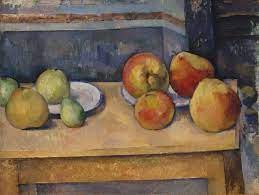
Paul Cezanne, Still Life with Apples and Pears (1892).

Larry Benn has a B.A. in English Literature from Harvard College, an M.Phil in English Literature from Oxford University, and a J.D. from Yale Law School. Making amends for a working life misspent in finance, he’s now a hobbyist in ancient languages and blogs at featsofgreek.blogspot.com.