“Why, therefore, the reasoning would go, do you still not believe it when you see that the weaker part still exists after the person has died? Doesn’t it seem to you necessary that the part which lasts long should be preserved still in this time? Think about this when you consider what I am saying. Like Simmias, I guess, I need some kind of an analogy.
It seems to me as if someone is saying similar things when he makes the comparison of an old weaver who has died. He claims that the man is not dead, but is still somewhere safe somehow because he can provide as proof a cloak which the man wove himself and was wearing and is still safe and has not perished. And if someone were skeptical at this, he would ask whether a human being lives longer than a cloak which was used and worn and the when he answered that human beings last longer than cloaks in general, he would think he had proved that the person remains sound since the shorter-lived thing had not withered.
This, Simmias, I do not think is true. Think about what I am saying. Everyone would imagine that it is stupid when someone says this. For this weaver, although he has worn out and then woven many of these kinds of cloaks, died and disappeared long after they did when there were many of them. But he did not before the last one. Even in this the person is no weaker or less complex than the cloak.
I think that the soul responds to the same analogy and anyone who said the same things about it would seem sensible to me. The soul is longer-lived, and the body is weaker and has less time. But if you were to say that each soul wears out many bodies, or something else if it has many years—since the body wears out and could be ruined while the person still lives, but the soul could always reweave what gets worn out—whenever the soul perishes, it would the be necessary for it to have taken on its final garment and to perish before only this one. Once the soul dies then, the body would display the nature of its weakness and disappear by rotting quickly.”
I am one of the people most exempt from this feeling, and I neither like it nor respect it, although the world has taken up with honoring it with particular favor, as if at a set price. They dress it up in sagacity, virtue, conscience – a stupid and ugly ornament.
The Italians in a more reasonable way have baptized it with the name of malignity. For it is a quality which is always harmful, always mad, always cowardly and base. The Stoics forbid this feeling to their wise people.
But the old story has it that Psammeticus, the king of Egypt, having been defeated and taken by Cambyses, the king of the Persians, and seeing his prisoner daughter pass before him clothed as a servant and sent to get water, kept himself quiet and said not a word while all of his friends were crying and lamenting around him, and fixed his eyes on the ground. Again, seeing his son led to his death, he held himself in the same manner. But having caught sight of one of his domestic servants led among the captives, he began to beat his head and display great suffering.
This could be compared with what we have recently seen of one of our princes, who, having heard at Trent, where he was, the recent report of the death of his brother, the one in whom the support and the honor of all his house consisted, and soon after that hearing about the death of his younger brother, the second hope, and held up against these two reversals with an exemplary constancy. When, a few days later, one of his people died, he let himself entirely loose at this last accident, and dismissing his resolution, he abandoned himself to grief and regrets in such a manner that some advanced the argument that he was not yet touched to the quick until this last disaster. But in truth, having been otherwise packed full with sadness, the slight overflow broke the barriers of his patience. I say that we could make a similar judgment about our story if it had not been added that Cambyses, enquiring of Psammticus why, having not been moved by the misfortune of his son and his daughter, nevertheless bore the bad luck of one of his friends so badly. He responded, ‘It is because only this last grief could be marked by tears, the first two having far surpassed what could be expressed.’
Perhaps related to this is the conceit of the ancient painter who represented, at the sacrifice of Iphigenia, the grief of the assistants according the the degrees of interest which each one bore to the death of this beautiful, innocent girl. Having expressed the final efforts of his art, when it came to the maiden’s daughter, he portrayed him with a covered face, as though no expression could convey this degree of suffering. There you have the same reason why the poets portray the miserable mother Niobe, overflowing with sadness for having first lost seven sons and then seven daughters, finally transformed into a rock
….stiffened by her misfortunes… [Ovid]
to express the dismal, silent, and unhearing stupidity which comes over us when the accidents of the world overwhelm us and surpass our ability to bear them. In truth, the effect of grief, if it is to be extreme, should shock the entire soul and prevent all of its actions, as when at some hot alarm of a new disaster it comes upon us to feel ourselves seized, numb, and precluded from all movement, in such a way that the soul, relaxing after the tears and the wailing, seems to let go of itself, to untangle itself, and to set itself out in greater space and at its ease.
And the voice’s path was scarcely then cleared by grief… [Vergil]
In the war which King Ferdinand conducted against the widow of King John of Hungary, around Buda, Raisciac, a German captain, took particular notice of a knight for having done exceedingly well in the melee, and lamented him with the common lament; but, curious to know who he was, the body was disarmed and Raisciac saw that it was his own son. In the middle of the public weeping, he alone let out neither cry nor tear, fixed on his feet, his eyes immobile, looking at him fixedly until the impact of the sadness froze his vital spirits and rendered him stone cold dead on the earth.
One who can say how much they burn is not burning much… [Petrarch]
say the lovers who wish to represent an unsustainable passion.
…which takes away all of my senses. For as soon as I saw you, Lesbia, there is nothing left for me to say in my madness. But my tongue goes slack, the slight flame under my limbs fades away, my ears ring with their own sound, and both eyes are covered in night. [Catullus]
Nor is it in the live and more burning heat of feeling that we are set to deploy our plaints and pleadings; the soul is then weighed down with deep thoughts, and the body worn out and languishing with love.
Sometimes this engenders the fortuitous fall which comes over lovers so out of season, and that coldness which seizes them by force from extreme ardor, in the very bosom of joy. All passions which let themselves be tasted and lingered over are just mediocre.
Light cares speak, but huge ones stand stupefied. [Seneca]
The surprise of an unexpected pleasure astonishes us in the same way.
As she saw me coming, and saw, madly, Trojan arms around, she froze in the middle of the sight, terrified by these great portents, the heat left her bones, she collapsed, and finally speaks after a long time with some difficulty. [Vergil]
Other than the Roman woman who died of surprise to see her son come back from the rout at Cannae, Sophocles and Dionysius the tyrant, who passed away from ease, and Talva who died in Corsica reading the news of the honors which the Senate of Rome had decreed for him, we understand in our own time that Pope Leo X, having been informed of the capture of Milan, which he had desperately wished for, was taken with such an excess of joy that he was taken by a fever and died.
And, for a more remarkable testimony of human stupidity, it has been remarked by the ancients that Diodorus the dialectitian died on the spot after being taken by an extreme feeling of shame, in his school and in public not being able to expand upon an argument which someone had made to him. I am not much in the grip of these violent passions. I have naturally hard apprehension; and I encrust and thicken it every day with reasoning.
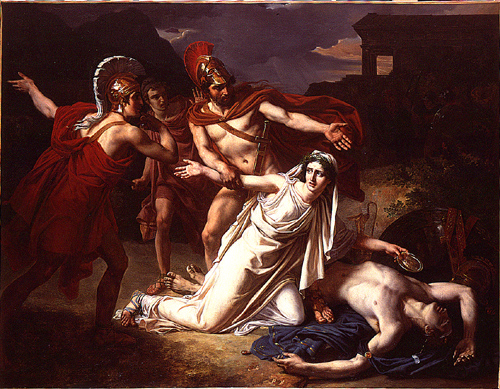
Adrien Guignet, ‘Meeting Between Cambyses II and Psammetichus III’
Je suis des plus exempts de cette passion, et ne l’ayme ny l’estime, quoy que le monde ayt prins, comme à prix faict, de l’honorer de faveur particuliere. ils en habillent la sagesse, la vertu, la conscience : sot et monstrueux ornement.
Les Italiens ont plus sortablement baptisé de son nom la malignité. Car c’est une qualité tousjours nuisible, tousjours folle, et, comme tousjours couarde et basse, les Stoïciens en défendent le sentiment à leurs sages.
Mais le conte dit, que Psammenitus, Roy d’Égypte, ayant esté deffait et pris par Cambisez, Roy de Perse, voyant passer devant luy sa fille prisonniere habillée en servante, qu’on envoyoit puiser de l’eau, tous ses amis pleurans et lamentans autour de luy, se tint coy sans mot dire, les yeux fichez en terre : et voyant encore tantost qu’on menoit son fils à la mort, se maintint en ceste mesme contenance ; mais qu’ayant apperçeu un de ses domestiques conduit entre les captifs, il se mit à battre sa teste, et mener un dueil extreme.
Cecy se pourroit apparier à ce qu’on vid dernierement d’un Prince des nostres, qui, ayant ouy à Trante, où il estoit, nouvelles de la mort de son frere aisné, mais un frere en qui consistoit l’appuy et l’honneur de toute sa maison, et bien tost apres d’un puisné, sa seconde esperance, et ayant soustenu ces deux charges d’une constance exemplaire, comme quelques jours apres un de ses gens vint à mourir, il se laissa emporter à ce dernier accident, et, quittant sa resolution, s’abandonna au dueil et aux regrets, en maniere qu’aucuns en prindrent argument, qu’il n’avoit esté touché au vif que de cette derniere secousse. Mais à la vérité ce fut, qu’estant d’ailleurs plein et comblé de tristesse, la moindre sur-charge brisa les barrieres de la patience. Il s’en pourroit (di-je) autant juger de nostre histoire, n’estoit qu’elle adjouste que Cambises s’enquerant à Psammenitus, pourquoy ne s’estant esmeu au malheur de son fils et de sa fille, il portoit si impatiemment celuy d’un de ses amis : C’est, respondit-il, que ce seul dernier desplaisir se peut signifier par larmes, les deux premiers surpassans de bien loin tout moyen de se pouvoir exprimer. A l’aventure reviendroit à ce propos l’invention de cet ancien peintre, lequel, ayant à representer au sacrifice de Iphigenia le dueil des assistans, selon les degrez de l’interest que chacun apportoit à la mort de cette belle fille innocente, ayant espuisé les derniers efforts de son art, quand se vint au pere de la fille, il le peignit le visage couvert, comme si nulle contenance ne pouvoit representer ce degré de dueil. Voyla pourquoy les poetes feignent cette misérable mere Niobé, ayant perdu premierement sept fils, et puis de suite autant de filles, sur-chargée de pertes, avoir esté en fin transmuée en rochier,
Diriguisse malis,
pour exprimer cette morne, muette et sourde stupidité qui nous transit, lors que les accidens nous accablent surpassans nostre portée. De vray, l’effort d’un desplaisir, pour estre extreme, doit estonner toute l’ame, et lui empescher la liberté de ses actions : comme il nous advient à la chaude alarme d’une bien mauvaise nouvelle, de nous sentir saisis, transis, et comme perclus de tous mouvemens, de façon que l’ame se relaschant apres aux larmes et aux plaintes, semble se desprendre, se demesler et se mettre plus au large, et à son aise,
Et via vix tandem voci laxata dolore est.
En la guerre que le Roy Ferdinand fit contre la veufve de Jean, Roy de Hongrie, autour de Bude, Raïsciac, capitaine Allemand, voïant raporter le corps d’un homme de cheval, à qui chacun avoit veu excessivement bien faire en la meslée, le plaignoit d’une plainte commune ; mais curieux avec les autres de reconnoistre qui il estoit, apres qu’on l’eut desarmé, trouva que c’estoit son fils. Et, parmi les larmes publicques, luy seul se tint sans espandre ny vois ny pleurs, debout sur ses pieds, ses yeux immobiles, le regardant fixement, jusques à ce que l’effort de la tristesse venant à glacer ses esprits vitaux, le porta en cet estat roide mort par terre.
Chi puo dir com’ egli arde é in picciol fuoco,
disent les amoureux, qui veulent representer une passion insupportable
misero quod omnes
Eripit sensus mihi. Nam simul te,
Lesbia, aspexi, nihil est super mi
Quod loquar amens.
Lingua sed torpet, tenuis sub artus
Flamma demanat, sonitu suopte
Tinniunt aures, gemina teguntur
Lumina nocte.
Aussi n’est ce pas en la vive et plus cuysante chaleur de l’accés que nous sommes propres à desployer nos plaintes et nos persuasions : l’ame est lors aggravée de profondes pensées, et le corps abbatu et languissant d’amour.
Et de là s’engendre par fois la défaillance fortuite, qui surprent les amoureux si hors de saison, et cette glace qui les saisit par la force d’une ardeur extreme, au giron mesme de la jouyssance. Toutes passions qui se laissent gouster et digerer, ne sont que mediocres.
Curae leves loquuntur, ingentes stupent.
La surprise d’un plaisir inespéré nous estonne de mesme,
Ut me conspexit venientem, et Troïa circum
Arma amens vidit, magnis exterrita monstris,
Diriguit visu in medio, calor ossa reliquit,
Labitur, et longo vix tandem tempore fatur.
Outre la femme Romaine, qui mourut surprise d’aise de voir son fils revenu de la route de Cannes, Sophocles et Denis le Tyran, qui trespasserent d’aise, et Talva qui mourut en Corsegue, lisant les nouvelles des honneurs que le Senat de Rome luy avoit decernez, nous tenons en nostre siècle que le Pape Leon dixiesme, ayant esté adverty de la prinse de Milan, qu’il avoit extremement souhaitée, entra en tel excez de joye, que la fievre l’en print et en mourut. Et pour un plus notable tesmoignage de l’imbécilité humaine, il a esté remarqué par les anciens que Diodorus le Dialecticien mourut sur le champ espris d’une extreme passion de honte, pour en son eschose et en public ne se pouvoir desvelopper d’un argument qu’on luy avoit faict. Je suis peu en prise de ces violentes passions. J’ay l’apprehension naturellement dure ; et l’encrouste et espessis tous les jours par discours.
“Phylarkhos claims that Thetis went to Hephaistos on Olympos so that he might create weapons for Achilles and that he did it. But, because Hephaistos was lusting after Thetis, he said he would not give them to her unless she had sex with him. She promised him that she would, but that she only wanted to try on the weapons first, so she could see if the gear he had made was fit for Achilles. She was actually the same size as him.
Once Hephaistos agreed on this, Thetis armed herself and fled. Because he was incapable of grabbing her, he took a hammer and hit Thetis in the ankle. Injured in this way, she went to Thessaly and healed in the city that is called Thetideion after her.”
“To be a sykophant: to falsely accuse someone. They the Athenians called it this at the time when a fig-plant was first discovered and they were stopping the export of figs for this reason. Those people who reported that figs were being exported were called “sykophants” [lit. “fig speakers”]. Over time, anyone who accused people in a super annoying manner were named in this way.
Aristophanes writes “these things are small and indigenous” since being a sykophant is a native characteristic of Athenians. Aelian adds “he alleged [sukophantei] that he god was negligent. For these reasons plagues and famine over came the Himerians’ city.”
“Sykophant: When there was a famine in Attica, some people were gathering figs in secrete which had been promised to the gods. After this, when times were good again. Some people were prosecuting these men. This is where the term developed. Look at the term “fig squeezer” too.
“Sykophant: The devil. For he made a false accusation of god, claimed that he prevented [humans] from having a share of the tree [of knowledge]. He also spoke slanderously against Job: “Does Job worship god with no return?”
Consider also sykophantia, which means false prosecution.
For the story of Solon and the sycophants, see Plutarch’s Life of Solon on the Scaife Viewer. The sense of flatterer or parasite is somewhat present in the ancient Greek but becomes more prominent in English usage. The negative use can be seen in the fragment from Alexis’ The Poet (fr. 187) preserved in Athenaeus:
The name of sykophant is not rightly
Given to corrupted men.
For it should have been right for any man
Who was good and sweet to have figs
Attached to him to reveal his character.
But it fills us with confusion on why something sweet
Has been attached to someone bad.
J.E. Sandys, Harvard Lectures on the Revival of Learning:
“Cicero and Virgil became the principal text-books of the Revival of Learning. Petrarch describes them in one of his poems as the ‘two eyes’ of his discourse. In his very boyhood he had been smitten with the charm of Virgil, and, even in his old age, he was still haunted by the mediaeval tradition of the allegorical significance of the Aeneid. But, unlike the mediaeval admirers of Virgil, he does not regard the Latin poet as a mysteriously distant and supernatural being; he finds in him a friend, and he is even candid enough to criticise him. Under his influence the Aeneid was accepted as the sole model that was worthy of imitation by the epic poets of the succeeding age. A German critic regards this result with regret, a regret that few, if any, will share; nor is it easy to believe that any scholar would really have preferred seeing Petrarch throw the weight of his example on to the side of any other Latin epic poet, such as Lucan.”
“Stop speaking before you fill me with rage!
And you’re revealed as a fool as well as an old man.
You speak of unendurable things, claiming that the gods
Have some plan for this corpse.
Did they do it to honor him so greatly for his fine work,
Concealing him, the man who came here
To burn their temples and their statutes,
To ruin their land and their laws?
Do you see the gods honoring evil people?”
“It is noble for me to do this and then die.
I will lie with him because I belong to him, with him,
Once I have completed my sacred crimes. There’s more time
When I must please those below than those here,
Since I will lie there forever. You? Go head,
Dishonor what the gods honor if it seems right.”
“Drink and get drunk with me, Melanippos.
Why would you say that once you cross the great eddying
River of Acheron you will see the pure light of the sun again?
The republics which maintained themselves in a well-ordered and civilized state, like the Cretans or the Spartans, did not make great account of orators. Ariston sagely defined rhetoric as ‘the science of persuading the people.’ Socrates and Plato described it as ‘the art of tricking and flattering.’ Those who deny it in genera description nevertheless confirm it in all of their precepts. Muslims prohibit its teaching to children on account of its uselessness. And the Athenians, perceiving how dangerous its use, which held total sway in their city, actually was, ordered that its principal part, which is to stir the emotions, be taken away, along with exordia and perorations. It is a tool invented for handling and agitating a crowd and an unruly community; and, as with medicine, this tool isn’t used except when people are in bad states.
In those states where the mob, or the ignorant, or indeed everyone possesses all the power, as in Athens, or Rhodes, or Rome, and where affairs are in a perpetual storm – there it is where orators have flooded in. In truth, there are few people in these republics who are driven to great credit without recourse to eloquence. Pompey, Caesar, Crassus, Lucullus, Lentulus, Metellus, took from eloquence their great support on which they launched themselves to the great authority at which they finally arrived, and they were aided by it more than by arms, contrary to the opinion of better times. For Lucius Volumnius, speaking publicly in favor of the election to the consulship of Quintus Fabius and Publius Decius, said, ‘They are of a type born for war, great men in their actions; they are uneducated in the combat of idle babbling; their minds are truly consular; the subtle, the eloquent, the brilliant – they are good for the city, praetors for administering justice. Eloquence flourished in Rome more when their affairs were in a sadder state, when the storm of civil wars was stirring.
Des républiques qui se sont maintenues en un état réglé et bien policé, comme la crètoise ou lacédémonienne, elles n’ont pas fait grand compte d’orateurs. Ariston définit sagement la rhétorique, « Science à persuader le peuple : » Socrate, Platon, « art de tromper et de flatter. » Et ceux qui le nient en la générale description le vérifient par tout en leurs préceptes. Les mahométans en défendent l’instruction à leurs enfants, pour son inutilité ; et les Athéniens, s’apercevant combien son usage, qui avait tout crédit en leur ville, était pernicieux, ordonnèrent que sa principale partie, qui est émouvoir les affections, fût ôtée, ensemble les exordes et péroraisons. C’est un outil inventé pour manier et agiter une tourbe et une commune déréglée ; et cet outil ne s’emploie qu’aux états malades, comme la médecine. En ceux où le vulgaire, où les ignorants, où tous ont tout pu, comme celui d’Athènes, de Rhodes et de Rome, et où les choses ont été en perpétuelle tempête, là ont afflué les orateurs. Et, à la vérité, il se voit peu de personnages en ces républiques là qui se soient poussés en grand crédit sans le secours de l’éloquence. Pompée, César, Crassus, Luciillus, Lentulus, Metellus, ont pris de là leur grand appui à se monter à cette grandeur d’autorité où ils sont enfin arrivés, et s’en sont aidés plus que des armes, contre l’opinion des meilleurs temps ; car L. Volumnius, parlant en public en faveur de l’élection au consulat faite des personnes de Q. Fabius et P. Decius : « Ce sont gens nés à la guerre, grands aux effets ; au combat du babil, rudes ; esprits vraiment consulaires : les subtils, éloquents et savants sont bons pour la ville, prêteurs à faire justice, » dit il. L’éloquence à fleuri le plus à Rome lorsque les affaires ont été en plus mauvais état et que l’orage des guerres civiles les agitait…
Cicero, Letters to Atticus 92 (4.18) October or November 54
You may ask me “how are you handling these things?” By god, pretty damn well and I love myself for doing so. My friend, we have not only lost the marrow and blood of a just state, but we’ve lost its decoration and facade too.
There is no Republic where I might find happiness or comfort. You may ask, “Can you really take this well?” Yes. That’s it. I recall how well the state thrived when I was governing it and the gratitude it gave me. No grief touches me at all at seeing one person capable of everything. Those who were upset that I had any power are wrecked by it.
No, I have many things to bring me solace. But I do not move from where I am, instead I return to that way of life which is most natural, to my books and my research.”
Dices ‘tu ergo haec quo modo fers?’ belle mehercule et in eo me valde amo. amisimus, mi Pomponi, omnem non modo sucum ac sanguinem sed etiam colorem et speciem pristinae civitatis. nulla est res publica quae delectet, in qua acquiescam. ‘idne igitur’ inquies ‘facile fers?’ id ipsum. recordor enim quam bella paulisper nobis gubernantibus civitas fuerit, quae mihi gratia relata sit. nullus dolor me angit unum omnia posse; dirumpuntur ii qui me aliquid posse doluerunt. multa mihi dant solacia, nec tamen ego de meo statu demigro, quaeque vita maxime est ad naturam, ad eam me refero, ad litteras et studia nostra.
“Previously Homeric grooves [arrows] were sounding out
The master-loving habit of Eumaios on golden tablets,
But now this stone, repeating the unforgetting word,
Will sing your wise wit even into Hades, Inakhos.
Philoskos, who reveres your home, will always increase
The fine gifts and honor you both among the living and the dead—
Along with your wife who honors your son who is weeping,
A young child who draws deep from the spring of her breasts.
O, inescapable Hades, why do you hoard this kind of blessing,
Taking away the famous son of Kleumakhis?”