78 “When Alexander arrived in Troy and gazed upon the tomb of Achilles he stopped and said “Achilles, how lucky you were to have Homer as your great herald!” Anaximenes, who was present, said, “but I, lord, will tell your tale.” “By the gods”, Alexander responded, “I’d rather be Homer’s Thersites’ than your Achilles.”
94 “When some of his friends were encouraging him to wage war against the Amazons, Alexander said “it will not bring me honor to conquer women, but it will bring me dishonor if I lose to them”
104 “When Diogenes the Cynic was asking Alexander for a drachma he said “this is not a kingly gift.” When he then said, “give me a talent”, Alexander responded “That’s not a Cynic request.”
Cicero, Academica II 28 (fragment from an unknown Latin tragedy)
“I see you, I see you. Live, Ulysses, while you can”
video, video te. vive, Ulixes, dum licet
Cicero, Letters to Friends 10.13 (To Plancus, 11 May 43)
“You must weave an end fit to the beginning. Whoever defeats Marcus Antonius will win the war. That’s why Homer called Ulysses the “city-sacker” instead of Ajax or Achilles”
tu contexes extrema cum primis. qui enim M. Antonium oppresserit, is bellum confecerit. itaque Homerus non Aiacem nec Achillem sed Ulixem appellavit πτολιπόρρθιον.
Tacitus, Germania 3
“But, I digress. Some people believe that Ulysses was taken by that long and fantastic journey and arrived in the German lands. Asciburgium, which is still inhabited on the banks of the Rhine, was founded by Ulysses and named by him. They add too that an altar was built and given the name of his father Laertes, which was found in the same place once. There were also monuments and certain mounds inscribed with Greek letters—these can be found still on the boundary between Germany and Raetia. I do not intend to confirm or refute these things with evidence—let everyone diminish or increase belief from his own inclination.”
ceterum et Ulixen quidam opinantur longo illo et fabuloso errore in hunc Oceanum delatum adisse Germaniae terras, Asciburgiumque, quod in ripa Rheni situm hodieque incolitur, ab illo constitutum nominatumque; aram quin etiam Ulixi consecratam, adiecto Laërtae patris nomine, eodem loco olim repertam, monumentaque et tumulos quosdam Graecis litteris inscriptos in confinio Germaniae Raetiaeque adhuc extare. quae neque confirmare argumentis neque refellere in animo est: ex ingenio suo quisque demat vel addat fidem.
Seneca, Epistulae Morales 88
“You ask, ‘where did Ulysses wander?’ rather than trying to ensure that we are not always wandering? We don’t have the time to listen to whether he was tossed between Italy and Sicily or beyond the world we know—indeed, so long a journey could not happen in such constraint—storms of the spirit toss us daily even as our madness compels us towards Ulysses’ sufferings. We never lack beauty to distract our eyes, nor an enemy; from this side wild monsters delight in human flesh too and from that side evil charms our ears. From another quarter still expect shipwrecks and every kind of evil. Teach me this instead: how I might love my country, my wife, my father, and how I may find my way to these true ports even when shipwrecked?”
Quaeris, Vlixes ubi erraverit, potius quam efficias, ne nos semper erremus? Non vacat audire, utrum inter Italiam et Siciliam iactatus sit an extra notum nobis orbem, neque enim potuit in tam angusto error esse tam longus; tempestates nos animi cotidie iactant et nequitia in omnia Vlixis mala inpellit. Non deest forma, quae sollicitet oculos, non hostis; hinc monstra effera et humano cruore gaudentia, hinc insidiosa blandimenta aurium, hinc naufragia et tot varietates malorum. Hoc me doce, quomodo patriam amem, quomodo uxorem, quomodo patrem, quomodo ad haec tam honesta vel naufragus navigem.
“When you cross the Northern ocean you come to the island of Britain which is bigger than a continent [The Romans] possess the greatest half of it and aren’t really missing the rest. For even the part they do hold doesn’t bring them a good profit.”
“They say that [Julius Caesar] attacked Britain because of a hope for pearls and that in comparing their mass he used to check their weight with his own hand. For he was extremely eager to collect gems, carvings, statues, and images by ancient artists. He was also fond of rather good looking slaves with better training for a huge price—this also caused him enough shame that he did not allow them to be entered into his expenditures.”
XLVII. Britanniam petisse spe margaritarum, quarum amplitudinem conferentem interdum sua manu exegisse pondus; gemmas, toreumata, signa, tabulas operis antiqui semper animosissime comparasse; servitia rectiora politioraque inmenso pretio, et cuius ipsum etiam puderet, sic ut rationibus vetaret inferri.
Tacitus, Agricola, 13
“The people of Britain themselves respond eagerly to drafts, tributes, and obligations set by the government, if abuses are absent. They endure these poorly since, although they are conquered enough to obey, they are not yet slaves [to us].
As a matter of fact, the divine Julius of all the Romans first attacked Britain with an army, and, although he terrified the inhabitants with a hasty battle and was master of the coast, he seems to have exposed Britain for his successors rather than handed it down. The Civil Wars followed soon after and while the arms of Rome’s first men were turned against the state, there was a prolonged forgetfulness of Britain, which the divine Augustus used to call a “plan” and Tiberius called a “precedent”.
13. Ipsi Britanni dilectum ac tributa et iniuncta imperii munera impigre obeunt, si iniuriae absint: has aegre tolerant, iam domiti ut pareant, nondum ut serviant. igitur primus omnium Romanorum divus Iulius cum exercitu Britanniam ingressus, quamquam prospera pugna terruerit incolas ac litore potitus sit, potest videri ostendisse posteris, non tradidisse; mox bella civilia et in rem publicam versa principum arma, ac longa oblivio Britanniae etiam in pace: consilium id divus Augustus vocabat, Tiberius praeceptum.
“Once he arrived at the ocean—as if he were about to mount a campaign against Britain—[Gaius Caligula Caesar] stationed all his soldiers on the shore and climbed on a trireme. After sailing a little from the land, he sailed back again. Then, after that, he perched on a high platform and gave the soldiers a sign for battle, even urging the trumpeters to help them. Then, suddenly, he ordered them to collect seashells.
Once he acquired all of this booty—for he obviously needed spoils for his triumphal procession—he was deeply impressed with himself, as if he had made a slave of the ocean itself. Then he gave many gifts to his soldiers. He took the seashells back to Rome so he could display his war booty to them too.
The senate had no plan for how it could take these things calmly—because it understood that he was acting as if this were a big deal, nor could it praise him in any way. For if someone showers lavish praise or weighty honors for some middling or minor accomplishment, there is a lingering suspicion of hissing or mockery for it.
And yet, once he entered the city, Caligula nearly asked for the whole senate to be killed because it did not vote him immortal honors for this…”
“At last, as if he was about to finish the war, he had the battle line stretched out along the shore along with the ballistas and siege engines. When no one understood or had any idea what he was going to do, he suddenly ordered them to gather shells and fill their helmets and clothes, announcing that there were “the Ocean’s spoils, owed to the Capitoline and Palatine.”
He also had erected as a monument to his victory a really tall tower from which fires were meant to shine for the purpose of guiding the course of ships at night just like the lighthouse of Pharos. Once he promised to each soldier a bonus of one hundred denarii—as if this were a sign of extreme generosity—he said “Go happily away; leave here rich.”
Postremo quasi perpetraturus bellum, derecta acie in litore Oceani ac ballistis machinisque dispositis, nemine gnaro aut opinante quidnam coepturus esset, repente ut conchas legerent galeasque et sinus replerent imperavit, “spolia Oceani” vocans “Capitolio Palatioque debita,” et in indicium victoriae altissimam turrem excitavit, ex qua ut Pharo noctibus ad regendos navium cursus ignes emicarent; pronuntiatoque militi donativo centenis viritim denariis, quasi omne exemplum liberalitatis supergressus: “Abite,” inquit, “laeti, abite locupletes.”
bronze sculpture of Caligula’s head, dated 37-41 CE, in the collection of the Museum of Fine Arts, Houston.
Juba, BNJ 275 F 5 (=Pseudo-Plutarch, Parallel Stories 23 p. 311b-c)
“After the destruction of Troy, Diomedes was shipwrecked in Libya where the king was Lykos. He had the custom of sacrificing foreigners to his father Ares. But Kallirhoe, his daughter, betrayed her father because she was infatuated with Diomedes.
She saved Diomedes by releasing him from his chains. But he sailed away without any concern for the woman who helped him and she killed herself by hanging. That is the story of Juba in the third book of his Libyan Tales.”
“After Troy was sacked, Diomedes threw stones from the walls of Troy into his ship for ballast. When he arrived in Argos and went unnoticed by Aigialeia, his wife, he went to Italy. When he found a Skythia dragon laying waste to Phaiacia, he killed it as he held Glaukos’ golden shield (and the dragon thought the shield was the golden skin of the ram).
Diomedes was especially honored for this act and he made a statue, shaping it from the stones taken from Troy. Timaios tells this story and Lykos does too in his third book. Later on, Daunos killed Diomedes and threw the statues into the sea. But they returned again over the waves and proceeded back to their bases. That’s the story, at least.”
“Just as when there is a certain local currency which is accepted in a city, the person who uses this is able to complete whatever his business obligations are in that city without too much bother, but the one who refuses to use it but creates for himself some new strange currency and tries to use that as currency instead is a feel, so too in life the person who does not want to use customary modes of discourse, like the currency, and tries to coin some particular kind of his own, is nearly insane.
And so, if the grammarians agree to give us some skill which they call analogy by which they compel us to speak with one another in accordance with some “Hellenism” then we must show that this skill has no support and that those who want to speak correctly must speak in a non-technical way, using a simple style in life and following the rules which are used by the majority of people.”
Jordan, Borimir. “The Honors for Themistocles after Salamis.” The American Journal of Philology, vol. 109, no. 4, 1988, pp. 547–571. JSTOR, http://www.jstor.org/stable/295081.
Who knows what Pindar poem this may have come from or what the context was–chances are it cannot be taken too seriously considering the on-again-off-again relationship between Sparta and Thebes and the fact that everything Pindar composed has to be understood from the perspective of the goal of the overall poem, to praise someone in particular by praising their country, their family, and their patron gods. (See Elroy Bundy’s Studia Pindarica for the clearest explanation of this.)
Since you’re a friend to us,
find a younger wife.
I won’t countenance marriage,
being older than you.
Philodemus 5.112
I loved—who hasn’t? And partied—who’s a stranger to that?
But my loss of all control, what was the cause? A god, no?
To hell with it! Grey hair is fast closing in on black ones,
Harbinger of the sober stage of life.
When it was the season to play, I played.
Now that’s over, I’m turning to more suitable concerns.
“Because I recognized that philosophy had been most expertly explored in the Greek language, I believed that anyone from Rome who was inclined toward the subject would prefer to read it in Greek, if they were educated in Greek doctrines. If they shuddered at Greek arts and learning, they would not be interested in those very matters which could not be understood without Greek. So, I did not want to write what the unlearned could not understand or what the learned would not care to.”
Nam cum philosophiam viderem diligentissime Graecis litteris explicatam, existimavi si qui de nostris eius studio tenerentur, si essent Graecis doctrinis eruditi, Graeca potius quam nostra lecturos; sin a Graecorum artibus et disciplinis abhorrerent, ne haec quidem curaturos quae sine eruditione Graeca intellegi non possunt; itaque ea nolui scribere quae nec indocti intellegere possent nec docti legere curarent.
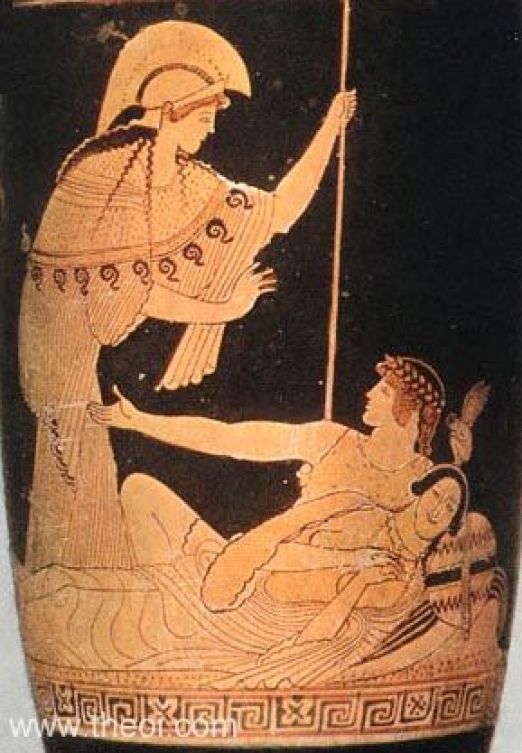
The following account is interesting for the variations in the story of Ariadne and Theseus but also for the strange detail of the ritual where young men imitate a woman in childbirth. Also, the counterfeit letters bit is precious. What would they say?.
Other tales about Ariadne, According to Plutarch (Theseus 20)
“There are many other versions circulated about these matters still and also about Ariadne, none of which agree. For some say that she hanged herself after she was abandoned by Theseus. Others claim that after she was taken to Naxos by sailors she lived with Oinaros a priest of Dionysus and that she was abandoned by Theseus because he loved another.
“A terrible lust for Aiglê the daughter of Panopeus ate at him” [fr. 105]—this is a line Hereas the Megarean claims Peisistratus deleted from the poems of Hesiod, just as again he says that he inserted into the Homeric catalogue of dead “Theseus and Perithoos, famous children of the gods” [Od. 11.631] to please the Athenans. There are some who say that Ariadne gave birth to Oinipiôn and Staphulos with Theseus. One of these is Ion of Khios who has sung about his own city “Oinopiôn, Theseus’ son, founded this city once.” [fr. 4D]
The most reputable of the myths told are those which, as the saying goes, all people have in their mouths. But Paiôn the Amathousian has handed down a particular tale about these events. For he says that Theseus was driven by a storm, to Cyprus and that he had Ariadne with him, who was pregnant and doing quite badly because of the sea and the rough sailing. So he set her out alone and he was carried back into the sea from the land while he was tending to the ship. The native women, then, received Ariadne and they tried to ease her depression because of her loneliness by offering her a counterfeit letter written to her by Theseus and helping her and supporting her during childbirth. They buried her when she died before giving birth.
Paiôn claims that when Theseus returned he was overcome with grief and he left money to the island’s inhabitants, charging them to sacrifice to Ariadne and to have two small statues made for her—one of silver and one of bronze. During the second day of the month of Gorpiaon at the sacrifice, one of the young men lies down and mouns and acts as women do during childbirth. They call the grove in which they claim her tomb is that of Ariadne Aphrodite.
Some of the Naxians claim peculiarly that there were two Minoses and two Ariadnes. They claim one was married to Dionysus on Naxos and bore the child Staphulos, and the young one was taken by Theseus and left when he came to Naxos with a nurse named Korkunê—whose tomb they put on display. They claim that Ariadne died there and has honors unequal to those of the earlier one. The first has a festival of singing and play; the second has one where sacrifices are performed with grief and mourning.”


 Image from: