Reputable Tales about Ariadne; And Strange Ones

The following account is interesting for the variations in the story of Ariadne and Theseus but also for the strange detail of the ritual where young men imitate a woman in childbirth. Also, the counterfeit letters bit is precious. What would they say?.

Other tales about Ariadne, According to Plutarch (Theseus 20)

“There are many other versions circulated about these matters still and also about Ariadne, none of which agree. For some say that she hanged herself after she was abandoned by Theseus. Others claim that after she was taken to Naxos by sailors she lived with Oinaros a priest of Dionysus and that she was abandoned by Theseus because he loved another.

“A terrible lust for Aiglê the daughter of Panopeus ate at him” [fr. 105]—this is a line Hereas the Megarean claims Peisistratus deleted from the poems of Hesiod, just as again he says that he inserted into the Homeric catalogue of dead “Theseus and Perithoos, famous children of the gods” [Od. 11.631] to please the Athenans. There are some who say that Ariadne gave birth to Oinipiôn and Staphulos with Theseus. One of these is Ion of  Khios who has sung about his own city “Oinopiôn, Theseus’ son, founded this city once.” [fr. 4D]

The most reputable of the myths told are those which, as the saying goes, all people have in their mouths. But Paiôn the Amathousian has handed down a particular tale about these events. For he says that Theseus was driven by a storm, to Cyprus and that he had Ariadne with him, who was pregnant and doing quite badly because of the sea and the rough sailing. So he set her out alone and he was carried back into the sea from the land while he was tending to the ship. The native women, then, received Ariadne and they tried to ease her depression because of her loneliness by offering her a counterfeit letter written to her by Theseus and helping her and supporting her during childbirth. They buried her when she died before giving birth.

Paiôn claims that when Theseus returned he was overcome with grief and he left money to the island’s inhabitants, charging them to sacrifice to Ariadne and to have two small statues made for her—one of silver and one of bronze. During the second day of the month of Gorpiaon at the sacrifice, one of the young men lies down and mouns and acts as women do during childbirth. They call the grove in which they claim her tomb is that of Ariadne Aphrodite.

Some of the Naxians claim peculiarly that there were two Minoses and two Ariadnes. They claim one was married to Dionysus on Naxos and bore the child Staphulos, and the young one was taken by Theseus and left when he came to Naxos with a nurse named Korkunê—whose tomb they put on display. They claim that Ariadne died there and has honors unequal to those of the earlier one. The first has a festival of singing and play; the second has one where sacrifices are performed with grief and mourning.”

Πολλοὶ δὲ λόγοι καὶ περὶ τούτων ἔτι λέγονται καὶ περὶ τῆς Ἀριάδνης, οὐδὲν ὁμολογούμενον ἔχοντες. οἱ μὲν γὰρ ἀπάγξασθαί φασιν αὐτὴν ἀπολειφθεῖσαν ὑπὸ τοῦ Θησέως, οἱ δὲ εἰς Νάξον ὑπὸ ναυτῶν κομισθεῖσαν Οἰνάρῳ τῷ ἱερεῖ τοῦ Διονύσου συνοικεῖν, ἀπολειφθῆναι δὲ τοῦ Θησέως ἐρῶντος ἑτέρας· Δεινὸς γάρ μιν ἔτειρεν ἔρως Πανοπηΐδος Αἴγλης. τοῦτο γὰρ τὸ ἔπος ἐκ τῶν Ἡσιόδου Πεισίστρατον ἐξελεῖν φησιν Ἡρέας ὁ Μεγαρεύς, ὥσπερ αὖ πάλιν ἐμβαλεῖν εἰς τὴν Ὁμήρου νέκυιαν τὸ Θησέα Πειρίθοόν τε θεῶν ἀριδείκετα τέκνα,χαριζόμενον Ἀθηναίοις· ἔνιοι δὲ καὶ τεκεῖν ἐκ Θησέως Ἀριάδνην Οἰνοπίωνα καὶ Στάφυλον· ὧν καὶ ὁ Χῖος Ἴων ἐστὶ περὶ τῆς ἑαυτοῦ πατρίδος λέγων· Τήν ποτε Θησείδης ἔκτισεν Οἰνοπίων.

Ἃ δ᾿ ἐστὶν εὐφημότατα τῶν μυθολογουμένων, πάντες ὡς ἔπος εἰπεῖν διὰ στόματος ἔχουσιν. ἴδιον δέ τινα περὶ τούτων λόγον ἐκδέδωκε Παίων ὁ Ἀμαθούσιος. τὸν γὰρ Θησέα φησὶν ὑπὸ χειμῶνος εἰς Κύπρον ἐξενεχθέντα καὶ τὴν Ἀριάδνην ἔγκυον ἔχοντα, φαύλως δὲ διακειμένην ὑπὸ τοῦ σάλου καὶ δυσφοροῦσαν, ἐκβιβάσαι μόνην, αὐτὸν δὲ τῷ πλοίῳ βοηθοῦντα πάλιν εἰς τὸ πέλαγος ἀπὸ τῆς γῆς φέρεσθαι. τὰς οὖν ἐγχωρίους γυναῖκας τὴν Ἀριάδνην ἀναλαβεῖν καὶ περιέπειν ἀθυμοῦσαν ἐπὶ τῇ μονώσει, καὶ γράμματα πλαστὰ προσφέρειν, ὡς τοῦ Θησέως γράφοντος αὐτῇ, καὶ περὶ τὴν ὠδῖνα συμπονεῖν καὶ βοηθεῖν· ἀποθανοῦσαν δὲ θάψαι μὴ τεκοῦσαν. ἐπελθόντα δὲ τὸν Θησέα καὶ περίλυπον γενόμενον τοῖς μὲν ἐγχωρίοις ἀπολιπεῖν χρήματα, συντάξαντα θύειν τῇ Ἀριάδνῃ, δύο δὲ μικροὺς ἀνδριαντίσκους ἱδρύσασθαι, τὸν μὲν ἀργυροῦν, τὸν δὲ χαλκοῦν. ἐν δὲ τῇ θυσίᾳ τοῦ Γορπιαίου μηνὸς ἱσταμένου δευτέρᾳ κατακλινόμενόν τινα τῶν νεανίσκων φθέγγεσθαι καὶ ποιεῖν ἅπερ ὠδίνουσαι γυναῖκες· καλεῖν δὲ τὸ ἄλσος Ἀμαθουσίους, ἐν ᾧ τὸν τάφον δεικνύουσιν, Ἀριάδνης Ἀφροδίτης.

Καὶ Ναξίων δέ τινες ἰδίως ἱστοροῦσι δύο Μίνωας γενέσθαι καὶ δύο Ἀριάδνας, ὧν τὴν μὲν Διονύσῳ γαμηθῆναί φασιν ἐν Νάξῳ καὶ τοὺς περὶ Στάφυλον τεκεῖν, τὴν δὲ νεωτέραν ἁρπασθεῖσαν ὑπὸ τοῦ Θησέως καὶ ἀπολειφθεῖσαν εἰς Νάξον ἐλθεῖν, καὶ τροφὸν μετ᾿ αὐτῆς ὄνομα Κορκύνην, ἧς δείκνυσθαι τάφον. ἀποθανεῖν δὲ καὶ τὴν Ἀριάδνην αὐτόθι καὶ τιμὰς ἔχειν οὐχ ὁμοίας τῇ προτέρᾳ. τῇ μὲν γὰρ ἡδομένους καὶ παίζοντας ἑορτάζειν, τὰς δὲ ταύτῃ δρωμένας θυσίας εἶναι πένθει τινὶ καὶ στυγνότητι μεμιγμένας.
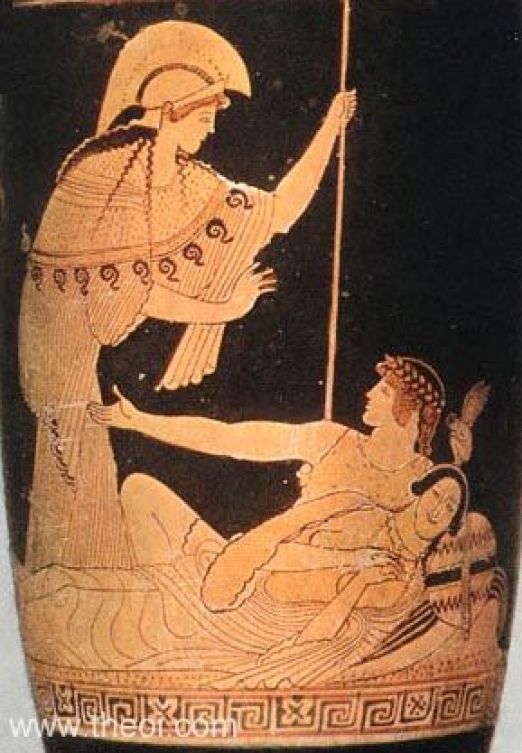
Image result for Ariadne and Theseus ancient
Athena, Ariadne, and Theseus: IL MUSEO ARCHEOLOGICO NAZIONALE DI TARANTO

Destroyer, Born on the Ground, Pitiable: Etymologies for Helen

In a choral ode from Aeschylus’ Agamemnon, we find a folk etymology implied for Helen’s name. Where I have translated “killer”, the Greek has versions of the aorist of αἵρεω (εἶλον) which, without its augment looks like the beginning of Helen’s name (ἑλ-).

 Aeschylus, Agamemnon 684-696

“Whoever pronounced a name
So thoroughly true?
Wasn’t it someone we’d not see
Guiding the tongue with luck
From a foreknowledge of fate?
Who named the spear-bride,
Struggled-over woman
Helen?
For, appropriately,
That ship-killer [hele-nas], man-killer [hel-andros]
City-killer [hele-ptolis], sailed
From her fine-spun, curtains
On the breath of great Zephyr
and many-manned bands
Of shield-bearers followed
The vanished journey struck
By the oars to the banks
Of leafy Simois
For a bloody strife.”

Χο. τίς ποτ’ ὠνόμαξεν ὧδ’
ἐς τὸ πᾶν ἐτητύμως—
μή τις ὅντιν’ οὐχ ὁρῶ-
μεν προνοί-
αισι τοῦ πεπρωμένου
γλῶσσαν ἐν τύχᾳ νέμων; —τὰν
δορίγαμβρον ἀμφινεικῆ
θ’ ῾Ελέναν; ἐπεὶ πρεπόντως
ἑλένας, ἕλανδρος, ἑλέ-
πτολις, ἐκ τῶν ἁβροπήνων
προκαλυμμάτων ἔπλευσε
Ζεφύρου γίγαντος αὔρᾳ,
πολύανδροί
τε φεράσπιδες κυναγοὶ
κατ’ ἴχνος πλατᾶν ἄφαντον
κελσάντων Σιμόεντος
ἀκτὰς ἐπ’ ἀεξιφύλλους
δι’ ἔριν αἱματόεσσαν.

Ancient etymologies do not follow this Aeschylean play.

Etym. Gudianum

“Helenê. From attracting [helkein] many to her beauty. Or it is from helô, helkuô, she is the one who drags young men to her personal beauty. Or it comes from Hellas [Greece]. Or it comes from being born on the ground [helos].”

     ῾Ελένη· … ἀπὸ τοῦ πολλοὺς ἕλκειν ἐν τῷ κάλλει αὐτῆς· ἢ παρὰ τὸ ἕλω, τὸ ἑλκύω, ἡ πρὸς τὸ ἴδιον κάλλος ἑλκύουσα τοὺς νέους ἀνθρώπους· ἢ παρὰ τὸ ῾Ελλάς· ἢ παρὰ τὸ ἐν ἕλει γεγεννῆσθαι.

Etym.  Magnum

“Helenê: A heroine. From helô, helkuô, she is the one who drags young men to her personal beauty. Or it comes from Hellas [Greece]. Or it comes from being born on the ground [helos]. Or because she was thrown in a marshy [helôdei] place by Tyndareus once she obtained some divine prescience and she was taken back up by Leda. Helenê was named from pity [heleos].”

     ῾Ελένη: ῾Η ἡρωΐς· παρὰ τὸ ἕλω, τὸ ἑλκύω, ἡ πρὸς τὸ ἴδιον κάλλος ἕλκουσα τοὺς ἀνθρώπους· διὰ τὸ πολλοὺς ἑλεῖν τῷ κάλλει· ἢ παρὰ τὸ ῾Ελλάς· ἢ παρὰ τὸ ἐν ἕλει γεγενῆσθαι, ἡ ὑπὸ τοῦ Τυνδάρεω ἐν ἑλώδει τόπῳ ῥιφθεῖσα, θείας δέ τινος προνοίας τυχοῦσα, καὶ ἀναληφθεῖσα ὑπὸ Λήδας. ᾿Εκ τοῦ ἕλους οὖν ῾Ελένη ὠνομάσθη.

Modern linguistics show that Helen’s name is just really hard to figure out.

Some Modern Material

In Lakonia, Helen was original spelled with a digamma. (And this may have extended to Corinth and Chalcidice too Cf. R. Wachter Non-Attic Vase Inscriptions 2001, §251).

74 Von Kamptz 1958, 136 suggests that her name is a “cognate of σέλας” to evoke a sense of “shining”, as in her beauty. Cf. Kanavou 2015, 72

Vedic Saranyu: Skutsch 1987, 189; Puhvel 1987, 141–143 (The initial breathing in Greek often points to a lost initial *s but the digamma in certain dialects confuses this) The Vedic name means swift. The PIE root suggested here is *suel-.

Helen has variously been suggested as coming from a vegetation goddess (see Helena Dendritis, Paus. 3.19.9–10; Herodotus 6.61; cf. Skutsch 1987) or a goddess of light.


Image result for Ancient Greek Helen

“If Wine Could Tell A Story”

Plautus, Truculentus 829-833

“This is no good. You are blaming the silent who cannot speak.
If wine could tell a story it would defend itself.
Wine doesn’t control men—men usually control wine!
Well, that’s how it is when men are fit for anything—certain fools
When they drink a little or not at all remain fools by nature.”

non placet: in mutum culpam confers quit loqui.
nam uinum si fabulari possit se defenderet.
non uinum moderari, sed uiri uino solent,
qui quidem probi sunt; uerum qui improbust si quasi Bibit
siue adeo caret temeto, tamen ab ingenio improbust.


Image result for Ancient Roman Drinking

Flammable Bones and Renewable Eyes: Some Amazing Animal Facts

Paradoxographus Vaticanus, 4-8

4 “Aristotle says in his work On Animals that all land animals have respiration—as many as have lungs—except for the wasp and bee which do not breathe. However many animals have a bladder also have bowels. But not all animals who have bowels also have a bladder.”

᾿Αριστοτέλης φησὶν ἐν τοῖς περὶ ζῴων τὰ χερσαῖα πάντα ἀναπνεῖν, ὅσα πνεύμονας ἔχει, σφῆκαν δὲ καὶ μέλισσαν οὐκ ἀναπνεῖν. ὅσα τε κύστιν ἔχει, πάντα καὶ κοιλίαν· οὐχ ὅσα δὲ κοιλίαν καὶ κύστιν.

5 “Many of the animals are bloodless, and and, in general they are animals who have more than four feet.”

῎Αναιμα πολλὰ τῶν ζῴων, καθόλου δὲ ὅσα πλείους πόδας ἔχουσι τῶν τεσσάρων.

6 “Fish do not have a throat[?]. For this reason, if a smaller fish is pursued by a bigger one, it pushes the stomach under the mouth [?]”

Οἱ ἰχθύες οὐκ ἔχουσι στόμαχον· διό, ἐὰν διώκηται ὁ ἐλάττων ὑπὸ μείζονος, ἄγει τὴν κοιλίαν ὑπὸ τὸ στόμα.

7 “Snakes have thirty ribs, and their eyes, if anyone strikes them, grow back again. The swallow’s qualities are similar.”

Οἱ ὄφεις πλευρὰς ἔχουσι τριάκοντα. καὶ τὰ ὄμματα αὐτῶν, ἐάν τις ἐκκεντήσῃ, πάλιν γίνονται, καθὰ καὶ τὰ τῶν χελιδόνων.

8 “The bones of a lion are so stiff that when they are struck often they burst into fire.”

Τοῦ λέοντος τὰ ὀστᾶ οὕτως εἰσὶ στερεά, ὥστε πολλάκις κοπτόμενα πῦρ ἐκλάμπειν.

Image result for medieval manuscript lion fire
British Library, Royal MS 12 C. xix, Folio 6r. Lion

A Fine Poem on Friendship

Martial 12.40

“You lie, I trust you. You recite terrible poems, I praise them.
You sing, I sing. You drink, Pontilianus and I drink too.
You fart, I ignore it. You want to play a board game, I am defeated.
You do one thing without me, I’ll be quiet too.
You do no duty for me at all: You say, “when you’re dead”
I will take good care of you. I don’t want anything, but you can die.”

Mentiris: credo. recitas mala carmina: laudo.
cantas: canto. bibis, Pontiliane: bibo.
pedis: dissimulo. gemma vis ludere: vincor.
res una est sine me quam facis: et taceo.
nil tamen omnino praestas mihi. ‘mortuus’ inquis
‘accipiam bene te.’ nil volo: sed morere.

Image result for medieval manuscript friendship
Royal 19 C II f. 59v

A Sacrifice, Made Twice or Thrice

Montesquieu, Dissertation on Politics in Roman Religion (Part V):

Cicero says that Fabius, when he was augur, held it as a rule that what was advantageous for the republic was always made under good auspices. He thinks, like Marcellus, that although the credulity of the people established the augurs in the beginning, they retained their function for the utility of the republic. And he sets this difference between the Romans and foreigners, that the latter preserved these things indiscriminately in all occasions, while the Romans only retained them in the affairs which pertained to the public interest. Cicero informs us that lightning falling on the left side was a good augury, except in the assemblies of the people praeterquam ad comitia. The rules of the art ceased in this occasion: the magistrates judged according to their own imagination about the favorability of the auspices, and these auspices were a bridle with which they managed the people. Cicero adds: This was instituted for the sake of the republic, so that the chief men of the state would be the interpreters, whether in legal matters, or in the judgments of the people, or in the creation of magistrates. He said beforehand that one could read in the sacred books: While Jove thunders, it is against divine law to hold the committees of the people. That was introduced, he says, to furnish the magistrates a pretext for breaking up the people’s assemblies. For the rest, it was a matter of indifference whether the victim which one had sacrificed offered a good or a bad augury, because if one were not content with the first sacrifice, they could sacrifice a second, a third, a fourth – this was called hostiae succedaneae. Aemilius Paulus, wishing to sacrifice, was obliged to immolate twenty victims: the gods were not appeased until the last one, in which they found the signs promising victory. It was for that reason that they had the custom of saying that, in the matter of sacrifices, the latest victims always had more potency than the first. Caesar was not as patient as Aemilius Paulus: having cut the throat of many sacrificial victims, according to Suetonius, without finding any of them favorable, he left the altars with contempt, and entered the senate.

Cicéron dit que Fabius, étant augure, tenait pour règle que ce qui était avantageux à la république se faisait toujours sous de bons auspices. Il pense, comme Marcellus, que, quoique la crédulité populaire eût établi au commencement les augures, on en avait retenu l’usage pour l’utilité de la république ; et il met cette différence entre les Romains et les étrangers, que ceux-ci s’en servaient indifféremment dans toutes les occasions, et ceux-là seulement dans les affaires qui regardaient l’intérêt public. Cicéron nous apprend que la foudre tombée du côté gauche était d’un bon augure, excepté dans les assemblées du peuple, præterquam ad comitia. Les règles de l’art cessaient dans cette occasion : les magistrats y jugeaient à leur fantaisie de la bonté des auspices, et ces auspices étaient une bride avec laquelle ils menaient le peuple. Cicéron ajoute : Hoc institutum reipublicœ causa est, ut comitiorum, vel in jure legum, vel in judiciis populi, vel in creandis magistratibus, principes civitatis essent interpretes. Il avait dit auparavant qu’on lisait dans les livres sacrés : Jove tonante et fulgurante, comitia populi habere nefas esse. Cela avait été introduit, dit-il, pour fournir aux magistrats un prétexte de rompre les assemblées du peuple Au reste, il était indifférent que la victime qu’on immolait se trouvât de bon ou de mauvais augure ; car lorsqu’on n’était pas content de la première, on en immolait une seconde, une troisième, une quatrième, qu’on appelait hostiœ succedaneœ. Paul Émile voulant sacrifier fut obligé d’immoler vingt victimes : les dieux ne furent apaisés qu’à la dernière, dans laquelle on trouva des signes qui promettaient la victoire. C’est pour cela qu’on avait coutume de dire que, dans les sacrifices, les dernières victimes valaient toujours mieux que les premières. César ne fut pas si patient que Paul Émile : ayant égorgé plusieurs victimes, dit Suétone, sans en trouver de favorables, il quitta les autels avec mépris, et entra dans le sénat.

Some Miraculous Misogyny From the Ancient World

The following passages are from the Paradoxographus Vaticanus (Admiranda), one of a selection of ancient paradoxographical collections which are not widely available in translation. I have been working on completing full rough translations of the paradoxa this summer. The Florentinus  and Palatinus manuscripts are now translated as are the Historiae Mirabiles of Apollonios Paradoxographus.

Of the collections, the Vaticanus is the most interesting and strange. Here are a few sections that jumped out while I translated them today.

15 “In a certain part of the region before Olympos there are trees similar to a tender-leafed willow which people say were once virgins. They changed into these trees when they were fleeing Boreas who was lusting after them. Even to this day, if someone touches the leaves, people claim that the wind gets enraged and immediately blows with a fury and barely stops before the third day”

῎Εν τινι τῶν κατὰ τὸν ῎Ολυμπον δένδρα ἐστὶν ἰτέᾳ λεπτοφύλλῳ ἐοικότα, ἃ παρθένους γεγενῆσθαι ἱστοροῦσι· εἰς <δὲ> δένδρα ταύτας ἀμειφθῆναι τὸν Βορρᾶν φευγούσας ἐρῶντα. Καὶ νῦν ἔτι, εἴ τις θίγοι τῶν φυλλῶν, χολοῦσθαι τὸν ἄνεμον λέγουσι καὶ σφοδρὸν αὐτίκα πνεῖν καὶ μόλις διὰ τρίτης παύεσθαι.

16 “In the middle of Thrace there is a river which reveals women who have been corrupted through adultery. When their husbands have them drink from the water they also say ‘If you were not corrupted by that water, may you have a son; but if you were, have a daughter’ “

Μέστος ποταμὸς ἐν Θρᾴκῃ τὰς μοιχευομένας ἐξελέγχει, τῶν ἀνδρῶν ποτιζόντων αὐτὰς ἀπὸ τοῦ ὕδατος τούτου καὶ λεγόντων· «εἰ μὲν οὐκ ἐμοιχεύθης, ἄρρεν τέκοις, εἰ δ’ οὖν, θῆλυ.»

17 “And among the Germanoi, the Rhênos tests this: for if a child is immersed in it, if it was the product of adultery, it dies, if not, it lives.”

 Καὶ παρὰ Γερμανοῖς ὁ ῾Ρῆνος ἐλέγχει· ἐμβληθὲν γὰρ τὸ παιδίον εἰ μὲν μοιχευθείσης ἐστί, θνῄσκει, εἰ δ’ οὐ, ζῇ.

24 “The Keltoi, whenever there is scarcity or a famine, punish their women as if they are to blame for the evils.”

Οἱ Κελτοί, ὅταν ἢ ἀφορία ἢ λοιμὸς γένηται, τὰς γυναῖκας αὐτῶν κολάζουσιν ὡς αἰτίας τῶν κακῶν.

Image result for medieval manuscript river women
Splendor Solis “(Germany, 1582), British Library, London.

Or

Image result for gif monty python found a witch

Missing Deadlines Because of Chronic Illness

Fronto to Praeciilius Pompeianus          (Ambr. 312, following 313)

“You will hear from my, Pompeianus, the truth of how the matter is and I would hope that you would believe that I am speaking the truth. Nearly last year I took that oration For the Bithynians into my hand and I started to correct it. I also promised you some things concerning that oration when I was at Rome then. And, if my memory serves me correctly, when we were having a conversation about certain sections of the speech, I said and was somewhat proud that I had carefully enough examined in that speech which hinged on the crime of contract killing.

But in the meantime a bout of neuritis overcame me pretty strongly and it has remained longer and more burdensome than is typical. When my limbs are coursing with pain, I am incapable of giving any attention to things that must be written or read. I have not dared up to now to ever ask this much of myself. When those wondrous beasts, philosophers, tell us that the wise man, even if he were locked in the bull of Phalaris, would be no less blessed, I could believe it more easily that we would be a little bit happier while cooking in the brass to contemplate some introduction or write some letters.”

Fronto Praecilio Pompeiano salutem.

Verum ex me, mi Pompeiane, uti res est,  audies; velimque te mihi verum | dicenti fidem habere. Orationem istam Pro Bithynisante annum fere in manus sumpseram et corrigere institueram. Tibi etiam Romae tunc agenti nonnihil de ista oratione promiseram. Et quidem, si recte memini, quom sermo inter nos de partitionibus orationum ortus esset, dixeram et prae me tuleram, satis me diligenter in ista oratione coniecturam, quae in crimine mandatae caedis verteretur, divisisse argumentis ac refutasse. Interea nervorum dolor solito vehementior me invasit, et diutius ac molestius solito remoratus est. Nec possum ego membris cruciantibus operam ullam litteris scribendis legendisque impendere; nec umquam istuc a me postulare ausus sum. Philosophis etiam mirificis hominibus dicentibus, sapientem virum etiam in Phalaridis tauro inclusum beatum nihilominus fore, facilius crediderim beatum eum fore quam posse tantisper amburenti in aheno prohoemium meditari aut epigrammata scribere.

Image result for Fronto Roman
Enter a caption

The Right To Criticize the King: The Iliad and Freedom of Speech

Homer, Iliad 9.32-34

“After a while, Diomedes good-at-the warcry, addressed them:
“I will fight with you first because you are being foolish, son of Atreus,
Which is right, Lord, in the assembly. So don’t get angry at all.”

ὀψὲ δὲ δὴ μετέειπε βοὴν ἀγαθὸς Διομήδης·
᾿Ατρεΐδη σοὶ πρῶτα μαχήσομαι ἀφραδέοντι,
ἣ θέμις ἐστὶν ἄναξ ἀγορῇ· σὺ δὲ μή τι χολωθῇς.

Schol. T ad Il. 9.32b ex

[“I will fight with you first”] “It is clear that he is also criticizing the rest of the Greeks because they are consenting to the retreat through their silence. For he says the fight in opposition to the speech.”

ex. σοὶ πρῶτα μαχήσομαι: δῆλον ὡς καὶ τοῖς ἄλλοις μέμφεται ὡς συναινοῦσι τῇ φυγῇ διὰ τοῦ σιωπᾶν. μάχην δέ φησι τὴν ἐναντίωσιν τοῦ λόγου. T

Schol. A ad Il. 9.33b ex

[“which is right in the assembly, lord”] This is the custom, in a democracy. It is established in the agora because it is the custom to speak with freedom of speech [parrêsia] in the assembly.

D | Nic. ἣ θέμις <ἐστίν, ἄναξ, ἀγορῇ>: ὡς νόμος ἐστὶν—ἐν δημοκρατίᾳ. | ἐπὶ δὲ τὸ ἀγορῇ στικτέον, ὡς νόμος ἐστὶν ἐκκλησίας μετὰ παρρησίας λέγειν.

Schol. bT ad Il. 9.33 ex

[“don’t get angry at all”] this is an anticipatory warning, since he is about to criticize him more severely than he has been reproached at anytime, [alleging that it is right] to speak against kings during assemblies. He asks him to set anger aside because he believes it is right to accept advantageous truth and he is clarifying the purpose of what is said—that it is not to insult.

ex. ἣ θέμις ἐστίν, ἄναξ, <ἀγορῇ· σὺ δὲ μή τι χολωθῇς>: προδιόρθωσις, ἐπειδὴ σφοδρότερον αὐτοῦ μέλλει καθάπτεσθαι ὡς ἐφιεμένου μὴ ἄλλοτε, ἐν δὲ ταῖς ἐκκλησίαις ἀντιλέγειν τοῖς βασιλεῦσιν. προπαραιτεῖται δὲ τὴν ὀργήν, ἀξιῶν δέξασθαι τὴν πρὸς τὸ συμφέρον ἀλήθειαν καὶ δηλῶν ὡς τοῖς εἰρημένοις, οὐκ αὐτῷ ἀπέχθεται

Image result for ancient greek political assembly
Painting of Perikles by Philipp von Foltz

Those Who Risked Everything For Freedom

Lysias, On the Property of Nicias’ Brother  24-27 (Go here for the full text)

“Jurors, I can’t bring anyone before you to plead for us. Some of our relatives died in war, proving they were good men and making this city great. Others died by drinking hemlock under the tyranny of the thirty for the sake of democracy and your freedom. For these reasons, the cause of our isolation is the excellence of our relatives and the sufferings of our city. It is right, then, for you to help us eagerly, once you consider this and understand that those people should be treated well by you in the democracy when they shared a great portion of sufferings with you under the oligarchy.

I also think it is right that the superintendents here are favorable to us, remembering that time when you were expelled from your country and you lost your wealth and you believed that the best people were those who died for your sake: you prayed to the gods that you would be able to give your thanks to their descendants.

Therefore, we sons and relatives of those very people who risked everything for your freedom, we ask you to return this favor now and not to bring us to unjust ruin but instead to help us more when we have shared in these troubles. I ask you and beg you and I kneel before you as a suppliant—I believe we are worthy of getting this treatment from you. For we do not risk losing small things, this is about everything we are.”

Οὐκ ἔχω, ὦ ἄνδρες δικασταί, οὕστινας δεησομένους ὑπὲρ ἡμῶν ἀναβιβάσομαι· τῶν γὰρ προσηκόντων οἱ μὲν ἄνδρας ἀγαθοὺς αὑτοὺς παρασχόντες καὶ μεγάλην τὴν πόλιν ποιοῦντες ἐν τῷ πολέμῳ τεθνᾶσιν, οἱ δ᾿ ὑπὲρ τῆς δημοκρατίας καὶ τῆς ὑμετέρας ἐλευθερίας ὑπὸ τῶν τριάκοντα κώνειον πιόντες, ὥστε τῆς ἐρημίας ἡμετέρας αἴτιαι γεγόνασιν αἵ τε τῶν προσηκόντων ἀρεταὶ καὶ αἱ τῆς πόλεως συμφοραί. ὧν ἄξιον ὑμᾶς ἐνθυμηθέντας προθύμως ἡμῖν βοηθῆσαι, ἡγησαμένους τούτους ἂν ἐν δημοκρατίᾳ δικαίως εὖ πάσχειν ὑφ᾿ ὑμῶν, οἵπερ ἐν ὀλιγαρχίᾳ τῶν συμφορῶν μετέσχον τὸ μέρος. ἀξιῶ δὲ καὶ τούτους τοὺς συνδίκους εὔνους ἡμῖν εἶναι, ἐκείνου τοῦ χρόνου μνησθέντας, ὅτ᾿ ἐκ τῆς πατρίδος ἐκπεπτωκότες καὶ τὰς οὐσίας ἀπολωλεκότες ἄνδρας ἀρίστους ἐνομίζετ᾿ εἶναι τοὺς ὑπὲρ ὑμῶν ἀποθνῄσκοντας, καὶ τοῖς θεοῖς ηὔχεσθε δυνηθῆναι χάριν τοῖς ἐξ ἐκείνων ἀποδοῦναι. ἡμεῖς τοίνυν, ὑεῖς ὄντες καὶ συγγενεῖς τῶν ὑπὲρ τῆς ἐλευθερίας προκεκινδυνευκότων, ἀπαιτοῦμεν ὑμᾶς νυνὶ ταύτην τὴν χάριν, καὶ ἀξιοῦμεν μὴ ἀδίκως ἡμᾶς ἀπολέσαι, ἀλλὰ πολὺ μᾶλλον βοηθεῖν τοῖς τῶν αὐτῶν μετασχοῦσι συμφορῶν. ἐγὼ μὲν οὖν καὶ δέομαι καὶ ἀντιβολῶ καὶ ἱκετεύω, καὶ τούτων παρ᾿ ὑμῶν τυγχάνειν ἀξιῶ· οὐ γὰρ περὶ μικρῶν κινδυνεύομεν, ἀλλὰ περὶ τῶν ὄντων ἁπάντων.

Lady holding a sandal to punish a young enslaved person. White-ground black-figure lekythosRegional Archaeological Museum in Palermo.