“What is life? What enjoyment is there without golden Aphrodite?
May I die when these things no longer interest me:
Secret sex and its moving gifts in bed,
Those blossoms of youth that tug
At men and women alike.
…But then painful old age
Presses down and makes a man ugly and embarrassing.
Cruel thoughts are always wearing down his mind
And he takes no pleasure seeing the sunrise.
No, he’s disgusting to boys and a joke to women too.
That the hard old age god makes for us.”
“I was once with Sophocles when someone asked him, ‘O Sophocles, how do things stand with you in the old love-making line? Can you still lie with a woman?’ Sophocles responded, ‘Ah man, you should sing a song of triumph for me – for indeed, I have most gladly fled from love as though I had gotten away from a cruel and raving master.’
It seemed to me at the time that he had spoken well on the subject, and I think so no less even today. Indeed, we are granted a certain peace and freedom from such concerns in old age. When our desires relent and finally cease to draw us out, then indeed does Sophocles’ saying come true, and we are entirely freed from many a raving master.
But respecting these things, and our relationships with our friends, my dear Socrates, there is one cause to consider – not old age, but rather the person’s character. If they have their lives well-ordered and are easily contented, then old age is a moderate burden. But to a man of the opposite character, both old age and youth happen to be burdensome affairs.
“I can summarize four the tools of Thucydides’ speech as follows: creativity in language, a variety of constructions, a harshness of order, and a swiftness of meaning. The character of his style includes density and thickness, bitterness and austerity, fierceness, and wonder and fear beyond all the emotional ranges.
This is what Thucydides is like from the character of his language in comparison to the rest. Whenever his intention and power coincide, his success is complete and divine. But whenever his force fails some and his power does not persist entirely, because of speed of his revelation, his expression becomes unclear and introduces another group of infelicities. For example, how it is right to express strange and synthetic language, how far to proceed before stopping, even though these are beautiful and necessary observations in all works, one should guard against it in all history.”
“No! The ones we’ve cut off, I’ll chop up and throw away”
Immo quos scicidimus conscindam atque abiciam.
Xenophon, Cyropaedia 7.5.62
“There is evidence from other animals too: out of control horses stop biting and bucking when they are neutered but they are no less useful in combat. When bulls are castrated they stop being so haughty and difficult but they aren’t deprived of their strength and ability to work. Similarly, when dogs are neutered they stop running away from their owners, but they are no worse at shepherding and hunting.”
“Aristotle claims in his work On the Pythagoreans that [Pythagoras] told people to refrain from beans either because they look like testicles or the gates of Hell.”
“If a swelling develops in the testicles when they haven’t been struck, blood should be let from the ankle; the patient should fast; and the swelling should be treated with bean meal cooked in honeyed-wine or rubbed with cumin with boiled honey; or ground cumin with rose oil, or wheat flour with honey wine and cypress roots; or the root of a lily, pounded.
In testiculis vero si qua inflammatio sine ictu orta est, sanguis a talo mittendus est; a cibo abstinendum; inponenda ex faba farina eo ex mulso cocta cum cumino contrito et ex melle cocto; aut contritum cuminum cum cerato ex rosa facto; aut lini semen frictum, contritum et in mulso coctum; aut tritici farina ex mulso cocta cum cupresso; aut lilii radix contrita.
Aristotle, Historia Animalium 7.50.20
“All animals who have testicles can be castrated.”
“By chance he told some country bumpkin
To chop off the goat’s testicles quickly with a sharp scythe
And get rid of that annoying stink of unclean meat.”
dixerat agresti forte rudique viro
ut cito testiculos †et acuta† falce secaret,
taeter ut immundae carnis abiret odor.
Hippocrates, Epidemics 2.12
“Swollen testicles”
…ὀρχίων οἴδησις…
Pliny the Elder, Natural History 26.81
“Ebulum, when ground up with its tender leaves and drunk with wine, takes care of stones; when applied as a salve, it helps testicles. Erigeron, as well, when mixed with frankincense and sweet wine, relieves swollen testicles.”
ebulum teneris cum foliis tritum ex vino potum calculos pellit, inpositum testes sanat. erigeron quoque cum farina turis et vino dulci testium inflammationes sanat.
Sumerians did it!
Kazuya Maekawa 1979 covers castration in Pre-Sargonic Lagaš (~2550-2350 BCE): they were often castrated in the spring just around the second year of birth. The term for this is amar.kud (amar = young; kud = to cut).
— 𒀭Andrew A.N. Deloucas (@AANDeloucas) July 28, 2021
Hippocrates, Internal Affections 282
“…and his testicles were ulcerated…”
καὶ οἱ ὄρχιες ἑλκοῦνται
Pliny the Elder, Natural History 28.215
“They say that a goat’s dung is good for you with honey or vinegar, or just butter by itself. Testicular swelling can be treated with veal suet mixed with soda, or by the calf’s dung reduced in vinegar.”
fimum etiam prodesse cum melle dicunt aut cum aceto et per se butyrum. testium tumor sebo vituli addito nitro cohibetur vel fimo eiusdem ex aceto decocto.
Bronze ritual Roman era castration clamps found in the river Thames and now at the Museum of London. SARAH E. BOND
“Below the penis there are two testicles. There is skin around them called a scrotum. The testicles are not the same as flesh nor are they far from it. Later, will will speak more precisely about what their nature is and generally about all these kinds of parts.”
“They become calmer once their testicles are removed because they no longer have seed.”
Demptis enim testiculis fiunt quietiores, ideo quod semine carent
Plutarch, Natural Phenomena 917D
“Or is Aristotle’s claim true too, that Homer calls khlounês the boar who only has one testicle? For he claims that the testicles of most of the boars get crushed when they scratch themselves on trees.”
“I hope Jupiter destroys you, soldier! Live without your testicles!”
Iuppiter te, miles, perdat, intestatus uiuito
Aristotle, Problems 879a-b
4.23 “Why does rigidity and increase happen to the penis? Is it for two reasons? First, is it because that weight develops on the bottom of the testicles, raising it—for the testicles are like a fulcrum? And is it because the veins become full of breath [pneuma]? Or does the mass become bigger because of an increase in moisture or some change in position or from the development of moisture itself? Extremely large things are raised less when the weight of the fulcrum is far away.”
“Attis traveled over the deep seas and reached Phrygian forest
To touch the grove with a swift foot and then
Enter the goddess’ unknown places.
Then, driven mad in a fierce rage, lost in himself
he cut off his groin’s weights with a flint’s edge.”
Super alta vectus Attis celeri rate maria
Phrygium ut nemus citato cupide pede tetigit
adiitque opaca silvis redimita loca deae,
stimulatus ibi furenti rabie, vagus animi,
devolsit ili acuto sibi pondera silice
Castration of Saturn, MS Douce 195 Guillaume de Lorris & Jean de Meung, Roman de la Rose. France, 15th century (end). Bodleian Library, MS. Douce 195, fol. 76v
The famously troublesome opening lines of Pindar’s second Isthmian Ode turn on a contrast between past and present poetic practices. In the noble past, Pindar says, poets spontaneously composed their songs when passion moved them. In the degraded present, however, they produce commissioned work when the fee is right.
A scholiast supposed that Pindar’s condemnation of his poetic contemporaries was chiefly a condemnation of Simonides. This isn’t particularly convincing given that Pindar himself “worked on commission” for an assortment of tyrants, and the lines in question belong to a commissioned work!
I suspect there’s a tongue-in-cheek aspect to Pindar’s critique:
Isthmian Ode 2 (lines 1-10)
In the old days, Thrasyboulus,
Men mounted the gold-wreathed Muses’ chariot
To partake of the glorious lyre.
Effortlessly they let fly sweet-voiced hymns to boys,
Provided one were beautiful
And had that most agreeable ripeness
Which calls to mind gorgeously throned Aphrodite.
Back then, the Muse was not a lover of profit,
And neither was she a working girl.
Sweet-voiced Terpsichore, Muse of the gladdening dance,
Did not sell her sweet soft-toned songs,
Their bodies covered in silver.
But Nowadays, she says observe the Argive’s maxim
As it best approximates truth:
“Money, money makes the man,” he said,
As he lost his wealth and lovers at the same time.
(Note: “Their bodies covered in silver”: the phrase may mean something like “wholly commercialized,” “completely bought and paid for,” etc. In contemporary language we might say “covered in dollar bills” or something of the like.)
In the old days, Pindar wrote at least one of those “hymns to boys.” Ancient sources regarded the lyric as autobiographical–something, as it were, which arose “effortlessly” from authentic feeling.
But praise poems of this type were highly conventional; I’m disinclined to read the fine fragment 123 below as verse confession. I’m sympathetic to scholars who suspect that the lyric was, like the poetry of “nowadays,” commissioned and paid for by a patron.
Pindar Fr. 123: Encomium for Theoxenus of Tenedos, Son of Hagesilas
You must pluck love in season, my heart,
At the fit age. Yet, a man who sees the sparkling rays
of Theoxenus’s eyes but doesn’t swell with lust
Has a black heart, one forged in a cold flame
From iron or steel. Aphrodite’s slighted him,
She of the curving eyelids,
So he works like mad for money,
Or he’s enchained to the impudence of women
And led down an altogether frigid path.
But I, by the grace of the goddess,
Melt like sacred bees-wax stung by the hot sun
When I see the fresh young limbs of boys.
In Tenedos, it’s true, Persuasion and Charm
Dwell in the son of Hagesilas.
“When we are sent back there, love does not come near our soul through its own devising but through the body. Just so, teachers of geometry, when their students are not yet capable of comprehending thoughts of the incorporeal or the concepts of immutable essence, they make shapes, manipulable and visible representations of spheres, cubes, and dodecahedrons to give them. In this way, heavenly love creates beautiful mirrors of the beautiful things, mortal versions of the divine, changeable manifestations of the unchanging, and merely sensible representations of pure thought.
By creating these things in the shape and color and image of the beautiful people in their youth, Love moves our memory carefully, and it is kindled first by these things.”
“These were the excuses you clearly made up about me and my relationship with Thrasymachos. And now that these excuses have escaped you, you stop at nothing to abuse me rather freely. I should have known then that it was my luck to endure these things, when you were shit-talking me to your associates. And then I have told you everything about Polykles, a man you are helping. Why didn’t I guard my words more carefully? I was a bit simple-minded, I guess. I believed that since I was your friend I wouldn’t be maligned by you because you were slandering everyone else to me! I thought I had some kind of contract from you in your terrible insults about each other.
Well, I am happily quitting your friendship, since, by the gods, I can’t see how I’ll suffer by not associating with you when I won nothing by being your friend.”
“Let’s offer some examples from other peoples as well. Many kings and people in charge, have given themselves to death after listening to an oracle, so that they might save their citizens with their own blood. And many private citizens have exiled themselves in order to decrease civil strife.”
“When a plague was afflicting the Spartans because of the murder of the heralds sent by Xerxes—because he demanded earth and water as signs of servitude—they received an oracle that they would be saved if some Spartans would be selected to be killed by the king. Then Boulis and Sperkhis came forward to the king because they believed they were worthy to be sacrificed. Because he was impressed by their bravery he ordered them to go home.”
Diogenes Laertius, Vitae philosophorum 1.110 [Epimenides]
“Epimenides was known among the Greeks and was thought to be extremely beloved to the gods. For this reason, when the Athenians were once afflicted by a plague and the Pythian oracle prophesied that they should cleanse their city, they sent a ship along with Nikias the son of Nikêratos, summoning Epimenides.
He made it to Athens at the time of the 46th Olympiad [c. 596 BCE] and cleansed the city. He stopped it in the following manner. After obtaining white and black sheep, he led them to the Areopagos and then allowed them to go wherever they wanted there. He ordered the people following them to sacrifice the sheep to whichever god was proper to the place where each sheep laid down.
This is how the plague stopped. For this reason it is still even today possible to find altars without names in certain Athenian neighborhoods as a commemoration of that ancient cleansing. Some people report that Epimenides indicated the pollution from the Kylon scandal as the cause of the plague along with a resolution for it. For this reason, they killed two youths, Kratinos and Ktêsibios and the suffering was relieved.”
“Kuanippos, a Syracusan by birth, did not sacrifice to Dionysus alone. In rage over this, the god caused him to become drunk and then he raped his daughter Kuanê in some shadowy place. She took his ring and gave it to her nurse as to be proof of what had happened in the future.
When they were later struck by a plague and Pythian Apollo said that they had to sacrifice the impious person to the Gods-who-Protect, everyone else was uncertain about the oracle. Kuanê understood it. She grabbed her father by the hair and sacrificed herself over him once she’d butchered him on the altar.
That’s the story Dositheos tells in the third book of his Sicilian Tales.”
“The whole state often suffers because of a wicked man
Who transgresses the gods and devises reckless deeds.
Kronos’ son rains down great pain on them from heaven:
Famine and plague and the people start to perish.
[Women don’t give birth and households waste away
Thanks to the vengeance of Olympian Zeus.] And at other times
Kronos’ son ruins their great army or their wall
Or he destroys their ships on the the sea.”
“When a plague struck the Selinuntians thanks to the pollution from a nearby river causing people to die and the women to miscarry, Empedocles recognized the problem and turned two local rivers at his own expense. They sweetened the streams by mixing in with them.
Once the plague was stopped in this way, Empedocles appeared while the Selinuntines were having a feast next to the river. They rose and bowed before him, praying to him as if he were a god. He threw himself into a fire because he wanted to test the truth of his divinity.”
“He had banquet and bedroom furniture made from silver. He often ate camel-heels and cock’s combs removed from birds who were still alive to imitate Apicius, as well as the tongues of peacocks and nightingales because it was said that whoever ate them was safe from the plague.
He also gave the the Palace visitors enormous serving dishes piled with the innards of mullets, flamingo-brains, partridge eggs, the brains of thrushes, and the whole heads of parrots, pheasants, and peacocks.”
Hic solido argento factos habuit lectos et tricliniares et cubiculares. comedit saepius ad imitationem Apicii calcanea camelorum et cristas vivis gallinaceis demptas, linguas pavonum et lusciniarum, quod qui ederet a pestilentia tutus diceretur. exhibuit et Palatinis lances ingentes extis mullorum refertas et cerebellis phoenicopterum et perdicum ovis et cerebellis turdorum et capitibus psittacorum et phasianorum et pavonum.
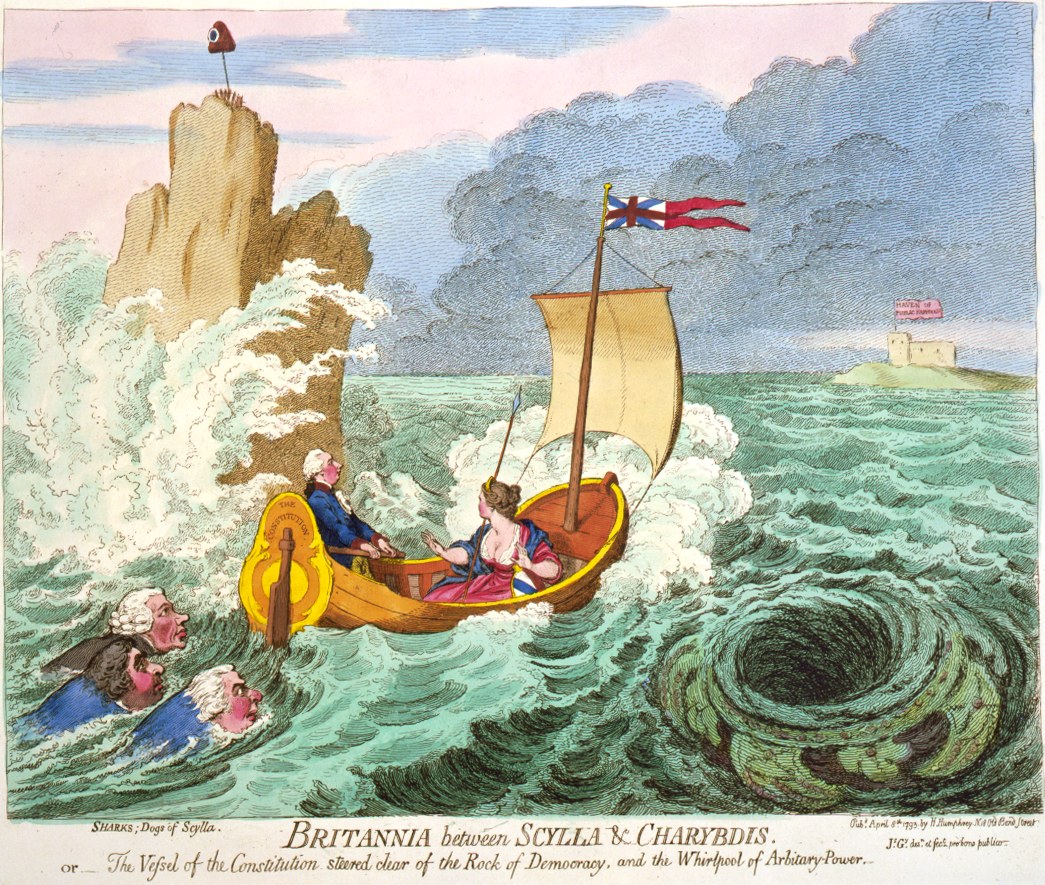
“Avoid Kharybdis and come close to Skyla.” This is similar to the saying, “I avoided it by finding a better evil”
They say about Skyla that she was a Tyrrhenian woman, something if a beast, who was a woman down to the navel but she grew dog heads beneath that point. The rest of her body was a serpent. This kind of a cerature is very silly to imagine. But here is the truth. There were the islands of the Tyrrenians, which used to raid the coasts of Sicily and the Ionian bay. There was a trirereme which had the named Skyla. That trireme used to overtake other ships often and use their food and there was many a story about it. Odysseus fled that ship. trusting a strong and favorable wind and he told this story in Corcyra to Alkinoos, how he was pursued and how he fled and what the shape of the ship was. From these stories, the myth was formed.”
“Charybdis is an obvious name for luxury and endless drinking. Homer has allegorized manifold shamelessness in Skylla, which is why she would logically have a belt of dogs, guardians for her rapacity, daring, and pugnacity. “
“But you, go away from “the smoke and the wave” and depart the ridiculous concerns of mortal life as from that fearsome Charybdis without touching it at all, don’t even, as the people say, brush it with your littlest toe.”
“For satiety seems to be becoming worn out in pleasures from the soul suffering in some way with the body, since the soul does not shirk from its pleasures. But when it is interwoven, as it is said, with the body, it suffers the same things as Odysseus, just as he was held, clinging to the fig tree, not because he desired it or delighted in it, but because he feared Charybdis lurking below him. The soul clings to the body and embraces it in this way not because of goodwill or gratitude but because it fears the uncertainty of death.
As wise Hesiod says, “the gods keep life concealed from human beings.” They have not tied the soul to the body with fleshly bonds, but they have devised and bound around the mind one cell and one guard, our uncertainty and distrust about our end. If a soul had faith in these things—“however so many await men when they die”, to quote Heraclitus—nothing would restrain it at all.”
Montesquieu, Dissertation on Politics in Roman Religion (Part 14)
The Romans had this advantage, that they had as a legislator the most sage prince that profane history has ever spoken of. This great man sought nothing in his entire reign but that justice and equity should flourish, and he made it so that his moderation was felt no less by his neighbors than by his subjects. He established the Fetials, who were priests without whose ministry the Romans could make neither peace nor war. In the peace which Rome concluded with Alba Longa, a Fetial says in Livy, ‘If the Roman people be the first to depart from this treaty, whether from the public counsel or an evil trick, it prays that Jupiter will strike it just as it will strike the pig which it holds in its hands.’ And the priest straightaway slaughtered the pig with the strike of a stone.
Before beginning a war, the Romans sent one of these Fetials to make their complaints to the people who had inflicted some injury on the Republic. He gave them some time for consultation and for looking for the means of reestablishing good terms; but if they neglected this accommodation, the Fetial turned around and departed from this unjust people after having invoked against them both the celestial and the infernal gods. At that time, the senate ordained that which it believed just and pious. Thus, wars were never undertaken in haste, and they could not occur except as a sequel to a long and mature deliberation.
Les Romains avaient cet avantage, qu’ils avaient pour législateur le plus sage prince dont l’histoire profane ait jamais parlé: ce grand homme ne chercha pendant tout son règne qu’à faire fleurir la justice et l’équité, et il ne fit pas moins sentir sa modération à ses voisins qu’à ses sujets. Il établit les fécialiens, qui étaient des prêtres sans le ministère desquels on ne pouvait faire ni la paix ni la guerre. Nous avons encore des formulaires de serments faits par ces fécialiens quand on concluait la paix avec quelque peuple. Dans celle que Rome conclut avec Albe, un fécialien dit dans Tite-Live: « Si le peuple romain est le premier à s’en départir, publico consilio dolove malo, qu’il prie Jupiter de le frapper comme il va frapper le cochon qu’il tenait dans ses mains ; » et aussitôt il l’abattit d’un coup de caillou.
Avant de commencer la guerre, on envoyait un de ces fécialiens faire ses plaintes au peuple qui avait porté quelque dommage à la république. Il lui donnait un certain temps pour se consulter, et pour chercher les moyens de rétablir la bonne intelligence ; mais, si on négligeait de faire l’accommodement, le fécialien s’en retournait et sortait des terres de ce peuple injuste, après avoir invoqué contre lui les dieux célestes et ceux des enfers : pour lors le sénat ordonnait ce qu’il croyait juste et pieux. Ainsi les guerres ne s’entreprenaient jamais à la hâte, et elles ne pouvaient être qu’une suite d’une longue et mûre délibération.
“The wise Euripides put in his poetic drama about the Cyclops that he had three eyes, indicating by this that he had three brothers and that they cared for one another and kept a watchful eye on one another’s places in the island, fought together, and avenged one another.
And he also adds that he made the Cyclops drunk and unable to flee, because Odysseus made that very Cyclops “drunk” with a ton of money and gifts so he would not “eat those with him up”, which is not actually to consume them with slaughter.
He also says that Odysseus blinded his one eye with torch fire, really meaning that he stole away the only daughter of Polyphemos’ brother, a maiden named Elpê, with “fire”, which means he seized her on fire with burning lust. This is what it means that he burned Polyphemos in one of his eyes, he really deprived him of his daughter. The very wise Pheidias of Corinth provided this interpretation saying that Euripides explained this poetically because he did not agree with what the wisest Homer said about the wandering of Odysseus.”






.jpg)
